
Reports
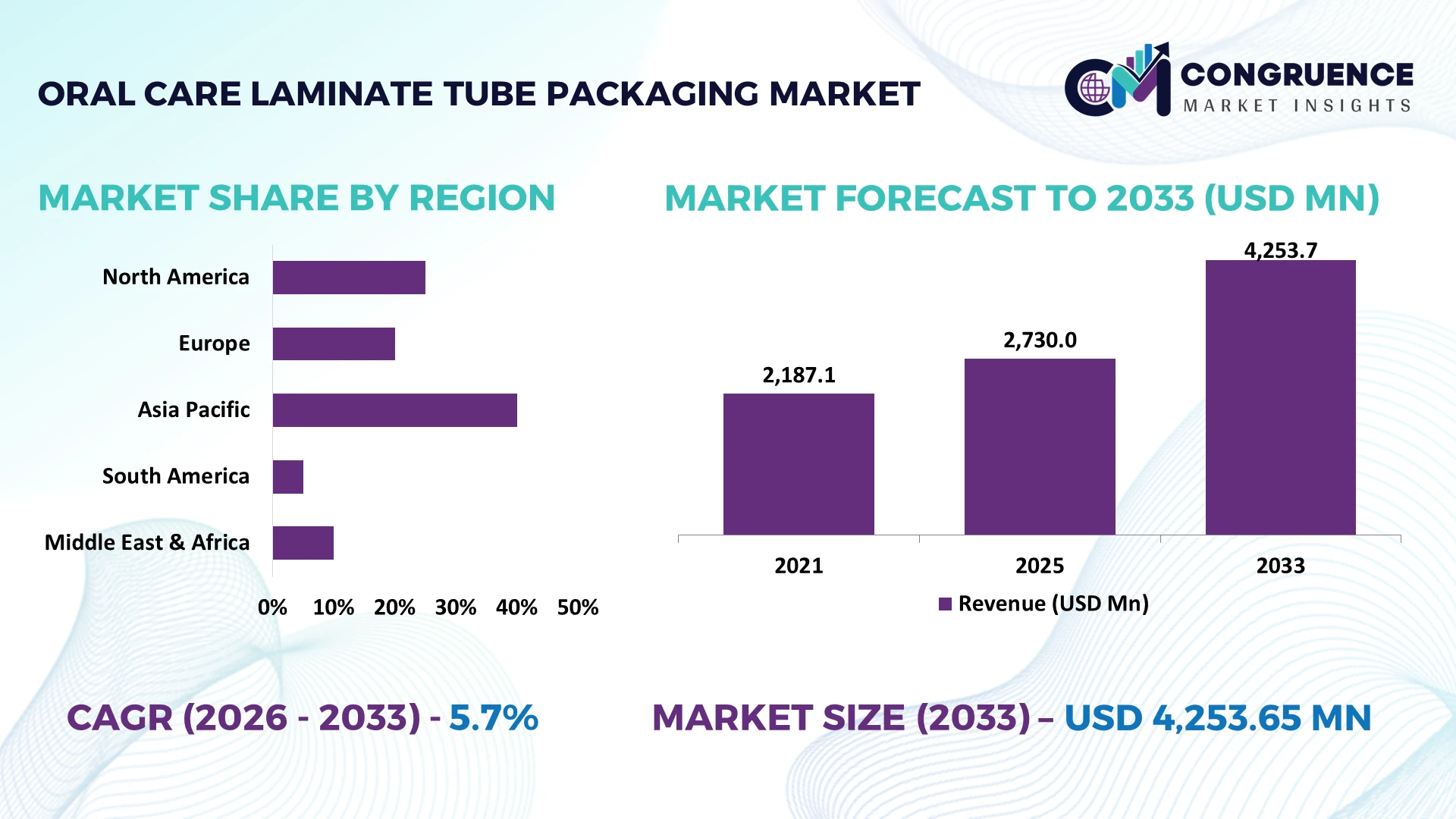
The Global Oral Care Laminate Tube Packaging Market was valued at USD 2730 Million in 2025 and is anticipated to reach a value of USD 4253.65 Million by 2033 expanding at a CAGR of 5.7% between 2026 and 2033. Toothpaste volume expansion, aluminum-barrier-to-plastic-barrier laminate conversion, recyclable mono-material structures, lightweighting, and high-speed tube filling are reshaping oral care packaging procurement.
China accounts for approximately 28% of global oral care laminate tube packaging demand, supported by its toothpaste manufacturing scale, extensive converting capacity, and integrated plastic-film supply chain. High-speed production lines increasingly exceed 200 tubes per minute, while downgauged laminate structures can reduce packaging material consumption by 10–20%. India operates a smaller installed converting base but benefits from rapidly expanding branded oral-care production and localized packaging procurement. China’s established petrochemical and converting ecosystem provides additional supply resilience as geopolitical trade friction encourages multinational consumer-goods companies to diversify sourcing across Asian manufacturing hubs.
Strategically, converters should prioritize recyclable barrier laminates, downgauging, high-speed digital decoration, and dual-country Asian sourcing to protect major oral-care accounts while meeting increasingly stringent packaging circularity requirements.
Market Size & Growth: USD 2,730 million in 2025 reaches USD 4,253.65 million by 2033 at 5.7% CAGR, supported by recyclable laminate conversion.
Top Growth Drivers: Toothpaste volume expansion contributes 39%, recyclable-format conversion 34%, and packaging lightweighting 27% to incremental demand.
Short-Term Forecast: By 2027, optimized downgauging and laminate redesign can reduce material consumption by approximately 10–20% per tube.
Emerging Technologies: Mono-material PE laminates, EVOH barriers, digital printing, and automated inspection target 15–25% faster artwork and production changeovers.
Regional Leaders: Asia-Pacific approaches USD 1.85 billion, Europe USD 950 million, and North America USD 850 million by 2033, with recyclable structures gaining penetration.
Consumer/End-User Trends: Toothpaste represents above 80% of oral-care laminate tube utilization, keeping high-volume branded products central to converter capacity planning.
Pilot/Case Example: 2025 recyclable laminate programs achieved approximately 20% packaging-material reduction through downgauging while preserving barrier and machinability requirements.
Competitive Landscape: EPL holds an estimated 18% share, competing with Huhtamaki, Albea, Hoffmann Neopac, and Berry Global across premium laminate formats.
Regulatory & ESG Impact: Mono-material laminate structures target more than 90% polyethylene content, improving compatibility with established flexible-plastic recycling streams.
Investment & Funding: Above USD 500 million in broader tube and flexible-packaging capacity investments supports printing modernization, recyclable materials, and Asian localization.
Innovation & Future Outlook: Next-generation laminates target 10–20% lightweighting alongside high-barrier performance, shifting competition toward recyclable structures engineered for existing filling lines.
Oral care laminate tubes remain concentrated in toothpaste, whitening gels, medicated formulations, sensitivity products, and premium dental-care applications where barrier performance, decoration quality, dispensing control, and filling-line efficiency determine packaging selection. Toothpaste accounts for more than 80% of sector utilization, sustaining large-scale laminate converting and printing capacity. Innovation is moving toward mono-material PE structures, EVOH barrier layers, downgauged webs, digital decoration, and recyclable closures. Europe’s tightening packaging circularity requirements are accelerating redesign programs, while Asian production hubs strengthen localized supply. These shifts position material architecture and recyclability as central strategic considerations for the market.
Oral care laminate tube packaging is becoming strategically important as toothpaste brands simultaneously pursue recyclability, material reduction, premium decoration, and uninterrupted high-speed filling. The structural shift is from aluminum-barrier laminates toward recyclable polyethylene-rich structures as packaging circularity requirements tighten. China retains scale advantages in laminate converting and tube manufacturing, while Europe is pushing faster material redesign through stricter packaging-recyclability requirements and brand sustainability commitments.
Next-generation PE-based laminates can reduce packaging weight by approximately 10–20% through downgauging while maintaining barrier performance required for toothpaste formulations. Compared with conventional aluminum-barrier structures, recyclable mono-material designs improve compatibility with polyethylene recycling streams without requiring wholesale replacement of established filling assets. Through 2028, high-barrier PE laminates, EVOH structures, digital printing, lightweight shoulders, and recyclable closures will move deeper into commercial portfolios.
A multinational toothpaste producer converting an established SKU to recyclable laminate can retain high-speed filling while reducing material complexity across large production volumes. Converters are therefore expanding material laboratories, digital decoration, extrusion-lamination capability, and partnerships with resin, barrier-film, closure, and recycling specialists. Competitive positioning will depend on delivering validated recyclability without sacrificing line speed, graphics, barrier integrity, or unit economics.
Brand-led conversion from aluminum-barrier laminates toward polyethylene-rich structures is the market’s strongest structural driver. Toothpaste represents more than 80% of oral care laminate tube usage, making packaging redesign scalable across exceptionally large SKU volumes. Optimized laminate downgauging can reduce material consumption by approximately 10–20%, while PE-rich structures targeting above 90% polyethylene content improve compatibility with established recycling pathways. Europe’s packaging circularity framework is accelerating specification changes, while India’s large toothpaste manufacturing base increases the commercial value of designs compatible with existing high-speed filling assets. Converters are investing in mono-material laminate development, recyclable shoulders and caps, downgauging trials, and customer qualification programs. The critical advantage is retrofit compatibility: solutions that run on installed filling lines remove a major barrier to brand conversion.
Replacing aluminum foil with recyclable polymer barriers creates a demanding balance between recyclability, oxygen protection, flavor retention, stiffness, printability, and sealing performance. Specialty barrier resins and multilayer structures can carry material premiums of approximately 10–20% versus established laminate specifications, while qualification trials can add 5–10% to packaging-development timelines. Resin-price volatility in polyethylene and EVOH further affects converter margins, particularly where toothpaste brands negotiate long supply contracts. Indian and Southeast Asian converters face additional pressure when specialized barrier grades remain import-dependent. Suppliers are reducing exposure through downgauging, dual sourcing, local resin qualification, and longer-term material contracts. The non-obvious restraint is specification fragmentation: multiple brand-specific recyclability requirements reduce production standardization, increasing changeovers and inventory complexity even when total material usage declines.
Digital printing, high-definition flexography, lightweight laminates, and connected inspection create an opportunity to serve premium, regional, promotional, and personalized oral-care SKUs without conventional print economics. Digital workflows can reduce artwork changeover time by 20–30% and lower setup waste by approximately 15–25%, while automated vision systems can inspect nearly 100% of decorated tubes for print and registration defects. India is particularly attractive as herbal, sensitivity, whitening, children’s, and premium toothpaste portfolios expand SKU complexity. Through 2028, variable-data decoration and digitally managed production will enable converters to economically handle smaller batches alongside mass-volume products. Companies are investing in digital presses, inline inspection, rapid artwork workflows, and brand-development partnerships. The strategic opportunity is SKU economics: converters can monetize product proliferation rather than treating frequent design changes as an efficiency penalty.
Scaling recyclable laminate structures from laboratory validation to continuous tube production creates execution complexity across forming, side-seam welding, shoulder bonding, decoration, capping, and toothpaste filling. Industrial lines operating above 200 tubes per minute leave narrow tolerances for laminate stiffness and sealing variation; even a 2–3% increase in reject rates materially affects high-volume economics. Downgauging by 10–20% also reduces processing margins if web tension, heat input, or shoulder geometry is poorly controlled. Chinese converters benefit from extensive manufacturing scale, but globally consistent quality requires standardized materials and process settings across plants. Companies must invest in inline vision inspection, closed-loop controls, operator training, material qualification, and joint trials with filling-equipment suppliers. Long-term leadership depends on making recyclable tubes perform like mature laminates at industrial speed, not merely demonstrating technical recyclability.
Lightweight Shoulders Reduce Resin Usage: Tube converters are redesigning shoulders, caps, and laminate gauges alongside body-web optimization, delivering approximately 10–20% packaging-weight reductions on selected formats. High-volume toothpaste lines magnify these savings across millions of units. European brand owners are accelerating lightweighting as packaging rules sharpen material-efficiency requirements. Suppliers are combining thinner webs with optimized shoulder geometry and lower-weight closures, reducing resin consumption without changing established filling infrastructure.
Barrier Layers Become Progressively Thinner: EVOH and advanced polymer barriers are replacing thicker multilayer structures where flavor retention and oxygen protection remain critical. Barrier layers can represent below 10% of total structure weight while polyethylene-rich designs exceed 90% compatible polymer content. Chinese and Indian converters are refining coextrusion and lamination controls to maintain uniformity at reduced gauges. The operational benefit is lower material intensity without sacrificing toothpaste shelf stability, making process precision increasingly valuable.
Decoration Shifts Toward Premium Effects: Oral-care brands are expanding matte finishes, tactile coatings, metallic effects, high-definition graphics, and seamless decoration to differentiate whitening, sensitivity, herbal, and premium products. Advanced print workflows can shorten artwork preparation by 20–30% and reduce setup waste by 15–25%. Converters are upgrading flexographic, offset, and hybrid decoration assets while integrating automated registration controls. Premiumization is consequently increasing packaging value even as structural lightweighting reduces material input.
Supply Networks Become More Regional: Brand owners are reducing dependence on single-country packaging supply by qualifying laminate, tube, closure, and resin sources across multiple manufacturing hubs. Dual sourcing can shorten disruption-related replenishment exposure by 20–30%, while localized production reduces long-distance logistics requirements by approximately 15–25% for selected programs. India and Southeast Asia are gaining qualification activity alongside China. Converters are expanding regional capacity and harmonizing specifications so multinational toothpaste SKUs can transfer between plants without extensive revalidation.
Plastic Laminate Tubes lead with an estimated 39% share, supported by mature converting infrastructure, cost-efficient high-volume production, strong printability, and compatibility with established toothpaste filling lines. Their scalable manufacturing economics keep them central to mass-market oral care. Aluminum-Plastic Tubes retain relevance where strong oxygen, moisture, and flavor barriers outweigh recycling complexity, while High-Barrier Tubes serve formulations requiring enhanced product protection. Optimized plastic laminates can achieve approximately 10–20% downgauging without wholesale filling-equipment replacement, reinforcing their installed-base advantage.
Mono-Material Tubes are the fastest-growing type as brands shift toward polyethylene-rich structures designed for recycling compatibility. Recyclable Tubes capture broader demand encompassing redesigned barrier and closure combinations, while mono-material formats push structural simplification further. Designs exceeding 90% polyethylene content increasingly align packaging functionality with recycling requirements. Converters are investing in PE barrier development, coextrusion, lightweight shoulders, qualification laboratories, and resin partnerships. Investment priorities are consequently moving from conventional barrier maximization toward achieving recyclability while retaining stiffness, decoration quality, sealing reliability, and industrial filling speed.
Toothpaste dominates applications with approximately 82% of oral care laminate tube demand, reflecting enormous unit volumes, standardized tube-filling infrastructure, repeat purchasing, and strong suitability for barrier laminate formats. Mass-market, herbal, sensitivity, children’s, and therapeutic toothpastes sustain production across China, India, the United States, and Europe. Mouthwash Gels and Oral Gels remain smaller applications but require controlled dispensing and formulation protection. Denture Care Products represent a specialized segment where product viscosity and hygienic dispensing favor tube formats.
Whitening Products are the fastest-growing application as premium formulations, peroxide-based gels, and targeted treatment products support smaller, higher-value pack sizes. Premium whitening tubes can use advanced barriers and decoration despite lower production volumes, shifting converter economics toward value per unit rather than scale alone. Toothpaste lines routinely exceed 200 tubes per minute, creating substantial requirements for dimensional consistency and sealing reliability. Packaging companies are responding with smaller-format tooling, high-barrier structures, premium decoration, recyclable laminates, and flexible production platforms capable of handling mainstream and specialized oral-care SKUs efficiently.
Oral Care Manufacturers lead end-user demand with an estimated 61% share because multinational and national toothpaste producers operate high-volume filling assets, extensive SKU portfolios, and stringent barrier, decoration, dimensional, and seal-performance specifications. Their scale supports direct qualification programs with laminate converters and resin suppliers. Dental Product Companies purchase specialized tubes for whitening and professional formulations, while Personal Care Companies leverage overlapping tube-packaging infrastructure. Pharmaceutical Companies emphasize controlled dispensing, barrier integrity, and documentation for therapeutic oral gels.
Contract Manufacturers are the fastest-growing end-user group as brands outsource regional production, promotional SKUs, private-label toothpaste, and specialist formulations. Outsourced operations can consolidate packaging procurement across multiple customers, improving equipment utilization by approximately 15–25%. High-speed oral-care lines exceeding 200 tubes per minute also make standardized tube dimensions and rapid SKU transitions commercially important. Converters are targeting contract manufacturers with lower minimum-order configurations, standardized recyclable structures, digital decoration, technical qualification, and regional supply agreements. Future procurement power is shifting toward buyers capable of aggregating multiple brands while demanding rapid packaging adaptability.
Asia-Pacific accounted for the largest market share at 43% in 2025 however, Asia-Pacific is expected to register the fastest growth, expanding at a CAGR of 6.6% between 2026 and 2033.
Recyclable Tubes Reshape Brand Specifications
North America accounted for approximately 20% of global oral care laminate tube packaging demand in 2025, with the United States concentrating toothpaste, whitening, sensitivity-care, and therapeutic oral-product packaging. Brand owners are shifting specifications toward polyethylene-rich tubes, lightweight closures, and structures compatible with existing recycling systems. Toothpaste represents more than 80% of regional laminate tube utilization, making material conversion commercially significant across high-volume filling operations. Advanced lines exceeding 200 tubes per minute require recyclable laminates to match conventional structures in stiffness, sealing, decoration, and dimensional consistency. U.S. converters are expanding material qualification, automated inspection, and digital decoration while working more closely with resin and closure suppliers. Procurement is consequently moving from lowest unit cost toward verified recyclability, filling-line compatibility, and dependable regional supply.
United States Market Outlook: The United States combines large branded oral-care consumption with sophisticated retail, dental, pharmaceutical, and contract-manufacturing channels. Packaging buyers increasingly require recyclability claims supported by compatible tube-body, shoulder, and closure systems. Automated inspection approaching 100% of output strengthens quality control, while localized converting and technical support reduce qualification and replenishment risk for nationally distributed toothpaste portfolios.
Circularity Rules Accelerate Structural Redesign
Europe represented approximately 24% of global demand in 2025, supported by major oral-care brands, advanced tube converters, and packaging engineering capabilities in Germany, France, Switzerland, Italy, and the United Kingdom. Packaging circularity requirements are accelerating movement away from difficult-to-recycle aluminum-barrier structures toward PE-rich and mono-material designs. Recyclable tube architectures increasingly target more than 90% polyethylene content, while lightweighting programs can reduce material requirements by 10–20% on optimized formats. Converters are refining EVOH barriers, low-migration decoration, lightweight shoulders, and recyclable closures to preserve shelf-life and filling performance. Germany and Switzerland remain important technology centers for premium tube engineering. Competitive advantage is shifting toward suppliers capable of validating complete tube systems against recyclability criteria rather than optimizing individual laminate layers independently.
Germany Market Outlook: Germany’s packaging-machinery, polymer-processing, and recycling infrastructure makes it a strategic qualification market for advanced oral-care tubes. Converters and brands increasingly evaluate laminate composition alongside inks, adhesives, shoulders, and closures. High-speed filling compatibility remains essential because large toothpaste plants cannot accept sustainability improvements that reduce established production rates exceeding 200 tubes per minute.
Manufacturing Scale Supports Material Transition
Asia-Pacific held approximately 43% of global demand in 2025, reflecting extensive toothpaste manufacturing and tube-converting capacity across China, India, Japan, South Korea, and Southeast Asia. China represents approximately 28% of worldwide demand and maintains deep supply chains spanning polyethylene films, barrier resins, printing, closures, and tube conversion. India adds substantial scale through mass-market, herbal, sensitivity, and premium toothpaste production. Large converters operate lines exceeding 200 tubes per minute, making process consistency decisive when thinner recyclable laminates replace conventional structures. Companies are expanding extrusion-lamination, digital printing, inline inspection, and localized resin qualification while multinational brands diversify procurement beyond single-country sourcing. The region therefore combines volume leadership with increasingly sophisticated material engineering, strengthening its position in both cost-sensitive and premium recyclable tube programs.
China Market Outlook: China retains the strongest integrated manufacturing ecosystem for oral care laminate packaging, covering films, printing, tube forming, shoulders, caps, and automation equipment. Domestic scale supports rapid commercialization and competitive tooling economics. Increasing qualification of polyethylene-rich structures also enables Chinese converters to serve multinational brands seeking recyclable packaging without sacrificing the high-volume economics established around conventional laminate production.
Brand Localization Strengthens Converter Demand
South America accounted for approximately 6% of global demand in 2025, with Brazil representing the principal oral-care manufacturing and packaging center. High toothpaste penetration, established multinational production, and extensive pharmacy and supermarket distribution sustain demand for laminate tubes across mainstream, whitening, sensitivity, and children’s formulations. Conventional plastic laminates remain prominent because they combine competitive conversion costs with proven filling performance, while recyclable structures are entering premium and multinational-brand programs. Optimized lightweighting can reduce material requirements by approximately 10–15%, improving economics where resin and imported input costs fluctuate. Brazilian converters are increasing local material qualification, decoration flexibility, and technical support to reduce dependence on imported packaging components. Currency volatility remains an execution constraint, reinforcing demand for locally sourced films, closures, and tooling.
Brazil Market Outlook: Brazil combines large domestic toothpaste consumption with established oral-care manufacturing and polymer-conversion capabilities. Local production provides multinational brands with shorter replenishment cycles and reduced exposure to imported finished tubes. Flexible decoration and smaller production campaigns are increasingly valuable as herbal, whitening, sensitivity, and premium formulations expand SKU complexity beyond traditional mass-market toothpaste formats.
Localized Production Reduces Import Dependence
Middle East & Africa represented approximately 7% of global oral care laminate tube packaging demand in 2025, with South Africa, Saudi Arabia, the UAE, Egypt, and other North African markets supporting regional consumption and conversion. Local toothpaste production is strengthening as consumer-goods manufacturers pursue shorter supply chains and governments promote domestic manufacturing. Laminate tubes remain operationally attractive because they combine lightweight logistics, high-quality decoration, controlled dispensing, and scalable filling. Regional converters increasingly target 10–20% material reductions through downgauging while adding PE-rich structures for multinational sustainability programs. Gulf markets emphasize premium graphics and imported oral-care brands, whereas African manufacturing centers remain more price sensitive. Suppliers are responding through localized printing, closure sourcing, flexible minimum orders, and technical partnerships that reduce dependence on imported finished tubes.
South Africa Market Outlook: South Africa offers the region’s strongest combination of established consumer-goods manufacturing, retail distribution, polymer conversion, and technical packaging capability. Domestic tube production supports faster replenishment across southern African markets. Converters capable of combining competitive conventional laminates with recyclable alternatives are positioned to serve both cost-sensitive local brands and multinational oral-care specifications.
EPL, Huhtamaki, Hoffmann Neopac, Berry Global, and Albea compete with Asian regional converters across high-volume toothpaste, premium oral-care, and recyclable tube programs. The top five suppliers collectively account for approximately 47% of organized demand, reflecting multinational customer relationships, manufacturing scale, and qualification expertise. Global converters compete through barrier engineering, decoration, recyclability, and geographic supply, while regional suppliers can offer standard laminate tubes at 10–20% lower conversion costs. Lightweight structures reduce material use by approximately 10–20%, while digital workflows can shorten artwork changeovers by 20–30%. Companies are expanding PE-rich portfolios, localizing production, partnering with resin and closure suppliers, and integrating printing with tube conversion. Competition is shifting from conventional aluminum-barrier performance toward validated recyclable structures and supply-chain flexibility. Qualification cycles, food-contact compliance, filling-line compatibility, and multinational plant approvals remain entry barriers. Winning requires scalable recyclable technology, consistent decoration, competitive conversion economics, rapid qualification, and multi-region manufacturing capable of protecting customer continuity globally.
EPL Limited
Huhtamaki Oyj
Hoffmann Neopac AG
Berry Global Group
Albea Group
Amcor plc
Montebello Packaging
Alltub Group
Pirlo Holding GmbH
Tubapack, a.s.
Lageen Tubes
Kyodo Printing Co., Ltd.
Essel Propack America, LLC
Auber Packaging Co., Ltd.
Current oral care laminate technology centers on aluminum-barrier laminates, plastic-barrier laminates, high-definition printing, automated tube forming, and high-speed filling compatibility. PE-rich structures increasingly replace aluminum layers while preserving flavor, moisture, and oxygen protection. Commercial recyclable designs can contain below 5% barrier resin, enabling HDPE-stream compatibility while maintaining established line performance and reducing material complexity.
Emerging technology combines EVOH barriers, mono-material PE bodies, PCR content, downgauging, digital printing, and inline vision inspection. PCR laminates now reach 50–60% recycled content in selected structures, while optimized conversions have reduced laminate usage by up to 20%. Compared with legacy aluminum-barrier tubes, recyclable PE laminates deliver equivalent functional protection with substantially improved recycling compatibility, benefiting toothpaste brands facing packaging mandates.
Disruptive development is moving toward digitally controlled lamination, machine-vision defect detection, variable-data decoration, lightweight shoulders, and data-linked quality assurance. Automated inspection can evaluate nearly 100% of production, reducing dependence on sampled quality checks and protecting high-speed lines exceeding 200 tubes per minute. During 2026–2028, recyclable structures with higher PCR content and thinner gauges will move from specialist programs into mainstream oral-care portfolios. Converters integrating material science, decoration, inspection, and filling-line qualification will gain specification advantage; investment now protects customer retention as recyclability requirements tighten globally.
March 2024 – Colgate-Palmolive reported that 90% of U.S. toothpaste tubes had designs compatible with the colored HDPE bottle recycling stream. The milestone demonstrates industry-scale conversion from legacy laminates and strengthens recyclable-tube infrastructure acceptance nationwide and processing confidence. Source: Colgate-Palmolive.
August 2025 – EPL reported converting Colgate Max Fresh from ABL 2715 to Platina Pro 220, cutting laminate usage 20% for large tubes. The program demonstrates commercially scaled lightweighting while retaining recyclable barrier performance for toothpaste packaging globally. Source: NSE.
May 2025 – Tube Council named Albéa’s Sensodyne Pronamel Clinical Enamel Strength Whitening Action toothpaste package Gold winner for Best Oral Care Tube. The recognition validates differentiated tube engineering for premium therapeutic oral-care applications and competitive shelf positioning. Source: TubeCouncil.
May 2026 – Neopac’s CariFree Polyfoil tube received the Tube Council Gold Award for Best Oral Care Tube, one of its 2026 packaging distinctions. The recognition reinforces high-performance laminate packaging as a differentiation route for specialist oral-care brands. Source: Neopac.
The Oral Care Laminate Tube Packaging Market Report evaluates Plastic Laminate Tubes, Aluminum-Plastic Tubes, High-Barrier Tubes, Recyclable Tubes, and Mono-Material Tubes across Toothpaste, Mouthwash Gels, Oral Gels, Whitening Products, and Denture Care Products. End-user coverage includes Oral Care Manufacturers, Dental Product Companies, Personal Care Companies, Pharmaceutical Companies, and Contract Manufacturers. Plastic laminates represent approximately 39% of type-level demand, while toothpaste accounts for roughly 82% of application consumption.
Regional analysis covers North America, Europe, Asia-Pacific, South America, and Middle East & Africa, including country-level converting and oral-care production dynamics. Technology coverage examines PE-rich barriers, EVOH structures, PCR laminates, downgauging, digital printing, vision inspection, lightweight components, and mono-material engineering. The 2026–2033 framework supports capacity investment, recyclable-material conversion, geographic expansion, supplier positioning, partnership decisions, and identification of high-value opportunities in whitening, therapeutic formulations, and contract manufacturing.
| Report Attribute/Metric | Report Details |
|---|---|
Market Revenue in 2025 | USD 2730 Million |
Market Revenue in 2033 | USD 4253.65 Million |
CAGR (2026 - 2033) | 5.7% |
Base Year | 2025 |
Forecast Period | 2026 - 2033 |
Historic Period | 2021 - 2025 |
Segments Covered | By Type
By Application
By End-User
|
Key Report Deliverable | Revenue Forecast, Growth Trends, Market Dynamics, Segmental Overview, Regional and Country-wise Analysis, Competition Landscape |
Region Covered | North America, Europe, Asia-Pacific, South America, Middle East, Africa |
Key Players Analyzed | EPL Limited, Huhtamaki Oyj, Hoffmann Neopac AG, Berry Global Group, Albea Group, Amcor plc, Montebello Packaging, Alltub Group, Pirlo Holding GmbH, Tubapack, a.s., Lageen Tubes, Kyodo Printing Co., Ltd., Essel Propack America, LLC, Auber Packaging Co., Ltd. |
Customization & Pricing | Available on Request (10% Customization is Free) |




