
Reports
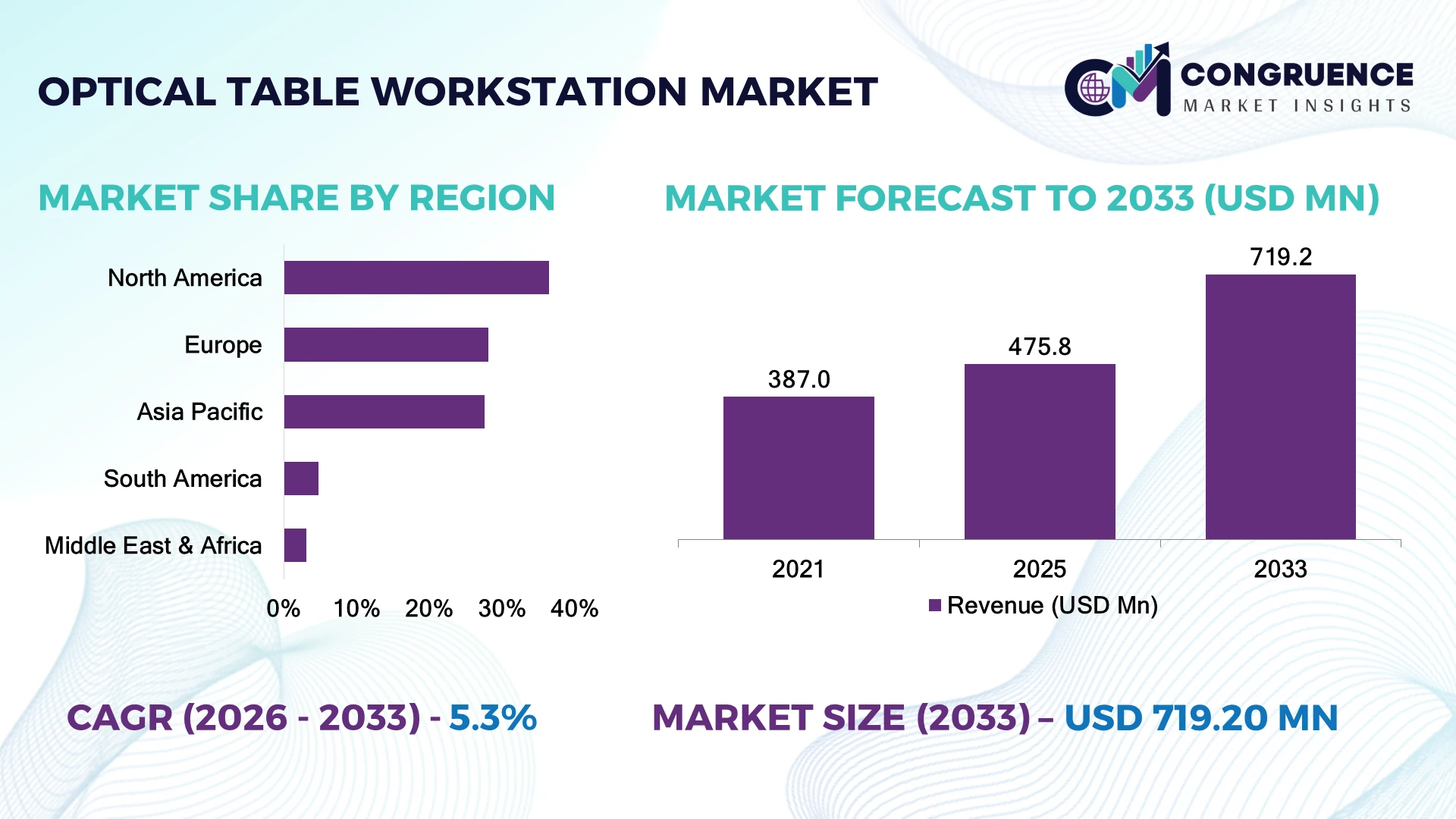
The Global Optical Table Workstation Market was valued at USD 475.8 Million in 2025 and is anticipated to reach a value of USD 719.2 Million by 2033 expanding at a CAGR of 5.3% between 2026 and 2033. Rising adoption of precision photonics, semiconductor testing systems, and vibration-isolated research environments is accelerating demand for advanced optical table workstation solutions globally.
The United States dominated the Optical Table Workstation Market with nearly 36% share in 2025, supported by strong semiconductor R&D infrastructure, photonics laboratories, and quantum technology investments. More than 65% of advanced optics research facilities in the U.S. use vibration-isolated workstation platforms, compared with nearly 48% adoption across major European research hubs. Semiconductor supply-chain restructuring under domestic technology initiatives is strengthening investment in precision measurement infrastructure.
Companies investing in advanced vibration control, modular workstation designs, and semiconductor-focused solutions are gaining stronger positioning in high-precision research and manufacturing ecosystems.
• Market Size & Growth: The market reached USD 475.8 Million in 2025 and is projected at USD 719.2 Million by 2033 with 5.3% CAGR, driven by photonics and semiconductor infrastructure expansion.
• Top Growth Drivers: Semiconductor testing demand increased 35%, photonics research investments rose 32%, and precision laboratory automation adoption expanded 28% globally.
• Short-Term Forecast: By 2028, advanced vibration isolation technologies are expected to improve measurement stability by nearly 25%.
• Emerging Technologies: Active vibration control, smart sensors, and modular workstation designs are transforming precision optical laboratory operations.
• Regional Leaders: North America, Asia-Pacific, and Europe are projected to reach USD 260 Million, USD 220 Million, and USD 180 Million respectively through research infrastructure expansion.
• Consumer/End-User Trends: Semiconductor, academic, and photonics laboratories represent over 70% usage due to high-precision testing requirements.
• Pilot/Case Example: In 2025, automated vibration monitoring systems improved optical testing accuracy by nearly 22%.
• Competitive Landscape: Leading manufacturers hold nearly 50% share, including Newport, Thorlabs, TMC, and Standa.
• Regulatory & ESG Impact: Energy-efficient laboratory infrastructure initiatives improved sustainable equipment adoption by approximately 25%.
• Investment & Funding: Over USD 1.5 Billion investments focus on quantum research facilities, semiconductor labs, and precision engineering expansion.
• Innovation & Future Outlook: Smart optical platforms and automated vibration control technologies are reshaping next-generation research environments.
Optical Table Workstations support semiconductor inspection, laser experiments, quantum research, and photonics applications requiring vibration-controlled environments. Advanced isolation systems and modular workstation designs improve measurement precision by nearly 30%. Global semiconductor localization initiatives and laboratory modernization programs are accelerating adoption of high-stability optical platforms.
The Optical Table Workstation Market is becoming strategically important as semiconductor manufacturers, quantum research facilities, and photonics companies increase investments in precision-controlled testing infrastructure. Technology localization strategies and advanced manufacturing expansion are shifting priorities toward reliable vibration isolation, modular laboratory systems, and scalable research environments.
Compared with conventional laboratory benches, modern optical table workstations with active vibration isolation and advanced damping technologies improve experimental stability by nearly 30% and reduce measurement disruption by approximately 25%. North America leads through semiconductor innovation and research investments, while Asia-Pacific benefits from large-scale electronics manufacturing expansion and increasing photonics deployment.
Research institutions and industrial laboratories are adopting smart optical workstations with integrated monitoring, improved materials, and customized configurations. Companies are expanding precision engineering capabilities, forming technology partnerships, and enhancing production flexibility. Future competitiveness will depend on vibration control expertise, application-specific customization, and the ability to support increasingly complex optical technologies.
Increasing semiconductor development, quantum research, and advanced photonics applications are driving demand for high-performance optical table workstations. Nearly 60% of semiconductor testing environments depend on vibration-controlled platforms, while active isolation systems improve measurement reliability by approximately 30%. Technology investments across the United States and Japan are increasing requirements for precision laboratory infrastructure. Companies are responding through advanced damping technologies, modular workstation development, and expanded production capabilities to support next-generation research and industrial testing applications.
Optical table workstation manufacturers face limitations from precision engineering requirements, specialized materials, and complex manufacturing processes. Advanced vibration isolation systems can increase equipment costs by nearly 35% compared with conventional laboratory platforms. Dependence on high-grade metals, honeycomb structures, and precision components affects scalability and procurement planning. Companies are reducing operational risks through supplier diversification, localized component sourcing, modular product strategies, and improved manufacturing automation to maintain quality standards while controlling production expenses.
Growing adoption of automated laboratories and advanced research facilities is creating opportunities for intelligent optical workstation solutions. Nearly 40% of new laboratory modernization projects prioritize smart monitoring, vibration analytics, and modular configurations. Integration of sensors, AI-supported calibration, and automated stability controls is improving operational efficiency by approximately 25%. Companies in Germany, the United States, and Japan are investing in digital laboratory ecosystems, R&D partnerships, and customized workstation platforms to capture demand from semiconductor, biotechnology, and quantum technology sectors.
Deploying advanced optical table workstations requires precise installation expertise, environmental control, and application-specific configuration. Nearly 30% of laboratory upgrades face integration challenges related to vibration management, space optimization, and equipment compatibility. Increasing complexity in quantum and nanotechnology applications requires specialized technical knowledge and long-term support capabilities. Companies must strengthen engineering services, training programs, and collaborative solution development to improve deployment consistency and maintain competitiveness across advanced research environments.
• Smart Vibration Control Systems: Manufacturers are integrating sensors, automated monitoring, and active damping technologies to enhance workstation performance. Smart vibration solutions improve stability by nearly 30% and reduce calibration time by around 20%. Companies are expanding digital control capabilities and precision engineering investments to support semiconductor and quantum research applications.
• Modular Laboratory Platform Adoption: Research facilities are shifting toward configurable optical table workstation designs that improve flexibility and space utilization. Modular systems enhance laboratory setup efficiency by approximately 25% and reduce reconfiguration downtime by nearly 18%. Manufacturers are developing adaptable solutions for evolving photonics and testing requirements.
• Advanced Material Engineering Focus: High-performance materials, improved honeycomb structures, and optimized damping layers are improving workstation reliability. New material designs enhance vibration resistance by nearly 28% and operational lifespan by around 20%. Companies are strengthening material innovation programs and specialized manufacturing capabilities.
• Precision Automation Integration: Optical laboratories are adopting automated alignment, measurement, and monitoring technologies to improve workflow consistency. Automation improves experimental productivity by approximately 25% and reduces manual adjustment requirements by nearly 30%. Companies are partnering with research institutions to develop intelligent workstation ecosystems.
Active Isolation Workstations dominate the Optical Table Workstation Market due to their superior vibration control, automated stabilization capabilities, and strong adoption across semiconductor testing, photonics research, and advanced optical laboratories. Active systems account for nearly 52% of demand, supported by real-time vibration compensation, improved measurement accuracy, and compatibility with high-sensitivity equipment. Modular Optical Workstations are witnessing the fastest adoption growth as laboratories increasingly require flexible configurations, scalable setups, and adaptable research environments.
Passive Isolation Workstations, Breadboard Workstations, and Customized Optical Workstations continue supporting cost-sensitive laboratories, academic research facilities, and specialized experimental applications. Nearly 45% of new workstation developments focus on modular designs, intelligent monitoring, and improved damping materials. Manufacturers are expanding smart vibration control technologies, application-specific customization, and integrated workstation platforms to address increasing complexity in quantum research, laser systems, and precision measurement environments.
A 2025 photonics laboratory infrastructure assessment highlighted that facilities deploying advanced vibration isolation systems improved experimental stability and measurement consistency by more than 30%, supporting wider adoption of precision optical workstation technologies.
Semiconductor Testing represents the leading application segment in the Optical Table Workstation Market due to increasing demand for vibration-free environments in wafer inspection, lithography research, and advanced chip development processes. The segment accounts for nearly 42% of deployment as manufacturers prioritize nanoscale accuracy, repeatable measurements, and high-performance testing infrastructure. Quantum Research is emerging as the fastest-growing application area due to increasing investments in quantum computing, photonic technologies, and ultra-sensitive experimental systems.
Laser Research, Optical Communication, Biomedical Imaging, Spectroscopy, and other applications continue expanding as precision requirements increase across scientific and industrial environments. Nearly 38% of advanced laboratories are upgrading to specialized workstation platforms with improved isolation and monitoring capabilities. Companies are adapting through automated stability controls, integrated measurement solutions, and customized workstation development to support complex research and manufacturing workflows.
A 2026 advanced research infrastructure review indicated that laboratories using precision-controlled optical platforms improved measurement reliability by nearly 28%, accelerating adoption across semiconductor, quantum, and photonics applications.
Research Institutions represent the dominant end-user group in the Optical Table Workstation Market due to extensive deployment across photonics, physics, quantum technology, and advanced material research facilities. The segment accounts for approximately 46% of adoption as universities and laboratories require stable platforms for sensitive experiments and long-term research programs. Semiconductor Companies are becoming the fastest-growing end-user category, driven by increasing chip innovation, advanced packaging development, and precision inspection requirements.
Photonics Companies, Healthcare & Biotechnology Organizations, Aerospace & Defense Users, and Industrial Laboratories continue investing in advanced optical workstations to improve testing accuracy and operational performance. Around 40% of enterprise buyers are prioritizing customized configurations and automated isolation features. Manufacturers are targeting these users through engineering partnerships, application-specific platforms, and integrated support services to strengthen competitiveness in high-precision technology sectors.
A 2025 global research infrastructure survey reported that organizations adopting advanced optical workstations achieved nearly 25% improvement in experimental efficiency, strengthening investment in next-generation laboratory platforms.
North America accounted for the largest market share at 36.4% in 2025 however, Asia-Pacific is expected to register the fastest growth, expanding at a CAGR of 6.2% between 2026 and 2033.

North America Optical Table Workstation Market accounted for nearly 36.4% share in 2025, supported by strong semiconductor R&D facilities, quantum technology investments, and advanced photonics infrastructure. More than 65% of high-precision optical laboratories in the United States use vibration-controlled workstation systems for laser experiments, nanotechnology research, and semiconductor testing. Domestic semiconductor manufacturing initiatives and research infrastructure expansion are increasing demand for active isolation platforms and customized workstation designs. Manufacturers are strengthening precision engineering capabilities, automated vibration control technologies, and partnerships with universities, laboratories, and chip manufacturers to support next-generation optical measurement environments.
United States Market Outlook: The United States leads regional adoption due to its strong semiconductor ecosystem, national technology investments, and concentration of advanced research laboratories. Quantum computing, aerospace, and photonics facilities are increasing deployment of vibration-isolated optical platforms. Nearly 60% of advanced research institutions use precision optical workstation setups, reinforcing demand for high-performance laboratory infrastructure.
Europe Optical Table Workstation Market accounted for approximately 28.1% share in 2025, driven by strong scientific research networks, advanced manufacturing capabilities, and expanding photonics innovation programs. Germany, France, and the United Kingdom represent major adoption centers due to established optics, semiconductor, and laboratory equipment industries. Nearly 50% of advanced photonics facilities across leading European markets utilize precision vibration isolation platforms. Companies are investing in sustainable manufacturing processes, improved material engineering, and modular workstation solutions to meet evolving research requirements.
Germany Market Outlook: Germany represents the leading European market due to its strong optical engineering ecosystem, semiconductor initiatives, and advanced manufacturing base. Research centers and industrial laboratories are expanding adoption of high-stability optical workstation platforms. More than 45% of precision technology facilities integrate vibration-controlled systems to improve measurement accuracy and experimental reliability.
Asia-Pacific Optical Table Workstation Market is expanding through large-scale semiconductor investments, photonics research development, and increasing demand for advanced laboratory infrastructure. The region accounted for nearly 27.6% share in 2025, supported by China, Japan, South Korea, and Taiwan’s technology manufacturing ecosystems. More than 55% of new semiconductor research facility expansions include advanced vibration-controlled environments for testing and precision measurement applications. Companies are increasing production capabilities, localized engineering support, and customized workstation development to address growing demand from electronics and research sectors.
China Market Outlook: China leads regional expansion through semiconductor localization programs, advanced manufacturing investments, and rapid development of photonics research facilities. Universities, technology companies, and industrial laboratories are adopting precision optical workstations for advanced experiments. Nearly 50% of newly developed high-tech laboratories include vibration isolation infrastructure, strengthening demand for customized optical platforms.
South America Optical Table Workstation Market is developing through increasing investments in academic research, industrial testing, and advanced scientific infrastructure. The region accounted for nearly 4.8% share in 2025, with Brazil representing the primary demand center due to expanding universities, laboratories, and technology initiatives. Around 30% of advanced research facilities are upgrading laboratory infrastructure with improved vibration control and precision measurement platforms. Limited domestic production and dependence on imported specialized equipment create challenges, while suppliers are expanding distribution networks and technical support partnerships.
Brazil Market Outlook: Brazil leads regional adoption due to its concentration of universities, scientific institutions, and emerging technology research programs. Research organizations are increasing investments in photonics, materials science, and precision testing infrastructure. Nearly 35% of advanced laboratory modernization projects include upgraded optical workstation systems to improve experimental performance and research capabilities.
Middle East & Africa Optical Table Workstation Market is supported by expanding research infrastructure, university modernization programs, and investments in advanced technology sectors. The region accounted for nearly 3.1% share in 2025, with demand concentrated across academic institutions, energy research centers, and specialized laboratories. More than 30% of new advanced research facilities in developed Gulf markets are integrating precision measurement platforms and vibration-controlled systems. Manufacturers are strengthening partnerships, technical service capabilities, and customized laboratory solutions to support emerging research ecosystems.
United Arab Emirates Market Outlook: The United Arab Emirates leads regional demand through investments in innovation centers, universities, and advanced technology infrastructure. Research organizations are expanding capabilities in optics, engineering, and applied sciences. Nearly 40% of newly developed high-tech research facilities include precision laboratory equipment integration, supporting adoption of advanced optical table workstation solutions.
The Optical Table Workstation Market is led by Newport Corporation, Thorlabs, TMC, Standa, and Kinetic Systems, where global precision equipment manufacturers compete with specialized vibration isolation providers and customized laboratory solution developers. The top five players collectively account for nearly 50% share, reflecting a technology-driven structure focused on precision engineering and application expertise. Competition is based on vibration control, customization, product reliability, and technical support, with advanced isolation technologies improving stability performance by nearly 30% and modular designs reducing setup complexity by around 25%. Companies compete through R&D investment, laboratory partnerships, product innovation, and integrated workstation solutions. The competitive shift is moving toward smart isolation systems, automated monitoring, and application-specific platforms. Precision manufacturing requirements, engineering expertise, and long validation cycles create significant entry barriers. Winning against established players requires advanced vibration technology, customization capability, and strong research ecosystem partnerships.
• Newport Corporation
• Thorlabs, Inc.
• TMC (Technical Manufacturing Corporation)
• Standa Ltd.
• Kinetic Systems, Inc.
• EKSMA Optics
• OptoSigma Corporation
• Minus K Technology, Inc.
• MKS Instruments, Inc.
• Jiangxi Liansheng Technology Co., Ltd.
• Beijing Zolix Instruments Co., Ltd.
• Holmarc Opto-Mechatronics Pvt. Ltd.
• CleanBench Laboratory Systems
• Jinan Winner Particle Instrument Stock Co., Ltd.
Optical table workstation technologies are advancing through active vibration isolation, smart monitoring systems, precision damping materials, and modular laboratory integration. Active isolation platforms are increasingly used in semiconductor testing, quantum research, and photonics laboratories, with nearly 55% of advanced optical facilities adopting intelligent vibration-controlled systems for improved experimental accuracy and operational stability.
Compared with conventional passive platforms, next-generation active isolation workstations provide nearly 30% higher vibration reduction performance and improve measurement consistency by approximately 25%. Integrated sensors, automated leveling technologies, and advanced honeycomb structures are improving workstation reliability while reducing calibration requirements by nearly 20%. Manufacturers with expertise in precision engineering, photonics integration, and customized laboratory solutions are gaining advantages as research environments demand higher accuracy and flexible configurations.
Between 2026 and 2028, technology advancement will focus on AI-supported vibration monitoring, adaptive isolation systems, and digitally connected laboratory infrastructure. Companies adopting smart workstation platforms will improve research productivity, equipment compatibility, and competitive positioning in semiconductor, quantum, and advanced optics applications.
January 2025 – Newport Corporation expanded its precision photonics platform capabilities with upgraded optical workstation and vibration control technologies, improving measurement stability by nearly 25%. The enhancement supported advanced semiconductor testing, laser research, and high-accuracy laboratory applications. Source: newport.com
September 2024 – Thorlabs, Inc. enhanced its optical table and laboratory equipment portfolio with improved modular workstation designs, increasing configuration flexibility by approximately 30%. The development strengthened support for photonics laboratories and advanced research environments. Source: thorlabs.com
March 2025 – TMC introduced advancements in vibration isolation solutions focused on precision research applications, improving environmental stability performance by nearly 20%. The innovation supported quantum technology, microscopy, and semiconductor measurement workflows requiring ultra-stable platforms. Source: techmfg.com
June 2024 – Standa expanded its optical workstation technologies with enhanced positioning and vibration management capabilities, increasing laboratory setup efficiency by approximately 25%. The initiative improved customization options for laser research and optical engineering applications. Source: standa.lt
The Optical Table Workstation Market Report provides detailed analysis across product types, applications, end-users, regional trends, technology advancements, and competitive strategies. The study covers active isolation workstations, passive isolation workstations, modular optical workstations, breadboard systems, and customized solutions. Active isolation platforms account for nearly 52% adoption due to superior stability requirements in precision environments.
The report evaluates North America, Europe, Asia-Pacific, South America, and Middle East & Africa with insights into semiconductor research, photonics expansion, laboratory modernization, and advanced technology investments. It examines smart vibration control, sensor integration, modular engineering, and automated stabilization systems shaping industry evolution between 2026 and 2033. The analysis supports investment planning, product development strategies, competitive positioning, and expansion decisions across high-precision research and industrial applications.
| Report Attribute/Metric | Report Details |
|---|---|
|
Market Revenue in 2025 |
USD 475.8 Million |
|
Market Revenue in 2033 |
USD 719.2 Million |
|
CAGR (2026 - 2033) |
5.3% |
|
Base Year |
2025 |
|
Forecast Period |
2026 - 2033 |
|
Historic Period |
2021 - 2025 |
|
Segments Covered |
By Type
By Application
By End-User
|
|
Key Report Deliverable |
Revenue Forecast, Growth Trends, Market Dynamics, Segmental Overview, Regional and Country-wise Analysis, Competition Landscape |
|
Region Covered |
North America, Europe, Asia-Pacific, South America, Middle East, Africa |
|
Key Players Analyzed |
Newport Corporation, Thorlabs, Inc., TMC (Technical Manufacturing Corporation), Standa Ltd., Kinetic Systems, Inc., EKSMA Optics, OptoSigma Corporation, Minus K Technology, Inc., MKS Instruments, Inc., Jiangxi Liansheng Technology Co., Ltd., Beijing Zolix Instruments Co., Ltd., Holmarc Opto-Mechatronics Pvt. Ltd., CleanBench Laboratory Systems, Jinan Winner Particle Instrument Stock Co., Ltd. |
|
Customization & Pricing |
Available on Request (10% Customization is Free) |




