
Reports
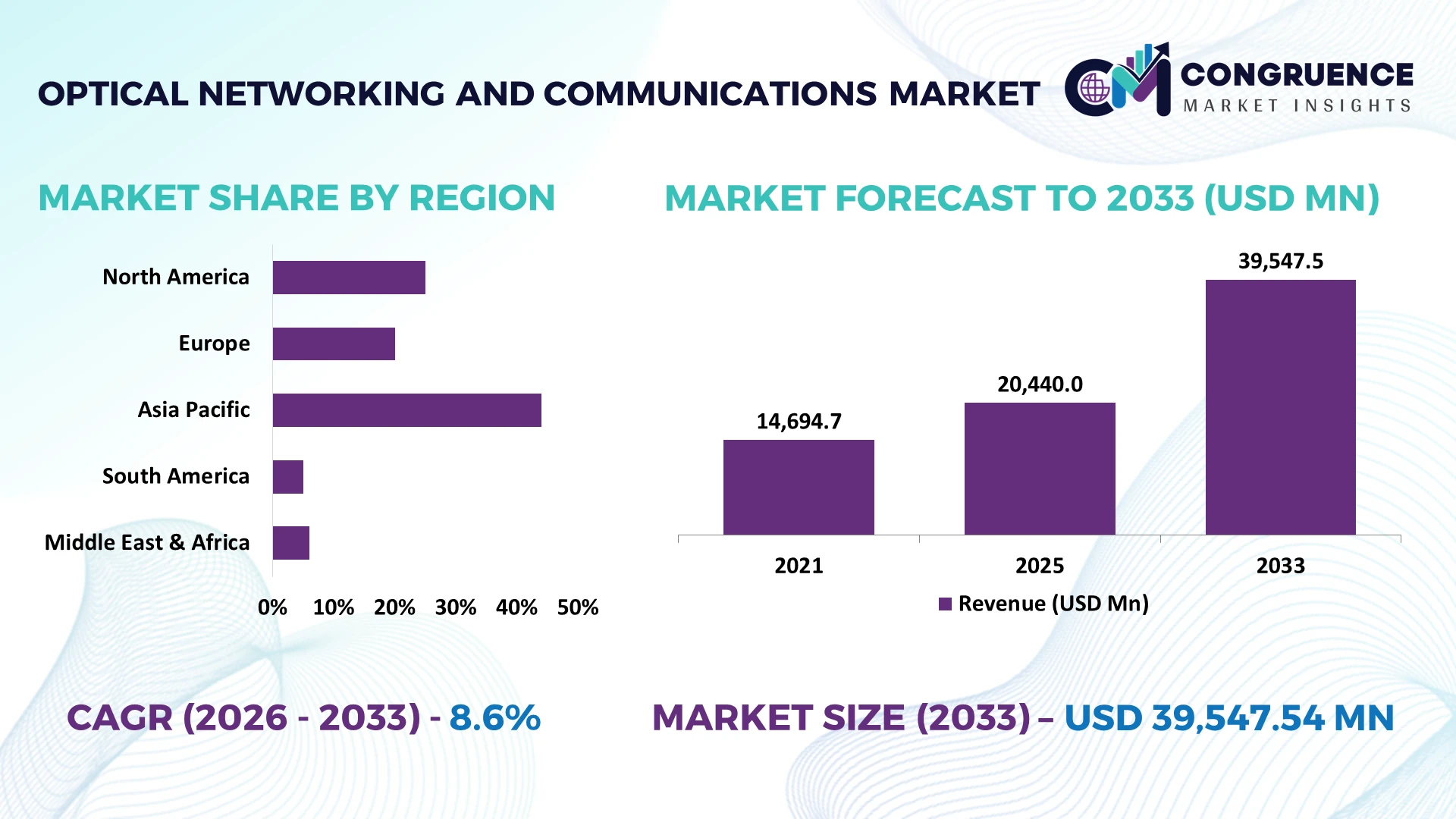
The Global Optical Networking And Communications Market was valued at USD 20440 Million in 2025 and is anticipated to reach a value of USD 39547.54 Million by 2033 expanding at a CAGR of 8.6% between 2026 and 2033. Growth is driven by hyperscale AI data-center interconnects, 400G/800G Ethernet migration, coherent optics, 5G transport densification, and carrier upgrades toward higher-capacity fiber networks.
The United States represents an estimated 30–35% of global optical networking demand, supported by hyperscale cloud campuses, AI infrastructure, telecom backbone upgrades, and dense data-center interconnect deployments. 800G optics are moving into volume cloud deployments, while 1.6T platforms are entering commercialization as GPU clusters increase east-west traffic. China operates the world’s largest fiber-access infrastructure, with gigabit-capable broadband reaching more than 200 million households. U.S. deployment is additionally reinforced by federal broadband programs exceeding USD 40 billion, while geopolitical technology controls are accelerating domestic and diversified optical-component supply chains.
Strategically, vendors controlling high-speed DSPs, coherent optics, silicon photonics, and scalable manufacturing capacity are positioned to capture the highest-value network upgrades as AI traffic reshapes optical infrastructure procurement.
Market Size & Growth: USD 20,440 million in 2025 advances to USD 39,547.54 million by 2033 at 8.6% CAGR, driven by AI data-center connectivity and 800G network migration.
Top Growth Drivers: AI interconnect traffic contributes approximately 35%, cloud network scaling 30%, and 5G/fiber transport modernization 20% to incremental optical infrastructure demand.
Short-Term Forecast: By 2028, 800G and emerging 1.6T interfaces are positioned to improve bandwidth density by approximately 100% versus comparable 400G architectures.
Emerging Technologies: 800G coherent optics, 1.6T transceivers, silicon photonics, and co-packaged optics target 20–30% improvements in power efficiency and interconnect density.
Regional Leaders: By 2033, North America approaches USD 13.5 billion, Asia-Pacific USD 12.7 billion, and Europe USD 8.3 billion as AI, fiber, and coherent-optics deployments scale.
Consumer/End-User Trends: Hyperscale cloud and data-center operators account for an estimated 35–40% of advanced high-speed optical transceiver demand as GPU clusters increase east-west bandwidth requirements.
Pilot/Case Example: In 2025, 1.6T optical demonstrations delivered 2× the interface capacity of 800G systems, establishing the next deployment step for AI-scale data-center fabrics.
Competitive Landscape: Huawei holds an estimated 20%+ optical transport position globally, competing with Ciena, Nokia, Cisco, and ZTE across coherent transport and packet-optical infrastructure.
Regulatory & ESG Impact: Advanced coherent and silicon-photonics architectures can reduce energy consumed per transmitted bit by more than 20%, strengthening data-center power-efficiency strategies.
Investment & Funding: U.S. broadband programs exceeding USD 40 billion are supporting fiber infrastructure expansion, while operators and hyperscalers increase investment in domestic and diversified optical supply chains.
Innovation & Future Outlook: 1.6T optics and co-packaged architectures target 2× higher interface capacity than 800G, shifting competitive investment toward photonic integration, thermal efficiency, and automated manufacturing.
The Optical Networking And Communications Market is shifting toward high-capacity infrastructure supporting AI clusters, hyperscale cloud networks, telecom backbones, 5G transport, and fiber broadband. Commercial deployments are moving from 400G toward 800G connectivity, delivering approximately 100% higher interface capacity, while 1.6T transceivers, coherent pluggables, silicon photonics, and co-packaged optics are reshaping product roadmaps. U.S.-China technology restrictions and supply-chain diversification are also increasing strategic attention on optical-component manufacturing locations. These changes place bandwidth density, energy efficiency, photonic integration, and manufacturing scale at the center of the market’s strategic discussion.
Optical networking is becoming strategic infrastructure as AI computing, hyperscale cloud, 5G transport, and fiber broadband force operators to increase bandwidth without proportional power or footprint expansion. AI clusters are accelerating the transition from 400G toward 800G interfaces, while U.S.-China technology restrictions are restructuring sourcing for optical components, DSPs, lasers, and photonic devices. Network ownership increasingly determines digital-service scalability and data-center competitiveness.
An 800G interface provides 100% more nominal capacity than 400G while reducing the number of ports required for equivalent aggregate bandwidth. North American deployment is concentrated around hyperscale AI campuses and coherent data-center interconnects; China combines extensive fiber-access infrastructure with large domestic equipment manufacturing, while Europe emphasizes carrier modernization and energy-efficient transport. Through 2026–2028, 800G deployment will broaden and 1.6T interfaces will transition from qualification into production networks.
A practical AI-cluster upgrade replaces multiple lower-speed links with 800G optical connections between switches, improving rack-level bandwidth density and simplifying cabling. Ciena, Cisco, Nokia, Coherent, and photonics suppliers are expanding coherent optics, silicon photonics, manufacturing, and ecosystem partnerships. Long-term advantage will belong to vendors combining optical performance, power efficiency, component availability, and scalable production.
AI data centers are creating the strongest structural demand for higher-speed optical connectivity as GPU clusters generate substantially greater east-west traffic than conventional enterprise computing. Migration from 400G to 800G doubles nominal interface capacity by 100%, while 1.6T technology delivers another 100% step-up over 800G. Hyperscale and cloud environments represent approximately 35–40% of advanced high-speed optical transceiver demand, concentrating procurement around bandwidth density and power efficiency. U.S. AI infrastructure expansion is accelerating deployment of 800G Ethernet and coherent data-center interconnects. Equipment and component suppliers are responding by expanding silicon-photonics capacity, 800G/1.6T portfolios, DSP development, and hyperscaler partnerships. Strategically, AI is shifting optical procurement from periodic network upgrades toward continuous capacity scaling tied directly to compute deployment cycles.
Optical networking remains exposed to concentrated semiconductor, laser, DSP, and advanced packaging supply chains, limiting sourcing flexibility during rapid capacity transitions. High-speed 800G modules can carry materially higher acquisition costs than mature 100G/400G products, while optical components can represent 10–20% of network equipment costs in bandwidth-intensive architectures. Qualification of alternative suppliers can require months because thermal behavior, interoperability, signal integrity, and reliability must be verified before deployment. U.S.-China export controls have further complicated access to selected advanced semiconductor and networking technologies. Vendors are responding through dual sourcing, localized assembly, long-term component agreements, and silicon-photonics integration. The operational constraint is qualification speed: adding suppliers without rigorous interoperability testing can transfer procurement risk directly into network availability and maintenance costs.
The transition toward 1.6T connectivity creates opportunities beyond conventional transceiver replacement by changing switch architecture, photonic integration, and power management. A 1.6T interface doubles bandwidth versus 800G, while co-packaged optics can shorten electrical paths and target 20–30% lower interconnect power in suitable high-density systems. Silicon photonics further enables multiple optical functions to be integrated onto compact platforms, improving manufacturability as port density rises. U.S. hyperscalers are driving qualification, while Japan and Taiwan provide important photonics, semiconductor, and packaging capabilities. Suppliers are investing in 1.6T modules, linear-drive optics, co-packaged architectures, advanced packaging, and foundry partnerships. A less obvious opportunity lies in reducing switch-faceplate constraints, allowing data centers to expand bandwidth without proportionally increasing rack space or cabling complexity.
Scaling optical capacity creates execution challenges around power, thermal management, fiber density, interoperability, and skilled network engineering. Moving from hundreds to thousands of high-speed optical connections per AI cluster multiplies failure points and makes component-level reliability operationally significant. Data centers can allocate 10–20% or more of facility electricity to networking and supporting infrastructure depending on architecture, while next-generation switch systems increasingly approach multi-kilowatt power envelopes. Dense U.S. AI campuses are consequently forcing operators to coordinate optical design with cooling, electrical distribution, and rack architecture rather than treating connectivity independently. Companies must improve photonic integration, telemetry, automated fault detection, liquid-cooling compatibility, and technician training. The strategic challenge is maintaining predictable performance at scale: bandwidth leadership loses value when thermal constraints, fiber-management complexity, or field-replacement requirements reduce infrastructure availability.
Cloud Buyers Reshape Optical Procurement: Direct cloud-provider purchases of WDM equipment increased about 50% in 2025, while data-center interconnect activity expanded nearly 40%. Hyperscalers are bypassing traditional carrier-centered procurement for ZR/ZR+ optics and optical line systems. Vendors are expanding direct cloud relationships and disaggregated transport portfolios, shortening purchasing cycles and making hyperscaler qualification increasingly important for volume production.
Disaggregated WDM Moves Mainstream: Disaggregated WDM deployments expanded approximately 40% during 2025 as operators separated transponders, optical line systems, and routing layers. North American optical transport demand increased 24% year-on-year during first-quarter 2025, with DCI spending rising more than 40%. Equipment suppliers are strengthening open interfaces, interoperable line systems, and software-controlled provisioning to reduce proprietary-system dependence and accelerate capacity additions.
Fiber Networks Replace Copper: Full-fiber migration is becoming an operational transition rather than an overlay strategy. Active fiber lines across surveyed European incumbent networks increased from 53% to 62%, while Norway and Spain completed copper switch-off during 2025. Operators are consolidating legacy infrastructure, redirecting maintenance resources toward fiber, and simplifying access networks; equipment vendors are aligning portfolios with FTTH aggregation, optical access, and automated service assurance.
Optical Supply Chains Tighten: AI infrastructure is pulling component capacity toward high-speed optics; 800G PAM4 chipset shipments nearly tripled during 2025 while sales more than doubled. Suppliers are expanding DSP, laser, packaging, and module capacity while hyperscalers secure longer-term component relationships. The less obvious shift is procurement risk: availability of qualified photonic components increasingly influences network deployment timing alongside equipment performance.
Optical Network Equipment represents the largest type, accounting for approximately 30–35% of market activity because carriers, hyperscalers, and enterprises require integrated transport platforms combining switching, wavelength management, amplification, and network control. Optical Fiber maintains a substantial installed-base position across backbone, metro, access, and submarine infrastructure, while Optical Amplifiers remain essential for extending transmission distances without electrical regeneration. Optical Switches increasingly support automated wavelength routing and dynamic traffic management as operators adopt software-controlled architectures.
Optical Transceivers are the fastest-growing type as 400G, 800G, and emerging 1.6T interfaces increase bandwidth density in AI data centers and DCI networks. In 2025, 800G PAM4 chipset shipments nearly tripled, demonstrating the speed of this transition. Optical Modules are simultaneously becoming more integrated through silicon photonics and coherent pluggable designs. Suppliers are prioritizing higher-speed transceivers, compact modules, programmable Optical Network Equipment, and manufacturing partnerships. Investment is therefore shifting from standalone component performance toward integrated optical platforms combining density, interoperability, power efficiency, and scalable production.
Data Center Networking represents approximately 30–35% of market demand and is the leading application as hyperscale cloud and AI facilities require dense east-west connectivity, campus interconnection, and high-capacity optical fabrics. Direct cloud-provider purchases of optical transport equipment increased approximately 50% during 2025, demonstrating how procurement is shifting toward data-center operators. Long-Haul Networks remain critical for national backbone capacity, while Metropolitan Networks increasingly deploy coherent pluggables and flexible wavelength architectures to connect distributed compute locations.
Data Center Networking is also the fastest-growing application as AI clusters move toward 800G and 1.6T connectivity. Fiber Access Networks retain broad deployment momentum as operators replace copper infrastructure; Submarine Communications remain strategically indispensable for international traffic, while Enterprise Networking increasingly adopts fiber for high-capacity campuses and data-intensive operations. Vendors are scaling DCI portfolios, coherent modules, programmable transport, and integrated management software. Operationally, investment is moving toward architectures that support both scale-up and geographically distributed scale-across computing without multiplying network complexity.
Telecommunications Operators represent the leading end-user group with approximately 35–40% of market activity because national backbone, metro aggregation, mobile transport, and fiber-access networks require continuous optical capacity investment. Internet Service Providers extend this demand through broadband aggregation and last-mile fiber infrastructure. Government Organizations prioritize resilient backbone and public-network connectivity, while Enterprises increasingly deploy fiber where campus bandwidth, latency, and data-security requirements exceed conventional copper capabilities.
Cloud Service Providers are the fastest-growing end-user group as AI infrastructure fundamentally increases inter-data-center traffic. Direct cloud purchases of WDM equipment expanded around 50% during 2025, while 800G PAM4 chipset shipments nearly tripled. Data Center Operators are consequently increasing high-density transceiver and DCI deployments alongside cloud customers. Suppliers are differentiating portfolios by buyer: programmable transport and coherent pluggables for operators, high-density optics for cloud providers, and simplified managed platforms for enterprises. Competitive positioning increasingly depends on serving both traditional telecom replacement cycles and faster hyperscale procurement schedules.
North America accounted for the largest market share at 36% in 2025 however, Asia-Pacific is expected to register the fastest growth, expanding at a CAGR of 10.2% between 2026 and 2033.
AI Infrastructure Accelerates High-Speed Optical Deployment
North America accounts for approximately 36% of global market activity, with U.S. hyperscale data centers, cloud campuses, telecom backbones, and broadband modernization concentrating demand. AI clusters are accelerating 800G Ethernet deployment, while coherent ZR/ZR+ optics increasingly connect distributed data-center facilities without traditional transponder-heavy architectures. Direct cloud-provider purchases of WDM equipment increased approximately 50% during 2025, reflecting procurement migration from carrier-led deployments toward hyperscaler-controlled optical infrastructure. Canada adds fiber-access and metro-network investment, but U.S. deployment scale remains substantially higher. Operators are also expanding disaggregated optical line systems to improve vendor flexibility and accelerate wavelength provisioning. Suppliers are responding with 800G transceivers, coherent pluggables, silicon-photonics platforms, and automated network-control software optimized for high-density AI and cloud environments.
United States Market Outlook: The United States combines hyperscale computing leadership with extensive fiber infrastructure and federal broadband modernization. The BEAD program allocated more than USD 42 billion for broadband infrastructure, strengthening long-term fiber requirements. Cloud operators increasingly procure optical systems directly, making hyperscaler qualification, domestic component availability, energy efficiency, and rapid volume scaling decisive supplier capabilities.
Fiber Migration Restructures Fixed Networks
Europe represents approximately 23% of global optical networking activity, supported by fiber-access modernization, metro-network upgrades, data-center interconnection, and cross-border backbone infrastructure. Copper retirement has become a major structural transition: active fiber lines across surveyed incumbent networks increased from approximately 53% to 62%, while Spain and Norway completed major copper switch-off milestones during 2025. Germany, France, Italy, and the United Kingdom continue expanding FTTH coverage alongside coherent metro and long-haul upgrades. Operators are consolidating legacy exchanges, reducing parallel copper-fiber maintenance, and shifting capital toward software-controlled optical infrastructure. Energy efficiency is also influencing equipment selection as carriers target lower power per transported bit. Vendors are responding with compact coherent systems, automated wavelength management, open optical architectures, and access platforms designed to support increasingly fiber-dominant networks.
Germany Market Outlook: Germany remains strategically significant because its fiber penetration historically lagged several European peers, creating substantial replacement demand. Nationwide gigabit targets are accelerating FTTH construction and aggregation-network modernization. Deutsche Telekom and alternative network builders are expanding fiber footprints, creating procurement opportunities across optical line terminals, transport systems, fiber components, network automation, and metro connectivity.
Fiber Scale Meets Photonics Manufacturing Strength
Asia-Pacific accounts for approximately 31% of global market activity and combines massive subscriber infrastructure with substantial optical-component manufacturing capacity. China operates the world’s largest fiber-access network, with more than 200 million gigabit broadband users and extensive 5G transport requirements. Japan supports advanced coherent transmission and photonics innovation, while Taiwan provides semiconductor and packaging capabilities critical to high-speed optical modules. India is rapidly expanding fiber backhaul, broadband access, and data-center interconnection as digital traffic rises. Regional suppliers benefit from proximity to lasers, passive components, electronics, and assembly ecosystems, shortening production cycles for optical modules. Export restrictions affecting advanced technologies are simultaneously encouraging localization and supply diversification. Manufacturers are increasing 400G/800G capacity, silicon-photonics investment, automated assembly, and domestic component sourcing to reduce geopolitical exposure.
China Market Outlook: China combines exceptional deployment scale with vertically integrated optical manufacturing spanning fiber, transceivers, transport equipment, and passive components. Gigabit broadband connections exceed 200 million, creating a large installed base for backbone and aggregation upgrades. Domestic vendors benefit from local telecom procurement and manufacturing depth, while technology controls reinforce investment in indigenous DSP, photonics, and semiconductor capabilities.
Fiber Expansion Reaches Secondary Cities
South America represents approximately 5% of global market activity, with Brazil accounting for the largest concentration of fiber broadband, data-center connectivity, and telecom transport investment. FTTH deployment has expanded beyond major metropolitan centers as operators replace legacy copper and fixed-wireless connections with fiber infrastructure. Brazil’s broadband market already contains tens of millions of fiber connections, supporting demand for optical access equipment, aggregation systems, and metro transport. Chile also maintains comparatively strong fiber penetration, while Colombia and Argentina continue network modernization. However, imported equipment exposure, currency volatility, difficult geography, and fragmented last-mile economics constrain deployment consistency. Vendors are responding with localized distribution, modular access platforms, lower-cost coherent solutions, and partnerships with regional ISPs. Network sharing increasingly offers smaller operators a route to improve fiber utilization without duplicating backbone infrastructure.
Brazil Market Outlook: Brazil provides the region’s strongest commercial base through extensive FTTH deployment, large cloud facilities, submarine-cable landing infrastructure, and numerous regional ISPs. Fiber has become the dominant fixed-broadband technology, strengthening demand for access and aggregation equipment. Suppliers that combine competitive hardware pricing with local inventory, technical support, and interoperable platforms gain an advantage across fragmented operator networks.
Digital Infrastructure Investment Expands Fiber Corridors
Middle East & Africa represents approximately 5% of global activity, with deployment concentrated around Gulf data-center hubs, national fiber programs, submarine connectivity, 5G transport, and African metropolitan networks. Saudi Arabia and the UAE are increasing cloud and AI infrastructure investment, creating demand for high-capacity data-center interconnect and coherent transport. Gulf operators also benefit from strategic geography linking European, Asian, and African submarine routes. Across Africa, fiber deployment remains uneven, with limited terrestrial backbone density increasing connectivity costs outside major cities. New submarine systems are expanding international capacity, but inland distribution remains the principal infrastructure bottleneck. Equipment providers are targeting carrier partnerships, modular metro platforms, open optical systems, and managed network solutions. Centralized data-center corridors create particularly concentrated opportunities for high-capacity optics compared with dispersed consumer access deployments.
Saudi Arabia Market Outlook: Saudi Arabia is strengthening its position through national digital transformation, hyperscale data-center development, cloud localization, and expanding 5G infrastructure. Large computing campuses require increasingly dense fiber interconnection between facilities and carrier networks. Suppliers offering coherent transport, automated provisioning, high-capacity transceivers, and dependable local technical support are positioned strongly as digital infrastructure investment intensifies.
Huawei, Ciena, Nokia, Cisco, and ZTE compete across carrier optical transport, while Coherent and photonics specialists pressure system vendors through high-speed component innovation. The top five equipment suppliers collectively control approximately 65–70% of optical transport activity, creating a concentrated technology market. Competition centers on coherent performance, power efficiency, interoperability, and deployment speed; 800G interfaces provide 100% more nominal capacity than 400G, while advanced coherent architectures can lower power per transmitted bit by over 20%. Huawei and ZTE leverage vertically integrated manufacturing and scale, whereas Ciena, Nokia, and Cisco emphasize programmable optics, open architectures, software control, and hyperscaler partnerships. Suppliers are expanding silicon-photonics capabilities, securing laser and DSP capacity, and integrating optical hardware with network automation. Geopolitical restrictions are simultaneously restructuring addressable markets and component sourcing. Entry barriers include photonic IP, semiconductor access, carrier qualification, reliability requirements, and manufacturing yield. Winning requires scalable optics, supply assurance, interoperability, automation, and sustained high-speed product execution.
Huawei Technologies
Ciena Corporation
Nokia
Cisco Systems
ZTE Corporation
Coherent Corp.
Lumentum Holdings
Infinera
Fujitsu
NEC Corporation
Broadcom
Marvell Technology
Adtran
Ribbon Communications
Current optical networks increasingly combine coherent pluggables, silicon photonics, flexible-grid WDM, and software-defined control. 800G interfaces provide 100% higher nominal capacity than 400G links, while routed optical architectures can reduce energy consumption by up to 80% in specific deployments. Adoption is strongest across hyperscale data centers and carrier backbones, where integrated telemetry and automation reduce provisioning complexity and improve utilization of installed fiber infrastructure.
Emerging 1.6T optics, 200G-per-lane transceivers, and advanced coherent DSPs are raising bandwidth density without proportional rack expansion. Compared with 800G technology, 1.6T interfaces deliver a 100% capacity improvement. Co-packaged optics and near-packaged optics move photonics closer to switching silicon; next-generation implementations target up to 70% lower interconnect power. Hyperscalers, cloud operators, and photonics suppliers benefit most as AI clusters require increasingly dense scale-up and scale-out connectivity.
Disruptive architectures combine co-packaged optics, programmable photonics, quantum-safe encryption, and AI-driven network automation. By 2026–2028, 1.6T coherent interfaces and 200G-per-lane technologies will progress from qualification into broader production deployments, while automated assurance increasingly controls wavelength optimization and fault isolation. Vendors integrating photonic hardware, DSPs, telemetry, and software gain competitive advantage because customers increasingly evaluate optical platforms on bandwidth-per-watt, density, interoperability, and operational automation rather than transmission capacity alone.
September 2024 Coherent demonstrated 1.6T-DR8 and 800G-DR4 transceivers operating at 200 Gbps per optical lane; its silicon-photonics 1.6T module supports 500-meter transmission, strengthening high-density AI and machine-learning data-center interconnect deployment. Source: Coherent
February 2025 Nokia completed its acquisition of Infinera for EUR 2.5 billion, combining optical transport portfolios and semiconductor capabilities. The integration expands Nokia’s North American and webscale presence while increasing scale for AI-driven data-center networking and optical product development. Source: Nokia
February 2025 Cisco introduced 400G ultra-long-haul coherent pluggable optics supporting connections up to 3,000 kilometers without traditional transponders. Its related 8000-series edge architecture targets 80% lower energy consumption, strengthening routed optical networking economics for service providers. Source: Cisco
August 2026 Ciena, Quantum Corridor and Toshiba completed 1.6 Tb/s quantum-safe optical encryption on a live U.S. commercial network, integrating NIST-certified post-quantum cryptography with quantum key distribution and demonstrating secure high-capacity connectivity for critical enterprise infrastructure. Source: Ciena
The report evaluates Optical Transceivers, Optical Fiber, Optical Amplifiers, Optical Switches, Optical Network Equipment, and Optical Modules, with network equipment representing approximately 30–35% of market activity. Application coverage includes Data Center Networking, Long-Haul Networks, Metropolitan Networks, Fiber Access Networks, Enterprise Networking, and Submarine Communications, while end-user analysis assesses telecommunications operators, data-center operators, cloud service providers, internet service providers, enterprises, and government organizations.
Geographic coverage spans North America, Europe, Asia-Pacific, South America, and Middle East & Africa, examining fiber deployment, hyperscale infrastructure, manufacturing ecosystems, and network modernization. Technology assessment tracks 800G, 1.6T optics, silicon photonics, coherent pluggables, WDM, co-packaged optics, programmable photonics, and network automation through 2026–2033. The analysis supports investment planning, geographic expansion, supplier positioning, partnership selection, and product-roadmap decisions as bandwidth density, power efficiency, interoperability, and AI infrastructure reshape optical-network procurement.
| Report Attribute/Metric | Report Details |
|---|---|
Market Revenue in 2025 | USD 20440 Million |
Market Revenue in 2033 | USD 39547.54 Million |
CAGR (2026 - 2033) | 8.6% |
Base Year | 2025 |
Forecast Period | 2026 - 2033 |
Historic Period | 2021 - 2025 |
Segments Covered | By Type
By Application
By End-User
|
Key Report Deliverable | Revenue Forecast, Growth Trends, Market Dynamics, Segmental Overview, Regional and Country-wise Analysis, Competition Landscape |
Region Covered | North America, Europe, Asia-Pacific, South America, Middle East, Africa |
Key Players Analyzed | Huawei Technologies, Ciena Corporation, Nokia, Cisco Systems, ZTE Corporation, Coherent Corp., Lumentum Holdings, Infinera, Fujitsu, NEC Corporation, Broadcom, Marvell Technology, Adtran, Ribbon Communications |
Customization & Pricing | Available on Request (10% Customization is Free) |




