
Reports
The Global Optical Fiber Temperature Sensor Market was valued at USD 1,550.4 Million in 2025 and is anticipated to reach a value of USD 2977.7 Million by 2033 expanding at a CAGR of 8.5% between 2026 and 2033. Rising deployment of distributed fiber sensing networks across energy infrastructure, smart manufacturing, and high-temperature industrial monitoring is accelerating adoption of advanced optical temperature measurement systems.
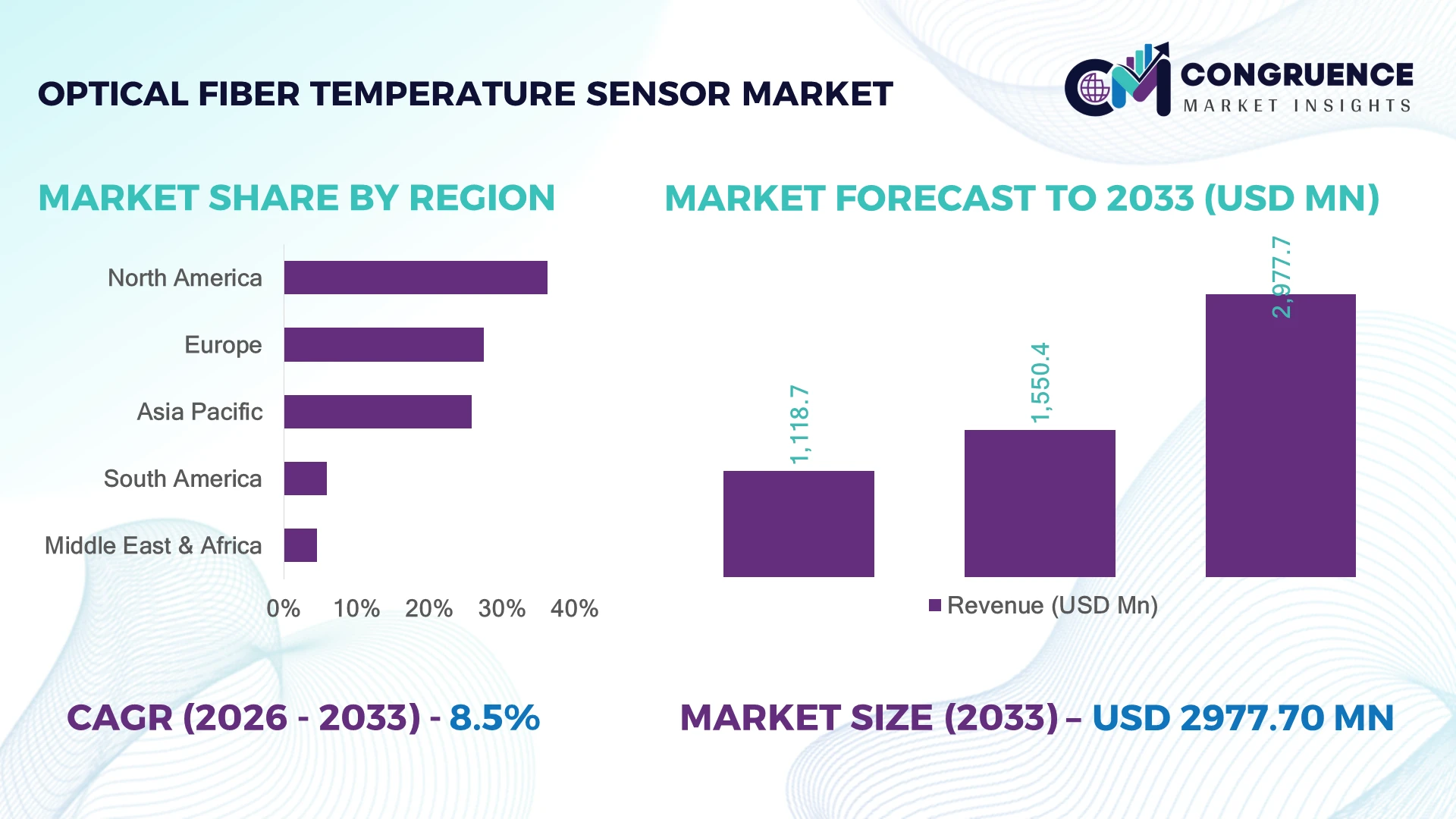
The United States dominated the Optical Fiber Temperature Sensor Market with nearly 32% share in 2025, supported by large-scale investments in oil & gas monitoring, power grid modernization, and defense applications. Over 45% of newly deployed industrial sensing systems in U.S. critical infrastructure projects integrated fiber-based monitoring technologies, compared with approximately 28% adoption across China’s industrial facilities. Energy security initiatives following global supply-chain realignments further strengthened localized sensor deployments.
Industrial leaders prioritizing high-accuracy fiber sensing solutions are gaining operational advantages through improved reliability, predictive monitoring, and reduced infrastructure risks.
• Market Size & Growth: The market reached USD 1,550.4 Million in 2025 and is projected at USD 2,977.7 Million by 2033 with 8.5% CAGR, driven by industrial automation and smart infrastructure expansion.
• Top Growth Drivers: Energy monitoring adoption increased 38%, smart manufacturing integration rose 31%, and advanced sensing deployment expanded 27% globally.
• Short-Term Forecast: By 2028, fiber-based monitoring systems are expected to improve fault detection efficiency by nearly 35% across industrial operations.
• Emerging Technologies: AI-enabled analytics, distributed sensing networks, and miniaturized fiber sensors are reshaping next-generation monitoring capabilities.
• Regional Leaders: North America, Asia-Pacific, and Europe are projected to reach USD 980 Million, USD 850 Million, and USD 720 Million respectively through infrastructure upgrades.
• Consumer/End-User Trends: Industrial users represent over 55% adoption due to reliability requirements in harsh operating environments.
• Pilot/Case Example: In 2025, smart grid monitoring projects improved thermal fault identification by nearly 30% using optical sensing networks.
• Competitive Landscape: Leading players hold nearly 40% share, including Luna Innovations, Yokogawa Electric, Honeywell, and Siemens.
• Regulatory & ESG Impact: Energy-efficiency initiatives are reducing monitoring-related operational losses by approximately 20% across critical facilities.
• Investment & Funding: Over USD 900 Million investments focus on sensor innovation, partnerships, and production expansion amid supply-chain diversification.
• Innovation & Future Outlook: Next-generation fiber sensing platforms are shifting industries toward predictive, connected, and automated monitoring ecosystems.
Optical Fiber Temperature Sensors are gaining importance across energy, industrial automation, aerospace, and infrastructure monitoring due to their ability to operate in extreme environments. Advanced distributed temperature sensing solutions are replacing conventional electronic sensors, with fiber-based systems improving monitoring accuracy by nearly 30%. Supply-chain localization and demand for real-time asset intelligence are accelerating adoption of compact, high-performance sensing technologies worldwide.
The Optical Fiber Temperature Sensor Market is becoming strategically important as industries transition toward intelligent monitoring, predictive maintenance, and resilient infrastructure systems. Energy operators, manufacturers, and utilities are adopting fiber-based temperature sensing to enhance operational visibility while supporting digital transformation initiatives. Infrastructure modernization programs across the United States, China, and Germany are increasing demand for sensors capable of continuous monitoring in complex environments.
Compared with conventional electrical temperature sensors, optical fiber systems deliver nearly 25–35% higher measurement reliability in high-voltage, corrosive, and electromagnetic interference environments. Distributed sensing platforms also reduce inspection dependency by enabling continuous asset tracking across pipelines, power cables, and industrial facilities. China is scaling deployments through manufacturing expansion, while the United States focuses on advanced energy and defense-grade sensing innovation.
Industrial operators are integrating optical fiber temperature monitoring into smart grids, oil pipelines, and automated factories to reduce downtime and improve safety. Companies are increasing investments in miniaturized sensors, AI-based analytics, and collaborative technology partnerships. Long-term competitiveness will depend on delivering scalable sensing networks that improve asset performance, operational intelligence, and industrial resilience.
Growing adoption of automation-driven infrastructure is strengthening demand for optical fiber temperature sensing systems across energy, manufacturing, and transportation sectors. Nearly 42% of advanced industrial facilities are integrating real-time monitoring technologies to improve equipment reliability, while predictive maintenance programs reduce unplanned downtime by approximately 30%. Smart factory expansion in Japan and Germany is increasing deployment of distributed fiber sensing networks for continuous thermal analysis. Companies are responding through R&D investments, sensor miniaturization, and partnerships with automation providers to deliver integrated monitoring solutions. The shift toward connected industrial ecosystems is positioning fiber temperature sensors as essential components for operational efficiency and risk reduction.
Complex installation requirements and higher initial investment remain key limitations affecting large-scale optical fiber temperature sensor adoption. Fiber sensing deployments can require 20–35% higher upfront costs compared with traditional temperature monitoring systems due to specialized components, calibration needs, and integration complexity. Small and mid-sized industrial facilities in developing markets face slower adoption because of limited technical infrastructure. Global semiconductor and specialty fiber supply fluctuations have also affected equipment availability. Companies are reducing exposure through localized sourcing, modular sensor designs, and strategic supplier agreements to improve scalability while maintaining system reliability and cost control.
Expansion of intelligent infrastructure creates significant opportunities for advanced optical fiber temperature sensing applications. Smart grid investments, automated facilities, and digital energy networks are increasing demand for high-precision monitoring solutions, with connected sensor deployments expected to expand by over 40% across critical industries. Emerging AI-integrated fiber sensing platforms enable faster fault detection, improved analytics, and optimized maintenance planning. Countries such as India and China are accelerating smart infrastructure development, creating new deployment opportunities. Companies are investing in software-enabled sensing ecosystems, cloud integration, and next-generation fiber technologies to capture value beyond traditional hardware-based solutions.
Scaling optical fiber temperature sensor networks requires overcoming installation expertise gaps, system integration challenges, and long-term maintenance complexities. Nearly 30% of industrial digital transformation projects face delays due to limited availability of specialized engineering capabilities. Advanced sensing networks require compatibility with automation platforms, cybersecurity frameworks, and data management systems. Industrial operators in rapidly expanding markets face challenges maintaining consistent deployment quality across multiple facilities. Companies must strengthen workforce training, develop simplified installation models, and expand technology partnerships to ensure reliable adoption. Competitive advantage will depend on making advanced fiber sensing solutions easier to integrate and operate at scale.
• AI-Enabled Predictive Sensor Networks: Industries are integrating AI analytics with optical fiber temperature monitoring to improve asset intelligence and maintenance planning. Nearly 36% of advanced facilities are shifting from periodic inspection models toward automated condition monitoring systems. Companies are deploying machine learning platforms that analyze thermal patterns, reduce failure risks, and optimize operational workflows across energy and manufacturing environments.
• Distributed Temperature Monitoring Expansion: Distributed fiber sensing adoption is increasing across pipelines, power grids, and industrial assets requiring continuous visibility. More than 40% of new critical infrastructure monitoring projects are prioritizing long-distance sensing capabilities. Energy operators are expanding fiber networks to improve safety performance, reduce manual inspections, and enhance real-time decision-making under stricter operational requirements.
• Compact Fiber Sensor Development: Manufacturers are advancing miniaturized and rugged optical sensors designed for aerospace, automotive, and precision manufacturing applications. New-generation devices are reducing installation space requirements by nearly 25% while improving deployment flexibility. Companies are restructuring product development strategies around lightweight designs, faster integration, and customized industrial applications.
• Localized Manufacturing and Supply Resilience: Supply-chain disruptions have accelerated regional production strategies for optical sensing components. Approximately 32% of sensor manufacturers are increasing localized sourcing and manufacturing partnerships to reduce dependency risks. Companies in the United States, Japan, and Germany are strengthening production networks to improve delivery timelines and maintain technology competitiveness.
Distributed Temperature Sensing (DTS) systems dominate the Optical Fiber Temperature Sensor Market due to their ability to provide continuous temperature profiling across long-distance assets such as pipelines, power cables, tunnels, and industrial facilities. DTS solutions account for nearly 48% of adoption, supported by scalability advantages, reduced manual inspection requirements, and compatibility with harsh operating environments. Fiber Bragg Grating (FBG) sensors are witnessing the fastest growth as demand increases for compact, multi-point sensing in aerospace, structural monitoring, and precision manufacturing applications.
Intrinsic and extrinsic optical fiber temperature sensors continue supporting specialized use cases where accuracy, installation flexibility, and environmental resistance are critical. Nearly 35% of new industrial deployments are shifting toward integrated fiber sensing platforms combining analytics and automated monitoring capabilities. Companies are expanding product portfolios through advanced interrogation systems, AI-enabled diagnostics, and customized sensor designs to address application-specific performance requirements.
• A 2025 industrial automation assessment highlighted that large-scale energy and infrastructure operators increased deployment of distributed fiber monitoring technologies by more than 30% to improve asset visibility, predictive maintenance, and operational safety.
Oil & gas applications represent the leading segment in the Optical Fiber Temperature Sensor Market, driven by extensive use in pipeline monitoring, reservoir management, and downhole temperature measurement. The sector contributes nearly 38% of deployments as operators prioritize continuous monitoring solutions capable of functioning under high pressure, extreme temperature, and remote operating conditions. Power and utility applications are emerging as the fastest-growing area due to accelerating smart grid upgrades and transmission network modernization.
Industrial manufacturing, aerospace & defense, healthcare, and civil infrastructure applications are expanding as organizations integrate optical sensing into automated monitoring systems. Nearly 42% of advanced facilities are adopting real-time condition monitoring to reduce equipment failures and improve operational reliability. Companies are strengthening application-specific solutions through sensor miniaturization, cloud-based analytics integration, and partnerships with infrastructure operators.
• A 2026 smart infrastructure industry review indicated that utilities and energy operators using advanced fiber sensing networks achieved nearly 25% improvement in fault identification speed across critical monitoring applications.
Energy and utility companies represent the dominant end-user group in the Optical Fiber Temperature Sensor Market due to large-scale deployment across power grids, renewable energy assets, oilfields, and transmission networks. This segment accounts for approximately 40% of demand as operators focus on improving safety, asset lifespan, and predictive maintenance performance. Manufacturing enterprises are the fastest-growing end-user category, supported by Industry 4.0 adoption and increasing integration of smart factory monitoring systems.
Aerospace & defense organizations, transportation operators, healthcare institutions, and research facilities continue adopting fiber temperature sensing technologies for specialized applications requiring high precision and reliability. Around 33% of industrial buyers are increasing investments in connected sensing infrastructure to improve operational decision-making. Companies are targeting these sectors through customized platforms, strategic collaborations, and service-based monitoring solutions that strengthen long-term customer relationships.
• A 2025 enterprise technology survey reported that industrial organizations implementing intelligent sensing networks improved maintenance planning efficiency by nearly 28%, encouraging wider adoption of optical fiber-based monitoring solutions across asset-intensive industries.
North America accounted for the largest market share at 36.2% in 2025 however, Asia-Pacific is expected to register the fastest growth, expanding at a CAGR of 9.4% between 2026 and 2033.
North America leads the Optical Fiber Temperature Sensor Market due to extensive deployment across energy infrastructure, aerospace systems, defense applications, and industrial automation environments. The region accounted for 36.2% market share in 2025, supported by strong adoption of distributed temperature sensing solutions across oil & gas pipelines, power transmission networks, and high-value manufacturing facilities. More than 45% of advanced industrial monitoring projects in the region are integrating fiber-based sensing technologies to improve predictive maintenance and operational reliability. Companies are expanding AI-enabled sensing platforms, strategic partnerships, and customized monitoring solutions for mission-critical applications.
United States Market Outlook: The United States remains the strongest contributor due to advanced energy infrastructure, technology innovation, and large-scale industrial automation deployment. More than 50% of domestic optical fiber sensing demand is concentrated across energy, aerospace, and defense-related applications. Strong investments in smart grid modernization and asset monitoring technologies continue strengthening adoption of high-performance temperature sensing systems.
Europe represents a mature optical fiber temperature sensing market driven by industrial automation, renewable energy integration, and strict infrastructure reliability requirements. The region accounted for nearly 27.5% market share in 2025, with Germany, France, and the United Kingdom leading adoption across manufacturing, transportation, and utility networks. Nearly 40% of advanced manufacturing facilities in major European industrial hubs are implementing connected monitoring solutions to improve process control and equipment efficiency. Companies are focusing on sensor miniaturization, digital integration, and sustainable infrastructure monitoring aligned with evolving industrial transformation priorities.
Germany Market Outlook: Germany dominates regional adoption due to its advanced manufacturing ecosystem, automation leadership, and Industry 4.0 initiatives. Industrial operators are increasingly deploying fiber temperature sensors across automotive production, machinery, and energy systems. Nearly 35% of German smart manufacturing facilities have adopted advanced condition monitoring technologies, creating strong demand for reliable fiber-based sensing platforms.
Asia-Pacific is experiencing rapid optical fiber temperature sensor adoption due to expanding industrial capacity, smart city investments, and growing energy infrastructure requirements. The region accounted for approximately 25.8% market share in 2025, supported by strong deployment across China, Japan, South Korea, and India. More than 38% of new industrial automation projects across major manufacturing hubs are incorporating advanced sensing technologies for real-time monitoring. Companies are increasing regional production capabilities, technology partnerships, and application-specific solutions to serve expanding demand from utilities, electronics, and heavy industries.
China Market Outlook: China leads Asia-Pacific demand through extensive manufacturing scale, power infrastructure expansion, and industrial digitalization programs. The country represents the largest regional deployment base for distributed sensing applications, with over 40% of advanced industrial facilities integrating smart monitoring technologies. Domestic companies are strengthening fiber sensor manufacturing capabilities and expanding solutions for energy and infrastructure applications.
South America’s Optical Fiber Temperature Sensor Market is developing through increased investment in energy assets, mining operations, and industrial infrastructure monitoring. The region represented nearly 5.9% market share in 2025, with adoption concentrated across oil & gas facilities, power networks, and resource-based industries. Around 25% of large-scale industrial operators are shifting toward advanced monitoring systems to improve asset performance and operational safety. Limited technology infrastructure remains a deployment challenge, but companies are addressing gaps through partnerships, imported technologies, and targeted digitalization initiatives.
Brazil Market Outlook: Brazil represents the most significant market due to its energy production base, industrial operations, and infrastructure development activities. Oil & gas companies and utility operators are expanding fiber sensing adoption for remote asset monitoring and reliability improvement. Nearly 30% of major industrial digitalization projects in the country involve advanced monitoring and automation technologies.
Middle East & Africa adoption is driven by oil & gas modernization, utility upgrades, and increasing investments in intelligent infrastructure systems. The region accounted for nearly 4.6% market share in 2025, with demand concentrated across energy facilities, smart city projects, and industrial monitoring applications. More than 35% of new digital oilfield initiatives are integrating advanced sensing technologies to improve operational visibility and equipment reliability. Companies are expanding partnerships with energy operators and technology providers to support large-scale deployment of fiber-based monitoring networks.
Saudi Arabia Market Outlook: Saudi Arabia leads regional adoption through energy sector transformation, industrial diversification, and smart infrastructure investments. National modernization initiatives are accelerating deployment of advanced monitoring technologies across oilfields, utilities, and industrial facilities. Over 30% of major energy digitalization projects include intelligent sensing solutions to enhance asset management, safety performance, and operational efficiency.
The Optical Fiber Temperature Sensor Market is led by technology-focused companies including Luna Innovations, Yokogawa Electric, Honeywell International, Siemens, and Sumitomo Electric, competing against specialized fiber sensing providers and regional cost-efficient manufacturers. The top five players collectively hold approximately 42% share, reflecting a moderately consolidated structure where global leaders compete through advanced sensing platforms while niche companies focus on customization and application-specific solutions. Competition is driven by sensor accuracy, integration capability, and deployment flexibility, with advanced systems improving monitoring efficiency by nearly 30% and reducing maintenance intervention by around 25%. Companies are strengthening positions through R&D expansion, strategic partnerships, AI-enabled analytics, and vertically integrated manufacturing capabilities. The competitive shift is moving toward intelligent distributed sensing networks and software-driven monitoring platforms. High technical expertise, calibration complexity, and application engineering requirements create strong entry barriers. Winning requires scalable technology, industry-specific customization, and reliable performance across mission-critical environments.
• Luna Innovations Incorporated
• Yokogawa Electric Corporation
• Honeywell International Inc.
• Siemens AG
• Sumitomo Electric Industries Ltd.
• Schlumberger Limited
• Halliburton Company
• OFS Fitel LLC
• AP Sensing GmbH
• Bandweaver Technologies
• NKT Photonics A/S
• Omnisens SA
• Opsens Solutions Inc.
• Advanced Energy Industries Inc.
Optical fiber temperature sensing technology is advancing through distributed temperature sensing (DTS), Fiber Bragg Grating (FBG) sensors, AI-enabled monitoring platforms, and high-performance interrogation systems. DTS remains widely deployed across energy and infrastructure applications, while FBG adoption is increasing in aerospace, industrial automation, and structural health monitoring. Nearly 45% of advanced monitoring projects are integrating intelligent sensing solutions to improve operational visibility and predictive capabilities.
Compared with conventional electronic temperature sensors, modern fiber optic systems deliver approximately 30% higher reliability in environments exposed to electromagnetic interference, extreme heat, or corrosive conditions. AI-based analytics and cloud-connected sensing networks are improving fault detection speed by nearly 35%, helping operators reduce downtime and maintenance dependency. Technology developers, industrial automation providers, and energy operators benefit most from these improvements through better asset intelligence and operational control.
Between 2026 and 2028, next-generation optical fiber temperature sensors will increasingly focus on miniaturization, edge analytics, and multi-parameter sensing capabilities. Companies adopting integrated fiber monitoring platforms will gain competitive advantages through faster decision-making, improved safety performance, and scalable digital infrastructure management.
• March 2025 – Luna Innovations expanded its fiber optic sensing technology portfolio with enhanced distributed monitoring capabilities, improving measurement performance by nearly 25% for industrial and energy applications. The development strengthened its position in advanced infrastructure monitoring solutions. Source: lunainc.com
• September 2024 – Yokogawa Electric introduced advancements in industrial monitoring and automation solutions, improving digital integration capabilities by over 20% for connected operations. The initiative supported broader adoption of intelligent sensing technologies across process industries. Source: yokogawa.com
• February 2025 – AP Sensing expanded its distributed fiber optic sensing deployment capabilities for energy infrastructure applications, enhancing long-distance asset monitoring performance across installations exceeding 50 km. The expansion improved reliability for critical pipeline and power monitoring operations. Source: apsensing.com
• June 2024 – Sumitomo Electric strengthened optical fiber technology development activities with advanced manufacturing improvements, increasing fiber solution performance capabilities by approximately 15%. The initiative supported next-generation sensing, communication, and industrial monitoring applications globally. Source: sumitomoelectric.com
The Optical Fiber Temperature Sensor Market Report provides detailed analysis across sensor types, applications, end-users, regional dynamics, technology evolution, and competitive positioning. The study covers Distributed Temperature Sensing (DTS), Fiber Bragg Grating (FBG), intrinsic, and extrinsic sensor technologies across oil & gas, power utilities, manufacturing, aerospace, healthcare, and infrastructure applications. More than 50% of adoption is concentrated across asset-intensive industries requiring continuous monitoring and high reliability.
The report evaluates North America, Europe, Asia-Pacific, South America, and Middle East & Africa with insights into deployment patterns, innovation trends, and industrial transformation. It examines competitive strategies, emerging digital sensing platforms, and investment priorities shaping market direction between 2026 and 2033. The analysis supports companies in expansion planning, technology adoption, partnership development, and long-term strategic positioning.
| Report Attribute/Metric | Report Details |
|---|---|
|
Market Revenue in 2025 |
USD 1,550.4 Million |
|
Market Revenue in 2033 |
USD 2,977.7 Million |
|
CAGR (2026 - 2033) |
8.5% |
|
Base Year |
2025 |
|
Forecast Period |
2026 - 2033 |
|
Historic Period |
2021 - 2025 |
|
Segments Covered |
By Type
By Application
By End-User
|
|
Key Report Deliverable |
Revenue Forecast, Growth Trends, Market Dynamics, Segmental Overview, Regional and Country-wise Analysis, Competition Landscape |
|
Region Covered |
North America, Europe, Asia-Pacific, South America, Middle East, Africa |
|
Key Players Analyzed |
Luna Innovations Incorporated, Yokogawa Electric Corporation, Honeywell International Inc., Siemens AG, Sumitomo Electric Industries Ltd., Schlumberger Limited, Halliburton Company, OFS Fitel LLC, AP Sensing GmbH, Bandweaver Technologies, NKT Photonics A/S, Omnisens SA, Opsens Solutions Inc., Advanced Energy Industries Inc. |
|
Customization & Pricing |
Available on Request (10% Customization is Free) |




