
Reports
The Global Optical Fiber Bypass Switches Market was valued at USD 280.0 Million in 2025 and is anticipated to reach a value of USD 368.7 Million by 2033 expanding at a CAGR of 3.5% between 2026 and 2033, according to an analysis by Congruence Market Insights. This growth is primarily driven by the increasing need for uninterrupted network uptime and automated fault management across telecom and data center infrastructures.
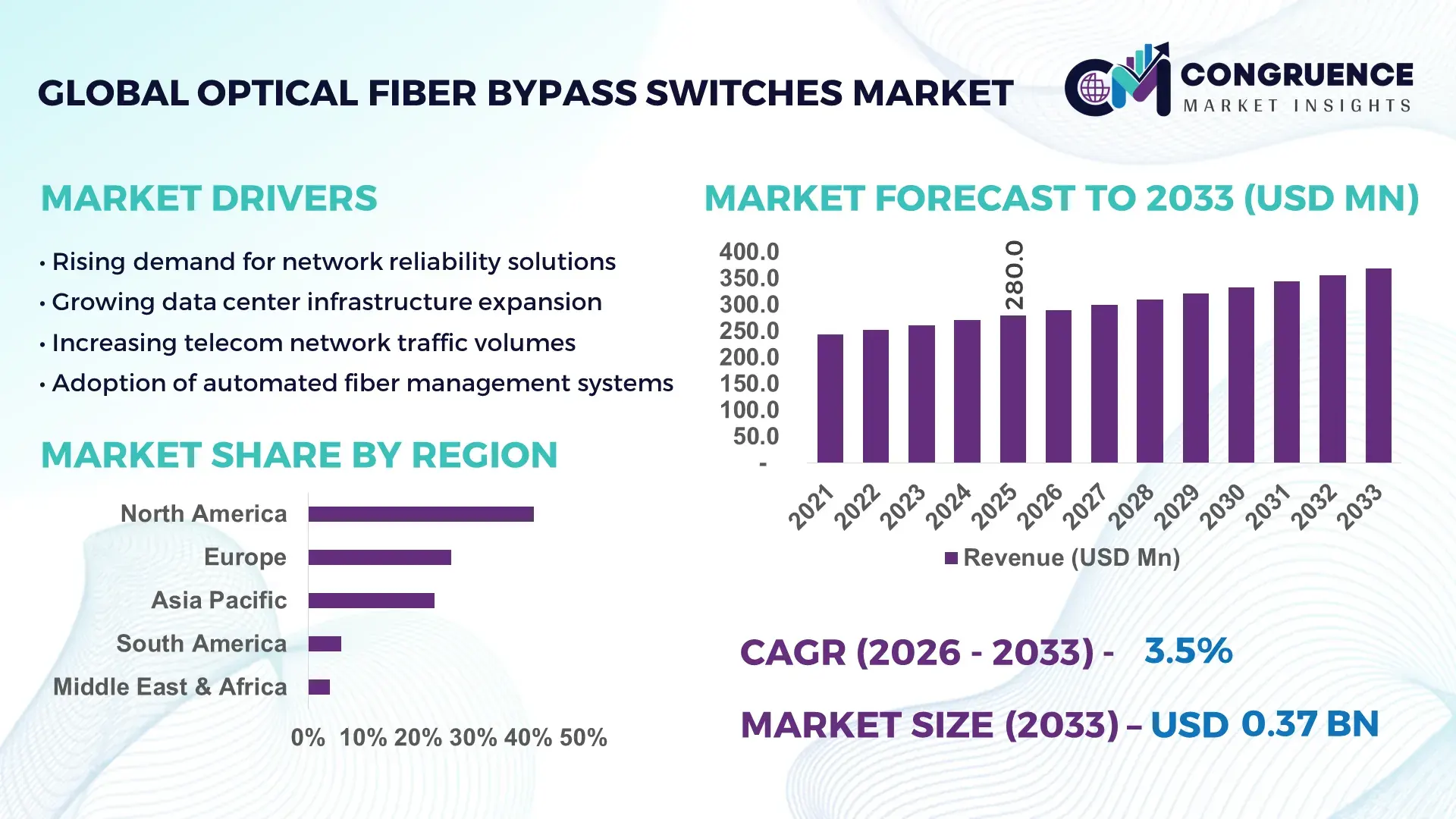
The United States leads the Optical Fiber Bypass Switches Market with robust deployment across hyperscale data centers and telecom backbone networks. Over 45% of global hyperscale data centers are located in the U.S., supporting large-scale adoption of optical bypass technologies. The country hosts more than 5,000 operational data centers, with fiber infrastructure investments exceeding USD 20 billion annually. Telecom operators in the U.S. have implemented automated optical switching systems in over 60% of long-haul fiber networks. Additionally, adoption of intelligent network monitoring integrated with bypass switches has increased by nearly 35% across enterprise IT environments, highlighting strong technological advancement and infrastructure readiness.
Market Size & Growth: USD 280.0 million in 2025, projected USD 368.7 million by 2033, CAGR 3.5%, driven by rising network uptime requirements.
Top Growth Drivers: Network automation adoption (42%), data center expansion (38%), telecom fiber upgrades (35%).
Short-Term Forecast: By 2028, network downtime reduction is expected to improve by 28% through automated bypass switching.
Emerging Technologies: AI-based network monitoring, software-defined optical switching, remote fiber diagnostics.
Regional Leaders: North America (~USD 140M by 2033) driven by hyperscale data centers; Asia-Pacific (~USD 110M) led by telecom expansion; Europe (~USD 80M) focused on smart infrastructure upgrades.
Consumer/End-User Trends: Telecom operators and cloud providers account for over 65% of deployments, with increasing enterprise adoption.
Pilot or Case Example: In 2025, a telecom network upgrade project reduced downtime by 32% using automated optical bypass switches.
Competitive Landscape: Leading players hold ~38% share; key companies include major telecom component manufacturers and network solution providers.
Regulatory & ESG Impact: Energy-efficient network infrastructure policies driving adoption of low-power optical switching solutions.
Investment & Funding Patterns: Over USD 1.2 billion invested in fiber infrastructure modernization projects globally in recent years.
Innovation & Future Outlook: Integration with AI-driven network orchestration and edge computing environments is shaping future demand.
Optical Fiber Bypass Switches Market growth is influenced by telecom (48%), data centers (32%), and enterprise IT (20%) sectors. Innovations such as AI-enabled switching and compact modular designs are enhancing performance efficiency by over 25%. Regulatory focus on energy-efficient networks and regional fiber expansion programs are accelerating adoption, while Asia-Pacific shows strong consumption growth due to rapid 5G infrastructure deployment.
The Optical Fiber Bypass Switches Market plays a critical role in ensuring network continuity, fault isolation, and automated traffic rerouting across modern digital infrastructures. With telecom operators handling over 70% of global data traffic through fiber networks, the demand for intelligent bypass solutions is increasing significantly. Strategically, these switches are becoming integral to reducing operational risks, with automated switching reducing network downtime incidents by nearly 30% compared to manual intervention systems.
Software-defined optical networking delivers 40% improvement compared to traditional hardware-based switching systems, enabling faster response times and improved scalability. North America dominates in volume, while Asia-Pacific leads in adoption with over 55% telecom operators integrating automated optical management systems. This regional variation highlights differing maturity levels and investment priorities across global markets.
By 2028, AI-driven network automation is expected to reduce operational costs by 25% while improving fault detection accuracy by over 35%. Firms are committing to sustainability improvements such as 20% reduction in network energy consumption by 2030 through adoption of low-power optical components. In 2025, a leading telecom operator in Japan achieved a 33% reduction in network downtime through deployment of AI-integrated bypass switching systems.
Looking ahead, the Optical Fiber Bypass Switches Market is positioned as a critical enabler of resilient, scalable, and sustainable network infrastructures. Its integration with AI, edge computing, and 5G ecosystems will reinforce its role as a pillar of operational continuity, regulatory compliance, and long-term digital transformation.
The Optical Fiber Bypass Switches Market is characterized by steady growth driven by increasing global data traffic, expansion of fiber-optic infrastructure, and the rising need for uninterrupted connectivity. Telecom operators are upgrading legacy systems to support high-speed networks, with over 65% of telecom infrastructure projects now incorporating automated switching solutions. Data centers are also contributing significantly, with more than 700 hyperscale facilities globally relying on optical bypass switches for network reliability. The market is influenced by advancements in AI-based monitoring systems, integration with cloud platforms, and demand for real-time fault management. Additionally, regulatory frameworks promoting energy-efficient and resilient network systems are shaping procurement strategies. However, factors such as high deployment costs, technical complexity, and integration challenges continue to impact adoption rates across smaller enterprises.
The increasing reliance on uninterrupted connectivity across industries is a major driver for the Optical Fiber Bypass Switches Market. Telecom networks now handle over 80% of global internet traffic through fiber infrastructure, making downtime costly and operationally disruptive. Studies indicate that network outages can lead to productivity losses exceeding 25% in enterprise environments. Optical bypass switches enable automatic rerouting within milliseconds, reducing downtime by up to 30%. Data centers, particularly hyperscale facilities, have integrated these switches in over 60% of operations to ensure continuous service delivery. Additionally, financial institutions and cloud service providers are adopting these solutions to maintain service-level agreements (SLAs) with uptime commitments exceeding 99.99%. This demand for high reliability is accelerating deployment across both developed and emerging markets.
High initial investment and installation complexity act as significant restraints for the Optical Fiber Bypass Switches Market. Advanced optical switching systems require specialized components, skilled labor, and integration with existing network infrastructure, increasing overall deployment costs by approximately 20–30% compared to conventional systems. Small and medium enterprises face budget constraints, limiting adoption despite operational benefits. Additionally, retrofitting existing networks with bypass switches can increase implementation timelines by up to 40%, causing delays in project execution. Maintenance and calibration requirements further add to operational expenses. The lack of standardized protocols across different network architectures also complicates integration, reducing interoperability and increasing system customization costs. These factors collectively hinder widespread adoption, particularly in cost-sensitive markets.
The rapid expansion of 5G infrastructure presents significant opportunities for the Optical Fiber Bypass Switches Market. Over 70% of 5G deployments rely on dense fiber backhaul networks, creating demand for automated fault management solutions. Optical bypass switches are critical in maintaining low latency and high reliability required for 5G applications. Telecom operators are investing heavily in fiber densification, with network nodes increasing by nearly 50% in urban areas. This expansion requires advanced switching solutions to manage complex network architectures. Additionally, edge computing deployments are expected to grow by over 35% in the next few years, further increasing demand for localized network resilience. These trends position optical bypass switches as essential components in next-generation communication ecosystems.
Integration complexities remain a major challenge in the Optical Fiber Bypass Switches Market. Existing telecom and enterprise networks often consist of heterogeneous systems, making seamless integration difficult. Studies show that nearly 45% of network operators face compatibility issues when deploying advanced optical switching solutions. Differences in communication protocols, hardware configurations, and vendor-specific technologies require extensive customization, increasing deployment time by up to 35%. Additionally, the need for skilled professionals to manage and maintain these systems adds to operational challenges. Cybersecurity concerns also arise as network automation increases, with over 30% of enterprises reporting vulnerabilities in integrated network systems. These challenges necessitate standardized solutions and improved interoperability to ensure smoother adoption.
• Increasing adoption of AI-enabled network automation: Around 48% of telecom operators have integrated AI-based monitoring with optical bypass switches, improving fault detection accuracy by 35% and reducing manual intervention by 40%. This trend is driving efficiency in large-scale fiber networks and enhancing predictive maintenance capabilities.
• Growth in hyperscale data center deployments: More than 700 hyperscale data centers globally now utilize optical bypass switches, with deployment rates increasing by 30% over the past three years. These facilities demand high-speed fault isolation and redundancy, boosting demand for advanced switching solutions.
• Expansion of 5G fiber backhaul networks: Approximately 65% of new 5G infrastructure projects incorporate optical bypass switching to ensure low latency and high reliability. Fiber node density has increased by 45% in urban areas, supporting higher adoption rates.
• Shift toward compact and modular switch designs: Nearly 38% of new product developments focus on compact, modular optical bypass switches, reducing installation space by 25% and improving scalability for enterprise and telecom networks.
The Optical Fiber Bypass Switches Market is segmented based on type, application, and end-user, each contributing uniquely to overall demand patterns. Product types vary from manual to automatic and intelligent bypass switches, with increasing preference for automated systems due to operational efficiency. Applications span telecom networks, data centers, and enterprise IT infrastructure, where reliability and uptime are critical. End-users include telecom operators, cloud service providers, and large enterprises, with telecom accounting for the largest adoption. The segmentation reflects evolving industry needs, where automation, scalability, and integration capabilities are key decision factors influencing procurement and deployment strategies across regions.
The Optical Fiber Bypass Switches Market by type includes manual bypass switches, automatic bypass switches, and intelligent/remote-controlled bypass switches. Automatic bypass switches lead the segment, accounting for nearly 52% share, driven by their ability to instantly reroute traffic during power or equipment failure without manual intervention. These switches are widely deployed across telecom backbone networks and hyperscale data centers where uptime requirements exceed 99.99%. Manual bypass switches hold approximately 18% share, primarily used in smaller enterprise networks and testing environments due to lower cost and simpler configuration. Intelligent bypass switches are emerging as the fastest-growing segment, expanding at a CAGR of 5.2%, supported by integration with AI-based monitoring systems and remote network management platforms. These systems provide real-time diagnostics and automated decision-making capabilities, improving network efficiency by over 30%. The remaining segment contributes around 30% combined share, reflecting niche applications in specialized industrial and defense communication systems.
• In 2025, a national telecom infrastructure upgrade program deployed automated optical bypass switches across 1,200+ fiber nodes, improving network uptime by 28% and reducing manual intervention significantly.
Applications of Optical Fiber Bypass Switches span telecom networks, data centers, enterprise IT systems, and industrial communication networks. Telecom networks dominate with nearly 48% share, as operators require continuous service availability and fault tolerance across long-haul fiber systems. Data centers follow with 32% share, driven by hyperscale expansion and demand for zero-downtime operations. Enterprise IT systems account for around 12%, while industrial applications contribute the remaining 8%. Data center applications are the fastest-growing, expanding at a CAGR of 5.6%, fueled by cloud computing growth and increasing digital workloads. Telecom networks, while dominant, are witnessing steady modernization with automated switching adoption improving network resilience by over 25%. In 2025, more than 41% of enterprises globally reported deploying automated network management systems, including optical bypass switches, to enhance operational efficiency. Additionally, over 58% of cloud service providers prioritize network redundancy solutions to meet service-level agreements.
• In 2025, a global cloud provider implemented optical bypass switches across 50+ data centers, reducing network downtime incidents by 31% and improving service reliability.
The Optical Fiber Bypass Switches Market by end-user includes telecom operators, cloud service providers, enterprises, and government/defense organizations. Telecom operators dominate with approximately 50% share, owing to extensive fiber network infrastructure and increasing data traffic volumes. Cloud service providers account for 28%, driven by hyperscale data center expansion and the need for uninterrupted connectivity. Enterprises contribute around 15%, while government and defense sectors represent the remaining 7%. Cloud service providers are the fastest-growing end-user segment, expanding at a CAGR of 5.8%, as demand for cloud computing and edge infrastructure rises. Telecom operators continue to invest heavily in network automation, with over 60% adopting intelligent switching systems. In 2025, nearly 44% of large enterprises reported integrating automated network redundancy solutions to minimize downtime risks. Additionally, more than 55% of telecom operators globally are transitioning toward AI-enabled network management systems.
• In 2025, a government-backed digital infrastructure initiative deployed optical bypass switches across national fiber networks, improving network resilience by 29% and enhancing communication reliability.
North America accounted for the largest market share at 41% in 2025 however, Asia-Pacific is expected to register the fastest growth, expanding at a CAGR of4.2% between 2026 and 2033.

North America leads due to strong data center presence and telecom infrastructure, with over 5,000 data centers and significant fiber investments exceeding USD 20 billion annually. Europe holds approximately 26% share, driven by regulatory focus on resilient digital infrastructure and increasing adoption of smart network solutions. Asia-Pacific accounts for nearly 23%, supported by rapid 5G deployment and expanding telecom networks, particularly in China, India, and Japan. South America and Middle East & Africa collectively contribute around 10%, with steady growth supported by infrastructure modernization and digital transformation initiatives. Increasing fiber penetration rates, which have exceeded 70% in developed regions, are further driving regional demand for optical bypass switching technologies.
North America holds approximately 41% market share, driven by large-scale deployment across telecom and data center sectors. The region hosts over 5,000 data centers, with hyperscale facilities accounting for more than 45% of global capacity. Key industries include cloud computing, financial services, and healthcare, all requiring high network reliability. Regulatory initiatives promoting resilient digital infrastructure and cybersecurity compliance further boost adoption. Technological advancements such as AI-driven network monitoring and software-defined networking are widely implemented, with over 60% of enterprises adopting automation solutions. A leading regional player has expanded its optical switching portfolio to support high-speed networks, improving operational efficiency by over 25%. Consumer behavior reflects strong enterprise adoption, particularly in mission-critical sectors.
Europe accounts for around 26% market share, with major markets including Germany, the UK, and France. Regulatory bodies emphasize energy-efficient and sustainable network infrastructure, driving demand for low-power optical switching solutions. Over 50% of telecom operators in Europe have adopted automated network management systems. The region is witnessing increased adoption of AI-integrated optical systems, improving network efficiency by nearly 30%. Sustainability initiatives such as carbon reduction targets are influencing procurement decisions. A European network equipment provider has introduced energy-efficient optical switches, reducing power consumption by 20%. Consumer behavior shows preference for compliant and transparent technologies, with enterprises prioritizing ESG-aligned infrastructure investments.
Asia-Pacific ranks as the fastest-growing region, contributing nearly 23% market share with strong demand from China, India, and Japan. The region has seen fiber network expansion exceeding 45% growth in urban areas, driven by 5G rollout and digital transformation initiatives. Telecom and manufacturing sectors are key demand drivers, with increasing investments in smart infrastructure. Innovation hubs in Japan and South Korea are advancing AI-based network technologies. A regional telecom operator deployed automated optical switching across thousands of nodes, improving network uptime by 27%. Consumer behavior reflects growth driven by mobile connectivity and digital services, with enterprises adopting scalable network solutions.
South America holds approximately 6% market share, with Brazil and Argentina leading adoption. Infrastructure modernization projects and telecom upgrades are key growth drivers, with fiber penetration increasing by 30% in major urban areas. Government incentives supporting digital connectivity are boosting demand for advanced network solutions. Media, telecom, and energy sectors are major contributors. A regional telecom provider has implemented optical bypass switches to enhance network reliability, reducing downtime by 22%. Consumer behavior indicates rising demand for reliable internet services, particularly in urban centers, supporting steady adoption of optical switching technologies.
The Middle East & Africa region accounts for around 4% market share, with growth driven by UAE and South Africa. Demand is supported by oil & gas, construction, and telecom sectors investing in digital infrastructure. Fiber network expansion has increased by 25%, particularly in urban and industrial zones. Governments are promoting smart city initiatives and digital transformation projects. A regional telecom operator deployed automated switching systems to improve network efficiency by 24%. Consumer behavior reflects growing demand for reliable connectivity, especially in emerging digital economies.
United States – 38% Market share: Dominance driven by extensive data center infrastructure and advanced telecom networks.
China – 21% Market share: Strong position due to large-scale 5G deployment and fiber network expansion.
The Optical Fiber Bypass Switches Market is moderately fragmented, with over 40 active global and regional players competing across telecom and data center segments. The top five companies collectively account for approximately 38% of the market share, indicating a competitive but not highly consolidated landscape. Market leaders focus on innovation, product differentiation, and strategic partnerships to strengthen their position.
Key competitive strategies include product launches featuring AI-enabled switching, mergers to expand technological capabilities, and collaborations with telecom operators for large-scale deployments. More than 25% of companies have introduced modular and compact optical switch designs to address space and efficiency requirements. Additionally, around 30% of players are investing in software-defined networking integration to enhance product offerings.
Innovation trends such as remote monitoring, predictive maintenance, and integration with cloud platforms are shaping competition. Companies are also expanding geographically, particularly in Asia-Pacific, where demand is rising rapidly. The market is characterized by continuous technological advancements and increasing emphasis on reliability, scalability, and energy efficiency, making innovation a key differentiator among competitors.
VIAVI Solutions
FS
HUBER+SUHNER
DiCon Fiberoptics
Agiltron Inc.
Sercalo Microtechnology Ltd.
OZ Optics Ltd.
Thorlabs Inc.
AFL Global
EXFO Inc.
Fujikura Ltd.
Yokogawa Electric Corporation
Furukawa Electric Co., Ltd.
Technological advancements in the Optical Fiber Bypass Switches Market are centered around automation, integration, and efficiency improvements. AI-enabled network monitoring systems are now integrated into nearly 45% of advanced optical switching solutions, enabling predictive fault detection and reducing downtime by over 30%. Software-defined networking (SDN) integration allows centralized control, improving network scalability and flexibility by approximately 35% compared to traditional hardware-based systems.
Miniaturization and modular design innovations have reduced device footprint by 25%, making deployment easier in high-density data centers. Additionally, energy-efficient designs have lowered power consumption by nearly 20%, aligning with sustainability goals. Optical switching technologies are also incorporating remote diagnostics and cloud-based management platforms, enabling real-time monitoring across geographically distributed networks.
Emerging technologies such as edge computing and 5G are further driving demand for intelligent switching solutions, with over 60% of new deployments supporting edge infrastructure. The integration of machine learning algorithms is improving network optimization, enhancing performance efficiency by 28%. These technological trends are transforming optical bypass switches into smart, adaptive components of modern digital ecosystems.
• In September 2025, Lumentum announced its R64 Optical Circuit Switch (OCS) designed for AI-driven data centers, featuring a compact 2RU architecture and improved scalability. The system is expected to begin customer sampling in late 2025, enhancing network efficiency and reducing latency in hyperscale environments. Source: www.businesswire.com
• In March 2026, Lumentum, in collaboration with Marvell, demonstrated its optical circuit switching platform at OFC 2026, enabling ultra-low latency and energy-efficient connectivity for AI data center fabrics. The solution eliminates intermediate signal conversions, improving real-time data transfer performance across high-bandwidth networks.
• In March 2026, Lumentum confirmed expansion of its optical manufacturing capacity through a new fabrication facility, supported by a $2 billion strategic investment from Nvidia. This initiative aims to accelerate production of advanced photonic components for AI and cloud networking infrastructure.
• In March 2025, Lumentum reported that its R300 optical circuit switch platform entered sampling with multiple hyperscale customers, offering up to 300×300 port connectivity. The solution enhances scalability and efficiency of AI clusters and high-performance data center networks.
The Optical Fiber Bypass Switches Market Report provides a comprehensive analysis of the industry across multiple dimensions, including product types, applications, end-user industries, and geographic regions. The report covers key product categories such as manual, automatic, and intelligent bypass switches, detailing their adoption patterns and technological advancements. It evaluates applications across telecom networks, data centers, enterprise IT infrastructure, and industrial communication systems, highlighting their operational requirements and deployment trends.
Geographically, the report spans North America, Europe, Asia-Pacific, South America, and the Middle East & Africa, offering insights into regional infrastructure development, fiber penetration levels, and digital transformation initiatives. The report also examines over 40 active market participants, analyzing their product portfolios, innovation strategies, and competitive positioning.
Additionally, the scope includes emerging technologies such as AI-based network management, software-defined networking, and edge computing integration. It highlights key industry trends, including automation, energy efficiency, and modular design innovations. The report further explores regulatory frameworks, sustainability initiatives, and investment patterns influencing market development. Overall, it provides decision-makers with actionable insights into market structure, technological evolution, and future growth opportunities across the Optical Fiber Bypass Switches Market.
| Report Attribute / Metric | Details |
|---|---|
| Market Revenue (2025) | USD 280.0 Million |
| Market Revenue (2033) | USD 368.7 Million |
| CAGR (2026–2033) | 3.5% |
| Base Year | 2025 |
| Forecast Period | 2026–2033 |
| Historic Period | 2021–2025 |
| Segments Covered |
By Type
By Application
By End-User Insights
|
| Key Report Deliverables | Revenue Forecast; Market Trends; Growth Drivers & Restraints; Technology Insights; Segmentation Analysis; Regional Insights; Competitive Landscape; Regulatory & ESG Overview; Recent Developments |
| Regions Covered | North America; Europe; Asia-Pacific; South America; Middle East & Africa |
| Key Players Analyzed | Lumentum; VIAVI Solutions; FS; HUBER+SUHNER; DiCon Fiberoptics; Agiltron Inc.; Sercalo Microtechnology Ltd.; OZ Optics Ltd.; Thorlabs Inc.; AFL Global; EXFO Inc.; Fujikura Ltd.; Yokogawa Electric Corporation; Furukawa Electric Co., Ltd. |
| Customization & Pricing | Available on Request (10% Customization Free) |




