
Reports
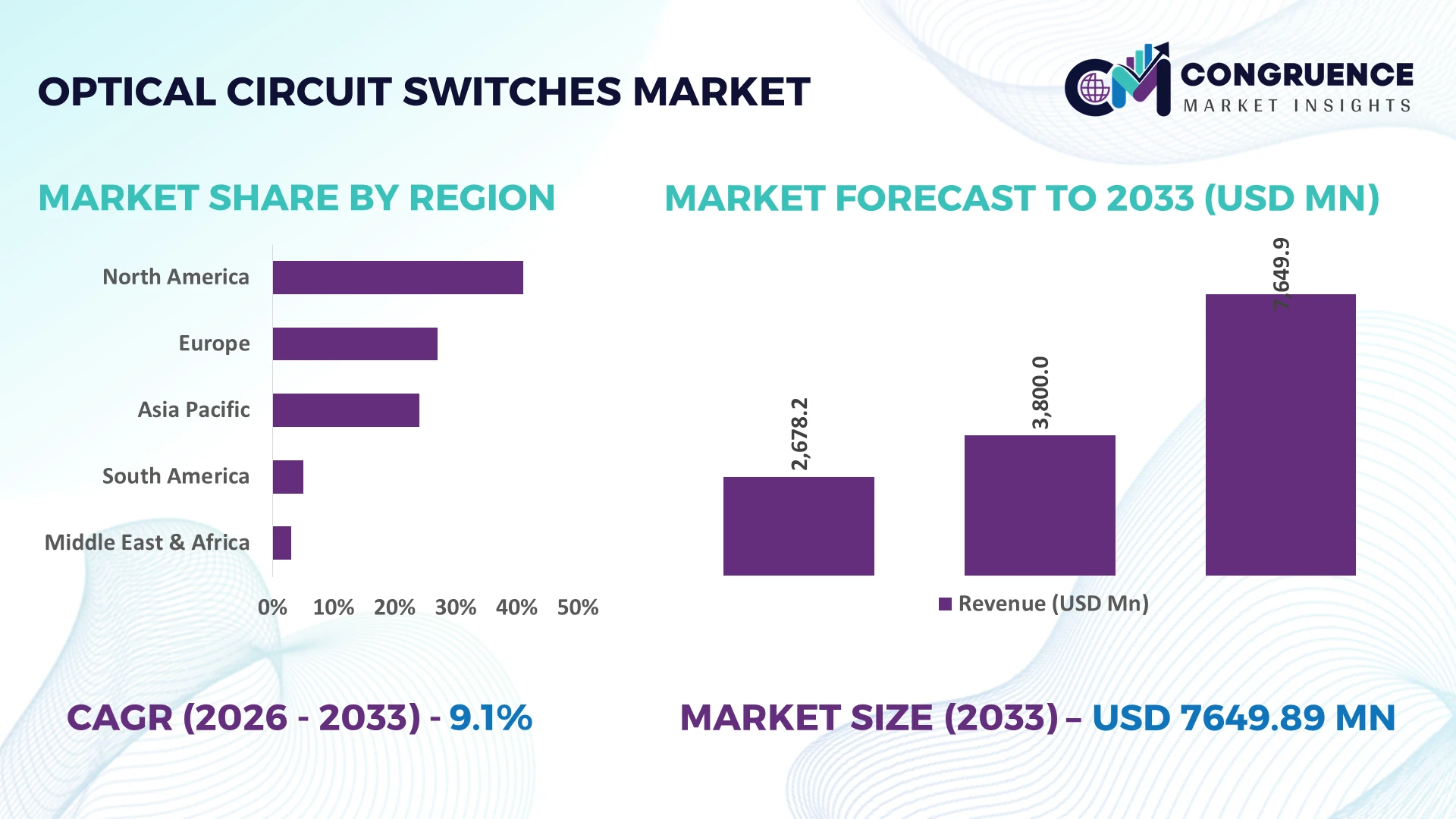
The Global Optical Circuit Switches Market was valued at USD 3800 Million in 2025 and is anticipated to reach a value of USD 7649.89 Million by 2033 expanding at a CAGR of 9.14% between 2026 and 2033. Growth is primarily driven by hyperscale AI data center expansion, rising deployment of high-capacity optical interconnects, and increasing adoption of energy-efficient switching architectures for cloud and telecom infrastructure.
The United States dominates the global Optical Circuit Switches Market with approximately 36% of total deployment, supported by multi-billion-dollar hyperscale data center investments, AI computing infrastructure, and advanced optical networking programs. More than 65% of newly commissioned hyperscale facilities are integrating optical transport technologies, while China continues expanding domestic optical backbone capacity through large-scale digital infrastructure projects despite ongoing semiconductor and photonics trade restrictions. This leadership reinforces long-term investment opportunities across advanced optical networking ecosystems and resilient supply chains.
Market Size & Growth: USD 3800 Million (2025) to USD 7649.89 Million (2033) at 9.14% CAGR, driven by AI-ready optical networking and hyperscale infrastructure expansion.
Top Growth Drivers: AI workloads (+42%), hyperscale cloud traffic (+35%), and optical network modernization (+28%) accelerate global adoption.
Short-Term Forecast: By 2028, network latency declines by 20% while switching efficiency improves by 18% across advanced deployments.
Emerging Technologies: AI-based traffic optimization, silicon photonics, and software-defined optical networking improve bandwidth utilization by over 25%.
Regional Leaders: North America exceeds USD 2.9 Billion, Asia-Pacific reaches USD 2.5 Billion, Europe approaches USD 1.4 Billion, supported by regional digital infrastructure expansion.
Consumer/End-User Trends: Nearly 62% of hyperscale operators prioritize optical circuit switching for AI cluster connectivity and lower power consumption.
Pilot/Case Example: In 2026, AI-focused optical switching deployments improved data center throughput by approximately 30% while reducing network congestion.
Competitive Landscape: Leading vendors collectively hold about 48% market share, with competition centered on Cisco, Huawei, Ciena, Nokia, and Fujitsu.
Regulatory & ESG Impact: Energy-efficient optical architectures reduce networking power consumption by up to 22% while supporting stricter sustainability targets.
Investment & Funding: More than USD 6 Billion in strategic investments supports photonics manufacturing, regional supply-chain diversification, and technology partnerships.
Innovation & Future Outlook: Co-packaged optics, programmable photonic switching, and AI-driven network orchestration strengthen next-generation high-capacity infrastructure strategies.
The Optical Circuit Switches Market continues expanding across hyperscale cloud computing, AI clusters, telecom backbone modernization, and high-performance computing environments where ultra-low-latency connectivity is essential. Recent innovations in silicon photonics and programmable optical fabrics have improved network utilization by nearly 25%, while regional supply-chain diversification and stricter energy-efficiency initiatives are accelerating commercial deployment. These developments establish a strong foundation for the strategic market analysis that follows.
The Optical Circuit Switches Market has become strategically important as hyperscale AI computing, cloud networking, and high-performance data center architectures demand deterministic, low-latency optical connectivity. Infrastructure modernization and supply-chain diversification are reshaping procurement priorities, with governments and private operators strengthening domestic photonics capabilities to reduce dependence on concentrated manufacturing ecosystems. This transition is intensifying competition among network equipment providers while creating new investment opportunities across advanced optical interconnect platforms and programmable networking technologies.
Modern optical circuit switches deliver nearly 35% lower power consumption and approximately 40% higher bandwidth efficiency than conventional electronic switching architectures in high-capacity environments, improving operational economics for hyperscale facilities. The United States leads commercial deployment through AI-driven data center expansion, while Japan advances photonic innovation with strong precision manufacturing capabilities and higher integration density. Over the next two to three years, optical switching deployment across new hyperscale facilities is expected to exceed 60%, supported by increasing adoption of software-defined network orchestration.
Cloud operators are expanding strategic partnerships with photonics manufacturers to accelerate deployment of scalable optical fabrics across AI clusters, reducing network congestion and improving workload distribution. Companies are prioritizing localized component sourcing, co-development agreements, and programmable switching platforms to strengthen supply resilience. Organizations that combine optical innovation with ecosystem collaboration will secure stronger competitive positioning, greater infrastructure efficiency, and sustained long-term market relevance.
The rapid expansion of AI training clusters and hyperscale cloud infrastructure is accelerating adoption of optical circuit switching technologies capable of supporting ultra-high-capacity traffic. More than 65% of newly planned hyperscale facilities are incorporating advanced optical interconnect architectures, while network energy consumption declines by nearly 22% through optical switching optimization and bandwidth utilization improves by approximately 28%. The United States continues expanding AI infrastructure investments, driving demand for programmable optical fabrics and high-density networking. In response, leading companies are increasing photonic R&D, expanding manufacturing capacity, and forming strategic technology partnerships to deliver scalable, low-latency networking platforms. The structural shift from electronic bottlenecks toward optical architectures strengthens operational efficiency while creating sustainable competitive advantages for infrastructure providers.
Optical circuit switch deployment remains constrained by the high cost of photonic components, integration complexity, and concentrated supplier ecosystems. Advanced optical modules account for nearly 40% of total networking hardware costs, while system integration expenses can increase deployment budgets by approximately 18%. Export restrictions affecting specialized photonic components and semiconductor technologies continue influencing procurement strategies, particularly for manufacturers in China and other import-dependent markets. These conditions limit deployment scalability and pressure operating margins for infrastructure providers. Companies are mitigating risk through localized manufacturing initiatives, diversified supplier agreements, and long-term procurement contracts while redesigning platforms to support greater component interoperability and reduce dependence on single-source supply chains.
The commercialization of silicon photonics and co-packaged optics is creating significant opportunities to improve bandwidth density while lowering network operating costs. Advanced photonic integration enhances data throughput by nearly 30% and reduces interconnect power consumption by approximately 20%, supporting increasingly complex AI computing environments. Japan and Singapore are strengthening national photonics ecosystems through research collaboration and advanced semiconductor initiatives, accelerating commercialization of integrated optical platforms. Companies are expanding joint development programs, investing in programmable photonic technologies, and building ecosystem partnerships that combine optical hardware with intelligent network software. This convergence creates differentiated service models while opening high-value opportunities beyond traditional telecom applications.
The largest long-term challenge lies in integrating optical circuit switching seamlessly across heterogeneous cloud, telecom, and enterprise network environments without compromising operational consistency. More than 45% of operators identify interoperability as a primary deployment concern, while specialized optical networking expertise remains scarce, extending implementation timelines by approximately 20%. Growing AI workloads also increase pressure on network orchestration software to manage dynamic traffic efficiently across distributed infrastructure. Companies must invest in automation platforms, standardized interfaces, workforce development, and collaborative technology ecosystems to simplify deployment. Organizations that solve integration complexity while maintaining network resilience and operational scalability will establish durable competitive advantages in the evolving optical networking landscape.
AI Cluster Network Redesign: Hyperscale operators are replacing conventional switching layers with optical circuit switching to support AI workloads, increasing optical fabric deployment by nearly 38% while reducing network latency by approximately 25%. Rising GPU cluster density and higher east-west traffic are reshaping network architectures in the United States. Companies are accelerating deployment through photonic platform integration, strategic technology alliances, and automated network orchestration to improve infrastructure utilization.
Silicon Photonics Integration Expands: Silicon photonics adoption has increased by nearly 32%, while integrated optical modules reduce power consumption by around 20% and improve port density by approximately 27%. As advanced semiconductor packaging becomes a strategic priority, manufacturers in Japan are expanding photonic chip production through collaborative development programs. Vendors are restructuring product roadmaps to combine optical switching, programmable networking, and compact hardware designs for higher operational efficiency.
Supply Chains Become Regionalized: Ongoing semiconductor trade policies and component availability challenges have encouraged over 45% of major suppliers to diversify manufacturing footprints and sourcing strategies. Production lead times have improved by nearly 18% through localized assembly and dual-supplier procurement models. Companies are investing in regional manufacturing partnerships, inventory optimization, and vertically integrated supply chains to strengthen delivery reliability and reduce operational disruptions.
Software-Defined Optical Operations: More than 55% of newly deployed optical switching platforms now integrate software-defined management, improving network provisioning speed by nearly 35% and reducing manual configuration tasks by approximately 30%. Enterprise operators increasingly automate traffic optimization using AI-enabled orchestration tools. Vendors are embedding intelligent control software into optical platforms, creating differentiated service offerings while improving scalability, maintenance efficiency, and long-term infrastructure flexibility.
MEMS Switches remain the leading segment, accounting for an estimated 42% of deployments because of their high scalability, low insertion loss, and proven reliability in hyperscale data centers and telecom backbone networks. Their mature manufacturing ecosystem and compatibility with large-scale optical fabrics continue to support enterprise adoption. Fiber Switches and Waveguide Switches maintain stable demand for specialized routing and compact photonic integration, while Liquid Crystal Switches remain relevant in applications requiring lower power consumption and precise optical control. Companies continue expanding MEMS portfolios through higher port-count designs and enhanced software integration.
Wavelength Switches represent the fastest-growing segment as dense wavelength division multiplexing (DWDM) deployments expand across AI-driven networks. Adoption has increased by nearly 29%, while programmable wavelength management improves network utilization by approximately 24%. Vendors are investing in integrated photonic platforms, strategic partnerships, and next-generation optical software to strengthen product differentiation. Investment priorities are gradually shifting from conventional switching hardware toward intelligent wavelength-aware optical architectures that improve bandwidth efficiency and operational flexibility.
Data Centers represent the dominant application as hyperscale operators continue deploying optical circuit switches to support AI infrastructure, cloud services, and low-latency networking. Nearly 48% of deployments are concentrated within large-scale data center environments, where optical switching reduces congestion and improves network efficiency by approximately 26%. Telecommunications remains a mature application supporting backbone traffic expansion, while Cloud Networks continue integrating programmable optical fabrics to improve resource utilization and network automation.
High-Performance Computing (HPC) is emerging as the fastest-growing application due to increasing demand for high-bandwidth interconnects supporting scientific computing and AI model training. Deployment across HPC environments has increased by nearly 31%, while 5G Networks continue adopting optical switching for transport optimization and network slicing. Companies are expanding optical infrastructure, integrating intelligent traffic management platforms, and strengthening deployment partnerships to address rising workload complexity and enhance operational resilience across multiple application environments.
Cloud Providers remain the largest end-user segment because hyperscale infrastructure depends on ultra-low-latency optical connectivity for AI processing and cloud service delivery. Approximately 46% of optical circuit switch deployments are associated with large cloud environments, while network utilization improves by nearly 28% through intelligent optical traffic management. Telecom Operators continue investing in optical backbone modernization, and IT Companies increasingly integrate programmable optical infrastructure into enterprise networking solutions to support digital transformation initiatives.
Enterprises represent the fastest-growing end-user group as private AI infrastructure, hybrid cloud deployment, and high-performance networking become strategic priorities. Enterprise adoption has increased by approximately 27%, while Government organizations and Research Institutes continue expanding advanced computing facilities requiring scalable optical networking. Vendors are responding with customized deployment models, ecosystem partnerships, flexible pricing strategies, and integrated management platforms to strengthen customer retention and expand market penetration across diverse operational environments.
North America accounted for the largest market share at 38.4% in 2025 however, Asia-Pacific is expected to register the fastest growth, expanding at a 10.6% between 2026 and 2033.

Hyperscale AI Infrastructure Drives Optical Networking Leadership
North America remains the largest Optical Circuit Switches Market due to the concentration of hyperscale cloud providers, AI computing infrastructure, and advanced telecom backbone modernization. The region represents nearly 38.4% of global deployments, supported by continuous investments in high-density optical networking and software-defined infrastructure. More than 65% of newly commissioned hyperscale facilities integrate advanced optical interconnect technologies to reduce latency and improve energy efficiency. Enterprise demand for AI clusters and cloud-native networking continues to accelerate deployment of programmable optical switching platforms. Companies are strengthening domestic manufacturing partnerships and expanding photonic R&D capabilities to improve supply resilience and accelerate commercialization of next-generation switching solutions.
United States Market Outlook: The United States leads the regional market through extensive AI infrastructure expansion, advanced semiconductor innovation, and strong cloud ecosystem investments. Large hyperscale operators continue deploying optical switching across next-generation data centers, with more than 70% of new AI infrastructure projects integrating advanced optical networking. Domestic photonics research programs, technology partnerships, and localized manufacturing initiatives continue strengthening the country's leadership in high-performance optical networking deployment.
Network Modernization and Sustainable Digital Infrastructure
Europe continues strengthening its optical networking ecosystem through digital infrastructure modernization, energy-efficient data center investments, and telecom backbone upgrades. The region accounts for approximately 24% of global deployment activity, supported by expanding cloud infrastructure and increasing adoption of programmable optical transport technologies. More than 40% of enterprise network modernization projects now prioritize energy-efficient optical architectures to meet sustainability objectives. Companies are investing in collaborative photonics development, advanced optical software integration, and regional manufacturing capabilities to improve long-term technology competitiveness while supporting resilient digital infrastructure.
Germany Market Outlook: Germany remains the leading European market through its advanced industrial manufacturing base, strong telecom infrastructure, and expanding enterprise cloud investments. Industrial digitalization initiatives continue supporting deployment of optical networking technologies across manufacturing and research facilities. Nearly 35% of large enterprise infrastructure upgrades now incorporate advanced optical communication systems, encouraging suppliers to expand engineering collaborations and integrated photonics development within the country.
Manufacturing Scale and Digital Expansion Accelerate Deployment
Asia-Pacific is emerging as the fastest-growing market through large-scale semiconductor manufacturing, expanding cloud infrastructure, and continuous telecom network upgrades. The region contributes approximately 31% of global deployment activity while accounting for a significant share of photonic component manufacturing. Optical networking investments have increased by nearly 30% across major digital infrastructure programs, supported by rapid AI adoption and enterprise cloud expansion. Manufacturers continue increasing production capacity, strengthening supply-chain integration, and expanding regional partnerships to improve optical component availability and accelerate commercialization.
China Market Outlook: China remains the largest country market in Asia-Pacific due to its extensive optical communication manufacturing ecosystem and nationwide digital infrastructure programs. Domestic enterprises continue investing in high-capacity backbone networks and AI-ready data centers despite technology export restrictions. More than 60% of regional photonic component manufacturing capacity is concentrated within China, encouraging continued investment in localized innovation, integrated optical technologies, and resilient production ecosystems.
Cloud Infrastructure Expansion Supports Emerging Demand
South America is gradually increasing optical circuit switch adoption through expanding cloud services, enterprise digital transformation, and telecom infrastructure modernization. The region contributes approximately 4.8% of global demand, with deployment primarily concentrated in metropolitan data center hubs. Optical networking projects have increased by nearly 18% as enterprises improve connectivity and network scalability. Infrastructure limitations and imported component dependency continue affecting deployment speed, prompting technology vendors to establish regional partnerships, strengthen local distribution networks, and improve technical support capabilities for enterprise customers.
Brazil Market Outlook: Brazil leads the regional market through its expanding cloud ecosystem, growing telecom investments, and increasing enterprise digitalization. Large-scale data center expansion and fiber broadband development continue supporting demand for advanced optical switching technologies. Enterprise optical networking deployments have increased by approximately 22% across major commercial centers, encouraging suppliers to strengthen local partnerships, workforce training, and after-sales engineering capabilities.
Digital Infrastructure Investments Transform Connectivity
The Middle East & Africa market is expanding through government-led digital transformation initiatives, hyperscale data center investments, and next-generation telecom infrastructure deployment. The region represents approximately 1.8% of global adoption but continues strengthening its position through strategic connectivity projects and smart city developments. Optical networking investments have increased by nearly 20% across major infrastructure initiatives, encouraging suppliers to establish regional service partnerships and technology integration centers. Companies are focusing on scalable optical platforms capable of supporting cloud expansion and advanced enterprise networking requirements.
United Arab Emirates Market Outlook: The United Arab Emirates leads regional deployment through sustained investment in hyperscale data centers, smart city infrastructure, and advanced digital services. National technology strategies continue encouraging deployment of high-capacity optical communication systems across public and private infrastructure. More than 50% of large-scale digital infrastructure projects incorporate advanced optical networking, positioning the country as a regional innovation hub for next-generation connectivity.
The Optical Circuit Switches Market is led by global networking companies including Cisco Systems, Ciena, Fujitsu, Nokia, and Huawei, competing directly with photonics innovators such as Infinera and HUBER+SUHNER for hyperscale cloud, telecom, and AI infrastructure projects. The top five players collectively control approximately 48% of the market through broad product portfolios and established customer ecosystems. Competition is driven by switching performance, optical integration, deployment speed, and software intelligence rather than pricing alone. Advanced optical platforms improve bandwidth utilization by nearly 25%, while automated network orchestration reduces provisioning time by approximately 30%, creating clear competitive differentiation. Companies are expanding manufacturing capacity, investing in silicon photonics, strengthening strategic partnerships, and increasing vertical integration to secure component availability. Technology complexity, photonic manufacturing expertise, and customer qualification cycles remain significant barriers for new entrants. Long-term success depends on delivering scalable optical innovation, resilient supply chains, interoperable platforms, and rapid deployment capabilities across hyperscale networking environments.
Cisco Systems
Ciena Corporation
Nokia Corporation
Fujitsu Limited
Huawei Technologies
Infinera Corporation
HUBER+SUHNER AG
Polatis
Calient Technologies
DiCon Fiberoptics
Sercalo Microtechnology Ltd.
Agiltron Inc.
Keysight Technologies
Molex LLC
Optical circuit switching technology is advancing from conventional MEMS architectures toward intelligent, software-defined optical fabrics built for AI-driven networking. MEMS switches remain the primary technology, representing more than 60% of large-scale deployments because they reduce switching latency by nearly 30% and lower network power consumption by approximately 22% compared with traditional electronic switching. Software-defined optical networking has reached adoption across nearly 55% of new hyperscale deployments, enabling automated traffic provisioning and reducing network configuration time by around 35%. These technologies deliver measurable operational savings while improving bandwidth utilization for cloud providers and telecom operators.
Emerging innovations including silicon photonics, co-packaged optics, and programmable wavelength switching are redefining optical network performance. Silicon photonics increases bandwidth density by approximately 28%, while integrated photonic platforms reduce interconnect power consumption by nearly 20%. Compared with legacy discrete optical modules, integrated photonic architectures improve switching efficiency by about 40% while reducing hardware footprint by almost 30%. Hyperscale cloud providers, AI infrastructure operators, and telecom backbone vendors gain the strongest competitive advantage through faster deployment, improved scalability, and lower infrastructure operating costs.
Between 2026 and 2028, AI-assisted optical orchestration, digital twins, and intelligent traffic optimization will become mainstream deployment priorities. AI-enabled optical network management is expected to exceed 65% adoption across newly commissioned hyperscale facilities, improving network availability by approximately 18% while reducing operational intervention. Vendors are integrating automation, programmable photonics, and vertically optimized hardware-software ecosystems to strengthen competitive differentiation. Organizations investing now in intelligent optical networking platforms will achieve superior scalability, higher infrastructure efficiency, and stronger positioning as AI-driven data traffic continues accelerating.
June 2024 – Ciena: Constl selected Ciena's 6500 Packet-Optical Platform powered by WaveLogic 5 Extreme to expand its pan-India metro and long-distance optical network, supporting 800G services with a migration path to 1.6T. The deployment strengthens India's digital backbone and enterprise connectivity strategy. Source: ciena.com
February 2025 – Ciena: Lumen Technologies selected Ciena's WaveLogic 6 Extreme coherent optical technology featuring 1.6 Tb/s transmission and delivering up to 50% lower space and power per bit. The deployment accelerates AI-ready network expansion for hyperscale cloud and data center customers. Source: ciena.com
March 2025 – Lumen Technologies: Lumen and Ciena successfully demonstrated a 1.2 Tb/s wavelength service across 3,050 kilometers, validating ultra-high-capacity optical transport for AI workloads and long-haul cloud networking while strengthening next-generation backbone infrastructure deployment. Source: Lumen Investor Relations
March 2026 – Vodafone Idea & Ciena: Vodafone Idea deployed Ciena's WaveLogic 6 Extreme after successfully transmitting 1.6 Tb/s on a single optical channel, enabling future 400G/800G hyperscale connectivity across India and strengthening enterprise, cloud, and AI transport capabilities. Source: Ciena Investor Relations e Optical Circuit Switches Market Report
The report delivers comprehensive analysis of the Optical Circuit Switches Market across MEMS Switches, Liquid Crystal Switches, Wavelength Switches, Fiber Switches, and Waveguide Switches while evaluating demand across Data Centers, Telecommunications, Cloud Networks, High-Performance Computing, and 5G Networks. It further examines adoption among Telecom Operators, Cloud Providers, IT Companies, Government organizations, Research Institutes, and Enterprises across North America, Europe, Asia-Pacific, South America, and the Middle East & Africa. More than 15 major industry participants, multiple deployment models, and evolving technology trends are assessed to provide detailed competitive intelligence.
The study evaluates optical networking architectures, silicon photonics, software-defined networking, programmable switching, and AI-enabled network automation expected to shape industry evolution between 2026 and 2033. It highlights deployment trends exceeding 60% across hyperscale environments, regional infrastructure modernization, supply-chain diversification, enterprise investment priorities, and emerging application areas. The report supports expansion planning, technology benchmarking, partnership evaluation, competitive positioning, product development, and long-term strategic decision-making through actionable operational and market intelligence.
| Report Attribute/Metric | Report Details |
|---|---|
Market Revenue in 2025 | USD 3800 Million |
Market Revenue in 2033 | USD 7649.89 Million |
CAGR (2026 - 2033) | 9.14% |
Base Year | 2025 |
Forecast Period | 2026 - 2033 |
Historic Period | 2021 - 2025 |
Segments Covered | By Type
By Application
By End-User
|
Key Report Deliverable | Revenue Forecast, Growth Trends, Market Dynamics, Segmental Overview, Regional and Country-wise Analysis, Competition Landscape |
Region Covered | North America, Europe, Asia-Pacific, South America, Middle East, Africa |
Key Players Analyzed | Cisco Systems, Ciena Corporation, Nokia Corporation, Fujitsu Limited, Huawei Technologies, Infinera Corporation, HUBER+SUHNER AG, Polatis, Calient Technologies, DiCon Fiberoptics, Sercalo Microtechnology Ltd., Agiltron Inc., Keysight Technologies, Molex LLC |
Customization & Pricing | Available on Request (10% Customization is Free) |




