
Reports
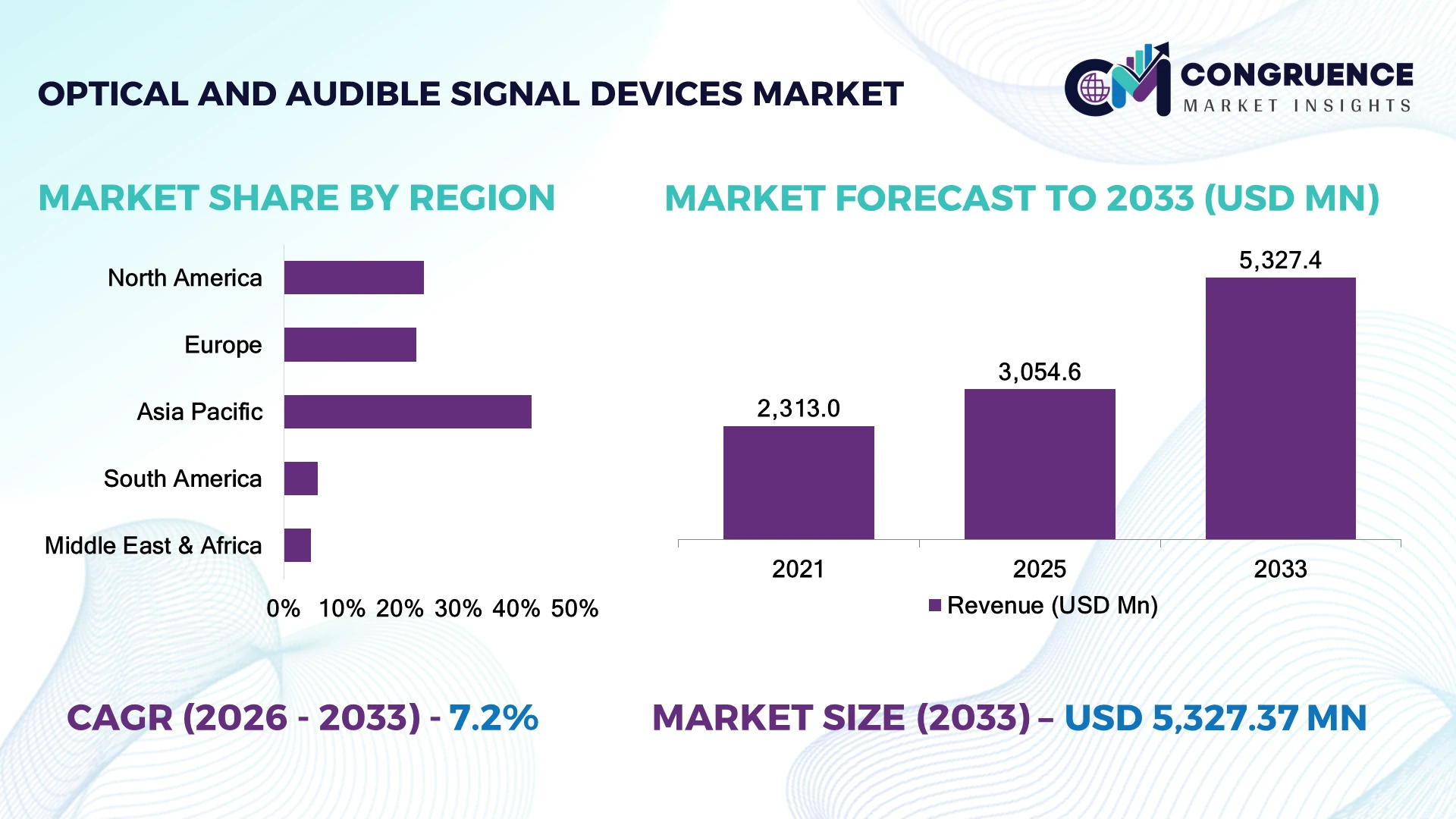
The Global Optical and Audible Signal Devices Market was valued at USD 3,054.6 Million in 2025 and is anticipated to reach a value of USD 5,327.4 Million by 2033 expanding at a CAGR of 7.2% between 2026 and 2033. Growth is driven by accelerating industrial automation, stricter workplace safety compliance, smart factory deployment, and increasing integration of network-connected visual and audible warning systems.
China accounts for approximately 31% of global optical and audible signal device manufacturing capacity, supported by large-scale industrial automation investments, electronics production, and expanding process industries. Compared with Germany's high-value industrial signalling market, China manufactures nearly 2.5 times more industrial signalling units while automated production has improved assembly efficiency by approximately 19%. Continued supply-chain diversification following global trade disruptions has accelerated localisation of electronic safety components and industrial signalling equipment across Asia.
Manufacturers investing in intelligent signalling technologies, digital integration, and resilient production networks are strengthening long-term competitiveness across industrial safety applications.
Market Size & Growth: USD 3,054.6 million in 2025 to USD 5,327.4 million by 2033 at 7.2% CAGR, driven by industrial automation and smart safety infrastructure.
Top Growth Drivers: Factory automation (+29%), workplace safety compliance (+24%), Industry 4.0 deployment (+21%).
Short-Term Forecast: By 2028, predictive maintenance reduces signalling system downtime by approximately 18%.
Emerging Technologies: IoT connectivity, LED signalling, wireless monitoring, and AI-enabled diagnostics accelerate deployment.
Regional Leaders: Asia-Pacific (~USD 2.3 billion), Europe (~USD 1.1 billion), North America (~USD 0.9 billion), supported by industrial digitalisation.
Consumer/End-User Trends: Nearly 66% of industrial facilities prioritise integrated visual and audible alarm platforms.
Pilot/Case Example: 2026 smart manufacturing deployment improved emergency response efficiency by approximately 22%.
Competitive Landscape: Leading supplier holds nearly 18% market share alongside Eaton, Siemens, PATLITE, Werma, and Federal Signal.
Regulatory & ESG Impact: Energy-efficient LED signalling lowers power consumption by approximately 35% versus conventional beacon technologies.
Investment & Funding: More than USD 1.9 billion supports smart factories, industrial safety upgrades, and signalling automation.
Innovation & Future Outlook: Connected warning systems and edge-enabled industrial monitoring redefine plant-wide safety management.
Optical and audible signal devices are becoming critical components of connected industrial safety systems as manufacturers integrate intelligent alarms, wireless communication, and predictive maintenance capabilities. Approximately 62% of newly commissioned industrial facilities now deploy network-enabled signalling platforms. Ongoing modernisation of manufacturing infrastructure and localisation of electronic components are reinforcing supply resilience, creating a strong foundation for the strategic market outlook.
The Optical and Audible Signal Devices Market has become strategically important as manufacturers, utilities, transport operators, and critical infrastructure providers modernise workplace safety through connected industrial systems. Digital transformation, industrial automation, and tightening occupational safety requirements are encouraging organisations to replace conventional standalone alarms with intelligent signalling networks capable of supporting real-time operational awareness. Supply-chain restructuring is also driving regional manufacturing expansion to improve delivery resilience for essential industrial safety equipment.
Modern LED-based intelligent signalling systems consume approximately 38% less energy while extending operational life by nearly 45% compared with traditional incandescent signalling devices. Germany continues leading industrial automation integration within manufacturing facilities, whereas China maintains larger production volumes through vertically integrated electronics manufacturing. During the next two to three years, more than 40% of newly installed industrial signalling systems are expected to include Ethernet connectivity, wireless monitoring, or predictive diagnostic capabilities.
A practical example is the deployment of network-connected signalling towers across automated production lines, allowing maintenance teams to identify faults remotely and reduce response delays. Manufacturers are expanding smart product portfolios, investing in software-enabled signalling platforms, and strengthening partnerships with industrial automation providers to deliver integrated safety ecosystems. Companies combining intelligent signalling technologies, standards-compliant solutions, and scalable digital integration will secure stronger competitive positioning as industrial safety evolves into a data-driven operational priority.
Industrial digitalisation is accelerating deployment of intelligent optical and audible signal devices across manufacturing, logistics, and critical infrastructure. Approximately 69% of newly automated production lines now incorporate network-enabled signalling systems, while factory safety upgrades have increased deployment of programmable alarm devices by nearly 27%. Germany's continued investment in Industry 4.0 and industrial safety compliance has accelerated adoption of integrated signalling architectures across advanced manufacturing facilities. This shift improves real-time fault visibility, reduces response delays, and strengthens operational continuity. Manufacturers are expanding connected product portfolios, investing in Ethernet-enabled signalling platforms, and partnering with industrial automation providers to deliver interoperable safety ecosystems. The strategic advantage increasingly lies in offering integrated signalling solutions rather than standalone warning devices.
The market continues facing structural pressure from dependence on semiconductors, industrial-grade LEDs, electronic control boards, and specialised acoustic components. Electronic materials account for approximately 41% of signalling device production costs, while lead times for certain industrial electronic components remain nearly 18% above pre-disruption levels. Export restrictions affecting selected electronic technologies continue influencing procurement strategies across global manufacturing networks. These conditions increase inventory costs, delay customised product deliveries, and reduce production flexibility for equipment manufacturers. Companies are mitigating exposure through supplier diversification, localisation of electronics assembly, long-term procurement agreements, and modular product designs that support alternative component integration without compromising safety certification.
Connected industrial safety platforms are creating new opportunities by integrating signalling devices with predictive maintenance, machine monitoring, and industrial analytics. Smart alarm systems reduce fault identification time by approximately 23%, while cloud-enabled diagnostics improve maintenance planning efficiency by nearly 19%. Japan is expanding digital manufacturing initiatives that encourage wider deployment of intelligent industrial monitoring technologies. Manufacturers are strengthening software partnerships, developing subscription-based monitoring platforms, and integrating signalling products with industrial IoT ecosystems. A significant emerging opportunity lies in converting signalling devices into real-time operational intelligence nodes that support productivity improvement in addition to workplace safety.
Integrating optical and audible signal devices across legacy industrial control systems, programmable logic controllers, and cloud-based monitoring platforms remains a significant execution challenge. Approximately 36% of industrial facilities continue operating mixed-generation automation infrastructure, while system integration projects increase engineering requirements by nearly 21%. The United States continues modernising ageing industrial assets, creating additional interoperability demands for equipment suppliers. Poor integration reduces alarm consistency, delays maintenance decisions, and limits enterprise-wide visibility. Companies must expand cybersecurity capabilities, standardise industrial communication protocols, invest in engineering support, and strengthen partnerships with automation vendors to ensure scalable deployment across increasingly connected industrial environments.
Connected Alarm Networks Expand: Network-enabled signalling systems now represent approximately 57% of new industrial safety installations, while remote alarm monitoring reduces response times by nearly 20%. Industrial digitalisation and stricter workplace safety requirements are encouraging manufacturers to integrate signalling devices with plant-wide automation platforms. Suppliers are expanding software capabilities, strengthening automation partnerships, and scaling intelligent product portfolios to improve operational visibility.
Programmable LED Beacons Advance: Programmable LED signalling devices have improved energy efficiency by approximately 34% while extending operational life by nearly 42% compared with conventional signalling technologies. Rising electricity costs are accelerating replacement programmes across manufacturing facilities. Companies are increasing production of configurable signalling platforms that simplify maintenance, reduce operating expenses, and support multiple industrial applications using a single hardware architecture.
Wireless Industrial Deployment Accelerates: Wireless signalling adoption has increased by approximately 26% across logistics centres and automated warehouses, reducing installation time by nearly 31%. Labour shortages in industrial maintenance are encouraging rapid deployment without extensive cabling infrastructure. Manufacturers are introducing battery-efficient wireless platforms, expanding industrial communication compatibility, and collaborating with warehouse automation providers to improve deployment flexibility.
Customised Safety Systems Increase: Demand for application-specific signalling solutions has increased by approximately 24%, while configurable alarm profiles improve operational efficiency by nearly 17% in process industries. Industrial operators increasingly require customised signalling logic instead of standard alarm products. Suppliers are restructuring engineering resources, expanding configurable product families, and investing in modular manufacturing to shorten delivery times while supporting diverse industrial safety requirements.
LED Signal Devices account for approximately 63% of the global Optical and Audible Signal Devices market, driven by superior energy efficiency, longer service life, and compatibility with intelligent industrial automation systems. Their low maintenance requirements and high visibility make them the preferred solution across manufacturing plants, warehouses, utilities, and transportation infrastructure. Xenon and incandescent signalling devices continue serving specialised legacy installations where certified replacement compatibility remains essential, while audible signalling devices retain a critical role in high-noise industrial environments requiring multi-sensory safety alerts.
Smart network-enabled LED signalling systems represent the fastest-growing segment as industrial operators increasingly replace conventional standalone alarms with programmable visual warning platforms. Adoption of intelligent LED towers has increased by approximately 29%, while maintenance costs decline by nearly 24% due to extended operating life. Manufacturers are expanding modular product portfolios, integrating industrial communication protocols, and strengthening automation partnerships to support digital factory deployments. Investment priorities continue shifting toward configurable signalling platforms capable of combining visual, audible, and network-based safety functions within a unified architecture.
According to a 2026 industrial safety assessment by the International Society of Automation (ISA), intelligent LED-based signalling systems have become the preferred choice for modern automated facilities due to improved reliability, simplified maintenance, and seamless industrial automation integration.
Manufacturing accounts for approximately 37% of total market demand, reflecting extensive deployment of optical and audible signalling devices across automated production lines, assembly operations, and machine safety systems. Industrial facilities require continuous visual and audible alerts to improve equipment monitoring, operator awareness, and emergency response. Warehousing and logistics continue expanding rapidly with warehouse automation, while transportation, energy, and commercial infrastructure maintain steady demand through operational safety upgrades and regulatory compliance programmes.
Warehousing and Logistics represents the fastest-growing application as automated storage systems, robotics, and fulfilment centres increasingly depend on intelligent signalling for equipment coordination and personnel safety. Deployment of programmable signalling systems has increased by approximately 26%, while alarm response efficiency improves by nearly 18% through network integration. Manufacturers are introducing application-specific signalling platforms, expanding industrial Ethernet compatibility, and collaborating with warehouse automation providers to strengthen operational performance. Demand is increasingly shifting from isolated warning devices to fully integrated plant-wide safety communication systems.
A 2025 enterprise automation survey conducted by MHI reported that automated warehouses increasingly prioritised integrated signalling technologies to improve worker safety, equipment coordination, and operational visibility throughout distribution facilities.
Industrial Manufacturing Enterprises account for approximately 46% of global demand owing to extensive deployment across production facilities, machine automation, and process safety applications. High equipment density, continuous operations, and stringent workplace safety requirements make this segment the largest purchaser of optical and audible signalling solutions. Logistics operators, utilities, transportation authorities, and commercial infrastructure owners continue investing steadily, while process industries maintain strong demand for hazardous-area certified signalling equipment and integrated emergency warning systems.
Logistics and E-commerce Operators represent the fastest-growing end-user segment as automated fulfilment centres expand and warehouse robotics require coordinated visual and audible communication. Intelligent signalling deployments have increased by approximately 31%, while wireless alarm systems reduce installation time by nearly 22%. Manufacturers are targeting these customers through modular product designs, industrial IoT integration, long-term service agreements, and customised signalling configurations. Competitive positioning increasingly depends on delivering scalable platforms that combine operational safety, automation compatibility, and simplified lifecycle management.
According to a 2026 industry review published by MHI, logistics operators significantly expanded investment in intelligent signalling technologies to support automated material handling, improve workforce safety, and increase operational efficiency across high-throughput distribution facilities.
Asia-Pacific accounted for the largest market share at 42.6% in 2025 however, Middle East & Africa is expected to register the fastest growth, expanding at a CAGR of 8.1% between 2026 and 2033.

Industrial Automation Accelerates Intelligent Safety Deployment
North America accounts for approximately 24.1% of the global market, supported by advanced manufacturing, warehouse automation, critical infrastructure upgrades, and widespread adoption of industrial IoT technologies. Industrial facilities continue replacing conventional signalling equipment with intelligent network-connected systems that integrate with programmable logic controllers and supervisory control platforms. Approximately 61% of newly commissioned automated facilities now deploy configurable LED signalling towers with remote monitoring capabilities. Manufacturers are expanding engineering partnerships with automation providers, investing in digital safety platforms, and strengthening local production to reduce lead times. Operational priorities increasingly focus on predictive maintenance, rapid fault identification, and enterprise-wide safety visibility across manufacturing and logistics operations.
United States Market Outlook: The United States leads regional demand through its extensive industrial automation ecosystem, advanced manufacturing facilities, and expanding logistics infrastructure. Industrial operators continue modernising legacy safety equipment with Ethernet-enabled signalling devices integrated into digital factory environments. Approximately 68% of large manufacturing facilities have accelerated investment in intelligent plant safety systems, encouraging suppliers to expand software-enabled product portfolios, engineering services, and application-specific signalling solutions.
Compliance-Driven Modernisation Strengthens Industrial Safety
Europe represents approximately 22.8% of the global market, driven by stringent workplace safety standards, industrial digitalisation, and energy-efficient manufacturing initiatives. Companies continue replacing conventional beacon systems with programmable LED signalling technologies that improve operational reliability while reducing maintenance requirements. Nearly 52% of industrial safety upgrade projects now include connected signalling devices capable of integrating with factory automation platforms. Manufacturers are strengthening sustainable production capabilities, expanding intelligent product portfolios, and supporting industrial modernisation through configurable signalling solutions designed for high-value manufacturing environments.
Germany Market Outlook: Germany remains the region's technological leader through its advanced automation industry, precision engineering capabilities, and strong industrial equipment manufacturing base. Signalling system suppliers increasingly collaborate with machinery builders and automation companies to develop integrated safety architectures. Approximately 47% of industrial signalling deployments involve digitally connected safety systems, reinforcing Germany's leadership in intelligent manufacturing infrastructure.
Manufacturing Scale Drives Global Leadership
Asia-Pacific holds approximately 42.6% of the global market, supported by large-scale electronics manufacturing, industrial automation, expanding logistics infrastructure, and sustained investment in smart factories. China, Japan, South Korea, and India continue strengthening industrial production while increasing deployment of intelligent workplace safety systems. Around 65% of newly installed automated production facilities now integrate network-enabled optical and audible signalling platforms. Manufacturers are expanding regional production capacity, investing in automated assembly, and improving export-oriented supply chains to satisfy rising industrial safety requirements across diverse manufacturing sectors.
China Market Outlook: China leads the regional market through its extensive industrial manufacturing ecosystem, expanding automation investments, and integrated electronics supply chain. Industrial enterprises continue upgrading production facilities with intelligent signalling devices that support machine safety and operational monitoring. Approximately 72% of new large-scale manufacturing projects incorporate advanced visual and audible signalling technologies, creating sustained opportunities for suppliers specialising in connected industrial safety solutions.
Industrial Upgrades Expand Safety Infrastructure
South America continues strengthening demand through manufacturing modernisation, mining operations, food processing, and logistics infrastructure development. Brazil and neighbouring markets are increasing adoption of industrial signalling systems to improve workplace safety and equipment monitoring within expanding production facilities. Approximately 39% of industrial safety improvement projects now include LED-based signalling upgrades with enhanced operational visibility. Although imported electronic components continue influencing procurement costs, manufacturers are expanding regional distribution partnerships and technical support networks to improve equipment availability and deployment efficiency.
Brazil Market Outlook: Brazil remains the largest market in the region due to its established manufacturing sector, mining industry, and growing warehouse automation investments. Industrial operators are increasingly replacing ageing safety infrastructure with programmable signalling platforms designed for demanding operating environments. Nearly 44% of industrial equipment modernisation programmes now prioritise integrated optical and audible signalling systems, strengthening opportunities for suppliers offering customised industrial safety solutions.
Infrastructure Investment Strengthens Industrial Safety Systems
The Middle East & Africa market is advancing through industrial diversification, smart infrastructure projects, energy sector expansion, and increasing investment in automated production facilities. Governments and industrial operators are integrating intelligent signalling technologies into transport, utilities, manufacturing, and oil and gas infrastructure to improve operational safety. Approximately 34% of newly commissioned industrial projects now include network-enabled warning systems with centralised monitoring capabilities. Equipment suppliers are expanding regional partnerships, establishing technical service networks, and developing certified signalling solutions for hazardous industrial environments.
Saudi Arabia Market Outlook: Saudi Arabia leads regional investment through large-scale industrial development, energy infrastructure expansion, and advanced manufacturing initiatives. Industrial operators continue deploying intelligent signalling systems across refineries, petrochemical facilities, logistics hubs, and new manufacturing zones. Approximately 41% of newly commissioned industrial facilities incorporate digitally integrated optical and audible signalling technologies, supporting safer operations while creating long-term opportunities for suppliers focused on industrial automation and compliant safety infrastructure.
Global specialists including PATLITE, WERMA, Federal Signal, E2S Warning Signals, and Pfannenberg compete directly in industrial signalling, while diversified automation companies challenge through integrated factory safety portfolios and regional manufacturers compete aggressively on price and delivery. The top five suppliers collectively account for approximately 54% of the market. Competition centres on intelligent connectivity, hazardous-area certification, product customisation, and supply-chain responsiveness. IoT-enabled signalling systems reduce maintenance interventions by approximately 21%, modular product architectures shorten installation time by nearly 18%, and local manufacturing lowers delivery lead times by around 16%. Leading companies are expanding smart signalling platforms, strengthening automation partnerships, increasing regional manufacturing capacity, and integrating software with hardware offerings. The competitive shift favours connected, programmable signalling ecosystems over standalone devices, accelerating portfolio consolidation around digital safety solutions. Strict industrial certifications, engineering expertise, and long qualification cycles remain key entry barriers. Winning requires certified intelligent products, scalable manufacturing, rapid customisation, and deep automation ecosystem integration.
PATLITE Corporation
WERMA Signaltechnik GmbH + Co. KG
Federal Signal Corporation
E2S Warning Signals
Pfannenberg GmbH
Auer Signal GmbH
Eaton Corporation plc
Schneider Electric SE
Siemens AG
R. STAHL AG
Moflash Signalling Ltd.
Sirena S.p.A.
LED signalling, programmable signal towers, industrial Ethernet connectivity, and intelligent acoustic warning systems currently define technology leadership in the Optical and Audible Signal Devices Market. Approximately 64% of newly deployed industrial signalling platforms incorporate network connectivity, improving fault response efficiency by nearly 19%. LED technology also reduces energy consumption by approximately 35% while significantly extending operational service life, enabling manufacturers to lower maintenance requirements and improve plant availability across automated facilities.
Emerging technologies include IO-Link-enabled signalling, wireless industrial communication, edge diagnostics, and AI-assisted predictive maintenance. Compared with conventional incandescent signalling devices, intelligent LED platforms improve operational visibility by approximately 28% while reducing lifecycle maintenance costs by nearly 24%. Industrial automation leaders and specialised signalling manufacturers benefit most through integrated hardware-software ecosystems, whereas equipment OEMs strengthen competitiveness by embedding configurable signalling directly into automated machinery and production cells.
Between 2026 and 2028, digital safety platforms, cloud-connected alarm management, and cybersecurity-enabled industrial signalling will reshape factory operations. More than 48% of advanced manufacturing facilities are expected to standardise connected signalling architectures for centralised monitoring and predictive maintenance workflows. Companies investing now in interoperable communication protocols, configurable software, and modular signalling platforms will secure stronger customer retention, faster deployment cycles, and greater differentiation as industrial safety evolves from isolated alerting toward intelligent operational management.
March 2025 WERMA presented new intelligent signal technology solutions for Industry 4.0 applications at LogiMAT, expanding connected signalling capabilities for automated factories. Business impact: strengthened smart manufacturing positioning and digital integration strategy. Source: WERMA. (Werma)
September 2024 Federal Signal launched the Series 400 LED beacon line with IoT connectivity and enhanced visibility for industrial monitoring, improving remote diagnostics and operational awareness. Business impact: accelerated adoption of connected signalling platforms.
February 2026 Federal Signal reported Safety and Security Systems Group sales growth of 23%, supported by strong demand, product innovation, and acquisitions. Business impact: reinforced investment in advanced industrial signalling technologies. Source: Federal Signal. (Federal Signal)
December 2025 WERMA introduced the eSIGN with PROFINET communication interface, enabling seamless integration into industrial Ethernet environments. Business impact: simplified deployment within smart factories and expanded interoperability for automation projects. Source: WERMA news portal. (Werma)
This report provides comprehensive coverage of the Optical and Audible Signal Devices Market across LED, xenon, incandescent, and audible signalling technologies, together with key applications spanning manufacturing, logistics, transportation, energy, utilities, and commercial infrastructure. It evaluates demand across industrial manufacturers, logistics operators, utilities, process industries, and public infrastructure organisations while assessing competitive positioning throughout North America, Europe, Asia-Pacific, South America, and the Middle East & Africa. More than 60% of new industrial automation projects now incorporate intelligent signalling platforms, making connected safety technologies a central focus of market analysis.
The study examines programmable signalling, industrial Ethernet integration, wireless communication, AI-assisted diagnostics, and predictive maintenance technologies shaping deployment between 2026 and 2033. It delivers strategic insights into manufacturing expansion, product innovation, supply-chain resilience, digital safety transformation, and competitive benchmarking, enabling stakeholders to strengthen investment planning, regional expansion, technology adoption, operational efficiency, and long-term positioning within the evolving industrial safety ecosystem.
| Report Attribute/Metric | Report Details |
|---|---|
|
Market Revenue in 2025 |
USD 3,054.6 Million |
|
Market Revenue in 2033 |
USD 5,327.4 Million |
|
CAGR (2026 - 2033) |
7.2% |
|
Base Year |
2025 |
|
Forecast Period |
2026 - 2033 |
|
Historic Period |
2021 - 2025 |
|
Segments Covered |
By Type
By Application
By End-User
|
|
Key Report Deliverable |
Revenue Forecast, Growth Trends, Market Dynamics, Segmental Overview, Regional and Country-wise Analysis, Competition Landscape |
|
Region Covered |
North America, Europe, Asia-Pacific, South America, Middle East, Africa |
|
Key Players Analyzed |
PATLITE Corporation, WERMA Signaltechnik GmbH + Co. KG, Federal Signal Corporation, E2S Warning Signals, Pfannenberg GmbH, Auer Signal GmbH, Eaton Corporation plc, Schneider Electric SE, Siemens AG, R. STAHL AG, Moflash Signalling Ltd., Sirena S.p.A. |
|
Customization & Pricing |
Available on Request (10% Customization is Free) |




