
Reports
The Global Open Source Intelligence (OSINT) Market was valued at USD 748.83 Million in 2025 and is anticipated to reach a value of USD 1840.87 Million by 2033 expanding at a CAGR of 11.9% between 2026 and 2033. Rising cyber threat investigations, national security modernization, financial crime monitoring, and AI-enabled intelligence workflows are accelerating enterprise-scale OSINT deployment across government, defense, banking, and critical infrastructure sectors.
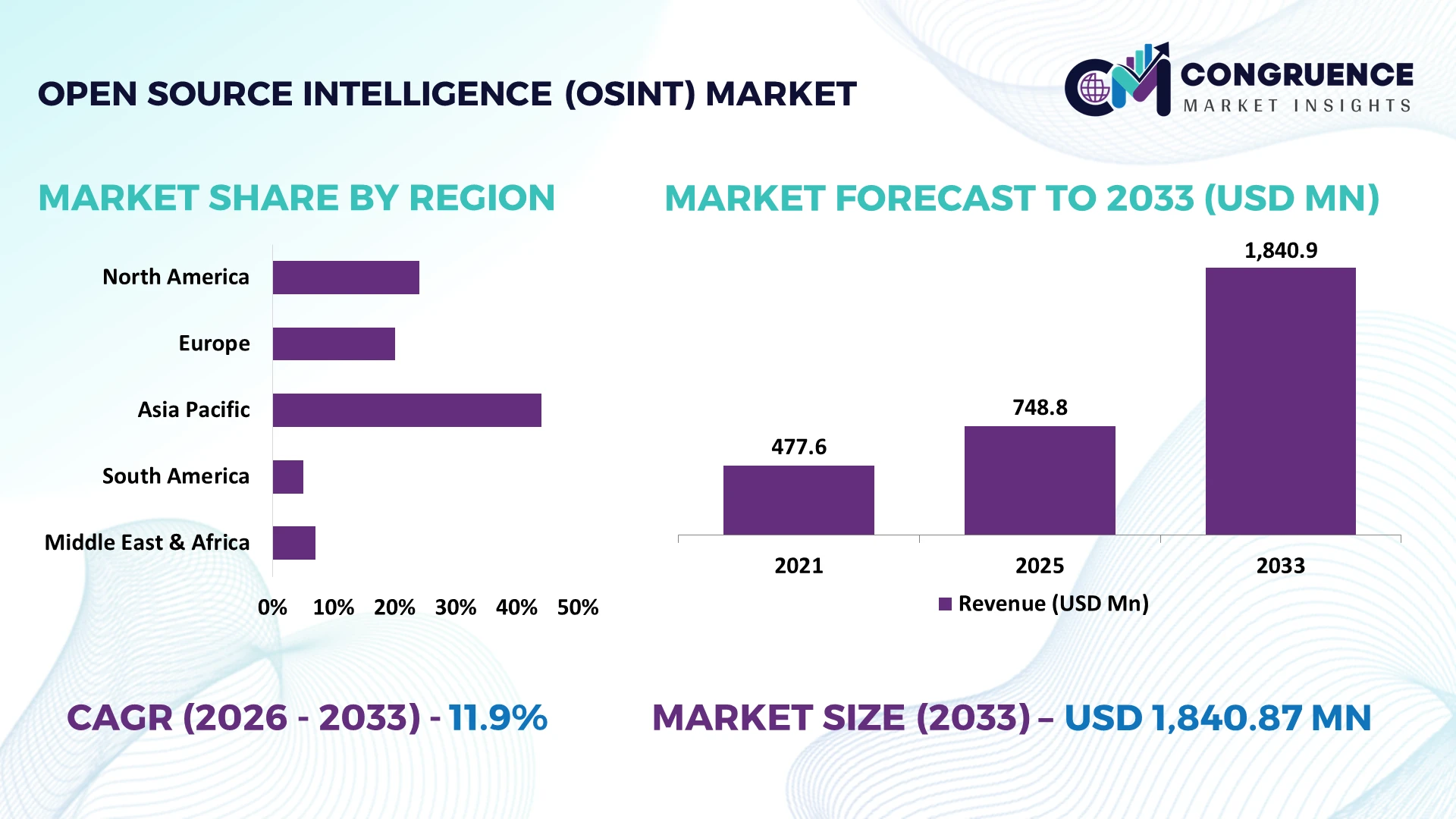
The United States leads the global Open Source Intelligence (OSINT) market with approximately 37% market share, supported by multi-billion-dollar cybersecurity and defense modernization programs, while over 68% of federal intelligence workflows incorporate AI-assisted data analytics. In comparison, the United Kingdom has strengthened OSINT adoption through national security and financial compliance initiatives, with digital investigation capabilities expanding by nearly 22% following evolving geopolitical tensions across Europe in 2026.
Organizations prioritizing AI-integrated intelligence platforms and region-specific compliance capabilities are positioned to secure stronger competitive advantages in high-value OSINT deployments.
Market Size & Growth: USD 748.83 Million in 2025, projected to reach USD 1840.87 Million by 2033 at 11.9% CAGR, driven by AI-powered intelligence automation and cyber risk monitoring.
Top Growth Drivers: AI-enabled analytics improve investigation speed by 35%, cybercrime monitoring demand rises 28%, and regulatory intelligence adoption expands 24%.
Short-Term Forecast: By 2028, automated intelligence workflows reduce investigation time by 32% while analyst productivity increases 29%.
Emerging Technologies: Generative AI, graph analytics, and multilingual NLP improve entity identification accuracy by nearly 30% across advanced OSINT platforms.
Regional Leaders: North America exceeds USD 760 Million, Europe approaches USD 520 Million, and Asia-Pacific surpasses USD 390 Million by 2033, supported by expanding digital security initiatives and regional technology investments.
Consumer/End-User Trends: More than 63% of government, BFSI, and cybersecurity organizations integrate automated OSINT into daily threat intelligence operations.
Pilot/Case Example: A 2026 digital threat intelligence deployment reduced investigation turnaround by 38% through AI-assisted social media and dark web monitoring.
Competitive Landscape: Leading vendors collectively account for approximately 44% market share, with IBM, Microsoft, Recorded Future, Palantir Technologies, and Maltego strengthening advanced intelligence capabilities.
Regulatory & ESG Impact: Digital compliance initiatives reduce investigation delays by 21% while improving cross-border intelligence collaboration amid evolving cybersecurity regulations.
Investment & Funding: More than USD 2.1 Billion supports AI platforms, strategic partnerships, cloud intelligence infrastructure, and regional expansion despite shifting global security priorities.
Innovation & Future Outlook: Autonomous intelligence orchestration, predictive threat modeling, and real-time multilingual analytics increase operational efficiency by over 33%, reinforcing long-term strategic competitiveness.
The Open Source Intelligence (OSINT) market continues to expand across cybersecurity operations, fraud detection, defense intelligence, and corporate risk management as organizations deploy AI-driven analytics and automated investigation platforms. More than 55% of newly implemented solutions emphasize real-time data correlation and multilingual analysis, while evolving digital security regulations and cross-border cyber threat activity accelerate investment in scalable intelligence ecosystems, setting the foundation for broader strategic market evaluation.
Open Source Intelligence (OSINT) has become a strategic capability as governments, financial institutions, and enterprises require faster intelligence to counter cyber threats, fraud, and geopolitical disruptions. Expanding digital infrastructure, stricter cybersecurity regulations, and supply-chain risk monitoring are shifting investment toward AI-enabled intelligence platforms that transform publicly available information into operational insights with greater speed and accuracy.
Modern AI-driven OSINT platforms process multilingual datasets nearly 42% faster than legacy rule-based investigation systems while reducing manual analytical effort by approximately 35%, improving investigation consistency and decision quality. The United States leads large-scale deployment across defense, financial services, and critical infrastructure, whereas Germany emphasizes compliance-focused intelligence for industrial manufacturing and export security. Over the next two to three years, enterprise deployment of automated OSINT workflows is expected to exceed 60%, supported by cloud-native architectures and integrated threat intelligence ecosystems.
A leading financial institution, for example, can combine social media monitoring, dark web intelligence, and sanctions screening within a unified OSINT platform to reduce investigation cycles and strengthen fraud detection. Companies are expanding AI partnerships, investing in advanced analytics, and integrating industry-specific intelligence models to strengthen competitive positioning, improve operational resilience, and accelerate strategic decision-making.
The primary market driver is the rapid adoption of AI-powered intelligence automation across cybersecurity, defense, banking, and corporate risk management. More than 64% of enterprise security teams now integrate automated OSINT into incident response, while AI-assisted entity resolution improves investigation accuracy by nearly 31% and reduces analyst workloads by approximately 34%. Following stronger cyber resilience regulations in the United States, organizations are expanding continuous intelligence capabilities to support compliance and threat detection. This shift enables faster operational decisions, prompting technology providers to increase investment in cloud-native analytics, strategic acquisitions, and partnerships with cybersecurity firms. The resulting competitive advantage comes from scalable intelligence workflows that convert diverse public data into actionable business intelligence with minimal manual intervention.
Complex regulatory frameworks and fragmented data environments continue to restrict efficient OSINT deployment across multinational organizations. Nearly 39% of enterprises report interoperability challenges between intelligence platforms and existing security infrastructure, while compliance management increases implementation effort by approximately 24%. Data localization requirements across several European jurisdictions further complicate cross-border intelligence sharing, limiting operational consistency for global investigations. These constraints affect deployment timelines, integration costs, and investigative efficiency, particularly for highly regulated industries. Companies are addressing these issues through localized data processing, standardized API frameworks, long-term cloud service agreements, and modular platform architectures that improve compatibility while maintaining regulatory compliance and operational flexibility.
The strongest opportunity lies in predictive intelligence powered by generative AI, graph analytics, and sector-specific intelligence models. Automated predictive analysis improves early threat identification by nearly 36%, while intelligent workflow orchestration reduces investigation processing time by approximately 28%. Japan is accelerating digital infrastructure modernization, creating demand for advanced intelligence platforms supporting critical manufacturing, transportation, and public-sector security. Vendors are increasing research investment, developing vertical-specific intelligence solutions, and forming ecosystem partnerships with cloud and cybersecurity providers. A notable strategic opportunity exists in integrating OSINT with supply-chain resilience platforms, enabling organizations to identify geopolitical disruptions and vendor risks before operational performance is affected.
Sustaining high-quality intelligence at enterprise scale remains the industry's most significant execution challenge. More than 41% of security teams identify information overload as a major operational obstacle, while false-positive alerts can consume up to 27% of analyst investigation time. The rapid expansion of AI-generated digital content further complicates source validation and intelligence credibility, increasing long-term operational pressure. Organizations must strengthen data verification models, automate confidence scoring, and expand skilled intelligence teams to maintain consistent analytical quality. Leading providers are investing in explainable AI, trusted data frameworks, workforce development, and interoperable intelligence architectures to improve deployment consistency, strengthen competitive differentiation, and support sustainable long-term operations.
AI-Native Investigation Workflows AI-native OSINT platforms are replacing manual intelligence processes, with automated correlation engines improving investigation speed by nearly 38% and reducing analyst review effort by around 33%. More than 60% of large enterprises now integrate generative AI into intelligence workflows following stricter cyber resilience requirements. Vendors are expanding AI partnerships and embedding explainable analytics to improve decision accuracy while lowering operational workloads across financial and security environments.
Cloud Intelligence Platform Expansion Cloud-based deployments now account for approximately 58% of newly implemented OSINT environments as organizations consolidate fragmented intelligence tools into unified platforms. Average deployment time has declined by nearly 30%, while infrastructure maintenance costs are reduced by about 24%. Enterprises in the United States increasingly prioritize cloud-native intelligence architectures, prompting providers to scale managed services and strategic cloud alliances that accelerate implementation without disrupting existing security operations.
Integrated Digital Risk Monitoring Organizations are merging OSINT with cyber threat intelligence, fraud analytics, and third-party risk monitoring, increasing cross-functional intelligence utilization by approximately 36%. Regulatory compliance and supply-chain disruption monitoring have become integrated operational priorities after continued geopolitical uncertainty in 2026. Companies are restructuring security operations centers and deploying unified intelligence dashboards that improve response coordination, operational visibility, and executive decision support across enterprise environments.
Industry-Specific Intelligence Platforms Vendors are developing sector-focused OSINT solutions for banking, defense, critical infrastructure, and manufacturing, improving investigation precision by nearly 27% while reducing irrelevant alert volumes by approximately 22%. Germany's industrial cybersecurity modernization and Japan's digital infrastructure initiatives are accelerating specialized deployments. Companies increasingly differentiate through vertical-specific intelligence models, ecosystem partnerships, and automated compliance capabilities instead of competing solely on data aggregation scale.
Software remains the leading segment, accounting for approximately 46% of the market due to its advanced analytics capabilities, AI integration, and seamless interoperability with cybersecurity platforms. Organizations increasingly prioritize software platforms that automate entity resolution, multilingual analysis, and real-time intelligence correlation, reducing manual processing by nearly 34%. Services remain strategically important as enterprises require consulting, deployment, customization, and managed intelligence operations to support increasingly complex digital investigations.
Cloud-Based solutions represent the fastest-growing segment as enterprises migrate intelligence operations to scalable environments supporting distributed security teams. More than 58% of new deployments now favor cloud architectures because implementation cycles are nearly 30% shorter than traditional infrastructure. On-Premises deployments continue to serve defense organizations, government agencies, and highly regulated industries requiring strict data sovereignty and operational control. Technology providers are expanding cloud-native product portfolios, strengthening managed service capabilities, and forming infrastructure partnerships to address evolving enterprise deployment requirements while balancing security and scalability.
Threat Intelligence leads the application landscape with an estimated 35% share as governments and enterprises strengthen proactive cyber defense and geopolitical monitoring capabilities. Organizations increasingly integrate OSINT into continuous threat monitoring, improving incident prioritization by approximately 32% while reducing response delays by nearly 26%. Investigations remain a mature application, particularly within law enforcement and corporate security teams managing digital evidence and open-source data collection.
Cybersecurity is the fastest-growing application as AI-powered detection platforms automate external threat discovery and vulnerability intelligence. Fraud Detection continues expanding across financial institutions where automated monitoring improves suspicious activity identification by nearly 29%. Risk Assessment is gaining operational importance as multinational organizations evaluate supplier exposure, sanctions compliance, and geopolitical disruptions through integrated intelligence ecosystems. Vendors are responding by embedding application-specific analytics, expanding automation capabilities, and integrating intelligence directly into enterprise security operations platforms.
Government Agencies remain the dominant end-user segment with approximately 34% market share due to national security priorities, public safety responsibilities, and large-scale intelligence infrastructure. Extensive deployment across border security, cyber intelligence, and regulatory enforcement sustains long-term procurement activity. Defense Organizations continue investing in AI-assisted intelligence fusion, while Law Enforcement agencies increasingly automate digital investigations, improving case processing efficiency by approximately 28%.
Enterprise Security Teams represent the fastest-growing buyer group as corporations strengthen cyber resilience and executive risk management programs. Nearly 62% of large enterprises now integrate OSINT into security operations centers, while BFSI institutions expand deployment for fraud prevention, sanctions screening, and third-party risk monitoring. Vendors are tailoring industry-specific platforms, subscription pricing models, and managed intelligence services while building strategic partnerships with cybersecurity providers to strengthen competitive differentiation and accelerate enterprise adoption.
North America accounted for the largest market share at 39.2% in 2025 however, Asia-Pacific is expected to register the fastest growth, expanding at a 13.4% between 2026 and 2033.
AI-Driven Intelligence Infrastructure Strengthens Market Leadership
North America maintains the leading position through extensive deployment across federal agencies, defense organizations, financial institutions, and enterprise cybersecurity operations. The region represents approximately 39.2% of global deployment activity, supported by mature cloud infrastructure, advanced AI ecosystems, and large-scale cyber resilience programs. More than 66% of enterprise security operations centers integrate OSINT into threat intelligence workflows, enabling faster incident prioritization and digital investigations. Continuous investment in automated intelligence platforms, cross-agency information sharing, and cloud-native analytics has accelerated operational efficiency. Strategic partnerships between cybersecurity vendors and cloud providers are expanding unified intelligence capabilities, while AI-enabled multilingual analytics improves investigative precision. Strong procurement activity and regulatory modernization continue reinforcing North America's operational leadership in advanced intelligence platforms.
United States Market Outlook: The United States leads regional deployment through substantial investment in cyber defense, digital intelligence, and critical infrastructure protection. More than 68% of federal cybersecurity programs integrate automated intelligence analysis into operational workflows. Financial institutions, defense contractors, and technology enterprises increasingly deploy AI-assisted OSINT platforms for fraud detection, geopolitical monitoring, and cyber risk assessment. Strong cloud infrastructure, advanced AI research, and an established cybersecurity ecosystem continue supporting enterprise-scale intelligence modernization and rapid deployment across strategic sectors.
Regulatory Compliance Drives Secure Intelligence Modernization
Europe continues expanding OSINT adoption through cybersecurity regulations, digital sovereignty initiatives, and industrial modernization strategies. The region accounts for approximately 28.5% of global market activity, with financial services, government agencies, and manufacturing organizations prioritizing secure intelligence platforms. Nearly 54% of enterprise deployments emphasize compliance-focused analytics and cross-border risk monitoring. Investments in secure cloud infrastructure and AI-assisted investigations continue strengthening operational resilience. Organizations increasingly integrate OSINT with governance, risk, and compliance frameworks to improve supply-chain visibility and regulatory reporting. The combination of digital transformation policies and enterprise cybersecurity modernization is accelerating deployment across highly regulated industries.
Germany Market Outlook: Germany represents the region's strongest industrial intelligence market due to advanced manufacturing, industrial cybersecurity investment, and export-oriented supply chains. Approximately 57% of large industrial enterprises have expanded external threat monitoring and digital risk intelligence capabilities. Manufacturers increasingly deploy AI-enabled OSINT to identify supplier risks, cyber threats, and geopolitical disruptions while supporting compliance with evolving European digital security requirements.
Rapid Digital Transformation Accelerates Enterprise Deployment
Asia-Pacific is emerging as the fastest-expanding OSINT market, supported by rapid digitalization, cybersecurity investment, and smart infrastructure programs. The region contributes approximately 24.8% of global market activity while enterprise deployments continue increasing across banking, telecommunications, manufacturing, and government sectors. Nearly 61% of newly implemented intelligence platforms emphasize cloud-native architecture and AI-powered automation. Expanding digital economies, growing cyber risks, and increasing investment in national cybersecurity frameworks continue strengthening demand. Technology providers are establishing regional partnerships, localized intelligence services, and multilingual analytics capabilities to support diverse operational requirements across rapidly digitizing economies.
Japan Market Outlook: Japan leads regional technology deployment through advanced digital infrastructure, industrial automation, and national cybersecurity modernization initiatives. More than 59% of large enterprises are integrating AI-enabled intelligence platforms into cyber defense and operational risk management. Strong investment in critical infrastructure protection, semiconductor manufacturing, and intelligent manufacturing ecosystems continues accelerating enterprise adoption of advanced OSINT technologies.
Enterprise Cybersecurity Adoption Gains Momentum
South America is experiencing expanding OSINT deployment as financial institutions, public agencies, and enterprise security teams strengthen digital risk management capabilities. The region contributes approximately 4.6% of global market activity, with cybersecurity modernization programs driving operational demand. Enterprise adoption has increased by nearly 23% as organizations automate fraud detection and cyber threat monitoring. However, infrastructure disparities and uneven digital maturity continue affecting deployment consistency across several markets. Technology providers are responding through managed intelligence services, cloud deployment models, and regional implementation partnerships that reduce operational complexity while improving accessibility.
Brazil Market Outlook: Brazil remains the largest OSINT market in South America due to its expanding financial sector, digital government initiatives, and enterprise cybersecurity investment. Approximately 49% of large organizations have increased spending on external threat intelligence and fraud analytics. Growing cloud adoption and stronger cyber resilience programs continue encouraging deployment of scalable intelligence platforms across banking, telecommunications, and public-sector organizations.
National Digital Security Investments Accelerate Adoption
The Middle East & Africa market is strengthening through national digital transformation strategies, critical infrastructure modernization, and cybersecurity investment programs. The region accounts for approximately 2.9% of global deployment activity, with government agencies and energy operators leading adoption. Nearly 46% of new enterprise implementations prioritize AI-assisted intelligence monitoring to strengthen operational resilience and cyber defense. Investments in secure cloud infrastructure, smart city programs, and digital governance initiatives continue creating demand for scalable intelligence platforms. Strategic partnerships between regional technology providers and global cybersecurity companies are improving deployment capability and localized service delivery.
United Arab Emirates Market Outlook: The United Arab Emirates leads regional market development through advanced smart government initiatives, digital infrastructure expansion, and cybersecurity investment. Around 58% of critical infrastructure organizations are strengthening intelligence-driven cyber monitoring capabilities. Continued investment in AI ecosystems, digital public services, and secure cloud infrastructure positions the country as the regional hub for advanced OSINT deployment across government, financial services, aviation, and energy sectors.
The Open Source Intelligence (OSINT) market is led by IBM, Palantir Technologies, Recorded Future, Maltego, and Babel Street, with the top five players collectively controlling approximately 47% of the market. Global AI-driven intelligence providers compete against specialized investigation platform vendors, while cloud-native security companies challenge traditional intelligence software suppliers through automation and faster deployment. Competition centers on AI analytics, multilingual processing, integration speed, and customization, with automated investigation platforms improving workflow efficiency by nearly 35% and reducing manual analysis time by about 30%. Vendors increasingly strengthen their positions through cloud partnerships, AI model development, product expansion, and integration with cybersecurity ecosystems rather than price competition alone. The market is shifting toward unified intelligence platforms capable of combining cyber threat intelligence, fraud monitoring, and geopolitical analysis within a single workflow. High regulatory compliance requirements, trusted data validation, and advanced AI capabilities remain key entry barriers. Sustained success depends on scalable intelligence automation, seamless interoperability, and continuous innovation.
IBM
Palantir Technologies
Recorded Future
Maltego
Babel Street
ShadowDragon
Echosec Systems
Social Links
Dataminr
Flashpoint
Voyager Labs
ZeroFox
Cobwebs Technologies
Liferaft Inc.
Artificial intelligence, natural language processing, graph analytics, and multi-source data fusion define today's OSINT technology landscape. AI-assisted entity resolution improves investigation efficiency by nearly 34%, while graph analytics increases relationship discovery accuracy by approximately 27%. Around 64% of enterprise-grade OSINT deployments now integrate cloud-native analytics with cybersecurity platforms, enabling faster intelligence correlation and continuous monitoring. Organizations benefit from shorter investigation cycles, reduced manual workloads, and stronger operational visibility across cyber risk, fraud detection, and geopolitical intelligence.
Emerging technologies between 2026 and 2028 include agentic AI, multimodal intelligence processing, explainable AI, and automated confidence scoring. Compared with legacy rule-based investigation systems, AI-powered intelligence platforms process complex multilingual datasets nearly 42% faster while reducing operational costs by approximately 23%. More than 58% of newly deployed solutions incorporate automated workflow orchestration, allowing enterprises to prioritize actionable intelligence rather than data collection. Integration with threat intelligence, digital risk protection, and supply-chain monitoring platforms is becoming a standard competitive requirement.
Disruptive innovation is shifting competition toward predictive intelligence ecosystems rather than standalone investigation tools. Vendors delivering proprietary AI models, automated verification engines, and scalable cloud architectures gain measurable operational advantages, while traditional platforms relying on manual correlation lose competitiveness. Through 2028, organizations investing early in AI-native OSINT ecosystems will strengthen investigation speed, enterprise resilience, and strategic decision-making across increasingly complex digital threat environments.
March 2025 Dataminr secured $85 million in new funding led by NightDragon and HSBC to accelerate Generative AI, Agentic AI, and international expansion across enterprise and government intelligence markets, strengthening platform innovation and global deployment capabilities.
April 2025 Recorded Future introduced AI-powered Malware Intelligence with automated analysis designed to combat rapidly evolving threats, highlighting detection against 70+ ransomware variants identified during late 2024. The launch strengthened proactive threat hunting and incident response capabilities. Source: Recorded Future
March 2025 Dataminr partnered with World Wide Technology to develop an AI-driven cyber-physical intelligence platform powered by 50+ proprietary LLMs, enabling customers to unify cyber, physical, and operational risk intelligence within a single environment. Source: Dataminr
March 2026 Babel Street announced its Agentic Risk Intelligence roadmap, introducing AI-driven intelligence workflows that automate complex investigations while preserving analyst oversight. The platform emphasizes AI-as-a-Worker orchestration, improving decision speed and operational scalability for mission-critical intelligence users. Source: babelstreet.com Babel Street
This report provides comprehensive analysis of the Open Source Intelligence (OSINT) market across Software, Services, Cloud-Based, and On-Premises solutions while evaluating demand across Threat Intelligence, Cybersecurity, Fraud Detection, Risk Assessment, and Investigations. It further examines adoption among Government Agencies, Defense Organizations, Law Enforcement, BFSI, and Enterprise Security Teams across North America, Europe, Asia-Pacific, South America, and the Middle East & Africa. More than 60% of current enterprise deployments emphasize AI-enabled automation and cloud-native intelligence integration.
The assessment delivers strategic insights into competitive positioning, technology innovation, deployment patterns, regulatory developments, and operational transformation shaping the market between 2026 and 2033. It evaluates regional adoption trends, enterprise implementation priorities, and emerging intelligence ecosystems while profiling key market participants and evolving investment strategies. The report supports expansion planning, product positioning, partnership evaluation, and long-term decision-making by identifying high-potential deployment segments, technology shifts, and operational opportunities across mature and emerging intelligence markets.
| Report Attribute/Metric | Report Details |
|---|---|
Market Revenue in 2025 | USD 748.83 Million |
Market Revenue in 2033 | USD 1840.87 Million |
CAGR (2026 - 2033) | 11.9% |
Base Year | 2025 |
Forecast Period | 2026 - 2033 |
Historic Period | 2021 - 2025 |
Segments Covered | By Type
By Application
By End-User
|
Key Report Deliverable | Revenue Forecast, Growth Trends, Market Dynamics, Segmental Overview, Regional and Country-wise Analysis, Competition Landscape |
Region Covered | North America, Europe, Asia-Pacific, South America, Middle East, Africa |
Key Players Analyzed | IBM, Palantir Technologies, Recorded Future, Maltego, Babel Street, ShadowDragon, Echosec Systems, Social Links, Dataminr, Flashpoint, Voyager Labs, ZeroFox, Cobwebs Technologies, Liferaft Inc. |
Customization & Pricing | Available on Request (10% Customization is Free) |




