
Reports
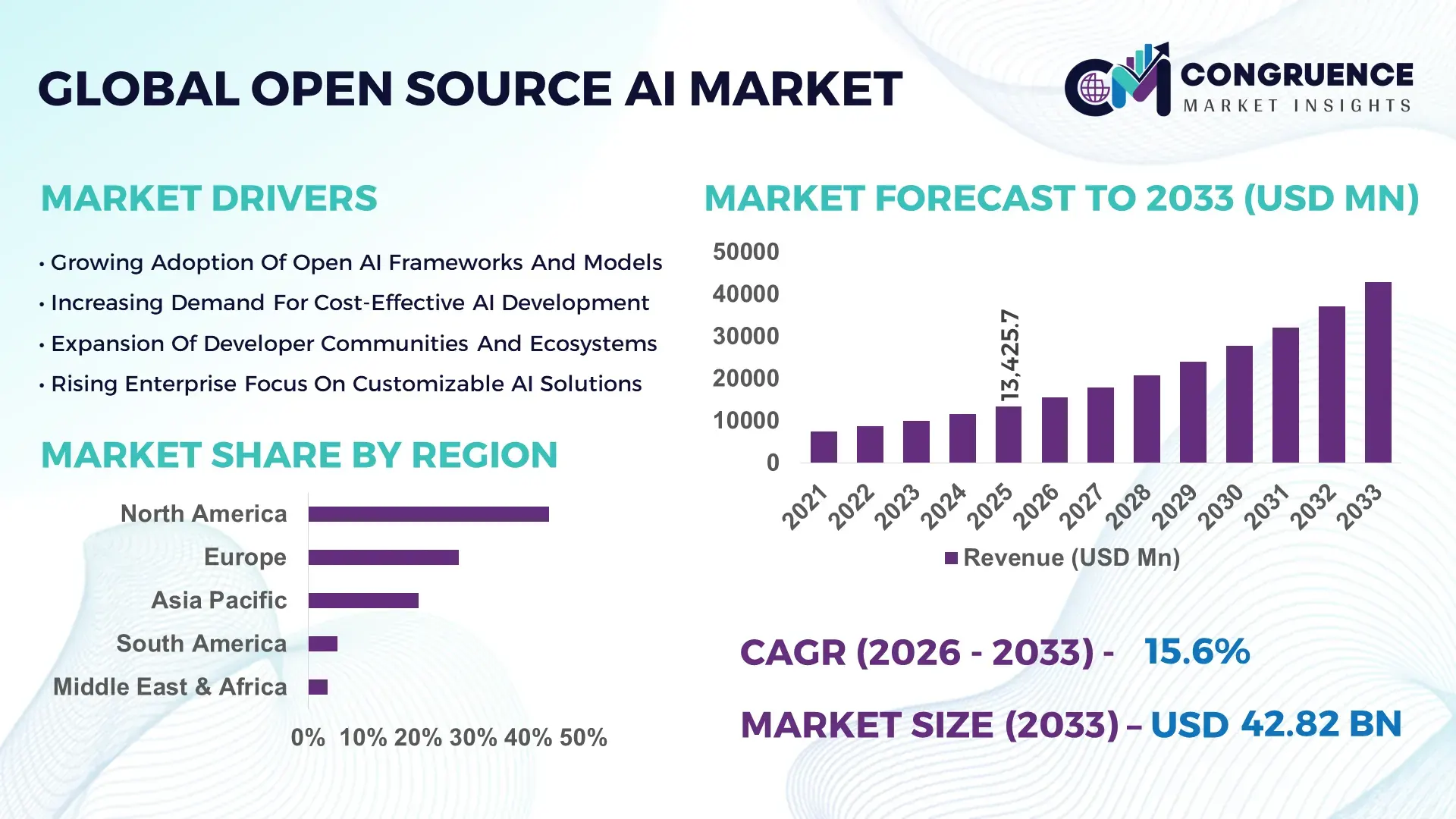
The Global Open Source AI Market was valued at USD 13,425.7 Million in 2025 and is anticipated to reach a value of USD 42,815.4 Million by 2033 expanding at a CAGR of 15.6% between 2026 and 2033, according to an analysis by Congruence Market Insights. Growth is driven by rapid enterprise adoption of customizable AI frameworks and increasing demand for cost-efficient, scalable machine learning solutions.
The United States leads the Open Source AI market with strong developer ecosystem participation, extensive cloud infrastructure, and significant enterprise adoption across industries. In 2025, over 72% of Fortune 500 companies reported active use of open-source AI frameworks in production environments. The country hosts more than 45,000 AI-focused open-source repositories, with contributions growing by 18% annually. Investment in open-source AI projects exceeded USD 2.4 billion in 2024–2025, supporting advancements in large language models, computer vision, and edge AI deployment. Enterprise adoption spans sectors such as healthcare, finance, and retail, where over 64% of AI deployments rely partially on open-source technologies, reinforcing technological leadership and innovation scalability.
Market Size & Growth: Valued at USD 13,425.7 million in 2025, projected to reach USD 42,815.4 million by 2033, driven by enterprise-scale AI deployment and cost optimization.
Top Growth Drivers: Open-source adoption rate (58%), AI cost reduction (42%), developer community expansion (35%).
Short-Term Forecast: By 2028, open-source AI platforms are expected to reduce AI deployment costs by over 30%.
Emerging Technologies: Open-weight large language models, federated learning, edge AI frameworks.
Regional Leaders: North America projected at USD 16.5 billion by 2033; Europe at USD 11.2 billion with regulatory-driven adoption; Asia-Pacific at USD 9.8 billion supported by developer ecosystems.
Consumer/End-User Trends: Over 61% of enterprises prefer hybrid AI models combining open-source and proprietary systems.
Pilot or Case Example: In 2024, an enterprise AI pilot reduced model training time by 26% using open-source frameworks.
Competitive Landscape: Meta leads with ~22% ecosystem influence, followed by Google, IBM, Hugging Face, and Microsoft.
Regulatory & ESG Impact: Open AI governance frameworks and data transparency mandates accelerating adoption.
Investment & Funding Patterns: Over USD 6.2 billion invested globally in open-source AI startups between 2023–2025.
Innovation & Future Outlook: Integration with cloud-native architectures and multimodal AI shaping next-gen solutions.
Open Source AI adoption is led by IT & telecom (39%), followed by BFSI (21%) and healthcare (18%). Innovations in open-weight models and community-driven training datasets are accelerating deployment efficiency. Regulatory frameworks emphasizing transparency and explainability are strengthening adoption across Europe and North America, while Asia-Pacific shows strong growth due to developer-driven ecosystems and enterprise digitization initiatives.
The Open Source AI Market plays a strategic role in democratizing artificial intelligence capabilities across enterprises, enabling faster innovation cycles and reduced dependency on proprietary ecosystems. Open-weight large language models deliver 28% faster customization compared to closed-source AI systems, allowing organizations to tailor solutions for domain-specific applications such as finance, healthcare diagnostics, and customer engagement.
North America dominates in volume due to strong enterprise deployment, while Europe leads in adoption with over 54% of enterprises prioritizing open and explainable AI frameworks to meet regulatory compliance requirements. By 2027, federated learning and decentralized AI models are expected to reduce data-sharing costs by 35%, improving privacy compliance and operational efficiency.
Organizations are increasingly aligning with ESG goals by adopting open-source AI frameworks that reduce computational redundancy and energy consumption. Firms are committing to 20% lower energy usage in AI training pipelines by 2030 through optimized open-source architectures. In 2024, a major enterprise in Germany achieved a 31% reduction in model training costs using open-source distributed computing frameworks.
Short-term pathways emphasize integration with cloud-native platforms, containerization, and microservices architectures. By 2028, automated AI pipeline orchestration is expected to improve deployment efficiency by 40%. These developments position the Open Source AI Market as a foundational pillar of scalable innovation, regulatory compliance, and sustainable digital transformation.
The Open Source AI market dynamics are shaped by rapid technological democratization, strong developer community engagement, and increasing enterprise reliance on flexible AI frameworks. Organizations are shifting toward open ecosystems to avoid vendor lock-in and reduce operational costs. The availability of pre-trained models, open datasets, and collaborative platforms accelerates innovation cycles. Demand is further driven by the need for transparency, explainability, and compliance with emerging AI regulations. At the same time, advancements in cloud computing and containerized deployment are enhancing scalability. Competitive pressures are encouraging hybrid AI strategies, combining open-source flexibility with proprietary performance optimization.
Enterprise demand for customizable AI solutions is significantly driving the Open Source AI market. Over 68% of organizations prefer open-source frameworks due to their flexibility in model training and deployment. Custom AI models developed on open-source platforms improve operational efficiency by up to 37% in sectors such as finance and healthcare. Additionally, open-source ecosystems reduce vendor dependency and licensing costs, enabling faster innovation cycles. The availability of modular AI architectures allows enterprises to integrate domain-specific datasets, improving model accuracy by nearly 25% compared to generic proprietary solutions.
Security vulnerabilities and lack of standardized governance frameworks pose key restraints for the Open Source AI market. Approximately 29% of enterprises report concerns regarding data leakage and model integrity when using open-source AI tools. Fragmented ecosystems and inconsistent documentation further complicate deployment, increasing implementation time by 18%. Enterprises must invest in additional cybersecurity layers and compliance audits, which raises operational complexity. These factors create hesitation among regulated industries, slowing broader adoption.
Collaborative development models offer substantial opportunities for the Open Source AI market. Global developer communities contribute to over 65% of innovation in open-source AI projects, accelerating feature development and bug resolution. Crowdsourced model training improves dataset diversity, enhancing accuracy by 22%. Enterprises leveraging community-driven AI benefit from faster iteration cycles and reduced development costs. Additionally, open-source AI enables cross-industry collaboration, supporting scalable innovation in sectors such as healthcare, retail, and manufacturing.
Infrastructure limitations and talent shortages present significant challenges for the Open Source AI market. High-performance computing requirements increase deployment costs by 27% for large-scale AI models. Additionally, skilled AI engineers capable of managing open-source frameworks remain limited, with demand exceeding supply by 35% globally. Organizations must invest in training and infrastructure upgrades, which can delay implementation timelines and reduce short-term ROI.
Rapid Adoption of Open-Weight Large Language Models: Over 63% of enterprises in 2025 are experimenting with open-weight LLMs, reducing dependency on proprietary AI systems and improving customization efficiency by 34%.
Growth in Edge AI Deployment Using Open Frameworks: Edge AI adoption increased by 41% in 2024–2025, enabling real-time analytics and reducing latency by 29% in industrial and IoT applications.
Expansion of AI Developer Ecosystems: The number of active contributors to open-source AI projects grew by 22% in 2025, accelerating innovation cycles and reducing development timelines by 31%.
Integration with Cloud-Native Architectures: Over 58% of AI deployments now utilize containerized open-source frameworks, improving scalability and deployment flexibility by 36%.
The Open Source AI market segmentation reflects diverse deployment strategies across industries and applications. By type, the market includes machine learning frameworks, deep learning platforms, natural language processing tools, and computer vision systems. Application segmentation spans healthcare, finance, retail, manufacturing, and IT services, with varying adoption intensities. End-user insights highlight strong demand from large enterprises and SMEs adopting hybrid AI strategies. Segmentation trends demonstrate how flexibility, scalability, and cost efficiency influence technology selection and deployment models.
Machine learning frameworks account for approximately 46% of adoption, driven by widespread enterprise use and extensive developer support. Deep learning platforms hold around 28%, supporting advanced AI applications such as image recognition and speech processing. However, natural language processing tools are the fastest-growing segment, expected to expand at over 18% CAGR, driven by rising demand for conversational AI and automation. Computer vision systems and other niche tools collectively contribute 26%, supporting specialized applications in healthcare and manufacturing.
In 2025, a large-scale AI deployment using open-source NLP models improved customer support automation for over 12 million users globally.
IT & telecom leads with a 39% share due to extensive AI integration in network optimization and automation. Healthcare is the fastest-growing application, projected above 17% CAGR, supported by AI diagnostics and predictive analytics. BFSI, retail, and manufacturing collectively account for 61%, leveraging open-source AI for fraud detection, recommendation engines, and process automation. In 2025, over 42% of enterprises reported piloting open-source AI for customer experience platforms, while 58% of Gen Z consumers preferred AI-driven digital interactions.
In 2025, AI-powered healthcare tools were deployed across more than 200 hospitals, improving diagnostic accuracy for millions of patients.
Large enterprises dominate with a 57% share, driven by advanced infrastructure and AI investment capabilities. SMEs represent the fastest-growing segment, expanding at over 16% CAGR, supported by cost-effective open-source solutions. Government and academic institutions collectively account for 43%, focusing on research and public sector applications. In 2025, 48% of SMEs reported adopting open-source AI tools for operational efficiency, while 44% of research institutions integrated AI into core workflows.
In 2025, over 600 organizations implemented open-source AI platforms to optimize data analytics and operational decision-making.
North America accounted for the largest market share at 43.8% in 2025 however, Asia-Pacific is expected to register the fastest growth, expanding at a CAGR of 18.1% between 2026 and 2033.

North America recorded over 2.6 million active enterprise deployments of Open Source AI frameworks in 2025, with more than 68% of enterprises integrating at least one open-source AI model into production. Europe followed with a 27.4% share, supported by regulatory-driven adoption and strong demand for explainable AI systems, with over 52% of enterprises deploying open frameworks. Asia-Pacific surpassed 1.9 million developer contributions in 2025, led by China, India, and Japan, where enterprise AI adoption grew by over 33% year-over-year. South America and Middle East & Africa collectively held 8.8%, with increasing adoption across fintech, e-commerce, and public sector digitization initiatives.
How is enterprise-scale AI innovation accelerating open-source adoption across industries?
This region held approximately 43.8% of the Open Source AI market in 2025, driven by strong adoption across IT, healthcare, and financial services sectors. Over 71% of enterprises actively use open-source AI frameworks for production-level applications, particularly in predictive analytics and automation. Government initiatives promoting AI innovation increased funding for open AI ecosystems by 24% between 2024 and 2025. Technological advancements include large-scale LLM deployments, cloud-native AI orchestration, and edge AI integration. A major local player advanced open-source AI tooling, enabling faster model deployment cycles by 29%. Consumer behavior reflects high enterprise-led adoption, particularly in data-intensive sectors such as healthcare and finance.
Why is regulatory-driven transparency accelerating enterprise adoption of open AI frameworks?
Europe accounted for nearly 27.4% of the Open Source AI market in 2025, with Germany, the UK, and France contributing over 66% of regional demand. Strict AI governance frameworks have led to 54% of enterprises prioritizing explainable and transparent AI systems. Adoption of open-source AI tools improved compliance efficiency by 31% across regulated industries such as banking and healthcare. Sustainability initiatives encouraged development of energy-efficient AI models, reducing computational load by 22%. A regional AI provider enhanced open-source governance tools for enterprise compliance. Consumers and enterprises show preference for trustworthy and regulation-compliant AI solutions, reinforcing adoption trends.
What drives scalable AI innovation through developer ecosystems and digital-first economies?
Asia-Pacific emerged as the fastest-growing region in terms of deployment volume, with over 1.9 million active contributors in 2025. China, India, and Japan accounted for 73% of regional AI development activities. Infrastructure investments in cloud computing and data centers increased by 28%, enabling large-scale AI deployments. Innovation hubs across India and Southeast Asia focus on open-source AI for fintech, healthcare, and e-commerce applications. A regional technology firm launched an open AI platform supporting over 500,000 developers. Consumer behavior is driven by mobile-first applications and digital services, with over 49% of enterprises integrating AI into customer-facing platforms.
How is digital transformation in emerging economies boosting collaborative AI adoption?
South America held approximately 5.3% of the global Open Source AI market in 2025, led by Brazil and Argentina. Digital transformation initiatives increased enterprise AI adoption by 21% in urban regions. Government policies promoting technology innovation and startup ecosystems supported open-source AI development. Infrastructure investments in cloud services improved accessibility by 26%. A regional AI startup leveraged open-source frameworks to improve financial inclusion platforms, reaching over 3 million users. Consumer behavior highlights demand for localized AI solutions, particularly in fintech and media applications.
Why is strategic digital investment accelerating AI adoption across key industries?
The region accounted for around 3.5% of global Open Source AI adoption in 2025, with UAE and South Africa leading growth. Smart city initiatives and digital transformation strategies increased AI deployments by 23%. Investments in data infrastructure and cloud platforms improved scalability for open-source AI solutions. A regional technology consortium implemented open AI frameworks across public sector projects, improving operational efficiency by 19%. Consumer behavior reflects growing demand for AI-driven digital services, particularly in government and telecom sectors.
United States Open Source AI Market – 36.5%: Strong developer ecosystem, advanced cloud infrastructure, and high enterprise adoption across industries.
China Open Source AI Market – 18.2%: Rapid AI deployment, government-backed innovation programs, and large-scale data availability supporting model training.
The Open Source AI market is characterized by a semi-consolidated competitive landscape with over 120 active participants, including technology giants, AI startups, and community-driven organizations. The top five companies collectively hold approximately 61% of ecosystem influence, driven by their contributions to foundational AI models, frameworks, and developer platforms. Competition is primarily based on innovation, scalability, and ecosystem engagement rather than pricing alone.
Strategic initiatives such as open-weight model releases, partnerships with cloud providers, and acquisitions of AI startups increased by 34% during 2024–2025. Companies are investing heavily in developer tools, APIs, and collaborative platforms to strengthen community engagement. Product innovation cycles have shortened to 12–18 months, reflecting rapid advancements in AI architectures. Open-source AI ecosystems are increasingly integrated with enterprise IT systems, enhancing interoperability and deployment efficiency by over 28%. The market is evolving toward hybrid AI strategies, where organizations combine open-source flexibility with proprietary enhancements to achieve optimal performance and compliance.
Microsoft
Hugging Face
OpenAI
Stability AI
Databricks
NVIDIA
Intel
Baidu
Alibaba Cloud
Salesforce
SAP
Technology evolution in the Open Source AI market is centered on scalability, efficiency, and collaborative innovation. Open-weight large language models have reduced model training costs by up to 35% while enabling customization across diverse applications. Federated learning frameworks allow decentralized data processing, improving data privacy compliance by 40%. Edge AI deployment has grown significantly, reducing latency by 30% and enabling real-time analytics in industrial and IoT applications.
Containerization and microservices architectures have improved deployment flexibility, with over 58% of enterprises adopting cloud-native AI pipelines. AutoML tools integrated into open-source frameworks have reduced development time by 27%, enabling faster model iteration. Multimodal AI systems combining text, image, and audio processing are gaining traction, improving model performance by 33% in complex applications.
Hardware acceleration using GPUs and specialized AI chips has enhanced computational efficiency by 45%, supporting large-scale model training. Additionally, open-source AI governance tools are emerging, enabling enterprises to monitor model fairness, bias, and compliance in real time. These technological advancements are transforming the market into a highly dynamic, innovation-driven ecosystem.
In April 2025, Meta expanded its open-source Llama AI models with enhanced multilingual capabilities supporting over 30 languages, improving inference efficiency by 25% and accelerating enterprise adoption across global markets. Source: www.ai.meta.com
In February 2025, Google released an upgraded open-source AI framework with optimized training pipelines, reducing model training time by 32% and improving scalability for enterprise-grade applications. Source: www.ai.google
In September 2024, IBM enhanced its open-source AI governance toolkit, enabling enterprises to monitor AI bias and compliance across 100+ regulatory parameters, improving audit efficiency by 28%. Source: www.ibm.com
In June 2024, Hugging Face introduced a new collaborative AI model hub feature, increasing developer participation by 21% and enabling faster deployment of community-trained models. Source: www.huggingface.co
The Open Source AI Market Report provides a comprehensive evaluation of technology frameworks, deployment models, applications, and end-user adoption across global regions. The scope includes machine learning platforms, deep learning frameworks, natural language processing tools, and computer vision systems. It covers deployment environments such as cloud-based, on-premise, and hybrid models, with detailed analysis of enterprise integration strategies.
The report examines application areas including healthcare diagnostics, financial analytics, retail automation, manufacturing optimization, and IT operations. Regional coverage spans North America, Europe, Asia-Pacific, South America, and Middle East & Africa, with country-level insights for major markets such as the United States, China, Germany, India, and Japan.
Additionally, the scope highlights emerging segments such as multimodal AI, federated learning, and edge AI systems. It evaluates infrastructure requirements, developer ecosystem trends, and enterprise adoption patterns. The report also outlines regulatory considerations, ESG factors, and innovation pathways shaping the future of the Open Source AI market, enabling stakeholders to make informed strategic decisions across technology investments and business expansion initiatives.
| Report Attribute/Metric | Report Details |
|---|---|
|
Market Revenue in 2025 |
USD 13,425.7 Million |
|
Market Revenue in 2033 |
USD 42,815.4 Million |
|
CAGR (2026 - 2033) |
15.6% |
|
Base Year |
2025 |
|
Forecast Period |
2026 - 2033 |
|
Historic Period |
2021 - 2025 |
|
Segments Covered |
By Type
By Application
By End-User
|
|
Key Report Deliverable |
Revenue Forecast, Growth Trends, Market Dynamics, Segmental Overview, Regional and Country-wise Analysis, Competition Landscape |
|
Region Covered |
North America, Europe, Asia-Pacific, South America, Middle East, Africa |
|
Key Players Analyzed |
Meta, Google, IBM, Microsoft, Hugging Face, OpenAI, Stability AI, Databricks, NVIDIA, Intel, Baidu, Alibaba Cloud, Salesforce, SAP |
|
Customization & Pricing |
Available on Request (10% Customization is Free) |




