
Reports
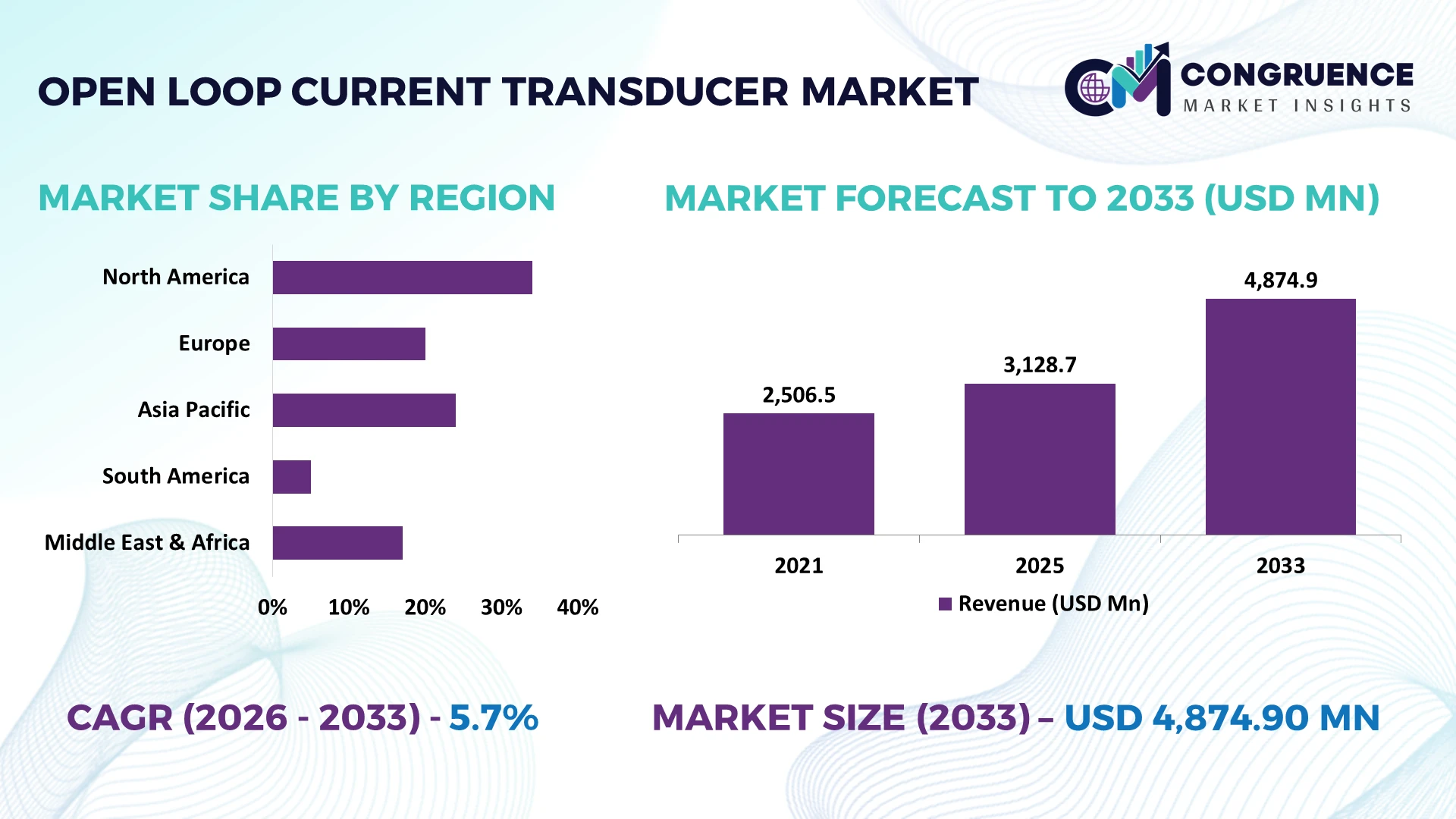
The Global Open Loop Current Transducer Market was valued at USD 3128.72 Million in 2025 and is anticipated to reach a value of USD 4874.9 Million by 2033 expanding at a CAGR of 5.7% between 2026 and 2033. Growth is driven by accelerating Hall-effect sensing deployment in electric vehicles, battery energy-storage systems, solar inverters, industrial motor drives, and power-conversion equipment requiring isolated, compact current measurement.
China holds the dominant position, accounting for more than 50% of global electric-vehicle production capacity and supporting high-volume demand for current sensors across EV powertrains, charging infrastructure, renewable-energy systems, and factory automation. China’s EV sales penetration exceeded 50% in 2025, compared with roughly 10% in the United States, reinforcing its sensor-intensive electrification advantage amid the global shift toward localized electronics supply chains.
Strategic implication: suppliers should prioritize China-led EV, renewable-energy, and industrial automation ecosystems while expanding localized sensing technologies for regional supply-chain resilience.
Market Size & Growth: USD 3.13 billion in 2025 is projected to reach USD 4.87 billion by 2033 at 5.7% CAGR, driven by EV power electronics and renewable-energy conversion.
Top Growth Drivers: EV adoption contributes 30%, industrial automation 24%, and renewable-energy systems 19% to major demand momentum.
Short-Term Forecast: By 2028, digital calibration and automated manufacturing are positioned to reduce sensing-system costs by 8% and improve measurement efficiency by 12%.
Emerging Technologies: AI-enabled diagnostics, miniature Hall-effect ICs, and advanced magnetic materials are reshaping high-precision current monitoring, with smart sensing adoption approaching 35%.
Regional Leaders: Asia-Pacific is projected at USD 2.4 billion, Europe at USD 1.2 billion, and North America at USD 0.9 billion, led by EV, charging, and energy-storage deployment.
Consumer/End-User Trends: More than 40% of new industrial power-conversion designs increasingly incorporate compact isolated current sensing to improve system monitoring and protection.
Pilot/Case Example: In 2025, advanced current-monitoring integration in automated power systems delivered approximately 15% faster fault detection and reduced diagnostic downtime by 10%.
Competitive Landscape: Leading manufacturers collectively command an estimated 35% share, with Allegro MicroSystems, LEM, TDK, Tamura, and CR Magnetics strengthening global sensor portfolios.
Regulatory & ESG Impact: Electrification and energy-efficiency policies are increasing sensor-intensive applications, while improved monitoring can reduce power-system losses by approximately 5%.
Investment & Funding: More than USD 1 billion in combined semiconductor, EV, charging, and energy-storage capacity expansion is accelerating demand for localized current-sensing components.
Innovation & Future Outlook: Next-generation transducers are shifting toward smaller footprints, higher isolation, digital interfaces, and integrated diagnostics as manufacturers respond to regional supply-chain diversification and advanced electrification requirements.
Open loop current transducers are gaining demand across EV battery management, photovoltaic inverters, industrial motor controls, UPS systems, and charging infrastructure. Miniaturized Hall-effect architectures and improved magnetic cores are raising sensing efficiency by approximately 10%, while digital monitoring integration is expanding rapidly. China’s accelerated EV and renewable-energy manufacturing build-out is strengthening regional component demand, creating a strategic opening for localized, high-precision sensing solutions.
Open loop current transducers are becoming strategically important because electrification is shifting current measurement from a component-level function into a core control, protection, and energy-management capability. Global electric-car sales reached 21 million units in 2025, while China accounted for nearly 75% of EV production, intensifying demand for compact isolated sensing across traction inverters, charging systems, and battery electronics. Companies are therefore prioritizing localized sensor supply and application-specific designs.
The market is also being reshaped by grid modernization and renewable integration. Solar PV and wind supplied 17% of global electricity generation in 2025, increasing the need for real-time current monitoring in distributed generation and storage. Compared with conventional shunt-based measurement, open-loop Hall-effect sensing provides galvanic isolation and lower insertion losses, while integrated designs can reduce thermal burden and simplify installation. China remains the largest deployment base, whereas the United States emphasizes grid resilience and Europe prioritizes efficiency-driven electrification.
Over the next 2–3 years, suppliers are positioned to increase digital-interface adoption, miniaturization, and automated calibration, with smart sensing penetration moving toward 30–40% of new advanced power-electronics designs. A practical deployment example is photovoltaic inverter monitoring, where isolated transducers support fault detection without interrupting high-current paths. Companies are responding through semiconductor partnerships, regional manufacturing, and customized automotive-grade platforms. Competitive advantage will increasingly depend on sensor accuracy, localization, integration speed, and lifecycle reliability.
China’s EV sales exceeded 13 million units in 2025, with electric vehicles approaching 55% of new-car sales, creating sustained demand for isolated current measurement in traction inverters, onboard chargers, and battery systems. Renewable deployment adds another structural driver: China commissioned nearly 500 GW of renewable capacity in 2025, intensifying requirements for current monitoring across converters and grid interfaces. These shifts are moving transducers from standalone measurement components toward embedded control architectures. Manufacturers are responding by expanding automotive-qualified portfolios, integrating signal conditioning, and forming OEM partnerships. The non-obvious advantage is design standardization: common sensor platforms can serve EV, solar, storage, and industrial drives, shortening qualification cycles and improving manufacturing utilization.
Open loop transducer manufacturers remain exposed to fluctuations in magnetic materials, semiconductor components, and specialized packaging inputs, with imported components representing a meaningful portion of supply chains in several electronics hubs. Automotive qualification can also extend product-development cycles by 12–24 months, limiting rapid substitution when shortages occur. China’s dominance in EV and electronics manufacturing strengthens local scale but increases geographic concentration for global buyers. Companies are responding through dual sourcing, regional assembly, longer procurement contracts, and greater use of standardized Hall-effect platforms. The key operational constraint is not sensor demand but continuity: a small disruption in magnetic cores, ICs, or encapsulation materials can delay qualified production lines disproportionately.
The strongest opportunity is the convergence of current sensing with digital power management. Global renewable capacity is projected to expand by roughly 4,600 GW from 2025 to 2030, with solar representing nearly 80% of renewable capacity additions, creating extensive demand for isolated sensing in inverters, storage systems, and distributed generation. Smart transducers integrating diagnostics and digital interfaces can improve monitoring efficiency by 10–15% while reducing system-level wiring complexity. India is particularly attractive as solar, battery storage, EV charging, and industrial electrification expand simultaneously. Manufacturers are positioning through R&D partnerships, localized assembly, and reference designs for inverter and charger OEMs. The strategic opportunity lies in selling sensing platforms rather than individual components.
Long-term competitiveness increasingly depends on integrating transducers into digitally controlled power architectures without sacrificing isolation, thermal stability, or electromagnetic compatibility. Advanced industrial and automotive systems are moving toward higher switching frequencies, while sensor placement and calibration must remain consistent across wide temperature and load ranges. In 2025, more than 20 million electric cars were sold globally, intensifying qualification pressure on automotive electronics suppliers and increasing expectations for repeatable sensor performance. Companies face additional workforce and testing requirements as applications become more software-defined. Manufacturers are addressing these pressures through automated calibration, application-specific reference designs, expanded validation laboratories, and semiconductor partnerships. The central challenge is achieving high-volume consistency while maintaining precision across increasingly compact power-electronics assemblies.
Miniaturization Reshapes Sensor Architectures: Compact Hall-effect packages are gaining traction in EV inverters and industrial drives, with footprint reductions of 10–20% improving board-level integration. Chinese automotive suppliers are shifting toward integrated sensing modules, while manufacturers automate assembly and calibration to shorten qualification cycles by 8–12%.
Digital Monitoring Expands Deployment: Transducers with CAN, Modbus, and digital diagnostic interfaces are moving into connected equipment, with adoption in advanced power-electronics designs approaching 30–35%. Integrated diagnostics can reduce wiring requirements by about 10%, encouraging suppliers to combine sensing, conditioning, and communications in standardized modules.
Localization Strengthens Supply Resilience: Component shortages and trade-policy uncertainty are driving dual sourcing, with manufacturers targeting 20–30% higher local procurement coverage. India is attracting electronics and EV manufacturing investments, while suppliers expand regional inventories and qualification networks to reduce disruption exposure and improve delivery responsiveness.
Automated Testing Raises Consistency: Automated calibration and end-of-line verification are expanding in high-volume production, reducing manual inspection workload by roughly 15% and improving process consistency by 8–12%. A non-obvious shift is the use of calibration data for predictive quality control, helping manufacturers identify sensor drift earlier and reduce warranty exposure.
Hall Effect remains the dominant type, accounting for approximately 62% of market demand, supported by scalable manufacturing, galvanic isolation, broad measuring ranges, and cost-efficient integration into automotive and industrial electronics. Its established production ecosystem keeps it ahead of Fluxgate, Rogowski Coil, and Current Transformer technologies in high-volume applications. Fluxgate is the fastest-growing type, with adoption increasing approximately 12–15% in precision-oriented monitoring where accuracy is prioritized over component simplicity. Rogowski Coil retains relevance for flexible AC and high-current measurement, while Current Transformer remains important in established power-monitoring installations.
Companies are prioritizing Hall-effect miniaturization while expanding Fluxgate portfolios for applications demanding tighter accuracy. Hall-effect architectures provide stronger cost-to-volume economics, whereas Fluxgate designs command greater value in precision applications. This is shifting investment toward application-specific platforms, with manufacturers allocating roughly 10% more development attention to precision sensing features and integrated signal conditioning.
Motor Drives represent the leading application at approximately 29% share, supported by continuous current feedback requirements for torque control, overload protection, and energy optimization. Power Monitoring follows at around 22%, while Industrial Automation contributes nearly 19% as connected production equipment expands. Battery Management is the fastest-growing application, with adoption rising roughly 16% as EV and storage architectures require accurate isolated current measurement during charging, discharging, and fault conditions.
Renewable Energy is strengthening as inverter deployment expands, while mature Motor Drives applications increasingly combine current sensing with digital control. Companies are embedding transducers directly into drives, battery controllers, and inverter platforms, reducing separate sensing hardware requirements by approximately 10%. The competitive implication is significant: suppliers supporting multiple control architectures from a common sensor platform can shorten integration cycles by 8–12% and improve OEM standardization.
Automotive is the leading end-user, representing approximately 34% of demand, driven by deployment across traction inverters, battery systems, onboard chargers, and electric powertrains. Industrial Manufacturing follows at around 27%, supported by motor drives and automated production equipment, while Energy & Utilities accounts for nearly 21%. Consumer Electronics remains more price-sensitive, whereas Aerospace & Defense prioritizes precision, isolation, and reliability over high-volume economics.
Energy & Utilities is the fastest-growing end-user, with adoption increasing approximately 14–16% as renewable generation, battery storage, and grid modernization intensify monitoring requirements. Automotive suppliers are emphasizing customized, qualification-ready designs, while utility-equipment manufacturers increasingly favor standardized sensing platforms. Companies are expanding partnerships with inverter, storage, and EV-system integrators, with customized designs commanding approximately 10% greater specification attention than standard industrial models.
North America accounted for the largest market share at 31% in 2025 however, Asia-Pacific is expected to register the fastest growth, expanding at a CAGR of 7.1% between 2026 and 2033.

EV electrification and grid modernization strengthen precision sensing demand
North America accounted for approximately 31% of global demand in 2025, led by the United States across automotive electronics, industrial automation, aerospace, renewable power, and energy storage. EV production expansion is increasing deployment of isolated current sensing in traction inverters, onboard chargers, and battery systems, while utility-scale storage is creating additional demand for converter monitoring. U.S. manufacturers are also increasing automation investment, strengthening sensor requirements in motor-control equipment. Suppliers are responding through automotive-grade qualification, domestic inventory expansion, and OEM partnerships. California, Michigan, and Texas remain important deployment hubs because of their concentration of EV, semiconductor, industrial, and renewable-energy activity. The strategic shift is toward compact, application-specific transducers that reduce integration complexity while supporting higher-density power electronics.
United States Market Outlook: The United States remains North America’s primary demand center, supported by EV manufacturing, aerospace electronics, industrial automation, and grid modernization. Texas and California are particularly important for renewable-energy and storage deployment. Suppliers are expanding application engineering and localized distribution to secure design wins with inverter, automotive, and industrial-equipment manufacturers.
Industrial electrification accelerates high-efficiency sensing upgrades
Europe represented approximately 25% of global demand in 2025, with Germany, France, Italy, and the United Kingdom forming the principal industrial and automotive clusters. Germany leads regional deployment through automotive manufacturing, industrial machinery, robotics, motor drives, and power-conversion equipment. European manufacturers are prioritizing efficiency, functional safety, and compact sensor architectures as industrial assets undergo modernization. Energy-efficiency requirements are also increasing the importance of precise current feedback in variable-speed drives and automated production systems. Suppliers are responding through partnerships with automotive Tier-1 manufacturers, automation integrators, and industrial equipment OEMs. Around 20% of newly developed advanced industrial-drive architectures increasingly incorporate connected monitoring functions, encouraging demand for transducers compatible with digital control and diagnostic systems.
Germany Market Outlook: Germany provides Europe’s strongest industrial base for open loop current transducers, supported by automotive production, machinery manufacturing, robotics, and industrial electronics. Its extensive supplier ecosystem enables specialized sensor integration. Manufacturers are increasingly targeting high-accuracy transducers for automated factories, electric mobility systems, and energy-efficient motor drives.
Manufacturing scale drives sensor localization and high-volume deployment
Asia-Pacific accounted for approximately 34% of global demand in 2025 and maintains the strongest manufacturing ecosystem for open loop current transducers. China dominates through EVs, batteries, solar inverters, electronics manufacturing, and industrial automation, while Japan and South Korea contribute advanced automotive electronics and precision industrial equipment. India is strengthening its position through electronics manufacturing and EV localization programs. China recorded more than 13 million electric-car sales in 2025, creating substantial demand for current sensing across powertrains, charging infrastructure, and battery systems. Suppliers are responding by expanding local production, strengthening OEM partnerships, and standardizing platforms across automotive and renewable-energy applications. Vertical integration is a major regional advantage because sensor manufacturers can coordinate closely with battery, inverter, and semiconductor producers.
China Market Outlook: China represents the most strategically significant country because its EV, battery, solar, and electronics ecosystems generate concentrated sensor demand. Domestic manufacturers increasingly integrate current sensing into broader power-electronics platforms. Large-scale automation and renewable deployment are also encouraging localized sourcing and faster qualification for high-volume OEM programs.
Renewable infrastructure expands selective industrial sensing demand
South America accounted for approximately 7% of global demand in 2025, with Brazil representing the principal market due to its automotive manufacturing, mining, industrial processing, renewable generation, and electricity infrastructure. Solar and wind expansion is increasing requirements for isolated current measurement in inverters, converters, and grid-connected equipment. Mining and manufacturing facilities are simultaneously upgrading motor drives and automation systems to improve energy management. Imported electronic components remain exposed to logistics delays, making inventory availability an important purchasing criterion. Companies are responding through distributor partnerships, regional stockholding, and application-specific engineering support. Brazil’s expanding distributed-energy ecosystem is creating demand beyond traditional industrial monitoring, particularly for compact sensors used in photovoltaic inverter control and protection systems. Suppliers with local technical support can secure an advantage over purely export-oriented competitors.
Brazil Market Outlook: Brazil offers the strongest country-level opportunity through its diversified industrial base and expanding renewable infrastructure. Solar deployment is strengthening inverter-monitoring requirements, while mining and manufacturing operations require reliable current measurement for motor-control systems. Regional distribution partnerships remain essential for reducing imported-component delivery constraints.
Energy diversification accelerates infrastructure-led sensor deployment
Middle East & Africa accounted for approximately 5% of global demand in 2025, with Saudi Arabia, the United Arab Emirates, South Africa, and Egypt serving as major deployment centers. Large solar projects, desalination facilities, oil and gas modernization, data centers, and industrial automation are increasing requirements for current monitoring in power-conversion and electrical-control systems. Saudi Arabia and the UAE are prioritizing renewable generation and smart infrastructure, while South Africa’s electricity-system modernization supports industrial sensing demand. Suppliers are responding through EPC partnerships, regional distributors, and project-specific engineering. Solar inverters and battery systems represent particularly important emerging applications because isolated sensing supports protection and control without interrupting high-current paths. However, limited local electronics manufacturing keeps import dependence significant, making inventory planning and technical support important competitive differentiators.
Saudi Arabia Market Outlook: Saudi Arabia offers strong strategic momentum through renewable-energy development, industrial diversification, and smart-infrastructure programs. Solar projects and advanced electrical systems are increasing current-monitoring requirements. Suppliers are increasingly partnering with EPC contractors and local industrial organizations to influence project specifications and establish technical support close to deployment sites.
LEM, Allegro MicroSystems, Tamura Corporation, TDK Corporation, and CR Magnetics compete across automotive, industrial, energy, and power-monitoring applications. These leading players collectively hold approximately 35% of market share, while regional specialists compete through customization and pricing. Competition centers on sensing accuracy, miniaturization, supply continuity, and application support, with advanced designs commanding roughly 10–15% higher value and localized sourcing reducing lead times by 15–20%. LEM and Allegro emphasize automotive-qualified technologies, while Tamura and CR Magnetics strengthen industrial applications. TDK leverages electronics integration capabilities, creating pressure on standalone sensor suppliers. Companies are expanding production, forming OEM partnerships, and integrating signal conditioning to secure design wins. The competitive landscape is shifting toward localized manufacturing as EV and renewable-energy customers prioritize resilient supply chains. Automotive qualification remains a major entry barrier because validation requirements increase development costs and timelines. Winning requires precision, reliable supply, rapid customization, and strong OEM integration capabilities.
LEM
Allegro MicroSystems
Tamura Corporation
TDK Corporation
CR Magnetics
Texas Instruments
Honeywell International
Sensata Technologies
Danisense
VACUUMSCHMELZE
Nidec Corporation
Asahi Kasei
Isabellenhütte Heusler
Infineon Technologies
Open-loop Hall sensing remains the baseline, combining galvanic isolation, low power and compact construction. Integrated ASIC conditioning can improve measurement efficiency 1–2%, while PCB-mounted deployment is widespread in drives, inverters and BMS. These established designs benefit cost-sensitive manufacturers requiring dependable AC/DC monitoring across demanding industrial environments, with installation, scalable current ranges, and minimal insertion losses for efficient power conversion.
Emerging coreless and integrated magnetic architectures remove bulky magnetic concentrators, improving packaging efficiency 1–2% and reducing sensor mass. LEM’s OLCI technology reaches 42 kA and 1 MHz bandwidth, while coreless Hall designs increasingly support direct PCB integration. Adoption is expanding across renewables, traction, EV power electronics and charging equipment, accelerating compact system architectures, faster switching, and easier maintenance while improving thermal behavior and integration flexibility at scale.
Disruptive hybrid sensing, TMR, digital diagnostics and high-speed interfaces are reshaping performance. New architectures can deliver 1–2% gains in response, thermal stability or system efficiency versus older implementations. Through 2026–2028, suppliers integrating sensing, diagnostics and control will gain design-win advantages; acting now reduces redesign risk, supports functional-safety requirements, and improves competitive differentiation. Automotive OEMs and power-electronics leaders benefit most from adoption, especially where space and reliability constraints are severe in electrification programs.
May 2024 LEM launched FRS and FL Open Loop Coreless Integral sensors, measuring 2–42 kA with bandwidth up to 1 MHz and 80% lower weight than comparable transducers. The expansion targets renewable-energy projects, improving installation flexibility and integration. Source: lem.com
June 2024 Yokogawa released CT1000S, a 1,000 A AC/DC split-core current sensor with DC–300 kHz bandwidth and ±0.2% reading accuracy. Its clamp design eliminates cable disconnection during installation, accelerating laboratory testing for EV, railway and renewable-energy equipment development. Source: yokogawa.com
September 2024 Allegro introduced high-bandwidth current sensors using XtremeSense TMR technology, following its Crocus acquisition. The launch expanded magnetic sensing options for power-conversion, targeting faster response and higher efficiency in EV, renewable-energy and industrial systems while strengthening sensing capabilities. Source: allegromicro.com
October 2025 Infineon introduced TLE4971/TLI4971 coreless magnetic current sensors with 0.7% total error across temperature and lifetime. Six pre-programmed ranges from 16–50 A and fast overcurrent detection support automotive and industrial designs, improving precision while enabling compact architectures. Source: infineon.com
The Open Loop Current Transducer Market Report covers Hall-effect, coreless, integrated, PCB-mounted, split-core, and high-current configurations across industrial, automotive, renewable-energy, traction, power-supply, inverter, battery-management, and automation applications. It evaluates adoption patterns by equipment type, application, end-user, and technology, with emphasis on compact sensing, galvanic isolation, thermal stability, digital diagnostics, and high-bandwidth measurement.
Regional analysis spans North America, Europe, Asia-Pacific, South America, and Middle East & Africa, identifying established demand centers and emerging deployment areas. The report assesses leading manufacturers, product participation, technology positioning, integration trends, and niche opportunities such as EV platforms, energy storage, wind systems, and high-current DC infrastructure. Insights support investment planning, capacity expansion, product prioritization, competitive positioning, and technology roadmaps through 2026–2033, helping stakeholders identify adoption gaps, specification shifts, and market-entry opportunities.
| Report Attribute/Metric | Report Details |
|---|---|
Market Revenue in 2025 | USD 3128.72 Million |
Market Revenue in 2033 | USD 4874.9 Million |
CAGR (2026 - 2033) | 5.7% |
Base Year | 2025 |
Forecast Period | 2026 - 2033 |
Historic Period | 2021 - 2025 |
Segments Covered | By Type
By Application
By End-User
|
Key Report Deliverable | Revenue Forecast, Growth Trends, Market Dynamics, Segmental Overview, Regional and Country-wise Analysis, Competition Landscape |
Region Covered | North America, Europe, Asia-Pacific, South America, Middle East, Africa |
Key Players Analyzed | LEM, Allegro MicroSystems, Tamura Corporation, TDK Corporation, CR Magnetics, Texas Instruments, Honeywell International, Sensata Technologies, Danisense, VACUUMSCHMELZE, Nidec Corporation, Asahi Kasei, Isabellenhütte Heusler, Infineon Technologies |
Customization & Pricing | Available on Request (10% Customization is Free) |




