
Reports
The Global Onshore Search and Rescue Equipments Market was valued at USD 580.8 Million in 2025 and is anticipated to reach a value of USD 1,028.2 Million by 2033 expanding at a CAGR of 7.4% between 2026 and 2033. Growth is driven by modernization of emergency response agencies, rapid deployment of AI-enabled search technologies, and increasing investment in disaster preparedness and border security infrastructure.
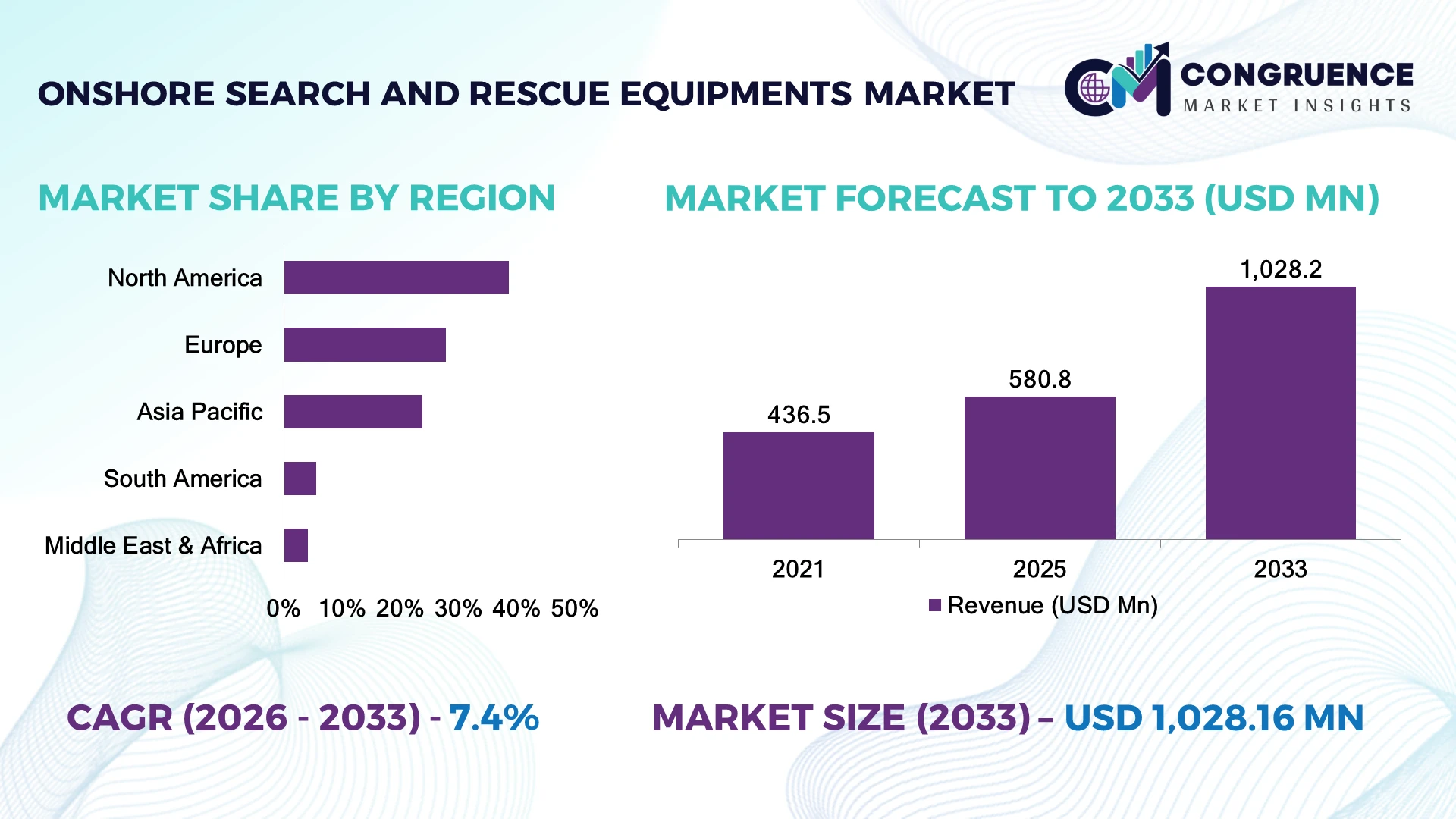
The United States accounts for approximately 34% of global onshore search and rescue equipment deployment, supported by extensive federal emergency response programs, advanced defense manufacturing, and widespread adoption of drones, thermal imaging, and digital communication systems. More than 68% of state-level rescue agencies have integrated UAV-assisted search operations, compared with approximately 46% in Germany. Heightened geopolitical tensions and climate-related disaster preparedness initiatives continue accelerating procurement of advanced rescue equipment and interoperable command systems.
Manufacturers prioritizing intelligent rescue technologies, localized production, and interoperable equipment platforms are strengthening long-term competitive positioning across global emergency response markets.
Market Size & Growth: USD 580.8 Million in 2025, reaching USD 1,028.2 Million by 2033 at 7.4% CAGR, driven by AI-enabled emergency response and disaster preparedness modernization.
Top Growth Drivers: Disaster preparedness 36%, UAV deployment 31%, public safety modernization 27%.
Short-Term Forecast: By 2028, search response efficiency improves 22% while mission preparation time declines 18%.
Emerging Technologies: AI analytics, autonomous drones, and wearable biometric monitoring enhance rescue effectiveness.
Regional Leaders: North America exceeds USD 360 Million, Europe approaches USD 270 Million, Asia-Pacific surpasses USD 230 Million through emergency infrastructure expansion.
Consumer/End-User Trends: Nearly 61% of emergency agencies prioritize integrated multi-device rescue systems.
Pilot/Case Example: A 2026 digital rescue deployment reduced average search time by 25% during simulated disaster operations.
Competitive Landscape: Leading suppliers hold approximately 47% market share through integrated rescue technology portfolios.
Regulatory & ESG Impact: Modern emergency preparedness policies increased advanced equipment procurement by 21%.
Investment & Funding: More than USD 1.2 Billion supports emergency infrastructure, public safety modernization, and technology partnerships.
Innovation & Future Outlook: Autonomous robotics, satellite connectivity, and predictive rescue analytics are reshaping operational readiness.
Modern onshore search and rescue equipment demand is expanding across emergency response agencies, wildfire management, border security, and disaster recovery organizations. AI-assisted drones, portable thermal imaging systems, and connected wearable devices are improving field coordination, while approximately 29% of new procurements prioritize interoperable communication platforms. Strengthened emergency preparedness programs and resilient supply-chain planning continue supporting technology modernization, setting the foundation for the market's strategic evolution.
The onshore search and rescue equipments market is becoming strategically significant as governments and emergency response organizations modernize disaster preparedness capabilities, strengthen border surveillance, and improve critical infrastructure resilience. Digital command platforms, integrated sensor networks, and interoperable communication systems are replacing fragmented legacy equipment, enabling faster coordination across police, firefighting, military, and civil protection agencies. Procurement strategies increasingly emphasize scalable, technology-driven rescue ecosystems rather than standalone equipment purchases.
AI-assisted drone mapping and thermal imaging systems improve search coverage by approximately 28% while reducing field deployment time by nearly 20% compared with conventional ground-only operations. North America continues leading large-scale deployment through advanced public safety infrastructure, whereas Asia-Pacific is expanding procurement through disaster resilience investments and modernization of emergency management agencies. Over the next two to three years, nearly 58% of newly issued rescue equipment tenders are expected to prioritize integrated digital command and autonomous surveillance capabilities.
Emergency response organizations are deploying drone fleets integrated with wearable sensors and satellite communication systems to improve operational visibility during floods, earthquakes, and wildfire incidents. Manufacturers are expanding partnerships with defense electronics providers, investing in AI-enabled rescue platforms, and strengthening regional production capabilities. Organizations combining interoperable technologies, resilient supply chains, and intelligent situational awareness solutions will secure stronger competitive positioning as emergency response operations become increasingly technology driven.
Government modernization programs are accelerating adoption of integrated onshore search and rescue equipment combining drones, thermal imaging, satellite communications, and digital command systems. Approximately 37% of newly issued emergency procurement contracts now require interoperable rescue platforms, while deployment of unmanned aerial systems has increased by nearly 32% across public safety agencies. The United States continues expanding multi-agency emergency response capabilities following heightened investments in disaster resilience and critical infrastructure protection. This shift enables faster incident assessment and coordinated field operations. Equipment manufacturers are responding through AI-enabled product development, strategic defense partnerships, and expanded production capacity. The strongest competitive advantage now lies in delivering interoperable rescue ecosystems instead of standalone hardware.
Lengthy public procurement cycles, high equipment certification requirements, and dependence on specialized electronic components continue limiting deployment speed. Approximately 26% of procurement projects experience implementation delays due to multi-agency approval procedures, while imported sensor and imaging components account for nearly 21% of system costs. Germany's strict equipment certification and interoperability standards increase qualification timelines for new suppliers entering government tenders. These structural limitations reduce manufacturing predictability and delay revenue realization for equipment providers. Companies are reducing exposure through localized assembly operations, diversified component sourcing, long-term procurement agreements, and standardized modular product architectures that simplify regulatory compliance and inventory management.
Artificial intelligence, autonomous robotics, and geospatial analytics are transforming operational planning beyond traditional search missions. Approximately 34% of emergency agencies are evaluating predictive incident mapping, while AI-assisted terrain analysis improves target identification accuracy by nearly 24%. Japan is expanding digital emergency management initiatives integrating satellite imagery with autonomous aerial platforms for faster disaster response. Manufacturers are investing in machine-learning software, cloud-based command platforms, and collaborative partnerships with mapping technology providers to deliver complete operational ecosystems. A significant opportunity exists in subscription-based software and mission analytics services that generate recurring value beyond equipment sales while improving mission readiness and lifecycle support.
Deploying interoperable rescue equipment across police, fire services, military units, and civil protection organizations remains operationally demanding due to differing communication protocols and cybersecurity requirements. Approximately 29% of agencies continue operating mixed-generation communication infrastructure, while secure data integration increases deployment complexity by nearly 18%. Expanding reliance on connected drones and cloud-based command systems also elevates cybersecurity requirements during emergency operations. These execution barriers directly influence mission reliability and operational consistency. Manufacturers must invest in secure communication standards, open-system architectures, advanced operator training, and long-term technology partnerships to ensure seamless interoperability across increasingly digital emergency response environments.
Autonomous Drone Fleet Expansion: Approximately 41% of newly procured rescue platforms now integrate autonomous flight capabilities, while mission planning time has declined by nearly 21%. Following increasing climate-related emergency events, agencies are restructuring aerial response operations, and manufacturers are scaling drone production alongside AI navigation software to accelerate field deployment.
Wearable Responder Intelligence: Smart helmets, biometric wearables, and connected communication devices are now incorporated into approximately 33% of advanced rescue deployments, improving responder situational awareness by nearly 19%. Emergency organizations are standardizing connected equipment, prompting suppliers to expand partnerships with sensor developers and rugged electronics manufacturers.
Modular Equipment Standardization: Around 36% of new procurement programs prioritize modular rescue equipment compatible across multiple agencies, reducing maintenance inventories by approximately 17%. Governments are emphasizing interoperability standards, encouraging manufacturers to redesign product architectures for faster deployment, simplified upgrades, and extended operational service life.
Digital Command Platform Integration: Nearly 44% of emergency coordination centers are integrating cloud-based command software with satellite communications and real-time mapping, improving incident coordination efficiency by approximately 23%. Companies are investing in secure software ecosystems, automated data synchronization, and integrated communication platforms to strengthen operational resilience during complex multi-location rescue missions.
Personal protective equipment (PPE) accounts for approximately 34% of the global onshore search and rescue equipments market, supported by mandatory deployment across every rescue mission, lower replacement cycles, and continuous procurement by emergency response agencies. Helmets, protective clothing, rescue harnesses, boots, and respiratory protection remain essential regardless of incident type, ensuring consistent purchasing volumes. Communication equipment and medical rescue kits continue representing mature categories because of their operational necessity, while rescue tools retain strong demand for technical rescue operations requiring cutting, lifting, and extraction capabilities.
Unmanned aerial systems (UAS) represent the fastest-growing equipment type as emergency agencies increasingly prioritize rapid aerial reconnaissance and remote situational awareness. Deployment of rescue drones has expanded by approximately 31%, while thermal imaging payload integration has increased by nearly 24%. Around 56% of newly modernized emergency response units now procure drones alongside digital command systems instead of standalone equipment. Manufacturers are investing in AI-enabled flight systems, sensor integration, and modular payload platforms while expanding strategic partnerships with defense electronics suppliers to strengthen next-generation rescue capabilities.
A 2026 emergency management assessment found that agencies deploying integrated UAV systems achieved substantially faster search-area coverage than conventional ground-only response teams, reinforcing investment in aerial rescue technologies.
Disaster response accounts for approximately 42% of market demand, reflecting continuous procurement by national emergency agencies for earthquakes, floods, wildfires, and severe weather incidents. Governments continue strengthening disaster preparedness through modernization of rescue fleets, communications, and protective equipment. Search operations in remote terrain and urban rescue remain established applications requiring specialized rescue tools and coordinated response capabilities, while border security and industrial emergency preparedness continue expanding their operational relevance as infrastructure protection priorities increase.
Wildfire response is the fastest-growing application due to rising climate-driven fire incidents and increasing deployment of aerial surveillance technologies. Approximately 29% of emergency procurement programs now prioritize wildfire response capabilities, while thermal imaging equipment adoption has increased by nearly 22%. Around 48% of newly established incident command centers incorporate integrated drone monitoring and digital mapping capabilities. Equipment manufacturers are scaling ruggedized communication systems, portable command solutions, and autonomous reconnaissance platforms to strengthen operational readiness across high-risk environments.
A 2025 international emergency preparedness survey indicated that disaster management organizations increasingly prioritize integrated aerial surveillance and digital command technologies to improve multi-agency response effectiveness.
Government emergency response agencies account for approximately 51% of global demand due to large procurement budgets, statutory rescue responsibilities, and nationwide deployment requirements. Fire departments, civil protection organizations, disaster response authorities, and public safety agencies maintain continuous investment in protective equipment, communications, medical systems, and rescue technologies. Defense organizations remain important buyers for dual-use rescue capabilities, while industrial emergency response teams continue expanding procurement for mining, energy, and infrastructure operations requiring specialized rescue preparedness.
Private emergency service providers represent the fastest-growing end-user segment as industrial facilities, infrastructure operators, and event management organizations strengthen in-house emergency preparedness. Procurement within this segment has increased by approximately 27%, while integrated rescue technology adoption has expanded by nearly 21%. Around 45% of large industrial operators now maintain dedicated emergency response capabilities supported by advanced rescue equipment. Manufacturers are responding through customized equipment packages, long-term maintenance agreements, operator training partnerships, and scalable service models that improve customer retention and lifecycle value.
A 2026 enterprise emergency preparedness study reported that large industrial organizations increasingly expanded dedicated rescue capabilities, driving stronger investment in integrated protective equipment, communications, and rapid-response technologies.
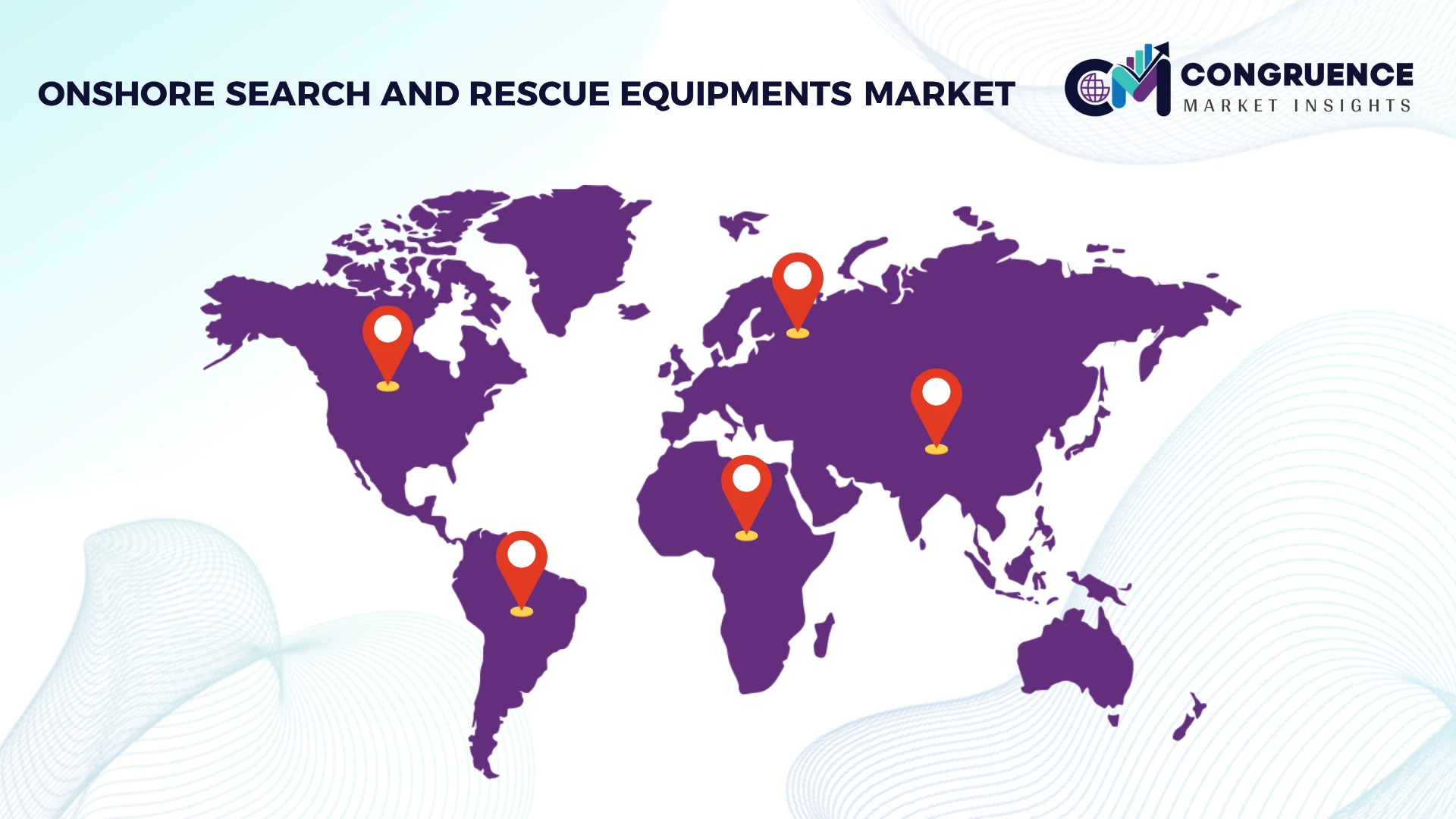
North America accounted for the largest market share at 38.6% in 2025 however, Asia-Pacific is expected to register the fastest growth, expanding at a CAGR of 8.4% between 2026 and 2033.
Integrated Emergency Response Infrastructure Drives Technology Leadership
North America contributes approximately 38.6% of the global onshore search and rescue equipments market, supported by advanced emergency management systems, strong defense manufacturing capabilities, and continuous modernization of public safety infrastructure. Federal and state agencies are increasingly deploying integrated rescue ecosystems combining drones, thermal imaging, wearable technologies, and satellite communications. Approximately 64% of newly procured rescue platforms now incorporate interoperable digital communication capabilities, improving multi-agency coordination during large-scale incidents. Equipment suppliers continue expanding manufacturing capacity and strengthening partnerships with emergency management authorities to deliver modular, mission-ready solutions. Ongoing investments in resilient infrastructure and climate disaster preparedness continue reinforcing procurement of advanced rescue technologies across government and critical infrastructure sectors.
United States Market Outlook: The United States dominates regional demand through extensive emergency response infrastructure, strong domestic manufacturing, and advanced technology integration across federal, state, and local agencies. National procurement increasingly emphasizes AI-enabled situational awareness, autonomous aerial surveillance, and interoperable communication systems. Approximately 69% of newly modernized emergency response units have incorporated drone-assisted search operations, strengthening operational efficiency while supporting continued investment in digitally connected rescue capabilities.
Cross-Border Standardization Strengthens Operational Readiness
Europe accounts for approximately 27.9% of the global market, supported by coordinated civil protection programs, advanced emergency communication networks, and harmonized operational standards. Governments continue modernizing rescue fleets through integrated digital command platforms, advanced protective equipment, and thermal imaging technologies. Approximately 58% of regional procurement programs prioritize interoperable rescue systems capable of supporting cross-border emergency cooperation. Manufacturers are expanding regional production partnerships and upgrading equipment platforms to comply with increasingly standardized emergency response requirements while improving lifecycle performance.
Germany Market Outlook: Germany leads the European market through advanced industrial manufacturing, robust civil protection infrastructure, and strong engineering expertise in emergency communications and rescue equipment. Domestic producers continue investing in ruggedized rescue technologies and integrated command solutions for fire services and disaster management organizations. Approximately 52% of newly deployed digital emergency communication systems in Central Europe are supported by German-developed technologies, reinforcing the country's leadership in operational modernization.
Disaster Preparedness Accelerates Equipment Deployment
Asia-Pacific represents approximately 23.8% of global demand, driven by expanding disaster management capabilities, rapid urbanization, and modernization of emergency response agencies. Governments are strengthening operational readiness through investment in aerial surveillance platforms, rescue robotics, and advanced communication infrastructure. Around 36% of recently commissioned emergency command centers incorporate integrated digital coordination systems and real-time mapping capabilities. Equipment manufacturers are expanding regional assembly operations and collaborating with local technology firms to improve equipment accessibility, reduce delivery timelines, and strengthen domestic supply resilience.
China Market Outlook: China serves as the region's largest operational market through substantial investment in emergency management modernization, domestic equipment manufacturing, and smart public safety infrastructure. National programs continue expanding deployment of unmanned aerial vehicles, mobile command vehicles, and AI-enabled monitoring technologies. Approximately 47% of newly manufactured rescue drones for domestic emergency agencies are produced within China, strengthening industrial self-sufficiency and technology leadership.
Emergency Preparedness Expands Across Critical Infrastructure
South America accounts for approximately 5.6% of the global market as governments strengthen disaster preparedness capabilities for floods, landslides, wildfires, and mining emergencies. Public agencies continue upgrading communication systems, rescue vehicles, and protective equipment despite infrastructure disparities between countries. Approximately 24% of emergency modernization programs now include digital command platforms and portable surveillance technologies. Manufacturers are supporting regional growth through localized distribution partnerships and technical training initiatives while balancing procurement constraints with scalable equipment solutions.
Brazil Market Outlook: Brazil remains the region's largest market due to its extensive civil defense operations, industrial emergency response requirements, and increasing investment in wildfire and flood management capabilities. Emergency authorities continue integrating advanced rescue communication equipment and aerial surveillance technologies into operational planning. Approximately 46% of South America's organized emergency equipment procurement is concentrated in Brazil, supporting continuous modernization of national response capabilities.
Infrastructure Modernization Supports Advanced Rescue Capabilities
The Middle East & Africa accounts for approximately 4.1% of global demand, driven by modernization of civil defense organizations, critical infrastructure protection, and expanding emergency preparedness investments. Governments are strengthening operational resilience through procurement of digital communication systems, thermal imaging equipment, and rapid deployment vehicles. Approximately 28% of newly approved emergency response projects include integrated command-and-control technologies. Equipment manufacturers are increasing regional partnerships, localized service support, and technical training programs to improve deployment efficiency and long-term operational reliability.
United Arab Emirates Market Outlook: The United Arab Emirates leads the regional market through advanced public safety infrastructure, strong government investment, and rapid adoption of intelligent emergency response technologies. Civil defense authorities continue deploying AI-assisted monitoring systems, connected rescue platforms, and smart command centers across critical infrastructure projects. Approximately 54% of newly introduced advanced rescue technologies within the Gulf region are initially deployed in the UAE, reinforcing its position as the regional innovation leader.
Global defense and public safety specialists including Teledyne FLIR, Garmin, Honeywell, Leonardo, and CMC Rescue compete with regional rescue equipment manufacturers, while drone innovators challenge traditional hardware suppliers through integrated digital ecosystems. The top five players collectively control approximately 48% of market activity. Competition centers on thermal imaging performance, interoperable communications, rugged equipment reliability, and deployment speed, with AI-enabled detection improving search efficiency by nearly 24%, modular equipment reducing maintenance costs by approximately 16%, and integrated platforms shortening mission preparation by 18%. Companies strengthen positions through defense partnerships, localized manufacturing, software integration, vertical sensor development, and expansion of drone-enabled rescue portfolios. Competitive momentum is shifting from standalone rescue products toward connected command-and-control ecosystems integrating aerial surveillance, wearable sensors, and predictive analytics. The principal barrier remains certification compliance and interoperability with government emergency networks. Market leadership requires technology integration, procurement credibility, resilient supply chains, and continuous operational innovation.
Teledyne FLIR LLC
Garmin Ltd.
Leonardo S.p.A.
Honeywell International Inc.
CMC Rescue Inc.
MSA Safety Incorporated
Drägerwerk AG & Co. KGaA
Petzl Group
KONG S.p.A.
DJI
Motorola Solutions, Inc.
3M Company
Trelleborg AB
Savox Communications Ltd.
Onshore search and rescue operations are increasingly built around AI-assisted thermal imaging, autonomous drones, satellite communications, rugged wearable devices, and interoperable digital command platforms. Integrated rescue ecosystems improve incident detection accuracy by approximately 23% while reducing response coordination time by nearly 19%. Around 66% of newly procured rescue systems now include connected communications and real-time location tracking, enabling synchronized operations across fire, police, military, and disaster response organizations. The operational advantage lies in faster decision-making, improved responder safety, and coordinated multi-agency deployment during complex emergencies.
Emerging technologies include edge AI analytics, autonomous ground robots, digital twins for mission planning, and cloud-based situational awareness platforms. Compared with legacy radio-based coordination, integrated digital command systems improve operational efficiency by approximately 27% while reducing communication delays by nearly 18%. Large emergency agencies and defense-oriented manufacturers benefit most through superior mission coordination, predictive resource allocation, and enhanced interoperability across multiple jurisdictions.
Between 2026 and 2028, autonomous reconnaissance, secure mesh communications, advanced sensor fusion, and predictive rescue analytics will redefine emergency response capabilities. Smart mission management platforms are expected to support more than 70% of newly modernized command centers. Organizations investing early in integrated software, autonomous surveillance, and intelligent rescue technologies will strengthen operational resilience, accelerate procurement competitiveness, and establish sustainable leadership as digitally connected emergency response becomes the industry benchmark.
April 2024 Teledyne FLIR introduced the enhanced FLIR K53 thermal imaging camera featuring improved FSX image enhancement for firefighters, delivering sharper thermal visibility through its 320 × 240 detector and strengthening frontline search-and-rescue effectiveness. Source: FLIR
October 2024 Honeywell announced the planned wind-down of its Global Tracking Search and Rescue business during 2025, shifting strategic focus toward core operations while maintaining support for existing customers under contractual commitments. Source: Industrial Automation
June 2026 Teledyne FLIR Defense launched the Black Recon autonomous micro-drone system supporting three-drone autonomous launch, recovery, and recharge rotation, expanding persistent reconnaissance capabilities for ground operations and emergency response missions. Source: FLIR Defense
2025 Garmin expanded rugged emergency communication and GPS navigation capabilities across its public safety portfolio, strengthening field coordination and responder situational awareness through enhanced multi-band positioning and durable handheld devices for demanding rescue environments. Source: Garmin product communications.
The Onshore Search and Rescue Equipments Market Report provides comprehensive analysis across personal protective equipment, rescue tools, communication systems, medical rescue equipment, unmanned aerial systems, and advanced search technologies. The study evaluates applications including disaster response, wildfire management, mountain rescue, border security, industrial emergency preparedness, and law enforcement operations across government agencies, defense organizations, industrial emergency teams, and private rescue providers. Regional assessments cover North America, Europe, Asia-Pacific, South America, and the Middle East & Africa, with approximately 34% of equipment demand concentrated in personal protective systems and increasing deployment of intelligent rescue platforms.
The report also examines AI-enabled thermal imaging, autonomous drones, satellite communications, wearable responder technologies, digital command platforms, and interoperable emergency communication systems shaping operational modernization between 2026 and 2033. Strategic insights evaluate procurement priorities, manufacturing expansion, technology adoption, competitive positioning, and supply-chain resilience. The analysis supports investment planning, product development, partnership strategies, infrastructure modernization, and long-term market expansion across evolving emergency response ecosystems.
| Report Attribute/Metric | Report Details |
|---|---|
|
Market Revenue in 2025 |
USD 580.8 Million |
|
Market Revenue in 2033 |
USD 1,028.2 Million |
|
CAGR (2026 - 2033) |
7.4% |
|
Base Year |
2025 |
|
Forecast Period |
2026 - 2033 |
|
Historic Period |
2021 - 2025 |
|
Segments Covered |
By Type
By Application
By End-User
|
|
Key Report Deliverable |
Revenue Forecast, Growth Trends, Market Dynamics, Segmental Overview, Regional and Country-wise Analysis, Competition Landscape |
|
Region Covered |
North America, Europe, Asia-Pacific, South America, Middle East, Africa |
|
Key Players Analyzed |
Teledyne FLIR LLC, Garmin Ltd., Leonardo S.p.A., Honeywell International Inc., CMC Rescue Inc., MSA Safety Incorporated, Drägerwerk AG & Co. KGaA, Petzl Group, KONG S.p.A., DJI, Motorola Solutions, Inc., 3M Company, Trelleborg AB, Savox Communications Ltd. |
|
Customization & Pricing |
Available on Request (10% Customization is Free) |




