
Reports
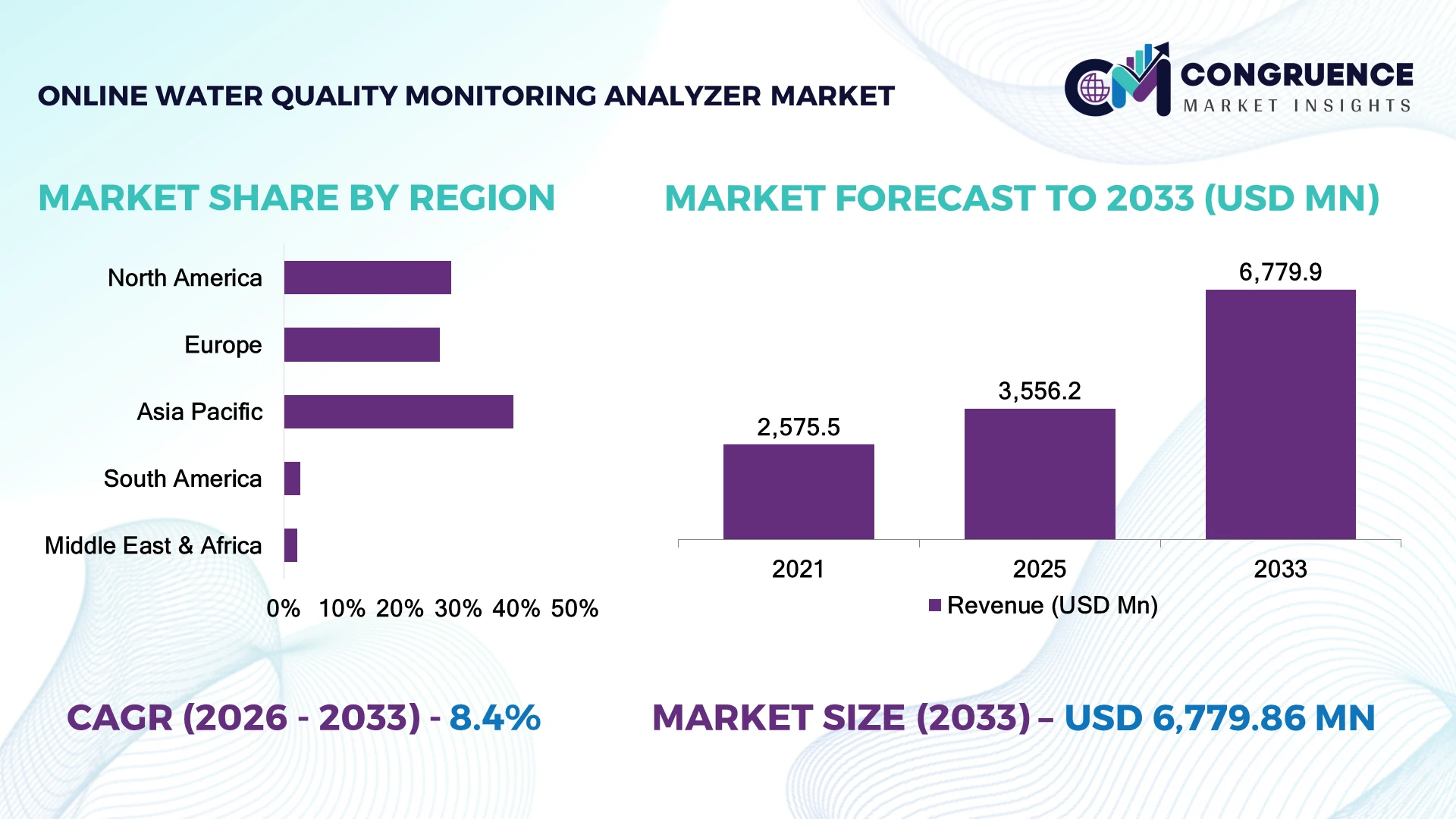
The Global Online Water Quality Monitoring Analyzer Market was valued at USD 3,556.2 Million in 2025 and is anticipated to reach a value of USD 6,779.9 Million by 2033 expanding at a CAGR of 8.4% between 2026 and 2033. Growth is driven by tightening industrial wastewater discharge standards, expansion of smart water infrastructure, and increasing deployment of real-time multi-parameter monitoring across municipal and industrial facilities.
China leads the Online Water Quality Monitoring Analyzer market with approximately 31% of global manufacturing capacity, supported by sustained investment in water treatment infrastructure, semiconductor-enabled sensor production, and industrial automation. Compared with the United States, China deploys nearly 2.4 times more continuous monitoring systems across municipal wastewater facilities, while approximately 64% of newly commissioned treatment plants incorporate online analyzers with IoT connectivity. Ongoing global supply-chain diversification following critical mineral sourcing realignments is accelerating localized production of sensing components and electronic modules.
Companies investing in intelligent analytics, localized manufacturing, and digital water management ecosystems are securing long-term competitive positioning in infrastructure modernization projects.
Market Size & Growth: USD 3,556.2 million in 2025 to USD 6,779.9 million by 2033 at 8.4% CAGR, driven by smart water infrastructure expansion.
Top Growth Drivers: Industrial wastewater monitoring (+33%), digital utilities (+29%), regulatory compliance (+25%).
Short-Term Forecast: By 2028, analyzer calibration time declines approximately 22% through automated diagnostics.
Emerging Technologies: AI analytics, IoT connectivity, optical sensing, and cloud-based monitoring platforms accelerate deployment.
Regional Leaders: Asia-Pacific, North America, and Europe lead adoption through utility modernization and industrial digitization.
Consumer/End-User Trends: Around 58% of water utilities prioritize continuous online monitoring over periodic sampling.
Pilot/Case Example: A 2026 smart water deployment reduced manual inspection requirements by approximately 31%.
Competitive Landscape: Leading suppliers collectively account for nearly 48% of global market activity.
Regulatory & ESG Impact: Continuous monitoring improves regulatory reporting efficiency by approximately 27%.
Investment & Funding: More than USD 2.8 billion supports digital water infrastructure and monitoring upgrades.
Innovation & Future Outlook: Predictive analytics and autonomous monitoring platforms strengthen operational resilience.
The Online Water Quality Monitoring Analyzer market is advancing through AI-enabled diagnostics, optical sensor technology, and cloud-integrated monitoring platforms that improve operational visibility across municipal and industrial water networks. Approximately 61% of newly installed analyzers now support remote monitoring and predictive maintenance. Rising infrastructure modernization and stricter compliance requirements are accelerating intelligent water quality management, setting the stage for broader strategic transformation.
The Online Water Quality Monitoring Analyzer market has become strategically important as utilities, industrial operators, and regulators prioritize continuous water quality intelligence over conventional laboratory-based testing. Infrastructure modernization, digital utility transformation, and stricter environmental compliance are reshaping procurement priorities toward intelligent monitoring systems capable of delivering real-time operational insights. Organizations increasingly view continuous analyzers as critical assets for risk reduction, operational continuity, and regulatory assurance.
Modern multi-parameter analyzers improve detection efficiency by approximately 28% while reducing manual sampling requirements by nearly 35% compared with traditional offline testing methods. China continues expanding large-scale smart water infrastructure deployments, whereas Germany emphasizes precision monitoring for industrial process optimization and environmental compliance. During the next two to three years, approximately 63% of new municipal water infrastructure projects are expected to integrate connected monitoring platforms with centralized supervisory control and predictive analytics capabilities.
Utilities and industrial enterprises are expanding partnerships with automation providers to integrate analyzers into digital control systems, enabling faster operational decisions and lower maintenance costs. Manufacturers are investing in modular sensor technologies, edge computing, and cloud-enabled software platforms to simplify deployment across distributed water assets. Companies combining advanced sensing accuracy, cybersecurity, digital interoperability, and lifecycle service capabilities will establish stronger competitive positioning as intelligent water management becomes an operational requirement rather than a compliance function.
Stricter industrial discharge regulations and continuous compliance monitoring requirements are accelerating deployment of online water quality monitoring analyzers across municipal utilities, semiconductor manufacturing, and process industries. Approximately 67% of newly commissioned wastewater treatment facilities now incorporate continuous multi-parameter analyzers, while automated monitoring reduces manual sampling frequency by nearly 38% and improves response time to contamination events by approximately 24%. India's expansion of smart water management programs is increasing procurement of connected monitoring systems for urban infrastructure. The operational shift toward continuous data acquisition enhances regulatory compliance and asset performance. Companies are expanding digital product portfolios, investing in intelligent sensor technologies, and partnering with automation providers to deliver integrated water quality monitoring solutions with predictive diagnostics.
Recurring sensor calibration, membrane replacement, and harsh operating environments continue limiting deployment efficiency for online water quality monitoring analyzers. Maintenance activities account for approximately 29% of total operating expenditure, while sensor fouling can reduce measurement accuracy by nearly 18% if preventive servicing is delayed. Industrial wastewater facilities in China frequently encounter accelerated sensor degradation due to high contaminant concentrations, increasing maintenance frequency and lifecycle costs. These conditions affect deployment scalability and service profitability for utilities and industrial operators. Manufacturers are responding through self-cleaning sensor technologies, localized service networks, predictive maintenance software, and long-term maintenance agreements that reduce operational interruptions and improve equipment reliability.
Artificial intelligence, edge computing, and digital twin technology are creating new opportunities for proactive water quality management beyond conventional monitoring. Approximately 54% of large utility modernization projects now evaluate predictive analytics platforms, while AI-assisted anomaly detection improves contaminant identification accuracy by nearly 27% and reduces unnecessary field inspections by approximately 22%. Singapore continues expanding intelligent water infrastructure through advanced digital monitoring initiatives integrated with centralized operational platforms. Technology providers are strengthening cloud software capabilities, expanding ecosystem partnerships, and investing in autonomous sensor networks. A significant strategic opportunity lies in delivering subscription-based water intelligence services that combine monitoring, predictive maintenance, and regulatory reporting through unified digital platforms.
Integrating online water quality analyzers with legacy SCADA systems, enterprise software, and multi-vendor digital infrastructure remains a critical execution challenge. Approximately 46% of utilities continue operating mixed-generation monitoring assets, while incompatible communication protocols increase integration effort by nearly 21%. Germany's industrial water treatment sector continues modernizing legacy infrastructure to support standardized digital communication across distributed monitoring assets. Fragmented interoperability limits operational consistency, slows modernization projects, and increases implementation complexity. Companies must strengthen cybersecurity, invest in open communication architectures, collaborate with automation vendors, and develop standardized software interfaces to achieve scalable deployment across increasingly connected water management environments.
Optical Sensors Replace Legacy Probes: Approximately 43% of newly installed online analyzers now utilize optical sensing technologies that reduce calibration frequency by nearly 25% while improving long-term measurement stability. Industrial automation upgrades are accelerating this transition. Manufacturers are expanding optical sensor production and strengthening technology partnerships to improve operational reliability.
Edge Analytics Gain Momentum: Nearly 48% of advanced monitoring installations now process water quality data at the network edge, reducing data transmission latency by approximately 32% and enabling faster operational decisions. Digital utility transformation is driving decentralized analytics. Companies are integrating edge computing with intelligent analyzer platforms to strengthen system responsiveness.
Modular Platforms Simplify Expansion: Around 39% of municipal modernization projects now deploy modular analyzer architectures capable of supporting additional sensing parameters without replacing installed infrastructure. Workforce shortages and maintenance efficiency requirements are encouraging standardized deployment strategies. Suppliers are redesigning platforms to enable faster installation and simplified lifecycle servicing.
Cybersecure Monitoring Becomes Standard: Approximately 45% of newly specified online water quality monitoring analyzers incorporate enhanced cybersecurity capabilities, reducing unauthorized network access risks by nearly 28%. Increasing digital integration across utility infrastructure is reshaping procurement priorities. Companies are embedding secure communication protocols and expanding software update capabilities to strengthen long-term operational resilience.
Multi-parameter analyzers account for approximately 58% of the Online Water Quality Monitoring Analyzer market due to their ability to measure pH, dissolved oxygen, conductivity, turbidity, and additional parameters through a single integrated platform. Their dominance is supported by lower lifecycle costs, simplified maintenance, centralized data management, and compatibility with SCADA and industrial automation systems. Single-parameter analyzers continue serving specialized industrial applications where measurement precision is prioritized, while nutrient-specific analyzers maintain strategic relevance for wastewater treatment and environmental compliance monitoring requiring targeted contaminant detection.
Optical analyzers represent the fastest-growing type as utilities and industrial operators transition toward low-maintenance, high-accuracy sensing technologies. Approximately 46% of newly commissioned smart water monitoring projects now specify optical sensing platforms, while automated calibration reduces maintenance interventions by nearly 24% and improves measurement stability by approximately 19%. Suppliers are expanding modular analyzer portfolios, investing in intelligent diagnostics, and strengthening automation partnerships to support digital water infrastructure. Investment is increasingly directed toward scalable analyzer platforms capable of supporting predictive monitoring and remote asset management.
A 2026 technical assessment by the International Water Association reported that integrated multi-parameter online analyzers are becoming the preferred deployment choice for digital utility modernization due to improved operational efficiency and centralized monitoring capabilities.
Wastewater treatment accounts for approximately 43% of Online Water Quality Monitoring Analyzer demand because continuous monitoring is essential for regulatory compliance, process optimization, and discharge quality assurance. Municipal treatment facilities rely on online analyzers to improve operational control while reducing manual sampling and laboratory dependence. Drinking water treatment remains another major application supported by increasing investment in smart utility infrastructure, while industrial process water monitoring continues expanding across power generation, pharmaceuticals, chemicals, and food processing operations requiring continuous quality verification.
Industrial process water monitoring is the fastest-growing application as manufacturers prioritize production efficiency, water reuse, and automated quality control. Nearly 41% of newly upgraded industrial facilities now integrate real-time online analyzers with centralized process automation systems, while predictive monitoring reduces unexpected process interruptions by approximately 18%. Equipment manufacturers are expanding cloud-enabled monitoring platforms, integrating advanced analytics, and scaling deployment through automation partnerships. Demand is increasingly shifting toward continuous monitoring systems that simultaneously improve operational reliability and regulatory compliance across complex industrial environments.
According to a 2025 enterprise survey conducted by the Water Environment Federation, continuous online monitoring is increasingly replacing periodic manual sampling within industrial wastewater operations to strengthen compliance and process optimization.
Municipal water and wastewater utilities account for approximately 49% of Online Water Quality Monitoring Analyzer procurement due to extensive treatment infrastructure, regulatory monitoring obligations, and continuous operational requirements. Large utility networks increasingly deploy integrated analyzer platforms across treatment plants, reservoirs, and distribution systems to improve process visibility and water quality management. Industrial facilities represent another major end-user group with strong demand from chemical manufacturing, power generation, and food processing operations, while environmental monitoring agencies continue expanding deployment for surface water surveillance and ecosystem protection.
Industrial enterprises are the fastest-growing end-user segment as digital manufacturing strategies increasingly incorporate continuous water quality intelligence into production workflows. Approximately 44% of newly modernized industrial water systems now deploy connected analyzers linked directly with process control platforms, reducing manual intervention by nearly 23%. Manufacturers are responding through industry-specific analyzer configurations, lifecycle service agreements, strategic automation partnerships, and subscription-based digital monitoring solutions. Future purchasing decisions are increasingly influenced by interoperability, predictive maintenance capabilities, and integrated compliance reporting rather than measurement functionality alone.
A 2026 utility infrastructure survey by the American Water Works Association found that digital water monitoring investments continue shifting toward networked online analyzers supporting real-time operational visibility, predictive maintenance, and centralized compliance management.
Asia-Pacific accounted for the largest market share at 39.4% in 2025 however, North America is expected to register the fastest growth, expanding at a CAGR of 9.1% between 2026 and 2033.
Digital Utility Modernization Accelerates Continuous Monitoring
North America accounts for approximately 28.7% of the Online Water Quality Monitoring Analyzer market, supported by advanced water infrastructure, industrial automation, and large-scale modernization of municipal utilities. Water operators are replacing periodic sampling with real-time monitoring networks capable of improving operational efficiency and regulatory compliance. Approximately 62% of newly upgraded municipal treatment facilities now integrate cloud-connected analyzers with centralized control systems. Industrial sectors including pharmaceuticals, semiconductors, and food processing are expanding deployment of continuous monitoring technologies to strengthen process control. Technology providers continue investing in AI-enabled analytics, cybersecurity, and integrated automation platforms while expanding partnerships with engineering firms to support large infrastructure modernization programs.
United States Market Outlook: The United States leads the regional market through extensive municipal utility upgrades, advanced industrial water management, and strong adoption of digital infrastructure. Utilities increasingly integrate online analyzers with SCADA, asset management, and predictive maintenance platforms to improve operational reliability. Approximately 67% of newly commissioned large-scale water infrastructure modernization projects include continuous online water quality monitoring systems, reinforcing long-term demand for advanced analyzer technologies.
Environmental Compliance Drives Intelligent Monitoring
Europe represents approximately 26.8% of global demand, supported by stringent environmental regulations, industrial wastewater monitoring requirements, and sustainable water resource management initiatives. Utilities and industrial operators continue deploying multi-parameter analyzers that improve process optimization and automated compliance reporting. Nearly 55% of newly modernized treatment facilities now utilize integrated digital water quality monitoring platforms. Equipment manufacturers are strengthening software capabilities, expanding sensor innovation, and collaborating with engineering contractors to support intelligent water infrastructure across municipal and industrial applications.
Germany Market Outlook: Germany remains the regional technology leader through advanced industrial automation, strong environmental engineering capabilities, and widespread deployment of intelligent water management systems. Manufacturing facilities increasingly implement continuous water quality monitoring to optimize production efficiency and regulatory compliance. Approximately 49% of advanced industrial wastewater treatment facilities now operate network-connected online analyzers integrated with enterprise automation systems.
Industrial Expansion Supports Large-Scale Deployment
Asia-Pacific contributes approximately 39.4% of the global Online Water Quality Monitoring Analyzer market through rapid industrialization, extensive municipal infrastructure investment, and expanding manufacturing capacity for analytical instruments. Governments continue modernizing wastewater treatment systems while industrial enterprises deploy intelligent monitoring platforms across chemicals, electronics, and power generation facilities. Approximately 59% of newly commissioned municipal water treatment projects incorporate continuous online monitoring systems. Manufacturers are increasing localized production, strengthening digital monitoring capabilities, and expanding exports of intelligent analytical equipment to international markets.
China Market Outlook: China dominates the regional market through large-scale water infrastructure development, advanced manufacturing capabilities, and widespread deployment of industrial monitoring systems. Municipal utilities and industrial operators continue expanding digital water management platforms to strengthen environmental compliance and operational efficiency. Approximately 64% of newly constructed large wastewater treatment facilities integrate multi-parameter online analyzers, reinforcing China's leadership in deployment scale and manufacturing capacity.
Industrial Water Compliance Expands Adoption
South America is steadily strengthening deployment of online water quality monitoring analyzers through modernization of municipal treatment facilities, mining operations, and industrial wastewater infrastructure. Growing environmental compliance requirements are increasing investment in continuous monitoring technologies that improve operational visibility and discharge management. Approximately 34% of recently upgraded industrial treatment facilities now utilize automated online analyzers linked with centralized process control. Technology suppliers continue expanding distributor partnerships, technical service capabilities, and localized support to improve deployment efficiency despite infrastructure disparities across national markets.
Brazil Market Outlook: Brazil leads regional adoption due to its extensive water treatment infrastructure, mining industry, and expanding industrial manufacturing sector. Water utilities and industrial operators continue investing in digital monitoring systems that strengthen regulatory reporting and operational control. Approximately 46% of South America's large industrial water monitoring deployments are concentrated in Brazil, supporting long-term demand for advanced analytical instrumentation.
Water Security Investments Drive Modernization
The Middle East & Africa market is advancing through sustained investment in desalination infrastructure, water reuse projects, and modernization of municipal water treatment systems. Governments are deploying online monitoring technologies to strengthen water security, improve operational efficiency, and optimize resource management across increasingly complex utility networks. Approximately 31% of recently commissioned desalination and advanced water treatment facilities now integrate continuous online analyzers for real-time process optimization. Equipment suppliers are strengthening regional partnerships, expanding engineering support, and introducing intelligent monitoring platforms tailored for harsh operating environments.
Saudi Arabia Market Outlook: Saudi Arabia remains the region's leading market through major investment in desalination capacity, industrial water infrastructure, and smart utility transformation. Water authorities increasingly deploy advanced online analyzers to support continuous monitoring across desalination plants and municipal distribution networks. Approximately 43% of new large-scale desalination projects incorporate integrated digital water quality monitoring systems, strengthening operational resilience and long-term infrastructure performance.
Global technology leaders including Hach, Xylem, Endress+Hauser, ABB, and Yokogawa compete directly on integrated digital monitoring platforms, while regional manufacturers challenge through cost-optimized analyzers and localized service capabilities. The top five players collectively account for approximately 47% of the global market. Competition is defined by analytical accuracy, cloud connectivity, lifecycle service, and deployment speed rather than hardware pricing alone. AI-enabled diagnostics reduce maintenance frequency by nearly 24%, optical sensing improves measurement stability by approximately 21%, and modular analyzer platforms shorten installation time by around 18%. Companies are expanding software ecosystems, acquiring sensor technology specialists, strengthening automation partnerships, and integrating remote asset management into water monitoring portfolios. Competitive advantage is shifting from standalone instrumentation toward intelligent monitoring networks combining analytics, cybersecurity, and predictive maintenance. Certification requirements, calibration expertise, and digital interoperability remain major entry barriers. Winning requires scalable digital platforms, reliable sensing performance, strong service infrastructure, and seamless integration with industrial automation ecosystems.
Xylem Inc.
Hach
Endress+Hauser
ABB Ltd.
Yokogawa Electric Corporation
Thermo Fisher Scientific Inc.
Emerson Electric Co.
HORIBA Ltd.
Metrohm AG
Shimadzu Corporation
Swan Analytical Instruments
Mettler Toledo
Bürkert Fluid Control Systems
Optical sensing, multi-parameter analyzers, IoT connectivity, and cloud-based monitoring platforms define the current technology landscape. Approximately 64% of newly deployed online analyzers support remote diagnostics and centralized monitoring, while optical sensor technology improves measurement stability by nearly 23% and reduces routine calibration requirements by approximately 19%. Continuous digital monitoring enables utilities and industrial operators to optimize treatment processes, reduce manual intervention, and strengthen regulatory compliance through real-time operational intelligence.
Emerging technologies include AI-driven anomaly detection, edge computing, digital twins, and autonomous sensor calibration integrated with SCADA and enterprise asset management systems. Compared with conventional electrochemical monitoring, advanced optical multi-parameter platforms improve analytical reliability by approximately 28% while lowering maintenance effort by nearly 20%. Companies offering integrated software, cybersecurity, and predictive maintenance capabilities gain a stronger competitive advantage than hardware-focused suppliers because customers increasingly prioritize lifecycle performance over individual instrument specifications.
Between 2026 and 2028, intelligent water monitoring ecosystems will accelerate adoption across municipal utilities, industrial manufacturing, and environmental monitoring networks. Connected analyzer deployment is expected to exceed 70% of new large-scale installations as utilities standardize digital infrastructure. Organizations investing now in AI-enabled analytics, interoperable communication protocols, edge intelligence, and modular sensor platforms will improve operational efficiency, reduce lifecycle costs, strengthen regulatory readiness, and secure long-term leadership in smart water infrastructure.
September 2025 Hach launched the EZ sc Series online analyzers with guided workflows, remote alerts, and expanded monitoring for organics, nutrients, and trace metals, reducing maintenance complexity while supporting broader process automation across municipal and industrial water facilities. Source: PR Newswire
March 2026 Endress+Hauser introduced the Liquiline Edge Module, enabling existing water treatment plants to connect measurement data securely to cloud platforms, simplifying digital retrofits and improving remote asset visibility without replacing installed analytical instrumentation. Source: Endress+Hauser
July 2026 Xylem acquired TriOS Mess- und Datentechnik GmbH, strengthening its real-time optical sensing portfolio for utilities and industrial users. The acquisition expands advanced monitoring capabilities as more than 40% of monitored global water bodies remain severely polluted. Source: Xylem YSI
July 2026 Hach introduced the DR4900 spectrophotometer featuring a 10-inch touchscreen with integrated temperature and turbidity diagnostics, improving measurement confidence and minimizing rework in municipal and industrial water laboratories. Source: Hach Product Communications.
This report provides a comprehensive assessment of the Online Water Quality Monitoring Analyzer market across analyzer types, monitoring technologies, applications, end-user industries, and major regional markets. It evaluates multi-parameter, single-parameter, optical, and electrochemical analyzer platforms deployed across municipal water treatment, industrial process monitoring, environmental surveillance, power generation, pharmaceuticals, and food processing. The analysis also examines AI-enabled diagnostics, cloud connectivity, edge computing, predictive maintenance, and intelligent automation technologies transforming continuous water quality monitoring.
The report evaluates competitive positioning, technology adoption, deployment strategies, manufacturing capabilities, and regional infrastructure development between 2026 and 2033. Approximately 60% of newly installed monitoring systems now support remote connectivity and centralized operational management, highlighting the industry's transition toward intelligent digital water networks. The study supports investment planning, market expansion, product development, partnership evaluation, competitive benchmarking, and long-term strategic positioning by identifying high-opportunity application segments, emerging technology trends, evolving customer requirements, and future deployment priorities across global water monitoring ecosystems.
| Report Attribute/Metric | Report Details |
|---|---|
|
Market Revenue in 2025 |
USD 3,556.2 Million |
|
Market Revenue in 2033 |
USD 6,779.9 Million |
|
CAGR (2026 - 2033) |
8.4% |
|
Base Year |
2025 |
|
Forecast Period |
2026 - 2033 |
|
Historic Period |
2021 - 2025 |
|
Segments Covered |
By Type
By Application
By End-User
|
|
Key Report Deliverable |
Revenue Forecast, Growth Trends, Market Dynamics, Segmental Overview, Regional and Country-wise Analysis, Competition Landscape |
|
Region Covered |
North America, Europe, Asia-Pacific, South America, Middle East, Africa |
|
Key Players Analyzed |
Xylem Inc., Hach, Endress+Hauser, ABB Ltd., Yokogawa Electric Corporation, Thermo Fisher Scientific Inc., Emerson Electric Co., HORIBA Ltd., Metrohm AG, Shimadzu Corporation, Swan Analytical Instruments, Mettler Toledo, Bürkert Fluid Control Systems |
|
Customization & Pricing |
Available on Request (10% Customization is Free) |




