
Reports
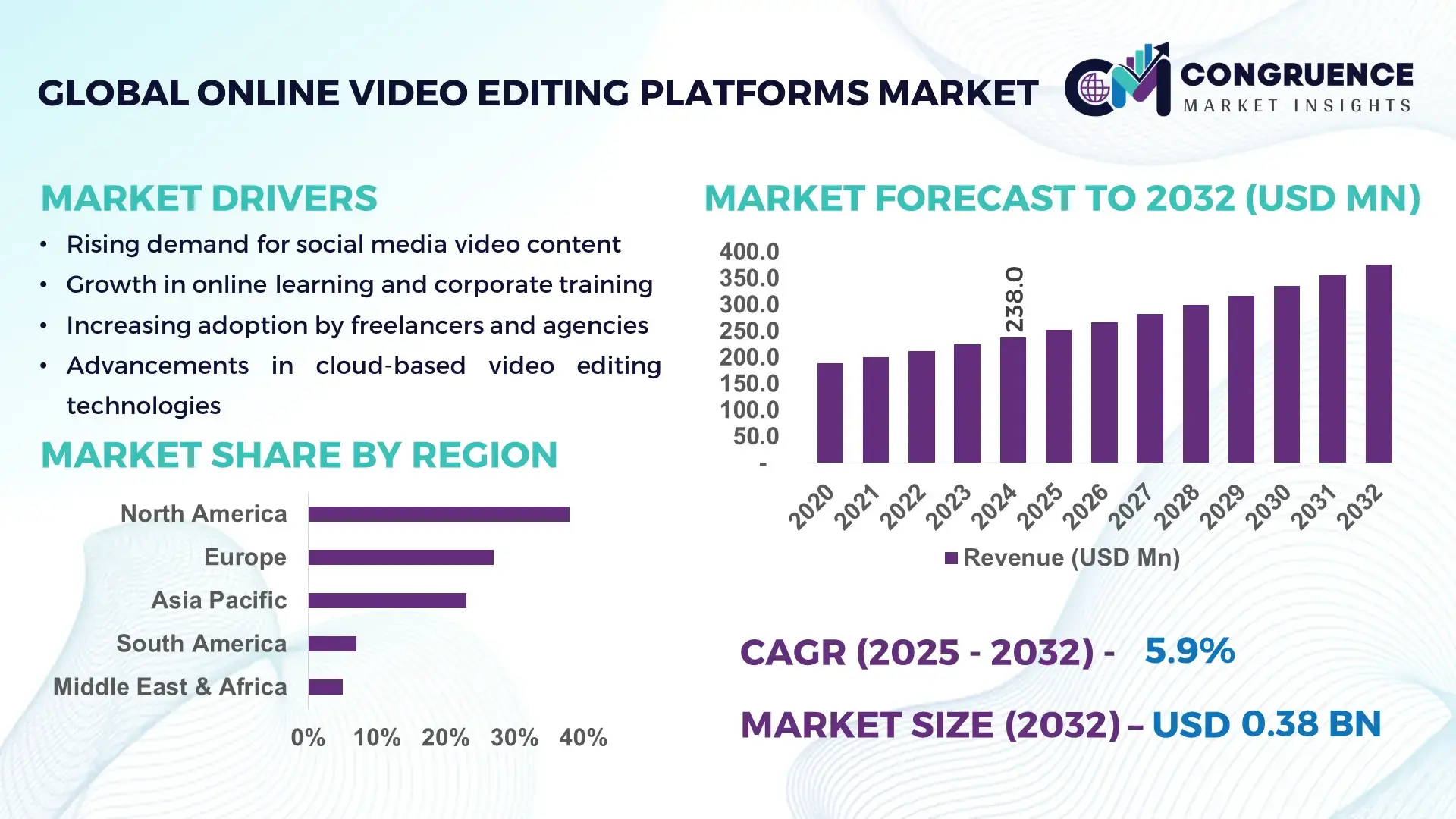
The Global Online Video Editing Platforms Market was valued at USD 238.0 Million in 2024 and is anticipated to reach a value of USD 376.5 Million by 2032, expanding at a CAGR of 5.9% between 2025 and 2032, according to an analysis by Congruence Market Insights. This growth reflects increasing demand for accessible, cloud‑based video editing tools across social media, enterprise content creation, and remote collaboration needs.
In terms of geographic dominance, the United States leads the market. The country demonstrates robust investment in cloud infrastructure and advanced editing platforms, with over 140 million active users of video editing apps in 2024 — accounting for roughly 22% of global consumption. Cloud‑based and browser‑based editing tools are heavily adopted by U.S. media companies, marketing agencies, educational institutions, and enterprises. Production capacity is high, with frequent releases of AI‑enabled editing software and scalable collaborative platforms, supporting large‑scale content creation across commercial, social‑media, and corporate sectors.
Market Size & Growth: Global market value estimated at USD 238.0 Million in 2024; projected to reach USD 376.5 Million by 2032 at a CAGR of 5.9%, driven by expanding demand for online video content and ease of cloud‑based editing.
Top Growth Drivers: 34% growth in social media video creation demand, 48% rise in remote content production workflows, 62% increase in enterprise digital communication needs.
Short-Term Forecast: By 2028, editing workflow efficiency expected to improve by up to 25% due to enhanced cloud collaboration and template‑based editing features.
Emerging Technologies: AI‑powered automated editing (auto‑cutting, scene detection), real‑time collaborative cloud editing, mobile-first browser-based editing tools.
Regional Leaders: North America – ~USD 150 M by 2032 (due to enterprise and professional creator demand); Asia‑Pacific – ~USD 90 M by 2032 (driven by rising social media adoption); Europe – ~USD 80 M by 2032 (steady growth in media and advertising sectors).
Consumer/End-User Trends: Growing adoption among small businesses, social‑media influencers, and educational institutions; rising use of mobile and browser‑based editors for short-form content and corporate communications.
Pilot or Case Example: In 2024, a U.S.-based media agency adopted a new AI‑enabled online editing platform and reported a 30% reduction in content production time within three months of deployment.
Competitive Landscape: Leading market player holds approximately 28% share; 3–5 major competitors occupy another 40–45%, while numerous niche and emerging players fill the remainder.
Regulatory & ESG Impact: Increasing data‑privacy regulations and cloud‑security compliance requirements; rising demand for energy‑efficient cloud infrastructure and sustainable software delivery practices.
Investment & Funding Patterns: Recent venture funding rounds worth over USD 120 million in 2024 focusing on AI‑powered editing tools, cloud‑native platforms, and mobile‑first video editing apps.
Innovation & Future Outlook: Continued integration of generative‑AI editing, real‑time collaboration, cross‑device synchronization, and automated content optimization — positioning online video editing platforms as essential tools for digital media, corporate communications, and social content workflows globally.
The market is witnessing continuous innovation in AI‑driven editing, collaborative cloud workflows, and mobile/browser-based accessibility, supporting diverse user needs from professional content creators to enterprises and casual users.
The Online Video Editing Platforms Market is increasingly leveraged by e‑learning, social media, digital marketing, corporate communications and entertainment sectors; recent innovations include AI-based auto-editing and collaborative cloud tools; regulatory focus on data security and sustainable cloud use is rising; regional consumption is shifting toward Asia‑Pacific due to mobile-first users; future growth is expected through generative‑AI, mobile‑browser editing, and deeper enterprise adoption.
The strategic relevance of the Online Video Editing Platforms Market lies in its role as a foundational infrastructure for digital content creation, marketing, education, and corporate communications. As video content becomes the dominant medium across social media, e‑learning, advertising, and internal enterprise communication, online editing platforms offer scalable, cost‑effective, and flexible tools compared to traditional desktop software. The shift from on‑premise editing suites to cloud-based and AI‑enabled platforms delivers substantial operational improvements: for example, AI‑powered auto-editing and scene detection can deliver up to 35% faster output compared to older manual editing workflows.
Regionally, North America dominates in volume, with high enterprise and professional creator usage, while Asia‑Pacific leads in rapid adoption among individual creators and small businesses, with over 1.1 million new users adopting browser-based and mobile‑first editing tools in 2024. This divergence presents dual pathways: established markets scaling enterprise-level collaboration and emerging markets driving user‑growth volumes.
In the next 2–3 years, generative‑AI editing tools are expected to improve content production efficiency by 25–30%, reducing editing time and lowering barriers for non-professional creators. Concurrently, firms will increasingly commit to ESG-compliant cloud operations — by 2027 many are expected to achieve at least 15% reduction in energy consumption per editing hour through optimized cloud infrastructure and recycling server workloads. For instance, in 2024 a leading U.S.-based media house deployed AI‑based cloud editing and achieved 30% reduction in editing time and 20% lower energy use per project.
Looking ahead, the market is positioned as a pillar of resilience and sustainable growth for digital media and enterprise content ecosystems. As AI‑driven automation, cloud scalability, and mobile accessibility converge, online video editing platforms will be central to supporting content‑heavy industries, enabling compliance with environmental and data‑security standards, and offering scalable tools adaptable to evolving content demands.
The Online Video Editing Platforms Market is undergoing rapid evolution driven by increasing content creation across social media, corporate communications, education, and entertainment sectors. As demand for video-based content surges globally, firms and individuals are shifting from traditional desktop editing software to cloud-based platforms that offer real-time collaboration, cross-device accessibility, and scalable workflows. The proliferation of high-speed internet, smartphones, and remote working arrangements has further accelerated adoption, enabling creators and enterprises worldwide to produce, edit, and distribute video content seamlessly. At the same time, technological innovations such as AI-enabled editing, auto-rendering, template-based workflows, and browser-based editing have democratized video editing — making it accessible even to casual users and non-professionals. The market dynamics are shaped by evolving end‑user behavior, technological progress, and increasing demand for agility, scalability, and content volume in digital operations.
The surge in demand for digital video content — fueled by social media platforms, online learning, corporate marketing, e‑commerce and entertainment — is a primary growth driver for the Online Video Editing Platforms Market. As more businesses and individuals seek to create videos for marketing, training, social sharing, and digital communication, the need for accessible, efficient editing tools increases. Cloud‑based and browser‑based editing platforms lower the barrier to entry, allowing creators without high-end hardware or deep technical skills to produce professional-quality video content. This democratization broadens the user base significantly. Enterprises adopting video marketing and e-learning modules increasingly rely on online editing platforms to generate and distribute video content at scale, supporting higher content volumes with lower cost and time investment.
Despite growth momentum, infrastructure and connectivity limitations — particularly in regions with unstable internet or lower broadband penetration — restrain adoption of online video editing platforms. Browser-based or cloud-based editing tools require stable, high-bandwidth internet connections, especially for uploading, rendering, and collaborating on high-resolution video files. In areas where internet speed is insufficient or data costs are high, users may experience latency, slow uploads/downloads, or inability to use advanced editing features — reducing their inclination to adopt online platforms. Additionally, enterprises in regions with unreliable connectivity may continue to rely on offline or desktop-based editing tools to ensure consistent performance and avoid disruptions, which limits the penetration of online editing solutions in those markets.
Rapid mobile internet penetration, especially in emerging markets, presents a significant opportunity for the Online Video Editing Platforms Market. As smartphones become ubiquitous and mobile‑first content creation grows, browser‑based and mobile‑optimized editing tools can tap into a large, underserved user base. The proliferation of social media content creation, influencer-driven marketing, and small business content needs in regions such as Asia‑Pacific and Latin America offers a scalable growth avenue. Online platforms can capture these users by offering low-cost or freemium models, lightweight editing tools, and ease of use — making video editing accessible without expensive hardware. With increasing demand for mobile-friendly features and collaborative editing among remote teams, online platforms are well-positioned to expand rapidly in regions where traditional desktop editing has limited reach.
Competition from free and low-cost editing tools poses a significant challenge to the Online Video Editing Platforms Market. Many basic editing applications, free browser‑based tools, and mobile apps offer sufficient functionality for casual creators, reducing the incentive to adopt premium or subscription‑based platforms. The wide availability of free tools lowers the entry barrier but also suppresses willingness to pay for advanced features — especially among casual users and small businesses. This limits revenue potential for online editing platform vendors and pressures them to continually innovate or differentiate with professional-grade features. As a result, monetization becomes more challenging, and platforms need to offer compelling value — such as AI‑powered automation, collaboration tools, cloud storage, consistent updates — to convert free‑tool users into paying customers.
Accelerated AI‑Driven Editing Automation: Editors increasingly rely on AI-powered features — such as auto‑cutting, scene detection, color correction, subtitle generation — which has boosted editing speed by roughly 30% and reduced manual effort across global platforms. The trend has made advanced editing accessible to non‑professional creators and small agencies that previously lacked resources for manual editing.
Surge in Cloud‑Based Collaborative Editing: More than 60% of video editing workflows among enterprises shifted to cloud-based collaborative platforms in the last 18 months, enabling remote teams across geographies to work simultaneously on projects — thereby cutting project turnaround times by approximately 25%.
Rise in Mobile and Browser‑First Editing Tools: With smartphone penetration rising in emerging markets, over 45% of new users in 2024 adopted mobile‑oriented online video editing apps, offering ease of editing on the go and broadening the user base beyond traditional desktop editors.
Growing Use in Corporate and Educational Video Production: Demand from corporate training, e‑learning, marketing, and internal communications increased by 38% in 2024, as organizations replaced traditional offline video editing with online platforms to streamline content production and distribution, improve consistency, and reduce production lead times.
The Online Video Editing Platforms Market is segmented based on type, application, and end-user, reflecting the diverse needs of content creators, enterprises, and media organizations. By type, platforms range from vision-language models and audio-text systems to video-language and hybrid systems, each catering to specific editing and automation requirements. Application-wise, segments include social media content creation, corporate communications, education, entertainment, and e-learning, each demonstrating distinct adoption patterns influenced by content volume, collaboration needs, and workflow efficiency. End-user segmentation captures professional creators, enterprises, educational institutions, freelancers, and hobbyists, highlighting the platform’s versatility and growing relevance across multiple industries and regions.
Vision-language models currently account for 42% of adoption, making them the leading type due to their advanced capability to automate scene recognition, captioning, and contextual video editing. Audio-text systems hold 25% of adoption, serving niches that require automated transcription and sound-based content management. Video-language models are experiencing the fastest growth, expected to surpass 30% adoption by 2032, driven by enhanced AI capabilities for summarizing video narratives and improving accessibility. Hybrid systems and other emerging types collectively contribute 8% of the market, catering to specialized workflows integrating multiple AI modalities.
Social media content creation dominates with 38% of adoption, driven by the demand for rapid, scalable, and professional-quality video production for platforms such as TikTok, YouTube, and Instagram. E-learning platforms are the fastest-growing application segment, benefiting from increased virtual learning adoption, personalized educational content, and interactive course creation, expected to achieve rapid expansion through 2032. Corporate communications, entertainment, and marketing applications collectively hold 24% of the market, supporting business workflows, promotional campaigns, and internal training initiatives. In 2024, more than 38% of enterprises globally reported piloting online video editing systems for corporate communication platforms. Additionally, over 60% of Gen Z consumers show higher trust in brands integrating AI-powered content creation tools.
Professional creators are the leading end-user segment, accounting for 40% of adoption due to their requirement for high-precision editing tools, real-time collaboration features, and AI automation. Freelancers and content agencies represent the fastest-growing segment, propelled by increasing demand for social media content, marketing campaigns, and e-learning modules. Educational institutions, enterprises, and hobbyists collectively comprise 20% of the market, leveraging online platforms for training, internal communications, and personal projects. In 2024, over 42% of media production firms in the U.S. adopted AI-assisted online video editing platforms to optimize post-production workflows.
North America accounted for the largest market share at 38% in 2024; however, Asia-Pacific is expected to register the fastest growth, expanding at a CAGR of 8.2% between 2025 and 2032.

In 2024, North America’s online video editing platforms market reached approximately 90 million users, supported by over 7,500 media and advertising agencies actively integrating AI-powered editing tools. Enterprise adoption is strong in healthcare, finance, and e-learning sectors, while over 60% of creative studios employ cloud-based collaborative platforms. Asia-Pacific has seen over 1.2 million new individual users of browser-based video editing tools, driven by mobile-first consumption, social media trends, and e-commerce content production. Europe accounted for 27% of regional consumption, with Germany, the UK, and France leading corporate and media adoption. South America contributed 12%, primarily in Brazil and Argentina, while Middle East & Africa accounted for 8% with UAE and South Africa leading in corporate and media production demand.
North America holds 38% of the global online video editing platforms market, driven by high enterprise adoption in healthcare, finance, and digital media. Regulatory frameworks promoting data security and privacy have accelerated cloud adoption, while technological advancements such as AI-assisted editing, automated scene detection, and collaborative cloud platforms enhance productivity. Companies like Adobe are expanding AI-based cloud solutions, offering real-time collaborative editing across devices. U.S. enterprises increasingly use browser-based editors for remote teams, while media agencies report that 65% of video campaigns now rely on online platforms. Regional consumer behavior indicates higher preference for professional-grade tools and real-time collaborative features compared to casual or individual use.
Europe accounts for 27% of the global market, with Germany, the UK, and France as key contributors. Regulatory compliance, such as GDPR, has fostered demand for secure, explainable AI-based editing platforms. Emerging technologies including real-time collaborative editing, AI-powered auto-captioning, and hybrid cloud solutions are increasingly adopted. Local players, such as Blackmagic Design’s European branches, are integrating advanced video automation into professional workflows. Corporate and educational users prioritize regulatory-compliant platforms, while regional consumer trends indicate a strong focus on privacy, sustainability, and explainable AI features for both professional and creative applications.
Asia-Pacific holds 23% of the global online video editing platforms market by volume. Top consuming countries include China, India, and Japan, driven by social media, e-commerce, and educational content creation. Infrastructure trends show rapid adoption of cloud computing and AI-driven editing platforms in urban centers, while innovation hubs in Tokyo, Shanghai, and Bengaluru are developing localized AI tools. Local players, such as Tencent and Bytedance, are integrating video-language models into mobile apps, supporting over 1.2 million new users in 2024. Consumer behavior indicates preference for mobile-friendly, automated editing tools and rapid sharing capabilities for social media and commercial content.
South America accounts for 12% of the global market, led by Brazil and Argentina. Demand is closely tied to media production, language localization, and marketing content creation. Regional infrastructure supports cloud-based solutions with increasing broadband coverage in urban areas. Government incentives promote digital media startups and content platforms. Local players, such as Globosat in Brazil, are incorporating AI-assisted editing for broadcasting and social media campaigns. Consumer behavior reflects rising adoption among influencers, marketing agencies, and educational institutions, emphasizing localized content, multilingual editing, and mobile-first access.
Middle East & Africa holds 8% of the global market, with the UAE and South Africa leading adoption. Regional demand is fueled by corporate communications, media production, and digital marketing sectors. Technological modernization includes AI-driven video automation, cloud-based collaborative platforms, and mobile-friendly editing solutions. Local regulations and trade partnerships encourage adoption of secure, compliant platforms. Companies like MediaPro in UAE are leveraging AI-based editing to streamline enterprise content production. Consumer behavior varies, with high interest in corporate, advertising, and media production applications, emphasizing compliance, efficiency, and multilingual capabilities.
United States - 38% Market Share: Dominance driven by high production capacity, extensive professional user base, and widespread enterprise adoption.
China - 20% Market Share: Strong end-user demand from social media and e-commerce content creation, supported by local AI-based platform development.
The competitive environment in the Online Video Editing Platforms Market remains moderately fragmented, with a substantial number of active competitors — more than 60 firms globally — vying for user acquisition, enterprise contracts, and innovation leadership. Among these, the top 5 companies together control an estimated 50–55% of the market, reflecting a mix of strong incumbents and rising challengers.
Many players are pursuing aggressive strategic initiatives: product launches, AI‑feature rollouts, acquisitions, and partnerships to enhance their platform capabilities and expand reach. For instance, established firms are integrating AI‑based editing, script generation, and cloud collaboration tools to stay relevant, while newer entrants focus on social‑media friendly, mobile‑first editing workflows and template-driven user experiences.
Innovation trends — especially generative-AI editing, real‑time collaboration, cloud-native architecture, and user‑friendly interfaces — are reshaping the competitive landscape. Companies are differentiating via automation (auto‑cutting, auto-captioning, noise suppression), collaboration (multi-user editing, cloud storage), and ease of use (drag‑and‑drop, template libraries).
Because many vendors address overlapping needs (professional creators, enterprises, small businesses, influencers), competition is intense on features, pricing, user experience, and infrastructure scalability. As a result, the market is neither fully consolidated around a monopoly nor highly fragmented with only minor players — it sits in a middle ground where a handful of major players hold significant share while a long tail of niche and emerging players compete aggressively.
Looking ahead, market positioning will likely tilt in favor of those combining advanced AI‑powered editing, enterprise-grade collaboration, and scalable cloud infrastructure — vendors making strategic investments now may cement leadership over the next years. The dynamic competitive pressures and rapid technological change make ongoing innovation and adaptability critical for survival.
Vimeo, Inc.
Kapwing, Inc.
Canva Pty Ltd.
Lumen5, Inc.
InVideo Software Limited
Current and emerging technologies are rapidly transforming online video editing platforms. Major innovation revolves around AI-powered editing — including features such as automated script generation, automatic removal of filler words and pauses, auto-captioning/subtitle generation, noise suppression, background removal, and auto‑formatting for different aspect ratios (e.g., vertical for social media, horizontal for YouTube). These capabilities reduce manual editing burdens and accelerate production cycles, making platforms viable even for non‑professional creators.
Cloud-native architecture is another critical enabler. By leveraging cloud infrastructure, platforms support real-time collaboration, cross-device access (desktop, mobile, web), and secure storage of large video assets. This enables distributed teams — marketing agencies, educational institutions, media houses — to work together remotely, increasing efficiency and scalability.
More advanced workflows are being enabled by generative‑AI and multimodal models. For example, emerging research like systems based on natural-language or sketch-based editing commands shows promise in letting users specify edits via text or drawings, dramatically lowering the skill barrier for complex editing. Similarly, experimental tools for spatial audio manipulation make it easier to create immersive video experiences without requiring full audio‑engineering expertise.
Integration with content‑production ecosystems is also expanding. Platforms are incorporating asset libraries (stock video, music, effects), template-based workflows optimized for social media or corporate storytelling, and features such as version control, metadata generation (titles, descriptions, SEO tags), and automated formatting for multiple output requirements.
For business users, enterprise‑grade features are gaining traction: centralized asset and rights management, multi‑user collaboration with permission control, white‑label branding, and compliance/security controls for organizations in regulated industries. These enhancements make online editing platforms competitive alternatives to traditional desktop-based editing suites for corporate video production.
In sum, the combined effect of AI automation, cloud infrastructure, generative editing, multimodal interfaces, and enterprise-grade collaboration is reshaping the video editing market — lowering barriers, enabling scale, and expanding the user base from niche professionals to everyday creators, businesses, educators, and agencies.
In Spring 2024, Vimeo rolled out a new AI suite including “Chat with video,” automatic highlight‑reel generation, auto‑generated captions/titles/tags/chapters, and AI‑powered video analytics — enabling enterprises and creators to streamline editing workflows and video management under one platform. Source: www.vimeo.com
In 2024, Clipchamp (owned by Microsoft) introduced several AI-driven editing enhancements: an AI-powered “silence removal” tool to trim silent sections, improved audio libraries, new vector shape overlays, customizable backgrounds, and enhanced user‑interface features — improving editing convenience for both casual users and enterprises. Source: www.techcommunity.microsoft.com
In 2024, Canva expanded its Magic Media and video editing capabilities: the video editor now includes AI-powered “Highlights” for auto‑selecting best parts of footage, “Magic Video” for automated social‑ready video creation, enhanced voice‑over and background‑noise reduction, and simplified workflows for social media and marketing content creators. Source: www.canva.com
In 2024, Adobe Premiere Pro (from Adobe) introduced its first publicly available video‑editing workflows powered by the new Firefly Video Model (beta), including “Generative Extend” for filling footage gaps automatically, and substantial performance improvements including up to 3× faster export speeds and context‑sensitive editing tools — significantly enhancing professional video editing productivity. Source: www.adobe.com
This market report on Online Video Editing Platforms covers a comprehensive array of segments including deployment modes (cloud-based, web-based, mobile‑first), technology types (AI‑driven editing, template-based editors, generative tools, collaboration‑enabled platforms), and end-use applications (social media content creation, corporate communications, e‑learning & education, digital marketing, entertainment, training/HR videos). The geographic scope spans all major regions — North America, Europe, Asia‑Pacific, South America, Middle East & Africa — highlighting regional consumption patterns, infrastructure variations, and adoption behaviors.
The report also catalogs end‑user segments such as professional creators, SMEs, agencies, educational institutions, enterprises, and individual content developers. It examines both lightweight editing tools for casual creators and full-featured platforms for enterprises and media houses. In addition, the report explores emerging niche segments — such as AI‑generated video workflows, multimodal editing interfaces (text/sketch-based editing), interactive video editing, and spatial‑audio enhancement — which represent growing innovation frontiers.
Technology focus areas include cloud-native video editing, collaborative editing and asset management, AI-assisted content creation and optimization (script generation, auto-captioning, auto-formatting), generative video creation and augmentation, and platform integrations with content distribution, marketing, and enterprise communication ecosystems.
By combining segmentation across technology, deployment mode, application, geography, and end-user type, this report offers decision-makers and analysts a broad yet detailed view of the online video editing sector’s structure, key trends, competitive landscape, and future opportunities.
| Report Attribute / Metric | Details |
|---|---|
| Market Revenue (2024) | USD 238.0 Million |
| Market Revenue (2032) | USD 376.5 Million |
| CAGR (2025–2032) | 5.9% |
| Base Year | 2024 |
| Forecast Period | 2025–2032 |
| Historic Period | 2020–2024 |
| Segments Covered |
By Type
By Application
By End-User Insights
|
| Key Report Deliverables | Revenue Forecast, Market Trends, Growth Drivers & Restraints, Technology Insights, Segmentation Analysis, Regional Insights, Competitive Landscape, Recent Developments, Regulatory Overview |
| Regions Covered | North America, Europe, Asia-Pacific, South America, Middle East & Africa |
| Key Players Analyzed | Adobe Inc., Microsoft Clipchamp, FlexClip, WeVideo, Inc., Vimeo, Inc., Kapwing, Inc., Canva Pty Ltd., Lumen5, Inc., InVideo Software Limited |
| Customization & Pricing | Available on Request (10% Customization Free) |




