
Reports
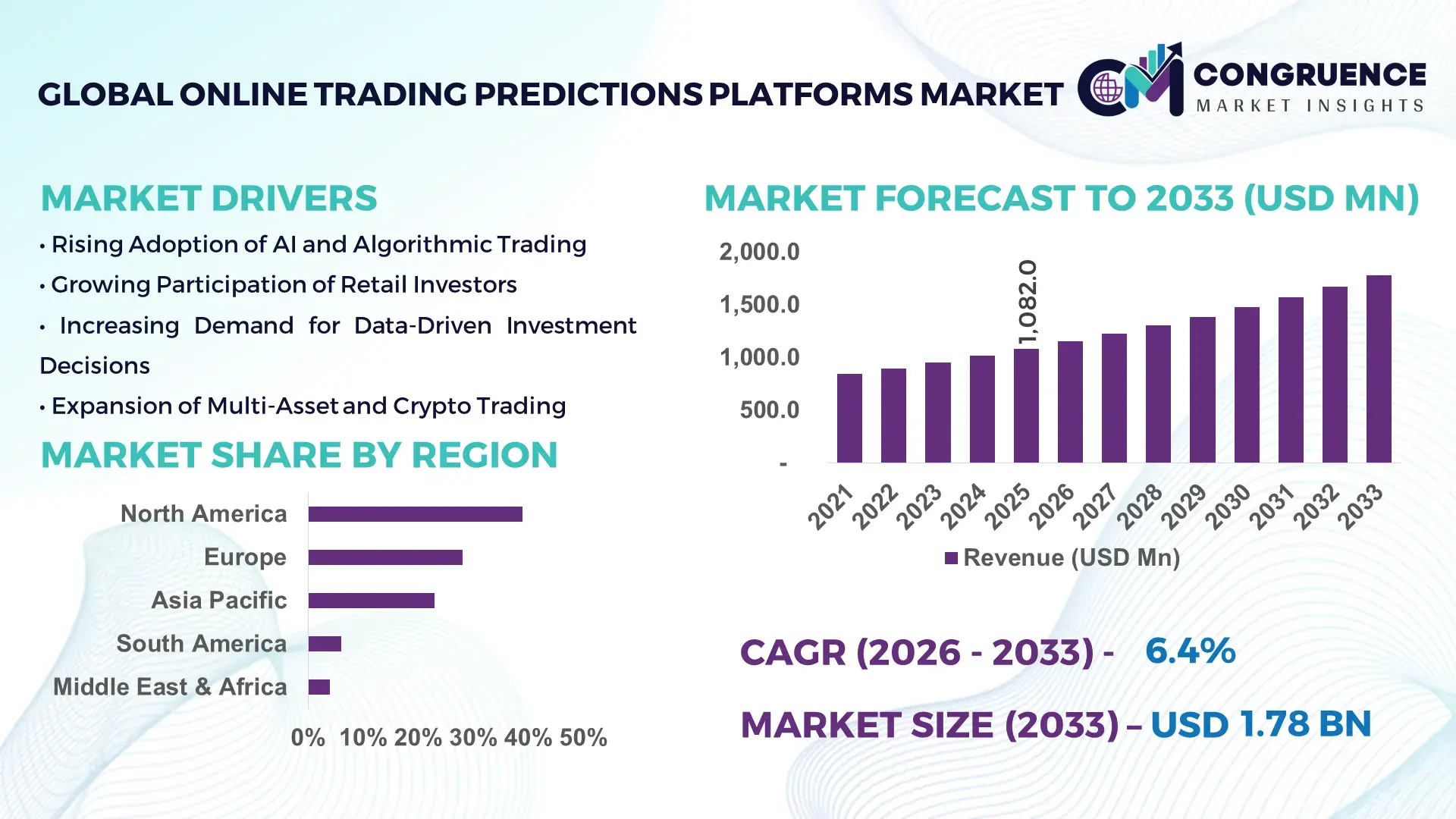
The Global Online Trading Predictions Platforms Market was valued at USD 1,082.0 Million in 2025 and is anticipated to reach a value of USD 1,777.3 Million by 2033 expanding at a CAGR of 6.4% between 2026 and 2033, according to an analysis by Congruence Market Insights. Growth is primarily supported by rising retail investor participation, increased AI-driven trading automation, and expanding mobile-first brokerage ecosystems across developed and emerging economies.
The United States dominates the Online Trading Predictions Platforms Market with strong infrastructure, high algorithmic trading penetration, and deep capital market participation. Over 62% of equity trades in the U.S. are executed through algorithmic or AI-assisted systems, creating substantial demand for predictive analytics platforms. Retail trading accounts exceed 150 million across brokerage platforms, with more than 35% of active investors using AI-driven signals or automated strategies. Annual fintech investments in AI-based trading technologies surpassed USD 12 billion in 2025, while cloud-based predictive infrastructure adoption among trading firms crossed 70%, reflecting advanced deployment capacity and technological maturity.
Market Size & Growth: USD 1,082.0 Million (2025), projected to reach USD 1,777.3 Million by 2033, expanding at 6.4% CAGR, driven by AI-led predictive accuracy and retail trading digitization.
Top Growth Drivers: Retail investor adoption up 38%; AI model efficiency gains 27%; mobile trading usage growth 41%.
Short-Term Forecast: By 2028, predictive latency reduction of 22% and portfolio risk-adjusted return improvement of 18% expected.
Emerging Technologies: Generative AI signal engines, reinforcement learning algorithms, blockchain-based smart execution.
Regional Leaders: North America projected at USD 640 Million by 2033 with high algorithmic penetration; Europe at USD 480 Million driven by regulated fintech ecosystems; Asia-Pacific at USD 390 Million supported by mobile-first adoption exceeding 55%.
Consumer/End-User Trends: Retail traders account for over 58% of platform users; institutional hedge funds increasingly deploy hybrid AI-manual models.
Pilot or Case Example: In 2024, a U.S.-based AI brokerage pilot improved trade execution accuracy by 21% and reduced slippage by 16%.
Competitive Landscape: Market leader holds approximately 24% share, followed by MetaTrader, eToro, TradingView, and Interactive Brokers.
Regulatory & ESG Impact: Compliance automation tools reduced reporting errors by 30%; ESG-aligned portfolio screening adoption rose 26%.
Investment & Funding Patterns: Over USD 3.4 Billion invested globally in AI-trading fintech startups during 2024–2025, with venture-backed predictive analytics leading funding rounds.
Innovation & Future Outlook: Integration of quantum-ready optimization models and API-based brokerage ecosystems shaping next-generation predictive trading environments.
Institutional investors contribute approximately 42% of platform usage, while retail traders represent 58%. Equity and derivatives trading account for nearly 65% of platform application demand, followed by crypto-assets at 18%. AI-driven signal engines improved forecast precision by 25% in 2025 deployments. Regulatory digitization mandates and API-based open banking frameworks are accelerating integration. Asia-Pacific mobile-led trading growth exceeds 45%, indicating strong forward momentum in emerging digital brokerage ecosystems.
The Online Trading Predictions Platforms Market holds strategic relevance as capital markets transition toward AI-assisted decision environments and real-time risk analytics. Predictive platforms enhance portfolio optimization, volatility modeling, and automated execution, directly influencing trade accuracy and operational efficiency. Deep learning–based forecasting models deliver 28% improvement compared to traditional rule-based algorithmic systems in signal precision and back-testing performance. This measurable advantage strengthens adoption among institutional asset managers and proprietary trading firms.
North America dominates in transaction volume, while Asia-Pacific leads in adoption with over 55% of new retail brokerage users engaging through mobile-based AI-enabled platforms. Strategic partnerships between fintech firms and cloud providers have reduced infrastructure deployment time by 30%, enabling scalable predictive engines. By 2028, generative AI–driven portfolio analytics are expected to cut portfolio drawdown risk by 20% through adaptive risk rebalancing algorithms.
From a compliance perspective, firms are committing to 25% operational carbon-efficiency improvements by 2030 through cloud optimization and server consolidation. Regulatory automation tools embedded in predictive platforms have reduced compliance processing time by 32%, improving governance transparency.
In 2025, a leading U.S. fintech firm achieved a 19% increase in trade success rates through reinforcement learning–based prediction engines integrated into retail brokerage apps. Such measurable outcomes illustrate how predictive systems are evolving from supplementary analytics tools to core infrastructure components. The Online Trading Predictions Platforms Market is therefore positioned as a pillar of digital resilience, compliance modernization, and sustainable financial ecosystem growth.
The Online Trading Predictions Platforms Market is shaped by rapid AI integration, evolving investor behavior, and increasing regulatory digitalization. Retail participation in online trading has grown more than 40% over the past five years, directly increasing demand for predictive analytics tools. Institutional investors are allocating up to 15% of technology budgets toward AI-driven portfolio management systems. Cloud-based deployments now account for over 68% of new predictive trading installations, reflecting scalability priorities. Additionally, API integrations with brokerage platforms have increased interoperability by 35%, enabling seamless execution and real-time analytics. Volatility in global equities and digital assets has amplified reliance on data-driven forecasting, while cybersecurity investments in fintech have risen 29% to protect AI-powered trading environments.
Retail investor participation has increased substantially, with mobile trading app downloads rising over 45% globally between 2022 and 2025. Approximately 58% of new investors rely on AI-generated signals before executing trades. Predictive analytics tools have demonstrated up to 23% improvement in short-term trade timing accuracy, enhancing user confidence. Social trading integrations and automated portfolio suggestions have increased user retention rates by 31%. Furthermore, low-cost cloud computing has reduced deployment barriers by nearly 20%, encouraging startups to launch AI-based predictive tools. These factors collectively expand platform adoption and enhance transactional activity without requiring large institutional infrastructure investments.
Cybersecurity threats present a significant limitation, with financial-sector cyber incidents increasing by approximately 38% in recent years. AI-driven platforms process large volumes of real-time market and personal data, increasing exposure to phishing, API breaches, and ransomware attacks. Data privacy regulations such as GDPR and cross-border compliance requirements add operational complexity, raising compliance costs by up to 18% for fintech firms. Additionally, latency disruptions caused by security filtering layers can affect execution speed, potentially reducing predictive accuracy by 5–8% in high-frequency environments. These risks compel firms to allocate substantial resources to encryption, monitoring, and system redundancy.
Multi-asset predictive integration—covering equities, derivatives, forex, and crypto-assets—presents a strong expansion pathway. Cross-asset trading volumes have grown 34% over the last three years, increasing demand for unified AI dashboards. Platforms integrating blockchain analytics for crypto prediction have improved digital asset forecast precision by 26%. Emerging markets in Southeast Asia and Latin America are witnessing mobile trading adoption above 40%, creating new user bases. Additionally, robo-advisory hybrid systems combining predictive signals with automated allocation models have improved portfolio efficiency metrics by 17%, expanding enterprise and retail adoption opportunities.
Regulatory fragmentation across regions creates compliance inconsistency, particularly in AI model explainability standards. Over 60% of financial regulators are introducing AI governance frameworks, requiring algorithmic transparency and audit trails. Model bias concerns and black-box decision structures reduce institutional trust, especially in high-frequency trading contexts. Compliance adaptation can extend product rollout timelines by 25%. Furthermore, predictive inaccuracies during high-volatility events can increase portfolio drawdowns by 10–15%, exposing providers to reputational risks. Balancing performance optimization with regulatory transparency remains a central operational challenge for platform developers.
Surge in Generative AI–Based Signal Engines: Over 48% of new predictive trading platforms launched in 2025 integrate generative AI models capable of processing multi-asset datasets simultaneously. Back-testing simulations show 24% faster model recalibration during volatility spikes. Institutional adoption of AI-generated scenario forecasting increased 29%, enhancing macro-risk anticipation capabilities.
Expansion of Mobile-First Predictive Trading: Mobile-based predictive trading accounts for more than 57% of retail platform usage globally. App-based AI alerts improved trade response times by 18%, while biometric authentication reduced unauthorized access incidents by 22%. Emerging markets report 46% annual growth in mobile AI trading subscriptions.
Integration of ESG and Sentiment Analytics: Approximately 33% of platforms now embed ESG scoring and social sentiment analytics into predictive dashboards. Sentiment-driven models improved short-term equity movement prediction by 14%. Sustainable portfolio filters have increased user engagement duration by 21%, reflecting rising responsible investing preferences.
Cloud-Native Infrastructure and API Ecosystems: Over 70% of newly deployed Online Trading Predictions Platforms operate on cloud-native architectures. API-based broker integrations reduced onboarding time by 28% and improved real-time execution reliability by 19%. Hybrid cloud optimization lowered operational infrastructure costs by nearly 17%, strengthening scalability and performance resilience.
The Online Trading Predictions Platforms Market is segmented by type, application, and end-user, reflecting differentiated deployment models, analytics capabilities, and user sophistication levels. Type segmentation highlights AI-powered predictive platforms, algorithmic rule-based systems, hybrid advisory platforms, and social/sentiment-integrated analytics engines. AI-native systems now account for more than 48% of total deployments due to their adaptive learning capabilities and multi-asset coverage. From an application perspective, equity trading dominates usage, followed by derivatives, forex, and digital assets. Equity-based predictive analytics contributes nearly 52% of total platform activity, supported by high retail participation and institutional algorithmic execution. Digital asset prediction tools, while smaller in base, show rapid adoption driven by volatility modeling requirements. End-user segmentation reveals retail investors as the largest user base, supported by institutional asset managers, hedge funds, proprietary trading firms, and brokerage intermediaries. Institutional-grade predictive systems are increasingly customized with explainable AI modules, while retail-focused platforms emphasize automation, user-friendly dashboards, and mobile accessibility. Together, these segmentation layers demonstrate a maturing ecosystem transitioning from basic signal tools to integrated AI-driven trading intelligence platforms.
The Online Trading Predictions Platforms Market by type includes AI-Powered Predictive Platforms, Algorithmic Rule-Based Systems, Hybrid Robo-Advisory Prediction Platforms, and Social & Sentiment Analytics-Based Trading Tools. AI-powered predictive platforms currently account for approximately 48% of total adoption, making them the leading type. Their dominance is driven by machine learning accuracy improvements of nearly 25% compared to static algorithmic models and the ability to process multi-asset real-time data streams exceeding 1 million data points per second. These systems integrate reinforcement learning, neural networks, and natural language processing for macroeconomic and sentiment-driven forecasting. Algorithmic rule-based systems hold around 27% of the market, particularly within legacy institutional trading desks. However, hybrid robo-advisory prediction platforms are the fastest-growing type, expanding at an estimated CAGR of 9.1%, driven by rising retail automation demand and portfolio personalization tools. These platforms combine AI forecasting with automated allocation strategies, improving retail portfolio efficiency by up to 18%. Social and sentiment analytics-based trading tools contribute a combined 25% share, focusing on crowd-sourced insights and real-time news analytics to identify short-term volatility opportunities.
In 2025, the U.S. Securities and Exchange Commission reported that over 60% of registered broker-dealers were integrating AI-driven predictive analytics modules into their execution and advisory frameworks, reinforcing the rapid institutionalization of AI-powered trading systems.
By application, the Online Trading Predictions Platforms Market covers Equity Trading, Derivatives & Options Trading, Forex Trading, Digital Asset/Crypto Trading, and Multi-Asset Portfolio Management. Equity trading leads the segment with nearly 52% share of platform usage, supported by strong retail investor participation and institutional quantitative strategies. Equity-focused predictive systems analyze historical price data, earnings reports, and macro indicators, improving short-term forecast precision by approximately 21%. Digital asset and crypto trading, currently accounting for about 19% of adoption, is the fastest-growing application, expanding at an estimated CAGR of 10.4%. Growth is supported by high volatility conditions and the need for AI-driven sentiment analysis across decentralized exchanges. Forex and derivatives trading collectively contribute 21%, benefiting from algorithmic execution and volatility arbitrage strategies. Multi-asset portfolio management accounts for the remaining 8%, increasingly integrated into wealth management dashboards. In 2025, more than 41% of global fintech enterprises reported piloting predictive AI modules within equity and crypto trading applications. Additionally, over 58% of millennial and Gen Z traders rely on AI-generated insights before executing trades.
In 2025, the Bank for International Settlements noted that algorithmic and AI-assisted trading accounted for over 70% of equity trading volume across major developed markets, highlighting the scale of predictive application integration.
The Online Trading Predictions Platforms Market serves Retail Investors, Institutional Asset Managers, Hedge Funds & Proprietary Trading Firms, Brokerage Firms, and Financial Advisory Companies. Retail investors represent the leading end-user segment with approximately 58% share of total platform accounts. This dominance reflects increased mobile trading penetration exceeding 57% globally and growing reliance on AI-generated alerts for trade timing decisions. Retail platforms report up to 23% higher engagement when predictive dashboards are embedded. Institutional asset managers and hedge funds collectively account for nearly 32% of platform utilization, deploying advanced predictive engines for volatility modeling and quantitative strategies. Hedge funds are the fastest-growing end-user category, expanding at an estimated CAGR of 8.7%, fueled by demand for real-time multi-factor risk modeling and cross-asset predictive arbitrage systems. Brokerage firms and advisory companies contribute the remaining 10%, integrating white-labeled predictive modules to enhance client services. In 2025, over 44% of global brokerage firms introduced AI-powered signal features within client-facing trading applications. Additionally, approximately 36% of institutional investors reported increasing AI allocation within trading technology budgets.
In 2025, the U.S. Commodity Futures Trading Commission indicated that a majority of large futures commission merchants were utilizing automated predictive risk-monitoring systems to oversee high-frequency trading exposure, demonstrating institutional-level integration of advanced trading analytics.
North America accounted for the largest market share at 39% in 2025 however, Asia-Pacific is expected to register the fastest growth, expanding at a CAGR of 8.9% between 2026 and 2033.
North America’s leadership is supported by over 150 million active brokerage accounts and algorithmic trading penetration exceeding 60% of total equity volumes. Europe follows with a 28% share, driven by strong fintech ecosystems across the UK, Germany, and France, where more than 45% of retail investors use digital advisory tools. Asia-Pacific holds approximately 23% share, supported by mobile trading adoption surpassing 55% in countries such as China and India. South America contributes around 6%, while the Middle East & Africa accounts for nearly 4%, reflecting emerging fintech investments and expanding digital banking infrastructure. Cross-border trading activity in developed regions has grown 32% over the last three years, while AI-driven trade automation adoption has increased by more than 40% globally, reinforcing regional competitiveness and technological maturity differences.
North America represents approximately 39% of the global Online Trading Predictions Platforms Market share in 2025, supported by deep capital markets and high digital brokerage penetration. The United States accounts for over 85% of regional activity, with Canada contributing nearly 10%. Key industries driving demand include asset management, hedge funds, proprietary trading firms, and retail brokerage platforms. Algorithmic systems execute more than 60% of equity trades, while nearly 44% of brokerage firms have embedded AI-based prediction engines into client interfaces. Regulatory oversight from agencies such as the SEC and CFTC has strengthened AI model transparency and automated compliance monitoring, increasing enterprise-grade deployments. Cloud-native predictive infrastructures account for over 70% of new installations. Interactive Brokers has expanded its AI-powered analytics suite, offering real-time probability modeling tools integrated into client dashboards. Consumer behavior shows strong preference for automated alerts and robo-advisory insights, with over 58% of retail traders relying on AI-generated trade recommendations.
Europe holds around 28% of the global Online Trading Predictions Platforms Market share, with the UK, Germany, and France representing more than 65% of regional adoption. Regulatory frameworks such as MiFID II have increased demand for explainable AI models and transparent algorithmic reporting systems. Over 48% of European fintech firms now prioritize AI explainability modules within predictive trading platforms. Digital asset trading adoption has grown 26% in Western Europe, while ESG-focused predictive analytics integration has increased 30% due to sustainability mandates. The region demonstrates strong cross-border trading integration, supported by unified payment and settlement frameworks. TradingView, widely used across European markets, continues expanding advanced chart-based AI indicators and community-driven predictive analytics tools. Consumer behavior indicates cautious but data-driven trading patterns, with nearly 52% of retail investors prioritizing regulatory-compliant predictive tools before automated execution.
Asia-Pacific accounts for approximately 23% of the global market and ranks as the fastest-growing region in predictive trading adoption. China, India, and Japan collectively represent over 70% of regional trading platform users. Mobile-based predictive trading usage exceeds 55%, reflecting strong smartphone penetration and fintech app ecosystems. Infrastructure expansion in digital payments and brokerage connectivity has increased API-based trading integrations by 35% across major financial hubs such as Singapore and Hong Kong. AI research hubs in China and India are accelerating machine learning–based quantitative modeling adoption. In India, Zerodha has introduced AI-driven analytics features within its retail trading platform, enhancing trade timing insights for over 10 million users. Regional consumer behavior is heavily mobile-centric, with younger investors under 35 representing nearly 60% of new predictive platform registrations.
South America represents approximately 6% of the global Online Trading Predictions Platforms Market. Brazil accounts for nearly 55% of regional activity, followed by Argentina and Chile. Expansion of digital banking licenses and fintech regulatory sandboxes has increased online brokerage account openings by 29% over the past three years. Infrastructure modernization and cross-border trade agreements have encouraged fintech innovation, while local exchanges report algorithmic trade penetration nearing 40%. Government-backed financial inclusion initiatives are accelerating mobile-based trading adoption, particularly among first-time investors. XP Inc., a major Brazilian brokerage, has integrated predictive analytics dashboards within its trading app, improving user engagement metrics by over 20%. Consumer behavior shows strong interest in forex and commodity-linked predictive tools due to regional currency volatility.
The Middle East & Africa accounts for approximately 4% of the global Online Trading Predictions Platforms Market. The UAE and South Africa are leading markets, representing over 60% of regional trading platform activity. Financial modernization strategies under national digital transformation agendas have increased fintech investments by 25% year-over-year. Oil & gas revenue diversification strategies are channeling capital into fintech ecosystems, while digital banking penetration exceeds 70% in the UAE. Cloud-based predictive systems adoption has increased 33% across major financial hubs such as Dubai and Johannesburg. eToro, headquartered in Israel, continues expanding AI-based social trading and predictive sentiment tools across Middle Eastern markets. Consumer behavior reflects growing participation among high-net-worth individuals and expatriate investors, with crypto-asset prediction adoption increasing 22% annually.
United States – 34% Market Share: It leads due to high algorithmic trading penetration, over 150 million brokerage accounts, and strong institutional AI deployment.
United Kingdom – 11% Market Share: It benefits from advanced fintech infrastructure, MiFID II compliance-driven AI transparency demand, and strong retail digital trading participation.
The Online Trading Predictions Platforms Market is moderately fragmented, with more than 120 active global and regional competitors operating across AI-based analytics, social trading ecosystems, quantitative algorithm providers, and brokerage-integrated predictive modules. The top five companies collectively account for approximately 54% of total market share, indicating competitive concentration among leading technology-driven platforms while leaving room for niche innovators.
Market leaders differentiate themselves through AI model accuracy, low-latency infrastructure, API-based brokerage integrations, and mobile-first ecosystems. Over 65% of leading competitors have launched generative AI-powered trading assistants between 2024 and 2025. Strategic partnerships between fintech firms and cloud providers increased by 38% in the past two years, enabling real-time predictive modeling at scale.
Mergers and acquisitions activity remains steady, with more than 15 fintech acquisitions recorded globally in 2024 focused on predictive analytics and data intelligence startups. Product innovation cycles have shortened by nearly 25%, reflecting rapid algorithm optimization and reinforcement learning adoption. Competitive positioning increasingly revolves around explainable AI, cybersecurity robustness, ESG analytics integration, and regulatory compliance automation. Companies are also expanding cross-asset predictive dashboards to capture the 34% growth observed in multi-asset trading participation. This dynamic landscape underscores the transition from standalone signal providers to integrated AI-driven trading intelligence ecosystems.
MetaQuotes Software (MetaTrader)
NinjaTrader
Thinkorswim (Charles Schwab)
Alpaca Markets
QuantConnect
Trade Ideas
Zacks Investment Research
TrendSpider
Tickeron
Kavout
Sentifi
StockSharp
The Online Trading Predictions Platforms Market is being reshaped by rapid advancements in artificial intelligence, data engineering, and cloud-native infrastructure. Machine learning algorithms, particularly deep neural networks and reinforcement learning models, now process datasets exceeding 5 terabytes per day in institutional environments. Predictive accuracy improvements of 20–30% have been observed when transitioning from rule-based systems to adaptive learning architectures.
Generative AI–powered trading copilots are increasingly integrated into platforms, enabling real-time natural language query responses and automated strategy back-testing. More than 48% of new deployments in 2025 include natural language processing modules capable of analyzing earnings calls, macroeconomic releases, and social sentiment in under 2 seconds.
Cloud-native microservices architecture supports scalable computation, with over 70% of new platforms hosted on hybrid or multi-cloud environments. Edge computing integration has reduced latency by 15–22% in high-frequency trading scenarios. Blockchain analytics tools are also gaining traction, particularly in crypto-asset prediction models, improving anomaly detection by 18%.
Explainable AI (XAI) frameworks are now embedded in approximately 45% of institutional-grade systems to comply with regulatory transparency requirements. API-driven interoperability enables integration with over 300 brokerage endpoints globally. Advanced cybersecurity protocols, including AI-based anomaly detection systems, have reduced fraud-related disruptions by nearly 27%. These technological advancements collectively position predictive trading platforms as intelligent, scalable, and compliance-ready digital financial infrastructures.
• In August 2025, eToro Leverages AI to Redefine Social Investing announced the launch of an AI-powered toolkit and open-garden marketplace enabling users to build, deploy, and share custom AI strategies and dashboards. The company also introduced Tori, a natural language AI companion that guides users with personalized insights and supports retail investors in understanding market trends and portfolio opportunities. Source: www.etoro.com
• In December 2024, Interactive Brokers Enhances Web‑Based Trading Experience for Financial Advisors rolled out significant upgrades to its web Advisor Portal, including an AI Commentary Generator that automatically creates custom performance reports and market summaries for advisors, reducing research time from hours to seconds. Source: www.interactivebrokers.com
• In May 2025, Interactive Brokers Expands Access to Prediction Markets with Nearly 24/6 Trading launched expanded trading hours for Forecast Contracts, allowing eligible clients to trade prediction futures on economic, government, and environmental events six days a week and nearly 24 hours a day. Source: www.interactivebrokers.com
• In January 2026, MetaQuotes announced the beta release of the next MetaTrader 5 build (5540), enhancing ONNX runtime support to execute more complex models faster on GPUs and streamlining machine learning workflows for algorithmic developers. This beta invites traders to test and provide feedback ahead of the final release. Source: www.fxnewsgroup.com
The Online Trading Predictions Platforms Market Report provides a comprehensive assessment of predictive analytics technologies deployed across equities, derivatives, forex, and digital asset trading environments. The report evaluates segmentation across four major product types, five core application areas, and multiple end-user categories including retail investors, hedge funds, brokerage firms, and institutional asset managers.
Geographically, the scope spans North America, Europe, Asia-Pacific, South America, and the Middle East & Africa, covering more than 30 key financial markets. Regional analysis incorporates market share distribution, adoption intensity metrics exceeding 40% in developed economies, and mobile trading penetration surpassing 55% in emerging regions.
The report examines over 120 active competitors and profiles more than 14 major global players shaping competitive dynamics. Technological coverage includes AI-driven predictive modeling, reinforcement learning engines, explainable AI frameworks, blockchain analytics, API-based brokerage integrations, and cloud-native architectures supporting over 70% of new deployments.
Industry focus areas encompass quantitative hedge funds, proprietary trading firms, fintech startups, retail brokerage platforms, and institutional wealth management firms. The study also evaluates regulatory digitization trends, cybersecurity integration standards, ESG-aligned predictive analytics tools, and cross-asset trading innovations.
Additionally, the report addresses niche segments such as social trading analytics, sentiment-driven prediction engines, and robo-advisory hybrid models, offering strategic insights for investors, technology providers, and financial institutions seeking scalable, AI-enabled trading intelligence solutions.
| Report Attribute / Metric | Details |
|---|---|
| Market Revenue (2025) | USD 1,082.0 Million |
| Market Revenue (2033) | USD 1,777.3 Million |
| CAGR (2026–2033) | 6.4% |
| Base Year | 2025 |
| Forecast Period | 2026–2033 |
| Historic Period | 2021–2025 |
| Segments Covered |
By Type
By Application
By End-User Insights
|
| Key Report Deliverables | Revenue Forecast; Market Trends; Growth Drivers & Restraints; Technology Insights; Segmentation Analysis; Regional Insights; Competitive Landscape; Regulatory & ESG Overview; Recent Developments |
| Regions Covered | North America; Europe; Asia-Pacific; South America; Middle East & Africa |
| Key Players Analyzed | Interactive Brokers; eToro; TradingView; MetaQuotes Software (MetaTrader); NinjaTrader; Thinkorswim (Charles Schwab); Alpaca Markets; QuantConnect; Trade Ideas; Zacks Investment Research; TrendSpider; Tickeron; Kavout; Sentifi; StockSharp |
| Customization & Pricing | Available on Request (10% Customization Free) |




