
Reports
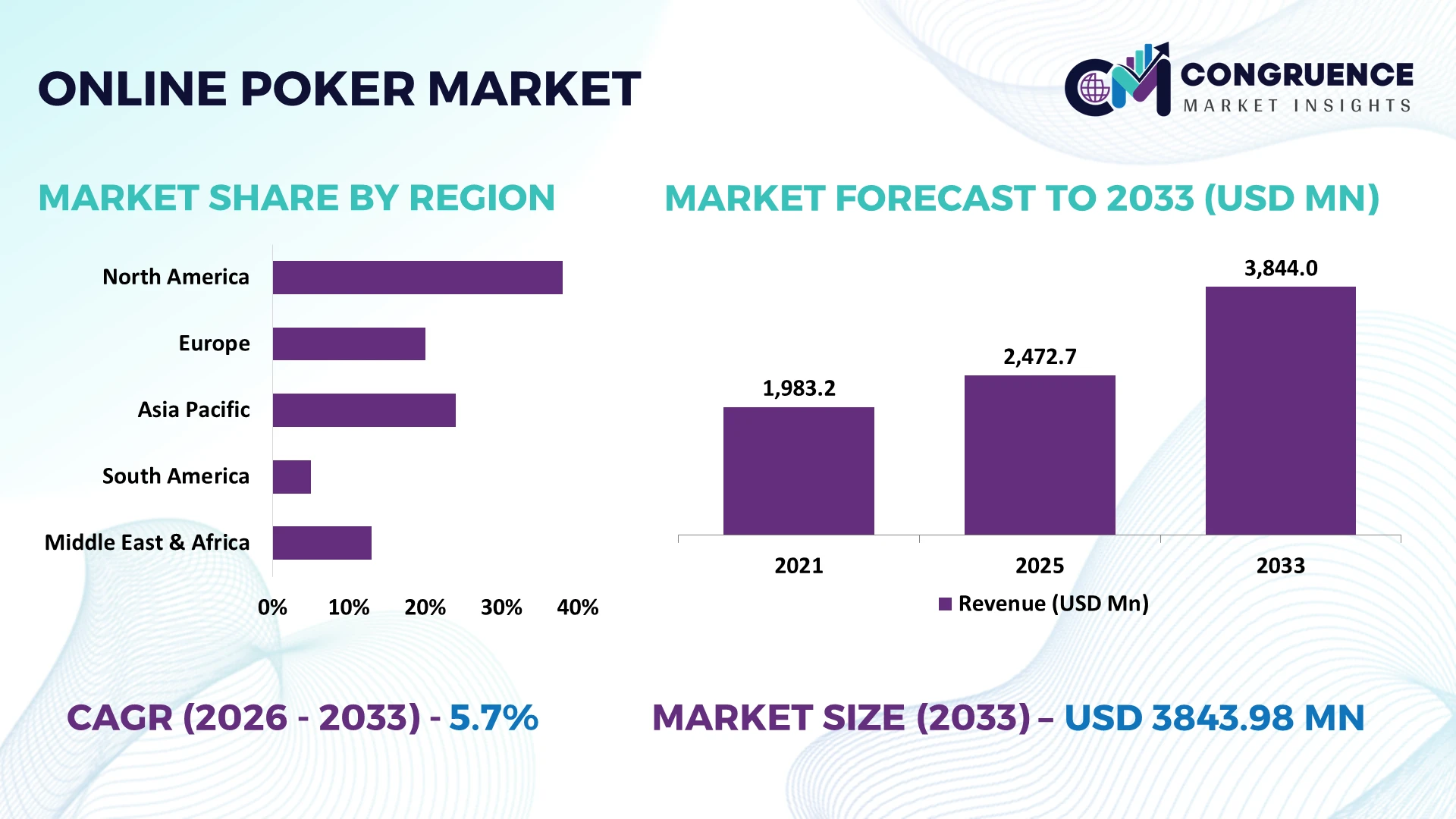
The Global Online Poker Market was valued at USD 2472.67 Million in 2025 and is anticipated to reach a value of USD 3843.98 Million by 2033 expanding at a CAGR of 5.67% between 2026 and 2033. Growth is primarily supported by secure digital payment ecosystems, AI-powered fraud detection, expanding mobile gaming penetration, and regulated online gambling frameworks across major economies.
The United States remains the leading market, accounting for approximately 31% of global regulated online poker activity, supported by multi-state player liquidity, advanced fintech integration, and investments exceeding USD 1 billion in regulated iGaming infrastructure. In comparison, the United Kingdom contributes nearly 11% through mature licensing systems and over 85% digital payment adoption, while evolving regulatory reforms across Europe continue to reshape competitive positioning amid tighter compliance standards in 2026.
Businesses should prioritize regulated jurisdictions, scalable gaming technology, and compliance-driven expansion to secure sustainable long-term market positioning.
Market Size & Growth: USD 2472.67 million in 2025, reaching USD 3843.98 million by 2033 at 5.67% CAGR, supported by AI-enabled gaming security and expanding regulated digital platforms.
Top Growth Drivers: Mobile gaming penetration exceeds 72%, digital wallet usage surpasses 68%, and AI fraud detection improves security efficiency by 35%.
Short-Term Forecast: By 2028, automated player verification reduces onboarding time by 40% while compliance processing efficiency increases by 30%.
Emerging Technologies: AI analytics, blockchain-based payment verification, and real-time behavioral monitoring improve operational accuracy by over 25%.
Regional Leaders: North America approaches USD 1.45 billion, Europe exceeds USD 1.10 billion, and Asia-Pacific nears USD 0.85 billion through expanding regulated digital ecosystems.
Consumer/End-User Trends: More than 70% of players access poker through smartphones, while live tournament participation rises approximately 18% annually.
Pilot/Case Example: A 2025 AI-driven responsible gaming deployment reduced fraudulent transactions by 32% and improved player retention by 16%.
Competitive Landscape: The leading operator holds approximately 14% market share alongside several global gaming technology providers competing through platform innovation and regional expansion.
Regulatory & ESG Impact: Enhanced digital compliance frameworks lower suspicious transaction reporting time by nearly 28%, strengthening regulated market transparency across key jurisdictions.
Investment & Funding: Global investments exceed USD 2 billion, driven by platform modernization, strategic partnerships, and expansion into newly regulated gaming markets.
Innovation & Future Outlook: AI-powered personalization, cloud-native gaming infrastructure, and omnichannel tournament ecosystems accelerate high-growth competitive differentiation amid continued regional regulatory expansion.
Online Poker Market demand continues to strengthen across mobile-first gaming platforms, cross-border tournament ecosystems, and secure digital payment environments. AI-powered responsible gaming tools, real-time fraud analytics, and personalized player engagement improve platform performance, with automated monitoring increasing operational efficiency by approximately 30%. Regulatory modernization across several jurisdictions in 2026 further supports scalable expansion, setting the foundation for the following strategic market discussion.
The Online Poker Market has become strategically important as regulated digital gaming expands into new jurisdictions and operators compete through technology, compliance, and player engagement rather than promotional spending alone. Regulatory modernization across countries including the United States and Brazil is reshaping licensing priorities, while digital identity verification and cashless payment infrastructure reduce onboarding friction. More than 75% of regulated operators now prioritize AI-based monitoring as responsible gaming standards become central to competitive differentiation.
Cloud-native gaming platforms process player sessions approximately 40% faster than legacy on-premise systems while lowering infrastructure maintenance costs by nearly 25%. The United Kingdom continues to lead in compliance-driven platform innovation, whereas India records faster mobile-user expansion through affordable smartphones and digital payment adoption. Over the next two to three years, AI-assisted risk management is expected to automate more than 60% of routine fraud detection workflows, enabling operators to allocate greater resources toward customer retention and tournament innovation.
A leading deployment trend involves integrating AI-driven responsible gaming tools with real-time behavioral analytics, allowing operators to detect high-risk activity while maintaining uninterrupted gameplay. Companies are expanding technology partnerships, investing in scalable cloud infrastructure, and pursuing regulated market entry to strengthen operational resilience. Organizations that combine compliance excellence with advanced digital capabilities will secure stronger competitive positioning as online poker evolves into a technology-led entertainment ecosystem.
Regulated mobile gaming remains the primary structural driver for the Online Poker Market as smartphone penetration exceeds 72% across major gaming economies and digital wallet usage surpasses 68% among active players. The continued legalization of online gaming in selected U.S. states has accelerated platform investments and encouraged operators to deploy AI-powered identity verification that shortens account approval times by nearly 35%. This combination of regulatory progress and digital infrastructure strengthens player acquisition while reducing compliance costs. Leading companies are expanding localized platforms, forming payment partnerships, and investing in advanced fraud prevention technologies, creating scalable operating models that improve retention and increase long-term competitive advantage.
Divergent licensing rules and taxation policies continue to restrict efficient market expansion, requiring operators to maintain separate compliance frameworks across jurisdictions. Compliance-related operating expenses account for nearly 18% of platform costs in regulated markets, while jurisdiction-specific certification can extend launch timelines by over 30%. Germany and several European markets illustrate how evolving regulatory standards increase operational complexity for cross-border operators. Companies are mitigating these pressures by establishing localized compliance teams, adopting modular gaming platforms, and negotiating long-term technology partnerships that simplify certification. Strong regulatory adaptability has become a decisive operational capability for sustaining profitability and deployment efficiency.
Advanced artificial intelligence is creating new monetization opportunities through personalized tournaments, predictive player engagement, and automated responsible gaming systems. AI-powered recommendation engines improve player retention by approximately 22%, while automated customer support resolves nearly 65% of routine queries without human intervention. Brazil and India represent attractive expansion markets as digital payment adoption and smartphone connectivity continue to strengthen regulated gaming ecosystems. Operators are increasing investment in cloud-native platforms, machine learning, and localized content partnerships to capture underserved player segments. Early investment in intelligent platform ecosystems provides measurable operational efficiency while strengthening long-term market differentiation.
Maintaining secure, uninterrupted gaming environments has become a long-term execution challenge as transaction volumes and real-time multiplayer activity continue to rise. Approximately 45% of gaming operators have increased cybersecurity budgets, while AI-based threat detection reduces fraudulent transaction response times by nearly 30%. The United States places growing emphasis on data privacy compliance and continuous platform monitoring, increasing technical complexity for operators managing multi-state networks. Companies must strengthen zero-trust security architectures, modernize cloud infrastructure, and expand cybersecurity partnerships to ensure consistent performance. Sustainable competitive leadership increasingly depends on resilient digital operations rather than platform scale alone.
AI-Driven Player Protection AI-powered behavioral monitoring is becoming a core operational capability, with automated fraud detection improving identification accuracy by nearly 35% and reducing manual compliance reviews by approximately 40%. Updated responsible gaming requirements in the United Kingdom and selected U.S. jurisdictions are accelerating deployment. Operators are integrating machine learning with identity verification platforms, improving trust, reducing operational overhead, and strengthening long-term player retention.
Mobile-First Tournament Expansion Mobile participation now exceeds 70% of total online poker sessions, while in-app tournament registrations have increased by nearly 28% over the past two years. Improved 5G connectivity and biometric authentication have shortened login times by around 30%. Platform providers are restructuring product development around mobile-exclusive tournaments, lightweight applications, and localized payment integrations to improve user engagement and operational scalability.
Cloud-Native Platform Modernization Cloud migration enables operators to process concurrent gaming traffic approximately 45% more efficiently while lowering infrastructure maintenance costs by nearly 25%. Technology modernization is replacing legacy hosting environments across regulated markets. Companies are expanding cloud partnerships, automating software deployment, and implementing continuous platform monitoring to increase service reliability during high-volume tournament activity and peak transaction periods.
Localized Compliance Automation Regulatory fragmentation is driving investment in configurable compliance technologies capable of adapting to jurisdiction-specific licensing requirements. Automated reporting systems reduce regulatory processing time by about 32%, while digital KYC verification improves onboarding efficiency by nearly 38%. Operators are expanding compliance partnerships and modular platform architectures, allowing faster entry into newly regulated markets without major operational restructuring.
Texas Hold'em remains the dominant segment, accounting for approximately 54% of global online poker activity due to standardized tournament formats, broad player familiarity, and strong compatibility with digital tournament ecosystems. Its scalability allows operators to support large player pools while maintaining stable platform performance and efficient matchmaking. Omaha Poker is the fastest-growing format, recording adoption growth exceeding 18% as experienced players seek higher strategic complexity and increased engagement. Operators are expanding Omaha tournaments and promotional events to diversify player acquisition while strengthening retention among advanced users.
Tournament Poker continues to reinforce competitive ecosystems through scheduled championship events, while Fast-Fold Poker gains traction by reducing waiting time by nearly 45%, increasing hands played per hour. Seven-Card Stud remains a niche but strategically valuable offering for premium player communities and legacy markets. Platform providers continue investing in AI-powered matchmaking, personalized tournament recommendations, and multi-format ecosystems to optimize engagement across all game types while balancing acquisition and lifetime player value.
Mobile Gaming leads the Online Poker Market with approximately 46% of total player activity, driven by smartphone accessibility, digital wallets, and seamless authentication technologies. Continuous improvements in application optimization and real-time gameplay have increased average daily engagement by nearly 24%. Live Dealer Poker represents the fastest-growing application, supported by high-definition streaming technology and immersive interactive experiences that strengthen player loyalty and premium participation.
Cash Games remain operationally important because they generate consistent daily player traffic and stable platform utilization. Tournaments continue attracting competitive communities through scheduled events and progressive prize structures, while Desktop Gaming maintains relevance among professional players requiring multi-table capabilities and advanced analytical tools. Operators are scaling cross-platform synchronization, AI-based personalization, and integrated payment ecosystems to create consistent experiences regardless of device or gameplay format.
Individual Players remain the largest end-user segment, representing approximately 61% of market participation due to widespread smartphone adoption, secure digital payments, and expanding regulated online gaming access. Personalized gameplay, loyalty systems, and AI-driven recommendations have increased player retention by nearly 20%. Poker Platforms are the fastest-growing end-user group as operators increasingly outsource platform technology, compliance infrastructure, and cloud-based gaming services to improve operational efficiency and accelerate deployment.
Gaming Operators continue investing in automation, fraud detection, and responsible gaming capabilities to strengthen regulatory compliance and customer retention. Casino Operators increasingly integrate online poker with omnichannel gaming ecosystems, while Esports & Gaming Organizations are expanding branded tournaments to attract younger digital audiences. Companies are responding through ecosystem partnerships, modular pricing strategies, localized platform customization, and technology investments that strengthen competitive positioning across diverse customer groups.
North America accounted for the largest market share at 38.4% in 2025 however, Asia-Pacific is expected to register the fastest growth, expanding at a 7.2% between 2026 and 2033.
Strategic Leadership Through Regulatory Expansion and Digital Gaming Infrastructure
North America maintains the highest concentration of regulated online poker platforms, supported by advanced payment infrastructure, multi-state liquidity agreements, and strong enterprise investment in cloud-native gaming technologies. The region represents approximately 38.4% of global market activity, with the United States and Canada leading deployment of AI-enabled fraud detection, identity verification, and responsible gaming systems. More than 80% of licensed operators have integrated real-time compliance monitoring into core platform operations. Strategic partnerships between gaming operators and fintech providers continue improving payment processing speed while strengthening regulatory compliance. Enterprise investment remains focused on scalable platform architecture, cybersecurity modernization, and personalized player engagement capabilities that increase operational efficiency and long-term competitiveness.
United States Market Outlook: The United States remains the region's operational center due to expanding state-level regulation, mature digital payment ecosystems, and strong technology infrastructure. More than seven regulated jurisdictions operate shared or standalone online poker frameworks, while AI-assisted verification has reduced onboarding processing time by approximately 35%. Operators continue investing in cloud infrastructure, responsible gaming technologies, and interstate liquidity expansion to strengthen player acquisition and improve long-term platform utilization.
Compliance-Driven Innovation Strengthens Market Stability
Europe remains one of the most mature online poker environments, accounting for approximately 31% of global market participation through harmonized digital infrastructure, established licensing frameworks, and high consumer trust in regulated gaming platforms. Countries continue modernizing responsible gaming standards while expanding AI-supported compliance systems that reduce manual monitoring workloads by nearly 30%. Operators increasingly consolidate technology platforms to improve operational consistency across multiple jurisdictions. Advanced payment integration, secure authentication technologies, and automated reporting solutions enable faster regulatory adaptation while maintaining high platform availability. Strategic technology modernization has become a defining competitive factor across Europe's regulated online poker ecosystem.
United Kingdom Market Outlook: The United Kingdom continues to lead through advanced regulatory oversight, strong enterprise investment, and widespread digital payment adoption exceeding 85%. Gaming operators increasingly deploy behavioral analytics, automated compliance monitoring, and responsible gaming technologies to meet evolving regulatory expectations. Continuous investment in cloud infrastructure and cybersecurity enables operators to maintain high platform reliability while expanding premium tournament offerings and personalized player engagement services.
Mobile-First Expansion Accelerates Digital Adoption
Asia-Pacific is emerging as the fastest-expanding online poker market through rapid smartphone penetration, digital payment innovation, and expanding cloud infrastructure. The region contributes nearly 22% of global activity, with mobile gameplay accounting for over 75% of user sessions in several leading digital markets. AI-powered localization, multilingual interfaces, and lightweight gaming applications enable operators to improve player accessibility while reducing infrastructure costs. Strategic partnerships between gaming technology providers and payment companies continue supporting scalable deployment. Strong digital ecosystem development positions the region as a key destination for long-term platform expansion and technology investment.
India Market Outlook: India has become a strategic growth hub due to its large mobile-first population, expanding fintech ecosystem, and increasing acceptance of skill-based online gaming platforms. Smartphone internet penetration continues rising, while UPI-based payment infrastructure enables faster transactions and improved user accessibility. Domestic operators are investing in AI-powered engagement systems, regional language support, and cloud-native infrastructure to strengthen platform performance and customer retention across competitive gaming environments.
Regulatory Modernization Unlocks Competitive Expansion
South America is experiencing stronger operational momentum as regulatory reforms encourage licensed gaming operations and digital payment adoption. The region represents approximately 6% of global market activity, with enterprise investment increasingly directed toward cloud infrastructure, localized payment systems, and mobile platform optimization. Digital identity verification has reduced customer onboarding time by nearly 25%, improving operational efficiency for licensed operators. While regulatory consistency remains uneven across countries, technology partnerships and localized compliance capabilities are helping companies accelerate market entry and improve platform scalability.
Brazil Market Outlook: Brazil has emerged as the region's most significant market following regulatory modernization and rapid digital payment adoption. Mobile gaming participation continues expanding alongside widespread instant payment usage, creating favorable operating conditions for licensed online poker platforms. Companies are prioritizing localized content, payment integration, and compliance technology investments while forming strategic partnerships to establish sustainable long-term market presence.
Digital Infrastructure Investment Shapes Future Adoption
The Middle East & Africa market remains comparatively smaller but is gradually advancing through digital infrastructure investment, expanding fintech ecosystems, and broader cloud adoption. The region contributes approximately 3% of global activity, with enterprise focus centered on secure payment architecture and scalable digital platforms. Automated identity verification improves onboarding efficiency by around 28%, supporting compliant gaming operations where regulation permits. Companies are emphasizing modular technology deployment, cybersecurity investment, and strategic partnerships to prepare for future regulatory developments while maintaining operational flexibility across diverse market environments.
South Africa Market Outlook: South Africa represents the region's strongest operational market due to established digital infrastructure, comparatively mature online gaming regulations, and widespread electronic payment adoption. Enterprise investment increasingly targets cloud-hosted gaming platforms, AI-assisted fraud detection, and advanced cybersecurity capabilities. Technology providers continue expanding localized platform services and compliance solutions, strengthening operational resilience while supporting sustainable digital gaming ecosystem development.
The Online Poker Market is led by Flutter Entertainment, Entain, PokerStars, GGPoker, and 888 Holdings, while regional licensed operators compete aggressively in regulated jurisdictions through localized platforms and payment integration. The top five participants collectively control approximately 57% of regulated online poker activity. Global leaders compete through AI-driven security, tournament ecosystems, and cross-market liquidity, whereas regional operators differentiate with localized compliance, language support, and faster customer onboarding. AI-powered fraud detection reduces operational losses by nearly 35%, cloud infrastructure lowers platform operating costs by approximately 25%, and automated identity verification shortens registration time by about 40%. Competition increasingly revolves around technology partnerships, mobile-first product expansion, responsible gaming capabilities, and cloud-native modernization rather than promotional spending alone. Regulatory compliance, cybersecurity investment, and scalable infrastructure have become major entry barriers for new participants. The competitive advantage now belongs to operators that combine regulatory excellence, intelligent automation, superior player experience, and rapid deployment across multiple regulated markets with sustainable operational efficiency.
Flutter Entertainment
PokerStars
GGPoker
Entain
888 Holdings
Winamax
WPT Global
PartyPoker
Chico Poker Network
iPoker Network
Unibet Poker
CoinPoker
Artificial intelligence, cloud-native architecture, and advanced behavioral analytics are redefining online poker operations. AI-driven fraud detection improves threat identification by approximately 35%, while automated responsible gaming systems reduce manual compliance workloads by nearly 40%. More than 70% of leading regulated operators have deployed AI-supported monitoring across customer onboarding and gameplay analysis. Cloud infrastructure enables rapid platform scaling during tournament peaks, improving service continuity while lowering infrastructure maintenance requirements. These technologies strengthen operational resilience and create measurable competitive differentiation.
Modern cloud-native gaming platforms process concurrent player activity approximately 45% more efficiently than legacy on-premise environments while reducing deployment time by nearly 30%. Real-time analytics, biometric authentication, and blockchain-assisted payment verification improve transaction integrity and accelerate settlement processes. Large international operators benefit most because integrated technology ecosystems support faster feature releases, stronger cybersecurity, and consistent player experiences across multiple regulated jurisdictions, whereas legacy operators face higher modernization costs and slower innovation cycles.
Between 2026 and 2028, generative AI for player engagement, predictive risk intelligence, and adaptive tournament management will become core competitive capabilities. Adoption of automated decision-support platforms is expected to exceed 60% among enterprise operators. Companies investing early in intelligent automation, modular cloud platforms, and secure digital identity technologies will strengthen operational efficiency, accelerate regulated market expansion, and establish durable competitive leadership as compliance and personalization become primary competitive differentiators.
March 2024 PokerStars unified the PokerStars India and Junglee Poker player pools into a single platform, improving tournament liquidity and matchmaking efficiency across the regulated ecosystem while completing full player migration. The integration strengthened operational scalability and player engagement. Source: https://www.pokerstars.com
March 2025 NSUS Group (GGPoker) acquired High Stakes Poker Productions, expanding its premium poker media portfolio and strengthening live poker content distribution. The acquisition enhanced brand reach and supported long-term ecosystem growth through integrated entertainment assets. Source: https://ggpoker.com
December 2025 Flutter Entertainment announced PokerStars' first PokerStars Open season concluded successfully, with the New Year Series distributing nearly USD 36 million in tournament prizes over 24 days. The initiative reinforced player acquisition and omnichannel tournament participation. Source: https://www.flutter.com
March 2026 PokerStars launched its integration with FanDuel Poker across New Jersey, Michigan, and Pennsylvania, enabling shared player liquidity across three regulated U.S. states. The deployment expanded tournament scale and improved cross-state player participation. Source: https://www.pokerstars.com
The report provides comprehensive analysis of the Online Poker Market across five game types, five application segments, and five end-user categories, supported by detailed evaluation of competitive positioning, operational trends, technology deployment, and regional performance. It covers North America, Europe, Asia-Pacific, South America, and the Middle East & Africa while assessing digital platform adoption, AI-enabled fraud detection, cloud infrastructure modernization, payment integration, and responsible gaming technologies. Mobile platforms account for more than 70% of gameplay in several mature markets, highlighting evolving deployment priorities.
The study evaluates strategic developments between 2026 and 2033, profiling major industry participants, regional deployment patterns, investment priorities, and emerging digital gaming ecosystems. It supports investment planning, expansion strategy, competitive benchmarking, partnership evaluation, product positioning, and long-term decision-making through detailed segmentation, technology assessment, operational intelligence, and market opportunity analysis across established and emerging regulated online poker markets.
| Report Attribute/Metric | Report Details |
|---|---|
Market Revenue in 2025 | USD 2472.67 Million |
Market Revenue in 2033 | USD 3843.98 Million |
CAGR (2026 - 2033) | 5.67% |
Base Year | 2025 |
Forecast Period | 2026 - 2033 |
Historic Period | 2021 - 2025 |
Segments Covered | By Type
By Application
By End-User
|
Key Report Deliverable | Revenue Forecast, Growth Trends, Market Dynamics, Segmental Overview, Regional and Country-wise Analysis, Competition Landscape |
Region Covered | North America, Europe, Asia-Pacific, South America, Middle East, Africa |
Key Players Analyzed | Flutter Entertainment, PokerStars, GGPoker, Entain, 888 Holdings, Winamax, WPT Global, PartyPoker, Chico Poker Network, iPoker Network, Unibet Poker, CoinPoker |
Customization & Pricing | Available on Request (10% Customization is Free) |




