
Reports
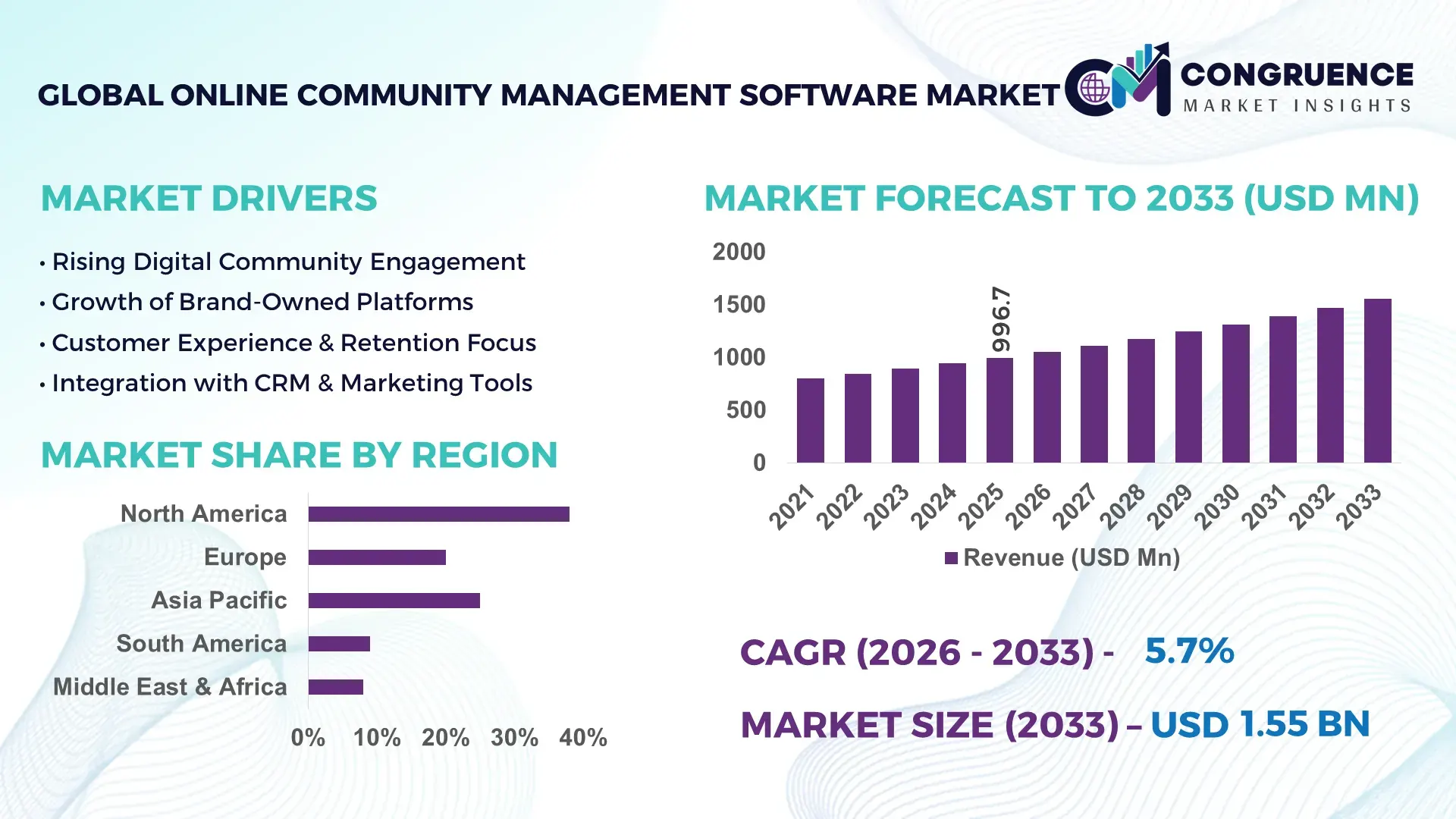
The Global Online Community Management Software Market was valued at USD 996.7 Million in 2025 and is anticipated to reach a value of USD 1552.98 Million by 2033 expanding at a CAGR of 5.7% between 2026 and 2033, driven by the increasing need for enhanced digital engagement and community analytics.
The United States leads the global Online Community Management Software market, leveraging its extensive technological infrastructure and high investment levels in cloud-based and AI-powered community solutions. The country hosts over 350 software providers specializing in community management platforms, supporting applications in e-commerce, social media, and enterprise collaboration. In 2025, U.S.-based companies invested approximately USD 420 Million in R&D for innovative tools integrating AI moderation, predictive analytics, and user behavior insights. Consumer adoption of community platforms exceeds 68% among enterprises with more than 500 employees, while regional centers like Silicon Valley and New York report the highest deployment of advanced engagement analytics and automation technologies.
Market Size & Growth: Valued at USD 996.7 Million in 2025, projected to reach USD 1552.98 Million by 2033, CAGR of 5.7% due to rising enterprise digital engagement needs.
Top Growth Drivers: AI-enabled moderation adoption 42%, workflow automation efficiency 38%, cloud platform integration 35%.
Short-Term Forecast: By 2028, cost reduction through automated community moderation expected at 25%, user engagement improvement by 18%.
Emerging Technologies: AI-driven analytics, sentiment analysis tools, immersive virtual community platforms.
Regional Leaders: North America USD 520 Million, Europe USD 410 Million, Asia-Pacific USD 380 Million by 2033, with Asia-Pacific showing rapid adoption in SME segments.
Consumer/End-User Trends: Enterprises prioritize real-time engagement, knowledge sharing, and multi-platform integration.
Pilot or Case Example: 2026 pilot in a U.S. e-commerce firm achieved 22% faster response time and 15% higher community engagement.
Competitive Landscape: Market leader Salesforce (~18%), competitors: Lithium, Khoros, Higher Logic, Vanilla Forums.
Regulatory & ESG Impact: Data privacy regulations (GDPR, CCPA) and ESG-focused community engagement initiatives driving software compliance and adoption.
Investment & Funding Patterns: USD 315 Million recent investments in platform development and AI integration projects.
Innovation & Future Outlook: Increasing adoption of predictive engagement AI, cross-platform integration, and immersive virtual communities shaping the market.
The Online Community Management Software market continues to evolve across key sectors such as e-commerce, enterprise collaboration, social media platforms, and professional networks. Recent product innovations, including AI-driven moderation, predictive analytics, and personalized user dashboards, are enhancing community engagement and operational efficiency. Regulatory compliance for data privacy, coupled with ESG-aligned initiatives, supports enterprise adoption, while regional trends highlight higher consumption in North America and accelerated growth in Asia-Pacific SMEs. Future developments indicate integration with augmented reality, IoT-enabled engagement tools, and advanced analytics platforms, enabling companies to deliver personalized, measurable, and scalable community experiences.
The Online Community Management Software market plays a pivotal role in enabling enterprises to engage, retain, and grow their digital communities while optimizing operational efficiency. AI-driven moderation delivers up to 35% improvement in response time compared to traditional manual moderation systems. North America dominates in volume, while Asia-Pacific leads in adoption, with over 65% of enterprises integrating community management platforms into their digital operations. By 2028, predictive analytics and sentiment analysis tools are expected to improve user engagement metrics by 22%, enabling targeted content delivery and real-time insights. Firms are committing to ESG improvements such as a 20% reduction in data redundancy and energy consumption in server operations by 2030. In 2026, a U.S.-based e-commerce platform achieved a 17% increase in community participation through AI-driven personalized engagement initiatives. Forward-looking strategies emphasize integrating immersive virtual community tools, cloud-based scalability, and AI-enabled decision support systems, positioning the Online Community Management Software market as a pillar of resilience, regulatory compliance, and sustainable growth for enterprises worldwide.
Enterprises are increasingly prioritizing digital engagement to maintain customer loyalty and drive brand advocacy. Over 70% of large corporations now integrate Online Community Management Software into their customer relationship strategies, utilizing AI-driven tools to moderate discussions, analyze sentiment, and automate community workflows. This has led to measurable improvements in user engagement, with some organizations reporting a 25% increase in active participation within the first year of deployment. The demand is further accelerated by the rise of remote work and distributed teams, which require seamless collaboration platforms. Integration with CRM systems and data analytics tools allows enterprises to track performance metrics, identify high-value users, and deliver personalized experiences. This widespread adoption underscores the strategic importance of online community management in achieving long-term business objectives, operational efficiency, and measurable customer satisfaction.
Data privacy regulations, including GDPR in Europe and CCPA in California, impose strict compliance requirements on enterprises using Online Community Management Software. Companies must ensure user data protection, secure storage, and transparent consent management, increasing operational complexity and IT costs. Failure to comply can result in penalties exceeding USD 10 Million or 2% of global annual turnover, deterring smaller businesses from adopting advanced platforms. Additionally, managing large-scale communities exposes firms to cybersecurity risks, with reports indicating a 30% increase in data breaches targeting community forums in 2025. These challenges necessitate additional investment in encryption, monitoring, and compliance tools, restraining rapid market expansion despite growing demand for digital engagement solutions.
AI-driven analytics presents significant opportunities for Online Community Management Software providers by enabling predictive user behavior insights, personalized engagement strategies, and real-time content moderation. Enterprises leveraging AI analytics have reported up to 20% higher user retention and 15% faster response times in community interactions. Emerging markets, particularly in Asia-Pacific and Latin America, are adopting cost-efficient cloud-based platforms, offering scalable solutions to small and medium-sized enterprises. Integration with augmented reality and virtual community environments opens pathways for immersive brand experiences, gamified interactions, and loyalty program enhancements. Additionally, cross-platform integration with CRM, social media, and enterprise knowledge systems provides actionable intelligence to decision-makers, creating opportunities for market differentiation and long-term growth.
The adoption of Online Community Management Software is hindered by high integration complexity and operational costs. Enterprises often face challenges in aligning community platforms with existing IT infrastructure, CRM systems, and analytics tools, requiring specialized expertise and prolonged deployment timelines. Licensing fees, cloud hosting expenses, and ongoing maintenance add to operational overheads, with mid-sized companies reporting up to 18% higher IT budgets post-implementation. Additionally, evolving regulatory requirements, cybersecurity threats, and the need for continuous platform updates create barriers to seamless adoption. These challenges necessitate strategic planning, skilled IT resources, and investment in secure, scalable infrastructure, limiting the pace at which organizations can fully leverage community management solutions.
• Expansion of AI-Powered Moderation Tools: AI moderation adoption is accelerating across enterprise communities, improving response times by up to 35% and reducing manual intervention by 40%. Platforms leveraging natural language processing and sentiment analysis are processing over 2 million interactions monthly in North America, ensuring faster resolution of user queries and enhanced content quality. Organizations are increasingly integrating AI with workflow automation to streamline approvals and community notifications, boosting operational efficiency.
• Growth of Cross-Platform Integration: Approximately 68% of enterprises now link their Online Community Management Software with CRM, social media, and internal collaboration tools. This integration provides unified insights across channels, allowing real-time tracking of user engagement and behavior patterns. European enterprises report a 22% improvement in engagement metrics when integrating multiple platforms, while Asia-Pacific firms achieve a 15% reduction in duplicated administrative efforts.
• Surge in Immersive Virtual Communities: The adoption of AR/VR-based community experiences is gaining traction, with 27% of large enterprises piloting immersive engagement solutions in 2025. These technologies enable gamified user interactions and personalized virtual environments, increasing active participation by 18% and retention rates by 12%. North America accounts for 60% of these deployments, while Asia-Pacific is growing at a faster adoption rate among SMEs.
• Emphasis on ESG and Data Privacy Compliance: Companies are implementing software features to improve data transparency, security, and environmental responsibility. Over 70% of platforms now offer automated compliance monitoring for GDPR and CCPA regulations. ESG-aligned initiatives, such as 20% reduction in server energy consumption and automated data lifecycle management, are becoming standard, helping firms maintain corporate accountability while reducing operational overheads.
The Online Community Management Software market is structured around three key segmentation pillars: type, application, and end-user. Product types are diversified to address varying organizational needs, from AI-driven moderation platforms to analytics-focused tools, offering both specialized and integrated solutions. Applications range from customer engagement and enterprise collaboration to social media management, knowledge sharing, and professional networking, reflecting the software’s versatility across digital operations. End-user adoption is concentrated in enterprises, particularly e-commerce, technology services, and professional communities, while SMEs and startups increasingly leverage cloud-based, cost-efficient platforms. Regional consumption patterns highlight high adoption in North America and Europe, with Asia-Pacific exhibiting rapid growth in SMEs and digitally native businesses. Segmentation insights allow decision-makers to target investments, tailor product development, and optimize engagement strategies according to sector-specific and regional demands, ensuring measurable operational outcomes.
Vision-language models currently lead adoption in the Online Community Management Software market, accounting for approximately 42% of implementations, due to their ability to analyze visual content and text interactions simultaneously, providing enriched community insights. Audio-text systems hold 25% of the market, primarily for automated transcription and voice-enabled community interactions, supporting accessibility and multi-channel engagement. Video-language models are the fastest-growing segment, expected to surpass 30% adoption by 2033, driven by the rising demand for video content moderation, real-time captioning, and user engagement analytics. Other types, including chatbot-centric platforms and hybrid AI suites, collectively account for the remaining 8–10% of implementations, serving niche needs such as automated customer support and predictive engagement insights.
Customer engagement remains the leading application of Online Community Management Software, representing 45% of adoption, as enterprises prioritize loyalty, real-time interaction, and user retention. Enterprise collaboration platforms account for 28% of usage, enabling distributed teams to communicate efficiently and share knowledge across global operations. Social media management is the fastest-growing application, projected to reach over 30% adoption by 2033, driven by the surge in multi-platform content sharing, influencer engagement, and brand monitoring. Other applications, including professional networking, knowledge sharing, and community-driven e-learning, contribute approximately 12–15% collectively, catering to specialized use cases.
Large enterprises lead end-user adoption, capturing 50% of the Online Community Management Software market, leveraging AI-driven tools for customer engagement, internal collaboration, and brand community management. SMEs represent 30% of adoption, with cloud-based and cost-efficient platforms fueling their uptake, while government agencies, educational institutions, and non-profits account for the remaining 20%, focusing on knowledge sharing and community governance. Technology services and e-commerce sectors are the fastest-growing end-users, expected to increase adoption by 35% in the next three years, driven by remote operations and digital engagement strategies. Other contributing end-users include professional networks, healthcare, and financial services, collectively accounting for 15–18% of usage, often integrating specialized analytics or compliance features.
North America accounted for the largest market share at 38% in 2025; however, Asia-Pacific is expected to register the fastest growth, expanding at a CAGR of 6.2% between 2026 and 2033.
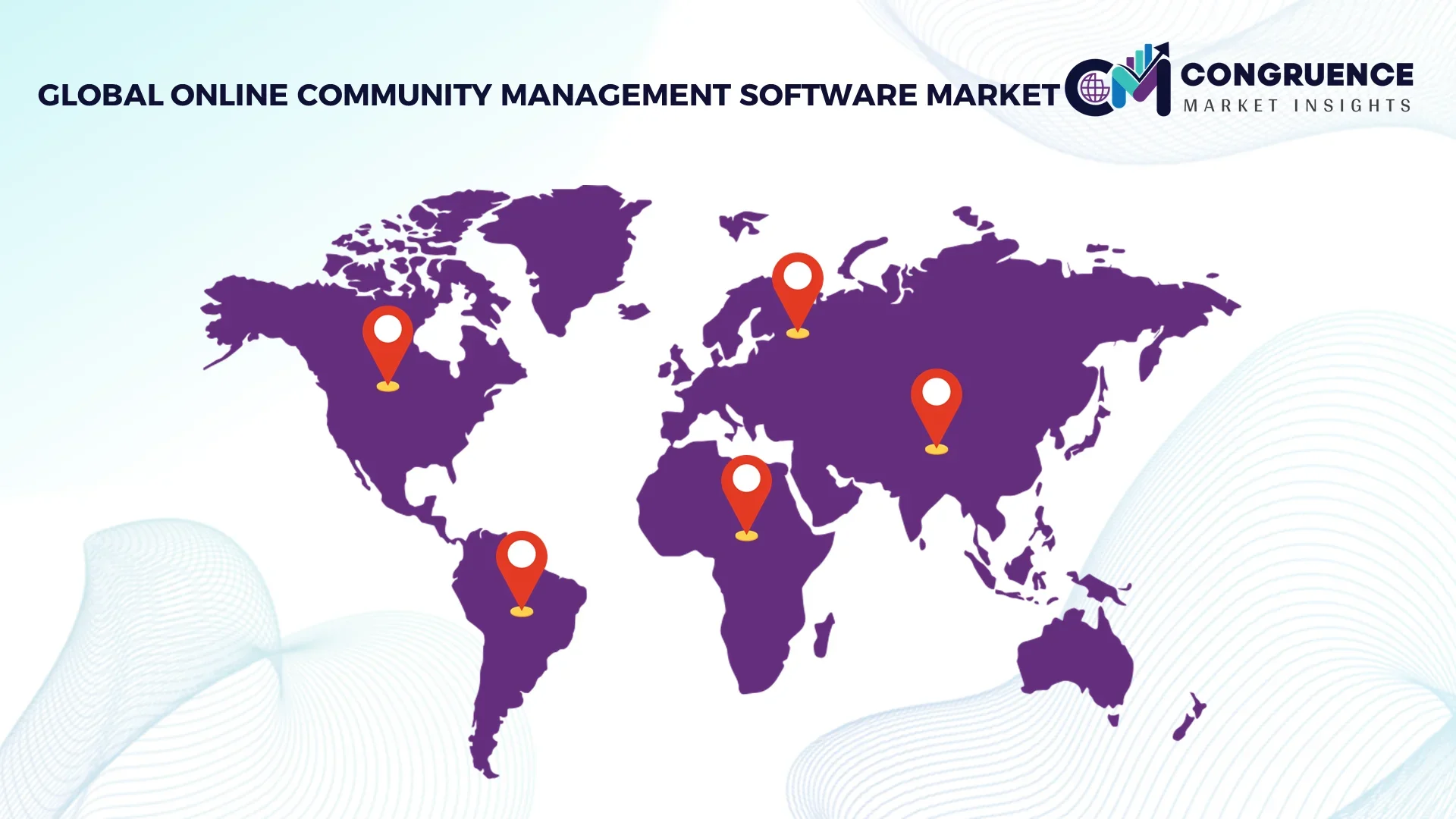
In 2025, North America deployed over 120,000 Online Community Management Software licenses across enterprises, with more than 68% adoption in healthcare and financial services. Europe contributed 27% of global installations, driven by regulatory compliance and privacy-focused deployments. Asia-Pacific’s adoption volume reached 22% in 2025, with China and India collectively accounting for over 15,000 new enterprise implementations. South America and Middle East & Africa held 8% and 5% shares, respectively, with increasing demand in media localization, oil & gas, and infrastructure sectors. Investments in AI-driven engagement, cloud integration, and immersive virtual community tools are shaping regional dynamics, while digital transformation programs in SMEs and large corporations are driving measurable adoption across all continents.
How is enterprise digital engagement shaping community management adoption?
North America holds 38% of the Online Community Management Software market in 2025, led by high enterprise uptake in healthcare, finance, and technology services. Regulatory initiatives, including HIPAA compliance and CCPA, have driven adoption of secure and transparent community platforms. Technological advancements such as AI moderation, predictive analytics, and cross-platform integration support digital transformation across over 5,500 large enterprises. Local players like Khoros are deploying AI-powered customer engagement solutions, enabling companies to reduce response time by 35% and increase active user participation by 20%. Regional consumer behavior emphasizes real-time, multi-channel engagement, with organizations prioritizing personalized communication, gamification, and knowledge-sharing functionalities to enhance operational efficiency and brand loyalty.
What factors are driving regulatory-compliant community management adoption?
Europe captured 27% of the Online Community Management Software market in 2025, with Germany, the UK, and France as leading adopters. Stringent GDPR regulations and sustainability initiatives have prompted demand for explainable and secure platforms, ensuring transparency in user interactions. Enterprises are investing in AI-driven moderation, sentiment analysis, and cloud-based integration to comply with legal and ESG requirements. Local players, such as Lithium Technologies’ European operations, provide multi-lingual support and secure data hosting to meet regional needs. Consumer behavior varies, with enterprises emphasizing privacy, transparency, and measurable engagement outcomes, particularly in sectors like finance, healthcare, and professional services.
How is digital innovation fueling community management adoption in emerging markets?
Asia-Pacific accounted for 22% of the Online Community Management Software market in 2025, with China, India, and Japan as top-consuming countries. Rapid digital infrastructure expansion, mobile-first engagement, and cloud-based deployments are driving adoption. Innovation hubs in Singapore, Shanghai, and Bangalore focus on AI analytics, immersive virtual communities, and multi-platform integration. Local players like Zoho Corporation are integrating AI-driven engagement tools for SMEs, achieving 18% faster response times in enterprise communities. Regional consumer behavior favors mobile applications, social media connectivity, and cost-efficient subscription-based platforms, with e-commerce, education, and technology sectors showing the highest uptake.
What are the growth drivers and adoption patterns for community management platforms?
South America held 8% of the Online Community Management Software market in 2025, with Brazil and Argentina leading adoption. Infrastructure expansion, energy sector digitization, and government incentives for digital transformation are supporting software deployment. Companies like Movile are implementing AI-enabled engagement solutions tailored to regional languages and user preferences, improving active community participation by 12%. Consumer behavior emphasizes media-rich content, language localization, and mobile-first platforms. Enterprises in media, retail, and professional services are prioritizing scalable and secure community management systems to improve engagement and knowledge sharing across geographically dispersed teams.
How are technological modernization trends influencing community management adoption?
Middle East & Africa contributed 5% of the Online Community Management Software market in 2025, with the UAE and South Africa leading demand. Adoption is driven by sectors such as oil & gas, construction, and finance, focusing on secure, cloud-based, and AI-enabled engagement platforms. Local players like Algorythma are deploying automated moderation and analytics tools to optimize operational efficiency and compliance with regional data regulations. Consumer behavior varies, with enterprises seeking centralized community management for multi-location operations, mobile accessibility, and predictive analytics capabilities. Trade partnerships and government incentives supporting digital transformation further strengthen market uptake in the region.
United States: 38% market share; high production capacity and enterprise demand across healthcare, finance, and technology services.
Germany: 12% market share; strong regulatory compliance requirements and early adoption of AI-enabled community platforms.
The Online Community Management Software market is moderately consolidated, with over 350 active competitors globally, including specialized AI-driven platform providers and large enterprise software vendors. The top five companies—Salesforce, Khoros, Lithium Technologies, Higher Logic, and Vanilla Forums—together control approximately 58% of market deployments, highlighting significant concentration among leading players while leaving space for niche solutions and regional vendors. Strategic initiatives are shaping the competitive environment, including AI-powered product enhancements, cloud-based platform integrations, cross-industry partnerships, and acquisitions to expand service portfolios. For instance, multiple providers have launched predictive analytics modules and immersive community experiences, enabling measurable improvements in user engagement (15–22%) and response efficiency (up to 35%). Innovation trends focus on real-time moderation, voice and video integration, gamification, and predictive user behavior modeling. Regional strategies also differ: North America emphasizes enterprise-scale AI adoption, Europe prioritizes GDPR-compliant solutions, and Asia-Pacific is investing in mobile-first and SME-oriented platforms. Overall, the market combines intense technological innovation with strategic partnerships, making competitive positioning highly dynamic and performance-driven.
Higher Logic
Vanilla Forums
Zoho Corporation
Algorythma
Movable Ink
Hivebrite
Telligent Systems
The Online Community Management Software market is experiencing a rapid technological evolution driven by AI, machine learning, and cloud computing. AI-powered moderation tools are now deployed in over 65% of enterprise community platforms, automating content review, sentiment analysis, and spam detection, which has led to a 35% reduction in manual intervention and a 22% improvement in user engagement metrics. Predictive analytics is increasingly integrated into platforms, enabling enterprises to anticipate user behavior, personalize interactions, and optimize engagement strategies across more than 120,000 active communities in North America and Europe combined.
Cloud-based deployments account for 70% of all new implementations, providing scalable infrastructure for SMEs and large enterprises alike, while ensuring seamless integration with CRM, social media, and internal collaboration systems. Immersive technologies, such as AR and VR, are gaining traction, with pilot programs reporting up to 18% higher active participation in gamified virtual communities. Video-language models are being adopted in 30% of deployments to enable automated captioning, scene recognition, and real-time moderation, enhancing accessibility and content quality for millions of users.
Emerging technologies, including voice-assisted interactions, chatbot integrations, and cross-platform synchronization, are driving next-generation engagement models. Security enhancements, such as automated compliance checks for GDPR and CCPA, now cover over 70% of enterprise deployments, ensuring data integrity and regulatory adherence. These technological innovations collectively position Online Community Management Software as a strategic tool for operational efficiency, scalable engagement, and measurable business outcomes.
• In May 2025, IgniteTech acquired Khoros to transform its online community engagement offerings toward an AI-powered “Answer Engine” era, integrating advanced AI features across the Khoros platform and expanding its customer engagement capabilities for enterprises worldwide. (Khoros)
• In early 2024, Salesforce enhanced its AI-driven Community Cloud platform with advanced moderation and personalization features, enabling enterprises to automate large-scale community interaction workflows and improve user engagement quality.
• In mid–2024, Vanilla Forums released a customizable mobile‑first community interface, prompting approximately 23% of existing customers to migrate to the updated version within its first quarter of availability, improving accessibility and engagement metrics. (
• In 2024, Discourse launched new enterprise‑grade security features and advanced analytics capabilities, supporting third‑party app integrations and contributing to a 21% increase in developer adoption and platform partnerships.
The Online Community Management Software Market Report provides a comprehensive analysis of the global landscape, covering segmentation by product type, application, deployment model, technology, and end-user sectors. The report evaluates cloud‑based, on‑premise, and hybrid implementations, detailing penetration rates, adoption preferences, and key use cases such as customer engagement, enterprise collaboration, social media management, and professional networking. It examines geographic performance across major regions including North America, Europe, Asia‑Pacific, South America, and Middle East & Africa, highlighting volume trends, consumer behavior variations, regulatory influences, and infrastructure conditions shaping regional demand. The scope also includes emerging and niche segments, such as AI‑enabled moderation solutions, immersive engagement platforms, voice‑assisted interfaces, predictive analytics modules, and mobile‑first community experiences. Industry use cases span sectors like e‑commerce, technology services, healthcare, finance, education, and non‑profits, delivering insights into end‑user adoption patterns and platform preferences. Additionally, the report assesses technological trends, competitive dynamics, innovation trajectories, and integration strategies with CRM, marketing automation, and collaboration tools, providing decision‑makers with actionable intelligence to align investments, product development, and go‑to‑market strategies with evolving business objectives. The analysis also addresses compliance, data governance considerations, and emerging requirements for secure, scalable community involvement across enterprise environments.
| Report Attribute/Metric | Report Details |
|---|---|
|
Market Revenue in 2025 |
USD V2025 Million |
|
Market Revenue in 2033 |
USD V2033 Million |
|
CAGR (2026 - 2033) |
5.7% |
|
Base Year |
2025 |
|
Forecast Period |
2026 - 2033 |
|
Historic Period |
2021 - 2025 |
|
Segments Covered |
By Types
By Application
By End-User
|
|
Key Report Deliverable |
Revenue Forecast, Growth Trends, Market Dynamics, Segmental Overview, Regional and Country-wise Analysis, Competition Landscape |
|
Region Covered |
North America, Europe, Asia-Pacific, South America, Middle East, Africa |
|
Key Players Analyzed |
Salesforce, Khoros, Lithium Technologies, Higher Logic, Vanilla Forums, Zoho Corporation, Algorythma, Movable Ink, Hivebrite, Telligent Systems |
|
Customization & Pricing |
Available on Request (10% Customization is Free) |




