
Reports
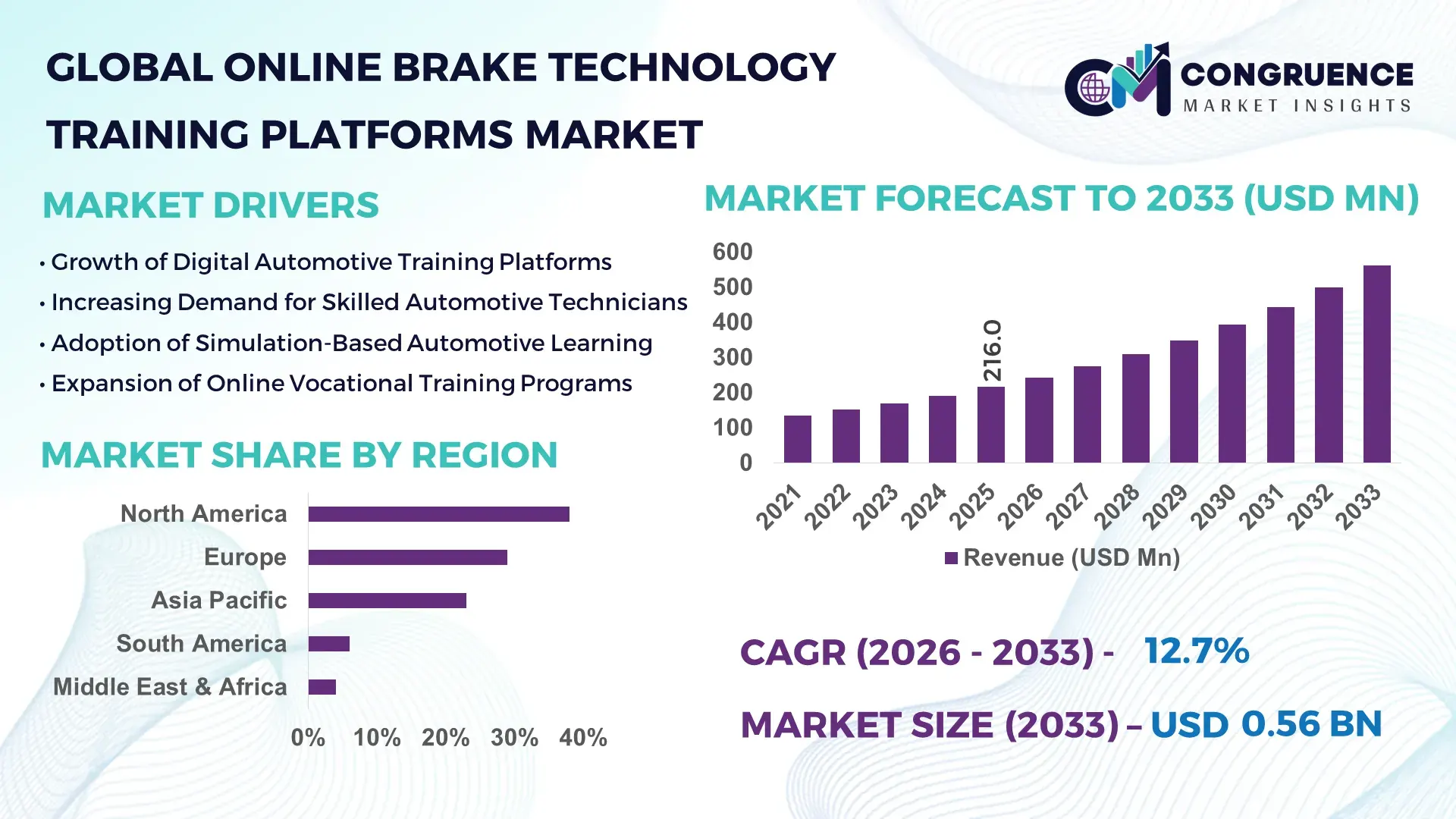
The Global Online Brake Technology Training Platforms Market was valued at USD 216.0 Million in 2025 and is anticipated to reach a value of USD 562.1 Million by 2033 expanding at a CAGR of 12.7% between 2026 and 2033, according to an analysis by Congruence Market Insights. The market growth is primarily driven by the increasing complexity of modern braking systems—including ABS, electronic braking systems, and regenerative braking—requiring continuous digital training for technicians and automotive professionals.
The United States remains a key country in the Online Brake Technology Training Platforms Market due to its extensive automotive service infrastructure and advanced technical training ecosystem. The country hosts over 278,000 automotive repair and maintenance establishments, creating strong demand for specialized digital training platforms. More than 800,000 automotive service techniciansoperate across the U.S., many requiring regular certification and upskilling in braking technologies such as ABS diagnostics, electronic stability control, and EV regenerative braking systems. Additionally, several major OEMs and aftermarket suppliers operate technical training programs through digital platforms, integrating virtual diagnostics simulations and AI-based training modules. Investments in automotive technical education exceed USD 1.5 billion annually across community colleges, technical institutes, and industry-supported certification programs, strengthening the adoption of online brake technology training platforms.
Market Size & Growth:The market reached USD 216.0 Million in 2025 and is projected to reach USD 562.1 Million by 2033, expanding at a 12.7% CAGR, driven by the rapid evolution of electronic braking systems and the need for continuous technician upskilling.
Top Growth Drivers:Rising adoption of EV braking systems (48% technician retraining demand), increased implementation of ABS and electronic braking diagnostics (42% adoption among service centers), and digital training platform penetration across automotive education institutes (37% adoption rate).
Short-Term Forecast:By 2028, digital brake training platforms are expected to improve technician diagnostic accuracy by 35%and reduce vehicle brake system repair time by 28%through simulation-based training modules.
Emerging Technologies:AI-driven diagnostics training, AR/VR-based mechanical simulation labs, and cloud-based automotive learning management systems are reshaping technician education across the industry.
Regional Leaders:North America is projected to reach USD 205 Million by 2033 driven by OEM training programs; Europe is expected to reach USD 162 Million supported by strong automotive vocational education; Asia-Pacific could reach USD 140 Milliondue to rapid expansion of automotive service networks.
Consumer/End-User Trends:Automotive repair workshops, technical institutes, and OEM training academies are the primary users, with over 52% of technicians globally relying on digital training modules for certification renewal and skill updates.
Pilot or Case Example:In 2024, a major automotive training institute implemented an AI-based brake diagnostic simulation program that improved technician training efficiency by 40%and reduced practical training equipment costs by 25%.
Competitive Landscape:The market leader holds approximately 18% share, followed by prominent players including Bosch Automotive Training Solutions, Snap-on Incorporated, Delphi Technologies, and AutoMate Training Systems.
Regulatory & ESG Impact:Increasing vehicle safety regulations and mandatory technician certification programs are driving digital training adoption, while sustainability initiatives emphasize efficient braking system maintenance reducing emissions and energy losses.
Investment & Funding Patterns:Over USD 850 Millionhas been invested globally in automotive digital training technologies during the last five years, with growing interest in AI simulation platforms and cloud-based automotive education tools.
Innovation & Future Outlook:Integration of digital twins, VR simulation labs, and predictive diagnostic training modules is expected to redefine automotive technician education, enabling real-time virtual practice environments for brake system maintenance.
The Online Brake Technology Training Platforms Market is influenced by several industry sectors including automotive repair networks (45%), technical education institutions (30%), and OEM training academies (25%). Recent innovations include AI-based brake diagnostic simulators and VR-enabled mechanical training labsimproving technician learning efficiency by over 35%. Regulatory requirements for vehicle safety certification, expanding EV adoption, and increasing digital learning penetration across automotive vocational institutes are shaping market expansion globally.
The Online Brake Technology Training Platforms Market has become strategically important as modern vehicle braking systems grow increasingly complex, integrating technologies such as anti-lock braking systems (ABS), electronic brake-force distribution, regenerative braking, and advanced driver-assistance system (ADAS) integration. Automotive service providers and OEM training academies are rapidly shifting toward digital platforms that provide scalable, simulation-based learning for technicians. Currently, more than 60% of newly introduced vehicle models incorporate advanced electronic braking technologies, significantly increasing the demand for continuous technician upskilling through digital training ecosystems.
From a technology benchmark perspective, AI-powered diagnostic training platforms deliver nearly 32% faster skill acquisition compared to traditional classroom-based mechanical instruction, while VR-enabled simulation labs improve knowledge retention by approximately 28%among automotive trainees. These improvements are particularly relevant for modern braking systems that involve complex electronic modules and sensor calibration procedures.
Regionally, North America dominates in training platform volume due to its extensive automotive service infrastructure, while Europe leads in adoption with nearly 58% of automotive vocational institutions integrating digital training platforms into their curriculum. Meanwhile, Asia-Pacific is witnessing rapid expansion in technician training demand as vehicle ownership and service networks expand across emerging economies.
Looking ahead, digital learning technologies are expected to reshape automotive technician education. By 2027, AI-driven automotive training platforms are projected to reduce diagnostic error rates by nearly 30%, significantly improving repair accuracy and workshop productivity. Automotive companies are also aligning their training strategies with sustainability goals. Firms are committing to 25–35% reductions in training-related material waste by 2030 through digital simulation-based learning environments, replacing physical training equipment.
A micro-scenario illustrates the transformation: in 2024, a U.S. automotive technical institute introduced an immersive VR braking system training program that improved technician certification pass rates by 33% and reduced training duration by 22%. Such measurable gains highlight the efficiency of digital training systems compared to conventional mechanical workshops.
Overall, the Online Brake Technology Training Platforms Marketis emerging as a foundational pillar supporting automotive safety, workforce development, and digital transformation across the vehicle maintenance ecosystem. As regulatory standards tighten and vehicle technologies advance, these platforms will continue to play a critical role in ensuring technician competency, compliance, and sustainable industry growth.
The Online Brake Technology Training Platforms Market is evolving rapidly as the automotive industry undergoes digital transformation and technological innovation. Modern vehicles incorporate complex braking technologies such as electronic stability control, regenerative braking systems in electric vehicles, and integrated braking control units. These developments have created strong demand for advanced technician training programs delivered through scalable digital platforms. Online training modules allow automotive technicians, service engineers, and vocational students to access simulation-based learning environments that replicate real-world diagnostic scenarios.
Industry trends indicate that more than 65% of automotive repair workshops globally now rely on digital knowledge bases or online training modulesto update technician skills. The shift toward electric vehicles is also influencing the training ecosystem, as regenerative braking and electronically controlled braking systems require new diagnostic procedures and maintenance protocols. Additionally, cloud-based learning management systems are enabling training providers to deliver modular courses, certification programs, and interactive workshops accessible through mobile devices or web platforms.
Another factor shaping market dynamics is the increasing collaboration between automotive OEMs, technical institutes, and digital training providers. Many OEMs are deploying proprietary training platforms that combine interactive 3D component visualization, real-time troubleshooting exercises, and remote instructor support. These platforms help standardize technician training across geographically distributed service networks. As digital adoption accelerates across automotive education and repair industries, the Online Brake Technology Training Platforms Market is expected to expand further through technological innovation, regulatory compliance requirements, and workforce skill development initiatives.
The rising complexity of braking technologies in modern vehicles is a major driver for the Online Brake Technology Training Platforms Market. Vehicles increasingly integrate anti-lock braking systems (ABS), electronic stability control, brake-by-wire systems, and regenerative braking technologies, requiring technicians to understand electronic diagnostics and software-assisted maintenance procedures. Automotive manufacturers now introduce dozens of new braking system variants annually, many of which involve advanced sensors, control modules, and integrated safety systems. Industry data indicates that more than 70% of passenger vehicles manufactured after 2022 include advanced electronic braking technologies, significantly increasing the need for specialized training. Traditional workshop training methods are often limited due to the high cost of equipment and the difficulty of replicating modern braking system failures. Digital training platforms address this challenge by providing interactive diagnostic simulations and virtual component breakdowns, enabling technicians to practice troubleshooting in a safe environment. Furthermore, automotive service centers are expanding rapidly across developing regions, creating a need to train thousands of technicians simultaneously. Online training systems allow automotive organizations to deliver standardized learning modules across multiple locations while reducing travel and equipment costs. These advantages make digital training platforms a critical tool for ensuring technicians remain proficient in maintaining evolving braking technologies.
Despite strong demand for digital technician training solutions, limited digital infrastructure in certain regions remains a restraint for the Online Brake Technology Training Platforms Market. Many small automotive repair workshops operate in regions where high-speed internet connectivity and advanced computer hardware are not readily available. These infrastructure limitations can restrict access to cloud-based learning management systems and interactive simulation platforms that require reliable connectivity and processing capabilities. Additionally, some automotive technicians still rely on traditional apprenticeship-based training methods and may be hesitant to adopt digital learning platforms. Surveys among automotive service workers indicate that nearly 35% of technicians prefer hands-on mechanical training over online simulation modules, primarily due to familiarity with conventional workshop environments. This resistance to digital learning can slow adoption, particularly in regions where vocational training institutions have not yet integrated online learning systems into their curricula. Cost considerations also affect adoption. Developing high-quality simulation-based training modules requires significant investment in software development, automotive data integration, and platform maintenance. Smaller training providers may face financial constraints in developing advanced digital platforms. Addressing these infrastructure and adoption challenges is essential for ensuring broader accessibility and growth of online brake technology training solutions.
The rapid expansion of electric vehicles presents a significant opportunity for the Online Brake Technology Training Platforms Market. Electric vehicles utilize regenerative braking systems that convert kinetic energy into electrical energy during deceleration, requiring technicians to understand both mechanical and electronic aspects of braking performance. As EV adoption increases globally, the demand for specialized training programs focused on regenerative braking diagnostics and maintenance is expanding rapidly. Automotive training providers are responding by developing digital modules that simulate EV braking system behavior, battery energy recovery mechanisms, and electronic brake control units. These modules allow technicians to learn how to diagnose issues such as regenerative braking failure, sensor misalignment, or controller malfunction without requiring physical EV components. Additionally, government initiatives supporting EV adoption often include workforce development programs that promote technician retraining. Another opportunity lies in integrating augmented reality (AR) and virtual reality (VR) technologies into online training platforms. These immersive technologies enable technicians to interact with 3D vehicle models and braking components, enhancing understanding of system architecture and troubleshooting procedures. As automotive technology continues to evolve toward electrification and digitalization, online brake training platforms will play an increasingly critical role in preparing technicians for next-generation vehicle maintenance.
One of the major challenges facing the Online Brake Technology Training Platforms Market is the high cost of developing and maintaining advanced digital training systems. Creating realistic simulation environments requires extensive automotive engineering data, 3D component modeling, and integration with vehicle diagnostic software. These development processes demand specialized expertise and significant investment in software infrastructure. Another challenge arises from the rapid pace of technological innovation in the automotive industry. Vehicle manufacturers frequently introduce new braking system architectures, sensor technologies, and electronic control modules. Training providers must continuously update course content and simulation environments to ensure technicians receive accurate and relevant instruction. This constant update cycle increases operational complexity and resource requirements for training platform providers. Additionally, ensuring compatibility across multiple vehicle brands and models presents technical difficulties. Automotive service technicians often work on vehicles from different manufacturers, each with unique braking system configurations and diagnostic procedures. Training platforms must incorporate diverse datasets and learning modules to address these variations effectively. Balancing technological accuracy with cost-efficient platform development remains a key challenge for companies operating in the Online Brake Technology Training Platforms Market.
Rapid Adoption of VR-Based Automotive Simulation Training: Virtual reality simulation platforms are transforming technician training for braking systems. Automotive training institutes report that VR-enabled programs improve technician learning retention by nearly 38%compared to conventional classroom instruction. In advanced training environments, more than 45% of automotive institutes in North America now deploy VR simulation modulesthat allow trainees to dismantle and analyze brake assemblies in virtual workshops. These systems also reduce physical equipment usage by approximately 30%, lowering operational costs while improving training scalability.
Integration of AI-Driven Diagnostic Training Modules: Artificial intelligence is increasingly integrated into digital training platforms to replicate real-world vehicle fault scenarios. Modern training systems can simulate over 150 different brake system fault conditions, allowing technicians to practice diagnostics through interactive troubleshooting exercises. AI-assisted learning platforms also track trainee performance and adapt training paths, improving learning efficiency by 28–32%. Automotive training providers report that nearly 40% of new digital courses introduced in 2024 incorporated AI-based learning analytics.
Expansion of Mobile-Accessible Automotive Learning Platforms: Mobile learning platforms are becoming a dominant delivery channel for technician training. Industry surveys indicate that over 60% of automotive technicians access training modules through smartphones or tablets, enabling flexible learning during workshop downtime. Mobile-optimized training apps allow technicians to access step-by-step brake system repair guides, interactive schematics, and real-time troubleshooting tools, improving diagnostic accuracy by nearly 25%during service operations.
Increasing Collaboration Between OEMs and Digital Training Providers: Automotive manufacturers are partnering with digital education providers to standardize technician training across global service networks. More than 70% of leading automotive OEMs now offer proprietary online training portalsfor service technicians. These portals deliver certification programs covering electronic braking systems, regenerative braking technologies, and ADAS-integrated braking modules. Collaborative training programs have helped automotive companies reduce technician retraining time by approximately 34%, ensuring consistent maintenance standards across dealership networks.
The Online Brake Technology Training Platforms Market is segmented based on training type, application areas, and end-user categories, reflecting the diverse learning needs across the automotive service ecosystem. Training platforms typically include self-paced e-learning modules, virtual simulation training systems, and instructor-led digital certification programs designed to enhance technician capabilities in diagnosing and repairing modern braking technologies. Application segments range from automotive repair workshops and vocational training institutes to OEM service networks and automotive engineering programs. End-users include professional automotive technicians, vocational students, and manufacturer-certified service engineers. Increasing adoption of digital learning platforms is driven by the need for standardized training, remote learning accessibility, and continuous technician certification as automotive braking technologies evolve.
The Online Brake Technology Training Platforms Market includes several types of digital training solutions such as self-paced e-learning platforms, virtual simulation training systems, and instructor-led online training programs. Among these, self-paced e-learning platforms currently dominate the market with approximately 46% share due to their accessibility, cost efficiency, and flexibility for technicians working in automotive service workshops. These platforms provide structured courses, diagnostic guides, and video-based technical tutorials covering braking system maintenance and troubleshooting. Virtual simulation training systems represent the fastest-growing type with an estimated CAGR of around 15%, driven by advancements in 3D modeling and immersive learning technologies. These systems allow technicians to practice diagnosing brake faults within realistic digital environments, replicating vehicle components such as ABS modules, brake calipers, and electronic control systems. Simulation platforms improve practical understanding without requiring expensive physical equipment. Instructor-led online training programs also play an important role in the market, particularly for certification courses offered by automotive OEMs and technical institutes. These programs combine live interactive sessions with digital course materials and assessments, accounting for approximately 28% of the market. Other specialized digital training formats, including AR-based instructional modules and hybrid training platforms, collectively represent about 26% of the market, serving niche learning requirements across advanced automotive training institutions.
• A 2024 automotive vocational education initiative introduced digital brake system simulation labs across technical colleges, enabling more than 12,000 automotive students to practice diagnostics using interactive training software.
The Online Brake Technology Training Platforms Market serves multiple application areas including automotive repair workshops, vocational training institutes, and OEM service network training programs. Automotive repair workshops represent the largest application segment with approximately 44% adoption, as service technicians require continuous training to maintain complex braking systems in modern vehicles. Digital training platforms help workshop technicians learn new repair procedures and diagnostic techniques without leaving their workplaces. Vocational training institutes account for approximately 32% of the application landscape, integrating digital braking technology modules into automotive engineering and technician certification programs. These institutions increasingly rely on online learning platforms to complement traditional mechanical workshops and laboratory training environments. OEM service network training programs represent the fastest-growing application segment with an estimated CAGR of around 14%, driven by automotive manufacturers expanding global service networks and introducing proprietary technician certification programs. OEMs are adopting digital learning systems to deliver standardized training across thousands of dealerships and service centers worldwide. Consumer adoption trends show that over 58% of automotive technicians globally now access at least one form of online training platform, while more than 40% of technical institutes integrate digital simulation modules into automotive curricula.
• A national automotive training initiative introduced digital braking system training modules across more than 200 vocational institutions, enabling technicians to learn electronic brake diagnostics through interactive software environments.
The Online Brake Technology Training Platforms Market serves several end-user groups including automotive technicians, technical training institutes, automotive manufacturers, and fleet maintenance organizations. Among these, professional automotive technicians represent the leading end-user segment with nearly 48% share, driven by the need for continuous upskilling as braking systems evolve with advanced electronics and safety features. Technicians rely on digital training programs to stay updated on new diagnostic procedures and maintenance protocols. Technical institutes and vocational education centers account for approximately 30% of the market, offering structured training programs that combine theoretical automotive knowledge with digital learning modules. These institutions are increasingly integrating simulation-based training tools to prepare students for modern automotive service environments. Automotive manufacturers and dealership service networks represent the fastest-growing end-user segment with an estimated CAGR of around 13%, as OEMs expand their digital training ecosystems to ensure standardized service quality across global repair networks. Fleet maintenance organizations and transportation service providers collectively contribute about 22% of the market, focusing on technician certification programs for maintaining large commercial vehicle fleets. Industry adoption statistics indicate that over 55% of automotive service companies now support digital technician training initiatives, while nearly 45% of vocational automotive students regularly use online simulation modules during training programs.
• A large automotive manufacturer launched a digital technician training platform for braking system diagnostics across more than 1,500 service centers, enabling thousands of technicians to complete advanced certification programs annually.
North America accounted for the largest market share at 38% in 2025, however, Asia-Pacific is expected to register the fastest growth, expanding at a CAGR of 14% between 2026 and 2033.

North America generated nearly USD 82 Million equivalent market value in 2025, supported by a large automotive service ecosystem and strong digital training adoption among technicians. Europe followed with 29% market share, representing around USD 63 Milliondue to widespread vocational training infrastructure and regulatory requirements for technician certification. Asia-Pacific held approximately 23% share in 2025, translating to about USD 50 Million, but the region is experiencing rapid expansion due to increasing automotive production, expanding service networks, and growing technician workforce training needs. South America contributed about 6% of the market, while the Middle East & Africa represented roughly 4%of global demand. Globally, more than 1.3 million automotive techniciansaccess some form of digital or hybrid training annually, and nearly 40% of automotive vocational institutes worldwide have integrated online brake system training modulesinto their technical education programs.
North America represents the leading regional market for Online Brake Technology Training Platforms, accounting for 38% of global demandin 2025. The region hosts more than 278,000 automotive repair facilitiesand employs over 800,000 automotive service technicians, creating strong demand for continuous professional training programs. Automotive service networks, dealership training centers, and vocational institutions are the primary industries driving adoption of digital brake system training solutions. Regulatory oversight in the region also contributes to demand. Safety standards related to braking systems and vehicle inspection requirements require technicians to remain updated with new diagnostic procedures and electronic braking technologies. Government-supported technical education initiatives and automotive workforce development programs have expanded digital training adoption across community colleges and technical institutes. Technological transformation is also evident. Approximately 52% of automotive training institutions in the region now use virtual simulation labs, while cloud-based learning platforms enable technicians to access repair diagnostics training through mobile devices. One regional example includes Bosch Automotive Service Solutions, which has introduced advanced digital training modules focused on electronic braking systems and vehicle diagnostics for thousands of dealership technicians. Regional consumer behavior shows strong digital learning adoption, with over 60% of technicians preferring flexible online training modules that can be completed during non-operational workshop hours, improving certification completion rates and professional skill development.
Europe accounts for approximately 29% of the global Online Brake Technology Training Platforms Market. Key markets include Germany, the United Kingdom, France, Italy, and Spain, where automotive manufacturing and service industries require a highly skilled technical workforce. The region operates more than 300,000 automotive service workshopsand maintains a large vocational training infrastructure that continuously updates technician skills in electronic braking technologies. Regulatory frameworks across the region require compliance with strict vehicle safety and inspection standards. Technician certification programs often include mandatory training modules for anti-lock braking systems, electronic brake distribution, and vehicle stability systems. Sustainability initiatives related to vehicle efficiency and safety further strengthen the need for digital training platforms that help technicians maintain complex braking technologies. Technological adoption is expanding rapidly. Nearly 48% of vocational automotive institutes across the region now use digital simulation platforms, while hybrid learning systems combining classroom instruction with online modules are increasingly common. An example of regional innovation includes Snap-on Incorporated, which has expanded its digital diagnostic and technician training tools across European service networks, supporting thousands of technicians with advanced repair training modules. Regional consumer behavior reflects regulatory influence, as automotive technicians in Europe often pursue structured certification programs required for workshop accreditation, driving continuous demand for online technical education platforms.
Asia-Pacific represents the third-largest regional market, accounting for approximately 23% of global demandfor Online Brake Technology Training Platforms. The region has one of the largest automotive technician workforces globally due to rapidly expanding vehicle ownership and service networks. Major consuming countries include China, India, Japan, and South Korea, which collectively support millions of automotive technicians and thousands of service facilities. China alone operates more than 450,000 automotive repair workshops, while India employs over 2 million automotive service technicians, highlighting the growing need for scalable training platforms. Infrastructure investments in automotive vocational education and industry skill development programs are accelerating digital learning adoption across technical institutes and automotive training centers. Technological innovation is also expanding rapidly. Automotive training institutions across the region increasingly deploy AI-driven diagnostic simulators and mobile-based learning applicationsthat enable technicians to access technical courses through smartphones. A regional example includes GP Strategies Corporation, which has collaborated with automotive manufacturers in Asia to develop digital technician training platforms focused on vehicle electronics and braking systems. Consumer behavior reflects strong mobile adoption, with over 65% of automotive trainees in the region accessing training modules through mobile learning platforms, enabling large-scale workforce training in emerging automotive markets.
South America accounts for approximately 6% of the global Online Brake Technology Training Platforms Market, with major demand concentrated in Brazil and Argentina. The region hosts more than 120,000 automotive repair and maintenance workshops, creating ongoing demand for technician training programs focused on vehicle safety systems and electronic braking technologies. Automotive service expansion and vehicle fleet growth are key drivers. Brazil alone has more than 45 million registered vehicles, requiring a continuous supply of trained service technicians. Governments and industry organizations are increasingly supporting vocational education initiatives aimed at strengthening technical skills across the automotive workforce. Digital training adoption is gradually increasing as automotive institutes integrate online learning modules into technician training programs. Cloud-based training systems allow instructors to deliver standardized automotive repair courses across multiple regions while reducing training costs. One regional example includes AutoMate Training Systems, which provides digital automotive training tools used by several technical institutes and training centers. Regional consumer behavior indicates strong demand for localized training content. Technicians often prefer courses available in Portuguese and Spanish, highlighting the importance of language localization and region-specific technical training modules.
The Middle East & Africa region represents approximately 4% of the global Online Brake Technology Training Platforms Market, but the region is gradually expanding as automotive service infrastructure develops. Key growth countries include the United Arab Emirates, Saudi Arabia, and South Africa, where increasing vehicle ownership and expanding service networks require skilled technicians trained in advanced braking technologies. The region hosts more than 70,000 automotive service workshops, and governments are investing in workforce development initiatives to support automotive maintenance industries. Automotive vocational training centers are introducing digital learning systems that allow technicians to access training modules covering brake diagnostics, vehicle electronics, and safety systems. Technological modernization is also underway. Many training institutes are adopting cloud-based automotive learning platforms and virtual diagnostic simulation tools, enabling technicians to gain practical experience without requiring extensive physical workshop infrastructure. An example of regional development includes Automotive Training Academy programs supported by industry partners in the UAE, which provide digital technician training modules for dealership service personnel. Consumer behavior varies widely across the region, with technicians in urban markets increasingly adopting digital learning platforms, while hybrid training models combining classroom instruction with online modules remain common.
United States – 34% Market Share: supported by extensive automotive service networks, advanced technician certification programs, and strong digital training platform adoption.
Germany – 12% Market Share: driven by a highly developed automotive manufacturing ecosystem, strong vocational training programs, and continuous technician certification requirements.
The Online Brake Technology Training Platforms Market features a moderately fragmented competitive landscape with approximately 35–40 active technology providers, automotive training institutions, and digital learning platform developersoperating globally. The top five companies collectively account for nearly 42% of the market, while numerous regional training providers and specialized software developers compete in niche segments such as simulation-based automotive diagnostics and online technician certification platforms.
Market leaders focus heavily on technological innovation and partnerships with automotive manufacturers. Several training providers collaborate directly with OEMs and dealership networks to deliver specialized courses on electronic braking systems, vehicle diagnostics, and integrated safety technologies. These collaborations allow training companies to access real-time vehicle engineering data and integrate accurate diagnostic simulations into digital learning environments.
Competition is also driven by the rapid adoption of immersive learning technologies. Companies are investing in virtual reality training modules, AI-driven diagnostic simulations, and interactive 3D automotive component librariesto differentiate their platforms. These technologies allow technicians to practice troubleshooting procedures and component repairs in realistic virtual environments.
Strategic initiatives such as product launches, partnerships with automotive institutes, and integration with cloud-based learning management systems are shaping the competitive environment. Several companies have expanded mobile learning applications that enable technicians to access repair guides and training modules directly from smartphones. As digital transformation accelerates across automotive education and service industries, competition is expected to intensify with increasing innovation and specialization among training platform providers.
Snap-on Incorporated
Delphi Technologies
GP Strategies Corporation
AutoMate Training Systems
CDX Learning Systems
ATech Training
ConsuLab Automotive Training Systems
Electude International BV
TPC Training Systems
Technical Training Aids (TTA)
LJ Create
Cengage Automotive Learning Solutions
ASE Education Foundation
Technology innovation is rapidly transforming the Online Brake Technology Training Platforms Market as digital learning tools evolve to address the complexity of modern vehicle braking systems. One of the most significant technological developments is the adoption of virtual simulation environments, which allow technicians to practice brake diagnostics, component replacement procedures, and troubleshooting exercises within interactive digital workshops. Simulation platforms can replicate more than 150 different brake system fault scenarios, enabling trainees to develop diagnostic skills without requiring expensive mechanical equipment.
Artificial intelligence is also becoming a core technology in modern training platforms. AI-driven learning systems analyze technician performance during training sessions and automatically adjust course difficulty levels or suggest additional learning modules. Automotive training institutions report that AI-powered platforms improve technician diagnostic accuracy by nearly 30%, while reducing training completion times by approximately 25%.
Another important development is the integration of augmented reality (AR)technologies into automotive technician education. AR-enabled applications allow trainees to visualize brake components, hydraulic systems, and electronic control modules directly on digital vehicle models. These applications provide step-by-step instructions and real-time annotations that enhance understanding of complex braking system architecture.
Cloud computing infrastructure is also enabling large-scale deployment of automotive training platforms. Cloud-based learning management systems allow thousands of technicians across different geographic locations to access training content simultaneously. Automotive service companies increasingly deploy enterprise training portals where technicians can complete certification programs, access repair manuals, and track their professional development progress.
Mobile learning technologies are further expanding accessibility. More than 60% of automotive technicians now use smartphones or tablets to access digital training modules, making mobile learning platforms a critical distribution channel for automotive education. These platforms allow technicians to review diagnostic procedures or technical documentation directly during vehicle servicing operations.
The integration of digital twins and predictive diagnostic modelsis another emerging technological trend. Digital twin platforms simulate the behavior of real braking systems, enabling trainees to analyze performance under different operating conditions. As vehicles incorporate more electronic components and software-driven safety systems, advanced digital training technologies will become essential for preparing technicians to maintain next-generation automotive braking systems.
In January 2025, Snap-on Incorporatedannounced a new lineup of “Tuesday Topic Training” online sessions designed for professional automotive technicians. The program includes weekly digital training on diagnostic tools, ADAS calibration, and electronic system testing delivered through interactive webinars and online streaming sessions for technicians worldwide. Source: www.snapon.com
In December 2025, Snap-on Incorporatedreleased more than 20 digital training modules supporting its MT2600 diagnostic scan tool. The modules cover hybrid systems, TPMS diagnostics, collision avoidance sensors, and code-scanning workflows, enabling technicians to learn the tool’s capabilities through on-demand online video training programs.
In September 2024, Electudeintroduced an upgraded training vehicle within its Electude Connect platform at the WorldSkills competition in Lyon. The training system integrates digital assignments, guided diagnostics, and simulated faults for EV and hybrid vehicle systems to support automotive technology education.
In August 2024, Electudelaunched its Heavy Vehicle Classroom learning solution, expanding its automotive e-learning portfolio. The platform provides digital modules covering brake systems, transmissions, electronics, and maintenance diagnostics, supporting training programs for heavy-vehicle technicians through integrated online coursework.
The Online Brake Technology Training Platforms Market Report provides a comprehensive analysis of the global industry covering technological developments, training platform types, application areas, end-user segments, and geographic markets. The report evaluates digital learning platforms used for training automotive technicians in braking system diagnostics, maintenance procedures, and safety compliance. The analysis includes various types of training solutions such as self-paced e-learning platforms, simulation-based training systems, instructor-led digital certification programs, and immersive VR or AR training environments.
The report also examines key application sectors including automotive repair workshops, vocational training institutes, OEM dealership service networks, and automotive engineering education programs. These application segments collectively represent the primary demand sources for digital brake technology training solutions. Additionally, the report analyzes the role of emerging training technologies such as AI-based learning analytics, cloud-based training management systems, and interactive 3D simulation toolsthat enable technicians to practice complex diagnostic procedures.
Geographic coverage includes North America, Europe, Asia-Pacific, South America, and the Middle East & Africa, with detailed insights into regional automotive service infrastructure, technician workforce size, and adoption of digital training systems. The report also explores industry trends related to workforce development, regulatory certification requirements, and increasing integration of electronic braking technologies within modern vehicles.
Furthermore, the report evaluates the competitive landscape by examining major technology providers, automotive training organizations, and digital learning platform developers. Key focus areas include product innovation, partnerships with automotive manufacturers, expansion of mobile learning platforms, and the integration of immersive technologies into automotive technician education.
Overall, the scope of the report is designed to support decision-makers, industry analysts, automotive training providers, and technology developers by delivering strategic insights into evolving training technologies, market adoption patterns, and future opportunities within the global Online Brake Technology Training Platforms Market.
| Report Attribute / Metric | Details |
|---|---|
| Market Revenue (2025) | USD 216.0 Million |
| Market Revenue (2033) | USD 562.1 Million |
| CAGR (2026–2033) | 12.7% |
| Base Year | 2025 |
| Forecast Period | 2026–2033 |
| Historic Period | 2021–2025 |
| Segments Covered |
By Type
By Application
By End-User Insights
|
| Key Report Deliverables | Revenue Forecast; Market Trends; Growth Drivers & Restraints; Technology Insights; Segmentation Analysis; Regional Insights; Competitive Landscape; Regulatory & ESG Overview; Recent Developments |
| Regions Covered | North America; Europe; Asia-Pacific; South America; Middle East & Africa |
| Key Players Analyzed | Bosch Automotive Service Solutions; Snap-on Incorporated; Delphi Technologies; GP Strategies Corporation; AutoMate Training Systems; CDX Learning Systems; ATech Training; ConsuLab Automotive Training Systems; Electude International BV; TPC Training Systems; Technical Training Aids (TTA); LJ Create; Cengage Automotive Learning Solutions; ASE Education Foundation |
| Customization & Pricing | Available on Request (10% Customization Free) |




