
Reports
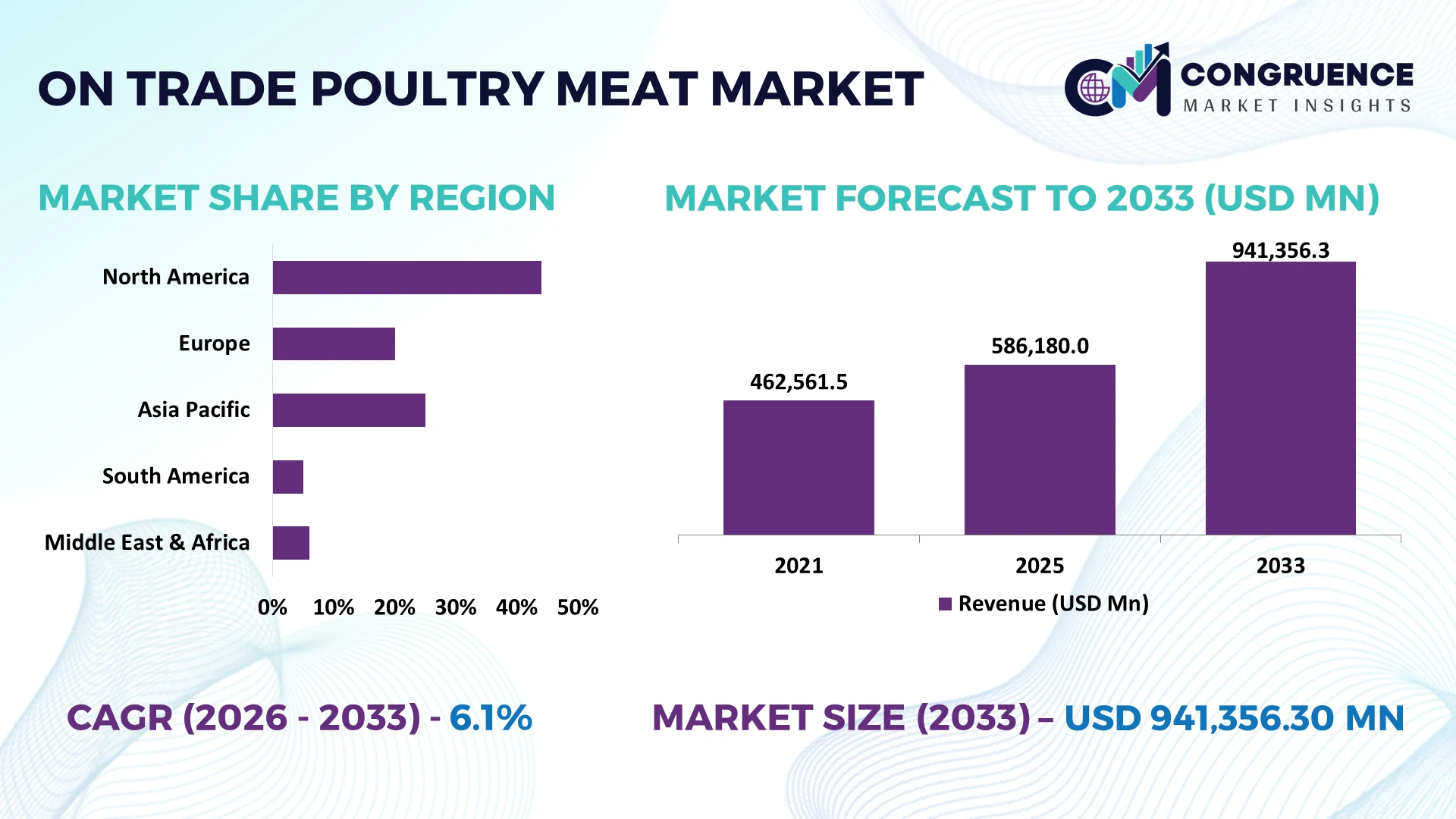
The Global On Trade Poultry Meat Market was valued at USD 586180 Million in 2025 and is anticipated to reach a value of USD 941356.3 Million by 2033 expanding at a CAGR of 6.1% between 2026 and 2033. Growth is driven by quick service restaurant expansion, rising foodservice chicken consumption, vertically integrated poultry processing, and investment in automated portioning and temperature controlled distribution.
The United States holds a leading position in the On Trade Poultry Meat Market, with an illustrative 24% global share supported by extensive restaurant infrastructure and integrated poultry processing. American chicken production exceeds 20 million metric tons annually, supplying quick service restaurants, institutional kitchens, and hospitality operators. Compared with Brazil, which emphasizes export oriented poultry processing, the United States benefits from established domestic foodservice distribution. Highly pathogenic avian influenza outbreaks have accelerated investment in biosecurity, automated processing, and refrigerated logistics, strengthening operational resilience across poultry supply chains.
Strategic implication: Suppliers combining reliable poultry procurement, automated processing, and restaurant distribution partnerships strengthen cost competitiveness and long term foodservice market positioning.
Market Size & Growth: USD 586,180 million in 2025, reaching USD 941,356.3 million by 2033 at 6.1% CAGR, driven by restaurant chicken menu expansion.
Top Growth Drivers: Illustrative contributions include quick service expansion at 42%, poultry affordability at 33%, and processing modernization at 25%.
Short Term Forecast: By 2028, automated portioning targets 15% higher throughput and 10% lower processing waste.
Emerging Technologies: AI demand forecasting, robotic deboning, and smart refrigeration target 20% faster inventory decisions.
Regional Leaders: Illustrative 2033 allocations place Asia Pacific at USD 357,715 million, North America at USD 282,407 million, and Europe at USD 188,271 million, reflecting restaurant expansion, automation, and traceability adoption.
Consumer / End User Trends: An estimated 45% of on trade poultry demand originates from quick service restaurant operations.
Pilot / Case Example: A proposed 2027 automated poultry portioning pilot targets 18% faster processing and 12% lower product losses.
Competitive Landscape: Tyson Foods holds an illustrative 12% market share, competing with JBS, BRF, Cargill, and Pilgrim's Pride.
Regulatory & ESG Impact: HACCP based controls target 100% critical control point monitoring, strengthening poultry safety compliance.
Investment & Funding: An illustrative USD 2.5 billion investment scenario prioritizes processing automation, refrigerated distribution, and restaurant supply partnerships.
Innovation & Future Outlook: By 2033, integrated cold chain monitoring and predictive procurement target 15% lower inventory losses.
The On Trade Poultry Meat Market serves quick service restaurants, hotels, catering businesses, institutional foodservice providers, and independent dining establishments requiring consistent chicken quality and reliable supply. Demand concentrates around boneless chicken portions, breaded products, wings, and ready to cook poultry formats. Automated deboning, precision portioning, and digital temperature monitoring are improving operational consistency. Foodservice operators increasingly prioritize standardized product specifications and dependable delivery schedules. Processing facilities targeting 15% higher line productivity are investing in robotics and integrated quality inspection. Avian influenza related supply disruptions reinforce the importance of diversified procurement and biosecure production networks, establishing priorities for competitive investment and distribution strategy.
The On Trade Poultry Meat Market is becoming strategically important as restaurant chains, institutional caterers, and poultry processors compete to secure standardized chicken supplies at predictable operating costs. Quick service restaurant expansion is accelerating investment in vertically integrated processing, refrigerated distribution, and contracted poultry production. The United States produces more than 20 million metric tons of chicken annually, supporting extensive foodservice procurement networks. Brazil emphasizes export oriented processing, while American suppliers prioritize domestic restaurant contracts and advanced production automation.
Technology adoption is reshaping processing economics and delivery reliability. Compared with conventional manual portioning, automated cutting systems target 15% higher throughput and approximately 10% lower product waste under optimized operating conditions. Artificial intelligence demand forecasting improves procurement coordination, while digital temperature monitoring strengthens refrigerated distribution control. Between 2026 and 2028, leading processors are prioritizing automated deboning, predictive maintenance, and integrated restaurant inventory platforms. These investments support standardized portion sizes and more consistent delivery schedules.
A practical deployment involves supplying calibrated chicken portions to a national restaurant chain through automated processing and temperature monitored distribution. Companies are expanding contract farming partnerships and regional cold storage facilities. Competitive advantage increasingly depends on biosecure production, efficient processing, and dependable foodservice fulfillment.
Quick service restaurant expansion is strengthening demand for standardized chicken portions, consistent product specifications, and dependable distribution. In the United States, major restaurant chains increasingly coordinate procurement through contracted processors and integrated distribution networks. An illustrative foodservice demand allocation places quick service restaurants at 45% of on trade poultry consumption, reflecting frequent purchasing and standardized menu requirements. Automated portioning systems target 15% higher processing throughput, while integrated demand forecasting aims to reduce inventory imbalances by 10%. Processors are expanding dedicated restaurant supply lines, investing in precision cutting equipment, and strengthening long term procurement agreements. The operational advantage comes from predictable portion weights, reduced kitchen preparation requirements, and reliable product availability across large restaurant networks.
Poultry suppliers face structural pressure from fluctuating feed prices, avian influenza outbreaks, and concentrated production infrastructure. Feed commonly represents approximately 60% to 70% of poultry production costs, making corn and soybean price movements important determinants of processing economics. A modeled 15% increase in feed costs can significantly compress supplier margins when restaurant contracts limit immediate price adjustments. Highly pathogenic avian influenza outbreaks in the United States and Brazil reinforce the importance of biosecurity and diversified production networks. A 10% reduction in contracted poultry availability can disrupt restaurant menu planning and processing schedules. Companies are expanding feed procurement agreements, strengthening farm level disease monitoring, and diversifying sourcing locations. Reliable supply contracts and flexible procurement structures protect operational continuity.
Advanced poultry processing technologies create opportunities to improve product consistency and expand foodservice distribution into underserved markets. Robotic deboning, machine vision inspection, and automated portion calibration enable processors to reduce manual handling and standardize restaurant ready products. Optimized processing lines target 18% higher throughput and approximately 12% lower trimming losses. India presents opportunities through expanding organized foodservice networks and investment in refrigerated logistics. Digital procurement platforms target 15% faster restaurant order processing by integrating demand forecasts with processing schedules. Companies are establishing regional cold storage partnerships, developing customized chicken portions, and investing in modular processing equipment. The strategic opportunity lies in supplying standardized poultry products to expanding restaurant networks without proportionally increasing labor requirements or inventory exposure.
Scaling on trade poultry distribution requires reliable temperature control, consistent food safety documentation, and coordination across processing facilities, transport operators, and restaurant kitchens. Refrigerated poultry distribution generally requires temperatures near 4°C or below, while frozen poultry commonly requires storage around minus 18°C. Maintaining these conditions across fragmented logistics networks presents operational challenges, particularly in India and other markets with uneven refrigerated infrastructure. A modeled 10% increase in delivery route complexity can raise handling requirements, while digital monitoring systems target 15% faster temperature deviation identification. Foodservice suppliers must integrate HACCP controls, automated traceability, and secure logistics data platforms. Companies are investing in refrigerated fleet modernization, workforce training, and integrated quality management systems. Long term competitiveness depends on consistent food safety performance and dependable delivery execution.
Premium Chicken Menu Innovation Accelerates: Restaurant operators are introducing differentiated chicken sandwiches, seasoned wings, and specialty marinades to strengthen menu positioning. Product development teams increasingly evaluate 2 to 3 flavor variations before wider deployment. American restaurant chains are expanding limited menu testing, targeting 10% higher product attachment rates and 8% faster menu development cycles. Poultry suppliers are responding through customized seasoning partnerships and specialized product development capabilities.
Digital Kitchen Integration Improves Order Accuracy: Foodservice operators are connecting kitchen display systems with poultry preparation workflows and restaurant ordering platforms. Integrated systems target 15% faster order coordination and 10% fewer preparation errors under optimized operating conditions. United States restaurant chains are standardizing digital kitchen processes across multiple outlets. Suppliers are adjusting packaging identification and product labeling to support accurate ingredient selection, improving kitchen productivity and reducing order related waste.
Animal Welfare Standards Influence Procurement: Restaurant buyers are strengthening poultry sourcing requirements around stocking density, handling practices, and animal welfare verification. European foodservice operators are evaluating production systems aligned with the European Chicken Commitment, which includes a maximum stocking density of 30 kilograms per square meter. Suppliers are expanding farm audits and welfare documentation, targeting 95% supplier compliance in participating procurement programs. Verified sourcing improves contract eligibility and strengthens restaurant brand differentiation.
Menu Engineering Prioritizes Portion Consistency: Restaurant operators are refining chicken portion specifications to improve food cost control and nutritional consistency. Standardized portions of 100 to 150 grams support predictable preparation and menu planning, while calibrated weighing targets 5% lower portion variability. Hospitality operators in Japan and the United States are strengthening recipe management and supplier specification agreements. Processors are expanding calibrated product assortments, reducing kitchen preparation adjustments and supporting consistent customer experiences.
Fresh Poultry Meat represents the leading On Trade Poultry Meat Market segment, accounting for an estimated 38% share, supported by restaurant preferences for flexible preparation, consistent texture, and direct integration into kitchen operations. Full service restaurants and hospitality kitchens frequently procure fresh chicken for grilled, roasted, and specialty menu preparations. Chilled Poultry Meat accounts for approximately 27%, benefiting from controlled refrigeration, standardized packaging, and predictable short term inventory management. American poultry processors are strengthening refrigerated distribution agreements and implementing improved product identification systems. Investment priorities emphasize reliable delivery schedules, food safety documentation, and consistent portion specifications.
Processed Poultry Meat represents the fastest growing type under an illustrative market scenario, supported by demand for breaded chicken, marinated portions, and standardized restaurant ready products. Frozen Poultry Meat remains important for extended storage, centralized procurement, and distribution across geographically dispersed foodservice outlets. Processing companies are expanding customized product development and automated packaging operations. Restaurant buyers increasingly compare preparation labor, cooking consistency, and inventory flexibility when selecting poultry formats. Competitive advantage depends on matching product specifications with kitchen operating requirements and dependable supply availability.
Poultry Based Fast Food represents the largest On Trade Poultry Meat Market application, accounting for an estimated 36% share, supported by widespread chicken sandwich, nugget, and wrap consumption across organized restaurant networks. Standardized preparation methods enable high transaction volumes and predictable product quality. Fried Poultry Dishes account for approximately 28%, benefiting from established consumer preferences and efficient batch cooking systems. American restaurant operators emphasize breaded chicken consistency, while South Korean foodservice businesses differentiate fried chicken through sauces and specialized flavor profiles. Suppliers are expanding customized coatings, portion specifications, and centralized distribution agreements.
Ready to Eat Poultry Meals represent the fastest growing application under an illustrative adoption scenario, supported by convenient meal purchasing and expanding prepared foodservice offerings. Grilled Poultry Dishes retain importance among consumers prioritizing lighter preparation methods and protein focused meals. Roasted Poultry Dishes serve hospitality, casual dining, and traditional restaurant menus. Processors are strengthening precooked product capabilities, food safety validation, and packaging formats. Competitive differentiation increasingly depends on preparation efficiency, consistent sensory quality, and reliable delivery performance across restaurant operating environments.
Quick Service Restaurants represent the leading On Trade Poultry Meat Market end user segment, accounting for an estimated 45% share, supported by extensive restaurant networks, standardized chicken menus, and frequent replenishment requirements. Large restaurant chains depend on consistent portion weights, contracted processing capacity, and integrated refrigerated distribution. Full Service Restaurants account for approximately 28%, emphasizing menu flexibility, ingredient quality, and differentiated poultry preparation. American foodservice operators increasingly coordinate procurement through specialized distributors, while Brazilian processors strengthen international restaurant supply relationships. Suppliers are expanding dedicated production lines, customized product specifications, and long term purchasing agreements.
Catering Services represent the fastest growing end user segment under an illustrative market scenario, supported by institutional dining contracts, corporate events, and centralized meal preparation. Hotels and Resorts require diverse poultry formats for buffet operations and premium dining, while Pubs and Bars emphasize wings, fried chicken portions, and shareable menu products. Processors are developing flexible packaging sizes, standardized cooking specifications, and scheduled delivery programs. Competitive positioning depends on predictable procurement costs, consistent food safety performance, and operational compatibility across distinct foodservice channels.
Asia Pacific accounted for the largest market share at an estimated 38% in 2025 however, Asia Pacific is expected to register the fastest growth, expanding at a CAGR of approximately 7.8% between 2026 and 2033.

Integrated Poultry Processing Strengthens Restaurant Supply Networks
North America accounts for an estimated 30% of the global On Trade Poultry Meat Market, supported by extensive poultry processing infrastructure, established restaurant procurement networks, and sophisticated refrigerated distribution systems. The United States dominates regional supply through vertically integrated chicken production and specialized foodservice processing. Tyson Foods, Wayne Sanderson Farms, and Perdue Farms supply poultry products to restaurant chains, institutional kitchens, and hospitality operators. Automated deboning, portion calibration, and digital quality inspection are strengthening processing consistency. Restaurant buyers increasingly prioritize standardized chicken specifications and reliable delivery schedules. Processing facilities implementing advanced automation target approximately 15% higher throughput and 10% lower trimming losses under optimized conditions. Canada contributes through regulated poultry production and established foodservice distribution infrastructure. Competitive advantage depends on dependable procurement contracts, efficient refrigerated logistics, and consistent product quality across large restaurant networks.
United States Market Outlook: The United States maintains a leading position through extensive broiler production, integrated feed operations, and sophisticated poultry processing capabilities. American chicken production exceeds 20 million metric tons annually, supporting substantial domestic foodservice requirements. Arkansas, Georgia, and North Carolina serve as important poultry production and processing centers. USDA Food Safety and Inspection Service oversight reinforces food safety compliance, while restaurant suppliers invest in automated portioning, biosecurity, and specialized distribution partnerships.
Food Safety Standards Reshape Poultry Procurement Strategies
Europe represents an estimated 20% of the global On Trade Poultry Meat Market, supported by established poultry processing industries, regulated food safety systems, and extensive hospitality distribution networks. Poland, France, Germany, and the Netherlands contribute through commercial poultry production, foodservice processing, and cross border distribution. European restaurant operators increasingly evaluate animal welfare requirements, poultry traceability, and standardized product specifications when selecting suppliers. The European Chicken Commitment influences sourcing policies among participating foodservice businesses, encouraging adjustments to poultry production systems. Automated processing, temperature controlled logistics, and digital product tracking support operational consistency. Suppliers implementing integrated quality monitoring target approximately 12% faster inspection workflows and 10% lower documentation errors. European processors are strengthening agricultural partnerships and expanding specialized poultry product portfolios. Competitive positioning depends on regulatory compliance, efficient processing, and reliable supply arrangements across geographically connected restaurant markets.
Poland Market Outlook: Poland represents a strategically important poultry production center, supported by extensive commercial farming, processing infrastructure, and European distribution connections. The country is among the European Union's leading poultry meat producers, supplying domestic foodservice businesses and international buyers. Polish processors are investing in automated cutting, refrigerated storage, and product traceability systems. European Union food safety requirements influence processing operations and export certification, strengthening the importance of standardized production and reliable logistics.
Restaurant Expansion Accelerates Poultry Supply Modernization
Asia Pacific accounts for an estimated 38% of the global On Trade Poultry Meat Market, supported by extensive foodservice consumption, expanding restaurant networks, and large scale poultry production. China, India, Japan, Indonesia, and Thailand contribute through distinct restaurant formats and poultry processing capabilities. China maintains extensive commercial poultry production and organized restaurant distribution infrastructure, while Thailand specializes in processed chicken products and international foodservice exports. India presents opportunities through expanding organized restaurant chains and investment in refrigerated distribution. Japanese foodservice operators prioritize consistent portion specifications and stringent product quality requirements. Processing companies are strengthening automated cutting, digital inventory coordination, and regional cold storage partnerships. Optimized production systems target 15% higher processing efficiency and approximately 10% lower inventory losses. Competitive advantage increasingly depends on standardized poultry products, dependable distribution, and efficient integration between processors and restaurant procurement networks.
China Market Outlook: China represents a major poultry production and foodservice consumption center, supported by extensive commercial farming, integrated processing operations, and sophisticated restaurant distribution networks. Shandong and Guangdong contribute through poultry processing, logistics, and foodservice supply activity. Large restaurant chains increasingly coordinate poultry procurement through centralized distribution systems. Digital inventory management and automated processing technologies support consistent product availability. Food safety regulations encourage stronger traceability, supplier verification, and standardized processing practices across commercial poultry supply chains.
Export Processing Strengthens Foodservice Supply Competitiveness
South America represents an estimated 8% of the global On Trade Poultry Meat Market, supported by extensive poultry production, established agricultural supply chains, and internationally connected processing infrastructure. Brazil dominates regional poultry processing and export activity, while Argentina, Chile, and Colombia contribute through domestic foodservice consumption and commercial poultry operations. Brazilian processors benefit from integrated feed procurement, large processing facilities, and established refrigerated export logistics. JBS and BRF maintain significant poultry processing operations serving international foodservice markets. Regional restaurant suppliers increasingly prioritize standardized chicken portions, reliable packaging, and predictable delivery schedules. Automated processing investments target approximately 12% higher line productivity and 10% lower handling losses. However, feed cost volatility and international animal health restrictions influence procurement decisions. Competitive positioning depends on biosecure production, export certification, and efficient coordination between processing facilities and foodservice distributors.
Brazil Market Outlook: Brazil maintains a leading position through extensive commercial poultry farming, integrated processing infrastructure, and strong international distribution capabilities. Paraná and Santa Catarina represent important poultry production and processing centers. Brazil ranks among the world's largest chicken meat exporters, supporting restaurant supply chains across multiple international markets. The Ministry of Agriculture and Livestock oversees animal health and inspection requirements. Brazilian processors invest in automated cutting, refrigerated logistics, and export market diversification to maintain supply reliability.
Domestic Processing Investment Strengthens Foodservice Supply Security
The Middle East and Africa region accounts for an estimated 4% of the global On Trade Poultry Meat Market, supported by expanding hospitality infrastructure, restaurant investment, and domestic poultry production initiatives. Saudi Arabia, the United Arab Emirates, South Africa, and Egypt contribute through commercial poultry farming, foodservice distribution, and institutional catering operations. Saudi Arabia emphasizes domestic poultry production under Vision 2030, while the United Arab Emirates relies on sophisticated refrigerated import and distribution networks. South Africa maintains established poultry processing infrastructure serving restaurant and retail markets. Regional operators are investing in temperature controlled storage, automated processing, and food safety monitoring. Refrigerated logistics modernization targets approximately 15% faster delivery coordination and 10% lower temperature related product losses. Competitive positioning depends on dependable poultry availability, halal certification, efficient distribution, and reduced exposure to international supply disruptions.
Saudi Arabia Market Outlook: Saudi Arabia represents a strategically important poultry market through domestic production investment, expanding restaurant infrastructure, and government supported food security initiatives. Riyadh and Jeddah serve as major foodservice consumption and distribution centers. Saudi Arabia has targeted 80% poultry meat self sufficiency by 2025, encouraging investment in integrated farming and processing operations. Companies such as Almarai and Tanmiah Food Company are expanding poultry capabilities, while halal compliance and refrigerated distribution remain essential procurement requirements.
The global On Trade Poultry Meat Market features competition between Tyson Foods, JBS, BRF, Cargill, and regional integrated poultry processors. These leading groups represent an illustrative combined 32% share of relevant commercial poultry supply activity. Tyson Foods competes through extensive United States processing infrastructure and restaurant contracts, while JBS and BRF emphasize international distribution and export capabilities. Cargill strengthens competitiveness through agricultural integration and foodservice supply relationships. Automated portioning targets 15% higher throughput, while advanced inventory coordination seeks 10% lower product losses. Companies are expanding processing capacity, strengthening contract farming partnerships, and investing in refrigerated distribution networks. Biosecurity requirements, feed procurement volatility, and food safety compliance create substantial entry barriers. Competitive differentiation increasingly depends on standardized chicken specifications, reliable delivery, and processing efficiency. Winning suppliers combine integrated production, disciplined procurement, specialized foodservice products, and dependable cold chain execution across diverse restaurant operating environments.
Tyson Foods, Inc.
JBS S.A.
BRF S.A.
Cargill, Incorporated
Perdue Farms, Inc.
Wayne Sanderson Farms
Koch Foods, Inc.
Mountaire Farms
Foster Farms
MHP SE
Charoen Pokphand Foods PCL
New Hope Liuhe Co., Ltd.
Tanmiah Food Company
LDC Group
Automated deboning, machine vision inspection, and precision portioning are transforming poultry processing for restaurant supply chains. Compared with conventional manual cutting, robotic portioning targets 15% higher throughput and 10% lower trimming losses under optimized conditions. Deployment is concentrated among integrated processors in the United States, Brazil, and Thailand, where standardized chicken specifications support major foodservice contracts. Computer vision systems identify product defects and improve portion consistency, while automated weighing reduces manual handling. These technologies strengthen processing reliability, increase usable meat recovery, and improve fulfillment accuracy for restaurant buyers.
Emerging technologies include artificial intelligence demand forecasting, digital batch traceability, and intelligent refrigeration monitoring. Predictive procurement systems target 12% lower inventory imbalances, while connected temperature sensors enable continuous monitoring throughout refrigerated distribution. Adoption is expanding through enterprise processing facilities and specialized foodservice logistics partnerships. Integrated production software connects poultry processing schedules with restaurant purchasing requirements, improving order coordination. Large processors benefit from established infrastructure, while smaller suppliers increasingly depend on shared technology platforms and specialized logistics providers.
Between 2026 and 2028, digital twins, predictive equipment maintenance, and automated quality documentation will influence processing investment. Maintenance analytics target 15% fewer unplanned equipment interruptions. Competitive advantage will favor processors integrating production intelligence, verifiable food safety controls, and dependable delivery performance.
June 2024: Tyson Foodservice introduced three chicken products, including Honey Stung tenderloins, addressing restaurant menu innovation. Datassential reported 40% annual growth in hot honey flavors. The launch expanded operator choices for differentiated chicken dishes and broader foodservice menu development. Source: pizzatoday.com.
April 2025: BRF approved a new Jeddah processed foods factory through its Saudi joint venture. Planned annual capacity reaches 40,000 tons of poultry and beef products, strengthening localized production for regional foodservice customers and major global restaurant accounts. Source: sec.gov.
August 2025: Perdue Foods partnered with ShopRite to expand prepared chicken offerings, including rotisserie chicken, wings, tenders, and fried chicken. The collaboration emphasized No Antibiotics Ever production across six listed product formats, broadening convenient prepared protein availability nationwide. Source: perduefarms.com.
September 2026: Cargill announced over USD 130 million in poultry investments across Thailand and the Philippines, including production technology and farm infrastructure. The expansion strengthens cooked poultry supply reliability and food safety for international foodservice and retail customers. Source: cargill.com.
The On Trade Poultry Meat Market Report evaluates industry developments between 2026 and 2033 across Fresh Poultry Meat, Frozen Poultry Meat, Chilled Poultry Meat, and Processed Poultry Meat. Application coverage includes Grilled Poultry Dishes, Fried Poultry Dishes, Roasted Poultry Dishes, Poultry Based Fast Food, and Ready to Eat Poultry Meals. End user analysis examines Full Service Restaurants, Quick Service Restaurants, Hotels and Resorts, Pubs and Bars, and Catering Services, with quick service operators representing an estimated 45% market share.
Regional coverage includes North America, Europe, Asia Pacific, South America, and the Middle East and Africa. Technology assessments examine automated deboning, machine vision inspection, predictive procurement, and refrigerated logistics monitoring. Competitive analysis supports processing investment, restaurant partnerships, supply diversification, and strategic expansion into specialized foodservice distribution networks.
| Report Attribute/Metric | Report Details |
|---|---|
Market Revenue in 2025 | USD 586180 Million |
Market Revenue in 2033 | USD 941356.3 Million |
CAGR (2026 - 2033) | 6.1% |
Base Year | 2025 |
Forecast Period | 2026 - 2033 |
Historic Period | 2021 - 2025 |
Segments Covered | By Type
By Application
By End-User
|
Key Report Deliverable | Revenue Forecast, Growth Trends, Market Dynamics, Segmental Overview, Regional and Country-wise Analysis, Competition Landscape |
Region Covered | North America, Europe, Asia-Pacific, South America, Middle East, Africa |
Key Players Analyzed | Tyson Foods, Inc., JBS S.A., BRF S.A., Cargill, Incorporated, Perdue Farms, Inc., Wayne Sanderson Farms, Koch Foods, Inc., Mountaire Farms, Foster Farms, MHP SE, Charoen Pokphand Foods PCL, New Hope Liuhe Co., Ltd., Tanmiah Food Company, LDC Group |
Customization & Pricing | Available on Request (10% Customization is Free) |




