
Reports
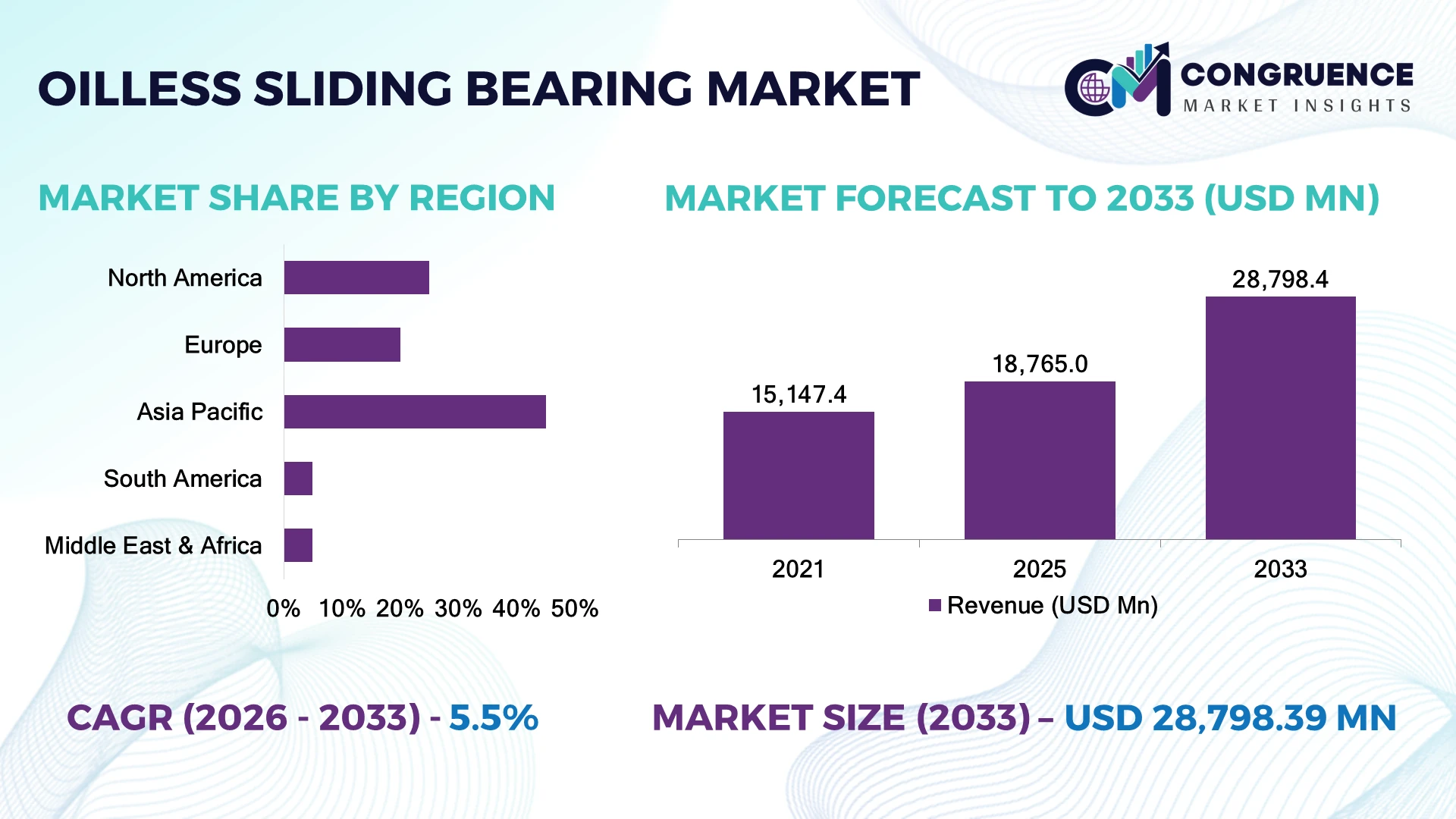
The Global Oilless Sliding Bearing Market was valued at USD 18,765.0 Million in 2025 and is anticipated to reach a value of USD 28,789.4 Million by 2033 expanding at a CAGR of 5.5% between 2026 and 2033. Growth is driven by rising adoption of self-lubricating bearing systems in electric vehicles, automation equipment, aerospace components, and maintenance-free industrial machinery.
China dominates the global landscape with approximately 38% market share, supported by large-scale manufacturing capacity, automotive production exceeding 30 million vehicles annually, and expanding industrial automation investments. Japan and Germany maintain strong positions through precision engineering and advanced material innovation, while Japan’s bearing sector emphasizes high-performance polymer composites with over 25% adoption in specialized applications. Strategic localization of bearing production across Asia-Pacific is reshaping supply chains following global manufacturing diversification initiatives.
Companies prioritizing advanced materials, localized production, and precision engineering capabilities will gain stronger competitive positioning in the evolving Oilless Sliding Bearing Market.
Market Size & Growth: USD 18.77 Billion in 2025 to USD 28.79 Billion by 2033 at 5.5% CAGR, driven by automation expansion and demand for maintenance-free components.
Top Growth Drivers: Electric vehicle adoption (+18%), industrial automation deployment (+15%), and energy-efficient machinery demand (+12%) are accelerating market expansion.
Short-Term Forecast: By 2028, advanced bearing adoption is expected to improve equipment maintenance efficiency by 20% and reduce lubrication-related downtime by 15%.
Emerging Technologies: AI-based predictive maintenance, self-lubricating composite materials, and automated manufacturing systems are transforming bearing performance.
Regional Leaders: Asia-Pacific projected at USD 12.5 Billion, Europe at USD 8.1 Billion, and North America at USD 6.2 Billion, supported by automotive electrification and smart factories.
Consumer/End-User Trends: Over 45% of industrial users are shifting toward oil-free bearing solutions to reduce maintenance requirements and operational waste.
Pilot/Case Example: A 2024 Japanese automotive automation project achieved 22% maintenance reduction after integrating advanced polymer sliding bearings.
Competitive Landscape:Oiles Corporation leads with approximately 15% share, followed by igus, GGB Bearing Technology, Daido Metal, and Tenneco.
Regulatory & ESG Impact: Sustainability initiatives have increased oil-free component adoption by nearly 20% in manufacturing sectors focused on waste reduction.
Investment & Funding: More than USD 1.5 Billion is being directed toward advanced materials, smart manufacturing, and regional production expansion partnerships.
Innovation & Future Outlook: Next-generation ceramic composites, sensor-integrated bearings, and digital monitoring platforms are driving a strategic shift toward intelligent industrial components.
The Oilless Sliding Bearing Market is gaining traction across automotive, aerospace, industrial automation, and renewable energy sectors due to its ability to support low-maintenance operations and improve equipment reliability. Approximately 40% of new industrial machinery designs increasingly consider lubrication-free components as manufacturers address efficiency targets and stricter environmental requirements. Recent supply-chain restructuring in Asia and Europe is encouraging localized bearing production, while advanced polymer and composite innovations are expanding application opportunities.
The Oilless Sliding Bearing Market is becoming strategically important as industries prioritize operational efficiency, reduced maintenance dependency, and environmentally responsible engineering solutions. Manufacturers are shifting from conventional lubricated bearings toward self-lubricating alternatives to address downtime concerns and evolving industrial sustainability requirements. Global supply-chain restructuring after recent geopolitical disruptions has encouraged companies to establish regional manufacturing networks and secure critical component availability.
Advanced composite sliding bearings are delivering measurable advantages over traditional metal bearings, including up to 30% lower maintenance requirements and improved performance in high-temperature or contamination-prone environments. Germany and Japan continue leading precision applications through material innovation, while China is expanding large-volume production capabilities through industrial modernization programs.
Automotive assembly plants, robotics manufacturers, and renewable energy equipment producers are increasing deployment of oilless bearing technologies, with industrial users targeting 15–20% reductions in maintenance cycles. Companies are strengthening competitiveness through partnerships, localized production facilities, and investments in polymer composites and smart monitoring systems. Strategic players that combine material innovation with supply-chain resilience will secure long-term advantages in industrial transformation.
Increasing demand for maintenance-free machinery is accelerating adoption of oilless sliding bearings across automotive, robotics, and heavy equipment sectors. Industrial automation facilities using self-lubricating components report maintenance reductions of nearly 20%, while electric vehicle manufacturing has increased demand for lightweight, durable bearing solutions by more than 15%. China’s rapid expansion of smart factories and Japan’s precision manufacturing ecosystem are creating strong deployment opportunities. Companies are responding through composite material investments, production expansion, and technology partnerships to improve durability and reduce operational interruptions. The shift toward automated production lines highlights a strategic advantage: lubrication-free components enable higher equipment availability and lower lifecycle costs.
Material volatility remains a key limitation, particularly for polymer composites, specialty alloys, and imported manufacturing inputs. Fluctuating resin and metal prices have increased component production costs by approximately 8–12% in some manufacturing markets. European producers face additional pressure from energy costs and stricter industrial compliance requirements, while smaller manufacturers experience difficulty achieving economies of scale. Companies are mitigating these constraints through supplier diversification, localized sourcing agreements, and alternative composite formulations. The non-obvious challenge is that material consistency, rather than availability alone, determines bearing reliability in precision applications such as aerospace and semiconductor equipment.
Emerging opportunities are developing through smart materials, additive manufacturing, and digitally optimized bearing designs. Advanced polymer composites can deliver up to 25% longer service intervals compared with conventional alternatives, creating demand across automation and electric mobility sectors. India’s expanding manufacturing ecosystem and Southeast Asia’s industrial investments are opening new application areas. Companies are increasing R&D spending on sensor-enabled bearings, lightweight materials, and customized solutions for specialized equipment. The integration of digital monitoring with self-lubricating technology represents a strategic opportunity, enabling predictive maintenance models and improving equipment efficiency across industrial operations.
Integration complexity remains a major challenge as industries require customized bearing specifications across diverse operating conditions. Approximately 30% of industrial equipment redesign projects require application-specific bearing modifications, increasing engineering time and validation costs. Semiconductor manufacturing, aerospace, and robotics sectors demand extremely precise tolerances, creating additional technology barriers. Companies must address these issues through advanced simulation tools, engineering partnerships, and localized technical support networks. The long-term competitive challenge is maintaining consistent performance across global applications while adapting products to increasingly automated and digitally controlled industrial environments.
Composite Material Optimization: Manufacturers are accelerating the use of PTFE-based composites, reinforced polymers, and advanced alloys, with composite adoption increasing by nearly 18% in precision machinery applications. Japanese and German bearing producers are improving load capacity by 20–25% through material engineering, while companies are expanding R&D partnerships to replace traditional metal-based solutions in demanding environments.
Smart Manufacturing Integration: Automated production lines are increasing demand for digitally monitored bearing systems, with smart factory deployments rising by approximately 15% across automotive and robotics facilities. Companies in China and South Korea are integrating AI-based quality inspection and sensor-enabled monitoring, reducing production defects by nearly 12% and improving manufacturing consistency through connected workflows.
Localized Supply Chain Expansion: Global manufacturers are restructuring bearing supply networks after logistics disruptions and geopolitical tensions, with localized sourcing initiatives improving component availability by 20%. European and Asian suppliers are establishing regional production hubs and supplier partnerships, reducing dependency on single-country manufacturing while improving delivery reliability for industrial customers.
Sustainable Engineering Adoption: Environmental compliance and industrial waste reduction programs are accelerating oil-free bearing adoption, with manufacturers reporting up to 30% lower lubricant consumption in targeted applications. Automotive and renewable energy companies are prioritizing low-maintenance components, while suppliers are redesigning products around recyclable materials and longer operational lifecycles to meet sustainability objectives.
Composite bearings represent the leading segment in the Oilless Sliding Bearing Market, accounting for approximately 42% market share due to superior wear resistance, lightweight construction, and suitability for high-speed industrial applications. Their ability to operate without external lubrication provides cost advantages in automotive, aerospace, and automation systems. Metal-based oilless bearings maintain significant demand with nearly 30% share, particularly in heavy-duty machinery requiring high load-bearing capability.
Polymer-based bearings are emerging as the fastest-growing type, expanding through adoption in electric vehicles, robotics, and food-processing equipment where corrosion resistance and low maintenance are critical. Demand for polymer solutions has increased by around 20% as manufacturers focus on lightweight designs and cleaner operations. Companies are investing in hybrid materials, customized bearing structures, and application-specific engineering to capture evolving industrial requirements.
Automotive applications dominate the Oilless Sliding Bearing Market with approximately 38% market share, supported by large-scale vehicle production, electric mobility expansion, and automated assembly operations. Manufacturers rely on self-lubricating bearings for steering systems, suspension components, and production equipment where reduced downtime improves operational efficiency. Industrial machinery follows with nearly 32% share, driven by manufacturing automation and heavy equipment modernization.
The fastest-growing application is robotics and automation, with adoption increasing by around 22% as factories transition toward smart production systems. Aerospace and renewable energy applications are also gaining attention due to demand for lightweight, durable components capable of operating under extreme conditions. Companies are responding through application-specific designs, automation partnerships, and expanded production capacity. The increasing integration of oilless bearings into electric vehicle manufacturing represents a major shift from traditional mechanical applications toward advanced mobility platforms.
Automotive manufacturers represent the leading end-user segment with approximately 40% market share due to extensive bearing requirements across vehicle production lines, electric vehicle platforms, and component assemblies. Large automotive hubs in China, Japan, Germany, and South Korea are increasing adoption as manufacturers target lower maintenance requirements and higher production reliability. Industrial equipment manufacturers account for nearly 35% share, supported by automation investments and factory modernization initiatives.
The fastest-growing end-user group is robotics and automation providers, with adoption rising by approximately 25% as companies deploy advanced manufacturing systems and automated handling equipment. Aerospace and renewable energy companies are also increasing procurement due to reliability requirements in specialized operating environments. Bearing manufacturers are adapting through customized solutions, strategic partnerships, and localized technical support networks. Future demand is shifting toward industries requiring precision, durability, and reduced maintenance dependency, creating competitive advantages for suppliers with advanced engineering capabilities.
Asia-Pacific accounted for the largest market share at 45% in 2025 however, North America is expected to register the fastest growth, expanding at a CAGR of 6.2% between 2026 and 2033.
North America holds a significant position in the Oilless Sliding Bearing Market with approximately 25% market share, supported by automotive manufacturing, aerospace production, robotics deployment, and advanced industrial automation. The United States contributes the majority of regional demand through large-scale manufacturing facilities and electric vehicle supply-chain investments. Industrial users are increasingly adopting maintenance-free bearing systems to reduce downtime and improve equipment reliability, with automated factories reporting nearly 20% efficiency improvements after component upgrades. Companies are expanding domestic production capabilities and forming technology partnerships to strengthen supply-chain resilience following recent manufacturing localization initiatives.
United States Market Outlook: The United States remains the key market due to its advanced manufacturing infrastructure, aerospace ecosystem, and growing electric mobility sector. More than 60% of North American industrial automation investments are concentrated in U.S. manufacturing hubs, increasing demand for durable and low-maintenance mechanical components. Companies are prioritizing localized production, advanced materials, and precision engineering solutions.
Europe represents approximately 20% of the global Oilless Sliding Bearing Market, supported by automotive engineering, industrial machinery production, and sustainability-focused manufacturing practices. Germany, France, and Italy are major adoption centers where manufacturers prioritize low-maintenance components for automated production systems. Environmental regulations encouraging reduced lubricant usage have accelerated adoption, with several industrial operators targeting lubricant consumption reductions of nearly 25%. European companies are investing in advanced polymer composites, automation integration, and strategic supplier partnerships to improve operational efficiency. The region’s strong engineering base continues supporting demand for high-performance bearing technologies across mobility and industrial applications.
Germany Market Outlook: Germany leads European adoption through its automotive manufacturing strength, precision engineering capabilities, and Industry 4.0 transformation programs. Over 30% of European industrial automation installations are concentrated in German manufacturing facilities, supporting demand for reliable bearing solutions. Companies are expanding research partnerships focused on lightweight materials and digitally optimized component designs.
Asia-Pacific dominates the Oilless Sliding Bearing Market with approximately 45% market share, driven by China’s manufacturing capacity, Japan’s precision engineering expertise, and South Korea’s advanced industrial ecosystem. The region benefits from large automotive production volumes, electronics manufacturing, and rapid automation adoption. China alone produces more than 30 million vehicles annually, creating substantial demand for maintenance-free bearing systems. Manufacturers are expanding production facilities, strengthening supplier networks, and investing in composite material technologies to support industrial growth. Supply-chain diversification strategies are also encouraging new manufacturing investments across India and Southeast Asia.
China Market Outlook: China remains the largest contributor due to its extensive manufacturing base, automotive output, and industrial automation expansion. More than 40% of global manufacturing equipment deployments are linked to Chinese production networks, increasing demand for durable mechanical components. Companies are focusing on smart factories, domestic sourcing, and advanced bearing production technologies.
South America accounted for approximately 5% market share in 2025, supported by demand from mining, automotive manufacturing, agricultural machinery, and industrial equipment sectors. Brazil represents the dominant contributor due to its large industrial base and infrastructure modernization activities. Mining operators are increasingly adopting maintenance-free bearing solutions, with industrial users targeting 15–20% reductions in maintenance downtime. However, dependence on imported precision components remains a limitation, encouraging companies to strengthen regional distribution networks and supplier partnerships. Investments in manufacturing upgrades and equipment modernization are creating new opportunities for specialized bearing applications across the region.
Brazil Market Outlook: Brazil holds the leading position in South America due to its automotive manufacturing, mining operations, and agricultural machinery ecosystem. The country contributes more than 50% of regional industrial output, supporting demand for durable mechanical components. Companies are focusing on localized service networks, strategic partnerships, and customized bearing solutions to improve adoption across industrial applications.
The Middle East & Africa accounted for approximately 5% market share in 2025, driven by infrastructure development, industrial diversification programs, energy projects, and modernization of manufacturing facilities. Adoption is concentrated in oil & gas equipment, construction machinery, water infrastructure, and industrial processing applications. Saudi Arabia and the United Arab Emirates are leading deployment activity, with automation and industrial modernization investments increasing by more than 15% in targeted manufacturing sectors. Companies are expanding regional partnerships and developing application-specific bearing solutions to address harsh operating environments and improve equipment reliability.
Saudi Arabia Market Outlook: Saudi Arabia is the key market contributor due to industrial diversification initiatives, infrastructure expansion, and manufacturing development programs. The country’s industrial transformation projects are increasing demand for advanced machinery components, while companies are establishing localized supply networks and technology collaborations. Growing investment in automated facilities is strengthening demand for low-maintenance bearing systems across industrial applications.
The Oilless Sliding Bearing Market features competition between global bearing specialists, regional manufacturers, and material technology innovators. Leading players such as Oiles Corporation, igus, and GGB compete with cost-focused Asian suppliers including Daido Metal and local OEM component producers. The top five companies collectively account for approximately 45% of market share, creating a moderately consolidated structure. Competition is shaped by composite material innovation, customization capability, supply reliability, and pricing efficiency, with advanced material solutions improving operational performance by 20–30% compared with conventional alternatives. Global leaders are expanding through partnerships, localized production, and vertical integration, while regional players compete through faster delivery and lower manufacturing costs. The market is shifting toward smart materials, application-specific designs, and supply-chain localization. High technical expertise, testing capabilities, and customer qualification requirements remain key entry barriers. Winning requires combining material innovation, manufacturing agility, and strong customer integration.
igus
GGB Bearing Technology
Daido Metal
Tenneco
Kaman Corporation
RBC Bearings Incorporated
SKF
Schaeffler AG
THK Co., Ltd.
NSK Ltd.
NTN Corporation
Advanced composite materials, including PTFE blends, reinforced polymers, and metal-polymer hybrids, are transforming oilless bearing performance. These materials deliver 20–30% lower maintenance requirements compared with traditional lubricated bearings and are increasingly deployed in automotive, robotics, and industrial automation systems. Companies investing in material science gain advantages through longer service intervals and reduced operational downtime.
Smart manufacturing integration is becoming a competitive differentiator, with automated inspection, digital monitoring, and predictive maintenance systems improving production accuracy by nearly 15%. Compared with conventional manufacturing methods, digitally optimized processes reduce quality variations by approximately 10–12%. Leading manufacturers are combining bearing engineering with automation capabilities to strengthen customer value propositions.
Between 2026 and 2028, sensor-enabled bearings, lightweight composites, and application-specific designs will influence market positioning. Technology leaders benefit by offering customized solutions for electric vehicles, aerospace equipment, and high-speed machinery, while cost-focused suppliers face pressure to upgrade capabilities. Companies adopting next-generation materials and digital production systems will achieve stronger operational efficiency and competitive resilience.
April 2025igus launched the drylin® SLX linear axis designed for heavy-duty, self-lubricating applications, supporting loads up to 600 kg with zero lubrication requirements. The innovation strengthens igus’ position in automation and industrial motion systems by improving maintenance efficiency. Source: igus Press Releases
June 2025Daido Metal announced the launch of a plain bearing bench testing machine to enhance evaluation capabilities for advanced bearing technologies. The development improves product validation processes and supports higher reliability standards for industrial and automotive applications. Source: Daido Metal News
June 2025SKF introduced sustainable bearing solutions at its ISEA Tech & Innovation Summit, including products targeting up to 25% carbon reduction and 99% grease usage reduction in selected applications. The initiative supports industrial sustainability and circularity strategies. Source: SKF Press Release
December 2025Oiles Corporation published its Integrated Report 2025 outlining continued focus on advanced bearing technologies, business transformation, and sustainable growth initiatives. The strategic update reinforces investment priorities in maintenance-free bearing solutions and industrial applications. Source: Oiles Corporation News
The Oilless Sliding Bearing Market Report covers comprehensive analysis across major segments including type, application, end-user, and geographic markets. The study evaluates composite bearings, metal-based solutions, polymer technologies, and their deployment across automotive, industrial machinery, robotics, aerospace, and specialized applications. Regional coverage includes North America, Europe, Asia-Pacific, South America, and Middle East & Africa with focus on manufacturing hubs, adoption patterns, and industrial demand concentration.
The report provides strategic insights into technology advancement, competitive positioning, supply-chain developments, and emerging application areas. Analysis includes participation from leading manufacturers, innovation trends, customization strategies, and adoption shifts supporting business decisions from 2026 to 2033. The study helps investors and industry participants identify expansion opportunities, technology priorities, and competitive strategies in evolving industrial markets.
| Report Attribute / Metric | Details |
|---|---|
| Market Revenue (2025) | USD 18,765.0 Million |
| Market Revenue (2033) | USD 28,789.4 Million |
| CAGR (2026–2033) | 5.5% |
| Base Year | 2025 |
| Forecast Period | 2026–2033 |
| Historic Period | 2021–2025 |
| Segments Covered |
By Type
By Application
By End-User
|
| Key Deliverables | Revenue Forecast; Market Trends; Growth Drivers & Restraints; Technology Insights; Segmentation Analysis; Regional Insights; Competitive Landscape; Regulatory & ESG Overview; Recent Developments |
| Regions Covered | North America; Europe; Asia-Pacific; South America; Middle East & Africa |
| Companies Profiled | Oiles Corporation; igus; GGB Bearing Technology; Daido Metal; Tenneco; Kaman Corporation; RBC Bearings Incorporated; SKF; Schaeffler AG; THK Co., Ltd.; NSK Ltd.; NTN Corporation |
| Customization & Pricing | Available on Request (10% Customization Free) |




