
Reports
The Global Oilfield Air Drilling Market was valued at USD 1571.76 Million in 2025 and is anticipated to reach a value of USD 2543.21 Million by 2033 expanding at a CAGR of 6.2% between 2026 and 2033. Growth is driven by faster penetration rates in hard-rock formations, underbalanced drilling requirements, reduced formation damage, and expanding unconventional drilling activity.
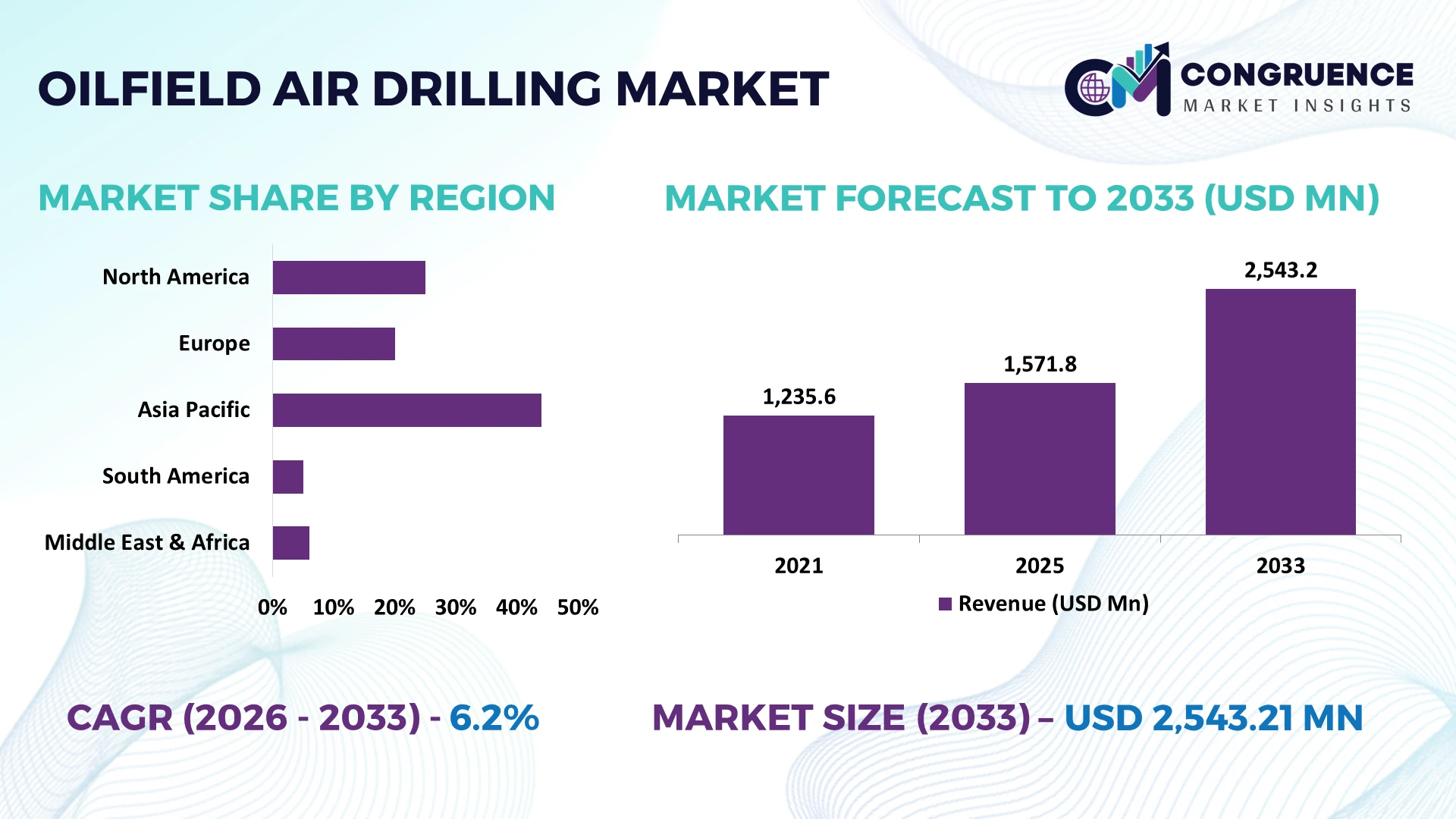
The United States remains the dominant country market, supported by shale development, horizontal drilling, and a mature oilfield-services ecosystem. U.S. unconventional wells increasingly use air, mist, and foam drilling techniques where faster penetration and reduced differential pressure improve drilling economics. North American shale operations generally deploy more advanced air-management and real-time monitoring systems than emerging markets, while Middle Eastern operators emphasize high-temperature reliability and equipment durability. Geopolitical supply-chain restructuring is also encouraging regional sourcing of compressors and drilling accessories.
Strategic priority should center on high-performance air systems, real-time monitoring, and localized service capacity across shale and technically demanding drilling programs.
Market Size & Growth: USD 1.57 billion in 2025 to USD 2.54 billion by 2033 at 6.2% CAGR, supported by faster penetration in unconventional formations.
Top Growth Drivers: Shale drilling 32%, underbalanced drilling 24%, and hard-rock applications 18% represent major demand drivers.
Short-Term Forecast: By 2028, optimized air-delivery systems target 10–15% higher drilling efficiency and 5–8% lower fluid-related operating costs.
Emerging Technologies: AI monitoring, automated compressor control, real-time pressure sensing, and advanced air-management systems are increasing operational precision.
Regional Leaders: North America targets approximately USD 1.05 billion, Asia-Pacific USD 620 million, and Middle East & Africa USD 430 million by 2033, supported by unconventional, infrastructure, and energy projects.
Consumer/End-User Trends: Unconventional drilling represents approximately 30% of application demand, increasing requirements for controlled-pressure and formation-sensitive drilling systems.
Pilot/Case Example: A 2025 shale drilling deployment using optimized air control achieved approximately 12% faster penetration and reduced nonproductive drilling time by 8%.
Competitive Landscape: Major suppliers including Atlas Copco, Epiroc, Sandvik, NOV, and Weatherford compete through approximately 10–15% efficiency improvements in equipment and service integration.
Regulatory & ESG Impact: Improved air-management systems can reduce drilling-fluid consumption by approximately 15–25%, supporting lower handling requirements and improved site logistics.
Investment & Funding: More than USD 1 billion in combined drilling-equipment and oilfield-service investment is supporting compressor upgrades, fleet expansion, and regional service capacity.
Innovation & Future Outlook: AI-assisted pressure control, automated drilling optimization, hybrid air systems, and remote monitoring will shift competition toward measurable penetration performance and lower operating intensity.
The Oilfield Air Drilling Market is gaining strategic relevance across shale, unconventional, hard-rock, and underbalanced drilling environments where penetration rate, formation protection, and reduced fluid dependency directly influence well economics. North American operators remain important users, while Middle Eastern and Asia-Pacific projects are expanding applications requiring reliable high-pressure air systems. Approximately 15–25% lower drilling-fluid requirements can improve logistics in remote operations when air drilling is technically suitable. Recent product development emphasizes variable-speed compressors, automated pressure regulation, real-time downhole monitoring, and dust-control systems. Supply-chain localization is also becoming important as operators seek shorter equipment-service cycles and greater spare-parts availability. These shifts are strengthening demand for integrated drilling equipment and field-service capabilities, creating a direct transition into strategic investment priorities.
Oilfield air drilling is becoming strategically important where operators need faster penetration, lower formation damage, and reduced dependence on conventional drilling fluids. In shale and hard-rock formations, optimized air systems can deliver 10–20% faster penetration than comparable fluid-based approaches under suitable geological conditions. The shift toward digitally controlled compressors and real-time pressure monitoring is also restructuring equipment procurement, with operators increasingly evaluating integrated drilling packages rather than standalone compressors.
The United States remains the primary technology and deployment center because of its mature shale ecosystem, while Saudi Arabia and other Middle Eastern markets emphasize equipment durability, high-temperature operation, and service reliability. By 2028, automated compressor controls and real-time drilling analytics are positioned to reduce air-system energy consumption by approximately 8–12% and unplanned operating interruptions by 5–10%. This creates a measurable advantage for contractors operating large equipment fleets.
In practical shale operations, combining variable-speed compressors with automated pressure control can improve air delivery consistency while reducing unnecessary compressor loading. Equipment manufacturers are therefore expanding service partnerships, remote-monitoring capabilities, and regional spare-parts networks. Over the next 2–3 years, competitive positioning will increasingly depend on penetration performance, energy efficiency, equipment uptime, and integrated field support rather than compressor capacity alone.
Faster penetration remains a central driver where geological conditions favor air, mist, or foam drilling. Suitable hard-rock and unconventional formations can achieve approximately 10–20% higher penetration rates than conventional fluid systems, while reduced fluid consumption can lower associated handling requirements by 15–25%. In the United States, continued shale development is strengthening demand for high-capacity compressors, air boosters, and real-time pressure controls. Operators are increasingly combining automated air regulation with downhole monitoring to stabilize drilling conditions. Equipment suppliers are responding through compressor fleet expansion, remote diagnostics, and integrated drilling-service partnerships. The non-obvious advantage is reduced logistics intensity: lower fluid requirements can simplify transportation and storage at remote well sites.
Air drilling requires substantial compressor and booster capacity, creating higher equipment intensity than conventional fluid circulation in demanding wells. Compressor fuel consumption can represent approximately 10–20% of drilling-system operating requirements, while unsuitable formation conditions can increase air-treatment and pressure-management costs by 15% or more. Remote U.S. shale locations can also face spare-parts and high-pressure equipment logistics constraints, extending maintenance response times. Operators are reducing exposure through variable-speed compressors, equipment-sharing contracts, regional service hubs, and hybrid drilling-fluid strategies. The key limitation is application selectivity: air drilling economics deteriorate when formation instability, excessive water influx, or pressure-control requirements overwhelm the efficiency gained from faster penetration.
Digital control creates an opportunity to transform compressor management from fixed-output operation toward demand-based air delivery. Variable-speed systems can reduce compressor energy consumption by approximately 8–12%, while real-time pressure analytics can reduce operating interruptions by 5–10% through earlier detection of unstable drilling conditions. U.S. shale contractors are positioned to deploy these systems at scale because existing fleets already support telemetry and automated control architectures. Saudi Arabia and other high-temperature drilling markets offer additional opportunities for ruggedized monitoring and high-pressure equipment. Manufacturers are investing in AI-assisted diagnostics, remote fleet management, and predictive maintenance partnerships. A differentiated opportunity lies in selling performance-based service packages that monetize uptime, fuel efficiency, and penetration improvements rather than equipment units alone.
Maintaining stable downhole pressure remains an execution challenge when formations contain variable permeability, water influx, or unstable intervals. Rapid changes in air demand can increase pressure fluctuations by approximately 5–10%, while inadequate moisture separation can accelerate equipment wear and maintenance requirements by 10–15%. In mature U.S. shale operations, dense drilling schedules increase pressure on contractors to maintain consistent equipment availability across multiple rigs. Companies must integrate compressors, boosters, separators, sensors, and drilling controls through interoperable monitoring platforms. Workforce capability is equally important because improper pressure management can erase penetration advantages. Long-term competitiveness therefore depends on standardized control architectures, technician training, predictive maintenance, and field-service infrastructure rather than equipment capacity alone.
Closed-Loop Air Control: Operators are integrating automated compressor controls, real-time pressure monitoring, and digital rig systems into air drilling workflows. Automated parameter management can reduce manual adjustments by 10–15% and improve drilling consistency by 5–8%. Contractors are scaling these systems to reduce labor dependency, response delays, and pressure fluctuations.
Rugged Downhole Tools Expand: Air drilling is increasing demand for vibration-resistant MWD systems, air motors, shock subs, and reinforced BHAs. Advanced configurations can extend tool operating life by approximately 8–12% under high-impact conditions. Service companies are responding through equipment redesign, field qualification, and partnerships focused on hard-rock drilling reliability.
Foam Management Gets Precise: Foam and air-mist drilling are adopting tighter density, stability, and circulation controls in fractured formations. Automated fluid-management systems can improve foam consistency by roughly 5–10% while limiting circulation interruptions. Companies are developing engineered foam packages and monitoring technologies to improve cuttings transport and reduce fluid-related downtime.
Remote Workflows Scale Faster: Contractors are combining remote monitoring, automated rig controls, and real-time data transmission to reduce manual intervention. Automation deployments can lower selected non-productive activities by approximately 5–10%, while improving parameter consistency. Companies are expanding technology partnerships and standardized workflows as skilled-rig labor shortages increase operational pressure.
Air Drilling Maintains Market Leadership
Air Drilling remains the leading type, accounting for approximately 38% of market deployment, supported by high penetration rates, established compressor infrastructure, and relatively straightforward fluid handling. Air-Mist Drilling represents nearly 21%, while Foam Drilling contributes about 16% where improved cuttings transport and formation protection justify additional fluid-management requirements. Companies are strengthening air-compatible motors, compressors, MWD systems, and reinforced BHAs, with equipment upgrades targeting approximately 5–8% improvement in drilling-cycle efficiency.
Underbalanced Drilling is the fastest-growing type, with adoption increasing by approximately 8–10% as operators target depleted, fractured, and pressure-sensitive formations. Aerated Drilling remains relevant where controlled pressure reduction is required without fully dry-air circulation. Suppliers are shifting investment toward separators, choke systems, pressure monitoring, and integrated packages. This favors companies capable of combining compression, downhole tools, separation, and pressure-control equipment rather than supplying isolated components.
Oil Exploration Leads Deployment
Oil Exploration represents approximately 34% of market demand, reflecting continued use of air-based systems for rapid penetration where conventional drilling fluids can restrict performance. Gas Exploration follows at nearly 23%, while Well Development accounts for about 18% through repeat drilling programs. Hard Rock Drilling remains important where penetration advantages offset equipment wear. Companies are integrating directional tools and automated controls to improve drilling-cycle efficiency by roughly 5–7%.
Deep Well Drilling is the fastest-growing application, with adoption expanding approximately 8–10% as operators encounter complex pressure regimes, harder formations, and greater wellbore-management requirements. Underbalanced Drilling is also gaining relevance for technically demanding wells. Operators are deploying real-time monitoring, automated choke management, and integrated surface systems. Investment is shifting toward equipment capable of maintaining stable pressure and drilling performance across deeper, more technically complex formations.
Oil Companies Drive Deployment
Oil Companies represent approximately 36% of market demand because they manage large drilling portfolios and influence equipment specifications, technology qualification, and contractor selection. Gas Companies account for nearly 24%, supported by specialized drilling requirements, while Drilling Contractors contribute around 19% through equipment-intensive field operations. Suppliers are responding with customized equipment packages, longer-term service agreements, and integrated technical support, targeting approximately 5–8% higher fleet utilization.
Oilfield Service Companies are the fastest-growing end-user group, with adoption increasing approximately 9–11% as operators outsource specialized air drilling, pressure management, automation, and downhole-tool requirements. Exploration Companies maintain a smaller but technically demanding customer base. Drilling Contractors are expanding partnerships with technology providers to combine automation, monitoring, and air systems. Purchasing is shifting from individual components toward integrated service packages and application-specific solutions that reduce operational complexity.
North America accounted for the largest market share at 31% in 2025, however, Asia-Pacific is expected to register the fastest growth between 2026 and 2033, supported by expanding drilling activity, unconventional resource development, and modernization of drilling fleets.

Automation and unconventional drilling strengthen regional leadership
North America accounted for approximately 31% of global Oilfield Air Drilling Market demand in 2025, supported by extensive shale activity, mature oilfield-service infrastructure, and established drilling-equipment supply chains. The United States represents the dominant deployment center, while Canada contributes through technically challenging formations and specialized drilling programs. Air drilling adoption remains concentrated where faster penetration and reduced drilling-fluid requirements improve operational efficiency. Contractors are increasingly integrating automated compressor controls, MWD systems, and remote monitoring, with selected digital upgrades reducing drilling-cycle delays by approximately 5–8%. Equipment manufacturers are responding with retrofit packages rather than complete fleet replacement, improving technology adoption across existing rigs. This installed-base advantage keeps North America strategically important for high-performance air-drilling equipment and integrated service solutions.
United States Market Outlook: The United States remains the region’s largest country market because of its extensive drilling fleet, unconventional well activity, compressor infrastructure, and established oilfield-service ecosystem. More than 900 active drilling rigs have operated during high-activity periods, creating substantial demand for equipment upgrades, replacement components, automated controls, and specialized downhole systems.
Mature fields accelerate precision drilling modernization
Europe represented approximately 15% of global Oilfield Air Drilling Market demand in 2025, with deployment concentrated around technically complex wells, mature-field redevelopment, and specialized drilling applications. Norway and the United Kingdom remain important markets because operators prioritize advanced downhole monitoring, equipment reliability, and controlled drilling workflows. Environmental requirements are also encouraging tighter management of drilling fluids and auxiliary equipment. European contractors are increasingly adopting automated controls and energy-efficient compressor systems, with modernization programs targeting approximately 5–7% improvements in selected operating efficiencies. Norway benefits from a sophisticated offshore-service ecosystem, while other European markets remain more cost-sensitive. Suppliers are therefore emphasizing modular equipment, remote diagnostics, and integrated service packages that reduce maintenance requirements and improve equipment availability.
Norway Market Outlook: Norway provides a strong technology environment through sophisticated offshore drilling infrastructure and established oilfield-service capabilities. The country supports demand for high-specification drilling equipment, digital monitoring, automated workflows, and reliable pressure-control systems. Offshore operators increasingly emphasize equipment reliability and environmental performance, creating opportunities for suppliers offering integrated air-management and downhole-control technologies.
Expanding drilling programs accelerate equipment deployment
Asia-Pacific accounted for approximately 24% of global Oilfield Air Drilling Market demand in 2025 and is becoming an important deployment center because of expanding exploration, unconventional resource evaluation, and infrastructure development. China, Australia, and India represent key markets, with China providing substantial equipment-manufacturing capacity and Australia supporting specialized drilling activity. Air drilling adoption is increasing as contractors seek faster penetration and lower dependence on conventional drilling fluids. Demand for automated compressors, ruggedized downhole tools, and monitoring systems is increasing by approximately 7–10% across modernization-focused projects. Regional manufacturers are expanding domestic production and forming technology partnerships to reduce imported-equipment dependence. The combination of manufacturing depth, expanding drilling programs, and localized equipment supply is strengthening the region’s strategic position.
China Market Outlook: China combines large-scale manufacturing capacity with substantial domestic energy-development activity. Local manufacturers increasingly supply compressors, drilling components, and control systems at competitive costs. Growing adoption of automated monitoring and domestically produced equipment is improving procurement flexibility while reducing equipment replacement lead times and dependence on overseas suppliers.
Deepwater development supports specialized equipment demand
South America accounted for approximately 12% of global Oilfield Air Drilling Market demand in 2025, with Brazil representing the principal deployment center. Offshore exploration, deepwater development, and technically complex formations are strengthening demand for specialized drilling equipment and reliable downhole systems. Argentina also contributes through unconventional development programs. Deployment of automated monitoring and pressure-control technologies is increasing by approximately 6–8% as operators seek greater consistency in challenging wells. However, equipment-import dependencies and uneven maintenance infrastructure can extend service-response times in smaller markets. Service companies are therefore developing regional workshops, spare-parts inventories, and localized technical teams. Suppliers with established field-support networks can differentiate through faster maintenance, equipment availability, and customized drilling packages, particularly for offshore projects requiring high equipment reliability.
Brazil Market Outlook: Brazil is the region’s most significant market because of its large offshore resource base, deepwater development expertise, and established oilfield-service ecosystem. Continued offshore drilling supports demand for high-reliability compressors, advanced downhole tools, pressure-control systems, and remote monitoring. Local service infrastructure remains important for maintaining specialized equipment and minimizing operational delays.
Rig modernization strengthens integrated technology adoption
Middle East & Africa accounted for approximately 18% of global Oilfield Air Drilling Market demand in 2025, with Saudi Arabia, Oman, the United Arab Emirates, and selected African producers driving specialized deployment. The Middle East benefits from extensive drilling infrastructure, large field-development programs, and established service networks. Oman is becoming particularly relevant for automated drilling applications, while Saudi Arabia continues modernizing large drilling fleets. Automation and digital monitoring are increasing equipment demand by approximately 8–10% within modernization programs. African markets remain more varied because logistics, maintenance infrastructure, and equipment availability differ substantially by country. Service providers are responding through regional workshops, equipment pooling, and localized partnerships. The competitive emphasis is shifting toward integrated drilling packages that combine air management, downhole equipment, monitoring, and field support.
Saudi Arabia Market Outlook: Saudi Arabia provides the region’s strongest combination of drilling scale, infrastructure depth, and technology investment. Large field-development programs support sustained demand for compressors, drilling systems, downhole tools, and automated monitoring. Operators increasingly favor standardized equipment platforms and digital control systems, improving fleet consistency and reducing maintenance complexity across large drilling programs.
The Oilfield Air Drilling Market features global oilfield-service leaders such as Halliburton, SLB, Baker Hughes, and Weatherford competing with regional drilling contractors and specialized equipment suppliers. The top five players collectively account for approximately 45% of market activity. Competition centers on technology integration, customization, equipment reliability, supply-chain responsiveness, and lifecycle cost. Automated controls and monitoring can improve selected operating efficiencies by 5–10%, while equipment standardization can reduce maintenance complexity by 8–12%. Global companies are expanding through technology partnerships, bundled service contracts, and vertical integration, while regional suppliers compete through localized maintenance, shorter delivery cycles, and cost-focused configurations. The market is shifting from standalone compressor and equipment sales toward integrated air-management packages combining surface systems, downhole tools, and digital monitoring. High entry barriers include field qualification, engineering expertise, established service networks, and proven equipment reliability. Winning requires validated performance, rapid field support, integrated technology, and competitive lifecycle economics.
Halliburton
SLB
Baker Hughes
Weatherford International
Nabors Industries
Precision Drilling
Patterson-UTI Energy
Helmerich & Payne
Atlas Copco
Epiroc
NOV
Boart Longyear
Air Drilling Associates
Sanjel Energy Services
Current air-drilling technology is shifting from manually controlled compressors and conventional downhole assemblies toward automated pressure management, MWD integration, and digital rig controls. Modern automated workflows can improve drilling efficiency by 5–8% versus manual parameter adjustments, while ruggedized downhole tools can extend operating performance by 8–12%. Automation platforms such as SmartROS are deployed on more than 150 rigs, signaling broader adoption.
Emerging technology combines edge computing, AI analytics, automated choke control, and real-time formation monitoring. Integrated systems can reduce selected non-productive activities by 5–10% and improve equipment utilization by 3–6%. Compared with older standalone monitoring, connected platforms provide faster parameter response and decision support. Large contractors and oilfield-service companies benefit most because standardized digital platforms can be replicated across multi-rig fleets without replacing drilling systems.
Disruptive development is moving toward closed-loop and autonomous drilling, where surface controls, downhole measurements, geosteering, and pressure management operate as one workflow. By 2028, automated decision support could become a standard differentiator in technically complex air-drilling programs, shifting competition toward software-enabled equipment, interoperability, and remote operations. Companies acting now can secure operational learning, reduce manual intervention, and build scalable workflows before autonomous drilling becomes a procurement requirement.
April 2025 Halliburton and Nabors completed Oman’s first fully automated surface and subsurface rotary and slide drilling execution. LOGIX and SmartROS coordinated closed-loop controls and real-time analytics, improving consistency and reducing well-construction time. The deployment strengthens automation-led efficiency.
June 2025 SLB and Cactus Drilling expanded their digital collaboration to scale automated and autonomous drilling. Cactus added DrillSync, DrillOps, and Neuro to its existing Precise deployment, extending real-time optimization and AI-enabled directional capabilities across U.S. land drilling.
January 2026 Baker Hughes launched Kantori, a unified autonomous well-construction solution combining AI, physics-based models, real-time analytics, planning, execution, and monitoring. The scalable platform strengthens integrated digital workflows, helping operators improve consistency and operational decision-making across field-level deployments.
June 2026 ADNOC Drilling delivered AD-300, its first AI-enabled automated walking island rig, nearly three months ahead of schedule. The 50-meter rig combines automation, robotics, digital systems, and hybrid power, accelerating deployment across a six-rig program. Improves execution.
The Oilfield Air Drilling Market Report evaluates demand across five types: Air Drilling, Air-Mist Drilling, Foam Drilling, Aerated Drilling, and Underbalanced Drilling, alongside six applications and five end-user groups. It assesses deployment patterns across North America, Europe, Asia-Pacific, South America, and Middle East & Africa, with country-level analysis emphasizing major drilling hubs, infrastructure strength, and technology adoption.
The report examines automation, real-time monitoring, advanced downhole tools, pressure-control systems, and emerging autonomous drilling workflows. It compares established and emerging applications, identifies leading and fastest-expanding segments, and evaluates company positioning across global and regional participants. Quantitative indicators covering market shares, adoption levels, deployment concentration, and technology-performance improvements support investment planning, geographic expansion, procurement decisions, and competitive positioning. The 2026–2033 outlook highlights changing technology priorities, operational requirements, and market opportunities shaping future drilling-equipment strategies.
| Report Attribute/Metric | Report Details |
|---|---|
Market Revenue in 2025 | USD 1571.76 Million |
Market Revenue in 2033 | USD 2543.21 Million |
CAGR (2026 - 2033) | 6.2% |
Base Year | 2025 |
Forecast Period | 2026 - 2033 |
Historic Period | 2021 - 2025 |
Segments Covered | By Type
By Application
By End-User
|
Key Report Deliverable | Revenue Forecast, Growth Trends, Market Dynamics, Segmental Overview, Regional and Country-wise Analysis, Competition Landscape |
Region Covered | North America, Europe, Asia-Pacific, South America, Middle East, Africa |
Key Players Analyzed | Halliburton, SLB, Baker Hughes, Weatherford International, Nabors Industries, Precision Drilling, Patterson-UTI Energy, Helmerich & Payne, Atlas Copco, Epiroc, NOV, Boart Longyear, Air Drilling Associates, Sanjel Energy Services |
Customization & Pricing | Available on Request (10% Customization is Free) |




