
Reports
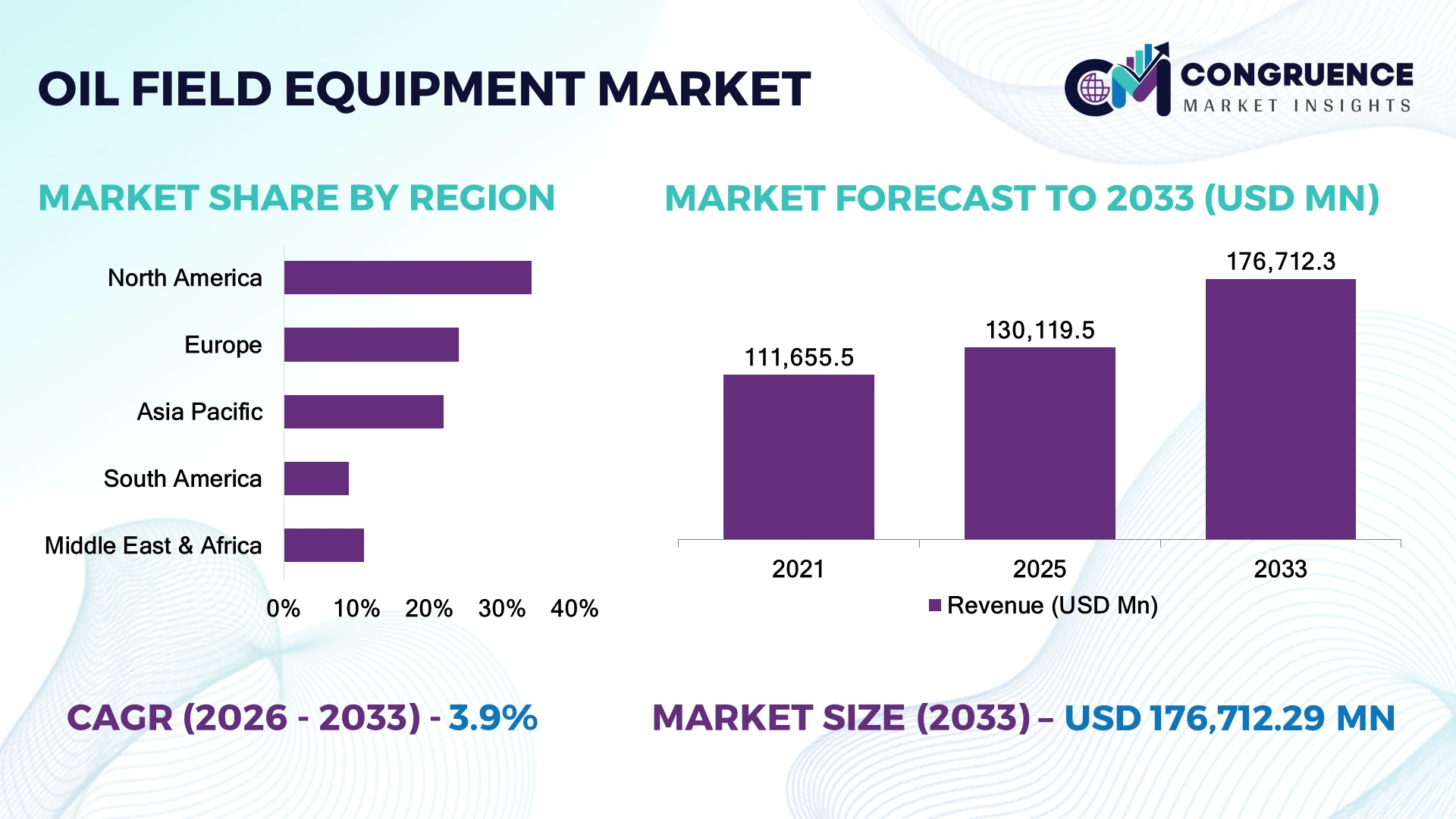
The Global Oil Field Equipment Market was valued at USD 130,119.5 Million in 2025 and is anticipated to reach a value of USD 176,712.3 Million by 2033 expanding at a CAGR of 3.9% between 2026 and 2033. Growth is being driven by mature-field redevelopment, unconventional drilling, deepwater projects, and replacement of aging drilling, completion, and production equipment with digitally monitored systems.
The United States remains the dominant equipment market, supported by shale drilling, offshore development, and a large installed equipment base, while Saudi Arabia is prioritizing upstream capacity expansion and advanced production technologies. U.S. shale operations increasingly deploy automated drilling and real-time downhole monitoring, with digitalization improving drilling productivity by roughly 10–15%. Geopolitical supply-chain restructuring following disruptions in global energy trade is reinforcing localized equipment sourcing and strategic inventory.
Strategically, suppliers with domestic manufacturing, digitally enabled equipment, and rapid field-service capabilities are best positioned to capture replacement and expansion spending.
Market Size & Growth: USD 130.1 billion in 2025 to USD 176.7 billion by 2033 at 3.9% CAGR, driven by drilling modernization and mature-field redevelopment.
Top Growth Drivers: Shale activity 18%, offshore investment 14%, equipment replacement 11% are strengthening equipment procurement.
Short-Term Forecast: By 2028, automated drilling can reduce nonproductive time by 8–12% while improving equipment utilization by 10%.
Emerging Technologies: AI drilling analytics, electric fracturing, digital twins, and autonomous control systems are expanding across advanced oilfield operations.
Regional Leaders: North America leads at roughly 36%, the Middle East approaches 25%, and Asia-Pacific exceeds 18%, with digital-field adoption accelerating.
Consumer/End-User Trends: Exploration and production companies are increasing digitally connected equipment deployment by approximately 12% annually across high-value assets.
Pilot/Case Example: 2025 automated drilling deployments demonstrated approximately 10% faster drilling cycles and reduced manual intervention requirements.
Competitive Landscape: SLB, Halliburton, Baker Hughes, NOV, and Weatherford compete through integrated equipment portfolios, field services, automation, and technology differentiation.
Regulatory & ESG Impact: Methane-control and emissions requirements are accelerating adoption of electrified equipment and monitoring systems, with emissions-intensive operations targeting 10–20% reductions.
Investment & Funding: More than USD 10 billion is being directed toward upstream equipment modernization, automation, offshore capacity, and digitally integrated field infrastructure.
Innovation & Future Outlook: Electrification, autonomous drilling, predictive maintenance, and modular equipment will shift competition toward lower operating costs and faster deployment.
Oil field equipment demand is concentrated across drilling rigs, well-control systems, pumps, pressure-control equipment, artificial-lift systems, completion tools, and production equipment. Advanced automation is becoming particularly important in unconventional and offshore operations, where digitally connected equipment can reduce operational inefficiencies by approximately 10–15%. In 2026, equipment suppliers are also responding to tighter methane-management requirements and longer procurement cycles by strengthening regional manufacturing, spare-parts inventories, and service networks.
Oil field equipment is becoming strategically important because operators are balancing production targets with higher equipment reliability, tighter emissions controls, and increasingly complex reservoirs. The competitive advantage is shifting from standalone hardware toward integrated drilling, completion, production, and digital-service platforms. Supply-chain restructuring is also encouraging operators to prioritize suppliers with regional manufacturing and assured spare-parts availability.
Modern automated drilling systems can improve drilling efficiency by roughly 8–12% compared with heavily manual workflows, while predictive-maintenance platforms can reduce unplanned equipment downtime by approximately 10%. North America remains technology-intensive because of shale and digitally managed drilling programs, whereas Middle Eastern producers emphasize high-capacity conventional fields, long-life assets, and production optimization.
Between 2026 and 2028, connected equipment deployment is expected to deepen across drilling and production operations, particularly where remote monitoring reduces field intervention requirements. A practical deployment model combines automated drilling controls, real-time pressure monitoring, predictive maintenance, and centralized analytics. Equipment manufacturers are therefore increasing software integration, forming technology partnerships, and expanding field-service capabilities. Long-term winners will combine equipment reliability, digital intelligence, localized supply, and rapid lifecycle support rather than competing on hardware price alone.
Automated drilling, intelligent completions, and digitally monitored production systems are strengthening equipment procurement as operators prioritize well productivity and asset utilization. In the United States, shale operators increasingly deploy real-time drilling analytics, with automation improving drilling-cycle efficiency by approximately 8–12% and reducing nonproductive time by 5–10%. Saudi Arabia is simultaneously advancing upstream capacity and field digitization, increasing demand for high-pressure equipment, artificial lift, and automated control systems. Electrification of hydraulic fracturing fleets is also reshaping equipment specifications as emissions requirements tighten. Manufacturers are responding through R&D, integrated control platforms, and regional service expansion. The strategic shift is clear: equipment suppliers that combine hardware with software and lifecycle support capture higher-value contracts.
Equipment manufacturers face persistent pressure from steel, electronics, specialty alloys, and precision-component costs, while complex oilfield machinery remains sensitive to extended procurement cycles. Material and component costs can fluctuate by 10–20%, directly affecting margins on drilling systems, pressure-control equipment, and subsea assemblies. U.S. and European suppliers also face longer lead times for selected electrical and control components, creating scheduling pressure for offshore projects. In the Middle East, high-capacity projects require stringent equipment qualification, increasing supplier onboarding time and engineering expenditure. Companies are mitigating exposure through multi-year procurement contracts, dual sourcing, localized machining, and higher regional inventories. The non-obvious pressure is working capital: suppliers with weak inventory discipline can lose profitability even when equipment order volumes remain strong.
Connected equipment creates an attractive upgrade pathway across mature oilfields where operators seek productivity gains without replacing complete production systems. Predictive-maintenance platforms can reduce unplanned downtime by approximately 10–15%, while automated drilling controls can improve operational efficiency by 8–12%. In Canada and the United States, electric fracturing equipment is gaining strategic relevance as operators target lower emissions and lower fuel consumption. Saudi Arabia and the United Arab Emirates are also investing in digitally integrated production infrastructure, creating opportunities for sensorized pumps, remote-control systems, and intelligent artificial lift. Equipment manufacturers are expanding software capabilities, partnering with analytics providers, and developing modular electrified systems. The strongest opportunity lies in retrofit solutions that upgrade installed equipment without requiring full-field replacement.
Oilfield digitalization introduces execution challenges beyond equipment installation, particularly when legacy drilling, production, and control systems use incompatible data architectures. Approximately 20–30% of mature-field equipment can require interface modification before seamless digital integration, increasing engineering workloads and commissioning time. Cybersecurity exposure also rises as remotely connected pumps, compressors, valves, and drilling controls expand across operational networks. In offshore environments, limited specialist availability can further extend commissioning and maintenance cycles by 5–10%. Operators therefore require standardized communication protocols, secure edge architectures, remote diagnostics, and specialized workforce training. Equipment companies are investing in interoperable platforms and cybersecurity partnerships, while operators increasingly favor suppliers capable of managing integration, commissioning, and lifecycle support through a single technical framework.
AI-Enabled Drilling Optimization AI-assisted drilling workflows are moving from pilot deployments toward operational integration, with automated parameter adjustment improving drilling efficiency by approximately 8–12% and reducing nonproductive time by 5–10%. U.S. operators are integrating real-time formation data, downhole sensors, and automated controls, while equipment suppliers expand analytics capabilities and remote-support teams.
Electric Fracturing Equipment Expansion Electric frac fleets are gaining traction as operators target lower fuel consumption and tighter emissions performance. Electrification can reduce onsite fuel use by roughly 20–30% while cutting equipment noise and maintenance requirements. North American service companies are scaling electric systems and strengthening partnerships with power-management providers.
Subsea Equipment Modernization Offshore operators are prioritizing higher-capacity subsea production systems, remote monitoring, and compact intervention technologies. Digital condition monitoring can improve equipment availability by approximately 5–10%, while predictive diagnostics reduce unnecessary offshore interventions. Suppliers are responding with integrated subsea packages, remote-control capabilities, and expanded lifecycle-service agreements.
Localized Equipment Supply Chains Geopolitical disruptions and longer component lead times are accelerating regional manufacturing and inventory localization. Oilfield equipment suppliers are increasing local sourcing and service capacity, with regionalized inventories targeting 10–15% faster replacement response. Middle Eastern producers are strengthening domestic supply ecosystems, while global manufacturers expand machining, assembly, and field-service capabilities closer to major producing hubs.
Drilling equipment leads the global oil field equipment market with an estimated 37.3% share in 2025, supported by rig deployment, directional drilling, hydraulic fracturing, and replacement of aging drilling systems. Its high capital intensity and integration with automated rig-floor controls give suppliers stronger pricing power than standardized ancillary equipment. Production and intervention equipment follows as mature fields require artificial lift, pumping, separation, and workover solutions, while completion equipment remains strategically important for reservoir productivity. Pressure and flow-control systems account for a smaller but technically critical position, particularly in high-pressure wells.
The fastest-growing shift is toward intelligent drilling and digitally integrated equipment, where automation can improve drilling efficiency by approximately 8–12%. Suppliers are prioritizing automated controls, high-pressure assemblies, and predictive-maintenance platforms, while operators are directing investment toward equipment that reduces nonproductive time. The implication is clear: technology-enabled drilling portfolios are gaining priority over conventional hardware-only offerings.
The International Association of Drilling Contractors reported 2025 global rig activity remained closely linked to regional drilling investment, reinforcing the importance of equipment availability and fleet utilization in procurement decisions.
Onshore operations represent the leading application, accounting for approximately 66% of global oil field equipment demand in 2025. The concentration reflects the extensive installed base of shale, conventional, and mature onshore wells across the United States, Canada, the Middle East, and China. Onshore projects also support faster equipment mobilization and lower infrastructure complexity than offshore developments. Offshore applications command a smaller share but require substantially higher-value drilling, subsea, pressure-control, and intervention systems, increasing supplier revenue intensity per deployment.
Offshore is the fastest-growing application, supported by deepwater developments in Brazil, Guyana, the Gulf of Mexico, and West Africa. Advanced offshore projects increasingly require 20,000-psi pressure-control systems, remote monitoring, and subsea intervention technologies. Offshore equipment procurement is therefore becoming more technology-intensive, with automation and remote diagnostics improving equipment availability by roughly 5–10%. Companies are expanding subsea engineering capabilities, forming technology partnerships, and securing long-cycle contracts, while onshore suppliers emphasize standardized modular systems and rapid deployment. Demand is shifting toward high-specification offshore equipment where technical qualification creates stronger competitive barriers.
The International Energy Agency’s 2026 investment assessment identifies energy-security concerns and Middle East supply disruptions as factors reshaping global energy investment priorities, reinforcing the strategic importance of resilient upstream infrastructure and diversified equipment supply.
Oil and gas operators, including national oil companies, integrated majors, and independent producers, represent the dominant end-user group, accounting for approximately 54% of equipment procurement. Their purchasing power reflects direct responsibility for drilling, production, well intervention, and field-development capital expenditure. Oilfield service companies follow with a substantial share because drilling contractors and service providers increasingly own or manage specialized equipment fleets. Operators prioritize reliability, lifecycle economics, and compliance, whereas service companies place greater emphasis on utilization, fleet standardization, and rapid redeployment.
Oilfield service companies represent the faster-shifting buyer group as contractors upgrade fleets with automation, electric systems, digital controls, and predictive-maintenance capabilities. Equipment utilization improvements of approximately 8–12% can materially strengthen contractor margins when fleets are deployed across multiple basins. National oil companies increasingly favor long-term equipment and service agreements, while independent operators remain more price-sensitive and often prioritize rental or refurbished assets. Suppliers are responding with customized packages, performance-based contracts, remote monitoring, and regional service centers. Competitive positioning is therefore moving toward lifecycle productivity rather than initial equipment price.
The Society of Petroleum Engineers’ recent industry discussions increasingly emphasize automation, digital drilling workflows, and integrated field technologies as practical mechanisms for improving operational efficiency, signaling stronger buyer preference for equipment bundled with digital capabilities.
North America accounted for the largest market share at 34.0% in 2025 however, Middle East & Africa is expected to register the fastest growth, expanding at a CAGR of 5.1% between 2026 and 2033.
Shale automation and equipment replacement are reshaping upstream procurement
North America maintains the largest position in oil field equipment, supported by extensive shale activity, offshore development, mature-field intervention, and a large installed base of drilling and production assets. The United States concentrates most regional demand, with drilling contractors increasingly upgrading rigs with automated controls, real-time formation monitoring, and predictive-maintenance systems. Digital drilling technologies can improve operational efficiency by approximately 8–12%, while electrified fracturing equipment is gaining traction as operators target lower fuel consumption and emissions. Canada contributes through oil-sands production, heavy-oil infrastructure, and specialized pumping and separation equipment. Suppliers are expanding regional service centers, stocking critical components, and integrating software with pressure-control and drilling portfolios. The strategic advantage increasingly rests with vendors capable of supporting equipment throughout its operating lifecycle.
United States Market Outlook: The United States remains the region's principal equipment market because of its extensive shale infrastructure, active drilling fleet, and technologically advanced service ecosystem. Horizontal drilling and hydraulic fracturing account for a substantial share of new well activity, while automated rig systems are increasingly deployed to improve consistency and reduce manual intervention. Operators are also increasing investment in electric fracturing, digital well monitoring, and high-efficiency artificial-lift equipment.
Mature-field optimization is shifting procurement toward high-efficiency systems
Europe's oil field equipment market is increasingly centered on North Sea maintenance, brownfield optimization, offshore intervention, and decommissioning-related equipment rather than large-scale greenfield expansion. Norway and the United Kingdom remain important technology and service hubs, with offshore operators prioritizing subsea systems, well-intervention tools, remote monitoring, and emissions-reduction technologies. Electrification and digital condition monitoring are gaining importance as operators seek lower offshore operating intensity. Automated inspection and predictive maintenance can reduce unnecessary intervention requirements by approximately 5–10%. Equipment suppliers are responding through specialized offshore engineering, lifecycle-service contracts, and technology partnerships. The market favors technically certified equipment with strong reliability and environmental performance, creating higher qualification barriers but attractive margins for specialized suppliers.
Norway Market Outlook: Norway represents Europe's strongest strategic equipment market because of its sophisticated offshore infrastructure, deepwater expertise, and concentration of technologically demanding field operations. Operators increasingly emphasize subsea production, remote monitoring, electrification, and efficient well intervention. Offshore equipment suppliers benefit from established engineering capabilities and mature service networks. Digital monitoring can improve equipment availability by roughly 5–10%, strengthening demand for connected subsea and production systems.
National production programs are accelerating equipment modernization
Asia-Pacific combines large conventional production bases with expanding offshore and unconventional development, making equipment demand increasingly diversified. China, India, Indonesia, Malaysia, and Australia are strengthening drilling, completion, artificial-lift, and production infrastructure, while offshore projects require increasingly sophisticated pressure-control and subsea equipment. China remains a major manufacturing base, supporting shorter equipment supply chains and competitive component sourcing. India's upstream modernization is increasing demand for digitally monitored drilling and well-completion systems, while Australia emphasizes high-specification offshore equipment and intervention services. Automated drilling and remote diagnostics can improve equipment utilization by approximately 8–12%. Suppliers are responding with localized manufacturing, technology partnerships, and modular equipment portfolios. The region's strategic opportunity lies in combining cost-efficient manufacturing with increasingly sophisticated field technologies.
China Market Outlook: China combines substantial upstream activity with a powerful industrial manufacturing ecosystem, giving domestic equipment suppliers an advantage in component availability, fabrication, and customization. Offshore exploration and mature-field redevelopment are supporting demand for drilling systems, pumps, artificial-lift equipment, and digital monitoring. Increasing automation can reduce manual intervention by approximately 10%, while domestic manufacturing strengthens procurement resilience and shortens replacement cycles.
Deepwater development is raising the technical value of equipment demand
South America's equipment market is increasingly shaped by Brazil's offshore production and Guyana's rapidly expanding petroleum infrastructure. Brazil's pre-salt fields require high-pressure drilling, subsea production systems, floating production equipment, and specialized well-intervention technologies, creating higher equipment value per project than conventional onshore operations. Deepwater projects increasingly incorporate remote monitoring and automated production controls, improving equipment availability by approximately 5–10%. Guyana is developing supporting logistics, fabrication, and service infrastructure around offshore production, while Argentina's Vaca Muerta development strengthens demand for land-based drilling and hydraulic-fracturing equipment. Suppliers are expanding local service capabilities and establishing partnerships with operators and contractors. The principal operational constraint remains logistics: specialized offshore equipment requires long lead times and robust port and service infrastructure.
Brazil Market Outlook: Brazil is the region's dominant equipment market because of its extensive pre-salt reserves, established offshore engineering base, and concentration of deepwater production infrastructure. Its offshore projects require advanced subsea systems, high-pressure equipment, drilling technologies, and floating production solutions. Deepwater development supports strong demand for specialized equipment, while local-content requirements encourage suppliers to establish Brazilian manufacturing, engineering, and maintenance capabilities.
Upstream capacity expansion is driving high-specification equipment investment
Middle East & Africa is becoming increasingly equipment-intensive as national oil companies expand production capacity, modernize mature fields, and deploy digital oilfield technologies. Saudi Arabia, the United Arab Emirates, Iraq, and Qatar are driving regional procurement through drilling programs, enhanced oil recovery, gas development, and field optimization. Saudi Arabia's upstream expansion particularly supports demand for drilling rigs, well-control systems, pumps, artificial lift, and high-pressure completion equipment. Automated drilling and predictive-maintenance technologies can improve equipment utilization by approximately 8–12%. African markets are simultaneously developing offshore projects in Nigeria, Angola, Mozambique, and emerging Atlantic basins. Suppliers are strengthening regional inventories, local service teams, and partnerships with national operators. The competitive advantage increasingly comes from rapid mobilization, localized maintenance, and the ability to meet demanding technical qualification requirements.
Saudi Arabia Market Outlook: Saudi Arabia represents the region's most strategically significant equipment market because of its extensive producing asset base, upstream capacity programs, and strong national investment in oilfield modernization. Demand spans drilling, pressure control, artificial lift, completion, and production equipment. Digital field technologies are increasingly integrated into upstream operations, with automation capable of improving drilling efficiency by roughly 8–12%. Local manufacturing and service development are also strengthening domestic equipment supply resilience.
SLB, Halliburton, Baker Hughes, NOV, and Weatherford compete as global integrated oilfield technology leaders, while regional equipment manufacturers, drilling contractors, and specialized pressure-control suppliers challenge them on cost and localization. The top five players collectively hold an estimated 30% share, leaving room for regional specialists. Technology is decisive, with automation improving drilling efficiency by 8–12%; predictive maintenance can reduce unplanned downtime by 10–15%, while localized sourcing can shorten equipment response times by 10%. Competition is shifting from standalone hardware toward integrated equipment, software, and lifecycle services. SLB is strengthening production technologies through portfolio integration, Halliburton is advancing autonomous drilling, and NOV is pairing drilling hardware with digital controls. Baker Hughes and Weatherford emphasize intelligent completion and production systems. Consolidation, automation, and supply-chain localization are reshaping procurement. High qualification requirements, capital intensity, and field-service infrastructure remain entry barriers. Winning requires reliability, digital integration, regional support, rapid deployment, and measurable lifecycle economics.
SLB
Halliburton Company
Baker Hughes Company
NOV Inc.
Weatherford International plc
Nabors Industries Ltd.
Transocean Ltd.
TechnipFMC plc
Tenaris S.A.
Expro Group Holdings N.V.
Dril-Quip, Inc.
KCA Deutag
Saipem S.p.A.
AI-enabled drilling, autonomous rig controls, digital twins, and real-time downhole analytics are becoming core technologies across advanced oilfield operations. Closed-loop drilling can improve drilling efficiency by approximately 8–12%, while AI-assisted parameter optimization reduces nonproductive time by roughly 5–10%. Adoption is strongest among technologically advanced operators in North America, the Middle East, and offshore Norway, where connected equipment is increasingly integrated with centralized operations centers. Suppliers benefit by combining drilling hardware, sensors, automation software, and remote-support capabilities into unified platforms.
Wired drill pipe, fiber-optic completion monitoring, intelligent artificial lift, and predictive-maintenance systems represent the next technology layer. Wired networks provide continuous downhole data and power, improving measurement responsiveness by approximately 10–15% compared with intermittent conventional telemetry. Predictive analytics can reduce unplanned equipment downtime by 10–15%, while intelligent completion systems improve intervention planning and production control. Operators gain better asset visibility, and equipment suppliers capture higher-value lifecycle contracts through integrated service models.
Between 2026 and 2028, autonomous drilling, electric fracturing, robotics, and AI-driven maintenance will move further into commercial deployment. Automated workflows can deliver approximately 10% higher operational consistency than manual processes, particularly in repetitive drilling activities. Technology leaders such as SLB, Halliburton, NOV, and Baker Hughes gain an advantage because their installed equipment ecosystems provide data access and integration pathways. The competitive priority is shifting toward interoperable equipment, secure connectivity, measurable productivity gains, and lower lifecycle costs.
July 2025 SLB completed its ChampionX acquisition, adding artificial lift, production chemicals, digital production, and emissions technologies. Former ChampionX shareholders received 9% of SLB shares, strengthening integrated production solutions and expanding international lifecycle coverage. Source: slb.com (SLB)
February 2025 Halliburton and Sekal deployed the world’s first automated on-bottom drilling system for Equinor in Norway, integrating closed-loop directional drilling, hydraulics, and rig controls. The deployment enabled parameter optimization and automated well placement, advancing autonomous drilling capabilities for wells. Source: halliburton.com (Halliburton)
January 2026 NOV reported that its Downhole Broadband Solutions technology drilled more than 750,000 feet during 2025, a 74% year-on-year increase. The result demonstrates adoption of wired drill-pipe data networks, supporting faster decisions, improved reservoir exposure, and drilling equipment demand. Source: nov.com (Novavax Investors)
January 2025 Baker Hughes launched SureCONNECT FE, a downhole fiber-optic wet-mate system designed for high-pressure, high-temperature wells. The technology enables monitoring across intelligent completions while reducing rig time, maintenance requirements, and intervention exposure, strengthening completion capabilities for operators. Source: bakerhughes.com (Baker Hughes)
The Global Oil Field Equipment Market Report covers drilling equipment, well-control systems, completion equipment, production machinery, artificial-lift systems, pressure-control equipment, subsea systems, and related digital technologies. Segmentation analysis evaluates equipment type, application across onshore and offshore operations, and end-users including integrated oil companies, national oil companies, independent producers, drilling contractors, and oilfield service providers.
Regional coverage spans North America, Europe, Asia-Pacific, South America, and the Middle East & Africa, with country-level analysis of drilling activity, equipment deployment, production infrastructure, offshore projects, and localization initiatives. Technology assessment includes automated drilling, AI-enabled analytics, wired drill pipe, intelligent completions, predictive maintenance, electrification, and remote operations. The report evaluates 10+ major market participants and their equipment portfolios, partnerships, expansion strategies, technology investments, and lifecycle-service models, supporting procurement planning, market entry, capacity expansion, competitive positioning, and strategic investment decisions through 2026–2033.
| Report Attribute/Metric | Report Details |
|---|---|
|
Market Revenue in 2025 |
USD 130,119.5 Million |
|
Market Revenue in 2033 |
USD 176,712.3 Million |
|
CAGR (2026 - 2033) |
3.9% |
|
Base Year |
2025 |
|
Forecast Period |
2026 - 2033 |
|
Historic Period |
2021 - 2025 |
|
Segments Covered |
By Type
By Application
By End-User
|
|
Key Report Deliverable |
Revenue Forecast, Growth Trends, Market Dynamics, Segmental Overview, Regional and Country-wise Analysis, Competition Landscape |
|
Region Covered |
North America, Europe, Asia-Pacific, South America, Middle East, Africa |
|
Key Players Analyzed |
SLB, Halliburton Company, Baker Hughes Company, NOV Inc., Weatherford International plc, Nabors Industries Ltd., Transocean Ltd., TechnipFMC plc, Tenaris S.A., Expro Group Holdings N.V., Dril-Quip, Inc., KCA Deutag, Saipem S.p.A. |
|
Customization & Pricing |
Available on Request (10% Customization is Free) |




