
Reports
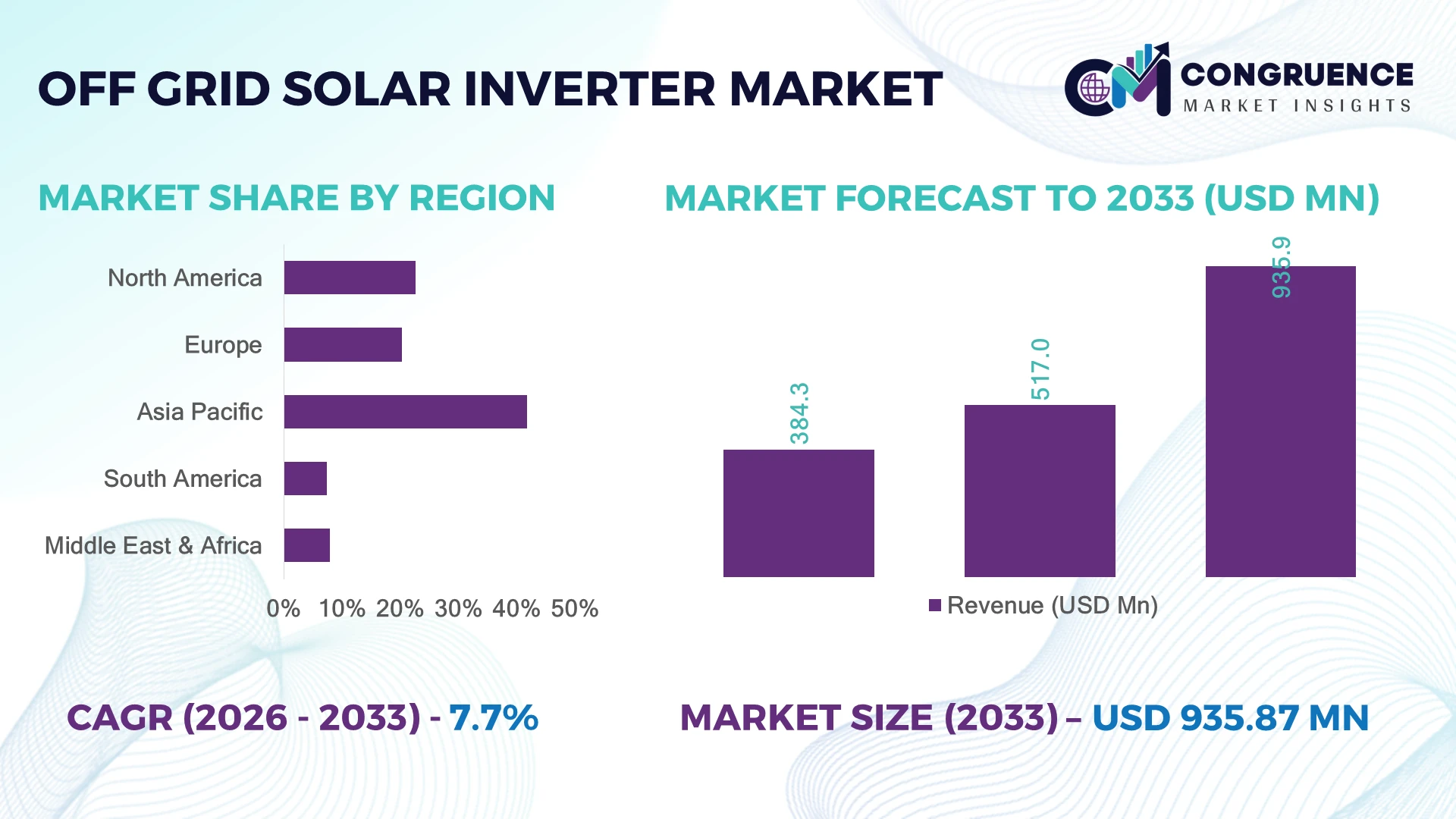
The Global Off-Grid Solar Inverter Market was valued at USD 517.0 Million in 2025 and is anticipated to reach a value of USD 935.9 Million by 2033 expanding at a CAGR of 7.7% between 2026 and 2033. Rural electrification initiatives, hybrid renewable energy deployment, battery storage integration, and resilient decentralized power infrastructure are accelerating adoption across residential, agricultural, telecom, and remote industrial applications.
China dominates the global market with approximately 32% manufacturing share, supported by over 430 GW of cumulative solar installations, advanced power electronics production, and strong battery ecosystem investments. India is expanding deployment faster through decentralized rural electrification and agricultural pumping programs, while African nations increasingly integrate off-grid systems to improve energy access.
This manufacturing and deployment leadership strengthens supply resilience, lowers system costs, and shapes long-term technology partnerships and market expansion strategies.
Market Size & Growth: USD 517.0 Million in 2025 reaching USD 935.9 Million by 2033 at 7.7% CAGR, supported by battery-integrated decentralized solar systems.
Top Growth Drivers: Rural electrification (38%), battery storage adoption (31%), telecom infrastructure expansion (24%) drive demand.
Short-Term Forecast: By 2028, inverter conversion efficiency exceeds 98% while system installation costs decline by nearly 15%.
Emerging Technologies: AI-based energy management, smart hybrid inverters, and advanced lithium battery integration improve operational performance.
Regional Leaders: Asia Pacific (~USD 345 Million), Africa (~USD 170 Million), Latin America (~USD 125 Million) expand through distributed renewable energy projects.
Consumer/End-User Trends: More than 48% of new remote installations integrate battery-backed intelligent energy management systems.
Pilot/Case Example: 2024 rural microgrid deployments reduced diesel consumption by nearly 60% through solar-storage integration.
Competitive Landscape: Top manufacturers collectively control about 45% of global shipments, led by Huawei, Sungrow, Schneider Electric, Victron Energy, and Growatt.
Regulatory & ESG Impact: National renewable-energy policies increased decentralized solar deployment by over 20% across multiple emerging economies.
Investment & Funding: More than USD 3 Billion supports manufacturing expansion, storage integration, and regional renewable infrastructure partnerships.
Innovation & Future Outlook: Next-generation digital monitoring, bidirectional power control, and modular hybrid architectures strengthen global energy resilience amid evolving supply chains.
Off-Grid Solar Inverter Market demand continues expanding across rural electrification, telecommunications infrastructure, agriculture, disaster-resilient backup systems, and commercial microgrids. Manufacturers increasingly integrate AI-enabled monitoring, remote diagnostics, and advanced battery compatibility to improve system reliability. Nearly 40% of newly deployed off-grid systems now include smart energy management features, while localization of manufacturing and supportive renewable-energy policies are strengthening supply-chain resilience, creating a strong foundation for broader strategic market transformation.
The Off-Grid Solar Inverter Market has become strategically important as governments, utilities, and private developers accelerate decentralized energy infrastructure to improve grid resilience and expand electricity access. Infrastructure modernization, localized manufacturing, and battery ecosystem development are reshaping competitive positioning. Companies are strengthening regional supply chains while expanding product portfolios to address residential, telecom, mining, healthcare, and agricultural applications in underserved locations.
Modern hybrid off-grid inverters deliver conversion efficiencies exceeding 98%, compared with approximately 92–94% for many conventional legacy systems, reducing energy losses and improving battery utilization. Asia-Pacific leads large-scale manufacturing capacity and deployment, while Africa records faster implementation of community microgrids and rural electrification projects. During the next two to three years, intelligent monitoring platforms, predictive maintenance, and integrated storage solutions are expected to become standard features across a growing share of new installations.
A practical example includes solar-powered telecom towers replacing diesel-dependent operations through integrated inverter-storage systems, reducing fuel logistics and maintenance requirements. Leading companies are expanding manufacturing partnerships, investing in localized service networks, and developing modular inverter platforms tailored for regional requirements. These strategies strengthen competitive differentiation, improve operational flexibility, and position suppliers to capitalize on the long-term transition toward resilient, decentralized renewable power infrastructure.
Rapid deployment of decentralized renewable energy systems is strengthening demand for advanced off-grid solar inverters across residential, telecom, agriculture, and industrial applications. More than 48% of newly commissioned off-grid solar installations now incorporate battery storage, while inverter conversion efficiency has exceeded 98% in premium hybrid platforms. India's rural electrification and solar irrigation initiatives, alongside China's continued expansion of distributed photovoltaic manufacturing, are accelerating product adoption. This structural transition is reducing diesel dependence, improving power reliability, and increasing demand for intelligent energy management. In response, manufacturers are expanding localized production, investing in hybrid inverter platforms, and forming battery technology partnerships to deliver integrated energy solutions with enhanced operational flexibility and lifecycle performance.
The market continues to face structural pressure from dependence on semiconductor devices, power electronics, and lithium-based battery components. Electronic components account for nearly 35% of total inverter manufacturing costs, while battery prices still represent over 40% of complete off-grid system expenditure in many projects. Periodic export restrictions on critical minerals and supply-chain disruptions have extended procurement timelines for manufacturers serving emerging markets. These conditions compress profit margins and delay commercial deployment schedules. Companies are mitigating exposure by diversifying supplier networks, increasing local sourcing in countries such as India, and securing long-term procurement agreements while redesigning inverter architectures to improve component interchangeability and manufacturing resilience.
The convergence of AI-enabled energy management, modular battery storage, and remote diagnostics is creating new value beyond conventional rural electrification. Nearly 45% of commercial off-grid installations are expected to integrate cloud-based monitoring within the next few years, while predictive maintenance can reduce service interventions by approximately 30%. Australia and India are expanding distributed renewable programs supporting hybrid microgrids for agriculture, mining, and remote healthcare facilities. Manufacturers are investing in digital software ecosystems, interoperable inverter platforms, and strategic battery partnerships to deliver energy-as-a-service solutions. A significant strategic opportunity lies in combining hardware with intelligent analytics, generating recurring service revenue alongside equipment sales.
Long-term market expansion depends on overcoming installation complexity, interoperability challenges, and technical workforce shortages. Approximately 28% of deployment delays are associated with commissioning, system integration, and installer capability gaps, while software configuration errors can increase maintenance requirements by nearly 20% in remote installations. As countries modernize distributed energy regulations and introduce smart-grid compatibility requirements, inverter manufacturers must ensure seamless communication between storage systems, controllers, and monitoring platforms. Companies are addressing these challenges through installer certification programs, digital commissioning tools, standardized communication protocols, and expanded technical support networks. Strengthening deployment consistency will become a critical competitive differentiator as intelligent off-grid energy ecosystems continue to scale.
Hybrid Storage Integration Accelerates: Battery-coupled off-grid systems now account for nearly 52% of newly deployed installations, while hybrid inverter shipments have increased by approximately 28% over the past two years. India's rural electrification programs and rising diesel replacement projects are driving deployment. Companies are expanding hybrid product portfolios, integrating lithium battery compatibility, and strengthening installer networks to improve energy reliability while lowering operating costs for remote consumers and commercial users.
AI-Based Energy Management Expands: More than 42% of premium off-grid inverter systems now incorporate AI-enabled energy optimization and cloud monitoring, reducing maintenance visits by nearly 30%. Growing labor shortages in remote operations are accelerating digital monitoring adoption. Manufacturers are partnering with software providers to deploy predictive maintenance, remote diagnostics, and mobile asset management platforms that improve uptime and reduce lifecycle servicing expenses across distributed energy installations.
Localized Manufacturing Gains Momentum: China continues supplying over 60% of global photovoltaic components, encouraging manufacturers in India and Southeast Asia to localize inverter assembly and electronic component sourcing. Local production has shortened delivery cycles by approximately 20% while improving inventory resilience against international logistics disruptions. Companies are expanding regional manufacturing facilities, qualifying alternative suppliers, and restructuring procurement strategies to strengthen operational continuity and reduce dependency on imported power electronics.
Modular Commercial Microgrids Advance: Modular off-grid solar microgrids are expanding rapidly across mining, agriculture, healthcare, and telecom infrastructure, with deployment increasing by nearly 35% in remote industrial locations. Government-backed clean energy initiatives and rising fuel transportation costs are encouraging decentralized energy investments. Companies are developing scalable inverter architectures, integrating remote commissioning capabilities, and forming EPC partnerships to deliver faster installation, lower maintenance complexity, and improved long-term operational performance.
Hybrid Off-Grid Inverters lead the market with approximately 47% of global demand owing to their ability to seamlessly integrate solar generation, battery storage, and backup generators within a single energy management platform. Their superior flexibility, intelligent load prioritization, and high conversion efficiency make them the preferred choice for residential, commercial, and telecom deployments. Manufacturers continue expanding hybrid product portfolios with advanced monitoring software and lithium battery compatibility to improve lifecycle performance and reduce operating costs. Pure Sine Wave Inverters represent the fastest-growing segment as sensitive electronics, medical equipment, and communication infrastructure increasingly require stable, utility-grade power quality. Shipments have expanded by nearly 24% in premium installations where power stability is mission-critical. Meanwhile, Modified Sine Wave Inverters retain relevance for entry-level residential applications because of their affordability, although investment is gradually shifting toward higher-efficiency alternatives. Companies are prioritizing digital control systems, modular architectures, and battery integration while reducing emphasis on conventional low-cost inverter designs to capture premium installation opportunities.
The Residential segment remains the largest application, accounting for nearly 44% of total deployments as homeowners increasingly adopt off-grid systems for energy security, rural electrification, and backup power. Declining battery costs and simplified installation packages continue supporting widespread household adoption. Manufacturers are strengthening dealer networks, introducing plug-and-play hybrid solutions, and expanding financing partnerships to improve accessibility for first-time buyers. Rural Electrification & Microgrids is emerging as the fastest-growing application, supported by government electrification programs and decentralized infrastructure investments. Project deployment has increased by approximately 30% across underserved communities requiring reliable electricity access. Agriculture & Irrigation continues expanding through solar-powered pumping systems, while Remote Telecom Infrastructure increasingly replaces diesel generators with renewable power solutions. Commercial and industrial users are emphasizing energy resilience and lower operating costs through larger-capacity inverter systems. Companies are scaling customized product offerings and integrated storage solutions tailored to diverse operational requirements.
Residential Consumers remain the dominant buyer group with approximately 46% of installed off-grid inverter systems, supported by increasing energy independence initiatives, rooftop solar adoption, and unreliable grid conditions in many developing countries. Consumer demand is shifting toward intelligent hybrid systems equipped with mobile monitoring, battery optimization, and remote diagnostics. Manufacturers continue expanding retail distribution channels and bundled solar-storage packages to strengthen market penetration. Telecom Operators represent the fastest-growing end-user segment as network operators modernize remote tower infrastructure and reduce diesel fuel dependence. Renewable-powered telecom sites have increased by nearly 27%, improving operational continuity while lowering maintenance logistics. Government & Public Infrastructure continues deploying off-grid systems for healthcare centers and educational facilities, whereas Commercial Enterprises, Industrial Facilities, and Energy & Utility Companies increasingly adopt modular inverter platforms for resilience, operational efficiency, and distributed power management. Suppliers are expanding strategic partnerships with EPC contractors and battery manufacturers while developing sector-specific inverter solutions that address unique operational requirements.
Asia-Pacific accounted for the largest market share at 41.8% in 2025 however, Middle East & Africa is expected to register the fastest growth, expanding at a CAGR of 9.4% between 2026 and 2033.
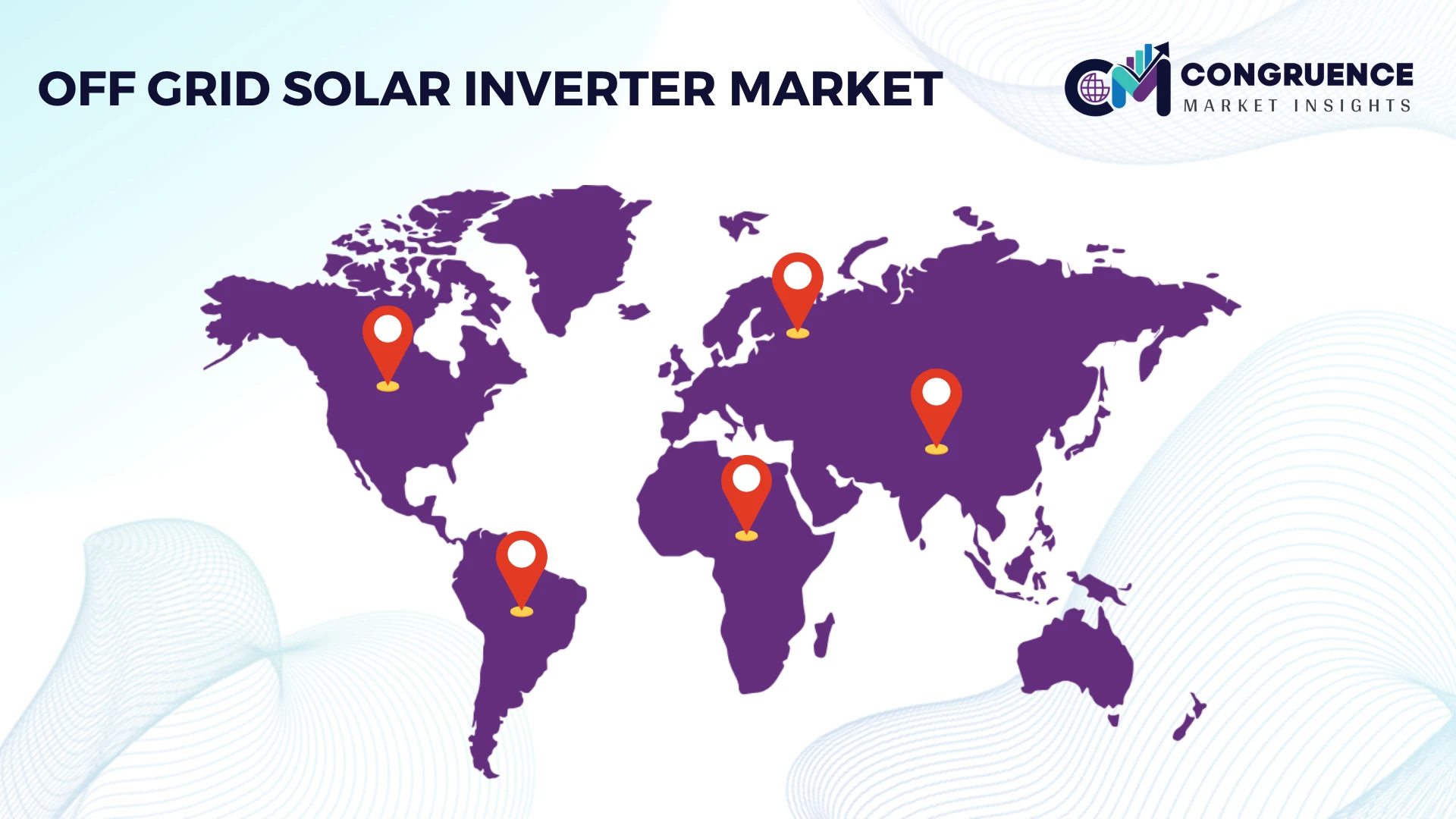
North America accounted for approximately 22.6% of the global Off-Grid Solar Inverter Market in 2025, supported by resilient energy infrastructure investments, remote industrial operations, and rising demand for reliable backup power. Commercial facilities, telecom operators, and agricultural enterprises continue replacing diesel-based systems with hybrid solar-storage installations to improve operational continuity. More than 55% of newly commissioned off-grid commercial projects now incorporate intelligent battery management and remote monitoring capabilities. Utilities and EPC contractors are expanding partnerships to accelerate deployment across wildfire-prone and grid-constrained locations while manufacturers introduce modular inverter platforms designed for scalable distributed energy systems.
United States Market Outlook: The United States remains the region's operational leader due to strong distributed energy deployment, advanced inverter manufacturing capabilities, and expanding energy resilience initiatives. More than 5 GW of microgrid capacity is either operational or under development, creating sustained demand for intelligent off-grid inverter systems. Domestic manufacturers continue investing in localized production, software-enabled energy management, and utility partnerships that strengthen supply-chain resilience while supporting remote industrial, defense, healthcare, and telecommunications applications.
Europe represented nearly 20.3% of the global market, driven by energy security initiatives, renewable integration, and modernization of decentralized electricity infrastructure. Remote commercial facilities, island communities, and industrial users increasingly deploy advanced hybrid inverter systems to improve grid independence. More than 50% of newly installed off-grid projects utilize integrated storage and digital monitoring to optimize energy utilization. Manufacturers are strengthening regional engineering partnerships while expanding compatibility with next-generation battery technologies and smart energy management platforms to improve operational efficiency and regulatory compliance.
Germany Market Outlook: Germany leads the European market through its mature photovoltaic ecosystem, advanced power electronics industry, and continuous investment in distributed renewable technologies. Industrial facilities increasingly combine battery storage with intelligent inverter platforms to improve energy flexibility and operational reliability. Domestic engineering companies are expanding inverter innovation, grid integration software, and digital monitoring capabilities while supporting commercial, agricultural, and industrial decentralized power projects with high-performance energy management solutions.
Asia-Pacific contributed approximately 41.8% of the global market in 2025, supported by extensive photovoltaic manufacturing, expanding battery production, and large-scale rural electrification initiatives. China and India continue driving deployment through distributed renewable energy programs and localized manufacturing ecosystems. Nearly 65% of regional inverter production is concentrated within China, enabling competitive pricing and shorter supply cycles. Manufacturers are expanding production capacity, strengthening export networks, and investing in intelligent hybrid inverter technologies to meet increasing demand across residential, agricultural, telecom, and commercial sectors.
China Market Outlook: China remains the global manufacturing hub for off-grid solar inverter systems through vertically integrated photovoltaic production, advanced power electronics, and large-scale battery manufacturing. The country accounts for over 60% of global photovoltaic module manufacturing capacity while maintaining one of the world's largest distributed solar installation bases. Domestic companies continue investing in AI-enabled inverter platforms, export expansion, and integrated storage technologies that reinforce technological leadership and global supply-chain competitiveness.
South America accounted for around 7.4% of global demand as remote mining operations, agricultural facilities, and isolated communities increasingly adopt decentralized renewable energy systems. Rising fuel transportation costs continue encouraging hybrid solar-storage deployment across off-grid locations. Nearly 35% of newly commissioned rural energy projects now integrate battery-backed inverter platforms to reduce operational dependence on diesel generation. Equipment suppliers are strengthening regional distribution partnerships while expanding localized technical support to improve installation quality and long-term operational reliability despite infrastructure constraints.
Brazil Market Outlook: Brazil represents the region's largest market owing to its expanding distributed solar sector, agricultural electrification initiatives, and remote industrial operations. Commercial farms, telecommunications infrastructure, and mining facilities increasingly deploy off-grid inverter systems to stabilize energy supply and reduce operating expenses. Domestic distributors are expanding installer training, after-sales services, and equipment availability while supporting broader deployment across underserved rural communities and isolated commercial operations.
Middle East & Africa is emerging as the fastest-expanding regional market, accounting for approximately 7.9% of global demand in 2025. National electrification initiatives, humanitarian energy access programs, and expanding telecom infrastructure continue driving deployment of decentralized solar power systems. More than 40% of newly installed rural electrification projects now integrate battery-supported inverter solutions to improve reliability and reduce diesel consumption. Manufacturers are expanding regional partnerships, localized assembly operations, and technical service networks to support long-term infrastructure modernization and improve equipment availability across underserved markets.
South Africa Market Outlook: South Africa leads the regional market through persistent electricity supply challenges, growing commercial solar adoption, and strong private-sector investment in distributed energy infrastructure. Mining operations, industrial facilities, and commercial enterprises increasingly install hybrid inverter systems to improve operational continuity during grid disruptions. Local distributors continue expanding engineering partnerships, installation capabilities, and battery integration services while accelerating deployment of intelligent off-grid energy systems across business and critical infrastructure sectors.
The Off-Grid Solar Inverter Market is led by global technology providers including Sungrow, Schneider Electric, Victron Energy, Growatt, and SMA Solar Technology, competing against regional manufacturers offering lower-cost alternatives. The top five companies collectively account for approximately 42% of the global market, while regional suppliers compete aggressively in emerging economies through pricing and local service networks. Competition centers on conversion efficiency, digital monitoring, battery compatibility, and supply-chain resilience rather than price alone. Premium manufacturers deliver inverter efficiencies above 98%, while localized manufacturing can reduce delivery lead times by nearly 20% and lifecycle service costs by 15%. Companies are expanding production, integrating battery storage, forming EPC partnerships, and strengthening software ecosystems to differentiate offerings. The market is shifting toward intelligent hybrid platforms and vertically integrated energy solutions, increasing pressure on standalone hardware suppliers. Certification requirements, after-sales networks, and advanced power electronics remain significant entry barriers. Winning requires technological leadership, reliable supply chains, localized service capabilities, and scalable hybrid energy ecosystems.
Schneider Electric
Victron Energy
Growatt
SMA Solar Technology
GoodWe Technologies
Solis (Ginlong Technologies)
Delta Electronics
OutBack Power
Samlex America
AIMS Power
MEAN WELL
Luminous Power Technologies
UTL Solar
Advanced hybrid inverter technology has become the industry's primary innovation focus, integrating photovoltaic generation, battery storage, and backup generation within a unified power management platform. Modern hybrid systems achieve conversion efficiencies exceeding 98%, improving energy utilization by approximately 5–7% over conventional inverter architectures. More than 50% of newly deployed premium off-grid systems now include integrated battery management, remote diagnostics, and intelligent load prioritization, enabling greater operational reliability for residential, commercial, and telecom applications.
Artificial intelligence, cloud monitoring, and predictive maintenance are transforming operational performance. AI-enabled monitoring platforms reduce unplanned maintenance by nearly 30% while improving fault detection speed and battery optimization. Manufacturers with integrated software ecosystems benefit from recurring service opportunities and stronger customer retention compared with hardware-only suppliers. Grid-forming capabilities, modular power electronics, and silicon carbide semiconductor components are further improving system stability, thermal performance, and installation flexibility.
Between 2026 and 2028, digital energy management, bidirectional power flow, and interoperable battery platforms are expected to become standard across premium installations. Companies investing early in intelligent hybrid architectures, cybersecurity, and cloud-connected energy platforms will strengthen competitive positioning, reduce lifecycle operating costs, and capture growing demand from distributed energy infrastructure, commercial microgrids, and resilient off-grid power applications.
April 2025 – Sungrow introduced the 1+X 2.0 Modular Inverter with a scalable architecture ranging from 800 kW to 9.6 MW, enabling faster field replacement and improved utility-scale project flexibility. The launch strengthens Sungrow's position in high-performance hybrid and off-grid applications while reducing maintenance complexity. Source: www.pv-magazine-australia.com
May 2025 – Sungrow showcased its latest renewable energy portfolio at Intersolar Europe 2025, including the European debut of the 1+X 2.0 platform and advanced energy storage systems. Module replacement time was reduced to approximately one hour, improving operational uptime for large-scale installations.
April 2025 – Solis (Ginlong Technologies) launched a new commercial and industrial hybrid inverter series with capacities of 80 kW, 100 kW, and 125 kW, expanding support for battery-integrated distributed energy systems. The product broadens high-capacity deployment options for commercial microgrids and decentralized renewable projects.
June 2026 – U.S. Federal Communications Commission (proposed action) advanced plans to restrict new foreign-made energy inverters over cybersecurity concerns, directly affecting leading Chinese suppliers including Sungrow and Huawei. The policy signals a major supply-chain realignment for critical power infrastructure across Western markets.
The report provides a comprehensive assessment of the global Off-Grid Solar Inverter Market across three product types, six application segments, and six end-user categories, covering deployment patterns, technology evolution, competitive positioning, and operational developments. It evaluates market dynamics across North America, Europe, Asia-Pacific, South America, and the Middle East & Africa, with dedicated country-level analysis for strategically significant markets. More than 40% of the assessment focuses on technology adoption, deployment trends, manufacturing strategies, and supply-chain transformation influencing business performance.
The study examines hybrid inverter architectures, intelligent energy management, battery integration, digital monitoring, and distributed renewable energy ecosystems while profiling leading industry participants and competitive strategies. It delivers actionable insights supporting investment prioritization, product development, geographic expansion, partnership evaluation, procurement planning, and competitive benchmarking between 2026 and 2033. The report also highlights emerging opportunities across rural electrification, telecom infrastructure, commercial microgrids, agricultural energy systems, and decentralized industrial power applications, enabling informed long-term strategic decision-making.
| Report Attribute / Metric | Details |
|---|---|
| Market Revenue (2025) | USD 517.0 Million |
| Market Revenue (2033) | USD 935.9 Million |
| CAGR (2026–2033) | 7.7% |
| Base Year | 2025 |
| Forecast Period | 2026–2033 |
| Historic Period | 2021–2025 |
| Segments Covered |
By Type
By Application
By End-User
|
| Key Report Deliverables | Revenue Forecast; Market Trends; Growth Drivers & Restraints; Technology Insights; Segmentation Analysis; Regional Insights; Competitive Landscape; Regulatory & ESG Overview; Recent Developments |
| Regions Covered | North America; Europe; Asia-Pacific; South America; Middle East & Africa |
| Key Players Analyzed | Sungrow; Schneider Electric; Victron Energy; Growatt; SMA Solar Technology; GoodWe Technologies; Solis (Ginlong Technologies); Delta Electronics; OutBack Power; Samlex America; AIMS Power; MEAN WELL; Luminous Power Technologies; UTL Solar |
| Customization & Pricing | Available on Request (10% Customization Free) |




