
Reports
The Global OEM Insulation Market was valued at USD 3,865.0 Million in 2025 and is anticipated to reach a value of USD 5,851.1 Million by 2033 expanding at a CAGR of 5.32% between 2026 and 2033. Tightening thermal-safety mandates for EV battery packs and HVAC efficiency codes are forcing OEM design engineers to specify higher-performance insulation at the platform-development stage.
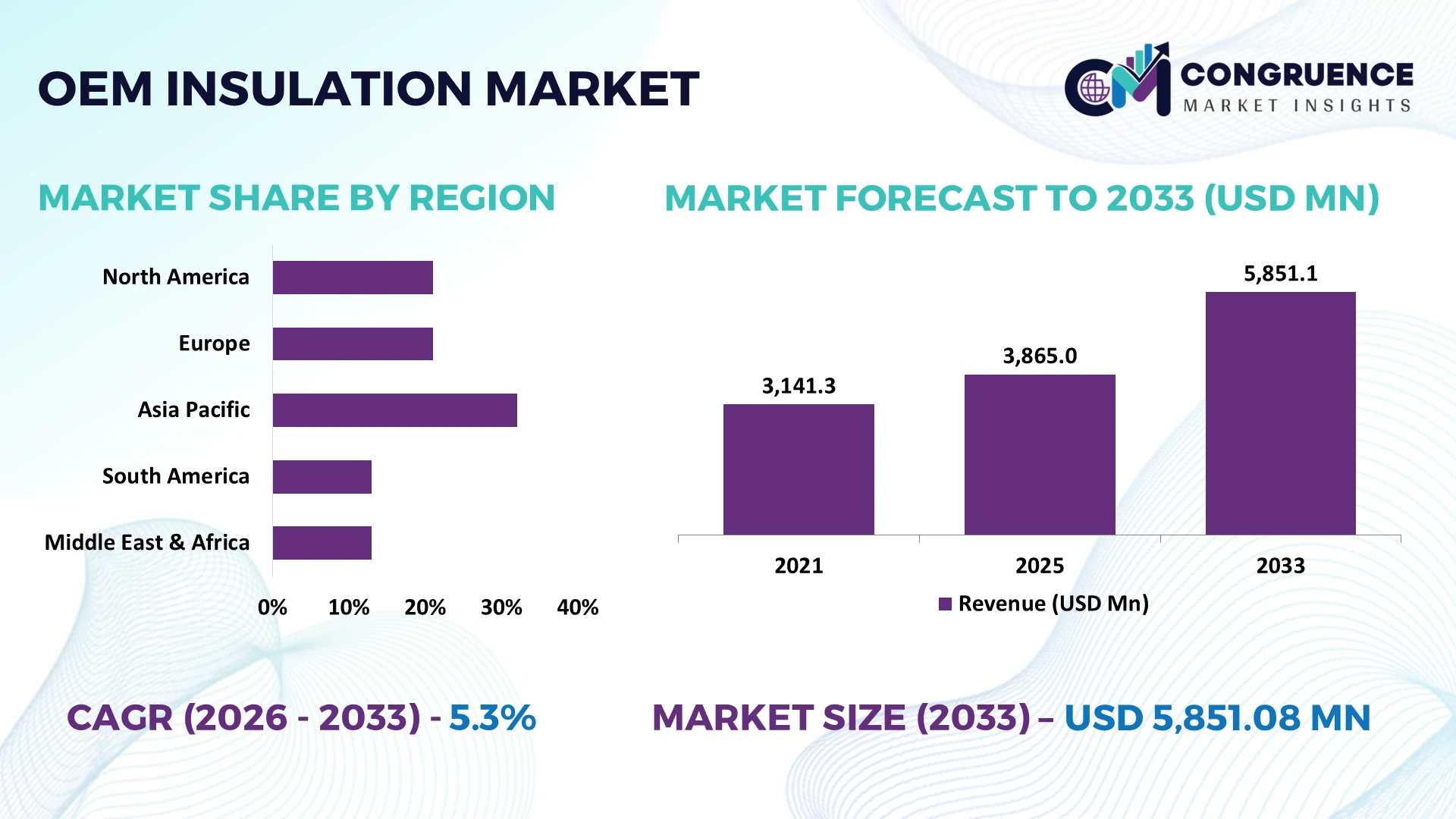
Asia Pacific commands a 38.4% share of global demand, anchored by China's automotive and appliance manufacturing corridors, where Tier-1 suppliers co-locate converting capacity near assembly hubs to compress lead times and qualify application-specific parts. China's GB 38031-2025 battery thermal-runaway standard, effective July 2026, creates a compliance-driven procurement cycle that outpaces Europe's renovation-led demand by a factor of roughly 2:1 in new-part qualification volume.
Suppliers with localized conversion assets in China and India secure platform nominations that lock in material specifications for five-to-seven-year vehicle lifecycles.
Market Size & Growth: Valued at USD 3,865.0 Million in 2025, rising to USD 5,851.1 Million by 2033, driven by EV battery thermal-barrier integration into OEM platform designs.
Top Growth Drivers: EV thermal-runaway compliance (38% of new automotive insulation specifications), HVAC refrigerant transition to A2L (29% of demand growth), lightweight acoustic packages (22%).
Short-Term Forecast: By 2027, localized conversion capacity in China and Mexico reduces landed insulation-component cost by 11–14% versus 2025 import-dependent models.
Emerging Technologies: Aerogel barrier sheets for cell-to-cell thermal isolation, bio-based polyurethane systems with 30% lower embodied carbon, and simulation-ready acoustic metamaterials.
Regional Leaders: Asia Pacific (USD 1.48 Billion, localized Tier-1 co-location), North America (USD 0.92 Billion, EV platform localization), Europe (USD 0.78 Billion, renovation-code compliance).
Consumer/End-User Trends: 64% of automotive OEMs now require multi-functional insulation (thermal + acoustic + fire) in a single part, reducing assembly steps by up to 18%.
Pilot/Case Example: 2025—Covestro Baysafe BEF flame-retardant PU sealing foam deployed for cylindrical-cell thermal propagation delay, achieving 40% longer runaway containment versus legacy foam.
Competitive Landscape: Owens Corning, Saint-Gobain, and Rockwool hold an estimated 31% combined share; Aspen Aerogels and Armacell gain traction in high-margin EV and HVAC niches.
Regulatory & ESG Impact: EU Construction Products Regulation 2024/3110 mandates embodied-carbon declarations, pushing 27% of European OEM buyers to prioritize low-carbon insulation grades in 2026 tenders.
Investment & Funding: Saint-Gobain acquired a North American glass-fiber plant in July 2026 to vertically integrate glass-wool supply, targeting 9% input-cost reduction across insulation lines.
Innovation & Future Outlook: Next-generation insulation integrates sensors for thermal-anomaly detection; suppliers investing in digital-twin-compatible material data secure earlier engineering-stage specification locks.
The OEM Insulation Market's demand center is migrating from generic construction insulation toward application-engineered thermal systems for electric vehicles, data-center cooling, and high-efficiency HVAC. Mineral wool remains the volume leader, but aerogel and flame-retardant PU foams capture disproportionate value in battery-pack and power-electronics assemblies. China's GB 38031-2025 standard alone compels an estimated 29% increase in thermal-barrier content per battery pack from 2026 onward, accelerating supplier qualification cycles and favoring converters with local test-and-validation capability.
OEM insulation has shifted from a commodity input to a platform-engineering decision with multi-year lock-in consequences. Regulatory mandates—China's battery thermal-runaway standard, the EU's embodied-carbon declaration requirements, and US refrigerant transition rules—now determine material specifications before a vehicle or HVAC unit reaches production. Suppliers that engage at the simulation and prototype stage capture specifications that competitors cannot displace without requalification costs.
Technology differentiation is measurable. Aerogel barrier sheets deliver thermal isolation at 30–50% lower thickness than mineral-wool alternatives, enabling battery-pack space savings that directly translate into range or cost advantages for EV platforms. Regionally, China's OEMs qualify new insulation grades in four to six months, while European and North American qualification cycles run eight to twelve months, creating a speed-to-market asymmetry that favors suppliers with Shanghai or Shenzhen application labs.
Operationally, Saint-Gobain's July 2026 acquisition of a North American glass-fiber plant exemplifies the shift toward vertical integration and regional supply sovereignty. Companies are pairing localized raw-material access with converter partnerships near OEM assembly corridors. The strategic conclusion is clear: insulation suppliers without platform-engineering presence and regional conversion assets will be relegated to spot-market material sales, while those embedded in OEM development cycles command specification premiums and multi-year volume visibility.
EV battery safety regulations are converting insulation from a secondary component into a design-gating requirement. China's GB 38031-2025 standard mandates thermal-runaway containment at the pack level, driving an estimated 29% increase in barrier-material content per vehicle from 2026. In Europe, EN 17956 sets minimum installed performance thresholds for industrial insulation systems across a −30°C to 650°C range, compelling OEMs to specify certified grades rather than commodity substitutes. Automotive Tier-1 suppliers in Shanghai and Guangzhou now co-engineer barrier systems with cell manufacturers, locking in material specifications eighteen to twenty-four months before SOP. The operational insight: insulation suppliers that position as compliance partners rather than material vendors capture specification share that persists across platform refreshes.
Polyurethane and mineral-fiber inputs remain exposed to petrochemical and energy price swings, with polyol feedstock volatility running at 14–18% annualized variance and European natural-gas-linked mineral-wool melting costs 2.3 times pre-2021 baselines. The Asia Pacific converter tier remains fragmented, with an estimated 34% of regional insulation conversion capacity operating outside certified quality systems, creating batch-consistency risk for OEMs requiring PPAP-level documentation. Automotive OEMs in Mexico and Thailand report 6–9% scrap rates from inconsistent foam density in Tier-2 deliveries, directly eroding program margins. Suppliers are responding through multi-sourcing of polyol feedstocks and contractual price-indexation clauses, but the structural fragmentation persists in cost-sensitive volume segments.
Proximity manufacturing within OEM industrial corridors represents the highest-margin expansion avenue. Building converting capacity in India, Vietnam, and Mexico reduces logistics exposure and enables application-specific cut-and-laminate parts that carry 22–28% higher unit margins than bulk material sales. Data-center cooling demand adds a parallel opportunity: Munters committed USD 29.95 Million in March 2025 to expand Virginia HVAC manufacturing by 200,000 square feet, signaling insulation content growth in precision-cooling assemblies. Suppliers that establish regional converting hubs with OEM-qualified testing capability shorten qualification cycles from twelve to five months, creating a defensible speed advantage over import-dependent competitors.
Multi-functional insulation parts combining thermal, acoustic, and fire performance require simultaneous certification across automotive (IATF 16949), construction (EN 13501), and electrical (UL) frameworks. An estimated 41% of OEM insulation development timelines now extend beyond twelve months due to sequential rather than parallel testing protocols. European OEMs face additional complexity from EU 2024/3110 declarations requiring third-party verified embodied-carbon data for every insulation component, adding 8–11 weeks to supplier onboarding. Companies must invest in in-house validation labs and early-phase regulatory mapping to compress these cycles; those that treat certification as a post-design step face late-stage specification changes and margin erosion on fixed-price contracts.
Electrified Melting Reshapes Cost Curves Saint-Gobain commissioned its first electric stone-wool furnace at Azuqueca, Spain in H1 2026, cutting Scope 1 and 2 CO₂ emissions by 70% versus 2017 while lifting capacity 40%. The €40 million investment locks in zero-carbon electricity through a 150 GWh PPA running to 2034. Spanish automotive and appliance OEMs now prioritize suppliers with verified low-carbon melting, and competitors are accelerating furnace electrification roadmaps to defend specification share.
Multi-Function Parts Replace Single-Property Insulation Automotive platforms increasingly demand thermal, acoustic, and fire performance from one component, with transportation insulation expanding at 6.48% as EV battery packs require cell-to-cell barriers that also damp vibration. Tier-1 suppliers in China and Germany are co-engineering laminate structures that reduce assembly steps, forcing material vendors to invest in application labs rather than sell commodity rolls.
Flexible Elastomeric Foam Gains HVAC Traction Refrigerant transition to A2L and compact heat-pump designs are driving flexible elastomeric foam adoption at 6.96%, as its conformability fits tight pipe routing where rigid boards fail. Japanese and Korean HVAC OEMs are qualifying FEF for R-32 systems, pushing converters to add closed-cell extrusion capacity near appliance corridors in Thailand and Vietnam.
Digital Qualification Compresses Launch Timelines OEM engineering teams now require simulation-ready thermal and acoustic material data before physical prototyping, with roughly 41% of development programs extending beyond twelve months due to sequential testing. Suppliers providing validated digital twins of insulation performance secure earlier design locks; those without data packages face exclusion from platform RFQs. Owens Corning’s Kansas City line, coming online in 2027, is positioned to supply technical insulation with documented performance consistency for data-center and nonresidential applications.
Mineral wool remains the leading OEM insulation type with approximately 34% share, sustained by fire-resistance ratings and acoustic performance that specification engineers treat as baseline requirements across automotive and industrial applications. Its cost-per-thermal-resistance advantage at high temperatures keeps it embedded in exhaust-adjacent and appliance cavity designs, though density and weight penalties limit adoption in EV battery enclosures where space budgets are shrinking.
Flexible elastomeric foam is the fastest-expanding type, advancing at 6.96% through 2032, driven by A2L refrigerant transition and compact heat-pump architectures that demand conformable, moisture-resistant closure at tight pipe bends. Polyurethane foam holds strong positions in appliance and cold-chain equipment, while fiberglass and glass wool retain cost-driven share in HVAC and construction OEM channels. Suppliers are rebalancing R&D toward FEF extrusion capacity in Thailand and Eastern Europe, where HVAC OEM assembly is concentrating.
Thermal insulation leads OEM applications with approximately 58% share, reflecting its role as the primary compliance lever for battery thermal-runaway containment, HVAC efficiency codes, and appliance energy ratings. Demand concentrates where regulatory penalties attach to failure—EV packs under GB 38031-2025 and A2L refrigerant systems—making thermal performance a non-negotiable specification rather than a cost-optimized choice.
Acoustic insulation is the faster-moving application, gaining ground as EV powertrains eliminate engine masking and expose wind and road noise, pushing cabin acoustic targets 15–20% tighter than combustion-era benchmarks. Fire protection remains embedded within thermal packages rather than specified separately, while moisture-control applications expand in cold-chain and data-center cooling. Converters in Guangzhou and Monterrey are adding dual-purpose thermal-acoustic lamination lines to serve platform nominations that bundle both requirements into single-part numbers.
Automotive OEMs represent the leading end-user group with approximately 31% share, concentrated in China, Germany, and the United States where EV platform localization and battery-safety regulation force material qualification at the cell-to-pack level. Demand intensity per vehicle is rising as multi-function barriers replace discrete thermal and acoustic parts, and qualified suppliers gain multi-year visibility across platform lifecycles.
Consumer appliances and equipment form the fastest-growing end-user group, propelled by heat-pump adoption, A2L refrigerant transition, and cold-chain expansion in India and Southeast Asia. Appliance OEMs in China and South Korea are shortening qualification cycles to twelve to sixteen weeks, rewarding suppliers with regional converting capacity. Industrial and commercial end-users remain steady but specification-driven, while aerospace and defense demand concentrates on high-temperature textile insulation with long certification tails—a niche where Saint-Gobain recently divested non-core assets to sharpen portfolio focus.
Asia Pacific accounted for the largest market share at 32.0% in 2025 however, the Middle East & Africa is expected to register the fastest growth, expanding at a CAGR of 5.4% between 2026 and 2033.
North America holds a 21.0% share of global OEM insulation demand in 2025, supported by stringent building energy codes, accelerating EV platform localization, and a construction sector prioritizing high-performance thermal solutions. Fiberglass remains the dominant material category by volume, while mineral wool and polyurethane foam gain traction in automotive and appliance OEM channels. Saint-Gobain's July 2026 acquisition of a North American glass-fiber plant exemplifies the region's pivot toward vertical integration and input security, strengthening glass-wool supply resilience across US industrial corridors. Deployment concentrates in HVAC OEM assembly, automotive thermal management, and data-center cooling infrastructure, where specification engineers prioritize certified performance consistency over commodity pricing. Regional converters are adding lamination and cut-to-size capability near Midwest and Southeast assembly hubs to shorten qualification and delivery cycles.
United States Market Outlook: The United States anchors North American demand through automotive manufacturing scale, HVAC equipment production, and commercial construction activity. Strict ASHRAE and IECC energy-efficiency mandates force OEMs to specify higher-performance insulation grades, while EV battery-safety validation protocols add thermal-barrier content per vehicle. Domestic glass-fiber and mineral-wool capacity investments reduce reliance on imported inputs, and Midwest appliance OEMs are compressing supplier qualification cycles to accelerate heat-pump production ramps. The data-center construction pipeline further expands demand for technical insulation in precision-cooling assemblies.
Europe accounts for 21.0% of global OEM insulation demand in 2025, shaped by embodied-carbon declaration requirements under EU Construction Products Regulation 2024/3110 and refrigerant transition rules accelerating A2L-compatible insulation adoption. Mineral wool producers are electrifying melting furnaces to meet Scope 1 and 2 reduction targets, with Saint-Gobain's Azuqueca stone-wool facility demonstrating 70% emissions reduction versus 2017 baselines. Automotive Tier-1 suppliers in Germany and France co-engineer multi-functional barrier systems for EV platforms, while HVAC OEMs in Italy and Poland qualify flexible elastomeric foam for compact heat-pump architectures. The region's established building stock sustains renovation-driven demand for certified insulation grades with verified environmental product declarations, and converter networks in Central Europe are consolidating to serve cross-border OEM programs.
Germany Market Outlook: Germany leads European OEM insulation specification through automotive engineering depth, heat-pump manufacturing scale, and stringent building certification frameworks. German OEMs require simulation-ready thermal and acoustic material data before prototype approval, pushing suppliers to invest in validated digital performance packages. Heat-pump deployment targets drive flexible elastomeric foam adoption in residential HVAC systems, while Tier-1 suppliers in Bavaria and Baden-Württemberg integrate battery thermal barriers into platform designs. Domestic manufacturers prioritize furnace electrification and low-carbon product lines to defend specification share against imports.
Asia Pacific commands the largest regional position at 32.0% share in 2025, anchored by China's automotive and appliance manufacturing corridors, India's infrastructure buildout, and Southeast Asia's expanding electronics production base. The region's converter ecosystem co-locates near OEM assembly hubs, compressing lead times and enabling rapid qualification of application-specific parts. China's GB 38031-2025 battery thermal-runaway standard compels elevated barrier-material content per EV pack, while appliance OEMs in South Korea and Japan accelerate A2L refrigerant-compatible insulation qualification. Export-oriented component production from Vietnam and Thailand supports HVAC OEM supply chains serving North American and European markets, reinforcing the region's dual role as demand center and supply base for global platform programs.
China Market Outlook: China drives Asia Pacific OEM insulation demand through unmatched EV production volume, appliance manufacturing scale, and aggressive energy-efficiency policy. The GB 38031-2025 standard, effective July 2026, mandates pack-level thermal-runaway containment, forcing automotive OEMs and cell manufacturers to co-engineer barrier systems eighteen to twenty-four months before vehicle SOP. Domestic suppliers benefit from proximity to Guangzhou, Shanghai, and Shenzhen assembly clusters, while foreign players including BASF and Owens Corning expand local converting capacity to capture platform nominations. Green-building initiatives further stimulate demand for advanced insulation in construction and HVAC applications.
South America represents 13.0% of global OEM insulation demand in 2025, shaped by infrastructure modernization, automotive production localization, and gradual adoption of energy-efficiency standards across building and appliance sectors. Brazil anchors regional demand through its automotive manufacturing base and expanding HVAC equipment production, though economic volatility and currency fluctuations constrain capital-intensive insulation capacity investments. The region's converter tier remains import-dependent for high-performance materials, creating lead-time and cost exposure for OEMs requiring certified thermal solutions. Infrastructure programs and cold-chain expansion in Brazil and Chile create selective demand for polyurethane and elastomeric foam insulation, while building energy-performance frameworks remain less stringent than European or North American benchmarks—a gap that both limits near-term specification intensity and signals untapped upside as codes tighten.
Brazil Market Outlook: Brazil concentrates South American OEM insulation demand through automotive assembly scale and expanding HVAC equipment manufacturing. Appliance producers in São Paulo and Manaus industrial zones require thermal and acoustic insulation for refrigeration and air-conditioning units, creating volume demand for polyurethane foam and fiberglass. Automotive OEMs producing in Brazil increasingly specify lightweight thermal barriers for flex-fuel and hybrid platforms, though qualification cycles remain longer than Asian benchmarks. Infrastructure investment in cold-chain logistics and commercial construction supports demand growth, while currency volatility and import dependency for advanced materials constrain margin stability across the value chain.
The Middle East & Africa region accounts for 13.0% of global OEM insulation demand in 2025, propelled by large-scale infrastructure investment, industrial diversification programs, and extreme-climate thermal requirements that elevate insulation specification importance. Gulf Cooperation Council construction megaprojects and data-center investments drive demand for high-performance thermal solutions in HVAC and industrial applications, with fiberglass leading material categories across the region. Local insulation manufacturing capacity remains limited relative to demand, creating import dependency for advanced materials and converters. UAE and Saudi Arabia's industrial diversification agendas—including automotive assembly and appliance production localization—create emerging OEM demand channels that require supplier qualification investment and regional distribution infrastructure.
United Arab Emirates Market Outlook: The UAE anchors Middle East OEM insulation demand through its construction megaproject pipeline, data-center investment scale, and extreme-climate HVAC requirements. Building envelope and cooling-system insulation specifications prioritize thermal performance under high ambient temperatures, driving demand for polyurethane and mineral-wool solutions. The country's industrial diversification initiatives support localized appliance and building-materials production, creating emerging OEM demand for application-specific insulation. The UAE's strategic position as a re-export hub for Gulf and African markets enables suppliers to serve regional demand from consolidated distribution and light-conversion facilities, though advanced material imports remain necessary for high-specification applications.
Global material majors—Owens Corning, Saint-Gobain, ROCKWOOL, Armacell, and Kingspan—compete directly against cost-focused regional converters in Asia Pacific and value-engineered local suppliers in Europe. The top five hold an estimated 31% combined share, leaving a fragmented field of application specialists and import-dependent Tier-2 producers. Competition pivots on specification speed, validated performance data, and supply-chain proximity, not raw material price alone. Suppliers that compress qualification cycles from twelve to five months capture platform nominations worth multi-year volume visibility, while laggards default to spot-market commodity sales with 22–28% lower unit margins. Players compete through vertical integration and localized capacity—Saint-Gobain’s glass-fiber plant acquisition and ROCKWOOL’s Hungarian stone-wool purchase both target regional supply control. The competitive shift is toward certification-backed multi-functional parts, where compliance documentation becomes a defensible moat. Entry pressure is acute: OEM qualification costs and eighteen-to-twenty-four-month lead times deter new entrants. Winning requires embedded engineering presence, regional conversion assets, and simulation-ready material data—not simply manufacturing scale.
Owens Corning
Saint-Gobain
ROCKWOOL A/S
Armacell International
Kingspan Group
BASF SE
Recticel
Aspen Aerogels
Knauf Insulation
Johns Manville
Fletcher Building
URSA Insulation
Tecnonic
Aerogel barrier sheets are displacing conventional mineral-wool barriers in EV battery packs, delivering 30–50% lower thickness at equivalent thermal isolation—a decisive advantage where pack space translates directly into vehicle range or cost. Adoption remains concentrated among premium EV platforms, with roughly 18–22% of new battery-pack designs specifying aerogel or aerogel-composite barriers as of 2026.
Flame-retardant polyurethane systems now achieve 40% longer thermal-runaway containment versus legacy foams in cylindrical-cell configurations, demonstrated in Covestro’s Baysafe BEF deployment. The competitive beneficiary is the material supplier that co-engineers with cell manufacturers at the pack-design stage, locking specifications before RFQ issuance. Digital qualification packages—simulation-ready thermal and acoustic data—are becoming a gating requirement, with 41% of OEM development timelines extending beyond twelve months due to sequential testing.
Between 2026 and 2028, expect consolidation around suppliers offering validated digital twins alongside physical materials. Companies that invest now in application labs and certification data capture specification share; those treating technology as a commodity input face exclusion from next-generation platform programs.
May 2026 — ROCKWOOL signed an agreement to acquire Ravago's Hungary-based stone wool factory, adding 40,000 tonnes annual capacity and strengthening Central-Eastern European supply for Romanian and Hungarian markets. Source: rockwool.com
May 2026 — Saint-Gobain announced plans to reinforce its supply chain through the acquisition of a glass fiber plant in North America, targeting input security and vertical integration for insulation manufacturing. Source: saint-gobain.com
April 2026 — Owens Corning completed the sale of its glass reinforcements business to Praana Group for $645 million enterprise value**, sharpening focus on branded building products and generating approximately **$280 million cash proceeds for growth initiatives. Source: investor.owenscorning.com
March 2026 — Armacell received NK type approval from ClassNK for its ArmaFlex Ultima flexible elastomeric foam insulation, enabling streamlined maritime inspection and expanding specification access for shipbuilding and offshore applications. Source: armacell.com
The report delivers a complete assessment of the global OEM insulation landscape, segmented by insulation type—including mineral wool, flexible elastomeric foam, polyurethane foam, fiberglass, and aerogel—alongside application coverage spanning thermal, acoustic, fire protection, and moisture control. End-user analysis addresses automotive OEMs, consumer appliances, HVAC equipment, industrial equipment, and commercial construction, with deployment intensity and qualification-cycle benchmarks quantified across each segment.
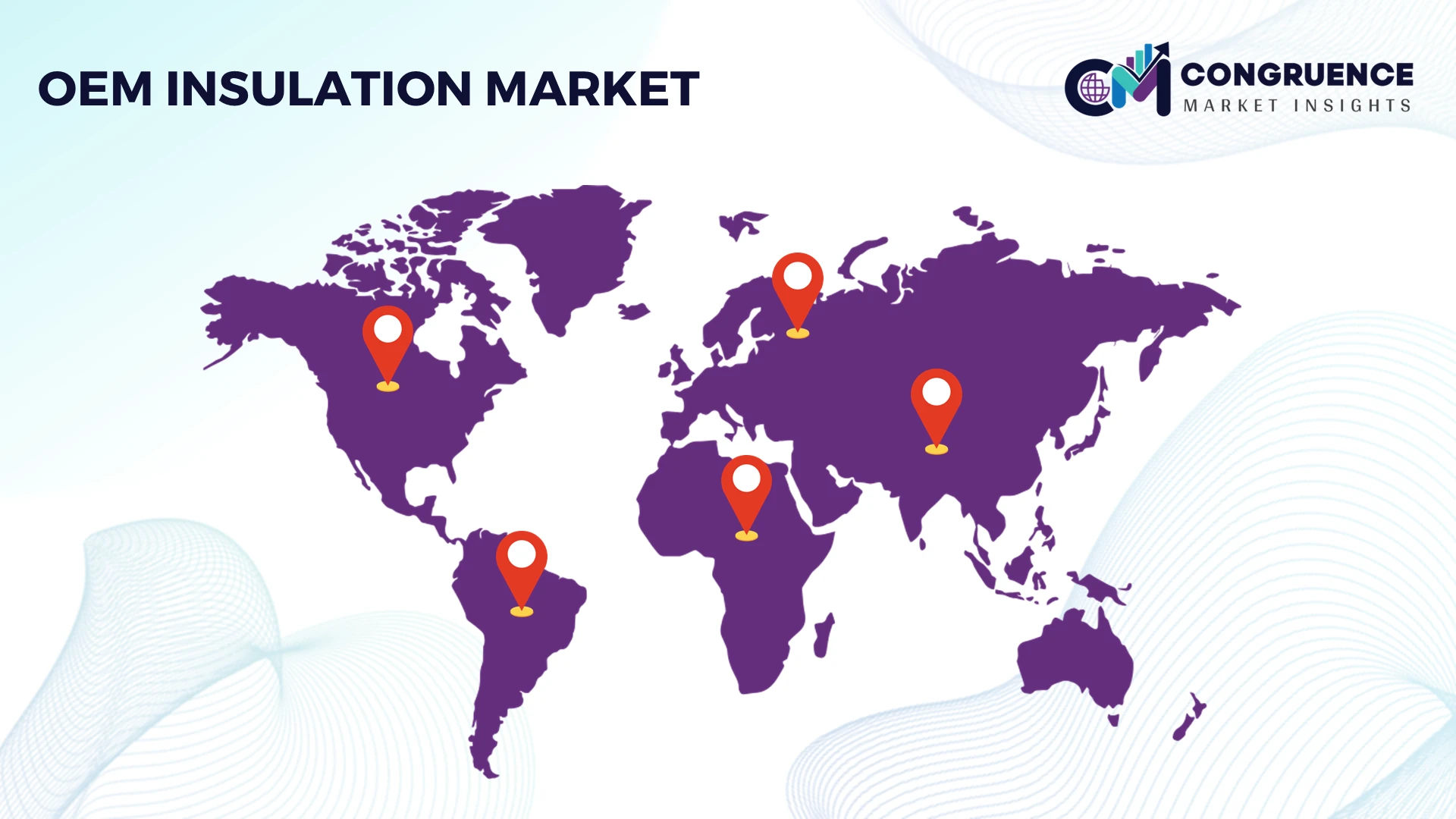
Regional coverage extends across Asia Pacific, North America, Europe, South America, and the Middle East & Africa, with country-level operational insights for China, the United States, Germany, Brazil, and the UAE. The report examines emerging niches including EV battery thermal barriers, A2L refrigerant-compatible insulation, and data-center precision-cooling systems, where adoption patterns and specification trends are shifting procurement priorities. Strategic analysis supports investment planning, capacity localization decisions, competitive positioning, and partnership targeting between 2026 and 2033, with company profiling covering global majors and application specialists driving specification cycles.
| Report Attribute / Metric | Details |
|---|---|
| Market Revenue (2025) | USD 3,865.0 Million |
| Market Revenue (2033) | USD 5,851.1 Million |
| CAGR (2026–2033) | 5.32% |
| Base Year | 2025 |
| Forecast Period | 2026–2033 |
| Historic Period | 2021–2025 |
| Segments Covered |
By Type
By Application
By End-User
|
| Key Deliverables | Revenue Forecast; Market Trends; Growth Drivers & Restraints; Technology Insights; Segmentation Analysis; Regional Insights; Competitive Landscape; Regulatory & ESG Overview; Recent Developments |
| Regions Covered | North America (32.8%); Asia-Pacific (24.6%); Europe (19.8%); South America (11.4%); Middle East & Africa (11.4%) |
| Companies Profiled | Owens Corning; Saint-Gobain; ROCKWOOL A/S; Armacell International; Kingspan Group; BASF SE; Recticel; Aspen Aerogels; Knauf Insulation; Johns Manville; Fletcher Building; URSA Insulation; Tecnonic |
| Customization & Pricing | Available on Request (10% Customization Free) |




