
Reports
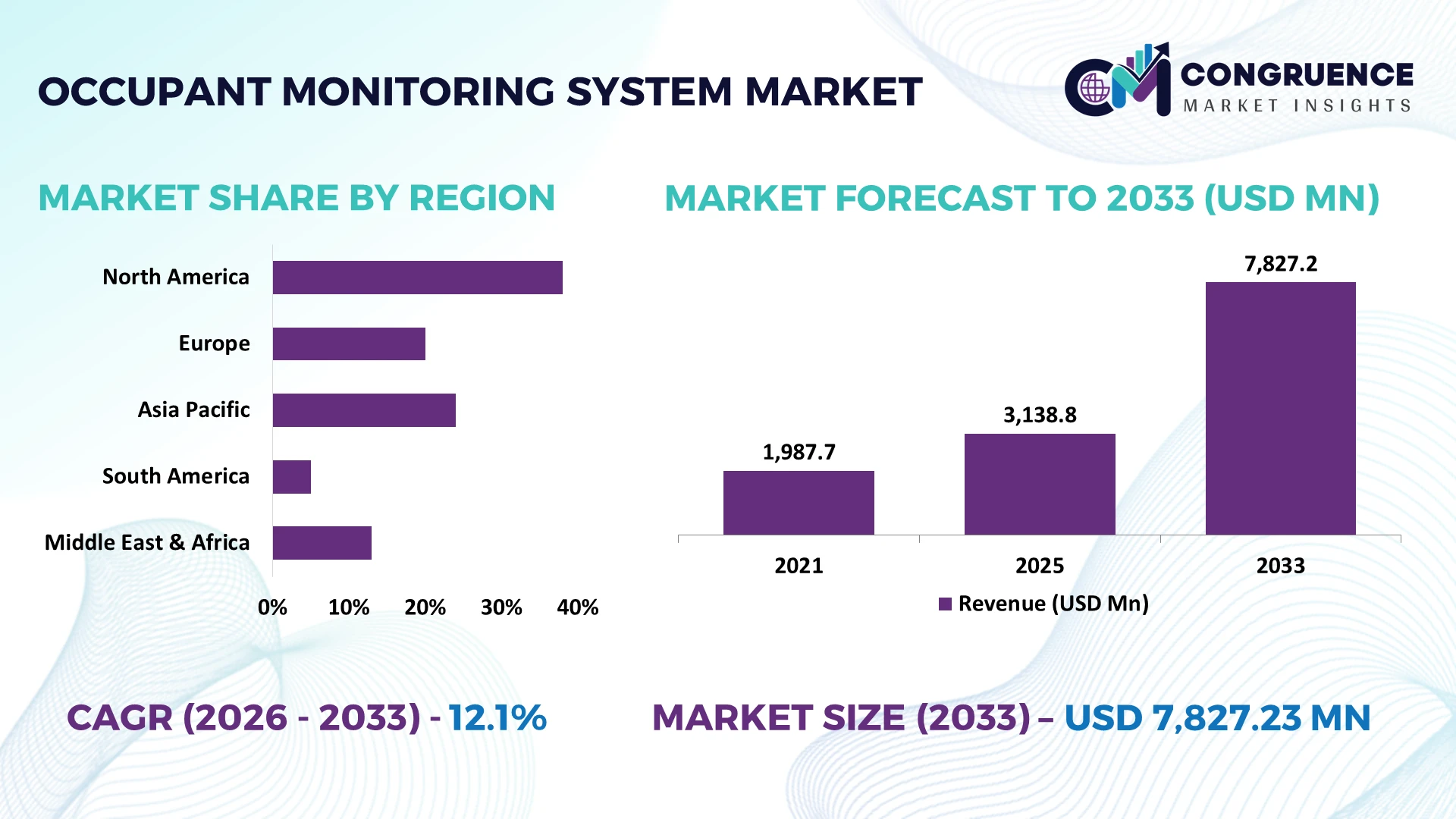
The Global Occupant Monitoring System Market was valued at USD 3138.8 Million in 2025 and is anticipated to reach a value of USD 7827.23 Million by 2033 expanding at a CAGR of 12.1% between 2026 and 2033. Growth is driven by increasing integration of AI powered driver monitoring cameras, child presence detection sensors, occupant classification technologies, and radar based cabin sensing into advanced driver assistance systems and connected vehicle architectures.
China dominates the Asia Pacific manufacturing landscape, supported by large scale electric vehicle production, domestic automotive electronics investment, and rapid integration of intelligent cabin technologies. In 2025, China's standard occupant monitoring system installations reached 1.417 million passenger vehicles, increasing 60.1% year over year, with a 6.2% installation rate. Driver monitoring systems reached 24.6% installation penetration, highlighting a wider adoption opportunity. Meanwhile, the European Union's General Safety Regulation made driver drowsiness and attention warning systems mandatory across new vehicles from July 2024, strengthening regulatory driven adoption.
Automotive suppliers should prioritize scalable camera and radar platforms, localized manufacturing, and OEM partnerships to capture opportunities across China's expanding electric vehicle ecosystem and Europe's increasingly regulated vehicle safety market.
Market Size & Growth: USD 3,138.8 million in 2025, reaching USD 7,827.23 million by 2033 at 12.1% CAGR, driven by AI enabled cabin safety integration.
Top Growth Drivers: Electric vehicle integration 60.1%, regulatory adoption 100%, and increasing camera based monitoring penetration 24.6%.
Short Term Forecast: By 2028, integrated sensing platforms target 8% lower component costs and 12% higher occupant detection processing efficiency, based on analyst estimates.
Emerging Technologies: AI vision analytics, 60 GHz radar sensing, and sensor fusion are advancing real time passenger classification and child presence detection.
Regional Leaders: Asia Pacific USD 2,896.08 million, North America USD 2,191.62 million, and Europe USD 2,035.08 million by 2033, based on modeled regional allocations.
Consumer and End User Trends: China's standard occupant monitoring installations reached 1.417 million vehicles in 2025, increasing 60.1% year over year.
Pilot and Deployment Example: China's 2025 OEM deployment expansion delivered 1.417 million standard installations, demonstrating accelerating integration into passenger vehicles.
Competitive Landscape: Bosch leads with an estimated 14% share; Continental, Magna, Aptiv, and Valeo strengthen competition through integrated sensing portfolios.
Regulatory and ESG Impact: EU General Safety Regulation requirements covering new vehicles from July 2024 accelerate driver attention monitoring and standardized safety integration.
Investment and Funding: USD 1 billion modeled global OEM and supplier investment through 2030 reflects growing commitments to cabin sensing, AI development, and manufacturing expansion.
Innovation and Future Outlook: Multimodal AI, interior radar, biometric sensing, and predictive occupant analytics are shifting competition toward integrated vehicle intelligence platforms.
The occupant monitoring system market is gaining traction across passenger vehicles, electric vehicles, commercial fleets, and premium automotive segments, where driver attention, passenger classification, and child presence detection are becoming essential safety functions. AI powered infrared cameras, millimeter wave radar, and sensor fusion are improving occupant recognition under low visibility conditions and reducing dependence on conventional seat based sensors. China's 60.1% annual increase in standard system installations during 2025 demonstrates accelerating OEM integration. Meanwhile, European safety regulations are strengthening demand for privacy conscious, real time monitoring architectures. These developments create strategic opportunities for suppliers specializing in intelligent cabin safety technologies.
The occupant monitoring system market is becoming strategically important as automotive manufacturers compete on intelligent cabin safety, autonomous driving readiness, and regulatory compliance rather than conventional vehicle protection alone. Integration of occupant detection with ADAS, airbag control, and automated emergency functions is shifting these systems from optional electronics toward critical vehicle architecture. The European Union's General Safety Regulation, applicable to all new vehicles from July 2024, has accelerated this transition, while China's proposed mandatory L2 monitoring requirements for 2027 are reshaping supplier investment priorities.
Technology integration is creating measurable cost advantages. Multifunctional cabin cameras combining driver and occupant monitoring reduce overall system costs by approximately 30% compared with separately integrated camera configurations. This approach also reduces installation complexity and component duplication. China leads deployment scale, with occupant monitoring installations increasing 60.1% in 2025, while European manufacturers prioritize regulatory compliance, privacy protection, and advanced safety validation.
During 2026–2028, manufacturers are expected to prioritize integrated camera and radar architectures, real time child presence detection, and AI based occupant classification. For example, combining cabin cameras with interior radar enables vehicle manufacturers to detect occupants across different seating positions without depending exclusively on seat sensors. Suppliers are consequently expanding software development, strengthening OEM partnerships, and investing in localized production. Competitive advantage will increasingly depend on delivering accurate, cost efficient, and regulation ready monitoring platforms.
Mandatory vehicle safety requirements and increasing ADAS integration are accelerating occupant monitoring adoption. China's standard occupant monitoring installations increased 60.1% in 2025, while driver monitoring penetration reached 24.6%, demonstrating the commercial potential of integrated cabin sensing. The European Union's July 2024 implementation of General Safety Regulation requirements has strengthened OEM procurement of driver attention monitoring technologies. China's proposed 2027 L2 safety standard further reinforces this transition. Automakers are responding through integrated camera platforms, AI based occupant classification, and expanded supplier partnerships. The strategic advantage lies in developing shared sensing architectures that support multiple safety functions without duplicating hardware investments.
High sensor costs, calibration requirements, and dependence on specialized semiconductor components constrain occupant monitoring system affordability in entry level vehicles. China's 2024 passenger vehicle market recorded only 3.7% standard occupant monitoring penetration, compared with 15.8% for driver monitoring systems, illustrating the adoption gap between established and emerging cabin safety functions. Additionally, the ten leading in cabin monitoring brands accounted for 62.7% of installations during January to November 2024, highlighting concentrated OEM procurement. Component shortages and supplier dependency expose manufacturers to pricing pressure and production interruptions. Companies are reducing exposure through dual sourcing, localized electronics manufacturing, modular sensor configurations, and longer term semiconductor procurement agreements.
Multifunctional cabin sensing creates opportunities to expand occupant monitoring beyond conventional passenger detection into child presence recognition, occupant positioning, and adaptive restraint control. Integrated camera configurations combining driver and occupant monitoring offer approximately 30% lower system costs than separately installed camera architectures. In China, the 2025 occupant monitoring installation penetration of 6.2% highlights substantial room for broader OEM integration. Meanwhile, 60 GHz radar sensing enables detection of subtle occupant movements without relying entirely on visible light imaging. Suppliers investing in AI algorithms, radar camera fusion, and compact sensor modules can target affordable electric vehicles, family vehicles, and commercial fleets. Partnerships with airbag manufacturers offer another route to differentiated safety solutions.
Maintaining consistent occupant recognition across vehicle interiors, seating configurations, lighting conditions, and occupant positions remains a significant engineering challenge. European General Safety Regulation requirements already demand attention monitoring across new vehicles, while privacy provisions restrict unnecessary continuous recording and retention of occupant data. China's proposed 2027 L2 monitoring requirements add further pressure for reliable driver state detection during assisted driving. False classifications, software latency, sensor interference, and cybersecurity vulnerabilities can undermine system reliability and OEM confidence. Manufacturers must strengthen validation across diverse cabin environments, implement privacy by design processing, and establish secure software update architectures. Competitive sustainability depends on measurable detection accuracy and dependable integration across multiple vehicle platforms.
Regulatory Driven Cabin Integration: The European Union's General Safety Regulation, effective for all new vehicles from July 2024, is accelerating integration of driver attention monitoring into vehicle electronics. Manufacturers are consolidating camera inputs with ADAS control units, reducing duplicated hardware and simplifying validation. China's proposed 2027 L2 monitoring requirements are also encouraging suppliers to standardize detection software and expand OEM engineering partnerships.
Privacy Centric Edge Processing: Automotive manufacturers are shifting occupant detection toward on device AI processing rather than continuous cloud transmission. Local processing reduces connectivity dependence and supports compliance with Europe's GDPR requirements. Suppliers are prioritizing embedded inference architectures, with development targets of 15% lower data transmission and 10% faster detection response compared with cloud dependent configurations. This shift strengthens demand for automotive grade processors and privacy focused software.
Radar Based Cabin Monitoring: Interior radar adoption is expanding beyond conventional camera systems, particularly for child presence detection and occupant movement recognition. 60 GHz sensing supports contactless detection without requiring direct visibility, addressing limitations associated with darkness and obstructed seating positions. Suppliers are integrating radar with camera based platforms to improve detection coverage, reduce false classifications, and support differentiated safety packages across electric and premium vehicle programs.
Software Defined Safety Architectures: Automakers are consolidating occupant classification, seat belt status, and driver monitoring within centralized vehicle computing platforms. This transition reduces fragmented electronic control units and enables software updates across vehicle generations. Manufacturers are prioritizing reusable algorithms, cybersecurity validation, and standardized sensor interfaces, strengthening opportunities for Tier 1 suppliers offering integrated hardware and software rather than standalone detection components.
Seat Occupancy Sensors Lead as Camera Based Systems Accelerate
Seat occupancy sensors hold an estimated 31% share of the global occupant monitoring system market, supported by established automotive integration, relatively low component costs, and compatibility with airbag deployment and passenger classification systems. Seat belt sensors account for an estimated 18%, retaining demand through restraint monitoring and safety compliance. Camera based systems represent approximately 24% and constitute the fastest expanding technology category, driven by AI powered driver recognition, child presence detection, and multi occupant tracking. Radar based systems account for an estimated 14%, gaining traction where low light performance and contactless detection are priorities.
Weight based systems contribute approximately 8%, particularly in advanced passenger classification, while ultrasonic systems represent 5%, serving proximity and presence detection applications. Camera and radar suppliers are increasing investment in sensor fusion, embedded AI, and compact processing units. Consequently, purchasing priorities are shifting from standalone sensing components toward multifunctional platforms that improve detection coverage and reduce duplicated electronics.
Driver Monitoring Leads While Child Detection Accelerates
Driver monitoring represents an estimated 29% of application demand, supported by increasing integration with ADAS, driver attention assessment, and assisted driving functions. Seat belt monitoring accounts for approximately 21%, while occupant classification contributes 19%, reflecting established integration with airbag control and passenger restraint systems. Child presence detection is the fastest growing application, with an estimated 18% annual expansion in deployment volumes as manufacturers prioritize rear seat safety and automated alerts. Passenger detection accounts for approximately 17%, supporting occupancy recognition and adaptive cabin functions, while intrusion detection contributes 8%, particularly in connected and security focused vehicles.
The adoption shift is moving from isolated driver alerts toward coordinated cabin intelligence. Automakers are integrating cameras, radar, and seat sensors into centralized safety platforms, enabling multiple applications through shared hardware. Suppliers are prioritizing child detection algorithms, rear seat sensing, and real time occupant classification to capture demand from family vehicles and connected electric vehicles. This integration also creates opportunities for software differentiation and lower incremental hardware costs.
Passenger Vehicle Manufacturers Anchor Deployment
Passenger vehicle manufacturers represent an estimated 46% of end user demand, reflecting high production volumes, extensive ADAS integration, and growing installation of intelligent cabin safety features. Automotive Tier 1 suppliers account for approximately 24% of procurement related demand and represent the fastest expanding end user category, supported by increasing responsibility for integrated sensing modules, electronic control units, and OEM ready software. Commercial vehicle manufacturers contribute an estimated 12%, prioritizing driver attention and occupant safety across demanding operating conditions. Fleet operators account for 8%, while automotive OEMs represent 10% of separately classified platform level procurement and technology integration demand.
Buying priorities differ across these groups. Passenger vehicle manufacturers emphasize scalable camera and radar packages, whereas commercial vehicle manufacturers and fleet operators prioritize driver monitoring, operational reliability, and retrofit compatibility. Tier 1 suppliers are expanding algorithm development, hardware integration, and strategic OEM partnerships to secure platform contracts. Companies that offer modular solutions across vehicle classes can improve manufacturing scale while reducing customer specific engineering costs.
North America accounted for the largest market share at 34% in 2025; however, Asia Pacific is expected to register the fastest growth, expanding at an estimated CAGR of 14.2% between 2026 and 2033.
OEM Safety Integration and Advanced Cabin Electronics Strengthen Regional Leadership
North America maintains its leading position through established automotive electronics manufacturing, high ADAS penetration, and strong integration of driver monitoring technologies across passenger vehicles and commercial fleets. The United States anchors regional demand through its automotive production ecosystem, supported by established engineering centers and Tier 1 supplier networks. The US, Mexico, and Canada produced approximately 15.6 million vehicles collectively in 2025, creating a substantial installation base for occupant classification, seat belt monitoring, and intelligent cabin sensing. Regulatory attention monitoring requirements and increasing investment in software defined vehicle architectures are accelerating procurement of integrated camera and radar platforms. Suppliers are strengthening relationships with Detroit based automakers and expanding localized component sourcing to reduce cross border supply exposure. The strategic opportunity lies in supplying multifunctional monitoring platforms across established vehicle production programs.
United States Market Outlook: The United States remains the primary commercial and technology development center for occupant monitoring systems in North America. Domestic production reached approximately 10.24 million vehicles in 2025, supporting demand for driver monitoring cameras, occupant classification electronics, and advanced restraint integration. Michigan, California, and automotive technology centers across the country strengthen software development, vehicle testing, and OEM collaboration. Manufacturers are prioritizing AI based cabin sensing and integrated safety electronics to differentiate vehicles and meet evolving regulatory expectations.
Regulatory Standardization Accelerates Integrated Cabin Safety
Europe represents an important occupant monitoring system market because of stringent vehicle safety requirements, established automotive engineering capabilities, and high concentration of premium vehicle manufacturers. The General Safety Regulation has accelerated adoption of driver attention and drowsiness monitoring across new vehicle programs since July 2024. Germany, France, the United Kingdom, and Italy form important demand and manufacturing centers, while European vehicle production reached approximately 17.2 million units in 2025. Automakers are integrating infrared cameras, radar sensors, and AI based occupant recognition into centralized electronic architectures. Increasing emphasis on GDPR compliance is also encouraging localized data processing instead of unnecessary cloud transmission. Suppliers are expanding engineering partnerships with European OEMs to deliver privacy conscious monitoring platforms and reduce vehicle specific integration costs.
Germany Market Outlook: Germany leads European occupant monitoring innovation through its concentration of premium automotive manufacturers, automotive electronics suppliers, and vehicle engineering facilities. Domestic vehicle production reached approximately 4.15 million units in 2025, supporting demand for advanced driver monitoring, occupant classification, and integrated restraint technologies. Manufacturers around Stuttgart, Munich, and Wolfsburg are emphasizing AI based cabin intelligence, software integration, and functional safety validation. This engineering concentration strengthens Germany's position as a development and qualification center for next generation occupant monitoring platforms.
Manufacturing Scale and Electric Vehicle Integration Drive Deployment
Asia Pacific is the fastest expanding occupant monitoring system market, supported by vehicle manufacturing scale, electric vehicle production, and rapid adoption of intelligent cockpit technologies. The region accounted for approximately 61% of global vehicle production in 2025, with China, Japan, India, and South Korea serving as major automotive manufacturing centers. China produced approximately 34.53 million vehicles, while India recorded 6.49 million units, strengthening demand for scalable camera based monitoring, seat occupancy sensors, and integrated safety electronics. Chinese electric vehicle manufacturers are accelerating cabin technology integration, while Japanese and South Korean suppliers emphasize precision sensing and automotive grade semiconductor development. Companies are expanding local production, establishing OEM partnerships, and developing cost optimized radar and camera modules. The strongest competitive opportunity lies in delivering advanced occupant detection at mass market vehicle pricing.
China Market Outlook: China leads Asia Pacific occupant monitoring deployment through its extensive electric vehicle manufacturing ecosystem, domestic automotive electronics supply chain, and rapid intelligent cockpit development. Vehicle production reached approximately 34.53 million units in 2025, creating substantial opportunities for integrated driver monitoring, child presence detection, and passenger classification. Domestic manufacturers are strengthening in vehicle software capabilities and increasing collaboration with sensor and semiconductor suppliers. Competitive positioning increasingly depends on affordable AI processing, localized component availability, and rapid integration into high volume vehicle platforms.
Automotive Modernization Creates Selective Technology Demand
South America represents an emerging occupant monitoring system market, with Brazil and Argentina anchoring regional automotive manufacturing and technology adoption. Brazil produced approximately 2.64 million vehicles in 2025, strengthening demand for seat occupancy sensors, seat belt monitoring, and camera based driver safety systems. Increasing availability of connected vehicles and gradual integration of ADAS technologies are creating opportunities for advanced occupant detection. However, vehicle affordability, imported electronic component costs, and uneven access to specialized automotive testing infrastructure constrain widespread deployment. Manufacturers are prioritizing modular sensing packages that can be integrated into multiple vehicle models without extensive platform redesign. Partnerships with established automotive suppliers and localized assembly arrangements offer a practical route to improving component availability while controlling procurement costs.
Brazil Market Outlook: Brazil is the principal occupant monitoring opportunity in South America because of its automotive manufacturing concentration, established OEM presence, and expanding vehicle technology ecosystem. Production reached approximately 2.64 million vehicles in 2025, providing a significant manufacturing base for integrated cabin electronics. São Paulo and surrounding automotive industrial centers support vehicle assembly, component manufacturing, and supplier collaboration. Manufacturers are increasingly positioned to introduce affordable driver monitoring and occupant classification technologies through localized supply arrangements and partnerships with international Tier 1 suppliers.
Vehicle Modernization and Industrial Investment Reshape Demand
The Middle East and Africa occupant monitoring system market is developing through automotive manufacturing investments, commercial fleet modernization, and increasing availability of connected vehicles. Saudi Arabia and the United Arab Emirates are strengthening demand through vehicle technology investment, premium vehicle sales, and smart mobility initiatives, while South Africa remains an established automotive manufacturing center. South Africa produced approximately 618,077 vehicles in 2025, accounting for 50.3% of African vehicle production. Saudi Arabia's automotive localization ambitions are creating additional opportunities for component suppliers and technology partnerships. However, limited local electronics manufacturing and dependence on imported sensing components influence procurement costs. Suppliers are responding through distributor partnerships, regional technical support, and investment in locally adaptable monitoring platforms.
Saudi Arabia Market Outlook: Saudi Arabia is emerging as a strategic automotive technology investment destination through its industrial diversification agenda and automotive manufacturing ambitions. The National Industrial Strategy and Vision 2030 support localization of vehicle production, advanced manufacturing, and automotive supply chains. The country's USD 500 billion NEOM development program and Ceer electric vehicle manufacturing initiative strengthen the surrounding technology ecosystem. Suppliers can target future OEM requirements through partnerships, localized engineering capabilities, and integrated occupant monitoring solutions designed for connected and electric vehicles.
The occupant monitoring system market is led by Tier 1 suppliers Bosch, Aptiv, Denso, ZF, and Valeo, competing with Magna, Visteon, and Hyundai Mobis for OEM programs. Specialist software companies Seeing Machines and Smart Eye challenge established suppliers in driver tracking, while Gentex differentiates through mirror integrated sensing. The five largest suppliers collectively hold an estimated 35% share, indicating moderate concentration with room for specialist providers. Competition centers on detection accuracy, functional safety validation, hardware cost, and platform integration. Camera and radar fusion can reduce duplicated sensing hardware by an estimated 10–15% versus separate modules, strengthening bundled offerings. Established suppliers leverage global manufacturing and OEM qualification histories; technology specialists pursue licensing and design partnerships. Supply chain localization and semiconductor access increasingly influence sourcing. High validation costs and lengthy vehicle program cycles restrict entry. Winning requires proven detection performance, scalable pricing, cybersecurity, and reliable multi platform delivery across vehicle production generations.
Robert Bosch GmbH
Aptiv PLC
Denso Corporation
ZF Friedrichshafen AG
Autoliv Inc.
Infineon Technologies AG
Valeo SA
Magna International Inc.
Visteon Corporation
Seeing Machines Limited
Smart Eye AB
Gentex Corporation
Current occupant monitoring technologies rely on seat occupancy sensors, seat belt switches, weight measurement systems, and camera based driver monitoring. These technologies support passenger classification, restraint control, and driver attention detection. AI enabled infrared cameras are increasingly replacing conventional single function sensors by combining facial recognition, occupant positioning, and behavioral analysis. China's 2025 installation penetration of 6.2% for standard occupant monitoring systems demonstrates growing integration into production vehicles, while driver monitoring adoption reached 24.6%.
Emerging technologies include 60 GHz radar, edge AI processors, ultrasonic sensing, and camera radar fusion. Compared with conventional standalone sensor configurations, integrated camera architectures can deliver an estimated 10–30% reduction in duplicated hardware costs. Bosch, Continental, and Aptiv benefit from combining sensing hardware, embedded software, and vehicle control integration, creating stronger OEM platform relationships. Radar based detection also improves occupant recognition when lighting conditions restrict camera performance.
Between 2026 and 2028, multimodal AI, privacy preserving edge computing, and predictive occupant classification will reshape cabin safety architectures. Integration with airbag controllers, ADAS, and centralized vehicle computers will reduce electronic duplication and improve response coordination. Manufacturers investing now in validated algorithms, automotive grade processors, and modular sensor platforms will gain competitive advantages through faster OEM qualification, improved system scalability, and differentiated intelligent cabin safety capabilities.
June 2026: Aptiv launched Advanced Occupancy Classification, a camera only occupant detection system that removes traditional in seat hardware and delivers up to 40% lower system cost. The architecture simplifies cabin electronics and strengthens Aptiv's position in integrated safety platforms. Source: aptiv.com
November 2024: Continental introduced its Invisible Biometrics Sensing Display, integrating a camera and laser projector behind an OLED screen to monitor passenger vital parameters. The innovation received 1 CES Innovation Award Honoree recognition, advancing concealed in cabin sensing integration. Source: continental.com
April 2025: Smart Eye secured its first design wins with a leading Japanese automaker, supplying driver monitoring software for 2 vehicle models. Its existing technology was already implemented in more than 2 million vehicles, strengthening its direct software supplier position. Source: nasdaq.com
October 2025: Seeing Machines secured an advanced development project with a Japanese OEM for a combined driver and occupant monitoring platform. Production is targeted for the second half of 2028, positioning the company for future multi function cabin sensing programs. Source: investegate.info
The Occupant Monitoring System Market Report provides comprehensive coverage of industry structure, competitive positioning, technology adoption, and regional demand across 2026–2033. The analysis examines six technology categories: Seat Occupancy Sensors, Seat Belt Sensors, Camera Based Systems, Radar Based Systems, Ultrasonic Systems, and Weight Based Systems. Application coverage includes Child Presence Detection, Driver Monitoring, Passenger Detection, Seat Belt Monitoring, Occupant Classification, and Intrusion Detection. End user assessment covers Passenger Vehicle Manufacturers, Commercial Vehicle Manufacturers, Automotive OEMs, Fleet Operators, and Automotive Tier 1 Suppliers.
Geographical coverage spans North America, Europe, Asia Pacific, South America, and Middle East and Africa, with country level assessments of manufacturing concentration, regulatory developments, and deployment activity. The report evaluates AI based sensing, infrared imaging, millimeter wave radar, edge computing, and integrated cabin intelligence. Competitive assessment covers 12 major industry participants, examining product innovation, partnerships, supply chain positioning, and technology differentiation. These insights support investment prioritization, market entry decisions, supplier selection, manufacturing expansion, and long term competitive positioning.
| Report Attribute/Metric | Report Details |
|---|---|
Market Revenue in 2025 | USD 3138.8 Million |
Market Revenue in 2033 | USD 7827.23 Million |
CAGR (2026 - 2033) | 12.1% |
Base Year | 2025 |
Forecast Period | 2026 - 2033 |
Historic Period | 2021 - 2025 |
Segments Covered | By Type
By Application
By End-User
|
Key Report Deliverable | Revenue Forecast, Growth Trends, Market Dynamics, Segmental Overview, Regional and Country-wise Analysis, Competition Landscape |
Region Covered | North America, Europe, Asia-Pacific, South America, Middle East, Africa |
Key Players Analyzed | Robert Bosch GmbH, Aptiv PLC, Denso Corporation, ZF Friedrichshafen AG, Autoliv Inc., Infineon Technologies AG, Valeo SA, Magna International Inc., Visteon Corporation, Seeing Machines Limited, Smart Eye AB, Gentex Corporation |
Customization & Pricing | Available on Request (10% Customization is Free) |




