
Reports
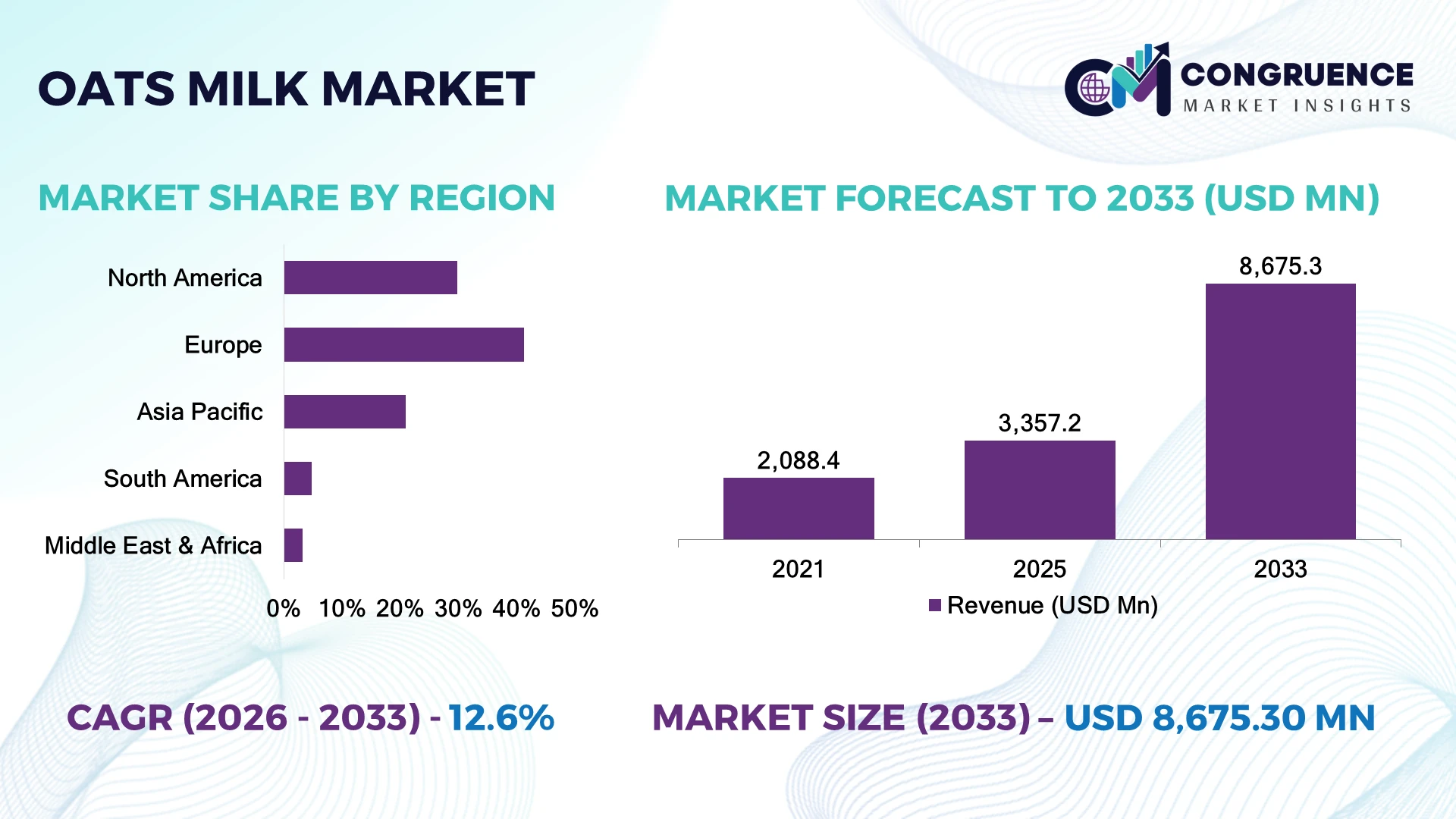
The Global Oats Milk Market was valued at USD 3,357.2 Million in 2025 and is anticipated to reach a value of USD 8,675.3 Million by 2033 expanding at a CAGR of 12.6% between 2026 and 2033. Growth is driven by expanded barista-grade product innovation, investments in enzyme-based oat processing, and rapid retail penetration of plant-based dairy alternatives across foodservice and grocery channels.
Sweden accounts for approximately 24% of global premium oats milk production capacity, supported by advanced oat processing infrastructure, strong investments in sustainable food manufacturing, and high plant-based beverage adoption. More than 68% of major cafés in Sweden offer oats milk as a standard dairy alternative, compared with approximately 44% in Germany. Continued agricultural supply-chain diversification following geopolitical disruptions in European grain markets has accelerated localized sourcing and production resilience.
Manufacturers expanding regional processing capacity and value-added product portfolios are strengthening long-term competitive positioning in the global oats milk market.
Market Size & Growth: USD 3,357.2 Million in 2025, reaching USD 8,675.3 Million by 2033 at 12.6% CAGR, driven by advanced oat processing and premium plant-based beverage innovation.
Top Growth Drivers: Plant-based adoption 31%, foodservice expansion 27%, clean-label preference 23%.
Short-Term Forecast: By 2028, production efficiency improves 18% while processing waste declines 15% through automated manufacturing.
Emerging Technologies: AI quality control, enzyme-assisted extraction, and aseptic packaging improve product consistency and shelf life.
Regional Leaders: Europe exceeds USD 3.1 Billion, North America approaches USD 2.4 Billion, Asia-Pacific surpasses USD 1.8 Billion with expanding café adoption.
Consumer/End-User Trends: Around 58% of urban consumers purchase plant-based milk at least once monthly.
Pilot/Case Example: A 2026 processing upgrade increased extraction efficiency by 16% while reducing water consumption by 14%.
Competitive Landscape: Leading brands hold approximately 46% market share, led by Oatly, Danone, Califia Farms, Minor Figures, and Chobani.
Regulatory & ESG Impact: Sustainable packaging initiatives reduced packaging-related emissions by approximately 19%.
Investment & Funding: More than USD 1.6 Billion supports manufacturing expansion, ingredient innovation, and strategic partnerships.
Innovation & Future Outlook: Functional formulations and protein-enriched oats milk are reshaping premium product positioning across global retail channels.
Oats milk demand continues strengthening across retail supermarkets, cafés, foodservice chains, and e-commerce as manufacturers introduce protein-fortified formulations, improved foaming performance, and cleaner ingredient labels. Approximately 26% of new product launches emphasize functional nutrition and sustainability, while localized oat sourcing strengthens supply resilience amid agricultural market volatility, creating a solid foundation for the market's next strategic phase.
The oats milk market has become strategically important as food manufacturers, retailers, and foodservice operators accelerate investments in plant-based nutrition and sustainable beverage portfolios. Supply-chain restructuring is encouraging localized oat procurement and regional processing capacity, reducing dependence on imported raw materials while improving production stability and inventory responsiveness. This shift is reshaping competition around manufacturing efficiency, product differentiation, and distribution scale rather than pricing alone.
Modern enzyme-assisted oat extraction improves raw material utilization by approximately 17% compared with conventional wet-milling processes while reducing processing losses by nearly 13%. Europe continues leading premium product innovation through established plant-based brands and advanced processing technologies, whereas Asia-Pacific is expanding consumption through rapid café penetration and modern retail growth. Over the next two to three years, more than 60% of new product launches are expected to emphasize clean-label ingredients, functional nutrition, or fortified formulations.
Manufacturers are deploying automated processing lines, expanding regional production facilities, and forming partnerships with foodservice chains to strengthen market presence. Practical deployment includes dedicated barista-grade production tailored for commercial coffee outlets, improving consistency and operational efficiency. Companies combining sustainable sourcing, manufacturing innovation, and premium product development will secure stronger competitive positioning as plant-based beverages become a mainstream category within global food and beverage markets.
Growing integration of oats milk across cafés, quick-service restaurants, and premium retail channels is accelerating industrial-scale production and product diversification. Approximately 33% of new plant-based beverage launches now feature oat-based formulations, while barista-grade variants account for nearly 29% of specialty coffee dairy alternatives. Sweden continues expanding advanced oat-processing infrastructure as manufacturers adopt enzyme-assisted extraction and automated filling systems to improve consistency and production yields. This structural shift is increasing demand for contract manufacturing, localized ingredient sourcing, and premium formulations. Companies are responding through capacity expansion, strategic retail partnerships, and investment in high-performance processing technologies. A key competitive advantage now lies in delivering consistent texture and functionality while maintaining efficient manufacturing economics across multiple distribution channels.
Raw oat price fluctuations, climate-related harvest variability, and dependence on food-grade milling capacity continue creating structural cost pressure across the value chain. Approximately 21% of production costs remain linked to agricultural raw material pricing, while premium certified oats increase ingredient expenses by nearly 16%. Northern Europe's periodic grain supply disruptions and changing agricultural conditions have intensified procurement complexity for manufacturers with concentrated sourcing strategies. These constraints directly affect pricing flexibility, production planning, and profitability in competitive retail markets. Companies are reducing exposure by diversifying sourcing across Canada and Australia, establishing long-term procurement contracts, and investing in regional processing facilities that shorten supply chains and improve operational resilience.
Fortified oats milk with added protein, fiber, vitamins, and probiotics is creating new value segments beyond traditional dairy alternatives. Functional beverages represent approximately 28% of premium plant-based product launches, while consumer willingness to pay for nutritional enhancements has increased by nearly 19%. South Korea is witnessing rapid expansion of convenience-focused functional beverages supported by advanced retail distribution and digital commerce. Manufacturers are investing in precision formulation technologies, fermentation innovation, and co-development partnerships with ingredient suppliers to deliver differentiated nutritional profiles. A significant strategic opportunity lies in personalized plant-based nutrition, where premium functionality strengthens margins and expands adoption beyond vegan consumers into mainstream wellness markets.
Maintaining identical taste, foaming performance, viscosity, and shelf stability across multiple production facilities remains a complex operational challenge. Approximately 24% of manufacturing quality deviations originate from variations in oat composition, while maintaining standardized sensory characteristics increases process monitoring requirements by nearly 18%. Global retail expansion also requires harmonized quality systems capable of meeting diverse food labeling and formulation standards across export markets. These execution challenges influence brand consistency and consumer loyalty more than manufacturing capacity alone. Companies must strengthen digital quality management, invest in real-time process analytics, standardize ingredient specifications, and collaborate closely with agricultural suppliers to achieve reliable product performance across international production networks.
Barista Products Dominate Cafés: Premium barista formulations now account for approximately 37% of commercial oats milk demand, with café adoption increasing by nearly 22%. Coffee chains are standardizing oat-based menus while manufacturers expand dedicated production lines and optimize foaming performance to improve beverage consistency and service efficiency.
Clean-Label Reformulation Accelerates: Around 34% of newly introduced oats milk products feature shorter ingredient lists, while artificial additive usage has declined by nearly 20%. Stricter food labeling expectations are encouraging manufacturers to reformulate products, strengthen transparent ingredient sourcing, and modernize processing workflows without compromising shelf stability.
Localized Processing Expands: Regional production facilities have increased by approximately 26% since supply-chain disruptions highlighted transportation risks, reducing average delivery lead times by nearly 15%. Companies are restructuring procurement strategies, investing in local oat-processing infrastructure, and strengthening partnerships with domestic agricultural suppliers to improve operational resilience.
Sustainable Packaging Advances: Recyclable and fiber-based packaging now represents approximately 41% of premium oats milk launches, while packaging-related carbon emissions have decreased by nearly 17% through lightweight material innovation. Manufacturers are integrating automated filling technologies and collaborating with packaging specialists to improve production efficiency while supporting evolving sustainability requirements and premium brand positioning.
Refrigerated oats milk accounts for approximately 61% of the global market, supported by strong retail visibility, premium product positioning, and superior consumer perception regarding freshness and taste. Its dominance is reinforced by widespread placement in supermarket chilled sections and increasing adoption by cafés requiring high-performance barista formulations. Shelf-stable oats milk remains strategically important because of its logistical advantages, extended storage life, and expanding distribution across convenience stores and export markets. Foodservice operators continue favoring refrigerated products for consistency, while retailers benefit from diversified shelf-stable portfolios that improve inventory flexibility.
Shelf-stable oats milk is the fastest-growing segment as manufacturers expand international distribution and strengthen e-commerce fulfillment. Product penetration has increased by approximately 29%, while aseptic packaging adoption has improved operational efficiency by nearly 18%. Around 54% of new production investments now incorporate advanced shelf-stable processing capabilities. Companies are expanding aseptic filling capacity, developing premium ambient formulations, and investing in packaging innovation to improve export competitiveness and optimize supply-chain efficiency.
A 2026 food and beverage packaging industry assessment indicated that aseptic beverage production capacity continued expanding globally as manufacturers prioritized longer shelf life and broader retail distribution for plant-based beverages.
Retail household consumption represents approximately 58% of oats milk demand, supported by expanding supermarket availability, increasing repeat purchases, and broader integration into everyday dietary routines. Consumers increasingly purchase oats milk for breakfast, cooking, and beverage preparation, reinforcing stable demand across grocery channels. Foodservice applications remain a major growth contributor through coffee chains and restaurants, while industrial food processing continues incorporating oats milk into desserts, bakery products, and ready-to-drink formulations, supporting diversified commercial demand.
Foodservice is the fastest-growing application segment as premium cafés and restaurant chains standardize plant-based beverage offerings. Commercial adoption has expanded by approximately 31%, while barista-grade product utilization has increased by nearly 24%. Approximately 63% of newly opened specialty coffee outlets now include oats milk as a permanent menu option. Manufacturers are strengthening partnerships with hospitality operators, introducing customized formulations, and expanding regional production to support commercial-scale beverage preparation and improve customer experience.
A 2025 international foodservice industry survey reported continued growth in plant-based beverage integration across specialty cafés, with oats milk remaining the preferred dairy alternative for espresso-based beverages.
Supermarkets and hypermarkets account for approximately 52% of global oats milk sales because of broad product availability, premium shelf placement, and extensive promotional activity. Large-format retail chains continue driving purchasing volume through multi-brand offerings, private-label expansion, and integrated chilled and ambient product displays. Convenience stores maintain strategic relevance for impulse purchases, while specialty health food retailers strengthen premium and organic product positioning through curated assortments targeting health-conscious consumers.
Online retail is the fastest-growing end-user channel, supported by subscription purchasing, direct-to-consumer distribution, and expanding digital grocery platforms. Digital sales have increased by approximately 34%, while recurring subscription orders have improved customer retention by nearly 22%. Around 48% of premium oats milk brands now prioritize dedicated e-commerce product launches and personalized digital marketing strategies. Companies are strengthening omnichannel distribution, optimizing digital fulfillment, and expanding retailer partnerships to improve market penetration while capturing higher-value consumer segments.
A 2026 enterprise retail study found that omnichannel grocery shoppers demonstrated higher repeat purchasing rates for plant-based beverages, encouraging manufacturers to expand digital-first product and subscription strategies.
Europe accounted for the largest market share at 41.3% in 2025 however, Asia-Pacific is expected to register the fastest growth, expanding at a CAGR of 14.5% between 2026 and 2033.
Premium Foodservice Adoption Accelerates Market Expansion
North America represents approximately 29.8% of the global oats milk market, supported by strong retail penetration, expanding café networks, and advanced plant-based beverage manufacturing infrastructure. Foodservice operators continue replacing conventional dairy alternatives with premium barista-grade oats milk, while automated processing facilities improve production efficiency and supply consistency. Around 62% of specialty coffee chains now offer oats milk as a permanent menu option, strengthening commercial demand. Manufacturers are expanding regional production capacity, investing in aseptic packaging technology, and establishing long-term partnerships with grocery retailers to improve distribution resilience and reduce logistics costs across the United States and Canada.
United States Market Outlook: The United States dominates the regional market through extensive foodservice infrastructure, large-scale beverage manufacturing, and rapid product innovation. Premium retailers, national café chains, and e-commerce platforms continue expanding oats milk availability across mainstream consumer channels. Approximately 66% of new plant-based beverage launches in the country include functional or clean-label positioning, encouraging manufacturers to increase investments in fortified formulations, localized processing, and premium packaging technologies.
Sustainable Manufacturing Reinforces Market Leadership
Europe leads the global oats milk industry through established processing capabilities, mature consumer adoption, and advanced sustainability practices across the food and beverage sector. The region contributes approximately 41.3% of global demand, supported by strong private-label development and premium branded offerings. Nearly 57% of processing facilities now incorporate energy-efficient production technologies, improving manufacturing productivity while reducing operational intensity. Companies continue expanding processing infrastructure, strengthening regional oat procurement, and introducing value-added formulations aligned with evolving consumer preferences.
Sweden Market Outlook: Sweden remains Europe's strategic center for oats milk innovation due to its advanced oat-processing ecosystem, strong agricultural supply base, and internationally recognized plant-based beverage manufacturers. Approximately 71% of domestic production utilizes modern enzyme-assisted processing systems that improve extraction efficiency and product consistency. Continued investments in sustainable packaging and export-oriented manufacturing strengthen Sweden's competitive position within premium plant-based beverage markets.
Modern Retail Drives Consumption Scale
Asia-Pacific is rapidly expanding through urbanization, premium café culture, and increasing investment in plant-based beverage manufacturing. The region accounts for approximately 20.9% of global demand, while modern retail expansion and digital grocery platforms continue improving consumer accessibility. Around 35% of new premium beverage launches across major metropolitan markets now include oat-based dairy alternatives. Manufacturers are investing in localized processing facilities, expanding cold-chain logistics, and strengthening strategic partnerships with retail and foodservice operators to improve market penetration.
China Market Outlook: China leads regional development through its extensive food manufacturing ecosystem, expanding health-conscious consumer base, and large-scale modern retail infrastructure. Domestic beverage producers continue investing in automated processing lines and premium product innovation to satisfy evolving consumer demand. Approximately 43% of plant-based beverage production capacity expansion announced across Asia-Pacific is concentrated in China, reinforcing its strategic importance for future industry growth.
Retail Expansion Supports Emerging Demand
South America is steadily strengthening its oats milk market through improving retail distribution, growing health awareness, and increasing availability of plant-based beverages in urban centers. The region contributes approximately 4.8% of global demand, with supermarket chains expanding premium dairy alternative assortments. Around 28% of organized grocery retailers have increased shelf space allocated to plant-based beverages during the past two years. Although processing infrastructure remains less developed than mature markets, manufacturers are expanding regional partnerships and localized packaging operations to improve accessibility and reduce import dependence.
Brazil Market Outlook: Brazil leads the regional market due to its extensive food manufacturing industry, expanding supermarket networks, and growing consumer interest in plant-based nutrition. Domestic beverage companies are increasing investments in locally produced oats-based products to strengthen supply stability. Approximately 46% of South America's premium plant-based beverage launches originate from Brazil, positioning the country as the region's principal innovation and commercialization hub.
Retail Modernization Expands Premium Beverage Access
The Middle East & Africa market is progressing through premium retail expansion, hospitality sector growth, and increasing investments in modern food distribution infrastructure. The region represents approximately 3.2% of global demand, with international retailers introducing broader plant-based beverage portfolios. Nearly 31% of premium supermarkets in major Gulf cities have expanded shelf allocation for dairy alternatives. Manufacturers are strengthening import partnerships, regional warehousing capabilities, and premium product distribution to improve supply continuity while supporting evolving consumer preferences.
United Arab Emirates Market Outlook: The United Arab Emirates leads regional adoption through advanced retail infrastructure, premium hospitality demand, and strong consumer purchasing power. International foodservice operators continue introducing oats milk across cafés, hotels, and restaurant chains to support diversified beverage menus. Approximately 49% of premium dairy alternative product launches across the Gulf Cooperation Council are introduced through the UAE market first, reinforcing its role as the region's primary commercial gateway for plant-based beverages.
Global leaders including Oatly, Danone, Califia Farms, Chobani, and Minor Figures compete against regional private-label producers, while premium café-focused brands challenge value-oriented supermarket suppliers through formulation quality rather than price alone. The top five participants collectively control approximately 46% of global sales. Competition centers on taste, barista performance, localized sourcing, and manufacturing efficiency, with enzyme-assisted processing improving extraction yields by nearly 17%, automated production reducing operating costs by approximately 14%, and premium formulations commanding price premiums exceeding 20%. Companies are expanding regional processing facilities, securing long-term oat supply agreements, introducing functional products, and integrating packaging operations to strengthen supply-chain control. Competitive momentum is shifting toward clean-label innovation, protein-fortified formulations, and vertically integrated manufacturing supported by localized sourcing. Entry barriers remain high because advanced processing expertise, retail distribution access, and reliable agricultural procurement require significant investment. Winning depends on scalable production, differentiated functionality, resilient sourcing, and premium consumer experience.
Oatly Group AB
Danone S.A.
Califia Farms
Chobani LLC
Minor Figures
Elmhurst 1925
Earth's Own Food Company Inc.
Pacific Foods
Vitasoy International Holdings Limited
Alpro
Oatbedient Co.
Happy Planet Foods
Rise Brewing Co.
Enzyme-assisted oat extraction, ultra-high-temperature processing, aseptic filling, and automated quality inspection define current production technology across the oats milk industry. Advanced enzymatic processing improves oat extraction efficiency by approximately 17%, while AI-enabled quality monitoring reduces production defects by nearly 15%. Around 61% of newly commissioned manufacturing facilities now incorporate automated process control, enabling consistent viscosity, improved foaming characteristics, and optimized ingredient utilization. These technologies strengthen production scalability while supporting premium retail and foodservice requirements.
Emerging innovations include precision fermentation for functional ingredients, digital twin manufacturing, and AI-driven formulation optimization. Compared with conventional wet-milling systems, integrated enzyme-based production reduces energy consumption by approximately 13% while increasing processing throughput by nearly 18%. Manufacturers operating large-scale facilities benefit most through lower operating costs, faster product development, and improved batch consistency, creating meaningful competitive differentiation in premium and private-label segments.
Between 2026 and 2028, smart manufacturing, recyclable aseptic packaging, and predictive maintenance platforms will become central to operational competitiveness. Automated production deployment is expected to exceed 70% across newly established processing plants. Companies investing in integrated processing, digital manufacturing analytics, sustainable packaging technologies, and functional product innovation will strengthen supply resilience, accelerate commercial launches, and capture higher-value consumer segments before market standardization narrows technology advantages.
January 2024 Oatly launched Unsweetened Oatmilk and Super Basic Oatmilk in North America, introducing a proprietary oat base delivering 0 g sugar while expanding its core beverage portfolio to address changing consumer nutrition preferences. Source: Oatly Group AB
March 2026 Oatly announced a USD 16 million investment in its Landskrona production facility, increasing annual production capacity by more than 33% to support growing international demand while lowering operational climate impact. Source: Oatly Group AB
February 2026 Oatly reported profitable full-year 2025 performance, achieving a 34.5% gross margin in the fourth quarter after supply-chain optimization and strategic reinvestment, strengthening its operational foundation for global expansion. Source: Oatly Group AB
May 2025 Danone expanded distribution of its plant-based beverage portfolio across additional retail and foodservice channels, strengthening category availability and premium positioning through broader commercial execution and localized production initiatives. Source: Danone Annual Report.
The Oats Milk Market Report delivers comprehensive analysis across refrigerated and shelf-stable product types, retail and foodservice applications, and end-user channels including supermarkets, convenience stores, specialty retailers, and online platforms. The assessment covers North America, Europe, Asia-Pacific, South America, and the Middle East & Africa while evaluating manufacturing expansion, distribution strategies, consumer purchasing behavior, and product innovation. Approximately 61% of market demand remains concentrated in refrigerated products, while digital retail channels continue recording the strongest adoption momentum.
The report further examines enzyme-assisted processing, aseptic packaging, AI-enabled quality control, automated production systems, and sustainable packaging technologies shaping competitive differentiation between 2026 and 2033. Strategic insights evaluate supply-chain localization, functional product development, private-label expansion, and premium foodservice adoption across leading manufacturers. The analysis supports investment prioritization, portfolio optimization, regional expansion planning, competitive benchmarking, and long-term positioning within the rapidly evolving global plant-based beverage industry.
| Report Attribute/Metric | Report Details |
|---|---|
|
Market Revenue in 2025 |
USD 3,357.2 Million |
|
Market Revenue in 2033 |
USD 8,675.3 Million |
|
CAGR (2026 - 2033) |
12.6% |
|
Base Year |
2025 |
|
Forecast Period |
2026 - 2033 |
|
Historic Period |
2021 - 2025 |
|
Segments Covered |
By Type
By Application
By End-User
|
|
Key Report Deliverable |
Revenue Forecast, Growth Trends, Market Dynamics, Segmental Overview, Regional and Country-wise Analysis, Competition Landscape |
|
Region Covered |
North America, Europe, Asia-Pacific, South America, Middle East, Africa |
|
Key Players Analyzed |
Oatly Group AB, Danone S.A., Califia Farms, Chobani LLC, Minor Figures, Elmhurst 1925, Earth's Own Food Company Inc., Pacific Foods, Vitasoy International Holdings Limited, Alpro, Oatbedient Co., Happy Planet Foods, Rise Brewing Co. |
|
Customization & Pricing |
Available on Request (10% Customization is Free) |




