
Reports
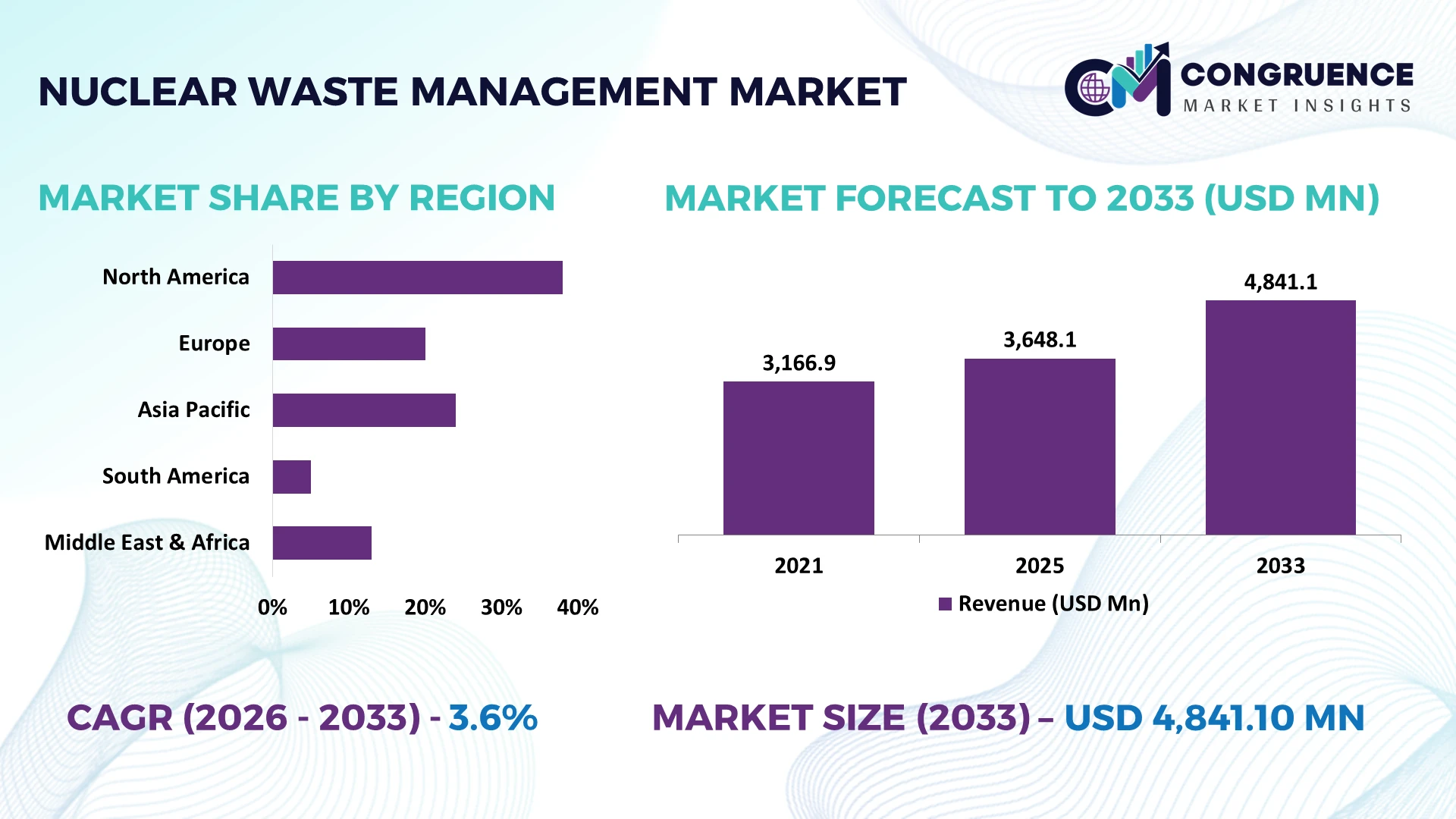
The Global Nuclear Waste Management Market was valued at USD 3648.13 Million in 2025 and is anticipated to reach a value of USD 4841.1 Million by 2033 expanding at a CAGR of 3.6% between 2026 and 2033. Growth is driven by nuclear reactor decommissioning, expanding spent-fuel storage requirements, radioactive waste treatment modernization, and investment in deep geological disposal infrastructure.
The United States holds a leading position in nuclear waste management activity, operating approximately 94 commercial nuclear reactors that generate nearly 19% of national electricity. Its commercial nuclear facilities have accumulated more than 90,000 metric tons of spent nuclear fuel, creating substantial demand for dry-cask storage, transportation systems, and long-term disposal solutions. Compared with Finland, which is advancing the ONKALO geological repository, the United States relies extensively on decentralized interim storage. Federal cleanup programs and nuclear facility decommissioning strengthen specialized waste management procurement.
Strategically, suppliers offering certified containment systems, advanced waste characterization, and integrated decommissioning services are positioned to secure long-duration nuclear waste management contracts.
Market Size & Growth: Valued at USD 3648.13 Million in 2025, projected to USD 4841.1 Million by 2033 at 3.6% CAGR, driven by reactor decommissioning and spent fuel storage demand.
Top Growth Drivers: Decommissioning wave from 15 US reactor retirements in 2025, Asia-Pacific nuclear capacity expansion at 9.2% growth, and regulatory mandates for long-term storage solutions.
Short-Term Forecast: By 2027, dry cask storage adoption increases as 194,488 US fuel assemblies require consolidated interim storage, reducing pool dependency by 57% of total inventory.
Emerging Technologies: Deep borehole disposal demonstrating 70% cost savings versus mined repositories, robotics for repository inspection at 1,000-meter depths, and AI-driven predictive safety analytics projecting 30% risk reduction by 2040.
Regional Leaders: Asia-Pacific at USD 14.5 billion and 38% global share, North America at USD 11.5 billion with US-led decommissioning, and Europe at USD 9.8 billion driven by France and UK programs.
Consumer/End-User Trends: High-level waste commands primary market focus; PWR reactors generate largest spent fuel volumes requiring specialized handling and containment.
Pilot/Case Example: Deep Isolation’s Project PUCK (2025) validated Universal Canister System for TRISO fuel with demonstrated commercial readiness for deep borehole disposal.
Competitive Landscape: Orano leads with La Hague reprocessing capacity; EnergySolutions, Veolia, Jacobs, Fluor, and Westinghouse compete across treatment, storage, and decommissioning services.
Regulatory & ESG Impact: Joint Convention Eighth Review Meeting (March 2025) identified 21 good practices; EU MDR equivalent for nuclear waste mandates 300 billion euro management cost estimate.
Investment & Funding: Deep Isolation raised USD 33 million and went public; newcleo raised USD 88 million for waste-powered reactors; Hanford FY2026 budget allocated USD 994 million for tank waste.
Innovation & Future Outlook: Deep borehole disposal, advanced vitrification processes, and autonomous transport systems reshape waste handling workflows.
The Nuclear Waste Management Market encompasses radioactive waste collection, characterization, conditioning, transportation, interim storage, and permanent disposal. Nuclear utilities, government cleanup programs, research laboratories, and medical isotope facilities generate distinct requirements for shielding, containment, and regulatory documentation. Advanced cementation, vitrification, robotic dismantling, and digital radiation monitoring are improving treatment precision and worker protection. In the United States, federal nuclear cleanup facilities face more than USD 1.5 billion in identified repair needs, emphasizing the importance of infrastructure modernization. Finland's progress toward geological disposal is shifting procurement priorities toward certified containment and long-duration repository operations, strengthening the market's strategic significance.
Nuclear waste management is becoming strategically important as reactor life extensions, facility dismantling, and permanent disposal programs reshape long-term infrastructure investment. Governments are transitioning from temporary containment toward integrated waste lifecycle management, creating procurement opportunities for specialized engineering, radiation monitoring, and certified storage technologies. The United Kingdom's Nuclear Decommissioning Authority oversees 17 nuclear sites, demonstrating the scale of coordinated remediation requirements. Regulatory emphasis on traceability and waste acceptance criteria is also accelerating digital inventory systems and standardized packaging procedures across nuclear facilities.
Automated waste characterization provides operational advantages over conventional manual sampling by reducing direct personnel exposure and improving material identification consistency. Robotic handling systems can eliminate routine worker entry into designated high-radiation work areas, while remote inspection enables continuous monitoring without repeated physical access. France emphasizes industrial-scale reprocessing and waste conditioning, whereas Finland prioritizes geological isolation through its approximately 430-metre-deep ONKALO repository. These contrasting approaches create distinct opportunities for treatment technology suppliers and underground engineering contractors.
Between 2026 and 2028, repository commissioning, remote dismantling, and digital waste tracking will influence equipment procurement and contractor qualification. Posiva's encapsulation and underground transfer operations illustrate the integration of specialized machinery with regulatory verification. Companies strengthening robotics capabilities, certified packaging portfolios, and repository engineering partnerships will secure operational advantages in increasingly complex nuclear cleanup programs.
Nuclear facility retirement and accumulated radioactive materials are strengthening demand for specialized treatment, dismantling, and containment services. France operates approximately 57 nuclear reactors, supplying around 65% of national electricity and sustaining substantial spent-fuel management requirements. In the United States, nuclear generation contributes approximately 19% of electricity, creating continuous waste handling obligations alongside legacy cleanup programs. Sweden derives roughly 30% of its electricity from nuclear power, supporting long-duration storage and disposal planning. Regulatory requirements for waste characterization, transport certification, and facility decommissioning are increasing technical procurement complexity. Companies including Orano, EnergySolutions, and Westinghouse are strengthening waste treatment capabilities, remote dismantling services, and integrated project delivery. Contractors combining regulatory expertise with specialized equipment gain advantages in multiyear cleanup contracts.
Limited permanent disposal infrastructure constrains radioactive waste management capacity and increases dependence on extended interim storage. Finland's ONKALO repository is designed for approximately 6,500 tonnes of spent nuclear fuel, while Germany continues developing its geological disposal framework following the shutdown of its final commercial reactors in 2023. Nuclear power previously supplied approximately 6% of Germany's electricity before the final phaseout, leaving substantial decommissioning and waste management responsibilities. In Japan, nuclear generation remains below its pre-Fukushima contribution of approximately 30%, reflecting continuing regulatory and infrastructure constraints. Extended storage periods increase inspection, security, and container maintenance obligations. Operators are mitigating these pressures through modular dry-storage systems, standardized waste packages, and long-term engineering contracts that improve lifecycle cost predictability.
Advanced radioactive waste sorting, treatment, and conditioning technologies create opportunities to reduce disposal requirements without compromising containment standards. Supercompaction can achieve volume reduction factors of approximately 3:1 to 10:1 for suitable compressible waste, corresponding to reductions of roughly 67%–90% in packaged volume before accounting for final conditioning requirements. Thermal treatment and selective decontamination provide additional pathways for separating radioactive materials from reusable equipment components. France's established nuclear fuel cycle infrastructure supports industrial applications of specialized waste conditioning technologies. Companies are investing in automated sorting, high-integrity encapsulation, and modular treatment systems to improve throughput. The strategic opportunity lies in reducing final disposal package volumes, allowing operators to preserve scarce repository capacity while improving transportation and storage efficiency.
Maintaining reliable radioactive waste containment across extended operating periods presents complex engineering and workforce challenges. High-level waste repositories must demonstrate safety over periods extending to 100,000 years or longer, requiring rigorous geological modeling, corrosion assessment, and barrier performance evaluation. Sweden's KBS-3 disposal concept uses copper canisters with approximately 5-centimetre-thick outer shells, while Finland applies comparable multibarrier principles. These designs require precise manufacturing tolerances and sustained quality assurance throughout encapsulation operations. Japan's nuclear industry also faces specialized workforce continuity requirements as experienced engineers retire and decommissioning projects progress. Companies must invest in digital engineering records, automated inspection, materials testing, and technical training partnerships. Long-term competitiveness increasingly depends on demonstrating verifiable containment performance rather than installation capacity alone.
Low-Level Waste represents the largest category by physical waste volume, accounting for approximately 90% of radioactive waste generated globally. Its dominance reflects routine maintenance, contaminated protective equipment, filtration materials, and operational components requiring established collection and disposal infrastructure. However, its relatively low radiological intensity allows more standardized treatment and packaging procedures than higher-activity materials. Intermediate-Level Waste requires additional shielding and specialized conditioning, particularly for reactor components and contaminated process equipment. Uranium Mill Tailings form another substantial volume category associated with uranium extraction and processing, requiring engineered containment and environmental monitoring.
High-Level Waste represents a particularly important investment category because of its thermal output, long-lived radionuclides, and stringent isolation requirements. Although high-level materials account for approximately 3% of radioactive waste volume, they contain around 95% of total radioactivity. Transuranic Waste requires specialized handling and disposal pathways, particularly within United States defense-related cleanup programs. Companies including Orano, Holtec International, and EnergySolutions are strengthening containment technologies, waste characterization capabilities, and long-term storage solutions to address differentiated treatment requirements.
Waste Storage represents a major application within nuclear waste management because operating reactors, retired facilities, and nuclear fuel cycle installations require continuous containment of radioactive materials. The United States has accumulated more than 90,000 metric tons of commercial spent nuclear fuel, supporting sustained demand for wet storage, dry-cask systems, and associated monitoring infrastructure. Waste Collection and Waste Transportation remain essential for moving radioactive materials through licensed handling pathways. Waste Treatment and Waste Conditioning support volume stabilization, chemical immobilization, and preparation for compliant storage or disposal. Suppliers are developing integrated equipment portfolios that connect characterization, packaging, and containment operations.
Waste Disposal is emerging as a strategically important application as geological repository projects transition toward implementation. Finland's ONKALO facility is designed to accommodate approximately 6,500 tonnes of spent nuclear fuel, demonstrating the specialized infrastructure required for permanent isolation. Site Decommissioning generates additional requirements for dismantling, material segregation, and radiological clearance. Companies are expanding repository engineering capabilities, certified transportation equipment, and project management services to capture opportunities across increasingly interconnected waste management activities.
Nuclear Power Plants represent the dominant operational end-user category because commercial reactors continuously generate spent fuel, contaminated components, filtration materials, and maintenance-related radioactive waste. The United States operates approximately 94 commercial nuclear reactors, while France maintains one of the world's largest nuclear electricity generation fleets. These facilities require recurring waste characterization, conditioning, storage, and transportation services throughout their operational lifecycles. Nuclear Fuel Cycle Facilities contribute additional requirements through uranium processing, fuel fabrication, and reprocessing activities. Suppliers are developing long-duration service agreements and integrated waste handling systems to improve procurement efficiency and regulatory consistency.
Government Agencies represent a strategically significant end-user group through publicly funded cleanup programs and long-term environmental remediation obligations. Defense Establishments require specialized management of legacy radioactive materials, while Research Reactors generate smaller but technically diverse waste streams. Nuclear Medicine Facilities create recurring requirements for controlled collection and disposal of short-lived radioactive materials. The United Kingdom's Nuclear Decommissioning Authority oversees 17 nuclear sites, demonstrating substantial government-directed project activity. Contractors are responding through specialized service partnerships, remote handling technologies, and site-specific containment solutions.
North America accounted for the largest market share at an estimated 38% in 2025 however, Asia-Pacific is expected to register the fastest growth, expanding at a CAGR of an estimated 4.8% between 2026 and 2033.
Federal Nuclear Cleanup and Advanced Waste Containment Infrastructure
North America maintains a leading position in nuclear waste management through extensive radioactive waste inventories, established regulatory frameworks, and specialized decommissioning infrastructure. The United States Department of Energy manages one of the world's largest environmental cleanup programs, covering former nuclear weapons production facilities and contaminated federal installations. The Waste Isolation Pilot Plant in New Mexico provides permanent geological disposal for eligible defense-related transuranic waste, with emplacement approximately 655 metres underground. Canada's nuclear waste management infrastructure is supported by CANDU reactor operations, radioactive material processing, and long-term disposal planning. The Nuclear Waste Management Organization is advancing geological repository development following its selection of the Wabigoon Lake Ojibway Nation–Ignace area in Ontario. Companies including EnergySolutions, Holtec International, and BWXT provide specialized containment, transportation, and waste processing capabilities, strengthening regional expertise in regulated nuclear waste management operations.
United States Market Outlook: The United States benefits from established nuclear cleanup contractors, extensive dry-storage infrastructure, and federal oversight through the Nuclear Regulatory Commission. The Hanford Site in Washington contains approximately 56 million gallons of radioactive and chemical tank waste, supporting sustained demand for vitrification, waste retrieval, and treatment engineering. Bechtel's Waste Treatment and Immobilization Plant represents a major infrastructure initiative, creating opportunities for specialized equipment suppliers, automation contractors, and radioactive material handling service providers.
Geological Repository Development and Integrated Decommissioning Programs
Europe's nuclear waste management landscape is transitioning toward permanent disposal infrastructure, standardized waste conditioning, and coordinated reactor dismantling. Finland and Sweden are advancing deep geological repository programs, establishing important benchmarks for long-term spent-fuel isolation. France maintains an extensive nuclear fuel cycle infrastructure through Orano's La Hague operations, supporting spent-fuel reprocessing and radioactive waste conditioning. The United Kingdom continues large-scale nuclear remediation through the Nuclear Decommissioning Authority, while Germany's nuclear phaseout has increased emphasis on dismantling and interim storage management. Sweden's approved Forsmark repository is designed to accommodate approximately 12,000 tonnes of spent nuclear fuel, reflecting substantial investment in engineered containment systems. European operators increasingly prioritize certified waste packages, automated material characterization, and integrated project delivery. These developments support specialized engineering contracts and long-duration equipment maintenance requirements across national nuclear cleanup programs.
France Market Outlook: France holds a strategically important position through its integrated nuclear fuel cycle, radioactive waste treatment capabilities, and specialized engineering expertise. The French National Agency for Radioactive Waste Management is advancing the Cigéo geological disposal project, designed for high-level and long-lived intermediate-level waste. Orano's industrial operations support waste vitrification, conditioning, and transportation, while EDF's reactor fleet sustains recurring waste management requirements. The country's centralized technical infrastructure strengthens supplier specialization and long-term procurement coordination.
Expanding Nuclear Fleets and Radioactive Waste Infrastructure Modernization
Asia-Pacific's nuclear waste management requirements are increasing as China, India, Japan, and South Korea address spent-fuel accumulation, reactor maintenance, and long-term disposal planning. China operates an expanding nuclear generation fleet and is developing dedicated radioactive waste treatment and storage infrastructure alongside new reactor construction. Japan's Fukushima Daiichi cleanup remains a major technological undertaking, requiring advanced remote handling, contaminated material processing, and specialized waste characterization. South Korea maintains centralized expertise in nuclear engineering and radioactive waste management through established institutional programs. India's nuclear expansion supports additional requirements for waste immobilization, containment, and regulated transportation. China's Beishan underground research laboratory is advancing geological disposal research in granite formations, strengthening technical capabilities for high-level waste isolation. Regional contractors are investing in robotics, radiation-resistant equipment, and waste processing technologies to address increasingly complex operational requirements.
China Market Outlook: China represents a major nuclear waste management opportunity through its expanding reactor fleet and domestic nuclear engineering capabilities. The country has more than 50 operational nuclear power reactors, creating substantial requirements for spent-fuel management and radioactive waste conditioning. China National Nuclear Corporation supports nuclear fuel cycle development and waste management infrastructure, while the Beishan research program advances geological characterization and repository engineering. Domestic equipment manufacturing strengthens opportunities for localized containment systems and specialized waste treatment technologies.
Nuclear Facility Modernization and Institutional Waste Management Development
South America's nuclear waste management market is concentrated around established reactor operations, research institutions, and government-controlled radioactive material programs. Argentina and Brazil maintain commercial nuclear power infrastructure, supporting requirements for spent-fuel storage, operational waste conditioning, and long-term facility management. Argentina's National Atomic Energy Commission oversees radioactive waste management activities and supports technical development for nuclear materials handling. Brazil's National Nuclear Energy Commission regulates radioactive waste activities across nuclear installations, research facilities, and medical applications. Argentina operates three commercial nuclear power reactors, creating recurring requirements for waste characterization and storage infrastructure. Chile and Peru maintain smaller radioactive waste management programs associated with medical, research, and industrial applications. Regional development is constrained by limited specialized treatment capacity and dependence on imported equipment, encouraging partnerships with established international nuclear technology suppliers.
Brazil Market Outlook: Brazil's nuclear waste management activities are supported by the Angra nuclear power complex, uranium processing operations, and institutional radioactive waste programs. The country operates two commercial nuclear reactors, Angra 1 and Angra 2, requiring ongoing spent-fuel storage and operational waste treatment. Eletronuclear manages nuclear electricity generation activities, while national regulatory institutions oversee radioactive material safety. Brazil's domestic nuclear engineering capabilities create opportunities for specialized containment equipment, technical services, and infrastructure modernization.
New Nuclear Infrastructure and Institutional Waste Management Expansion
The Middle East & Africa nuclear waste management market is evolving through commercial nuclear power development, research reactor operations, and radioactive material management infrastructure. The United Arab Emirates has established a significant regional nuclear operating base through the Barakah Nuclear Energy Plant, comprising four commercial reactors. This development creates requirements for operational radioactive waste conditioning, spent-fuel storage, and long-term containment planning. South Africa maintains an established nuclear industry through the Koeberg power station and radioactive waste management facilities. Egypt's El Dabaa nuclear power project is introducing additional infrastructure requirements, including radioactive material handling and regulatory oversight. Regional governments are strengthening institutional capabilities through international nuclear cooperation, specialized workforce training, and waste management planning. Equipment suppliers and engineering contractors are targeting certified storage systems, radiation monitoring technologies, and technical support services suited to developing nuclear infrastructure.
United Arab Emirates Market Outlook: The United Arab Emirates is establishing a structured nuclear waste management ecosystem through the Emirates Nuclear Energy Company and the Federal Authority for Nuclear Regulation. Barakah's four APR1400 reactors provide approximately 5.6 gigawatts of installed nuclear generation capacity, creating sustained requirements for radioactive waste handling and spent-fuel management. The country's regulatory framework emphasizes licensed storage, material accountability, and operational safety. International engineering partnerships support specialized equipment procurement and technical capability development.
Orano, EnergySolutions, Veolia, and Waste Control Specialists (WCS) anchor the global nuclear waste management market, with the top five players commanding approximately 46.6% of worldwide revenue in 2025. Competition bifurcates between integrated full-scope providers (EnergySolutions, Orano) offering decommissioning, transport, treatment, and disposal under single contracts, and specialized regional players competing on localized waste processing and interim storage. EnergySolutions leads with 19.6% market share, leveraging ownership of licensed disposal sites in Clive, Utah and Barnwell, South Carolina to control cost and schedule. The basis of competition centers on regulatory licensing depth and disposal infrastructure access—barriers that new entrants cannot replicate. Consolidation is accelerating: WCS acquired Alaron’s Pennsylvania facility in December 2025 to expand Northeast processing footprint, while Perma-Fix partnered with Mirion Technologies in August 2026 to combine treatment infrastructure with radiological instrumentation.
Orano
EnergySolutions
Veolia Nuclear Solutions
Waste Control Specialists (WCS)
Perma-Fix Environmental Services
Bechtel Corporation
Fluor Corporation
Jacobs Solutions
Westinghouse Electric Company
Studsvik
US Ecology
Augean
Posiva Oy
Holtec International
Current nuclear waste management technologies emphasize vitrification, dry-cask containment, automated radiation monitoring, and remote material handling. Vitrification immobilizes radioactive constituents within durable glass matrices, while robotic manipulators reduce direct personnel exposure during hazardous operations. Modern automated handling can eliminate 100% of routine human entry into designated remotely operated work zones. Compared with manual inspection, integrated radiation sensors provide continuous monitoring rather than periodic measurements, improving detection frequency and operational oversight. Nuclear operators benefit from stronger containment verification and reduced occupational exposure.
Emerging technologies include AI-assisted waste characterization, laser-based decontamination, digital waste inventories, and advanced ceramic immobilization. Supercompaction achieves approximately 67%–90% volume reduction for suitable compressible radioactive waste, improving packaging efficiency and conserving disposal capacity. Digital identification systems connect waste containers with radiological records, supporting automated compliance verification and material traceability. Adoption is advancing through repository qualification programs and remote dismantling projects, encouraging contractors to integrate sensing, robotics, and standardized data platforms.
Between 2026 and 2028, disruptive technologies will increasingly combine autonomous inspection, radiation-resistant robotics, and predictive containment monitoring. Finland's geological disposal infrastructure demonstrates integrated underground handling and engineered barrier systems. Specialized contractors offering validated automation and digital documentation capabilities gain competitive advantages through reduced worker exposure, improved operational consistency, and stronger regulatory compliance.
December 2025: Waste Control Specialists completed the acquisition of Alaron’s nuclear services facility in Wampum, Pennsylvania, expanding its national footprint for low-level waste processing, equipment decontamination, and transloading near multiple nuclear utilities. This strengthens WCS’s vertically integrated disposal capabilities. Source: wcstexas.com
October 2025: The Hanford Site’s Low-Activity Waste Facility achieved hot commissioning, beginning vitrification of 56 million gallons of tank waste into glass for permanent disposal. This marks the first operational deployment of large-scale nuclear waste vitrification in the United States. Source: ecology.wa.gov
June 2025: EnergySolutions completed the DOE’s Test Bed Initiative demonstration, solidifying and disposing of 1,000 gallons of liquid mixed low-level waste from Hanford at its Clive facility, validating commercial treatment pathways for complex tank waste streams. Source: energysolutions.com
November 2025: Holtec International completed the St. Lucie dry storage campaign in record time, loading 12 HI-STORM FW casks with 144 spent fuel assemblies using an average pool-to-pad duration of 2.8 days per canister. Source: ans.org
The Nuclear Waste Management Market Report evaluates radioactive waste handling, infrastructure development, regulatory compliance, and competitive opportunities between 2026 and 2033. Coverage includes five waste types: Low-Level Waste, Intermediate-Level Waste, High-Level Waste, Transuranic Waste, and Uranium Mill Tailings. Seven application categories encompass collection, treatment, conditioning, storage, transportation, disposal, and site decommissioning. End-user analysis examines Nuclear Power Plants, Government Agencies, Research Reactors, Nuclear Fuel Cycle Facilities, Defense Establishments, and Nuclear Medicine Facilities.
Geographic coverage spans North America, Europe, Asia-Pacific, South America, and Middle East & Africa, emphasizing national disposal strategies and infrastructure maturity. Technology assessment addresses vitrification, robotic dismantling, dry-cask containment, digital characterization, and geological repositories. Analysis of established operators, emerging technologies, and specialized contractors supports procurement decisions, investment prioritization, geographic expansion, and competitive positioning across nuclear waste management services.
| Report Attribute/Metric | Report Details |
|---|---|
Market Revenue in 2025 | USD 3648.13 Million |
Market Revenue in 2033 | USD 4841.1 Million |
CAGR (2026 - 2033) | 3.6% |
Base Year | 2025 |
Forecast Period | 2026 - 2033 |
Historic Period | 2021 - 2025 |
Segments Covered | By Type
By Application
By End-User
|
Key Report Deliverable | Revenue Forecast, Growth Trends, Market Dynamics, Segmental Overview, Regional and Country-wise Analysis, Competition Landscape |
Region Covered | North America, Europe, Asia-Pacific, South America, Middle East, Africa |
Key Players Analyzed | Orano, EnergySolutions, Veolia Nuclear Solutions, Waste Control Specialists (WCS), Perma-Fix Environmental Services, Bechtel Corporation, Fluor Corporation, Jacobs Solutions, Westinghouse Electric Company, Studsvik, US Ecology, Augean, Posiva Oy, Holtec International |
Customization & Pricing | Available on Request (10% Customization is Free) |




