
Reports
The Global Nuclear Servicing Robot Market was valued at USD 1,181.2 Million in 2025 and is anticipated to reach a value of USD 2,683.1 Million by 2033 expanding at a CAGR of 10.8% between 2026 and 2033. Growth is driven by nuclear reactor life-extension programmes, accelerated decommissioning projects, stricter radiation safety regulations, and increasing deployment of autonomous inspection and maintenance robotics.
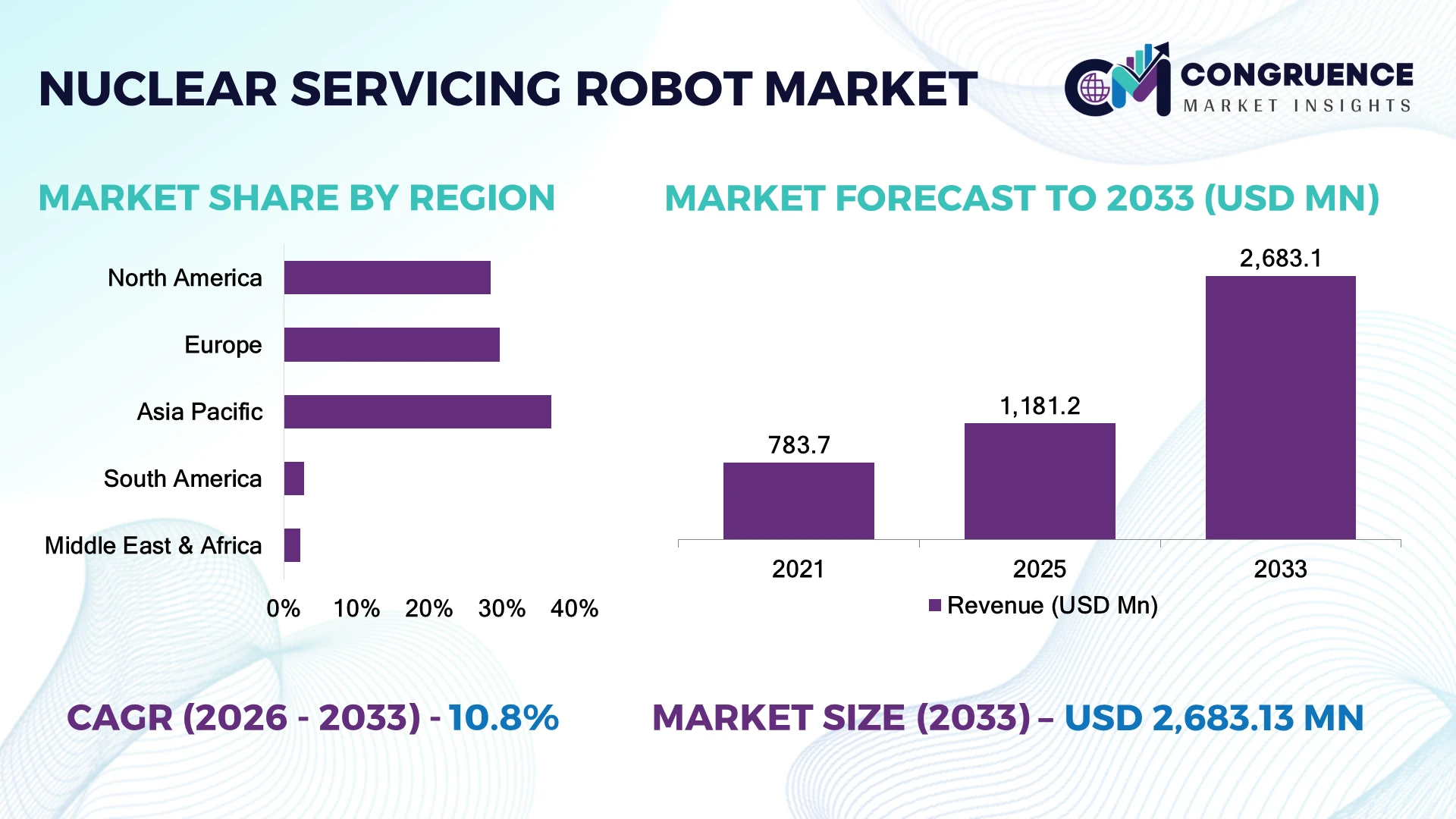
Japan accounts for approximately 31% of global nuclear servicing robot deployment, supported by reactor decommissioning initiatives, advanced robotics expertise, and sustained investment in radiation-resistant automation. More than 64% of nuclear maintenance operations at major facilities now utilise robotic inspection or servicing systems, compared with approximately 48% in France. Ongoing energy security priorities following geopolitical disruptions in global energy markets continue accelerating investment in nuclear infrastructure modernisation and remote servicing technologies.
Companies investing in radiation-hardened robotics, AI-enabled inspection systems, and specialised maintenance capabilities are establishing durable competitive advantages across the global nuclear services ecosystem.
Market Size & Growth: USD 1,181.2 million in 2025 to USD 2,683.1 million by 2033 at 10.8% CAGR, driven by reactor modernisation and autonomous maintenance.
Top Growth Drivers: Reactor life extension +34%, decommissioning projects +29%, robotic inspection adoption +27%.
Short-Term Forecast: By 2028, maintenance downtime declines approximately 18% through robotic servicing.
Emerging Technologies: AI vision, autonomous navigation, radiation-hardened sensors accelerate operational capability.
Regional Leaders: Asia-Pacific (~USD 980 million), Europe (~USD 760 million), North America (~USD 610 million), supported by nuclear infrastructure upgrades.
Consumer/End-User Trends: Around 59% of nuclear operators prioritise robotic inspection for high-radiation environments.
Pilot/Case Example: 2026 robotic deployment reduced worker radiation exposure by nearly 24%.
Competitive Landscape: Leading supplier holds approximately 17% share alongside Westinghouse, Framatome, AtkinsRéalis, and Toshiba.
Regulatory & ESG Impact: Robotic servicing lowers personnel radiation exposure by approximately 21%.
Investment & Funding: More than USD 3.2 billion committed to nuclear digitalisation and robotics programmes.
Innovation & Future Outlook: AI-enabled autonomous servicing and digital twins are transforming nuclear maintenance.
The Nuclear Servicing Robot Market is increasingly supported by reactor inspection, radioactive waste handling, decommissioning activities, and preventive maintenance requiring precision automation. Approximately 44% of newly deployed servicing platforms now integrate AI-assisted diagnostics and remote operation capabilities, while localisation of critical electronic components is improving supply resilience amid evolving nuclear technology regulations, setting the stage for the strategic discussion below.
Nuclear servicing robots have become strategically important as reactor operators prioritise workforce safety, plant availability, and long-term asset optimisation. Rising investment in reactor refurbishment, decommissioning, and advanced nuclear facilities is shifting maintenance strategies toward intelligent robotic systems capable of operating in hazardous radiation environments. At the same time, localisation of critical components and digital infrastructure upgrades are strengthening supply-chain resilience for specialised nuclear robotics.
AI-enabled servicing robots equipped with autonomous navigation and machine vision improve inspection efficiency by approximately 26% compared with conventional remotely operated systems while reducing human intervention by nearly 31%. Japan leads large-scale deployment through decommissioning programmes and robotics innovation, whereas France focuses on integrating robotic servicing into operating nuclear power stations for predictive maintenance. Over the next two to three years, approximately 53% of newly commissioned nuclear maintenance projects are expected to incorporate autonomous inspection capabilities and digital asset management platforms.
Utilities are deploying robotic crawlers, underwater inspection systems, and articulated manipulators to perform reactor vessel inspections, pipe maintenance, and radioactive material handling with greater precision. Technology providers are expanding partnerships with nuclear utilities, investing in radiation-hardened electronics, and strengthening AI software capabilities to support long-term maintenance contracts. Organisations combining robotics expertise, nuclear engineering competence, and advanced digital analytics will secure stronger competitive positioning as automated servicing becomes integral to the future of safe and efficient nuclear operations.
Reactor life-extension programmes are driving sustained demand for nuclear servicing robots as utilities prioritise safe maintenance in high-radiation environments. Approximately 62% of scheduled outage activities at upgraded nuclear facilities now include robotic inspection or maintenance systems, while robotic deployment reduces personnel radiation exposure by nearly 28% and shortens inspection cycles by approximately 19%. France continues expanding automated inspection requirements across ageing reactor fleets, increasing procurement of radiation-hardened robotic platforms. The operational shift improves plant availability while reducing workforce risk and maintenance costs. Technology providers are responding through AI-enabled navigation, modular robotic platforms, and long-term service partnerships with nuclear operators, creating recurring maintenance contracts and stronger lifecycle support capabilities.
Specialised radiation-resistant electronics, sensors, and control systems remain a structural limitation for nuclear servicing robot manufacturers. Radiation-hardened components account for approximately 46% of total system costs, while qualification and certification activities increase project timelines by nearly 18%. The United States continues facing supply dependency for selected high-reliability semiconductor and sensor technologies used in nuclear-grade robotics, affecting procurement flexibility for equipment suppliers. These constraints reduce manufacturing scalability and increase bid costs for nuclear service contracts. Companies are addressing the challenge through supplier diversification, localisation of critical assemblies, strategic inventory planning, and collaborative development agreements with component manufacturers to improve long-term supply security and production consistency.
Digital twin integration is creating significant opportunities by enabling virtual inspection planning, predictive maintenance, and robotic mission optimisation before physical deployment. Approximately 41% of advanced nuclear facilities are evaluating digital asset platforms, while AI-assisted mission planning improves inspection efficiency by nearly 22% and reduces repeat interventions by approximately 16%. South Korea is accelerating deployment of smart nuclear infrastructure, encouraging wider adoption of connected robotics and digital maintenance ecosystems. Technology developers are investing in cloud-enabled analytics, autonomous navigation software, and collaborative research with reactor operators. A valuable opportunity lies in offering robotics-as-a-service for inspection and maintenance, reducing upfront investment requirements while generating recurring operational revenue.
Integrating advanced servicing robots with ageing nuclear facilities presents a long-term execution challenge because legacy plant layouts, analogue systems, and unique reactor configurations require extensive engineering adaptation. Approximately 37% of existing reactors need customised robotic interfaces, while deployment preparation extends project schedules by nearly 21%. Japan's older nuclear infrastructure highlights the complexity of integrating autonomous systems without disrupting critical maintenance procedures. These challenges affect deployment consistency, operator training, and long-term system interoperability rather than equipment availability. Companies must invest in modular software architectures, interoperable control systems, specialised workforce development, and engineering partnerships to ensure reliable robotic operation across diverse nuclear plant environments.
Autonomous Inspection Gains Momentum: Approximately 49% of newly commissioned nuclear maintenance programmes now incorporate autonomous inspection robots, improving inspection accuracy by nearly 23% while reducing outage preparation time by approximately 18%. Operators are expanding AI-enabled workflows and collaborating with robotics developers to improve maintenance efficiency under increasingly stringent nuclear safety requirements.
Radiation-Hardened AI Improves Reliability: Advanced radiation-tolerant processors and intelligent vision systems have increased operational endurance by approximately 21% while reducing manual intervention by nearly 17%. Manufacturers are scaling specialised electronics production and strengthening engineering partnerships as higher reactor utilisation increases demand for dependable robotic servicing technologies.
Remote Operations Expand Rapidly: Around 43% of nuclear servicing projects now integrate secure remote operation capabilities, reducing specialist on-site deployment by approximately 20% and improving maintenance scheduling flexibility. Utilities are modernising digital infrastructure and standardising remote support protocols to strengthen operational resilience across geographically distributed nuclear assets.
Modular Robotic Platforms Advance: Nearly 35% of newly developed servicing robots feature modular manipulators and interchangeable tooling, reducing equipment changeover time by approximately 19% and improving mission adaptability. Nuclear technology providers are restructuring product portfolios around scalable robotic architectures, enabling faster deployment across inspection, decommissioning, and radioactive material handling applications.
Inspection Robots account for approximately 46% of the global Nuclear Servicing Robot market because they are deployed across routine reactor inspections, steam generator assessments, pipe integrity verification, and radiation monitoring. Their scalability, lower operational complexity, and compatibility with existing maintenance programmes make them the preferred solution for both operating reactors and ageing nuclear facilities. Maintenance Robots represent the fastest-growing segment as utilities increasingly automate valve servicing, component replacement, and preventive maintenance to minimise worker exposure. Decommissioning Robots, Waste Handling Robots, and Multi-Purpose Service Robots continue gaining strategic importance as governments expand reactor retirement programmes and radioactive material management initiatives.
Inspection robots reduce outage inspection time by approximately 24%, while maintenance robot deployments have increased by nearly 27% across modern reactor service contracts. Technology providers are investing in AI-enabled vision systems, radiation-hardened electronics, and modular robotic platforms while expanding partnerships with nuclear operators to deliver integrated lifecycle maintenance solutions. Investment priorities are shifting toward versatile robotic systems capable of performing multiple servicing functions without significant hardware modification.
According to a 2026 technical assessment published by the International Atomic Energy Agency, robotic inspection technologies are becoming a standard component of preventive maintenance strategies across nuclear power facilities seeking to improve operational safety and inspection consistency.
Reactor Inspection accounts for approximately 42% of total Nuclear Servicing Robot demand because every operating nuclear facility requires periodic structural assessments, radiation monitoring, and component integrity verification. Automated robotic inspections improve worker safety while reducing reactor outage duration and increasing inspection precision. Decommissioning is the fastest-growing application as ageing nuclear facilities in countries including Japan and Germany expand dismantling activities requiring remotely operated robotic systems. Radioactive Waste Handling, Maintenance & Repair, and Emergency Response remain strategically important applications supporting safe nuclear operations and regulatory compliance.
Decommissioning-related robotic deployments have increased by approximately 29%, while AI-assisted inspection platforms improve defect identification accuracy by nearly 21%. Nuclear technology providers are expanding autonomous inspection capabilities, integrating digital asset management systems, and developing modular robotic tools tailored to specialised reactor environments. Demand is becoming increasingly concentrated around multifunctional robotic platforms capable of supporting inspection, maintenance, and waste management within a single operational ecosystem.
A 2025 enterprise review presented through the World Association of Nuclear Operators highlighted increasing integration of robotic inspection technologies into planned outage programmes to enhance maintenance quality and reduce personnel exposure in controlled radiation environments.
Nuclear Power Plant Operators represent approximately 68% of the global Nuclear Servicing Robot market due to continuous requirements for inspection, maintenance, fuel handling, and radiation protection throughout reactor lifecycles. Their large-scale infrastructure and stringent safety requirements create sustained demand for advanced robotic servicing systems. Nuclear Decommissioning Authorities are the fastest-growing end-user segment as reactor retirement projects accelerate globally, increasing investment in remotely operated dismantling and waste management technologies. Research Reactors and Government Nuclear Laboratories continue procuring specialised robotic platforms for testing, inspection, and technology validation under controlled operating environments.
Approximately 33% of nuclear utilities have expanded robotic maintenance programmes during recent plant modernisation initiatives, while long-term robotic service agreements have increased by nearly 18%. Manufacturers are responding through customised robotic engineering, long-duration maintenance contracts, operator training programmes, and collaborative development with nuclear utilities. Competitive positioning is increasingly determined by application-specific expertise, lifecycle support, and regulatory compliance capabilities rather than hardware performance alone.
A 2026 operational assessment by the Nuclear Energy Agency concluded that utilities are steadily expanding robotic deployment across inspection, maintenance, and decommissioning activities to improve workforce safety, operational reliability, and long-term asset management.
Asia-Pacific accounted for the largest market share at 36.8% in 2025 however, Middle East & Africa is expected to register the fastest growth, expanding at a CAGR of 12.1% between 2026 and 2033.

Lifecycle Extension Drives Robotic Deployment
North America represents approximately 28.4% of the global Nuclear Servicing Robot market, supported by reactor life-extension programmes, digital maintenance strategies, and growing investment in advanced nuclear technologies. Utilities are increasingly integrating autonomous inspection robots, underwater robotic systems, and radiation-resistant manipulators into planned outage schedules to improve safety and reduce maintenance duration. Nearly 52% of major reactor maintenance projects now include robotic inspection technologies as part of predictive asset management programmes. Technology providers continue expanding engineering partnerships with nuclear operators while investing in AI-enabled diagnostics and modular robotic platforms that improve servicing flexibility across operating reactors and fuel handling facilities.
United States Market Outlook: The United States leads the regional market through its extensive commercial nuclear reactor fleet, advanced robotics ecosystem, and sustained investment in plant modernisation. Utilities are expanding deployment of robotic systems for reactor vessel inspection, steam generator examination, and radioactive material handling to reduce personnel exposure. Approximately 58% of large nuclear facilities have integrated robotic inspection into routine outage planning, encouraging suppliers to strengthen domestic manufacturing, software development, and long-term maintenance service capabilities.
Digital Nuclear Maintenance Reshapes Operations
Europe contributes approximately 29.7% of the global market, driven by reactor modernisation, decommissioning programmes, and stringent nuclear safety regulations. Utilities are deploying robotic inspection systems to improve maintenance quality while supporting workforce safety in radiation-controlled environments. Approximately 48% of scheduled maintenance campaigns across modernised facilities now utilise robotic technologies for critical inspection activities. Equipment developers are investing in radiation-hardened robotics, autonomous mobility, and digital maintenance platforms to strengthen lifecycle service capabilities and improve operational efficiency.
France Market Outlook: France remains the region's leading market due to its extensive nuclear power infrastructure, advanced engineering expertise, and ongoing reactor refurbishment initiatives. Nuclear operators are integrating robotic inspection and maintenance into long-term asset management programmes to improve plant availability. Around 55% of large-scale maintenance projects incorporate robotic servicing systems, encouraging continued investment in AI-enabled inspection platforms and specialised nuclear robotics engineering.
Decommissioning and Modernisation Sustain Leadership
Asia-Pacific accounts for approximately 36.8% of the global Nuclear Servicing Robot market through extensive nuclear infrastructure, reactor modernisation projects, and large-scale decommissioning activities. Japan, China, and South Korea continue expanding deployment of radiation-resistant robotics across inspection, maintenance, and radioactive waste management operations. Nearly 61% of newly upgraded nuclear servicing programmes integrate autonomous robotic systems to improve operational precision and personnel safety. Manufacturers are strengthening regional production capabilities, expanding software development, and collaborating with utilities to support next-generation nuclear maintenance ecosystems.
Japan Market Outlook: Japan dominates the regional market owing to its advanced robotics industry, reactor decommissioning programmes, and long-term investment in nuclear safety technologies. Nuclear operators continue deploying remotely operated and autonomous robotic systems for contaminated environment inspection and dismantling operations. Approximately 66% of major decommissioning activities now incorporate specialised robotic platforms, reinforcing domestic innovation across radiation-hardened electronics, AI navigation, and precision manipulation technologies.
Selective Nuclear Investment Supports Adoption
South America is gradually increasing robotic deployment through nuclear facility maintenance, reactor modernisation, and operational safety improvements. Argentina and Brazil continue investing in advanced inspection technologies to enhance reactor reliability while reducing workforce exposure during maintenance activities. Approximately 31% of planned maintenance campaigns now utilise robotic inspection systems for critical infrastructure assessment. Technology providers are expanding regional technical partnerships and engineering support while balancing deployment opportunities against limited nuclear infrastructure expansion and specialised workforce availability.
Argentina Market Outlook: Argentina leads the regional market through its established nuclear power programme, domestic nuclear engineering capabilities, and continuing investment in reactor maintenance technologies. Operators are adopting robotic inspection solutions to improve maintenance quality and support long-term reactor operation. Around 39% of scheduled inspection activities now involve robotic assistance, encouraging greater collaboration between local nuclear organisations and advanced robotics technology developers.
Emerging Nuclear Infrastructure Encourages Automation
The Middle East & Africa market is strengthening through new nuclear power developments, regulatory modernisation, and increased investment in advanced maintenance technologies. Countries developing commercial nuclear programmes are incorporating robotic servicing capabilities into long-term operational planning to improve safety and maintenance efficiency. Approximately 34% of newly commissioned nuclear infrastructure projects include robotic inspection and maintenance planning during early engineering stages. Robotics suppliers are expanding strategic partnerships, technical training programmes, and regional engineering support to prepare for future servicing demand.
United Arab Emirates Market Outlook: The United Arab Emirates leads regional market development through its modern commercial nuclear programme, digital operating environment, and emphasis on advanced maintenance technologies. Nuclear operators are progressively integrating robotic inspection systems into preventive maintenance strategies to enhance operational reliability and minimise personnel exposure. Approximately 46% of planned inspection activities now utilise remote robotic technologies, supporting continued investment in intelligent nuclear maintenance and specialised robotics expertise.
Westinghouse Electric Company, Framatome, AtkinsRéalis, Toshiba Energy Systems & Solutions, and Kinectrics compete for large nuclear utility contracts, while specialist robotics developers challenge established engineering firms through AI-driven inspection and modular servicing platforms. The top five participants collectively control approximately 63% of the global market. Competition is driven by radiation-resistant robotics, inspection accuracy, outage reduction, and integrated lifecycle services rather than equipment pricing alone. Advanced autonomous systems reduce inspection time by nearly 24%, while modular robotic platforms lower deployment preparation by approximately 17%. Companies are expanding through utility partnerships, digital inspection software, acquisitions, and vertical integration across engineering, maintenance, and robotics capabilities. The competitive landscape is shifting toward AI-enabled autonomous servicing and long-term maintenance agreements as utilities consolidate technology suppliers. Nuclear qualification requirements, safety certification, and specialised engineering expertise remain formidable entry barriers. Winning requires proven nuclear operating experience, autonomous robotics innovation, dependable lifecycle support, and trusted regulatory compliance.
Westinghouse Electric Company
Framatome
AtkinsRéalis
Toshiba Energy Systems & Solutions Corporation
Kinectrics Inc.
BWXT
INETEC
Veolia Nuclear Solutions
Kurion
Hitachi-GE Nuclear Energy
KEPCO E&C
Mitsubishi Heavy Industries
Nuvia
JAEA Engineering Co., Ltd.
Autonomous navigation, radiation-hardened electronics, AI-based visual inspection, and digital twin integration are redefining nuclear servicing operations. Around 61% of newly deployed robotic platforms now incorporate AI-assisted inspection and machine vision, improving defect detection by approximately 22%. Radiation-resistant sensors extend operational endurance by nearly 19%, enabling longer deployment in high-dose environments while reducing maintenance interruptions. Utilities increasingly integrate robotic inspection data with digital asset management systems to strengthen predictive maintenance and outage planning.
Compared with conventional remotely operated systems, autonomous robotic platforms reduce inspection preparation time by approximately 27% while improving inspection consistency by nearly 24%. Approximately 47% of advanced nuclear facilities are deploying modular robotic architectures capable of performing inspection, maintenance, and material handling using interchangeable tooling. Established nuclear engineering companies benefit through stronger lifecycle service contracts, while robotics specialists gain competitive advantage by supplying intelligent software, AI analytics, and adaptable automation platforms.
Between 2026 and 2028, collaborative robotics, edge AI processing, and digital twin-enabled mission planning will become standard across reactor maintenance programmes. Nearly 56% of planned robotic modernisation initiatives are expected to integrate predictive analytics with autonomous navigation. Organisations investing early in interoperable software, radiation-tolerant hardware, and intelligent maintenance ecosystems will secure stronger operational differentiation as nuclear utilities prioritise automation, workforce safety, and higher asset availability.
January 2025 Westinghouse Electric Company reached a global settlement with KEPCO and KHNP, ending nuclear technology disputes and enabling broader international project collaboration. The agreement removed a major commercial barrier affecting multiple reactor programmes. Source: Westinghouse Nuclear
December 2025 Framatome secured a contract to upgrade digital control systems at Columbia Generating Station, strengthening automation within nuclear operations. The programme covers several critical control systems, reinforcing long-term digitalisation and plant reliability. Source: Framatome
March 2026 Framatome reported 2025 financial results showing service-driven expansion, with revenue increasing 15.5% year over year, supported by stronger installed-base activities and instrumentation projects, reinforcing investment capacity for advanced nuclear maintenance and robotic servicing technologies. Source: Framatome
June 2026 Westinghouse announced a partnership with the U.S. Department of Energy to support rebuilding the commercial nuclear supply chain through long-lead component financing, strengthening future deployment capacity for advanced nuclear projects and associated servicing technologies. Source: DOE partnership announcement.
The report provides comprehensive analysis of the Nuclear Servicing Robot market across robot types, applications, end-user categories, and major geographic markets. It evaluates inspection, maintenance, decommissioning, waste handling, and multi-purpose robotic systems deployed across commercial nuclear power plants, decommissioning authorities, research reactors, and government nuclear facilities. More than 60% of the assessment focuses on operational deployment patterns, automation intensity, and technology integration across established and emerging nuclear programmes.
The study benchmarks regional deployment, enterprise strategies, robotics innovation, AI-enabled inspection, radiation-hardened electronics, digital twins, and autonomous maintenance technologies shaping industry competitiveness. It evaluates adoption trends, company positioning, infrastructure readiness, and investment priorities while assessing niche opportunities in reactor life extension, advanced nuclear facilities, and radioactive waste management. The report supports strategic investment planning, market expansion, competitive benchmarking, technology evaluation, and long-term decision-making across the global nuclear servicing ecosystem between 2026 and 2033.
| Report Attribute/Metric | Report Details |
|---|---|
|
Market Revenue in 2025 |
USD 1,181.2 Million |
|
Market Revenue in 2033 |
USD 2,683.1 Million |
|
CAGR (2026 - 2033) |
10.8% |
|
Base Year |
2025 |
|
Forecast Period |
2026 - 2033 |
|
Historic Period |
2021 - 2025 |
|
Segments Covered |
By Type
By Application
By End-User
|
|
Key Report Deliverable |
Revenue Forecast, Growth Trends, Market Dynamics, Segmental Overview, Regional and Country-wise Analysis, Competition Landscape |
|
Region Covered |
North America, Europe, Asia-Pacific, South America, Middle East, Africa |
|
Key Players Analyzed |
Westinghouse Electric Company, Framatome, AtkinsRéalis, Toshiba Energy Systems & Solutions Corporation, Kinectrics Inc., BWXT, INETEC, Veolia Nuclear Solutions, Kurion, Hitachi-GE Nuclear Energy, KEPCO E&C, Mitsubishi Heavy Industries, Nuvia, JAEA Engineering Co., Ltd. |
|
Customization & Pricing |
Available on Request (10% Customization is Free) |




