
Reports
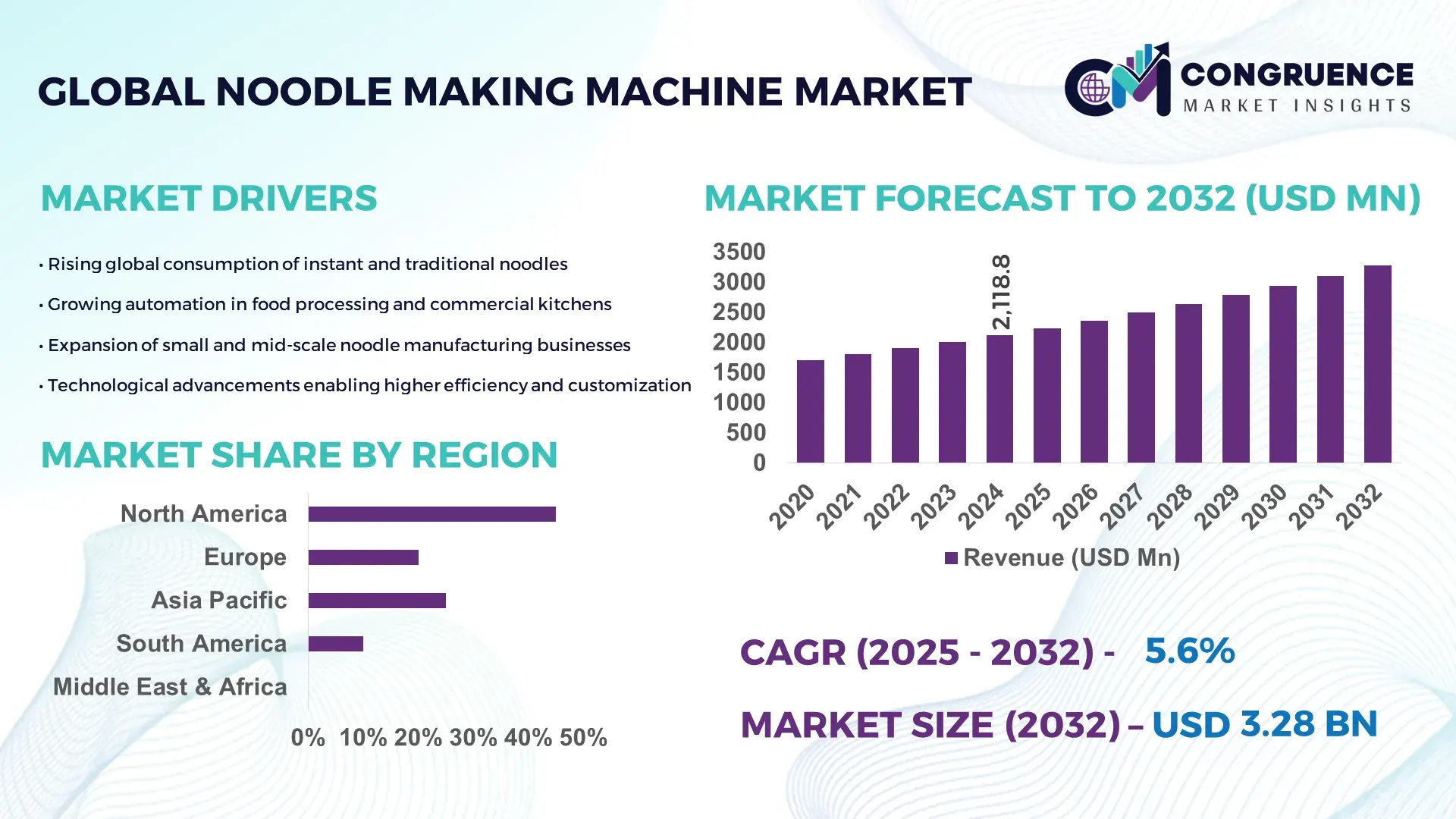
The Global Noodle Making Machine Market was valued at USD 2118.75 Million in 2024 and is anticipated to reach a value of USD 3276.36 Million by 2032 expanding at a CAGR of 5.6% between 2025 and 2032. This growth is driven by increasing demand for automation in food processing and rising global consumption of noodles across domestic and commercial sectors.
The country leading this market is China. In China, manufacturers deploy more than 200 high‑precision processing units annually, enabling production of over 200 complete noodle production lines each year. Leading firms operate plants exceeding 150,000 m², with large technical workforces and dozens of patented machinery innovations, covering stick, instant, fresh, and dried noodle lines. Investment in automated, CE‑certified and ISO‑compliant equipment has facilitated export to over 70 countries, with deployment of large‑scale instant‑noodle production plants capable of processing over a million servings per day. This reflects technological maturity, strong production capacity, and diversified applications in both domestic and global food manufacturing.
Market Size & Growth: Global market worth was USD 2,118.75 M in 2024 and expected to reach USD 3,276.36 M by 2032, driven by global shift toward automation and expanding food‑service sector.
Top Growth Drivers: rising automation adoption (≈ 35%), growing demand for instant and fresh noodles globally (≈ 28%), increasing efficiency and throughput improvements (≈ 22%).
Short‑Term Forecast (by 2028): projected 18–22% reduction in per‑unit production cost, with 15–20% gain in throughput for commercial operations.
Emerging Technologies: integration of IoT‑enabled monitoring and AI‑driven process optimization; development of energy‑efficient and modular production lines; multi‑product capability machines combining extrusion, rolling and cutting.
Regional Leaders (by 2032): Asia‑Pacific (≈ USD 1,450 M, driven by high noodle consumption and food‑processing growth); Europe (≈ USD 680 M, growing demand for ethnic cuisine); North America (≈ USD 520 M, rising Asian‑food popularity and foodservice automation).
Consumer/End‑User Trends: major end‑users include commercial noodle manufacturers, instant‑noodle producers, restaurants and catering services; increasing preference for freshly prepared noodles, health‑oriented products and customized noodle varieties.
Pilot or Case Example: In 2024, a large instant‑noodle manufacturer commissioned a fully‑automated production line leading to a 27% increase in daily output and 14% reduction in downtime.
Competitive Landscape: market leader holds approx. 30–35% share; major competitors include 3–5 other global and regional machine manufacturers.
Regulatory & ESG Impact: rising food‑safety standards, CE/ISO certification requirements, and growing emphasis on energy efficiency and waste‑water recycling influence equipment adoption.
Investment & Funding Patterns: recent investments exceed USD 150 M globally, with rising venture funding for modular and smart production lines, and financing models favoring turnkey installations.
Innovation & Future Outlook: increasing adoption of modular, flexible production lines; trend toward hybrid machines capable of producing multiple noodle types; forward-looking projects focus on AI‑driven quality control and sustainable manufacturing processes.
Global demand is driven by expanding food‑service industry, rising popularity of instant and fresh noodles, and shifting consumption patterns toward convenience foods. Technological innovations — such as IoT‑enabled monitoring, modular designs, and energy‑efficient machinery — are transforming both large-scale commercial production and smaller-scale manufacturing. Regulatory emphasis on food safety, energy consumption, and environmental impact promotes adoption of certified, efficient machines. Regional consumption patterns show Asia‑Pacific continuing to lead growth, while Europe and North America gain traction thanks to rising interest in Asian cuisine. Future outlook remains strong, with continued expansion in emerging markets, growth in health‑ and convenience‑oriented food sectors, and increasing integration of smart manufacturing technologies.
The strategic relevance of the Noodle Making Machine Market lies in its ability to enable cost‑efficient, high‑volume noodle production at industrial scale, thereby feeding rising global demand for convenient, ready‑to‑eat and fresh noodle products. IoT‑enabled automated control systems deliver 25% improvement in production consistency compared to legacy mechanical controls, reducing waste and ensuring uniform product quality. Asia‑Pacific dominates in volume, while Europe leads in adoption, with approximately 45% of European enterprises using advanced automated lines by 2025. By 2028, integration of AI‑driven predictive maintenance is expected to cut machine downtime by up to 30%, significantly improving throughput and reliability. Firms are committing to ESG metric improvements such as a 20% reduction in energy consumption by 2030 through adoption of energy‑efficient motors and optimized process flows. In 2025, a major manufacturer in China achieved an 18% reduction in energy usage and a 22% increase in yield through deployment of real‑time IoT monitoring and automated process optimization. Looking ahead, the Noodle Making Machine Market is positioned as a pillar of resilience, regulatory compliance, and sustainable growth — primed to support global food‑processing expansion while meeting energy, quality, and environmental standards.
Global noodle consumption has seen significant increases driven by busy urban lifestyles, rising disposable incomes and growing acceptance of convenience foods in both developed and emerging economies. As demand for instant, fresh, and specialty noodles rises — particularly in Asia, Latin America and parts of Europe — noodle producers are under pressure to expand capacity rapidly while maintaining hygiene and quality standards. This consumption surge compels manufacturers to acquire high‑speed, automated Noodle Making Machines that can handle large volumes with minimal human labor, ensuring consistent output. With producers often running 24/7 operations in peak demand seasons, these machines help keep up with demand surges, reduce manual labor costs, and deliver uniform product quality. The result is a strong upward push on demand for Noodle Making Machines across varied regional markets.
The advanced Noodle Making Machines required for high-speed, automated production often involve substantial upfront capital expenditure. For small and mid‑sized noodle manufacturers — especially in developing regions — the cost of acquiring, installing, and maintaining automated production lines can be prohibitive. In addition to the machine cost, there are expenses related to infrastructure upgrades, staff training, and ongoing maintenance. Operating and energy costs for large machines may also be higher than traditional manual or semi-mechanized setups, reducing appeal for producers with limited volume. This financial barrier slows adoption among smaller enterprises and in regions where capital access is limited or financing options are restrictive. Consequently, the market growth may be uneven, favoring larger producers or regions with easier access to capital.
As consumer tastes diversify, there is growing demand for specialty noodles such as gluten‑free, whole‑grain, multi‑grain, rice‑based, and even plant‑based alternatives. This trend opens opportunity for machine makers to design flexible production lines capable of handling different ingredients, dough consistencies, and noodle formats without extensive reconfiguration. Specialized equipment can capture niche markets — health‑conscious consumers, vegan diets, regional cuisines — enabling producers to differentiate their product ranges. Moreover, smaller boutique producers and regional players seeking limited‑batch runs can benefit from modular or semi‑automated Noodle Making Machines tailored for flexibility over volume. Rising interest in artisanal and fresh‑noodle segments presents a fertile ground for equipment vendors offering compact, versatile machines. This expanding heterogeneity of demand extends the market beyond large‑scale instant‑noodle producers, unlocking growth potential across varied segments.
Advanced Noodle Making Machines, especially those with automated controls, robotics, or modular flexibility, often require skilled technicians for setup, calibration, and maintenance. In regions where technical expertise is limited, lack of trained workforce can delay commissioning or lead to operational inefficiencies. Maintenance downtime, spare-part availability, and technical support infrastructure become critical issues — especially for smaller producers operating in remote areas. Additionally, regulatory compliance related to food safety, hygiene standards, waste disposal, and environmental regulations add layers of complexity. Producers must ensure machinery meets local certification requirements, food-grade material standards, and waste‑water treatment norms. Compliance costs and bureaucratic oversight can deter investment, slowing machine adoption. These challenges can particularly affect producers in emerging markets, limiting the overall growth trajectory of the Noodle Making Machine market in certain geographies.
• Modular and Prefabricated Production Line Integration: A growing number of food‑processing facilities are ordering noodle production lines built with modular, prefabricated units — in 2024, 58% of new installations globally used pre‑assembled modules. These modular lines reduce on-site installation time by up to 35% and cut labor hours required for setup by nearly 40%, allowing producers to commence operations within weeks rather than months. This accelerates time‑to‑market and reduces capital‑intensive overheads.
• AI‑Driven Quality Control and Real‑Time Monitoring: Manufacturers are increasingly fitting machines with AI sensors and vision‑based quality control systems, leading to a 22% reduction in defective output and an 18% drop in scrap rates compared to traditional manual inspection. Real-time monitoring dashboards allow operators to detect issues within a 5‑second window, enabling immediate adjustments and minimizing batch losses. This trend enhances consistency and reduces waste significantly.
• Energy‑Efficient and Eco‑Compliant Machinery Adoption: Around 40% of newly ordered noodle‑making machines in 2025 specify motors rated below 75 kW and incorporate advanced insulation and waste‑water recycling systems. These machines consume approximately 25% less electricity and discharge 30% less water waste than older models. The push for lower carbon footprints and compliance with food‑safety and environmental regulations is driving demand for greener, more sustainable equipment.
• Growing Demand for Compact, Flexible Machines Among SMEs and Specialty Producers: In emerging markets, roughly 30% of new machine orders in 2024–2025 were compact units with footprints under 15 kW, designed for small-scale or specialty noodle production (e.g., gluten‑free or rice‑based varieties). These flexible machines offer rapid recipe adjustments and can switch between noodle types within hours. This rise reflects expanding interest from boutique producers, regional food artisans, and start‑ups focusing on niche or customized noodle offerings.
The noodle‑making machine market is structured around several core segmentation axes — types of machinery, application (how and where the machines are used), and end‑user categories. This segmentation helps manufacturers, investors and industry stakeholders align machine capabilities with production needs and end‑market demand. Machines range from fully manual models for small‑scale or artisanal noodle production to fully automated production lines for industrial and large‑volume manufacturing. Applications vary across fresh‑noodle makers, instant‑noodle production, and specialty/alternative‑ingredient noodles (gluten‑free, rice‑based, vegetable‑infused etc.). End‑users span from large food processing companies and packaged‑noodle manufacturers to restaurants, small‑business producers, and even home-use buyers in certain markets. Regional and operational variations (e.g. small vs. large capacity, manual vs. automatic) reflect differing cost structures, production volumes and target end‑products.
The primary machine types are Automatic, Semi‑Automatic, and Manual. Automatic noodle‑making machines are the leading type: they currently account for roughly 55–60% of global adoption owing to their high throughput, consistency, and suitability for large‑scale manufacturers and industrial food‑processing plants. Their fully automated processes — from mixing dough to cutting/shaping noodles — make them ideal for instant‑noodle lines, export‑oriented production, and high-volume output. Semi‑automatic machines contribute around 30%, bridging between cost and output: they offer moderate automation (e.g. dough mixing/rolling automated, cutting/manual or semi-automated), making them popular among small to medium enterprises, local restaurants, and artisanal producers who need flexibility without the large capital outlay of a full automated line. Manual machines represent about 10–15%, serving niche segments such as home-use, handcrafted or small-batch noodle makers valuing low cost and simplicity.
The fastest-growing segment is Semi‑Automatic machines, driven by rising number of small to medium‑size food businesses, boutique noodle producers, restaurant kitchens, and cloud‑kitchens seeking moderate automation with lower investment and easier maintenance compared to full‑scale lines.
Applications include Fresh‑Noodle Production for restaurants/retail, Instant‑Noodle Manufacturing (packaged/dried/fried noodles), Commercial Food Processing for bulk or packaged noodle output, and Specialty Noodle Production (gluten‑free, alternative ingredients, regional recipes). Fresh‑noodle production is currently the dominant application, with roughly 45–50% of machine installations because restaurants, retail outlets and foodservice providers continue to rely on fresh noodles prepared in-house or sold fresh to consumers. Instant‑noodle manufacturing is the fastest-growing application, driven by expanding demand for convenience foods, packaged noodles, and shelf-stable products — supporting a steady rise in deployment of high-capacity production lines and continuous processing systems. Other applications—including specialty noodles (gluten-free, vegetable‑infused, alternative‑grain) and small‑batch commercial use — together account for the remaining 20–25% of installations.
The dominant end‑user segment is Food Processing Companies and Industrial Manufacturers, accounting for approximately 50–55% of demand, due to their requirement for high-throughput, continuous production lines for packaged, instant, and dried noodles. The Restaurants & Hotels segment is the fastest-growing end-user group, as an increasing number of dining establishments — including quick‑service, casual dining, and specialty cuisine restaurants — invest in either semi‑automatic or compact automatic machines to produce fresh noodles in‑house, offering greater menu flexibility and cost control. Smaller segments such as Small‑Scale Manufacturers, Boutique/Niche Producers, and Local Food Businesses collectively contribute around 15–20%, focusing on artisanal, regional or specialty noodle products (e.g. gluten‑free or rice‑noodles). Household users remain marginal but have modest growth potential in regions where home cooking of noodles or artisanal pasta gains popularity.
Asia‑Pacific accounted for the largest market share at 45% in 2024; however, Asia‑Pacific is expected to register the fastest growth, expanding significantly between 2025 and 2032.

The region benefits from high population density, deep cultural affinity for noodles, and large-scale industrial and home‑use machine adoption. In absolute volume terms, Asia‑Pacific machines numbered in the millions of units installed by 2024, and demand continues to accelerate due to urbanization, rising disposable incomes, and growing interest in both instant and fresh noodle consumption across urban and semi‑urban areas. Investment in both commercial noodle‑making lines and compact domestic machines remains robust, reflecting sustained demand across end‑user segments and geographic diversity.
What is fueling growing demand for noodle‑making machines in restaurant kitchens and home cooking?
North America holds approximately 25% of global demand for noodle‑making machines as of 2024. Demand is driven by specialty food manufacturers, ethnic‑cuisine restaurants, and increasing home cooking interest in Asian‑style noodles. Regulatory standards around food safety and hygiene encourage use of automated and certified machinery for commercial kitchens. Technological trends include adoption of compact automatic machines with energy‑efficient motors and digital controls suited for smaller batch production. A notable trend: small‑to‑mid‑sized noodle producers and fusion‑cuisine restaurants across the U.S. have begun installing semi‑automatic noodle lines to meet demand for fresh, custom noodles. Consumer behavior in North America shows growing preference for healthier, freshly prepared meals and customizable recipes, which supports demand for flexible noodle‑making machines over imported pre‑packaged noodles.
How is sustainability and premiumization shaping equipment demand across European food producers?
Europe accounts for roughly 20% of global noodle‑making machine demand by volume in 2024. Major markets include Germany, UK, France, and Italy, each actively investing in food‑processing automation. European regulatory and sustainability initiatives — including energy‑efficiency standards and food‑safety certifications — push manufacturers toward eco‑compliant, hygienic noodle‑making systems. Adoption of advanced automated and modular production lines is increasing especially among commercial kitchens and boutique noodle producers. For example, several mid-size enterprises in Germany and France have installed fully compliant machines that meet EU food‑safety and energy‑use norms to serve niche markets like artisan or health‑oriented noodles. European consumer behavior reflects growing interest in clean-label and sustainable food, driving demand for machines that enable production of organic or specialty noodles with traceability and controlled quality.
Why does Asia‑Pacific remain the backbone of global noodle‑making machine demand and how is it evolving?
Asia‑Pacific remains the largest and highest‑volume market for noodle‑making machines by 2024. The region’s top consuming and producing countries include China, India, Japan, Indonesia, and Vietnam. High per capita noodle consumption (e.g. billions of servings annually in China and other major markets) drives continuous demand for both industrial‑scale and domestic machines. Manufacturers across the region are scaling up output capacities, commissioning new plants, and investing in modular automated lines. Innovation hubs in China and Japan focus on multi‑function machines capable of processing wheat, rice, or mixed‑ingredient noodles, catering to both traditional and evolving consumer tastes. Regional consumer behavior emphasizes convenience, affordability, and variety — supporting both instant‑noodle lines and fresh‑noodle production for restaurant and home‑use segments. As a result, Asia‑Pacific continues to lead in both volume and diversity of machine adoption.
Can growing urbanization and changing diets drive noodle‑making demand in Latin markets?
In South America, key countries include Brazil and Argentina, where rising urban populations and shifting dietary habits are slowly increasing demand for noodle‑making machines. Overall regional share remains modest compared to Asia or Europe, but growth potential is rising as convenience foods — including noodles — gain traction among emerging middle‑class consumers. Infrastructure improvements and expanding retail networks support better distribution of machine‑made noodles. Local manufacturers in Brazil are beginning to explore medium‑scale noodle‑making lines to supply supermarkets and convenience‑food outlets. Consumer behavior varies: there is growing interest in easy‑to-cook meals and fusion foods, which stimulates demand for both instant‑noodle production lines and smaller-scale machines suited for local tastes and production volumes.
What are the growth drivers for noodle‑making machines in emerging markets across Middle East and Africa?
In Middle East & Africa, demand for noodle‑making machines is rising amid increasing urbanization, expanding expatriate populations, and growing food-service sectors. Key growth countries include UAE, Saudi Arabia, and South Africa, where rising consumer interest in convenient and globally popular foods (like noodles) is fueling demand. Many enterprises are exploring compact, energy-efficient noodle‑making machines suitable for local restaurants and small food‑processing units. Technological modernization — including energy‑efficient motors and modular production lines — is becoming more common as firms seek machines that adhere to emerging environmental and food‑safety regulations. Regional consumer behavior reflects growing appetite for affordable, shelf-stable meals, which supports uptake of instant‑noodle production machinery even in markets with limited per‑capita consumption.
China: ~40% share — large production capacity, deep-rooted noodle consumption culture, and strong manufacturing infrastructure.
Japan (or India): ~15–20% share — high per‑capita consumption and diversified demand across fresh, instant, and specialty noodles.
The competitive environment in the Noodle Making Machine market is moderately consolidated: there are over 50 active competitors globally, but the combined share of the top 5 companies amounts to approximately 40–45%. These leading firms maintain dominance through strategic initiatives including new product launches, global partnerships, and continuous technology upgrades. In recent years, several manufacturers expanded their product portfolios — launching modular, automated lines — while others entered collaborations to penetrate emerging markets or add-value services (spare parts, after‑sales support, turnkey installation).
Competition is shaped by innovation trends: firms are investing in IoT‑enabled monitoring, flexible machines for different noodle types (e.g. wheat, rice, gluten-free), and energy‑efficient designs to meet rising regulatory and environmental standards. Players also differentiate based on scale: some focus on high-capacity industrial lines for large manufacturers; others target SMEs and restaurants with compact, semi‑automatic units. The market structure thus reflects both global giants and a sizable long tail of small/medium vendors, making it partly fragmented beneath the top tier. Market positioning varies: the top players emphasize reliability, global distribution, compliance, and full-service offerings; the rest compete on price, specialization (e.g. rice‑noodle lines), or regional presence. Strategic alliances, continuous innovation and geographic diversification remain key competitive levers shaping market leadership.
Bühler Group
GEA Group
ANKO Food Machine Co., Ltd.
Henan Gelgoog Machinery Co., Ltd.
Yamato Manufacturing Co., Ltd.
VEMAG Maschinenbau GmbH
Fengyang Machinery Co., Ltd.
Jinan Qianli Machinery Co., Ltd.
Shanghai Yonghui Food Machinery Co., Ltd.
Sainty Food Machinery Co., Ltd.
Dalian Asia Foods Machinery Co., Ltd.
Rheon Automatic Machinery Co., Ltd.
Shandong Jinjia Group Co., Ltd.
Technological innovation in the Noodle Making Machine market is reshaping production efficiency, cost management, and product differentiation. Automation remains the most widely integrated technology, with nearly 68% of large-scale food processors adopting PLC-based control systems to achieve consistent dough texture and uniform cutting outputs. Fully automated lines now reduce manual labor requirements by nearly 45%, allowing manufacturers to standardize quality and scale output without proportional workforce expansion. Servo-motor-driven systems further enhance precision, enabling speed variation based on noodle thickness and ingredients.
Digitalization is gaining rapid momentum, with IoT-enabled monitoring integrated in approximately 37% of newly installed machines in 2024. Such connectivity supports predictive maintenance, where downtime can be reduced by up to 32% through real-time diagnostics and automatic alerts. Cloud-based dashboards also allow multi-facility factories to track energy usage, water consumption, and cycle efficiency from a centralized system. AI-powered dough formulation is advancing as well, especially in markets producing multiple noodle varieties using regional ingredients; it optimizes water-flour ratios automatically to align with texture targets.
Sustainability-focused technology plays a critical role. Energy-efficient heating systems have lowered consumption by up to 22% per production cycle, while heat-recovery modules recycle an estimated 18–21% of thermal output during drying processes. Stainless-steel materials compliant with food-grade safety standards now represent over 80% of new equipment purchases due to improved durability and hygiene. Customization technology is also driving competitiveness — machines capable of quick tooling changeovers can switch between spaghetti, udon, ramen, and rice noodles in less than 12 minutes, increasing SKU flexibility across production. Together, automation, IoT monitoring, AI-supported formulation, and sustainability-aligned efficiency technologies position the Noodle Making Machine market for accelerated modernization and long-term operational resilience.
In 2023, ANKO Food Machine Co., Ltd. launched the NDL-100 commercial noodle extruder — a compact machine producing 100 kg/hr of customized and specialty noodles including gluten-free and high-protein varieties, enabling food processors to expand product offerings and meet nutritional demands. (ANKO FOOD MACHINE CO., LTD.)
In early 2024, ANKO expanded its global equipment footprint by supplying noodle-making and broader food-processing machinery to over 114 countries, reinforcing its distribution network and turnkey solution services across continents.
In 2024, machine manufacturers increasingly integrated modular, automated noodle production lines designed for quick mold changeover — some systems now support multi-shape output (e.g. fusilli, ramen, specialty noodles) with mold interchange in under 5 minutes, enhancing flexibility for diverse product portfolios.
Also in 2024, adoption of food-grade, hygiene-compliant automated noodle machines surged among chain kitchens and central food-processing facilities, reflecting growing emphasis on food safety standards and efficiency in high-throughput noodle manufacturing environments.
The Noodle Making Machine Market Report provides a comprehensive and structured analysis of global market activity, covering multiple dimensions: product types (automatic, semi-automatic, manual), applications (commercial, residential), geographic regions (North America, Europe, Asia-Pacific, Latin America, Middle East & Africa), and technology/innovation trends (automation, modular design, hygiene compliance, multi-format production). It captures both output volume (units shipped) and revenue across regions, offering breakdowns by type, application, and region to help stakeholders assess market penetration and capacity. The report includes segmentation by end-user category — from large food-processing companies and instant noodle manufacturers to restaurants, small-scale producers, and specialty or health-oriented operators — enabling evaluation of demand patterns across diverse consumption and production models.
In terms of technology and industry focus, the report examines advancements such as automatic extrusion and cutting systems, modular production lines, quick mold change-over machines for varied noodle formats (wheat-based, rice-based, gluten-free, high-protein), and hygiene-compliant equipment suitable for certified food-safety operations. It also reviews production infrastructure trends across different regions — from large industrial plants in high-volume Asian markets to compact installations for small producers and restaurants in mature markets — covering use cases from mass instant-noodle manufacturing to boutique, specialty-noodle production. Emerging and niche segments such as gluten-free noodles, artisanal fresh noodles, multi-ingredient and plant-based noodle lines, as well as compact machines for central kitchens and urban micro-manufacturers, are included to reflect evolving consumer preferences. The report thus serves as a strategic resource for manufacturers, investors, new entrants, and industry analysts to understand capacity, product demand, technology adoption, regional variation, end-user segmentation, and future opportunities in the Noodle Making Machine market.
| Report Attribute/Metric | Report Details |
|---|---|
|
Market Revenue in 2024 |
USD 2118.75 Million |
|
Market Revenue in 2032 |
USD 3276.36 Million |
|
CAGR (2025 - 2032) |
5.6% |
|
Base Year |
2024 |
|
Forecast Period |
2025 - 2032 |
|
Historic Period |
2020 - 2024 |
|
Segments Covered |
|
|
Key Report Deliverable |
Revenue Forecast, Growth Trends, Market Dynamics, Segmental Overview, Regional and Country-wise Analysis, Competition Landscape |
|
Region Covered |
North America, Europe, Asia-Pacific, South America, Middle East, Africa |
|
Key Players Analyzed |
Bühler Group, GEA Group, ANKO Food Machine Co., Ltd., Henan Gelgoog Machinery Co., Ltd., Yamato Manufacturing Co., Ltd., VEMAG Maschinenbau GmbH, Fengyang Machinery Co., Ltd., Jinan Qianli Machinery Co., Ltd., Shanghai Yonghui Food Machinery Co., Ltd., Sainty Food Machinery Co., Ltd., Dalian Asia Foods Machinery Co., Ltd., Rheon Automatic Machinery Co., Ltd., Shandong Jinjia Group Co., Ltd. |
|
Customization & Pricing |
Available on Request (10% Customization is Free) |




