
Reports
The Global Nonwoven Fabric Market was valued at USD 47,980.6 Million in 2025 and is anticipated to reach a value of USD 73,635.2 Million by 2033 expanding at a CAGR of 5.5% between 2026 and 2033. Growth is driven by high-speed spunmelt production, advanced medical and hygiene materials, industrial filtration requirements, and lightweight nonwoven solutions for automotive and infrastructure applications.
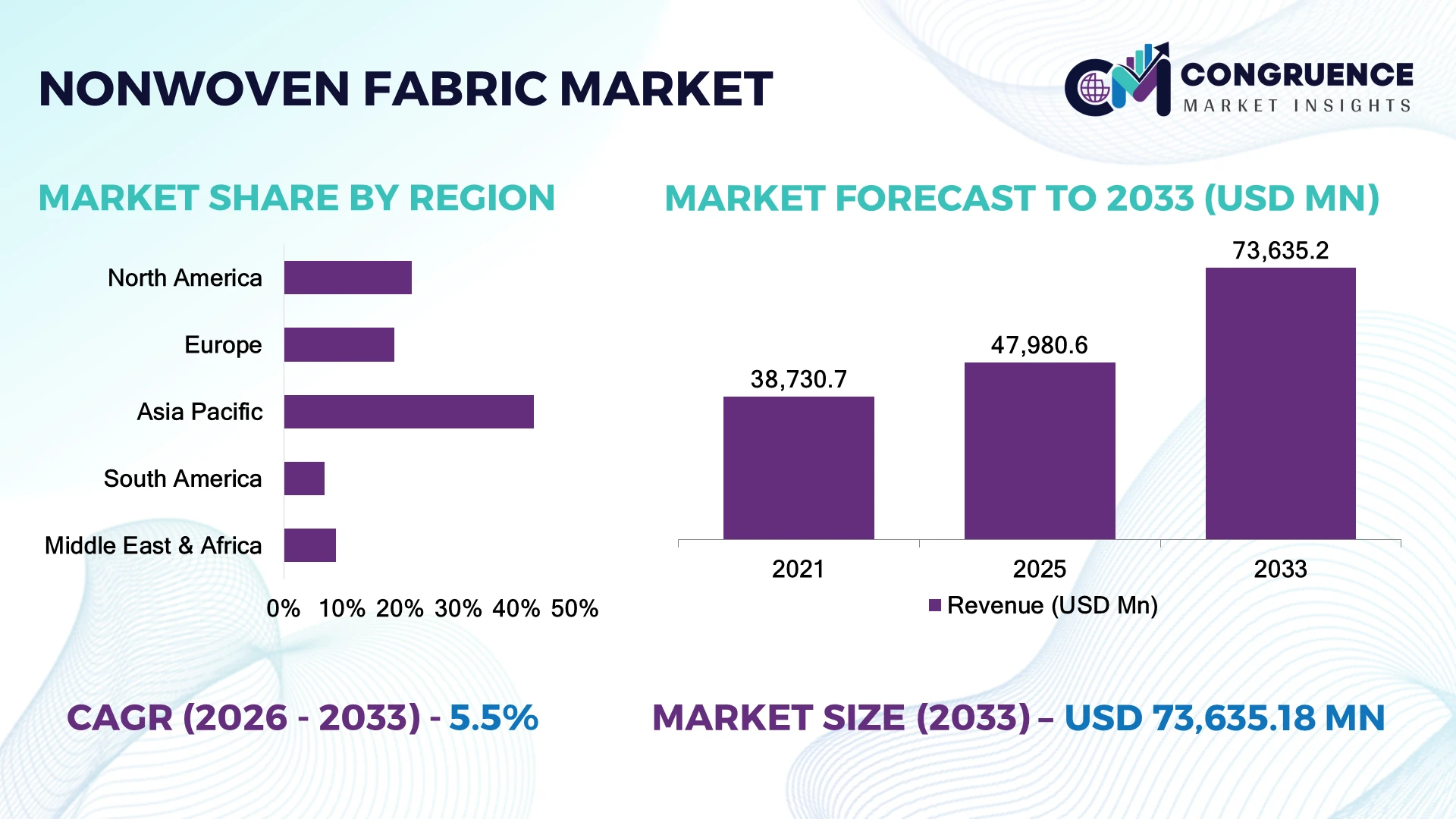
China remains a major manufacturing hub, producing 9.207 million tonnes of nonwoven fabrics in 2025, up 7.5% year-on-year, while surveyed enterprises reported 73.5% capacity utilization. The United States is strengthening domestic supply through capacity investment, including Avgol’s USD 100 million production-line investment completed in 2025. China’s scale favors cost-efficient volume production, whereas North American investments target advanced materials and long-life applications. These developments position production efficiency and specialized product capabilities as critical competitive factors.
Manufacturers should prioritize material-efficient production, differentiated performance, and regionally resilient supply chains rather than competing exclusively on commodity fabric prices.
Market Size & Growth: The market is valued at USD 47.98 billion in 2025 and projected to reach USD 73.64 billion by 2033, supported by hygiene, medical, filtration, and lightweighting applications.
Top Growth Drivers: China’s nonwoven output increased 7.5% in 2025; European building and roofing nonwovens grew 14.2% in 2024; personal-care wipes expanded 4.8% in Europe during 2024.
Short-Term Forecast: By 2028, producers prioritizing downgauging, process automation, and optimized line utilization will be positioned to reduce material consumption and improve output consistency.
Emerging Technologies: Industrial AI, advanced spunbond and meltblown systems, hydroentanglement, and bio-based fibers are expanding opportunities for high-performance nonwoven materials.
Regional Leaders: Indicative 2033 allocations based on regional volume shares imply approximately USD 36.7 billion for Asia-Pacific, USD 15.8 billion for North America, and USD 16.9 billion for Europe.
Consumer/End-User Trends: Hygiene accounted for 27% of European nonwoven deliveries in 2024, sustaining demand for absorbent, skin-compatible, and lightweight materials.
Pilot/Case Example: Advanced spunbond technology has enabled up to 50% lower fabric grammage in selected applications compared with earlier line generations, while maintaining required functionality.
Competitive Landscape: Berry Global, Freudenberg, Fitesa, Toray Industries, and Avgol compete through scale, product engineering, specialized fibers, and customer-linked capacity expansion.
Regulatory & ESG Impact: Recyclability, reduced material consumption, and lower-waste product design are influencing investment decisions, especially for European packaging and disposable-product supply chains.
Investment & Funding: Avgol completed a USD 100 million production-line investment in the United States in 2025, expanding high-speed spunbond and composite-material capabilities.
Innovation & Future Outlook: Through 2033, competitive advantage will increasingly depend on lighter fabrics, application-specific fiber engineering, process automation, and reliable regional supply.
The nonwoven fabric market supplies essential materials for hygiene products, medical disposables, filtration, automotive interiors, construction, and industrial protection. Spunmelt remains important for high-volume hygiene applications, while hydroentangled, needle-punched, and wetlaid materials address specialized performance requirements. In Europe, hygiene represented 27% of deliveries in 2024, while building and roofing materials recorded strong gains. Manufacturers are increasingly balancing high-speed production with downgauging, fiber innovation, and product-specific sustainability requirements, setting the stage for greater differentiation beyond commodity roll goods.
Nonwoven fabrics are becoming strategically important because they combine engineered performance with scalable production across essential consumer and industrial applications. Their role in hygiene, healthcare, filtration, and infrastructure makes material consistency and supply reliability commercially important. At the same time, changing packaging rules, demand for lower-material products, and supply-chain diversification are pushing manufacturers to invest in more efficient production systems and differentiated fiber technologies.
Technology is reshaping manufacturing economics. Advanced spunbond systems can reduce fabric grammage by up to 50% in selected applications compared with earlier generations, lowering polymer use while maintaining functional performance. China’s 2025 nonwoven output reached 9.207 million tonnes, whereas Greater Europe produced approximately 2.919 million tonnes in 2025. The contrast reflects Asia’s manufacturing scale and Europe’s focus on specialized materials, application engineering, and sustainability-driven product development. Regional strategies therefore need to balance volume, customer proximity, and technical differentiation.
During 2026–2028, producers will prioritize line upgrades, automation, bio-based fibers, and process control. Avgol’s USD 100 million U.S. investment illustrates the value of locating capacity near hygiene-product customers, while investments in wetlaid technology are opening opportunities in flushable wipes. Manufacturers should direct capital toward measurable material savings, quality consistency, and specialized end-use performance. The strongest competitive positions will combine production efficiency with customer-specific engineering and supply-chain resilience.
Hygiene products remain a core driver because diapers, feminine-care products, adult incontinence items, and wipes require softness, liquid management, and consistent barrier performance. Hygiene accounted for 27% of European nonwoven deliveries in 2024, equivalent to 797,300 tonnes, while personal-care wipes grew 4.8%. These applications reward manufacturers that can improve fiber fineness and reduce grammage without sacrificing strength or comfort. An aging population and continuing healthcare requirements reinforce demand for reliable disposable materials. Producers are responding with high-speed spunbond lines, composite structures, and application-specific fibers. The strategic opportunity lies in increasing functional value per gram, allowing manufacturers to protect customer relationships even when commodity polymer costs fluctuate.
Polypropylene and polyester price fluctuations directly affect nonwoven conversion margins, particularly for producers selling standardized roll goods under competitive contracts. China’s surveyed nonwoven enterprises reported 73.5% capacity utilization in 2025, while approximately 36% exceeded 80%, indicating that utilization conditions vary considerably across manufacturers. Excess capacity in selected product categories can intensify price competition and weaken the recovery of capital costs. European production also declined 2.2% in 2025, reflecting weaker demand in several end-use markets and increasing external competition. Manufacturers are mitigating these pressures through diversified sourcing, longer-term polymer contracts, energy-efficiency projects, and product-mix optimization. High utilization alone is not sufficient; profitable growth depends on matching line capability to durable customer demand.
Bio-based fibers, advanced hydroentanglement, and application-engineered cellulose materials offer opportunities beyond conventional polypropylene roll goods. In April 2025, ANDRITZ received an order for a wetlaid production line designed for sustainable flushable wipes, with start-up scheduled for the first half of 2027. This investment reflects demand for materials combining tensile strength with dispersibility and improved end-of-life characteristics. Lenzing also announced a EUR 15 million investment in specialized nonwoven fiber capacity at the end of 2025. Such projects create opportunities for producers that can validate performance, scale consistent fiber quality, and collaborate with converters. Companies should prioritize applications where material differentiation supports customer value rather than entering sustainability-led categories without validated product performance.
Nonwoven manufacturers face a technical challenge in balancing lower material use, recycled or bio-based inputs, production speed, and consistent finished-product performance. Reducing grammage can lower raw-material consumption substantially, but inadequate process control can compromise tensile strength, opacity, absorbency, or barrier properties. European nonwoven production declined 2.2% in 2025, and spunmelt output fell 3.3%, demonstrating that technology investments must be matched to market requirements rather than installed capacity alone. Producers also need to qualify alternative fibers on existing equipment and demonstrate compatibility with converting processes. Investment in pilot trials, process analytics, supplier collaboration, and customer validation will be essential to prevent sustainability improvements from creating quality failures or costly line disruptions.
Production Capacity Becomes More Selective: North American nonwoven capacity reached 5.73 million tonnes in 2024, following a second consecutive annual increase exceeding 100,000 tonnes. In 2025, China produced 9.207 million tonnes, up 7.5%. These contrasting conditions highlight the need to distinguish capacity expansion from actual demand. Manufacturers are prioritizing lines that serve defined hygiene, filtration, and long-life product markets instead of adding undifferentiated commodity capacity.
European Product Mix Is Rebalancing: Greater European production declined 2.2% in 2025 to 2.919 million tonnes, while spunmelt output fell 3.3%. Hydroentanglement and needle-punched production recorded modest gains of 0.1% and 0.8%, respectively. The divergence indicates that process selection and end-use exposure matter more than aggregate industry volume. Producers are reviewing product portfolios and redirecting technical resources toward applications with stronger customer-specific performance requirements.
Specialized Fiber Investment Accelerates: Lenzing announced a EUR 15 million investment in specialized nonwoven fiber capacity at the end of 2025, targeting absorbent fibers for feminine hygiene applications. This reflects a shift toward engineered fiber geometry and application-specific performance rather than basic fiber supply. Producers are developing differentiated materials that improve liquid management and converter performance, helping customers secure product advantages in competitive personal-care categories.
Automation Supports Output Consistency: New line-control systems, industrial AI, and upgraded process equipment are becoming important responses to skill shortages and tighter manufacturing tolerances. Reifenhäuser’s RF 5.10 upgrade, introduced in 2026, is designed to raise output by at least 10% while improving nonwoven laydown quality. Such upgrades can improve productivity without requiring a completely new production line. Manufacturers are prioritizing retrofit options that increase output, reduce process variation, and extend the useful life of existing assets.
Spunbond nonwoven fabric is estimated to account for approximately 38% of the global market, supported by continuous-filament production, high throughput, consistent tensile strength, and competitive unit costs. Its established position in diapers, feminine hygiene products, medical disposables, and construction materials enables manufacturers to spread capital costs across large production volumes. Meltblown fabrics remain strategically important for fine-fiber filtration and specialized barrier applications, while needle-punched materials serve automotive interiors, insulation, and geotextiles. Wetlaid and airlaid technologies address applications requiring controlled fiber distribution, absorbency, or specific structural properties. These established technologies retain relevance because performance requirements differ substantially across end uses.
Spunlace, or hydroentangled nonwoven fabric, is positioned as a faster-growing type, supported by demand for premium wipes, personal-care materials, and soft, lint-controlled substrates. Its market share is estimated at approximately 15%, while spunbond holds the larger volume position. Other specialized structures, including composite and bio-based nonwovens, offer additional differentiation. A 2–3 percentage-point increase in spunlace share over the medium term is a plausible scenario rather than a verified forecast. Manufacturers are prioritizing flexible production, fiber blending, and downgauging to improve material efficiency. Investment decisions increasingly favor technologies matched to customer specifications and long-term offtake commitments.
EDANA reported that spunmelt continued to dominate European nonwoven production by surface area in 2024, while average fabric grammage declined to 34.9 gsm from 37.2 gsm in 2019, illustrating the industry's shift toward lighter material structures.
Hygiene is estimated to represent approximately 40% of global nonwoven fabric demand, reflecting continuous consumption in baby diapers, feminine hygiene products, and adult incontinence products. These applications require consistent softness, absorbency, liquid management, and high-speed converting compatibility, supporting large-scale spunbond and composite-fabric production. Medical and healthcare applications are estimated to account for around 15%, supported by surgical gowns, drapes, masks, wound-care materials, and sterilization packaging. Filtration, automotive and transportation, building and construction, agriculture, and other industrial uses provide additional demand diversification. Their specifications vary from fine-particle capture and thermal insulation to mechanical durability and fluid resistance, making application-specific engineering central to supplier selection.
Filtration and medical nonwovens are positioned for faster expansion than several mature commodity applications as air-quality requirements, healthcare capacity, and demand for higher-performance protective materials strengthen. A potential 2–3 percentage-point increase in their combined share over the medium term is an analytical scenario, not a published industry forecast. Building and roofing materials also offer cyclical opportunities; EDANA recorded 14.2% growth in this European application category in 2024. Producers are responding through finer fibers, multilayer structures, validated barrier performance, and automated quality control. Investment is shifting toward application-qualified capacity that supports differentiated pricing and reduces exposure to commodity roll-good competition.
EDANA reported that hygiene accounted for 27% of European nonwoven deliveries in 2024, equivalent to 797,300 tonnes, while building and roofing materials grew 14.2%, demonstrating the coexistence of a large recurring-demand base and expanding construction-related applications.
Personal-care and hygiene product manufacturers are estimated to represent approximately 42% of global nonwoven fabric demand, reflecting the substantial material requirements of diaper, feminine-care, and adult-incontinence production. Their high-speed converting lines require reliable roll quality, stable grammage, controlled absorbency, and consistent delivery schedules. Medical-product manufacturers and healthcare supply companies form another strategically important buyer group, procuring materials that meet application-specific barrier, cleanliness, and sterilization requirements. Automotive suppliers, construction-material producers, filtration companies, agricultural businesses, and industrial converters purchase nonwovens according to distinct mechanical, thermal, filtration, and durability specifications. These differences create separate qualification cycles and pricing structures rather than one interchangeable buyer market.
Medical-product manufacturers are positioned as a faster-growing end-user group as healthcare infrastructure and demand for protective and disposable medical materials expand. A potential 2–3 percentage-point increase in their share over the medium term represents an analytical scenario, not a verified forecast. Established hygiene buyers emphasize long-term supply agreements, high-volume capacity, and cost optimization, whereas medical and filtration customers prioritize performance validation, traceability, and application-specific compliance. Automotive and construction buyers increasingly assess weight reduction, durability, and product-life requirements. Manufacturers are responding through dedicated production lines, technical partnerships, customized fiber structures, and supply agreements with converters. Future competitiveness will depend on qualifying materials for demanding applications while preserving cost efficiency and dependable delivery.
INDA's 2025 North American Nonwovens Supply Report recorded regional capacity of 5.730 million tonnes in 2024 and noted that new production lines were concentrated primarily in long-life sectors, indicating investment beyond traditional disposable-product demand.
Asia-Pacific accounted for the largest market share at 43% in 2025 however, Asia-Pacific is expected to register the fastest growth, expanding at a CAGR of 5.3% between 2026 and 2033.
Capacity Modernization Shifts Investment Toward Specialized Materials
North America represents an estimated 22% of global nonwoven fabric production, supported by established hygiene, healthcare, filtration, automotive, and construction supply chains. The United States dominates regional manufacturing, while Canada and Mexico contribute through industrial applications and cross-border converting networks. Investment is increasingly directed toward long-life products, filtration media, and advanced materials rather than capacity expansion alone. According to INDA, regional production capacity reached 5.730 million tonnes in 2024, following a second consecutive annual increase exceeding 100,000 tonnes. However, the 2026 industry assessment reported operating rates of 78% in 2025, highlighting the importance of matching new equipment with market demand. Producers are prioritizing line upgrades, automation, and customer-linked investments to improve utilization and defend margins against import competition.
United States Market Outlook: The United States benefits from a substantial converting industry, established technical-textile expertise, and strong demand for medical, hygiene, and filtration materials. Domestic production investments support supply reliability and access to specialized substrates. Producers are increasingly targeting long-life applications, where performance requirements and qualification processes create differentiation beyond price. The combination of advanced manufacturing equipment, established customer relationships, and technical service capabilities positions the country as a strategic center for premium nonwoven products and application-specific innovation.
Specialized Production and Material Efficiency Counter Demand Pressure
Europe accounts for an estimated 19% of global nonwoven fabric production, supported by established hygiene, automotive, filtration, construction, and medical-material manufacturers. Germany, Italy, and France provide important industrial and converting capabilities. However, competitive imports and softer demand are pressuring production economics. EDANA reported that Greater European nonwoven production declined 2.2% in 2025 to 2.919 million tonnes. Spunmelt output fell 3.3%, while needle-punched production increased 0.8%, indicating diverging performance between high-volume and specialized technologies. Manufacturers are responding through product differentiation, downgauging, process optimization, and investment in application-specific materials. Capital allocation increasingly favors productivity and customer-qualified products over undifferentiated capacity additions.
Germany Market Outlook: Germany's established automotive, industrial filtration, healthcare, and technical-textile sectors support demand for engineered nonwoven materials. Its manufacturing ecosystem favors suppliers able to meet precise specifications for strength, filtration efficiency, thermal performance, and dimensional consistency. Automotive lightweighting and industrial filtration provide opportunities for specialized substrates, while energy and labor costs place pressure on production efficiency. Manufacturers that combine process automation with application engineering and dependable delivery can strengthen their position among industrial customers seeking reliable, technically qualified materials.
Manufacturing Scale and Domestic Demand Reinforce Regional Leadership
Asia-Pacific represents an estimated 43% of global nonwoven fabric production, supported by extensive polymer processing, hygiene-product manufacturing, medical supplies, construction, and automotive applications. China is the principal production hub, while India, Japan, South Korea, and Southeast Asian economies contribute through domestic consumption and specialized manufacturing. China's Nonwovens and Industrial Textiles Association reported that national nonwoven production reached 9.207 million tonnes in 2025, increasing 7.5% year-on-year. The scale advantage supports cost-efficient supply, but profitability varies by product category and utilization. Producers are expanding higher-performance spunbond, spunlace, and composite capabilities while serving regional converters. Investment priorities increasingly balance high-volume production with specialized materials and closer customer integration.
China Market Outlook: China benefits from an extensive polymer supply chain, large-scale nonwoven production, and established manufacturing links with hygiene, medical, construction, and industrial customers. National nonwoven output reached 9.207 million tonnes in 2025, reflecting the country's manufacturing depth. Domestic producers can leverage scale, supplier proximity, and rapid product customization, while international suppliers compete in specialized filtration and high-performance materials. Manufacturers seeking to expand in China must balance competitive pricing with quality consistency, efficient production, and access to established downstream converters.
Regional Converting Capacity Supports Selective Industrial Expansion
South America represents an estimated 7% of global nonwoven fabric production, with Brazil serving as the principal industrial and consumer market. Demand is supported by hygiene products, healthcare supplies, agricultural applications, automotive components, and construction materials. Local converting operations benefit from access to large consumer markets, while imported machinery and selected specialty inputs remain important to production economics. Market development varies by application: hygiene materials benefit from recurring consumption, whereas geotextiles and construction-related products depend more heavily on infrastructure activity. Producers are focusing on efficient converting, product localization, and distribution partnerships to manage logistics and price sensitivity. Expansion opportunities are strongest where manufacturers can combine regional customer access with reliable input sourcing and consistent product quality.
Brazil Market Outlook: Brazil offers the strongest regional platform for nonwoven fabric manufacturing and conversion through its large consumer base and established hygiene, healthcare, agricultural, and automotive industries. Local producers can respond to customer specifications and delivery requirements more directly than distant suppliers, particularly for high-volume disposable products. Opportunities also exist in agricultural covers, filtration, and construction materials. However, exchange-rate movements, imported equipment costs, and uneven infrastructure investment affect expansion economics. Companies that strengthen local sourcing, technical support, and converter relationships can improve responsiveness and reduce exposure to supply-chain disruptions.
Healthcare Localization and Industrial Diversification Shape Investment
The Middle East & Africa region accounts for an estimated 9% of global nonwoven fabric production, with demand concentrated in hygiene, healthcare, construction, filtration, and industrial applications. Saudi Arabia and the United Arab Emirates are developing manufacturing capabilities as economic-diversification programs encourage local industrial supply, while South Africa remains important for established industrial and healthcare demand. Investment opportunities include medical disposables, hygiene substrates, filtration media, and geotextiles for infrastructure projects. However, local production capacity and downstream converting capabilities vary substantially by country. Producers are evaluating regional manufacturing partnerships, imported technology, and distribution networks to serve customers more efficiently. Long-term competitiveness depends on securing polymer supplies, developing technical skills, and building sufficient demand to support commercially viable production lines.
Saudi Arabia Market Outlook: Saudi Arabia offers an emerging platform for nonwoven fabric manufacturing through industrial diversification, healthcare investment, and demand for locally supplied consumer and infrastructure materials. Development of domestic converting capacity can improve access to hygiene and medical-product manufacturers while reducing dependence on imported finished products. The country's National Industrial Strategy targets increasing industrial exports and strengthening domestic manufacturing capabilities. For nonwoven producers, the commercial opportunity lies in selecting applications with dependable local demand, securing reliable polymer inputs, and establishing technical partnerships that support product qualification and efficient production.
Producers such as Freudenberg, Fitesa, Ahlstrom, Toray, and Magnera compete across hygiene, medical, filtration, and industrial applications; regional manufacturers challenge them on price and delivery. Technology suppliers such as Reifenhäuser and ANDRITZ enable line upgrades and entry into specialized categories. The market remains fragmented: the top five manufacturers are estimated to hold 20–25% combined share, although estimates vary by scope. Buyers compare unit cost, grammage, consistency, converting compatibility, and supply reliability. Downgauging can reduce material use by 5–15%, while Reifenhäuser’s 2026 RF 5.10 upgrade targets at least 10% higher output. Companies compete through capacity additions, fiber innovation, qualification, and converter partnerships. Lenzing prioritizes cellulosic fibers, while Avgol expanded U.S. spunbond and composite capabilities. Competition is shifting toward application-specific materials and efficient retrofits. Entry barriers include capital intensity, qualification requirements, and input sourcing. Winning requires scale, validated performance, and engineering, and customer relationships across multiple end-use markets and supply resilience.
Nonwoven production combines spunbond and meltblown lines with automated web monitoring, process controls, and inline defect detection. These systems stabilize basis weight and reduce off-spec output; gains depend on line age, polymer, and product design. Reifenhäuser’s RF 5.10 upgrade, introduced in 2026, targets 10% higher output and improved web-laydown quality, giving existing-line owners a productivity route without replacing a line.
Hydroentanglement and wetlaid-hybrid technologies expand options for wipes made with pulp and other fibers. ANDRITZ’s Wetlace platform combines wetlaid forming, hydroentanglement, and drying for flushable and conventional wipes. Published equipment specifications include speeds up to 350 metres per minute and capacity up to 30,000 tonnes annually. These are equipment capabilities, not adoption rates. Producers gain flexibility but must validate dispersibility, strength, and converting performance.
Cellulosic fibers, digital process analytics, and upgraded composite lines are shaping investment through 2028. Lenzing’s EUR 15 million fiber expansion targets absorbent fibers for feminine hygiene, while Avgol’s USD 100 million U.S. line added high-loft, spunbond, and lamination capabilities. Adoption remains application-led: hygiene converters prioritize softness and absorbency, filtration buyers emphasize capture performance, and industrial customers require durability. Companies acting can secure qualification and differentiate beyond commodity pricing today.
February 2025 — Avgol opened a U.S. nonwovens line following a USD 100 million investment. The flexible multi-beam line and three-layer lamination capability expand high-loft and spunbond supply for hygiene converters in North Carolina, supporting regional supply for customers. Source: Avgol
December 2025 — Lenzing announced a EUR 15 million expansion of nonwoven-fiber capacity in Austria, focused on trilobal VEOCEL Viscostar fibers for feminine hygiene. The investment strengthens absorbency offerings and supports cellulosic alternatives for premium hygiene product development. Source: Lenzing
May 2026 — ANDRITZ received an order for a Wetlace line for Dalian Ruiguang, taking its annual capacity to 40,000 tonnes. The line targets biodegradable flushable wipes and strengthens a technology partnership, with startup scheduled for year-end 2026. Source: ANDRITZ
June 2026 — Reifenhäuser introduced the RF 5.10 upgrade, targeting at least 10% higher output and improved web-laydown quality. The retrofit offers existing spunbond producers productivity gains for production platforms and improved plant utilization in existing plants. Source: reifenhauser.com
The report evaluates the global nonwoven fabric market by type, including spunbond, meltblown, spunlace, needle-punched, airlaid, wetlaid, and composite structures. Application coverage includes hygiene, medical and healthcare, filtration, automotive, construction, agriculture, and industrial uses. End-user analysis examines hygiene-product manufacturers, healthcare suppliers, automotive and construction companies, filtration businesses, and industrial converters. Geographic coverage spans North America, Europe, Asia-Pacific, South America, and the Middle East & Africa, with country-level analysis of production capacity, industrial demand, supply chains, and manufacturing investment.
Technology assessment covers high-speed spunmelt production, hydroentanglement, wetlaid systems, advanced fiber engineering, inline quality monitoring, downgauging, and cellulosic alternatives. Competitive analysis compares global producers, regional suppliers, and equipment technology providers, including their capacity strategies and product differentiation. The report supports investment planning, market-entry assessment, capacity expansion, customer targeting, and competitive positioning between 2026 and 2033. It also evaluates niche opportunities in flushable wipes, filtration media, specialized hygiene fibers, and sustainable nonwoven materials, helping decision-makers distinguish scalable demand from application-specific opportunities.
| Report Attribute/Metric | Report Details |
|---|---|
|
Market Revenue in 2025 |
USD 47,980.6 Million |
|
Market Revenue in 2033 |
USD 73,635.2 Million |
|
CAGR (2026 - 2033) |
5.5% |
|
Base Year |
2025 |
|
Forecast Period |
2026 - 2033 |
|
Historic Period |
2021 - 2025 |
|
Segments Covered |
By Type
By Application
By End-User
|
|
Key Report Deliverable |
Revenue Forecast, Growth Trends, Market Dynamics, Segmental Overview, Regional and Country-wise Analysis, Competition Landscape |
|
Region Covered |
North America, Europe, Asia-Pacific, South America, Middle East, Africa |
|
Key Players Analyzed |
Freudenberg Performance Materials, Fitesa, Ahlstrom, Magnera, Toray Industries, Kimberly-Clark, DuPont, Suominen, Johns Manville, Avgol, Asahi Kasei, Mitsui Chemicals, Fibertex Nonwovens |
|
Customization & Pricing |
Available on Request (10% Customization is Free) |




