
Reports
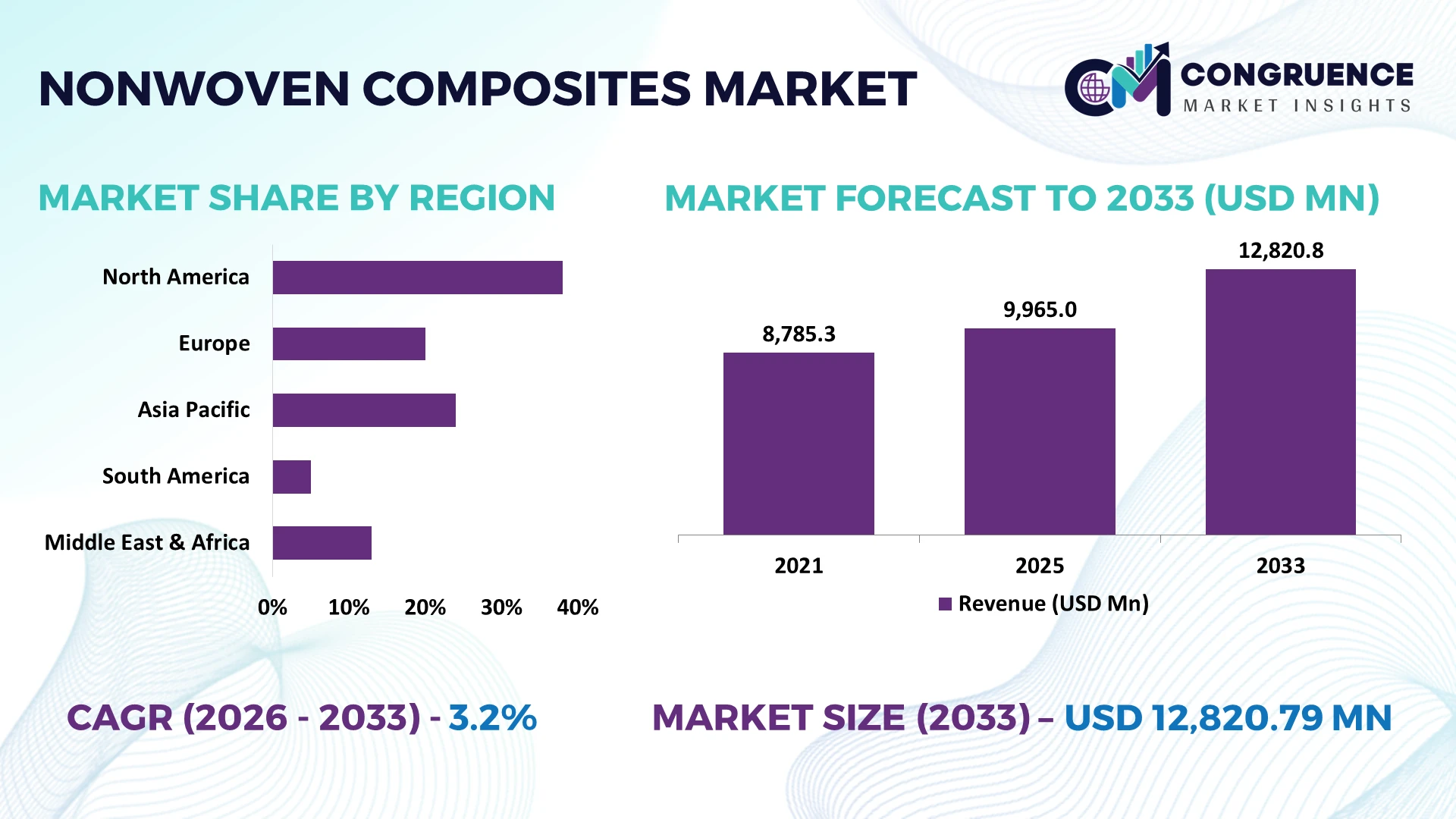
The Global Nonwoven Composites Market was valued at USD 9965 Million in 2025 and is anticipated to reach a value of USD 12820.79 Million by 2033 expanding at a CAGR of 3.2% between 2026 and 2033. Growth is driven by the replacement of heavier glass-fiber and metal components with lightweight nonwoven composite structures in automotive interiors, construction insulation, filtration, and industrial applications, supported by automated thermoforming and recycled-fiber processing.
China remains the dominant country, accounting for approximately 31% of global nonwoven composite production capacity, supported by automotive, construction, filtration, and battery-related manufacturing. Chinese manufacturers are increasing automated production and recycled-fiber integration, with recycled-content adoption approaching 20% in selected applications. Germany follows with about 9% capacity, while the U.S. maintains stronger high-performance aerospace and automotive applications.
Strategic decisions should prioritize China-linked supply chains while targeting higher-value recycled, lightweight, and engineered composite applications in Europe and North America.
Market Size & Growth: USD 9.97 billion in 2025 is projected toward USD 12.82 billion by 2033 at a 3.2% CAGR, supported by lightweight material substitution and automated composite processing.
Top Growth Drivers: Automotive lightweighting 31%, construction insulation 24%, and filtration applications 18% represent the leading demand drivers.
Short-Term Forecast: By 2028, automated forming and digital process control are positioned to reduce production costs by 7% and improve manufacturing efficiency by 10%.
Emerging Technologies: AI-enabled process monitoring, automated fiber placement, and recycled thermoplastic reinforcement are accelerating advanced nonwoven composite development.
Regional Leaders: Asia-Pacific is projected near USD 6.2 billion, Europe around USD 3.1 billion, and North America approximately USD 2.4 billion, with automation and recycled-material adoption rising across all three regions.
Consumer/End-User Trends: Lightweight vehicle-component adoption is increasing, with nonwoven composite use in selected automotive interior applications approaching 25%.
Pilot/Case Example: In 2024, lightweight automotive composite programs delivered approximately 12% component-weight reduction while maintaining structural performance.
Competitive Landscape: China leads production capacity at about 31%, with major competition from Freudenberg, Johns Manville, Owens Corning, Toray Industries, and SGL Carbon.
Regulatory & ESG Impact: European circular-material policies are pushing recycled-content integration, with selected manufacturers targeting 20% or more recycled fiber in composite formulations.
Investment & Funding: More than USD 1.5 billion in announced capacity expansion and technology investments is supporting automation, recycling, and regional supply-chain diversification.
Innovation & Future Outlook: Next-generation thermoplastic composites, bio-based fibers, AI quality control, and closed-loop recycling are shifting competition toward lower-carbon, higher-performance material platforms.
The Nonwoven Composites Market is gaining traction across automotive lightweighting, building materials, filtration media, transportation, and industrial reinforcement, where manufacturers increasingly prioritize weight reduction and recyclable material content. Recycled-fiber integration is reaching approximately 20% in selected commercial applications, while supply-chain diversification following global logistics disruptions is strengthening regional production strategies. These shifts are directing investment toward advanced processing, material efficiency, and higher-value engineered composite solutions.
Nonwoven composites are becoming strategically important as automakers, infrastructure suppliers, and industrial manufacturers replace heavier materials with lightweight, formable structures. The shift improves material efficiency while supporting carbon-reduction targets. Supply-chain restructuring is also encouraging localized fiber conversion and composite production, particularly as manufacturers seek shorter lead times and greater control over recycled feedstock availability.
Technology adoption is reshaping cost structures. Automated thermoforming and digital process monitoring can reduce cycle times by approximately 15% compared with conventional manual forming, while improving material utilization by 8–10%. China maintains the largest production scale, whereas Germany and the United States emphasize higher-value automotive, aerospace, and engineered applications. Over the next 2–3 years, automated lines and recycled-fiber processing are expected to expand across major manufacturing hubs.
A practical deployment example is automotive door-panel and interior-component production, where nonwoven composites can deliver weight reductions of 10–15% without major redesign of existing assembly processes. Companies are directing investment toward automated equipment, recycled-material partnerships, and localized manufacturing. Competitive positioning will increasingly depend on combining material performance, processing efficiency, circularity, and supply-chain resilience rather than competing on material cost alone.
Automotive lightweighting is the strongest structural driver, with nonwoven composite penetration in selected interior and trim applications approaching 25%. Material-weight reductions of 10–15% support vehicle efficiency targets while enabling component consolidation. In Germany, automakers and Tier-1 suppliers are increasing thermoplastic composite integration as vehicle platforms become more modular. The shift from multi-material assemblies toward molded nonwoven structures reduces joining requirements and manufacturing complexity. Companies are responding through automated thermoforming investments, recycled-fiber partnerships, and application-specific material development. The non-obvious advantage is faster component redesign: manufacturers can combine reinforcement and surface functions within fewer layers, improving assembly productivity while supporting increasingly stringent vehicle sustainability requirements.
Raw-material volatility remains a structural constraint, particularly where synthetic fibers, specialty binders, and reinforcement inputs account for substantial production costs. Feedstock fluctuations of 8–12% can pressure margins for manufacturers operating under fixed-price contracts. European producers also face higher energy-intensive processing costs than several Asian manufacturing hubs, affecting competitiveness in commodity-grade applications. Supply disruptions involving specialty fibers can further extend procurement cycles by 10% or more. Companies are reducing exposure through dual sourcing, localized fiber conversion, longer-term procurement contracts, and increased recycled-content utilization. A key operational insight is that scale alone does not eliminate cost pressure; integrated feedstock-to-composite production increasingly provides stronger margin protection.
Recycled-fiber and thermoplastic composite platforms offer a high-value opportunity as manufacturers combine lightweighting with circular-material objectives. Recycled content in selected nonwoven composite applications is approaching 20%, while automated processing can improve material utilization by approximately 8–10%. China is emerging as a particularly important manufacturing base because automotive, appliance, and construction supply chains can absorb recycled composite output at scale. European producers are additionally benefiting from circular-material requirements that encourage traceable recycled inputs. Companies are expanding R&D, partnering with recyclers, and developing closed-loop material systems. The strategic opportunity lies beyond substitution: integrated recyclable structures can reduce component count, simplify end-of-life processing, and strengthen supplier differentiation.
Scaling advanced nonwoven composites across diverse production environments remains difficult because fiber orientation, resin distribution, forming temperature, and surface quality require tightly controlled process parameters. Production variability of 5–8% can emerge when automated lines process mixed recycled feedstocks, creating quality-consistency pressure for automotive and industrial suppliers. In the United States, high-performance applications also demand stringent validation before qualification. Companies are investing in machine vision, digital process monitoring, automated material handling, and workforce training to stabilize production. The deeper challenge is interoperability between material formulations and existing manufacturing equipment. Suppliers that standardize process data and develop equipment-compatible material platforms will gain a stronger advantage in multi-site deployment and long-term customer retention.
Automated Forming Gains Ground: Automated thermoforming and robotic handling are reducing cycle times by 10–15% and material waste by 6–9%, as manufacturers in China and Germany replace labor-intensive workflows. Suppliers are scaling integrated forming lines to improve throughput and address skilled-labor constraints.
Recycled Feedstock Integration Accelerates: Recycled-fiber content is approaching 20% in selected composite applications, while closed-loop processing is reducing virgin-material dependence by 8–12%. European end-of-life vehicle policy discussions are strengthening traceability requirements, prompting suppliers to establish recycler partnerships and localized feedstock networks.
Automotive Mix Shifts Toward Lightweighting: Electrification is increasing attention on mass-efficient interior and structural components. EU battery-electric vehicles reached 17.4% of new-car registrations in 2025, up from 13.6%, strengthening lightweight-material qualification programs. Composite suppliers are expanding thermoplastic and fiber-based product portfolios for EV platforms.
Wind Components Scale Rapidly: Global wind-turbine installations increased 23% in 2025, while mechanically installed capacity rose 40%, intensifying demand for lightweight, durable composite structures. Chinese OEM expansion is accelerating material localization, while suppliers are developing higher-performance reinforcement systems to support larger turbine architectures.
Glass fiber remains the leading type, accounting for approximately 48% of demand because of its favorable strength-to-cost ratio, mature processing infrastructure, and compatibility with automotive, construction, and industrial applications. Carbon fiber represents about 17%, concentrated in aerospace and premium lightweight structures where performance outweighs material cost. Aramid fiber holds roughly 10%, supported by impact and thermal resistance requirements, while natural fiber approaches 25% across selected automotive interiors and sustainable construction applications.
Natural fiber is the fastest-shifting segment, with adoption in targeted applications increasing approximately 8–10% as manufacturers pursue lower embodied-carbon materials and localized feedstocks. Glass fiber remains the volume anchor, but investment is moving toward hybrid structures combining natural or carbon reinforcement with thermoplastic matrices. Companies are expanding formulation partnerships and application-specific production rather than treating fiber categories as interchangeable commodities.
Automotive Components lead applications at approximately 42% share, supported by high-volume interior panels, headliners, trunk liners, underbody structures, and acoustic components. Construction Materials account for nearly 24%, while Aerospace Components represent about 13%, reflecting higher qualification requirements but stronger performance economics. Sports Equipment contributes approximately 9%, with Wind Turbine Components near 12% and gaining importance as blade structures become larger.
Wind Turbine Components are the fastest-growing application, with deployment momentum supporting approximately 10–12% annual expansion in selected composite-component programs. Global wind turbine installations increased 23% in 2025, reinforcing demand for lightweight reinforcement and durable structural materials. Companies are expanding automated layup, reinforcement integration, and OEM partnerships, while automotive suppliers are prioritizing scalable high-volume forming platforms.
Automotive is the dominant end-user, representing approximately 43% of demand because of large production volumes and intensive requirements for lightweight interiors, acoustic insulation, trim, and structural components. Construction contributes around 23%, while Aerospace & Defense accounts for nearly 14% and maintains premium demand for high-performance reinforcement. Wind Energy represents about 12%, with Sports & Recreation near 8%.
Wind Energy is the fastest-expanding end-user, with composite-material deployment increasing approximately 10–12% in active turbine-component programs as larger turbines require greater structural efficiency. Global turbine installations increased 23% during 2025, strengthening the downstream case for advanced reinforcement materials. Companies are responding through customized material grades, OEM partnerships, localized production, and automated processing. The strategic shift is toward application-specific composite platforms rather than standardized material supply.
Asia-Pacific accounted for the largest market share at 42% in 2025 however, Asia-Pacific is expected to register the fastest growth, expanding at a CAGR of 4.1% between 2026 and 2033.
EV lightweighting and automated composite processing strengthen industrial demand
North America represents approximately 24% of global Nonwoven Composites Market activity, supported by automotive, aerospace, construction, and advanced filtration manufacturing. The United States concentrates most regional production and high-performance applications, particularly where lightweight thermoplastic structures replace conventional materials. Automotive suppliers are increasing automated forming and digital quality inspection, with selected production lines achieving 8–12% higher throughput. Aerospace qualification programs are also strengthening demand for higher-performance fiber architectures. Companies are prioritizing domestic sourcing, long-term fiber contracts, and partnerships with material developers to reduce exposure to imported specialty feedstocks. The strategic shift toward EV platforms is encouraging suppliers to redesign interior and underbody components around weight-efficient composite structures, creating stronger opportunities for customized materials and automated processing.
United States Market Outlook: The United States remains the regional technology and manufacturing anchor, supported by established automotive and aerospace supply chains. More than 15% of selected advanced composite development programs increasingly emphasize recycled or lower-weight material solutions, encouraging domestic producers to expand automated production and application-specific engineering capabilities.
Circular-material requirements accelerate higher-value composite integration
Europe accounts for approximately 21% of global market activity, with Germany, France, Italy, and the United Kingdom forming major industrial clusters. Germany maintains strong automotive integration, while France and Italy support aerospace, transportation, and industrial applications. European manufacturers are increasingly aligning nonwoven composite production with circular-material requirements, pushing recycled-fiber utilization toward 20% in selected applications. Automated thermoforming and digitally monitored production are improving process consistency by approximately 8–10%. Companies are responding through recycler partnerships, localized feedstock procurement, and hybrid-fiber product development. Regulatory pressure is changing purchasing criteria: suppliers increasingly compete on traceability, recyclability, and component weight alongside conventional performance metrics. This favors technologically capable producers able to integrate material engineering with compliant, lower-waste manufacturing systems.
Germany Market Outlook: Germany remains Europe’s strongest industrial base for nonwoven composites because of its dense automotive supplier network and advanced processing infrastructure. Approximately 30% of selected automotive composite development activity is concentrated around lightweight interior, acoustic, and structural applications, supporting investment in automated forming and recyclable thermoplastic systems.
Manufacturing scale and localized supply chains reinforce market leadership
Asia-Pacific holds approximately 42% of global Nonwoven Composites Market activity, led by China, Japan, South Korea, and India. China provides the largest manufacturing base, supported by automotive, construction, electronics, filtration, and industrial production. Regional manufacturers benefit from large-volume fiber processing and integrated conversion networks, enabling production-cost advantages of roughly 10–15% versus smaller-scale facilities. Chinese suppliers are expanding recycled-fiber processing and automated forming to serve domestic OEMs and export markets. India is strengthening automotive and infrastructure applications, while Japan and South Korea emphasize precision materials and advanced manufacturing. Companies are increasingly localizing feedstock, forming, and finishing within integrated industrial clusters. The non-obvious advantage is supply-chain responsiveness: integrated Asian production allows faster formulation changes and shorter qualification-to-volume cycles.
China Market Outlook: China is the dominant country in the regional market, accounting for roughly 31% of global production capacity. Its automotive and construction manufacturing base supports large-volume composite conversion, while expanding automated lines and recycled-material processing are improving production flexibility and strengthening export competitiveness.
Automotive localization and infrastructure modernization create selective demand
South America represents approximately 7% of global Nonwoven Composites Market activity, with Brazil accounting for the majority of regional consumption and manufacturing. Automotive production, construction materials, filtration, and agricultural equipment provide the strongest demand channels. Brazil’s established vehicle manufacturing network supports nonwoven composite integration in interior components, insulation, and acoustic systems, while infrastructure modernization is creating additional applications. Local manufacturers increasingly use automated cutting and forming, improving throughput by approximately 6–9% compared with labor-intensive workflows. However, imported specialty fibers and equipment remain important, increasing procurement exposure and extending qualification cycles. Companies are responding through local conversion partnerships, multi-year procurement contracts, and regional manufacturing alliances. The strongest strategic opportunity lies in converting locally available natural fibers into engineered composite products rather than competing directly with Asian commodity-scale suppliers.
Brazil Market Outlook: Brazil remains the region’s principal industrial market because of its automotive manufacturing concentration and established construction supply chain. Natural-fiber composite adoption in selected automotive and building applications is approaching 15%, encouraging domestic processors to develop locally sourced reinforcement and lower-cost composite formulations.
Infrastructure investment drives engineered-material adoption
Middle East & Africa contributes approximately 6% of global Nonwoven Composites Market activity, with the United Arab Emirates, Saudi Arabia, South Africa, and Turkey serving important industrial demand centers. Construction, transportation, filtration, infrastructure modernization, and industrial equipment are supporting adoption. Large-scale urban development programs in Gulf economies are increasing requirements for lightweight insulation, durable reinforcement, and high-performance building materials. Selected automated composite-processing projects are delivering productivity improvements of approximately 8–10%. Companies are forming regional distribution partnerships and establishing localized finishing capabilities to shorten project lead times. The region remains more dependent on imported specialty fibers than China or Germany, creating a strategic opening for local conversion and technical service providers. Suppliers combining engineering support with reliable regional inventories are gaining stronger project access.
Saudi Arabia Market Outlook: Saudi Arabia offers the strongest industrial expansion opportunity in the region through infrastructure modernization and manufacturing diversification. Construction and transportation projects increasingly incorporate advanced lightweight materials, while localized industrial investment is supporting composite-processing capacity and reducing dependence on imported finished components.
The Nonwoven Composites Market pits global material specialists such as Freudenberg, Johns Manville, Owens Corning, Toray Industries, and SGL Carbon against regional processors competing on cost, localized supply, and application customization. The top five players collectively command approximately 28% of the market, leaving substantial space for specialized suppliers. Competition increasingly centers on material performance, production consistency, recycled-content integration, and supply reliability. Advanced producers can achieve 8–12% higher processing efficiency through automation, while localized manufacturers target 10–15% cost advantages through integrated feedstock and conversion operations. Freudenberg and Johns Manville emphasize engineered nonwovens and industrial applications, whereas Asian producers increasingly compete through scale and faster delivery. Partnerships with automotive and aerospace OEMs are becoming critical, alongside vertical integration into fiber preparation. High qualification requirements remain a major entry barrier. Winning requires scalable technology, dependable feedstock, rapid customization, and proven OEM integration.
Freudenberg SE
Johns Manville
Owens Corning
Toray Industries, Inc.
SGL Carbon SE
DuPont de Nemours, Inc.
Ahlstrom
Berry Global Group, Inc.
Hollingsworth & Vose Company
TWE Group
Fibertex Nonwovens
Autoneum Holding AG
J.H. Ziegler GmbH
Fitesa S.A.
Automation, precision thermoforming, and integrated quality inspection are becoming core technologies, replacing labor-intensive forming with digitally controlled production. Automated processing can improve throughput by 8–12% and reduce material waste by 6–9%, while adoption is strongest among automotive and industrial suppliers. By 2026–2028, AI-assisted inspection and process monitoring will strengthen consistency, particularly for high-volume composite components requiring tighter dimensional control and faster qualification cycles.
Advanced thermoplastic matrices, recycled-fiber reinforcement, and adhesive-free multilayer bonding are emerging as important technology pathways. New lightweight nonwoven systems can deliver 20% lower component weight than conventional materials, while selected recycled-fiber technologies incorporate up to 70% recycled content. Adhesive-free coating processes can reduce material utilization by 28% and manufacturing costs by up to 34% versus conventional adhesive systems. Technology leaders with integrated material-processing capabilities gain the strongest competitive advantage.
Disruptive development is shifting toward mono-material composites, closed-loop recycling, and multifunctional structures combining acoustic, thermal, mechanical, and protective performance. Autoneum's PET-based systems demonstrate up to 50% lower component weight than equivalent plastic parts, while new composite battery protection systems integrate thermal insulation and impact resistance. During 2026–2028, companies investing now in recyclable thermoplastics, automated forming, and digital quality control will secure faster production cycles, lower conversion costs, and stronger OEM qualification positions.
February 2025 Avgol opened a high-speed nonwovens line after a USD 100 million investment, adding a three-layer lamination system for nonwoven composites. The expansion strengthens lightweight composite capacity and automated quality control at its North Carolina facility. Source: indoramaventures.com
February 2025 Autoneum completed its acquisition of 70% of Jiangsu Huanyu Group, strengthening Chinese production access and OEM relationships. The transaction expands localized manufacturing and supports Autoneum’s Asia strategy, targeting 20% of group activity in Asia over the medium term. Source: autoneum.com
May 2025 Autoneum introduced E-Fiber flame shields for EV batteries, delivering heat resistance up to 1,400°C with lightweight composite construction. The technology has entered pre-development with European customers, strengthening non-mica thermal protection for battery systems. Source: autoneum.com
November 2025 Freudenberg agreed to acquire Toray’s remaining 25% stake in Japan Vilene Company for approximately EUR 100 million. The transaction gives Freudenberg full ownership of a nonwoven producer operating 15 production sites globally, strengthening technical-textile and filtration capabilities. Source: freudenberg.com
The Nonwoven Composites Market Report covers four major types: Glass Fiber, Carbon Fiber, Natural Fiber, and Aramid Fiber, alongside Automotive Components, Construction Materials, Aerospace Components, Wind Turbine Components, and Sports Equipment applications. End-user analysis spans Automotive, Aerospace & Defense, Construction, Wind Energy, and Sports & Recreation, enabling comparison of mature high-volume demand with emerging engineered-material applications.
Geographic coverage includes North America, Europe, Asia-Pacific, South America, and Middle East & Africa, with country-level analysis emphasizing China, the United States, Germany, Brazil, and Saudi Arabia. Technology assessment covers automated forming, thermoplastic matrices, recycled-fiber reinforcement, digital inspection, adhesive-free bonding, and closed-loop recycling. The report supports investment planning, capacity localization, partnership decisions, competitive positioning, and technology prioritization across 2026–2033, while identifying adoption patterns and application-specific opportunities.
| Report Attribute/Metric | Report Details |
|---|---|
Market Revenue in 2025 | USD 9965 Million |
Market Revenue in 2033 | USD 12820.79 Million |
CAGR (2026 - 2033) | 3.2% |
Base Year | 2025 |
Forecast Period | 2026 - 2033 |
Historic Period | 2021 - 2025 |
Segments Covered | By Type
By Application
By End-User
|
Key Report Deliverable | Revenue Forecast, Growth Trends, Market Dynamics, Segmental Overview, Regional and Country-wise Analysis, Competition Landscape |
Region Covered | North America, Europe, Asia-Pacific, South America, Middle East, Africa |
Key Players Analyzed | Freudenberg SE, Johns Manville, Owens Corning, Toray Industries, Inc., SGL Carbon SE, DuPont de Nemours, Inc., Ahlstrom, Berry Global Group, Inc., Hollingsworth & Vose Company, TWE Group, Fibertex Nonwovens, Autoneum Holding AG, J.H. Ziegler GmbH, Fitesa S.A. |
Customization & Pricing | Available on Request (10% Customization is Free) |




