
Reports
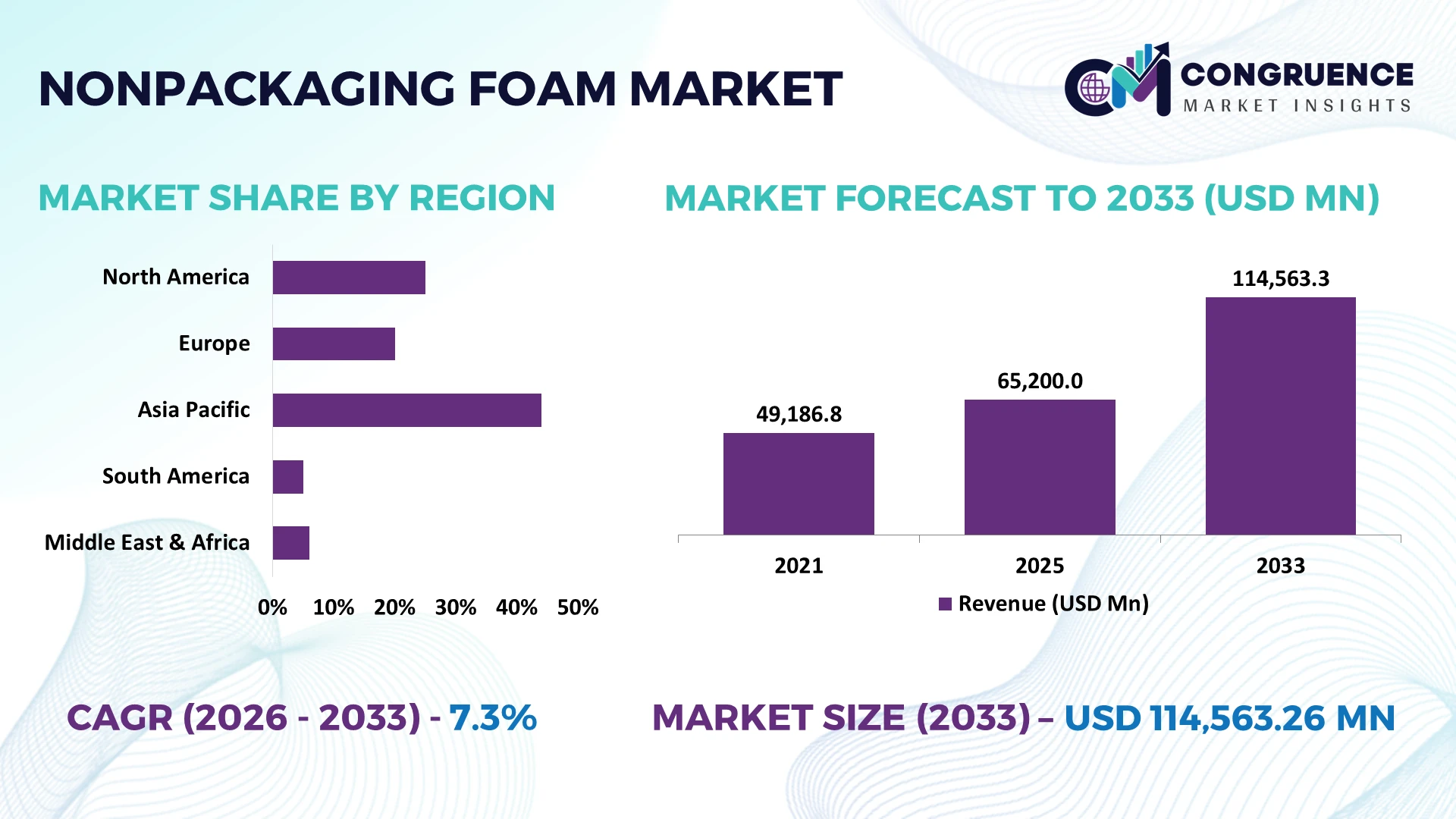
The Global Nonpackaging Foam Market was valued at USD 65200 Million in 2025 and is anticipated to reach a value of USD 114563.26 Million by 2033 expanding at a CAGR of 7.3% between 2026 and 2033. Growth is driven by automotive lightweighting, energy-efficient building insulation, polyurethane cushioning applications, and increasing adoption of engineered acoustic and thermal insulation materials.
China remains a dominant manufacturing hub for nonpackaging foam, supported by its automotive, furniture, construction, and appliance industries. The country produced approximately 31.28 million vehicles in 2024, compared with India's approximately 6 million vehicles, demonstrating China's substantially larger automotive materials consumption base. China's industrial infrastructure supports polyurethane, polyethylene, and expanded polystyrene foam processing, while investments in electric vehicles and building insulation reinforce demand for advanced formulations. China's evolving energy-efficiency requirements also encourage improvements in foam thermal performance and production technologies.
Manufacturers prioritizing localized chemical sourcing, low-emission formulations, and high-performance foam conversion are positioned to strengthen supply reliability and access higher-value industrial applications.
Market Size & Growth: USD 65,200 million in 2025, projected to reach USD 114,563.26 million by 2033, with 7.3% CAGR, supported by automotive lightweighting and advanced building insulation.
Top Growth Drivers: Automotive weight reduction, improved building thermal efficiency, and demand for durable furniture cushioning underpin expansion across 3 major application categories.
Short-Term Forecast: Through 2028, manufacturers are prioritizing lower-density formulations and improved production yields across 2 critical performance indicators: material consumption and processing efficiency.
Emerging Technologies: AI-assisted formulation optimization, automated foam dispensing, and bio-based polyurethane chemistry represent 3 important innovation pathways.
Regional Leaders: Asia-Pacific, North America, and Europe constitute 3 principal industrial markets, emphasizing automotive foam components, construction insulation, and recyclable cushioning materials, respectively.
Consumer/End-User Trends: Demand spans 4 major application groups: furniture and bedding, transportation, construction, and industrial acoustic insulation.
Pilot/Case Example: In 2024, BASF's biomass-balanced polyurethane portfolio demonstrated a commercial pathway for replacing fossil-based feedstock through certified mass-balance production.
Competitive Landscape: BASF, Dow, Covestro, Huntsman, and Carpenter compete across 5 major areas: formulation technology, supply integration, product performance, sustainability, and customer qualification.
Regulatory & ESG Impact: The European Union's revised Energy Performance of Buildings Directive, adopted in 2024, establishes zero-emission requirements for new public buildings from 2028.
Investment & Funding: Capital deployment increasingly targets 3 priorities: regional manufacturing capacity, automated foam conversion, and circular polyurethane processing.
Innovation & Future Outlook: Next-generation nonpackaging foams emphasize 3 strategic capabilities: enhanced insulation performance, reduced material density, and improved chemical recyclability.
The global nonpackaging foam industry is evolving through specialized material development and changing manufacturing requirements. Flexible polyurethane foam supports mattresses, seating, and automotive interiors, while rigid polyurethane and polystyrene foams provide thermal insulation for buildings and refrigeration equipment. Advanced developments include low-VOC formulations, bio-based polyols, and automated mixing systems that improve processing consistency. The European Union's building-efficiency framework establishes a 2028 milestone for zero-emission new public buildings, strengthening the importance of insulation performance. Meanwhile, localized chemical supply chains and circular material processing are reshaping procurement priorities, creating strategic opportunities for integrated foam manufacturers and specialty formulation suppliers.
Nonpackaging foam is becoming strategically important as automotive manufacturers, construction companies, and furniture producers prioritize material efficiency, thermal performance, and supply-chain resilience. Polyurethane, polyethylene, and polystyrene foam technologies support lightweight vehicle components, energy-efficient buildings, and industrial cushioning applications. Transportation electrification is accelerating material substitution, with electric vehicles accounting for more than 20% of global car sales in 2024. Manufacturers are restructuring procurement around regional polyol production, specialty chemical availability, and lower-emission formulations to protect manufacturing continuity.
Technology differentiation increasingly determines supplier competitiveness. Closed-cell polyurethane insulation can achieve thermal conductivity of approximately 0.022–0.028 W/m·K, compared with 0.035–0.040 W/m·K for conventional expanded polystyrene, delivering superior insulation performance at comparable thickness. China benefits from extensive foam conversion capacity and automotive manufacturing scale, while Germany emphasizes precision-engineered acoustic insulation, automotive seating, and recyclable polyurethane systems. These differences influence supplier qualification, production economics, and product development priorities.
During 2026–2028, manufacturers are expected to accelerate automated dispensing, digital density monitoring, and alternative polyol integration. Automotive seating suppliers already use robotic polyurethane dispensing to maintain consistent component geometry and reduce manual processing variability. Companies including BASF, Covestro, and Huntsman are advancing specialty formulations and circular material technologies. Competitive advantage will increasingly depend on application-specific performance, reliable chemical sourcing, and scalable production efficiency.
Automotive electrification and stricter building-efficiency requirements are strengthening demand for engineered nonpackaging foams. Electric vehicles represented more than 20% of worldwide car sales in 2024, increasing requirements for lightweight seating, acoustic insulation, and battery-adjacent thermal management components. Polyurethane foam densities of approximately 25–60 kg/m³ support cushioning applications, while rigid insulation formulations achieve thermal conductivity near 0.022–0.028 W/m·K. Germany's building decarbonization policies and automotive engineering investments reinforce demand for higher-performance materials. BASF, Covestro, and Huntsman are developing advanced polyurethane systems, low-emission formulations, and specialized automotive materials. Suppliers combining lightweight structural performance with consistent thermal properties secure stronger positions in vehicle platforms and construction specifications.
Nonpackaging foam production remains exposed to petrochemical feedstock volatility, particularly propylene oxide, toluene diisocyanate, and methylene diphenyl diisocyanate. Polyurethane formulations commonly contain approximately 40–70% polyol components by formulation weight, creating substantial sensitivity to upstream chemical availability. India's dependence on imported specialty intermediates increases exposure to international freight disruptions and currency movements. European REACH requirements also restrict industrial handling of diisocyanates, with training obligations applying to products containing concentrations of 0.1% or more. These constraints increase compliance expenses, procurement complexity, and inventory requirements. Manufacturers are responding through diversified sourcing, longer-term chemical contracts, and localized blending operations. Securing qualified feedstock alternatives is becoming essential for protecting production margins and maintaining reliable delivery schedules.
Chemical recycling and alternative polyol technologies are creating opportunities for higher-value nonpackaging foam applications. Germany is emerging as an innovation center, with Covestro developing carbon dioxide-based polyols containing up to 20% CO₂ as an alternative feedstock component. Its smart pyrolysis technology produces recycled aniline with approximately 99% purity, enabling integration into conventional polyurethane chemical production. A planned 2,000-ton annual recycling pilot, scheduled for 2028, targets rigid insulation waste from buildings and appliances. Covestro and Fraunhofer UMSICHT are advancing industrial validation, while Indian research partnerships explore polyurethane waste upcycling. Manufacturers integrating recovered feedstocks with existing foam production systems can differentiate products through material circularity, reduced fossil dependence, and specialized procurement agreements.
Scaling polyurethane recycling from controlled pilot environments to commercially consistent production presents substantial technical challenges. European mattress disposal generates approximately 300,000 metric tons of polyurethane foam annually, with only 17% recycled, primarily into lower-value applications. Approximately 33% undergoes incineration, while 50% enters landfills, illustrating deficiencies in collection, sorting, and recovery infrastructure. Germany's emerging chemical recycling facilities must manage mixed foam formulations, additives, contamination, and variable feedstock composition without compromising recovered polyol quality. Evonik's hydrolysis development in Hanau demonstrates progress toward recovering reusable chemical components. Manufacturers must establish standardized waste classification, reliable collection partnerships, and industrial purification systems. Consistent recycled-material specifications will determine whether circular foam production achieves commercial scalability and sustained customer acceptance.
Low-Emission Foam Formulations Gain Traction: Furniture and bedding manufacturers are transitioning toward low-VOC polyurethane formulations to meet indoor air quality and product certification requirements. CertiPUR-US limits total VOC emissions to 0.5 mg/m³ and formaldehyde emissions to 0.1 mg/m³. Producers are refining catalyst chemistry, optimizing curing cycles, and strengthening emission testing. This shift improves access to premium mattress procurement programs while increasing the importance of formulation consistency and documented product compliance.
Digital Foam Conversion Improves Precision: Automated cutting, robotic dispensing, and inline density measurement are reshaping foam fabrication workflows. CNC cutting systems support dimensional tolerances approaching ±1 mm, while digital formulation controls regulate 2 critical parameters: component mixing ratios and dispensing temperatures. Automotive component suppliers are integrating machine vision and programmable dosing to reduce scrap, stabilize production quality, and improve repeatability across complex seating geometries. Digital traceability also simplifies customer qualification and production audits.
Specialized Thermal Materials Replace Conventional Grades: Manufacturers are introducing graphite-enhanced polystyrene and advanced rigid insulation panels for thickness-constrained applications. Graphite-enhanced EPS commonly achieves thermal conductivity around 0.030–0.032 W/m·K, compared with approximately 0.035–0.040 W/m·K for conventional white EPS. Insulation converters are expanding premium product portfolios to deliver equivalent thermal resistance with thinner assemblies, improving installation flexibility and material utilization in dense urban construction.
Localized Foam Fabrication Reshapes Procurement: Furniture producers and automotive suppliers are increasingly positioning foam conversion near assembly operations to reduce transportation inefficiencies. Flexible polyurethane foam commonly operates within a 20–60 kg/m³ density range, making shipping volume an important logistics consideration. Local cutting, contouring, and just-in-time deliveries reduce finished-component storage requirements. Manufacturers are responding through satellite conversion facilities, regional fabrication partnerships, and tighter production scheduling linked to customer assembly volumes.
Polyurethane Foam represents the leading material category in the global nonpackaging foam market, supported by extensive utilization in mattresses, upholstered furniture, automotive seating, and thermal insulation. Its flexible and rigid formulations provide manufacturers with differentiated cushioning, load-bearing, and insulation characteristics. In India's broader foam industry, polyurethane accounted for approximately 54.8% of material-type demand in 2025, demonstrating its established industrial position. Polystyrene Foam remains important for building insulation because of its dimensional stability and competitive processing economics. Polyethylene Foam serves industrial cushioning and acoustic applications, supported by chemical resistance and closed-cell structures.
Polypropylene Foam is positioned for accelerated adoption in lightweight transportation components, benefiting from recyclable thermoplastic processing and favorable energy absorption characteristics. EVA Foam supports sports and recreation products through flexibility and impact resistance, while Rubber Foam remains relevant for vibration damping and specialized insulation. Manufacturers are increasing investment in expanded polypropylene molding, precision foam extrusion, and differentiated polyurethane formulations. Material selection is increasingly determined by application-specific performance rather than standardized density specifications.
Furniture and Bedding represents the largest application category in the global nonpackaging foam market, supported by recurring mattress replacement, upholstered furniture production, and demand for differentiated comfort materials. In India's flexible slab-stock polyurethane foam industry, furniture and mattress applications accounted for approximately 72% of demand during FY2025, illustrating the importance of cushioning-intensive manufacturing. Producers increasingly differentiate products through variable-density construction, pressure-distribution characteristics, and improved compression recovery. Automotive Interiors represents another established application, particularly for molded seating, headrests, and vibration isolation components. Industrial Cushioning supports machinery protection and impact absorption, while Sports and Recreation applications emphasize flexible, lightweight materials.
Building Insulation is positioned for accelerated adoption as construction companies strengthen thermal performance specifications and adopt more efficient building envelopes. Polystyrene and rigid polyurethane foam manufacturers are developing insulation boards with improved dimensional stability and reduced thermal conductivity. Acoustic Insulation is also gaining importance in commercial buildings and transportation equipment. Manufacturers are expanding application-specific product lines, integrating automated fabrication, and strengthening relationships with construction contractors and automotive component suppliers.
Furniture Manufacturers constitute a major purchasing group within the global nonpackaging foam industry, supported by large-scale mattress manufacturing, upholstered seating production, and standardized cushioning requirements. In India's flexible slab-stock polyurethane foam market, furniture and mattresses represented approximately 72% of demand in FY2025, demonstrating concentrated purchasing activity. Manufacturers prioritize consistent foam density, compression resistance, and reliable delivery schedules to support continuous production. Automotive Manufacturers represent another strategically important customer group, requiring precision-molded seating materials and acoustic components. India's flexible molded polyurethane foam market recorded approximately 81% of demand from automotive seating applications during FY2025, highlighting the industry's dependence on specialized foam conversion.
Construction Companies are positioned for stronger adoption as building projects prioritize thermal insulation performance and energy-efficient materials. Industrial Equipment Manufacturers procure engineered foam for vibration control, equipment cushioning, and machinery insulation, while Sports and Leisure Product Manufacturers emphasize impact absorption and lightweight construction. Suppliers are strengthening technical collaboration with original equipment manufacturers, expanding customized foam production, and developing application-specific supply agreements. Competitive positioning increasingly depends on customer qualification, material consistency, and production integration.
Asia-Pacific accounted for the largest market share at approximately 43% in 2025 however, Asia-Pacific is expected to register the fastest growth, expanding at a CAGR of approximately 8.5% between 2026 and 2033.
Advanced Foam Manufacturing and Automotive Material Integration
North America represents an established nonpackaging foam manufacturing center, supported by automotive production, engineered insulation, furniture manufacturing, and specialized polyurethane processing. The region accounts for an estimated 25% of global market demand, with the United States contributing the largest proportion. Automotive manufacturers increasingly specify molded polyurethane components for seating comfort, acoustic management, and lightweight interior assemblies. Mexico's expanding vehicle assembly infrastructure strengthens cross-border demand for precision-cut cushioning and molded foam components. In construction, updated energy codes encourage greater use of rigid polyurethane and polystyrene insulation systems. Dow and Huntsman maintain significant regional polyurethane technology and chemical manufacturing operations, supporting downstream foam converters. The United States produced approximately 10.6 million motor vehicles in 2024, reinforcing industrial demand for automotive interior materials. Regional suppliers prioritize automated conversion, formulation consistency, and shorter delivery cycles to improve competitiveness.
United States Market Outlook: The United States benefits from integrated petrochemical manufacturing, established polyurethane processing capabilities, and large furniture and construction industries. Huntsman's polyurethane operations and Dow's materials portfolio support domestic access to specialized chemical formulations. The Department of Energy's building-efficiency initiatives encourage improved thermal insulation performance, while American automotive suppliers increasingly integrate precision-molded foam into vehicle interiors. Approximately 4.1 million single-family homes were sold in 2024, including existing properties, supporting replacement and renovation activity relevant to insulation and furnishing materials.
Regulatory Modernization Accelerates High-Performance Material Adoption
Europe accounts for an estimated 21% of global nonpackaging foam demand, with Germany, France, Italy, and Poland supporting significant automotive, furniture, and insulation manufacturing activity. European producers increasingly differentiate foam products through thermal performance, emission compliance, and material traceability. The revised Energy Performance of Buildings Directive establishes zero-emission requirements for new public buildings from 2028 and all new buildings from 2030, reinforcing demand for effective insulation materials. Automotive suppliers are developing specialized polyurethane seating systems and acoustic components for electric vehicles, while mattress manufacturers emphasize certified low-emission cushioning formulations. Covestro and BASF are advancing alternative chemical feedstocks and application-specific polyurethane technologies. The region's established chemical infrastructure supports specialty material development, although high energy costs encourage manufacturers to improve processing efficiency and prioritize higher-value foam applications over commodity-grade production.
Germany Market Outlook: Germany combines advanced chemical manufacturing with automotive engineering and industrial insulation expertise. Approximately 4.1 million passenger cars were manufactured domestically in 2024, sustaining demand for seating foam, acoustic components, and lightweight interior materials. Covestro's Leverkusen operations and BASF's Ludwigshafen chemical complex provide important polyurethane innovation and production capabilities. German manufacturers increasingly prioritize low-emission formulations, material recovery technologies, and precise component engineering to meet demanding industrial specifications.
Large-Scale Manufacturing and Integrated Foam Supply Chains
Asia-Pacific dominates global nonpackaging foam consumption, supported by concentrated automotive production, furniture manufacturing, residential construction, and integrated petrochemical infrastructure. China, India, Japan, and South Korea provide substantial manufacturing capacity for flexible polyurethane, expanded polystyrene, and engineered thermoplastic foams. China's extensive appliance and automotive manufacturing ecosystem enables high-volume foam conversion, while India's expanding mattress industry supports demand for differentiated cushioning materials. Japan maintains specialized expertise in automotive acoustic insulation and precision-molded foam components. Regional manufacturers benefit from proximity to chemical intermediates, established component suppliers, and large domestic industrial customers. China's automobile production reached approximately 31.28 million units in 2024, reinforcing its manufacturing advantage. Companies including Wanhua Chemical and INOAC are strengthening material innovation, production integration, and application-specific foam technologies to improve processing efficiency and maintain competitive supply capabilities.
China Market Outlook: China maintains a strong competitive position through integrated polyurethane chemical manufacturing, large-scale furniture production, and extensive automotive component supply networks. Wanhua Chemical's domestic manufacturing infrastructure supports access to isocyanates and specialized polyurethane formulations. China's electric vehicle industry recorded more than 11 million electric car sales in 2024, strengthening demand for lightweight interior components and specialized acoustic materials. Domestic foam converters increasingly emphasize automated molding, customized formulations, and closer integration with vehicle assembly operations.
Furniture Manufacturing and Automotive Localization Strengthen Demand
South America's nonpackaging foam industry is concentrated in Brazil and Argentina, where furniture manufacturing, vehicle assembly, industrial equipment production, and construction applications support material consumption. Brazil provides the region's strongest manufacturing base, particularly for flexible polyurethane cushioning and molded automotive components. Argentina maintains established mattress and upholstered furniture production, although currency volatility and imported chemical dependency influence procurement strategies. Brazilian vehicle production reached approximately 2.55 million units in 2024, sustaining demand for seating systems, interior insulation, and vibration-damping materials. Foam converters increasingly emphasize local processing, efficient slab-stock cutting, and customized product specifications. Regional expansion remains constrained by chemical feedstock logistics and uneven manufacturing infrastructure. Producers are strengthening domestic supplier relationships and optimizing inventory management to improve delivery reliability, reduce imported finished-component dependence, and support industrial customers.
Brazil Market Outlook: Brazil benefits from established furniture manufacturing clusters in Rio Grande do Sul and Santa Catarina, alongside automotive production centers in São Paulo and Minas Gerais. The country's industrial infrastructure supports flexible polyurethane foam processing for mattresses, upholstered seating, and automotive interiors. Brazil's automotive industry recorded approximately 14% production growth in 2024, reinforcing demand for molded seating materials. Domestic converters are investing in specialized fabrication, supplier integration, and more efficient material utilization to strengthen local competitiveness.
Construction Investment and Industrial Diversification Reshape Demand
The Middle East & Africa nonpackaging foam market is influenced by infrastructure development, commercial construction, furniture manufacturing, and industrial insulation requirements. Saudi Arabia and the United Arab Emirates are strengthening demand for rigid polyurethane and polystyrene insulation through large-scale building projects and energy-efficiency initiatives. South Africa maintains established automotive manufacturing and furniture production capabilities, supporting flexible cushioning and engineered acoustic materials. Saudi Arabia's Vision 2030 industrial diversification program encourages local manufacturing and downstream petrochemical processing, creating opportunities for foam conversion businesses. Regional manufacturers are increasingly evaluating localized production, thermal insulation partnerships, and specialized industrial applications. However, uneven technical capabilities and dependence on imported processing equipment influence manufacturing economics. Suppliers combining regional chemical access with reliable fabrication and installation networks are better positioned to serve construction and industrial customers.
Saudi Arabia Market Outlook: Saudi Arabia offers strategic advantages through domestic petrochemical infrastructure, industrial diversification, and construction investment. SABIC's chemical manufacturing capabilities support downstream polymer and specialty material development. The Saudi Building Code establishes thermal insulation requirements that influence material selection for building envelopes and cooling efficiency. Major developments associated with Vision 2030 are encouraging suppliers to expand local insulation fabrication and technical services. Manufacturers prioritizing thermal performance, installation efficiency, and regional production partnerships are positioned to strengthen their presence in construction-related foam applications.
The global nonpackaging foam market features competition between integrated chemical leaders BASF, Dow, Covestro, Huntsman, and Wanhua Chemical and specialized converters including Carpenter and INOAC. The five chemical leaders collectively influence an estimated 30–35% of upstream polyurethane supply, although downstream foam fabrication remains fragmented. Integrated producers compete through feedstock security, formulation technology, and manufacturing scale, while converters differentiate through customization, delivery speed, and application engineering. Advanced rigid polyurethane insulation achieves approximately 20–35% lower thermal conductivity than conventional expanded polystyrene, supporting premium product positioning. Automated foam cutting targets material utilization improvements of 5–10%, strengthening converter economics. BASF and Covestro emphasize alternative polyols, Huntsman develops specialized polyurethane systems, and Wanhua expands integrated chemical production. Increasing localization and customer qualification requirements intensify competitive pressure. Capital-intensive isocyanate production, formulation expertise, and certification requirements restrict entry. Winning requires reliable chemical access, consistent material performance, efficient conversion, and established industrial customer relationships.
BASF SE
Dow Inc.
Covestro AG
Huntsman Corporation
Wanhua Chemical Group Co., Ltd.
Carpenter Co.
INOAC Corporation
Recticel NV
Armacell International S.A.
Rogers Corporation
JSP Corporation
Kaneka Corporation
Woodbridge Foam Corporation
Zotefoams plc
Polyurethane processing increasingly combines high-pressure mixing, robotic dispensing, and inline density measurement to stabilize foam quality. Modern metering systems regulate component ratios and temperature, reducing manual adjustment during automotive seating production. Closed-cell rigid polyurethane insulation achieves thermal conductivity around 0.022–0.028 W/m·K, compared with 0.035–0.040 W/m·K for conventional expanded polystyrene, representing approximately 30% lower conductivity at typical specification points. Insulation suppliers benefit through thinner assemblies and improved thermal resistance.
Emerging technologies focus on bio-based polyols, carbon dioxide-derived feedstocks, and recyclable thermoplastic foams. Covestro's carbon dioxide-based polyol technology incorporates up to 20% CO₂ in relevant polyol formulations, replacing part of the conventional fossil-derived input. Expanded polypropylene molding supports lightweight automotive components, while advanced cross-linked polyethylene foams improve dimensional stability and cushioning consistency. Producers are integrating formulation simulation with automated quality inspection to shorten qualification cycles and improve traceability.
Between 2026 and 2028, chemical recycling and digital manufacturing will reshape investment priorities. Germany's polyurethane recycling initiatives target recovery of usable chemical intermediates from post-consumer insulation waste, while converters expand sensor-equipped cutting and dispensing lines. Companies with integrated chemical expertise and validated recycled-feedstock specifications gain procurement advantages. Smaller fabricators can compete through precise customization, lower scrap rates, and localized delivery rather than commodity-scale production alone.
March 2025 – BASF introduced biomass-balanced Elastoflex polyurethane foam systems for North American furniture manufacturers, offering potential product carbon footprint reductions of up to 75% versus conventional formulations. REDcert2 certification strengthens sustainable material procurement and supports lower-emission cushioning production. Source: basf.com.
February 2025 – Woodbridge and TM Automotive Seating Systems inaugurated their Pune joint venture manufacturing facility, covering 45,413 square feet and employing nearly 80 workers. The investment strengthens localized molded foam production and automotive seating supply capabilities in India. Source: woodbridgegroup.com.
September 2025 – Zotefoams announced a £6.8 million investment over three years to establish advanced innovation capabilities, including a global research hub in Croydon and a footwear innovation center in South Korea, accelerating specialized foam development and customer collaboration. Source: zotefoams.com.
June 2025 – Armacell inaugurated its Pune manufacturing facility for ArmaGel XG insulation products, doubling available aerogel blanket production capacity. The expansion supports industrial insulation applications operating between −196°C and +650°C, strengthening specialized thermal material supply for international customers. Source: armacell.com.
The Nonpackaging Foam Market Report evaluates industry structure, manufacturing developments, and competitive opportunities across 2026–2033. Segmentation covers six material types: Polyurethane Foam, Polystyrene Foam, Polyethylene Foam, Polypropylene Foam, EVA Foam, and Rubber Foam. Application analysis examines Furniture and Bedding, Automotive Interiors, Building Insulation, Industrial Cushioning, Sports and Recreation, and Acoustic Insulation. Five end-user categories are assessed through procurement requirements, material performance, and industrial deployment patterns.
Geographic coverage includes North America, Europe, Asia-Pacific, South America, and the Middle East & Africa, with country-level analysis of manufacturing concentration and industrial investment. Technology coverage addresses automated foam conversion, advanced insulation chemistry, low-emission formulations, and material recycling. Competitive benchmarking examines 14 influential manufacturers and suppliers, supporting capacity planning, product diversification, supply-chain localization, and investment decisions in specialized foam applications.
| Report Attribute/Metric | Report Details |
|---|---|
Market Revenue in 2025 | USD 65200 Million |
Market Revenue in 2033 | USD 114563.26 Million |
CAGR (2026 - 2033) | 7.3% |
Base Year | 2025 |
Forecast Period | 2026 - 2033 |
Historic Period | 2021 - 2025 |
Segments Covered | By Type
By Application
By End-User
|
Key Report Deliverable | Revenue Forecast, Growth Trends, Market Dynamics, Segmental Overview, Regional and Country-wise Analysis, Competition Landscape |
Region Covered | North America, Europe, Asia-Pacific, South America, Middle East, Africa |
Key Players Analyzed | BASF SE, Dow Inc., Covestro AG, Huntsman Corporation, Wanhua Chemical Group Co., Ltd., Carpenter Co., INOAC Corporation, Recticel NV, Armacell International S.A., Rogers Corporation, JSP Corporation, Kaneka Corporation, Woodbridge Foam Corporation, Zotefoams plc |
Customization & Pricing | Available on Request (10% Customization is Free) |




