
Reports
The Global Non-woven Abrasives Market was valued at USD 2,724.8 Million in 2025 and is anticipated to reach a value of USD 4,150.1 Million by 2033 expanding at a CAGR of 5.4% between 2026 and 2033. Growth is being driven by automated surface finishing, lightweight-metal fabrication, tighter automotive coating specifications, and increasing replacement of conventional abrasive wheels in controlled finishing operations.
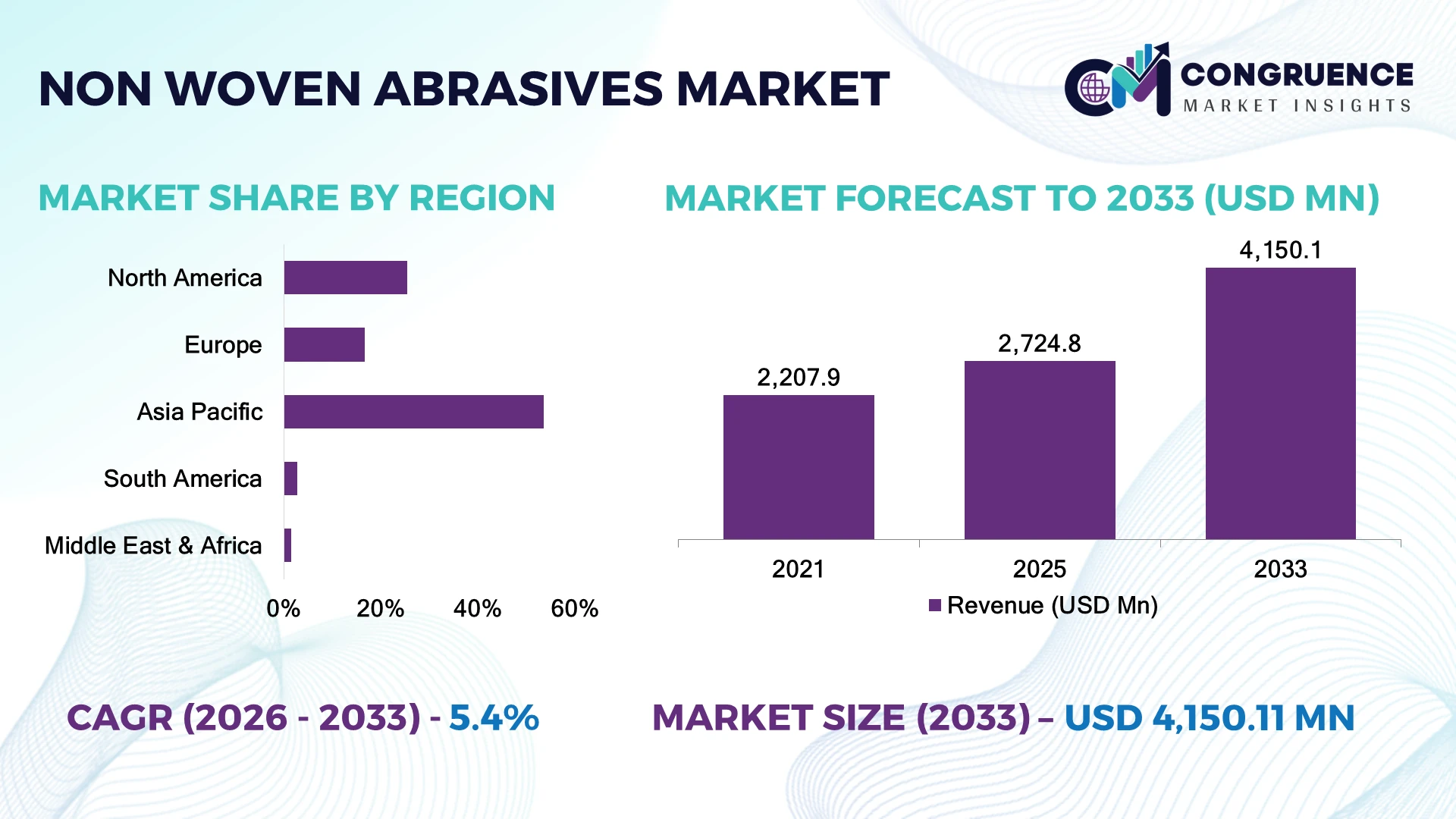
The United States remains the dominant country, representing approximately 25% of global non-woven abrasive consumption, supported by automotive, aerospace, metal fabrication, and industrial maintenance. Germany follows at roughly 9%, with strong automated finishing adoption, while China represents about 18% and benefits from large-scale automotive and machinery production. U.S. manufacturers increasingly integrate robotic finishing cells, with automation penetration in high-volume applications exceeding 30%, compared with substantially lower adoption among fragmented fabricators.
Suppliers that combine consistent abrasive performance with robotic-compatible formats, application-specific engineering, and localized converting capacity are best positioned to capture premium industrial demand.
Market Size & Growth: USD 2.72 billion in 2025 to USD 4.15 billion by 2033 at 5.4%, supported by automated finishing and replacement of rigid abrasives.
Top Growth Drivers: Automotive finishing 31%, metal fabrication 24%, and industrial maintenance 18% represent the strongest demand drivers.
Short-Term Forecast: By 2028, automated finishing can reduce consumable-related process costs by 6–9% and improve finishing productivity by 8–12%.
Emerging Technologies: Robotic finishing, precision abrasive grain distribution, AI-assisted process monitoring, and advanced fiber substrates are improving consistency.
Regional Leaders: Asia-Pacific approaches USD 1.55 billion by 2033, North America approximately USD 1.05 billion, and Europe about USD 950 million.
Consumer/End-User Trends: Industrial metalworking accounts for approximately 42% of demand, while automotive applications increasingly favor automated surface preparation.
Pilot/Case Example: Robotic abrasive finishing cells can deliver approximately 15–20% higher process consistency than manual finishing in repetitive metal-component operations.
Competitive Landscape: 3M leads premium industrial applications at roughly 15% share, competing with Saint-Gobain, PFERD, Klingspor, and Sia Abrasives.
Regulatory & ESG Impact: Lightweight non-woven formats can reduce abrasive waste by approximately 10–20% versus heavier conventional finishing products in suitable applications.
Investment & Funding: Industrial automation investment is shifting toward robotic finishing cells, with individual integrated production deployments increasingly exceeding USD 1 million.
Innovation & Future Outlook: Next-generation products are moving toward longer-life abrasive webs, automated pressure control, recyclable substrates, and application-specific finishing systems.
The Non-woven Abrasives Market is concentrated in automotive paint preparation, stainless-steel finishing, weld blending, aerospace components, and general metal fabrication. Fine-grit and surface-conditioning products increasingly account for premium applications, while robotic-compatible discs and wheels are gaining adoption. Automated finishing already exceeds 30% penetration in selected high-volume applications. Tight labor availability and greater process standardization are accelerating the transition from manual abrasive selection toward engineered finishing systems.
Non-woven abrasives are becoming strategically important because manufacturers increasingly link surface finishing with throughput, coating quality, labor utilization, and rejection rates rather than treating abrasives as low-value consumables. Automotive and aerospace producers are tightening surface-finish tolerances while expanding automated cells, creating demand for products that deliver predictable cut rates throughout their operating life. This shift is particularly relevant as manufacturers in the United States, Germany, Japan, and China modernize metal-processing operations.
Compared with conventional rigid wheels, engineered non-woven products can reduce aggressive material removal while improving surface uniformity, with optimized automated applications delivering approximately 8–12% higher finishing productivity and 6–9% lower process costs. North America leads high-value automated applications, Europe emphasizes precision finishing and sustainability, while China and other Asian manufacturing centers benefit from large production volumes.
During 2026–2028, adoption will increasingly move toward robotic-compatible discs, wheels, belts, and convolute products integrated with pressure and speed controls. A practical deployment is robotic weld blending on automotive and fabricated-metal components, where consistent abrasive contact reduces operator variability. Suppliers are responding through application engineering, customized grain structures, automated-cell partnerships, and localized converting. Competitive advantage will increasingly depend on lifecycle productivity rather than abrasive unit price alone.
Automotive and metal-fabrication plants are shifting repetitive finishing from manual labor toward robotic cells, increasing demand for predictable non-woven abrasive performance. Automated finishing already exceeds 30% penetration in selected high-volume applications, while optimized abrasive systems can improve productivity by 8–12% and reduce operator variability by 15–20%. Germany and the United States are leading adoption where labor costs and tighter surface specifications justify automation. Manufacturers are responding with robotic-compatible discs, convolute wheels, controlled-density webs, and application-specific grain structures. The strategic advantage is consistency rather than simple cutting speed: suppliers that engineer abrasives around robotic pressure, RPM, and tool geometry gain qualification advantages and recurring consumable demand.
Non-woven abrasive economics remain exposed to fluctuations in synthetic fiber, resin, mineral grain, and energy costs. Raw-material inputs can represent roughly 45–55% of manufacturing cost, while energy-intensive curing and converting can contribute another 10–15%. European producers face additional pressure from higher industrial energy costs and tighter chemical-management requirements. Smaller manufacturers have less purchasing leverage and are more exposed to short-term input-price movements, creating margin compression when customer contracts are fixed. Leading suppliers are responding through multi-source procurement, regional inventory buffers, resin reformulation, and longer supplier agreements. A non-obvious constraint is specification lock-in: changing backing or binder chemistry can trigger customer requalification even when the substitute lowers cost, limiting rapid material substitution.
The expansion of robotic finishing creates a high-value opportunity for abrasives engineered around automated toolpaths rather than generic manual applications. Robotic-compatible products can improve process productivity by 10–15%, while controlled-density structures can extend usable abrasive life by approximately 15–20% in repetitive finishing operations. Japan and Germany offer particularly attractive opportunities because automotive and precision-metal producers increasingly integrate automated surface treatment. Manufacturers are developing sensor-compatible finishing tools, application-specific grain blends, and digitally optimized abrasive specifications. Another underpenetrated opportunity is aerospace component refurbishment, where controlled surface preparation can reduce rework. Suppliers that combine abrasive products with process engineering and automation integrator partnerships can capture higher-margin recurring demand instead of competing solely on consumable price.
Scaling non-woven abrasive adoption across automated production lines requires consistent performance across changing pressure, RPM, contact angles, and component geometries. Variations of 5–10% in abrasive density or contact pressure can materially alter cut rate and surface finish, while automated cells require repeatable tool-change and calibration procedures. Labor shortages are also increasing dependence on operators capable of programming robotic finishing systems and interpreting process data. U.S. and German manufacturers are therefore demanding application validation before broad deployment. Suppliers must invest in application laboratories, robotic-cell testing, digital process monitoring, and technical training. The long-term challenge is not abrasive availability but maintaining identical surface outcomes across high-mix automated lines, making process engineering and application-specific qualification critical competitive capabilities.
Robotic Finishing Becomes Standardized: Automated surface-finishing deployments are expanding in automotive and fabricated-metal plants, with selected high-volume operations exceeding 30% automation penetration. Robotic cells can deliver 8–12% higher productivity and 15–20% greater consistency than manual processes. Abrasive manufacturers are redesigning discs and wheels for controlled pressure and programmed toolpaths.
Fine-Finish Products Gain Premium Demand: Automotive paint preparation, stainless-steel finishing, and aerospace components are shifting toward finer surface-conditioning grades. Fine-finishing applications now represent roughly 25–30% of premium product demand, while optimized products can reduce visible surface defects by 10–15%. Suppliers are increasing fine-grit and multi-layer product ranges rather than relying on conventional coarse formats.
Binder Engineering Improves Product Life: Advanced resin systems and controlled-density fiber structures are extending abrasive service life by approximately 15–20% in repetitive operations. This reduces tool-change frequency and improves cell utilization. U.S. and European manufacturers are increasingly qualifying products on total cost per finished component, encouraging suppliers to invest in longer-life formulations.
Localized Converting Gains Importance: Supply-chain disruption and shorter customer lead-time requirements are encouraging regional converting and inventory hubs. Localized finishing operations can shorten delivery cycles by 20–30% compared with cross-border supply in selected markets. Producers are expanding regional warehousing, dual-source raw materials, and application-support teams to protect automotive and industrial accounts from logistics interruptions.
Non-woven abrasive discs represented approximately 32% of the market in 2025, retaining leadership because of broad compatibility with angle grinders, orbital tools, and automated finishing equipment. Their balance of conformability, consistent surface conditioning, and relatively low tool-change requirements supports widespread adoption for deburring, blending, and paint preparation. Non-woven wheels accounted for about 24%, while belts, hand pads, and rolls collectively represented the remaining demand across specialized finishing operations. Discs also benefit from scalable converting and multiple density and grit configurations, keeping procurement costs competitive.
Non-woven wheels are emerging as the fastest-growing type, supported by robotic weld blending and automated edge finishing where consistent contact geometry is important. Adoption in automated cells is increasing, with robotic-compatible formats capable of reducing process variability by roughly 15–20%. Companies are expanding precision-density wheels, longer-life fiber structures, and application-specific grain formulations. Investment is shifting from commodity hand-use products toward engineered discs and wheels that improve productivity by approximately 8–12%, strengthening recurring consumable demand and application-engineering opportunities.
The International Federation of Robotics reported that U.S. automotive manufacturers installed 13,700 industrial robots in 2024, a 10.7% increase, reinforcing the equipment base supporting automated abrasive-finishing applications.
Deburring accounted for approximately 29% of non-woven abrasive demand in 2025, supported by extensive use across machined metal components, castings, welded assemblies, and automotive parts. The application benefits from non-woven abrasives’ ability to remove burrs while limiting aggressive dimensional change. Surface blending and finishing followed at roughly 26%, with strong penetration in stainless steel, aluminum, and coated components. Cleaning and paint preparation remain important mature applications, particularly where consistent surface conditioning is required before coating or bonding.
Surface blending and precision finishing represent the fastest-expanding application group, driven by tighter cosmetic specifications and greater automation. Automated finishing can improve repeatability by approximately 15–20%, while optimized abrasive selection can reduce consumable-related process costs by 6–9%. Manufacturers are responding with finer abrasive grades, controlled-density constructions, and robotic-compatible discs and wheels. Automotive component suppliers are increasingly integrating abrasive operations into programmed production cells, while aerospace and precision-machining users prioritize repeatable surface profiles. The business implication is a shift toward application-specific consumables rather than interchangeable general-purpose products.
OICA reported that global vehicle production reached 96.4 million units in 2025, up 3.9% year over year, supporting sustained demand for automated deburring and finishing processes.
Automotive manufacturers represented approximately 36% of non-woven abrasive consumption in 2025, making them the largest end-user because of high production volumes, extensive metal-component processing, and repeated requirements for deburring, blending, and coating preparation. Metal fabrication followed at around 27%, supported by welding, stainless-steel finishing, and general component preparation. Industrial machinery and general manufacturing maintain significant demand, particularly for maintenance and precision surface conditioning where flexible abrasives offer better control than rigid grinding products.
Aerospace is emerging as the fastest-growing end-user, supported by increased aircraft production, advanced materials, and stringent surface-quality requirements. Aerospace users can command approximately 10–15% higher abrasive value per application than conventional fabrication customers because of tighter process validation and material-specific specifications. Suppliers are responding through customized grain structures, qualification support, technical partnerships, and dedicated aerospace product ranges. Automotive demand remains volume-led, whereas aerospace demand is increasingly specification-led. This distinction is shifting investment toward premium, traceable, longer-life abrasives capable of maintaining consistent results across titanium, aluminum, composites, and high-value precision components.
The Aerospace Industries Association reported that U.S. aerospace and defense generated $988.6 billion in sales in 2025, with capital expenditure reaching $45 billion, supporting production modernization and capacity expansion.
Asia-Pacific accounted for the largest market share at 53.6% in 2025 however, Asia-Pacific is expected to register the fastest growth, expanding at a CAGR of 6.1% between 2026 and 2033.
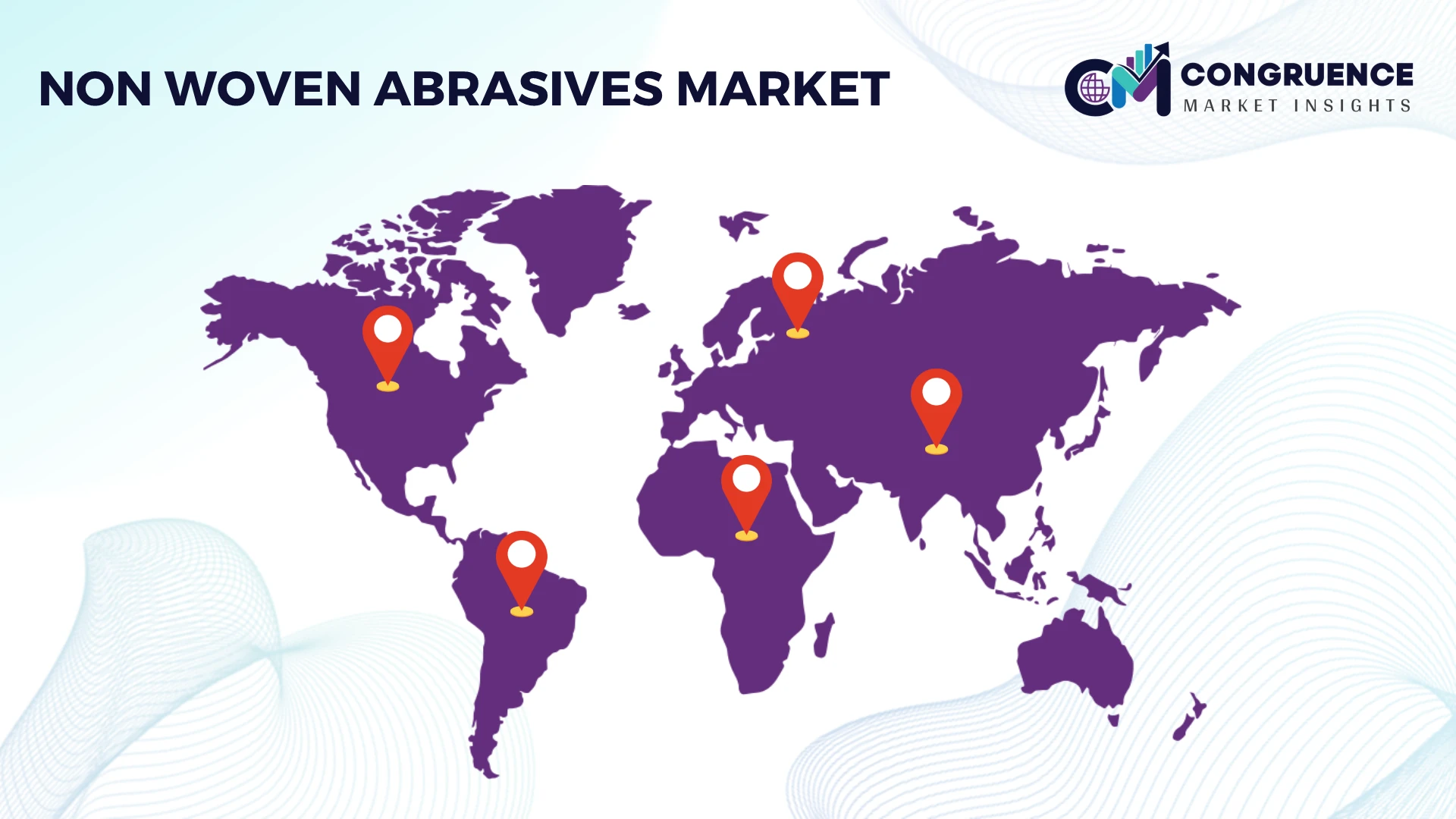
North America represented approximately 25.4% of the global non-woven abrasives market in 2025, supported by established automotive, aerospace, machinery, and metal-fabrication industries. The U.S. accounts for most regional consumption, with demand concentrated around automated deburring, weld blending, surface preparation, and precision finishing. Automotive and aerospace manufacturers increasingly integrate abrasive operations into robotic production cells, supporting premium demand for controlled-density discs and wheels. Industrial automation is also raising requirements for consistent abrasive performance across repeated toolpaths. U.S. manufacturers are expanding domestic production and application-engineering capabilities, while suppliers increasingly collaborate with automation integrators to qualify abrasive specifications for specific components. The regional market is therefore shifting from labor-dependent finishing toward repeatable, engineered consumable systems.
U.S. Market Outlook: The U.S. remains North America's principal demand center because of its large aerospace, automotive, defense, and industrial machinery base. More than 1 million industrial robots are now operating across U.S. manufacturing facilities, increasing the addressable opportunity for robotic-compatible abrasive products. Suppliers are prioritizing localized inventory, technical support, and application testing to reduce production interruptions and improve finishing consistency.
Europe accounted for approximately 16.7% of global demand in 2025, with Germany, Italy, France, and the United Kingdom representing important industrial consumption centers. Automotive component manufacturing, machinery production, stainless-steel processing, and aerospace applications sustain demand for flexible finishing products. European manufacturers increasingly prioritize abrasive life, controlled surface finish, and reduced material waste as energy and environmental requirements influence procurement decisions. Germany remains particularly important because of its concentration of automotive and industrial automation capabilities. Suppliers are responding with longer-life fiber structures, lower-waste formats, and application-specific products designed for automated finishing. Premium abrasives are gaining share where consistent surface quality reduces rework and downstream coating defects.
Germany Market Outlook: Germany is the region's most strategically significant market because of its dense automotive, engineering, machine-tool, and industrial automation ecosystem. The country hosts more than 260 industrial robots per 10,000 manufacturing employees, supporting demand for repeatable finishing consumables. Manufacturers increasingly specify abrasive products around automated process parameters rather than manual operator preference, benefiting suppliers with application-engineering capabilities.
Asia-Pacific held approximately 53.6% of the global market in 2025, making it the largest regional consumption base. China, Japan, South Korea, and India account for substantial demand through automotive manufacturing, electronics-related metal processing, machinery, shipbuilding, and general fabrication. China combines high production volumes with expanding factory automation, while Japan and South Korea generate stronger demand for precision finishing and engineered consumables. India's automotive and infrastructure manufacturing expansion is creating additional demand for deburring and surface preparation. Suppliers are increasing localized converting, distribution, and technical-support capabilities to reduce lead times. High-volume manufacturers increasingly favor consistent-density abrasives that can operate within automated finishing cells.
China Market Outlook: China represents the region's largest country-level opportunity because of its extensive automotive, machinery, metal fabrication, and industrial manufacturing base. The country produced more than 34 million vehicles in 2025, creating a substantial recurring requirement for deburring, blending, cleaning, and coating preparation. Domestic abrasive producers are simultaneously improving product consistency and expanding higher-performance ranges, intensifying competition with international suppliers.
South America represented approximately 2.8% of global non-woven abrasive demand in 2025, with Brazil accounting for the majority of regional consumption. Automotive assembly, metal fabrication, agricultural machinery, mining equipment, and general industrial maintenance create recurring requirements for surface preparation and finishing. Demand remains more price-sensitive than in North America or Europe, favoring versatile discs, wheels, and hand-use formats. However, larger manufacturers are gradually adopting automated finishing where labor consistency and throughput are critical. Brazil's established automotive and machinery clusters provide the strongest platform for premium abrasive adoption, while uneven industrial investment and imported-equipment dependence remain practical constraints. Suppliers are emphasizing distributor partnerships, localized inventory, and multi-application products to improve market coverage.
Brazil Market Outlook: Brazil dominates regional demand because of its automotive, agricultural-equipment, steel, mining, and machinery industries. The country produced more than 2.5 million light vehicles in 2025, sustaining requirements for component deburring, weld blending, and coating preparation. Local distributors and multinational abrasive suppliers are increasingly focusing on inventory availability and technical application support to serve geographically dispersed industrial customers.
Middle East & Africa represented approximately 1.5% of global non-woven abrasive demand in 2025, with Saudi Arabia, the United Arab Emirates, South Africa, and Turkey providing important industrial demand centers. Infrastructure development, metal fabrication, oil and gas equipment maintenance, construction machinery, and automotive servicing support consumption. Gulf markets are increasingly moving toward higher-quality finishing products as fabrication facilities modernize and industrial diversification programs expand. South Africa contributes demand through mining and heavy equipment maintenance, while Turkey provides a stronger manufacturing base. Suppliers are responding through regional distribution partnerships and broader product portfolios covering heavy-duty cleaning, weld finishing, and surface conditioning. Demand remains fragmented, but large infrastructure and industrial projects can generate concentrated procurement opportunities.
Saudi Arabia Market Outlook: Saudi Arabia offers the strongest strategic opportunity in the region because industrial diversification is expanding fabrication, machinery, construction, and energy-related manufacturing. The country's industrial localization program targets substantial expansion of domestic manufacturing capacity, increasing demand for surface-preparation consumables. Suppliers with regional technical support and dependable project-scale distribution are better positioned to capture requirements from large fabrication and infrastructure programs.
3M, Saint-Gobain Abrasives, Klingspor, PFERD, and Weiler Abrasives compete across surface-conditioning discs, wheels, belts, and hand formats, with leaders challenging regional manufacturers on performance, availability, and application support. The top five players hold an estimated 54% share, leaving a fragmented remainder for specialist and regional suppliers. Competition centers on abrasive life, cut consistency, customization, and supply reliability: premium formulations can deliver 15–20% longer service life, while engineered products can improve finishing productivity by 8–12%. 3M is pushing precision-shaped grain into non-woven products; Saint-Gobain is combining manufacturing scale with localized conversion; Weiler is differentiating through ceramic and silicon-carbide formulations; Klingspor emphasizes format coverage and application-specific densities. The competitive shift is from commodity consumables toward engineered products that reduce tool changes and process variation. Entry barriers include formulation know-how, qualification requirements, converting capability, distributor networks, and customer trust. Winning requires measurable productivity gains, reliable supply, application engineering, and customization rather than price alone.
3M Company
Saint-Gobain Abrasives
Klingspor AG
PFERD
Weiler Abrasives Group
Mirka Ltd.
Sia Abrasives Industries AG
Osborn International
Cratex Manufacturing Company
DEWALT
Walter Surface Technologies
ARC Abrasives
VSM Abrasives
Merit Abrasives
Non-woven abrasive technology is moving toward engineered grain, controlled-density fiber webs, and hybrid constructions. Precision-shaped ceramic grain can raise cut efficiency by roughly 2%, while optimized resin-fiber structures can extend life 1–2%. Adoption is strongest in metalworking, with automated or semi-automated finishing estimated at more than 30% of selected high-volume operations. Fewer tool changes, tighter surface consistency, and better consumable utilization improve operational economics.
The most important emerging shift is combining non-woven layers with coated abrasive technology. Norton’s hybrid constructions target single-step grinding and finishing, reducing process time by 1–2% in repetitive operations. Digital process monitoring and robotic tool control add another 1–2% improvement in repeatability by regulating contact pressure, speed, and programmed toolpaths. Compared with conventional manual abrasive selection, engineered products provide approximately 2% better process consistency and create a competitive advantage for suppliers offering application engineering alongside consumables.
From 2026 to 2028, investment will increasingly favor precision grain distribution, automated density control, hybrid abrasive architectures, and robotic-compatible formats. Manufacturers with formulations, testing laboratories, and automation partnerships should benefit first because qualification data shortens customer trials. Commodity products will remain important for price-sensitive industrial production applications, but premium systems will increasingly compete on total cost per finished component, productivity, and process stability rather than unit price today.
January 2025 Weiler Abrasives introduced Tiger Ceramic and Tiger Silicon Carbide non-woven strip discs; Tiger Ceramic removed up to 20% more material and cut up to 20% faster, strengthening metal-fabrication productivity and premium surface-conditioning positioning for steel applications. Source: weilerabrasives.com
January 2025 Norton launched Rapid Prep 2in1, combining coated flaps with non-woven conditioning material in one disc. The design eliminates abrasive-step changes, reducing handling and tool requirements while targeting faster weld removal, blending, and finishing in fabrication shops. Source: nortonabrasives.com
July 2025 Saint-Gobain opened its new Maia, Portugal non-woven production and conversion facility, adding advanced equipment and broader jumbo-size capability. The investment expands EMEA supply flexibility, improves efficiency, and strengthens localized manufacturing for growing industrial demand across EMEA. Source: saint-gobain-surfacesolutions.com
March 2025 3M’s Scotch-Brite Precision Surface Conditioning Discs were highlighted for delivering 40% longer life and 2X greater aluminum removal versus leading competitor discs. The technology raises performance expectations and supports premium positioning in automated and metal-finishing operations. Source: mscdirect.com
The report covers the global non-woven abrasives market across discs, wheels, belts, rolls, sheets, pads, and other formats, with analysis by deburring, blending, finishing, cleaning, paint preparation, and related applications. End-user coverage spans automotive, metal fabrication, aerospace, industrial machinery, and other manufacturing environments. Regional assessment includes North America, Europe, Asia-Pacific, South America, and Middle East & Africa, with country-level focus on major production and consumption centers.
The study evaluates conventional and emerging abrasive technologies, including controlled-density fiber structures, advanced ceramic and silicon-carbide grains, hybrid abrasive constructions, and robotic-compatible formats. More than 30% automation in selected high-volume finishing operations signals growing demand for engineered consumables. The report supports investment planning, product expansion, application targeting, supply-chain localization, competitive benchmarking, and technology prioritization, helping companies assess where demand is shifting and how product portfolios should evolve between 2026 and 2033.
| Report Attribute/Metric | Report Details |
|---|---|
|
Market Revenue in 2025 |
USD 2,724.8 Million |
|
Market Revenue in 2033 |
USD 4,150.1 Million |
|
CAGR (2026 - 2033) |
5.4% |
|
Base Year |
2025 |
|
Forecast Period |
2026 - 2033 |
|
Historic Period |
2021 - 2025 |
|
Segments Covered |
By Type
By Application
By End-User
|
|
Key Report Deliverable |
Revenue Forecast, Growth Trends, Market Dynamics, Segmental Overview, Regional and Country-wise Analysis, Competition Landscape |
|
Region Covered |
North America, Europe, Asia-Pacific, South America, Middle East, Africa |
|
Key Players Analyzed |
3M Company, Saint-Gobain Abrasives, Klingspor AG, PFERD, Weiler Abrasives Group, Mirka Ltd., Sia Abrasives Industries AG, Osborn International, Cratex Manufacturing Company, DEWALT, Walter Surface Technologies, ARC Abrasives, VSM Abrasives, Merit Abrasives |
|
Customization & Pricing |
Available on Request (10% Customization is Free) |




