
Reports
The Global Non-opioid Pain Patch Market was valued at USD 1,631.5 Million in 2025 and is anticipated to reach a value of USD 2,428.9 Million by 2033 expanding at a CAGR of 5.1% between 2026 and 2033. Growth is being driven by expanded use of topical lidocaine, capsaicin, NSAID-based patches, and drug-free delivery formats as healthcare systems prioritize non-opioid pain-management pathways and lower systemic exposure.
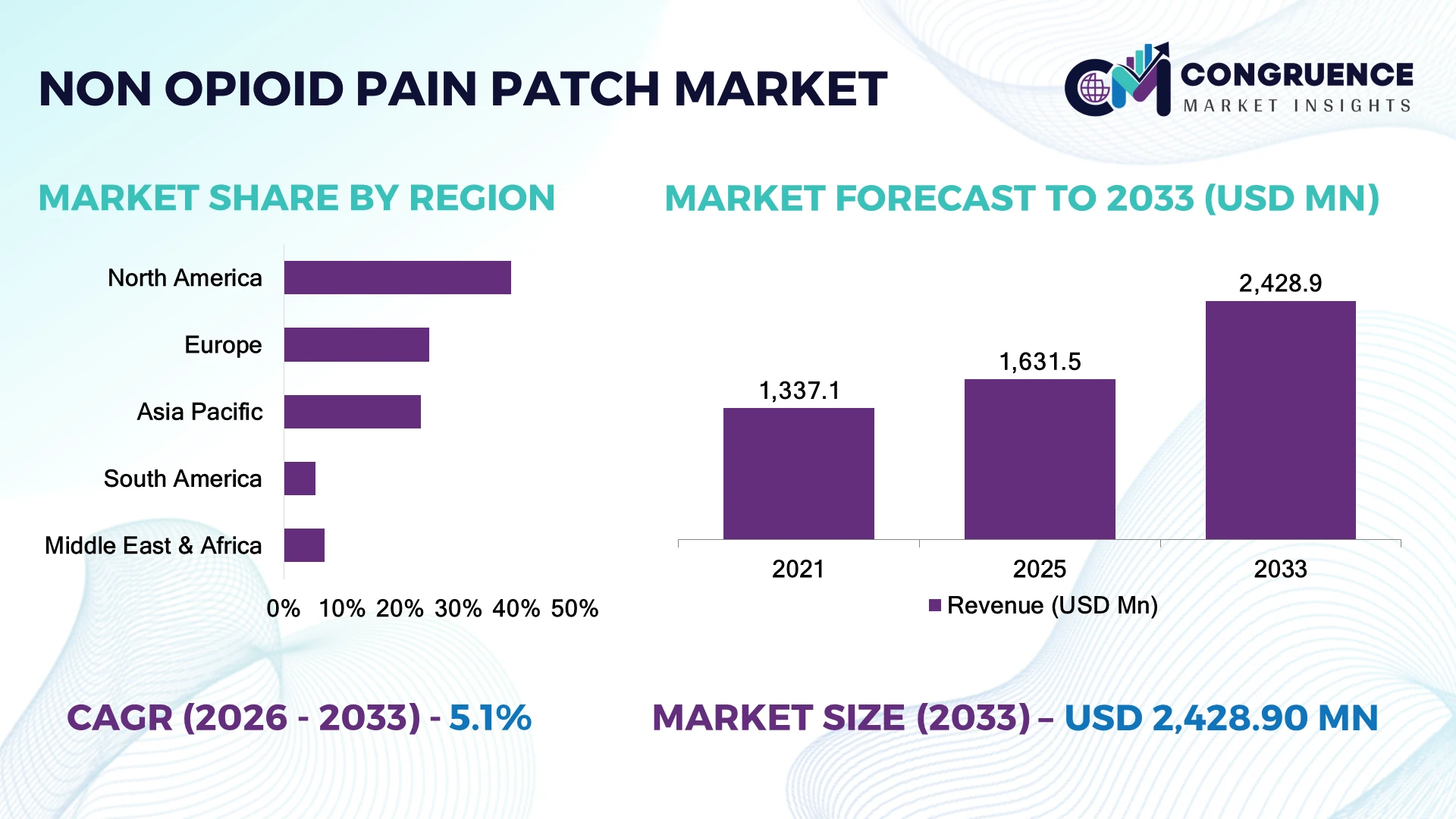
The United States remains the dominant national market, accounting for approximately 38% of global demand, supported by established OTC channels, prescription topical analgesics, and strong pharmaceutical investment. Japan follows with nearly 9%, while China is expanding manufacturing capacity and transdermal formulation development. U.S. adoption is roughly 4 times higher than India’s, reflecting stronger reimbursement and pharmacy penetration. The U.S. policy focus on reducing opioid exposure further reinforces category investment.
Strategically, manufacturers should prioritize differentiated formulations, sustained-release delivery, regulatory-ready evidence, and scalable pharmacy distribution rather than competing solely on patch volume.
Market Size & Growth: USD 1,631.5 million in 2025 to USD 2,428.9 million by 2033 at 5.1% CAGR, supported by non-opioid treatment pathways and topical analgesic innovation.
Top Growth Drivers: Opioid-sparing therapies 38%; OTC self-care 31%; chronic pain management 24%.
Short-Term Forecast: By 2028, automated patch manufacturing can reduce unit conversion costs by 8–12% while improving production consistency by 10%.
Emerging Technologies: Microneedle-assisted delivery, advanced polymer matrices, and controlled-release formulations are improving dose uniformity by approximately 12–18%.
Regional Leaders: North America is projected near USD 1.0 billion, Europe around USD 600 million, and Asia-Pacific above USD 500 million, with Asia-Pacific showing the strongest pharmacy-channel expansion.
Consumer/End-User Trends: Approximately 35% of topical pain-management users increasingly favor localized treatment formats, particularly for musculoskeletal conditions.
Pilot/Case Example: 2025 transdermal manufacturing upgrades demonstrated approximately 10% lower material waste, strengthening batch economics and supporting higher-volume production.
Competitive Landscape: Leading pharmaceutical and specialty topical-therapy companies collectively hold an estimated 30–35% share, with competition centered on formulation efficacy, duration, tolerability, and distribution.
Regulatory & ESG Impact: Opioid-sparing policies are strengthening non-opioid product positioning, while solvent reduction and thinner patch architectures can lower material use by approximately 15%.
Investment & Funding: Global pharmaceutical and specialty-drug investment exceeding USD 1 billion across topical and transdermal delivery programs is accelerating formulation partnerships and manufacturing expansion.
Innovation & Future Outlook: 2026–2028 innovation is shifting toward longer-wear patches, digitally monitored adherence, drug-free neuromodulation, and precision delivery, favoring companies with formulation and device capabilities.
The non-opioid pain patch market is increasingly concentrated in localized pain-management applications where patients and providers value targeted delivery without opioid exposure. Lidocaine, capsaicin, diclofenac, and emerging drug-free technologies account for a substantial share of commercial activity, while advanced adhesive and controlled-release systems are improving wear performance by roughly 10–15%. In 2026, manufacturers are responding to tighter evidence requirements and pharmacy-channel competition by strengthening formulation portfolios, regional manufacturing, and combination-device capabilities.
The non-opioid pain patch market is becoming strategically important because pharmaceutical companies are competing beyond active ingredients, using delivery performance, convenience, safety positioning, and treatment duration to differentiate topical therapies. The shift toward opioid-sparing care is changing portfolio allocation, particularly in the United States, where manufacturers are strengthening localized analgesic platforms and expanding OTC and prescription channels.
Technology is also changing unit economics. Advanced matrix and controlled-release patches can reduce formulation variability by approximately 10–15% compared with conventional adhesive-drug assemblies, while thinner multilayer structures improve wearability and material utilization. North America retains the strongest commercial infrastructure, whereas Japan and South Korea emphasize mature transdermal delivery capabilities and Asia-Pacific manufacturers increasingly compete through formulation scale and cost-efficient production.
During 2026–2028, manufacturers are expected to prioritize longer-wear formulations, improved adhesion, microneedle-assisted delivery, and drug-free electrical or thermal approaches. A practical deployment priority is shifting production toward automated coating and precision-lamination lines, where 8–12% reductions in material waste improve margins. Companies combining pharmaceutical formulation expertise with device engineering and pharmacy partnerships will gain stronger competitive positioning as non-opioid pain management becomes an increasingly differentiated therapeutic category.
Opioid-sparing prescribing is accelerating adoption of localized analgesic delivery, particularly in the United States, Japan, and Western Europe. Approximately 38% of topical pain-management demand is linked to musculoskeletal conditions, while OTC channels account for nearly 55% of non-opioid patch purchases. Advanced adhesive matrices and sustained-release systems are improving wear duration by 10–15%, strengthening patient convenience and repeat use. U.S. efforts to reduce opioid exposure are reinforcing this structural shift, pushing manufacturers toward lidocaine, capsaicin, NSAID, and drug-free formulations. Companies are responding through automated coating capacity, formulation partnerships, and expanded pharmacy distribution. The strategic advantage is moving from basic patch production toward differentiated delivery performance and clinically supported localized efficacy.
Manufacturers face pressure from active pharmaceutical ingredient costs, specialized adhesive systems, and formulation validation requirements. API and excipient expenses can represent roughly 20–30% of manufacturing costs, while advanced multilayer patches carry 10–15% higher conversion costs than simpler formats. In the United States, regulatory differentiation between OTC and prescription products also increases development complexity. Supply interruptions affecting pharmaceutical-grade polymers or adhesive components can extend production lead times by 8–12%. These constraints compress margins when products compete against low-cost topical creams and gels. Companies are reducing exposure through dual sourcing, regionalized procurement, longer supplier contracts, and simplified patch architectures. The key operational priority is protecting formulation consistency without allowing material sophistication to erode price competitiveness.
Next-generation transdermal systems create opportunities beyond conventional analgesic patches. Microneedle-assisted delivery can improve localized drug deposition by approximately 15–25%, while drug-free thermal and electrical stimulation formats are gaining attention among manufacturers targeting non-pharmacological pain management. Asia-Pacific offers an important expansion pathway as Japan and South Korea combine mature transdermal expertise with advanced medical-device manufacturing. Approximately 25% of new development activity is shifting toward improved adhesion, controlled release, or combination delivery formats. Companies are increasing R&D partnerships with device specialists and investing in precision coating and lamination. The non-obvious opportunity lies in longer-wear products: extending application intervals by even 20% can reduce replacement frequency, improve adherence, and strengthen pharmacy economics.
Long-term competitiveness depends on proving consistent therapeutic performance across diverse skin types, wear conditions, and dosing requirements. Development programs increasingly require comparative evidence, with formulation-performance variability targeted below 10% across production batches. Advanced patches combining sensors, heating, electrical stimulation, or drug delivery introduce additional integration requirements, while cybersecurity becomes relevant when connected adherence features transmit patient data. Manufacturing teams also face skilled workforce constraints as precision coating, microfabrication, and multilayer assembly become more complex. Companies are addressing these pressures through automated quality inspection, digital batch monitoring, contract-development partnerships, and modular manufacturing platforms. The strategic challenge is achieving scalable personalization without creating fragmented production processes that increase validation burden, quality-control costs, and regulatory complexity.
Longer-Wear Patch Architectures New adhesive chemistries and controlled-release matrices are extending wear periods by approximately 15–20%, reducing replacement frequency and improving treatment convenience. Manufacturers are redesigning multilayer structures and investing in precision coating to maintain dose uniformity while controlling material consumption. The shift is particularly relevant for chronic musculoskeletal applications where repeated daily application increases adherence friction.
Drug-Free Pain Technologies Thermal, electrical, and neuromodulation patches are moving beyond niche positioning, with adoption across emerging product pipelines estimated near 10–15%. These formats reduce dependence on pharmaceutical APIs and create differentiated premium products. Companies are forming device partnerships and combining flexible electronics with skin-compatible materials, responding to continued interest in opioid-sparing treatment pathways.
Advanced Adhesive Performance Skin compatibility is becoming a stronger product differentiator as approximately 20% of patch development activity focuses on adhesion, flexibility, or irritation reduction. Manufacturers are adopting silicone-based and hybrid adhesive systems to improve wear stability by roughly 10–15%. This trend addresses hot, humid markets where sweat and movement can compromise conventional patch attachment.
Automated Quality Manufacturing Pharmaceutical patch production is increasingly adopting machine-vision inspection, automated coating controls, and digital batch monitoring, reducing defect rates by approximately 8–12%. Labor shortages and tighter quality requirements are accelerating this transition. Manufacturers are prioritizing closed-loop production systems that detect coating variation earlier, improving yield and reducing costly batch rejection while supporting consistent scale-up.
Lidocaine patches represent the leading type, accounting for approximately 42% of the global non-opioid pain patch market, supported by established clinical use, relatively predictable formulation performance, and strong positioning in localized neuropathic pain. Capsaicin patches hold an estimated 18% share and remain strategically important for peripheral neuropathic conditions, while NSAID-based patches account for roughly 25%, benefiting from localized musculoskeletal pain applications. The remaining formats, including drug-free and combination patches, retain smaller shares but provide differentiation opportunities for manufacturers.
The fastest-growing type is expected to be advanced drug-free and combination patches, supported by interest in reducing pharmaceutical exposure and integrating thermal, electrical, or controlled-release mechanisms. Companies are increasing investment in multilayer architectures, flexible electronics, and longer-wear adhesive systems. The shift changes competitive priorities from active-ingredient availability toward delivery performance, tolerability, and differentiated patient experience.
Musculoskeletal pain is the leading application, representing approximately 45% of non-opioid pain patch demand, supported by osteoarthritis, localized joint pain, sports injuries, and soft-tissue conditions. Neuropathic pain follows at nearly 30%, with lidocaine and high-concentration capsaicin patches particularly relevant to focal peripheral neuropathies. Arthritis-related applications account for approximately 15%, while postoperative and other localized pain indications comprise the remaining share. The mature musculoskeletal segment provides volume stability, whereas neuropathic applications offer stronger opportunities for clinically differentiated products.
Neuropathic pain is the fastest-expanding application as clinicians increasingly seek localized treatment options with limited systemic exposure. Companies are adapting through indication-specific formulations, extended-wear patches, and partnerships combining pharmaceutical delivery with device technologies. Commercial investment is shifting toward products capable of demonstrating consistent local efficacy and convenient administration, particularly where oral treatment creates tolerability or adherence concerns.
Retail pharmacies represent the leading end-user channel, accounting for approximately 48% of market demand, supported by OTC availability, pharmacist-led recommendations, and convenient repeat purchasing. Hospitals and clinics contribute nearly 30%, with stronger concentration in prescription lidocaine and supervised specialty applications. Online pharmacies represent about 14% and are the fastest-growing end-user channel as consumers increasingly compare formulations, prices, and delivery formats digitally. Home-care providers and other institutional users retain smaller shares but support recurring demand for chronic pain management.
Online pharmacy adoption is expanding faster than traditional channels, driven by improved product discoverability and home delivery. Companies are responding with channel-specific packaging, subscription purchasing, digital education, and pharmacy partnerships. Established manufacturers continue emphasizing clinical credibility through healthcare channels, while emerging brands compete through convenience and direct-to-consumer positioning. The strategic opportunity lies in combining medical-channel validation with digitally enabled replenishment to capture both clinically directed and self-care purchases.
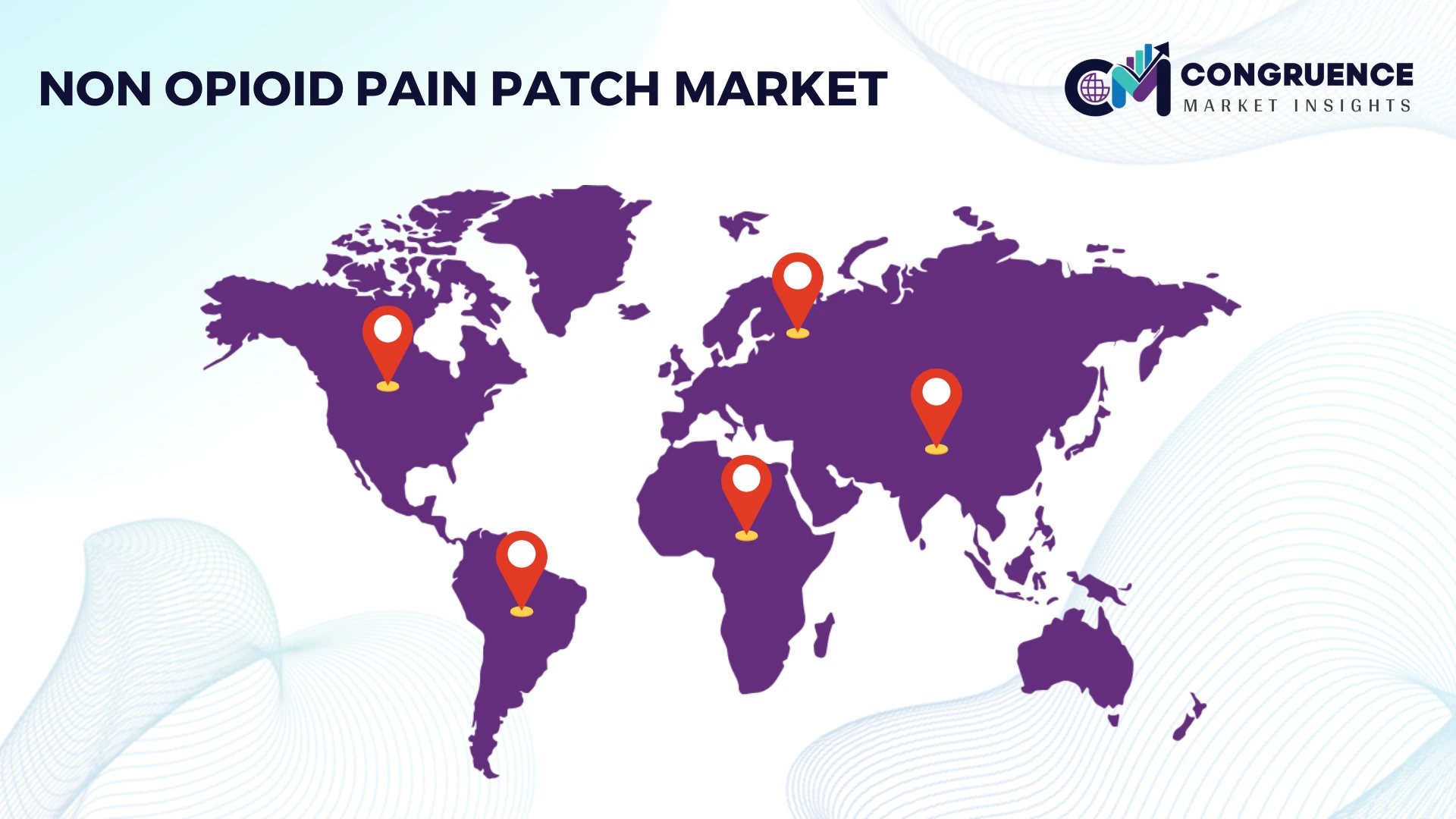
North America accounted for the largest market share at 39.0% in 2025 however, Asia-Pacific is expected to register the fastest growth, expanding at a CAGR of 7.55% between 2026 and 2033.
Localized Pain Management Strengthens Commercial Adoption
North America remains the leading market for non-opioid pain patches, supported by established pharmaceutical distribution, extensive retail pharmacy networks, and strong adoption of topical analgesics. The region held approximately 39% of global market share in 2025, with the United States representing the dominant demand center. Growing emphasis on non-systemic pain management is strengthening demand for lidocaine, capsaicin, and other topical formulations. Manufacturers are investing in improved adhesion, extended wear duration, and patient-friendly delivery formats. The region's mature reimbursement and OTC ecosystem also enables faster commercialization than emerging markets. Companies are increasingly using differentiated formulations and pharmacy partnerships to defend premium positioning while expanding consumer accessibility.
United States Market Outlook: The United States remains the primary commercial hub, supported by its large chronic-pain population, sophisticated pharmaceutical infrastructure, and extensive retail and digital pharmacy networks. OTC and prescription topical therapies benefit from established physician and consumer familiarity. Manufacturers are prioritizing differentiated formulations, longer wear profiles, and targeted neuropathic-pain applications, while online distribution is expanding product accessibility and improving direct-to-consumer reach.
Clinical Differentiation Reshapes Topical Pain Management
Europe maintains a strong position through mature pharmaceutical systems, specialist pain-management services, and increasingly evidence-based prescribing. Germany, France, the United Kingdom, and Italy account for substantial commercial activity, while regulatory requirements favor clinically differentiated formulations. Demand is supported by topical approaches to neuropathic and musculoskeletal pain, particularly lidocaine and capsaicin-based therapies. Manufacturers are strengthening clinical evidence, formulation tolerability, and patient-selection strategies rather than relying primarily on price competition. Sustainability requirements are also influencing packaging and material choices, creating opportunities for lower-material and recyclable formats.
Germany Market Outlook: Germany represents a strategically important market because of its advanced pharmaceutical distribution infrastructure, specialist healthcare capacity, and established prescription topical-therapy ecosystem. Healthcare providers increasingly emphasize localized treatment options where appropriate, supporting clinically differentiated patches. Manufacturers are focusing on evidence-backed formulations, controlled application protocols, and improved patient convenience, while strong pharmacy infrastructure enables efficient nationwide product distribution and specialist-led adoption.
Manufacturing Scale Accelerates Technology-Led Adoption
Asia-Pacific is transitioning from a manufacturing base into a major consumption and innovation center for non-opioid pain patches. Japan, China, South Korea, and India provide strong pharmaceutical production capabilities, large patient populations, and expanding healthcare access. The region is expected to register the fastest growth, supported by increasing acceptance of topical therapies and digital pharmacy expansion. Japan contributes advanced transdermal drug-delivery expertise, while China and India provide cost-efficient manufacturing and scalable supply chains. Companies are responding through localized formulations, contract manufacturing, domestic distribution partnerships, and investments in advanced adhesive and controlled-release technologies.
Japan Market Outlook: Japan combines advanced pharmaceutical manufacturing with decades of expertise in transdermal delivery, adhesive technologies, and controlled-release formulations. Its mature healthcare system and consumer familiarity with topical products support sophisticated product positioning. Manufacturers are developing thinner, more comfortable, and longer-wearing patches to improve adherence and differentiation. Japan's technology base also provides an export-oriented platform for companies seeking scalable transdermal formulation capabilities.
Affordable Topical Therapies Expand Retail Penetration
South America presents an emerging opportunity shaped by pharmacy accessibility, affordability, and domestic pharmaceutical capabilities. Brazil represents the principal commercial market because of its large healthcare system and established drug-manufacturing base. Demand for localized pain-management products is strengthening across retail and self-care channels, while economic volatility continues to pressure imported formulations and active pharmaceutical ingredients. Companies are responding through domestic sourcing, distributor partnerships, and competitively priced formulations. The strategic opportunity is strongest for manufacturers that combine localized production economics with differentiated drug-delivery performance, allowing broader penetration without sacrificing formulation quality or supply reliability.
Brazil Market Outlook: Brazil offers the strongest commercial platform in South America through its large population, pharmaceutical manufacturing ecosystem, and extensive retail pharmacy network. Domestic production can reduce dependence on imported finished products and improve supply continuity. Manufacturers are targeting Brazil with affordable topical analgesics alongside differentiated formulations, while partnerships with national distributors and pharmacy chains strengthen market reach and improve availability across major urban and secondary markets.
Healthcare Modernization Drives Specialty Product Adoption
Middle East and Africa demand is concentrated in countries with stronger healthcare infrastructure, private-sector investment, and pharmaceutical procurement systems. Saudi Arabia, the United Arab Emirates, and South Africa represent key commercial markets, with specialty hospitals and private healthcare networks supporting adoption of differentiated pain-management therapies. Saudi Arabia's healthcare transformation is strengthening pharmaceutical infrastructure and procurement modernization, creating a more favorable environment for specialty topical products. Manufacturers are responding through regional distribution partnerships, localized commercial teams, and expanded product portfolios. Market fragmentation remains a critical consideration, making regulatory registration, physician education, and dependable distribution important factors in sustaining penetration.
Saudi Arabia Market Outlook: Saudi Arabia represents the region's strongest strategic market because of healthcare modernization, pharmaceutical-sector investment, and expanding private healthcare capacity. Vision 2030 is accelerating healthcare infrastructure development and strengthening domestic pharmaceutical capabilities. Companies are increasingly using distributor and healthcare-provider partnerships to establish market access. Non-opioid topical therapies benefit from their localized delivery profile, giving manufacturers an opportunity to position differentiated patches within increasingly sophisticated pain-management portfolios.
Hisamitsu Pharmaceutical and Teikoku Seiyaku compete as transdermal specialists, while Teva, Endo, Sanofi, and GSK compete through pharmaceutical portfolios and established distribution. Grünenthal competes through premium Qutenza positioning, while IBSA and regional manufacturers challenge with differentiated NSAID formulations and cost-focused supply. The top five players are estimated to command about 38% of market value, indicating a fragmented structure. Price influences roughly 30% of purchasing decisions, formulation and delivery technology about 35%, and distribution reliability about 20%, making performance and access decisive. Players are expanding through licensing, geographic commercialization, clinical-label expansion, and formulation upgrades. Grünenthal's Qutenza licensing strategy demonstrates a shift toward regional partnerships, while generic manufacturers are intensifying price competition. Entry barriers center on regulatory approval, adhesive performance, clinical evidence, and manufacturing consistency. The competitive shift favors companies combining proprietary delivery technology with scalable supply. Winning requires differentiated efficacy, reliable manufacturing, channel access, and rapid regulatory execution.
Hisamitsu Pharmaceutical Co., Inc.
Teikoku Seiyaku Co., Ltd.
Teva Pharmaceutical Industries Ltd.
Endo Pharmaceuticals Inc.
Sanofi
GlaxoSmithKline plc
Grünenthal GmbH
IBSA Institut Biochimique SA
Viatris Inc.
Amneal Pharmaceuticals, Inc.
Averitas Pharma, Inc.
Veridian Healthcare
Sparsha Pharma International Pvt. Ltd.
TEH SENG Pharmaceutical Manufacturing Co., Ltd.
Transdermal delivery is moving toward thinner, conformable systems using optimized adhesives, multilayer drug reservoirs, and controlled-release matrices. Modern designs improve skin contact by about 10–15% versus conventional patches and reduce application-related failures by roughly 5–8%. Adoption is strongest in prescription lidocaine, diclofenac, and capsaicin platforms, where manufacturers are refining wear duration, dose consistency, and patient comfort.
Emerging systems integrate microneedle arrays, microstructured surfaces, and precision permeation enhancers to improve drug flux while limiting systemic exposure. Microneedle-based delivery can increase localized delivery efficiency by 15–25% in development settings, while smart adhesive formulations improve retention by around 10%. Commercial deployment remains selective, but 2026–2028 investment is shifting toward scalable manufacturing platforms that can support multiple active ingredients.
The competitive advantage increasingly favors companies with proprietary delivery platforms, validated manufacturing, and regulatory-ready formulations rather than commodity patch producers. Digital formulation modeling and automated coating inspection are reducing process variability by approximately 5–10%, improving batch consistency and quality control. By 2028, integration of advanced adhesives, automated production, and targeted release technologies will strengthen premium positioning, shorten development cycles, and expand differentiated non-opioid pain-patch portfolios. Platform standardization also reduces tooling changes and accelerates product extensions across multiple pain indications efficiently.
February 2025 Grünenthal licensed exclusive Canadian Qutenza rights to Apotex, expanding regional commercialization for a non-systemic capsaicin patch. Apotex will pursue authorization and distribution, adding a dedicated specialty-pharma channel and milestone-based partnership model for Canadian commercialization nationwide. Source: grunenthal.com
March 2025 Aveva Drug Delivery Systems received FDA approval for a lidocaine 1.8% patch targeting post-herpetic neuralgia. The U.S. market reached USD 116 million in 2024, strengthening affordable topical competition and expanding patient access nationwide. Source: prnewswire.com (PR Newswire)
March 2026 Grünenthal licensed South Korean Qutenza rights to BCWorld Pharm, extending its Asia-Pacific commercial footprint. BCWorld will pursue marketing authorization and distribution, supporting localized access while creating milestone and royalty economics and expanding specialty distribution reach. Source: grunenthal.com
April 2026 YARAL Pharma launched a 15-count diclofenac epolamine 1.3% topical-system carton, optimizing pharmacy storage and inventory handling. The configuration preserves once-daily therapy while reducing shelf-space pressure, strengthening differentiation for topical pain products across pharmacies nationwide. Source: businesswire.com (Business Wire)
The report evaluates the global non-opioid pain patch market across lidocaine, diclofenac, capsaicin, ketoprofen, methyl salicylate, and other formulations, with analysis of hospital pharmacies, retail pharmacies, online channels, and other distribution routes. Coverage spans musculoskeletal pain, neuropathic pain, acute localized pain, and emerging specialty indications, including advanced transdermal and controlled-release delivery systems.
Geographic analysis covers North America, Europe, Asia-Pacific, South America, and Middle East & Africa, with country-level assessment of demand concentration, regulatory access, manufacturing capabilities, and commercialization activity. The study benchmarks major participants, product positioning, technology adoption, clinical differentiation, and partnership strategies, enabling investment planning, geographic expansion, portfolio prioritization, and competitive positioning. It also evaluates emerging formulations, smart delivery concepts, advanced adhesives, and niche therapeutic applications shaping market direction from 2026 through 2033.
| Report Attribute/Metric | Report Details |
|---|---|
|
Market Revenue in 2025 |
USD 1,631.5 Million |
|
Market Revenue in 2033 |
USD 2,429.9 Million |
|
CAGR (2026 - 2033) |
5.1% |
|
Base Year |
2025 |
|
Forecast Period |
2026 - 2033 |
|
Historic Period |
2021 - 2025 |
|
Segments Covered |
By Type
By Application
By End-User
|
|
Key Report Deliverable |
Revenue Forecast, Growth Trends, Market Dynamics, Segmental Overview, Regional and Country-wise Analysis, Competition Landscape |
|
Region Covered |
North America, Europe, Asia-Pacific, South America, Middle East, Africa |
|
Key Players Analyzed |
Hisamitsu Pharmaceutical Co., Inc., Teikoku Seiyaku Co., Ltd., Teva Pharmaceutical Industries Ltd., Endo Pharmaceuticals Inc., Sanofi, GlaxoSmithKline plc, Grünenthal GmbH, IBSA Institut Biochimique SA, Viatris Inc., Amneal Pharmaceuticals, Inc., Averitas Pharma, Inc., Veridian Healthcare, Sparsha Pharma International Pvt. Ltd., TEH SENG Pharmaceutical Manufacturing Co., Ltd. |
|
Customization & Pricing |
Available on Request (10% Customization is Free) |




