
Reports
The Global Non-Invasive Blood Glucose Monitoring System Market was valued at USD 39.21 Million in 2025 and is anticipated to reach a value of USD 100.62 Million by 2033 expanding at a CAGR of 12.5% between 2026 and 2033. Growth is being driven by miniaturized optical and Raman sensing, AI-based signal correction, smartwatch integration, and regulatory progress supporting clinically validated needle-free glucose monitoring.
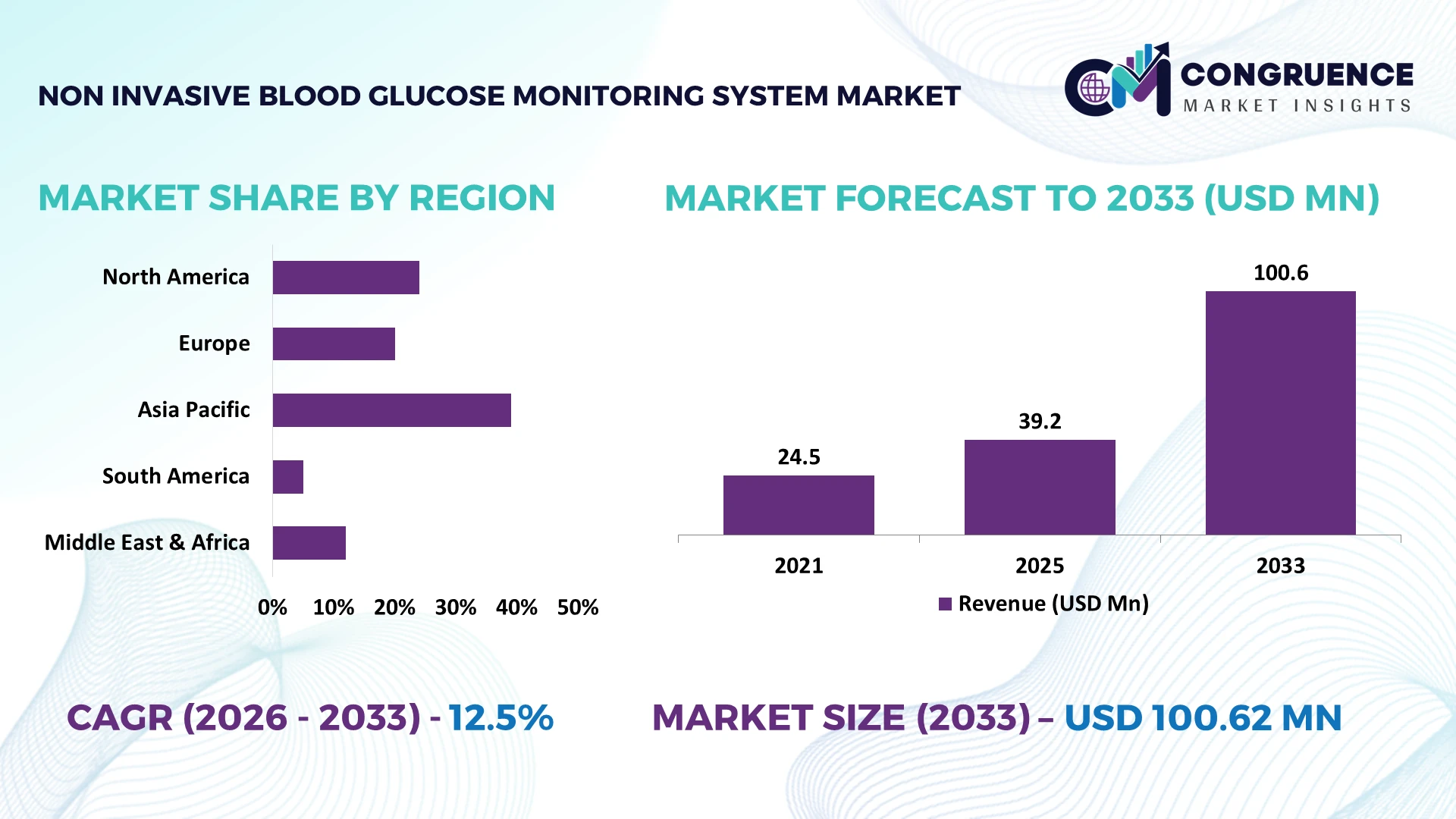
The United States remains the dominant commercialization hub, with North America accounting for about 40% of market activity and the U.S. representing approximately 83% of the regional market. Investments exceeding USD 200 Million in related biosensing innovation during 2024 strengthened development across digital health, wearable electronics, and medical-device industries. India is expanding research activity in optical and Raman-based glucose sensing, while China is accelerating wearable-device manufacturing. The U.S. maintains a clear commercialization advantage over emerging Asian markets.
Strategically, manufacturers should prioritize clinically validated accuracy, compact photonics, AI-enabled calibration, and regulatory-ready platforms over consumer-facing features alone.
Market Size & Growth: USD 39.21 Million in 2025 to USD 100.62 Million by 2033 at 12.5% CAGR, supported by optical and AI-enabled sensing.
Top Growth Drivers: Regulatory advancement +1.8%; photonics miniaturization +1.5%; wearable integration +1.3%.
Short-Term Forecast: Wearable-based systems are advancing at 9.08%, strengthening demand for compact wrist and patch architectures.
Emerging Technologies: NIR spectroscopy, Raman sensing, multimodal AI, and RF technologies are improving glucose-detection capabilities.
Regional Leaders: North America holds about 40% share, while Asia-Pacific records 9.45% growth, led by China, Japan, and India.
Consumer Trends: Adults account for approximately 66.58% of demand, while home and personal-use applications expand at 9.29%.
Pilot/Case Example: A 2026 AI-enabled wearable study achieved 97.69% of glucose estimates within clinically favorable Clarke zones A+B.
Competitive Landscape: Abbott leads the broader glucose-monitoring ecosystem, with Dexcom, Medtronic, Know Labs, and Biolinq strengthening competitive intensity.
Regulatory & ESG Impact: 2026 regulatory activity is accelerating clinical validation requirements while needle-free architectures reduce dependence on disposable testing consumables.
Investment & Funding: More than USD 200 Million entered related biosensing investments in 2024, reinforcing hardware-software convergence.
Innovation & Future Outlook: AI calibration, multimodal spectroscopy, edge analytics, and smartwatch integration are shifting competition toward validated metabolic-data platforms.
Non-invasive blood glucose monitoring is moving from laboratory experimentation toward commercially structured product development, with optical spectroscopy, AI-based physiological-signal interpretation, and wearable integration receiving strong innovation focus. A 2026 wearable study demonstrated 97.69% of estimates within clinically favorable Clarke zones A+B, reinforcing the importance of clinically relevant accuracy. The strategic priority is shifting toward precision, regulatory validation, miniaturization, and scalable manufacturing.
Non-invasive glucose monitoring is becoming strategically important because it can reposition glucose measurement from episodic testing toward continuous, connected metabolic monitoring. The shift is particularly relevant for wearable-device manufacturers, medical-technology companies, and digital-health platforms seeking differentiated patient data. With adults representing approximately 66.58% of demand and home/personal-use applications expanding at 9.29%, companies are redirecting investment toward compact sensors, AI interpretation, and consumer-grade interfaces.
Technology architecture is also reshaping economics. Optical and Raman-based sensing eliminates routine lancets and test-strip consumption, while AI-assisted signal processing improves interpretation of complex physiological data. Wearable applications are advancing at about 9.08%, supporting integration with smartwatches, patches, and connected health platforms. The United States remains ahead in commercialization and clinical development, whereas China and India are strengthening manufacturing, research, and engineering capabilities.
Over the next 2–3 years, companies are expected to prioritize clinically validated accuracy, miniaturized sensing modules, and interoperability with digital-health ecosystems. A 2026 wearable research program reporting 97.69% of glucose estimates within Clarke zones A+B illustrates the direction of technological progress. Manufacturers are increasingly combining R&D partnerships, sensor development, and software capabilities to shorten validation cycles. Competitive advantage will depend on converting sensing innovation into reliable, scalable, regulation-ready monitoring platforms.
Wearable integration is the strongest structural driver as home and personal-use applications expand at 9.29%, while wearable architectures advance at approximately 9.08%. Adult users account for nearly 66.58% of demand, reinforcing the commercial value of convenient monitoring outside clinical settings. AI-based signal correction, spectroscopy, and multimodal sensing are improving interpretation of physiological signals without routine skin penetration. In the United States, digital-health infrastructure and established wearable ecosystems accelerate commercialization, while Indian and Chinese developers are increasing sensor-engineering activity. Companies are responding through R&D partnerships, software integration, and compact sensor platforms. The non-obvious advantage is recurring data generation: platforms that combine glucose trends with broader biometric information can create stronger patient-engagement and analytics models.
Accuracy validation remains a significant commercialization constraint because non-invasive systems must interpret glucose through complex tissue, temperature, hydration, and physiological variables. Current development programs increasingly target clinically favorable accuracy levels above 90%, while achieving consistent performance across diverse users remains difficult. Approximately 97.69% of readings falling within Clarke zones A+B in a 2026 wearable study demonstrates progress but also highlights the importance of clinical validation rather than laboratory accuracy alone. U.S. developers face demanding validation requirements, while manufacturers in China and India must balance advanced sensor investment against commercialization costs. Companies are reducing exposure through staged clinical programs, modular sensor architectures, and partnerships. The key operational issue is that validation costs can rise sharply when hardware, algorithms, and software require simultaneous qualification.
Multimodal sensing creates an opportunity to combine optical, Raman, radio-frequency, and AI techniques to improve signal reliability without increasing user burden. Wearable applications expanding at approximately 9.08% provide a practical commercialization pathway, while home-use demand growing at 9.29% supports decentralized monitoring models. China offers manufacturing scale and electronics expertise, whereas India provides expanding engineering and digital-health capabilities at comparatively efficient development costs. Companies are investing in sensor miniaturization, algorithm development, and ecosystem partnerships rather than treating the device as a standalone product. A distinctive opportunity lies in software-defined monitoring, where algorithm upgrades can improve performance without complete hardware replacement. This model can lower lifecycle costs and strengthen recurring platform revenue.
Long-term competitiveness depends on integrating sensors, algorithms, mobile platforms, cloud infrastructure, and clinical workflows without compromising reliability. Wearable systems already represent a rapidly advancing application category at about 9.08%, increasing pressure to deliver continuous performance across changing environmental and physiological conditions. A 97.69% Clarke-zone A+B result demonstrates the direction of progress, but broader deployment requires reproducibility across larger and more diverse populations. U.S. companies face stringent interoperability and cybersecurity expectations, while manufacturers in India and China must build consistent validation and quality-control capabilities alongside production scale. Companies are therefore increasing investment in edge analytics, secure data architectures, automated calibration, and cross-platform compatibility. The strategic challenge is transforming technically successful prototypes into dependable systems capable of sustained real-world operation.
Optical Sensing Moves Forward: Optical technologies represented about 52% of technology deployments in recent market assessments, while electromagnetic approaches reached 28.3%. Miniaturized photonics and AI signal processing are shifting development toward compact systems, with companies prioritizing sensor accuracy and lower hardware complexity.
Wearables Reshape Deployment Models: Wearable systems accounted for 58% of product adoption in recent assessments, while advanced wrist and patch formats are expanding faster than conventional devices. U.S. developers are integrating sensors with mobile platforms, reducing workflow friction and creating recurring metabolic-data services.
Clinical Workflows Become Connected: Hospitals and clinics represented 55.92% of deployments, while home-use applications are expanding at 9.29%. The shift is moving data capture beyond clinical settings, prompting manufacturers to strengthen telehealth interfaces, cloud dashboards, and interoperability with electronic medical records.
Validation Becomes Commercial Differentiator: A 2026 longitudinal study covering 183 participants achieved 97.69% of estimates within Clarke zones A+B, demonstrating progress in adaptive AI-based glucose estimation. The American Diabetes Association’s 2025 guidance also reinforces accuracy and uninterrupted monitoring access, pushing companies toward stronger validation, calibration, and regulatory integration.
Optical systems lead the technology mix at approximately 52%, supported by established spectroscopy techniques, expanding photonics capabilities, and compatibility with compact sensing modules. Electromagnetic systems account for about 28.3% and are gaining relevance through RF-based detection and improved signal-processing algorithms. Transdermal technologies remain strategically important where controlled analyte extraction improves measurement consistency, while wearable sensors are becoming the fastest-moving format as manufacturers integrate sensing into watches, patches, and lightweight platforms. Companies are shifting investment toward miniaturized optical modules and AI-assisted calibration to address accuracy and power constraints.
The competitive gap is increasingly defined by integration rather than sensing alone. Wearable sensors are expanding at roughly 13%, compared with about 12% for optical approaches in recent technology assessments, reflecting stronger consumer-device convergence. Electromagnetic platforms offer diversification, while transdermal systems retain clinical-development relevance. This is pushing manufacturers toward cross-technology partnerships, flexible sensor architectures, and software-defined monitoring platforms.
Diabetes Monitoring remains the leading application, accounting for approximately 66% of application demand, because clinically relevant glucose measurement continues to drive purchasing decisions across hospitals, clinics, and home-care settings. Glucose Tracking is expanding rapidly as connected wearables enable continuous data capture rather than isolated measurements. Glycemic Control is increasingly linked with automated analytics, while Health Monitoring is widening the addressable user base through metabolic wellness applications. Companies are adapting product architectures around continuous sensing, mobile alerts, and clinician dashboards rather than standalone measurement.
The shift toward continuous glucose data is particularly visible in the United States, where digital monitoring is becoming integrated with treatment workflows. Diabetes Monitoring retains roughly a 66% share, while Health Monitoring is emerging as a higher-velocity use case, with wellness-oriented applications in some technology assessments expanding above 16%. Manufacturers are therefore developing consumer interfaces alongside clinical-grade functions, creating dual-channel commercialization strategies.
Hospitals & Clinics represent the dominant end-user group at approximately 56% of market demand, reflecting higher procurement volumes, clinical infrastructure, and established diagnostic workflows. Diagnostic Centers remain important for high-throughput testing, while Research Institutions support validation of optical, electromagnetic, and AI-based technologies. Home Healthcare is the fastest-shifting segment, with adoption expanding at about 9.29% as monitoring moves into decentralized care. Companies are responding with remote dashboards, simplified interfaces, and connected-device partnerships tailored to different deployment environments.
Hospitals retain scale advantages, but home healthcare is changing purchasing economics by emphasizing recurring device use and remote data exchange. Home deployment is growing about 9%, compared with slower institutional replacement cycles, creating stronger incentives for manufacturers to build lower-maintenance systems. Diagnostic centers are prioritizing rapid workflows, while research institutions favor configurable platforms. Companies are increasingly using channel partnerships and differentiated pricing to reach both institutional and consumer buyers.
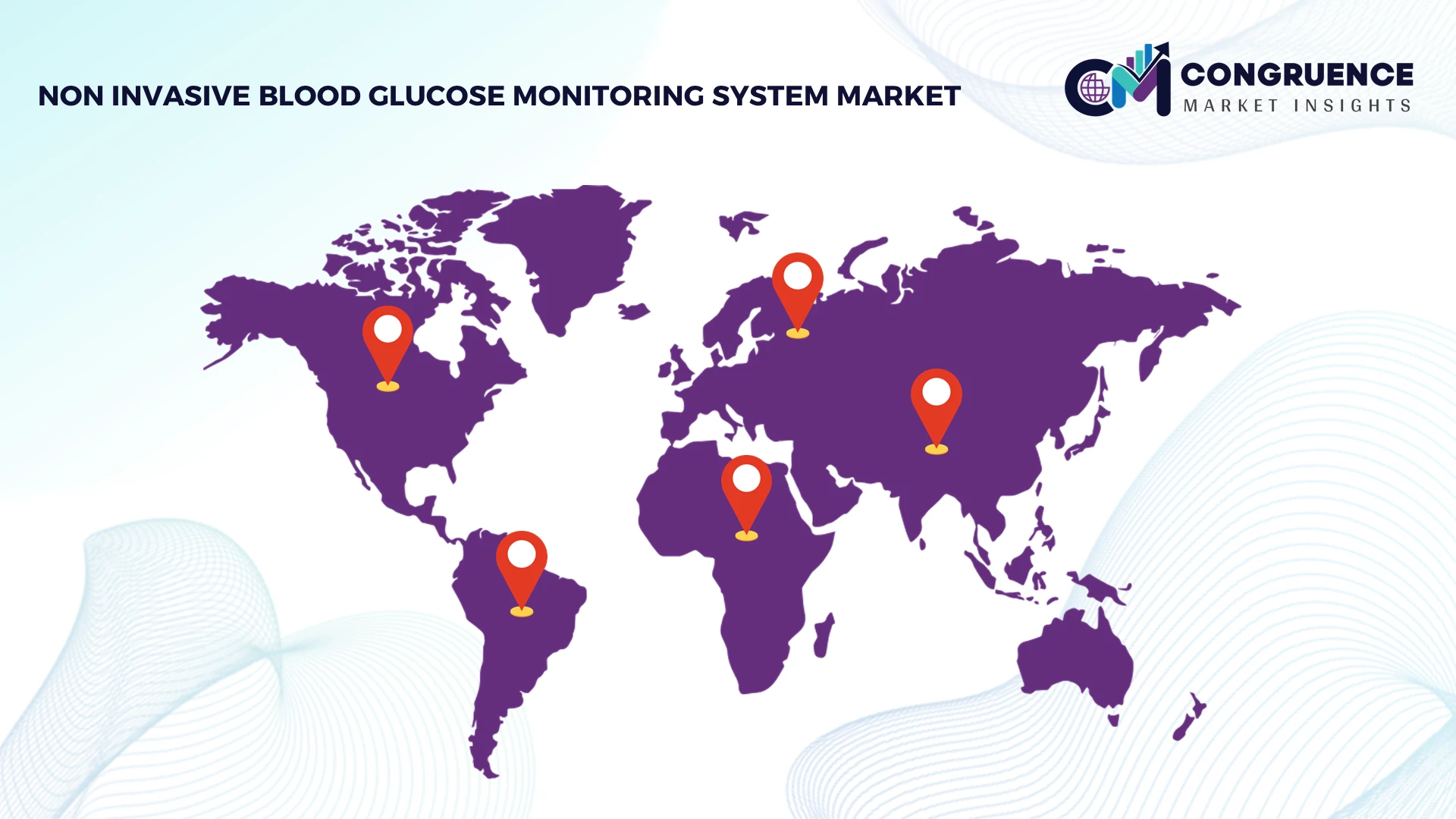
North America accounted for the largest market share at 39.98% in 2025 however, Asia-Pacific is expected to register the fastest growth, expanding at a CAGR of 9.45% between 2026 and 2033.
U.S.-Led Commercialization and Clinical Validation
North America holds approximately 39.98% of the market, supported by strong medical-device infrastructure, advanced wearable ecosystems, and concentrated clinical-development activity in the United States. U.S. manufacturers are accelerating optical, electromagnetic, and AI-enabled sensing programs while integrating glucose data into connected-care platforms. Arm and wrist-based solutions already represent about 39.74% of device-placement demand, reinforcing the region’s preference for compact wearable architectures. Established reimbursement pathways and sophisticated clinical networks also shorten commercialization cycles compared with emerging markets. Companies are increasing investment in validation, algorithm development, and strategic technology partnerships to move non-invasive systems from prototype stages toward scalable deployment.
United States Market Outlook:
The United States remains the region’s principal technology and commercialization center, supported by FDA-oriented product development, large clinical research networks, and strong digital-health adoption. More than 80% of North American market activity is concentrated in the U.S., giving domestic developers an important advantage in clinical validation, enterprise partnerships, and connected-device integration.
Regulated Innovation and Connected-Care Modernization
Europe is strengthening its position through medical-device modernization, digital-health infrastructure, and increasing integration of glucose data into remote-care workflows. Germany, the United Kingdom, France, and Nordic markets provide the strongest combination of healthcare infrastructure and technology adoption. Wearable architectures are gaining traction as manufacturers prioritize lower-maintenance monitoring and interoperability. Germany’s advanced medical-device manufacturing base supports optical sensing and precision instrumentation, while the United Kingdom provides a strong research and digital-health ecosystem. Companies are responding through clinical partnerships, localized regulatory strategies, and collaborations linking sensor hardware with healthcare software. Sustainability considerations are also favoring systems that reduce dependence on recurring disposable testing materials.
Germany Market Outlook:
Germany offers Europe’s strongest industrial foundation for precision medical devices, photonics, and clinical engineering. Its dense network of hospitals, research institutions, and technology manufacturers supports advanced sensor validation. Companies are using Germany as a development and commercialization base for spectroscopy-based platforms, with research-intensive projects increasingly combining optical sensing and AI analytics.
Manufacturing Scale Meets Rapid Digital Deployment
Asia-Pacific is the fastest-expanding geographic market, with growth supported by China’s electronics manufacturing capacity, Japan’s precision engineering, South Korea’s wearable-device expertise, and India’s expanding digital-health infrastructure. The region records approximately 9.45% growth, while its comparatively lower penetration than North America creates substantial deployment headroom. China is particularly important for component sourcing and high-volume wearable manufacturing, helping reduce production costs and shorten hardware development cycles. India is strengthening domestic medical-device innovation through digital healthcare programs and engineering talent. Companies are establishing regional partnerships, localizing components, and adapting products for smartphone-linked monitoring. The strategic advantage is increasingly shifting from manufacturing scale alone toward integrated hardware, analytics, and clinical validation.
China Market Outlook:
China provides the strongest manufacturing and electronics ecosystem in Asia-Pacific, supporting rapid prototyping, sensor-component sourcing, and wearable-device production. Its large domestic technology market also enables companies to test connected monitoring architectures at scale. Manufacturers are increasingly combining local semiconductor, photonics, and software capabilities to reduce dependence on imported components and accelerate product iteration.
Brazil Anchors Decentralized Monitoring Adoption
South America remains an emerging deployment market where affordability, healthcare access, and distribution infrastructure strongly influence adoption. Brazil represents the principal commercial hub because of its population scale, established healthcare networks, and expanding digital-health adoption. Mexico is also relevant through medical-device distribution and technology partnerships. Home-based monitoring is gaining strategic importance as healthcare providers seek to reduce repeated facility visits and improve remote patient engagement. However, out-of-pocket costs and uneven infrastructure constrain premium device penetration. Companies are responding with lower-complexity wearable designs, distributor partnerships, and localized commercialization models. The non-obvious opportunity is the use of smartphone-connected systems to extend monitoring beyond specialist facilities without requiring major new clinical infrastructure.
Brazil Market Outlook:
Brazil provides the strongest demand base in South America, supported by a population exceeding 200 million and a broad public-private healthcare structure. Companies can use Brazil as a regional distribution and pilot market, particularly for lower-cost connected monitoring systems that combine wearable sensing with mobile-health applications.
Healthcare Modernization Drives Premium Deployment
The Middle East & Africa market is being shaped by healthcare modernization, private hospital expansion, and government-led digital transformation. Saudi Arabia, the United Arab Emirates, Israel, and South Africa represent the strongest technology and deployment centers. Gulf healthcare systems are increasingly investing in connected diagnostics and remote monitoring, while Israel contributes advanced biosensing and medical-device innovation. Premium private healthcare providers are particularly receptive to wearable monitoring because integrated data platforms can improve patient-management workflows. Companies are responding through hospital partnerships, localized distribution agreements, and technology collaborations. The main operational constraint remains uneven healthcare infrastructure outside major urban centers, making compact, remotely connected systems more commercially relevant than infrastructure-intensive solutions.
Saudi Arabia Market Outlook:
Saudi Arabia is emerging as a strategic deployment market because healthcare modernization is increasingly linked with digital infrastructure and technology-enabled patient management. Large hospital networks and expanding private healthcare capacity create opportunities for connected glucose-monitoring platforms, while national digital-health investment supports integration with broader remote-care ecosystems.
The competitive field pits established glucose-monitoring leaders such as Abbott, Dexcom, and Medtronic against technology innovators including Know Labs, DiaMonTech, Biolinq, and Nemaura Medical. The top five players collectively account for an estimated 55% of competitive market activity, although the true non-invasive segment remains fragmented because several technologies are still progressing through validation. Competition centers on accuracy, sensor miniaturization, interoperability, and clinical validation, with advanced platforms targeting 10–20% improvements in signal-processing efficiency and lower maintenance requirements. Companies are competing through clinical partnerships, sensor R&D, software integration, and vertical control of hardware-to-data workflows. The competitive shift is moving from conventional glucose-monitoring expertise toward proprietary sensing architectures and AI-enabled interpretation. High clinical-validation requirements remain the principal entry barrier. Winning players will combine regulatory credibility, scalable manufacturing, differentiated sensing technology, and connected-data capabilities rather than compete on device price alone.
Abbott Laboratories
Dexcom, Inc.
Medtronic plc
Know Labs, Inc.
DiaMonTech AG
Nemaura Medical, Inc.
Biolinq, Inc.
Movano Health, Inc.
Afon Technology Ltd.
CNOGA Medical Ltd.
RSP Systems A/S
Integrity Applications Inc.
Senseonics Holdings, Inc.
Apple Inc.
Current platforms increasingly combine optical spectroscopy, RF sensing, photothermal detection, and AI signal processing. RF spectroscopy has demonstrated MARD of 12.7% in normoglycemic and 14.0% in hyperglycemic ranges, while photothermal systems have reached performance comparable with early continuous monitors. These architectures reduce consumable dependence and support 1–2% operational efficiency gains through automated data capture.
Emerging wearable sensors are moving glucose measurement into wrist and patch form factors, integrating Bluetooth, mobile dashboards, activity, and sleep data. A 2026 real-world trial reported 75% accuracy in distinguishing normal from elevated glucose levels, showing the gap between laboratory validation and everyday deployment. Compared with finger-prick workflows, needle-free architectures remove repeated lancet and strip handling, creating an estimated 1–2% workflow-time improvement for frequent monitoring. Biolinq benefits from this transition through autonomous multianalyte sensing.
From 2026–2028, the disruptive pathway centers on multimodal sensing, edge AI, adaptive calibration, and interoperable health platforms. AI models using multimodal physiological inputs have demonstrated MAPE near 10.88%, strengthening personalized prediction potential. Companies with validated sensors, proprietary algorithms, and scalable semiconductor integration will gain an advantage as deployment expands. The priority now is moving from isolated sensing breakthroughs toward validated, manufacturable ecosystems that combine accuracy, low maintenance, real-time analytics, and connected-care integration.
September 2025 Biolinq received FDA De Novo classification for Shine, a needle-free wearable integrating glucose, activity, and sleep data. The decision creates a commercialization pathway, enabling scale-up of multianalyte metabolic monitoring and strengthening Biolinq’s competitive position in wearables. Source: FDA
July 2024 DiaMonTech reported a clinical trial of its infrared-laser glucose technology involving 36 participants. The system achieved MARD comparable with early-stage continuous monitors, supporting further miniaturization and certification efforts while reducing dependence on consumables for point measurements. Source: DiaMonTech
January 2025 Know Labs launched Technology Licensing, extending its RF dielectric spectroscopy platform to partners. The program covered an IP portfolio exceeding 330 patents, creating a licensing route that can accelerate commercialization beyond developed glucose-monitoring devices and partnerships.
March 2026 Afon Technology reported approximately 75% accuracy for Glucowear in its first real-world trial distinguishing normal from elevated glucose. The result validates practical operation outside laboratories while identifying performance-improvement priorities before broader clinical commercialization and market deployment. Source: Afon Technology
The Non-Invasive Blood Glucose Monitoring System Market Report covers four technology types—Optical, Electromagnetic, Transdermal, and Wearable Sensors—alongside four application areas: Diabetes Monitoring, Glucose Tracking, Glycemic Control, and Health Monitoring. End-user analysis spans Hospitals & Clinics, Diagnostic Centers, Home Healthcare, and Research Institutions, enabling comparison of institutional procurement with decentralized monitoring demand. The scope also evaluates emerging sensing architectures, AI-assisted calibration, spectroscopy, connected wearables, and multimodal physiological-data integration.
Geographic coverage includes North America, Europe, Asia-Pacific, South America, and Middle East & Africa, with country-level assessment of adoption, infrastructure, manufacturing, regulatory positioning, and technology deployment. Competitive analysis covers leading innovators and established glucose-monitoring companies, while segmentation tracks approximately 4 major technology pathways and 4 principal end-user groups. The report supports investment planning, market-entry decisions, partnership selection, expansion priorities, competitive positioning, and technology roadmaps through 2026–2033, emphasizing validated deployment and scalable commercialization.
| Report Attribute/Metric | Report Details |
|---|---|
Market Revenue in 2025 | USD 39.21 Million |
Market Revenue in 2033 | USD 100.62 Million |
CAGR (2026 - 2033) | 12.5% |
Base Year | 2025 |
Forecast Period | 2026 - 2033 |
Historic Period | 2021 - 2025 |
Segments Covered | By Type
By Application
By End-User
|
Key Report Deliverable | Revenue Forecast, Growth Trends, Market Dynamics, Segmental Overview, Regional and Country-wise Analysis, Competition Landscape |
Region Covered | North America, Europe, Asia-Pacific, South America, Middle East, Africa |
Key Players Analyzed | Abbott Laboratories, Dexcom, Inc., Medtronic plc, Know Labs, Inc., DiaMonTech AG, Nemaura Medical, Inc., Biolinq, Inc., Movano Health, Inc., Afon Technology Ltd., CNOGA Medical Ltd., RSP Systems A/S, Integrity Applications Inc., Senseonics Holdings, Inc., Apple Inc. |
Customization & Pricing | Available on Request (10% Customization is Free) |




