
Reports
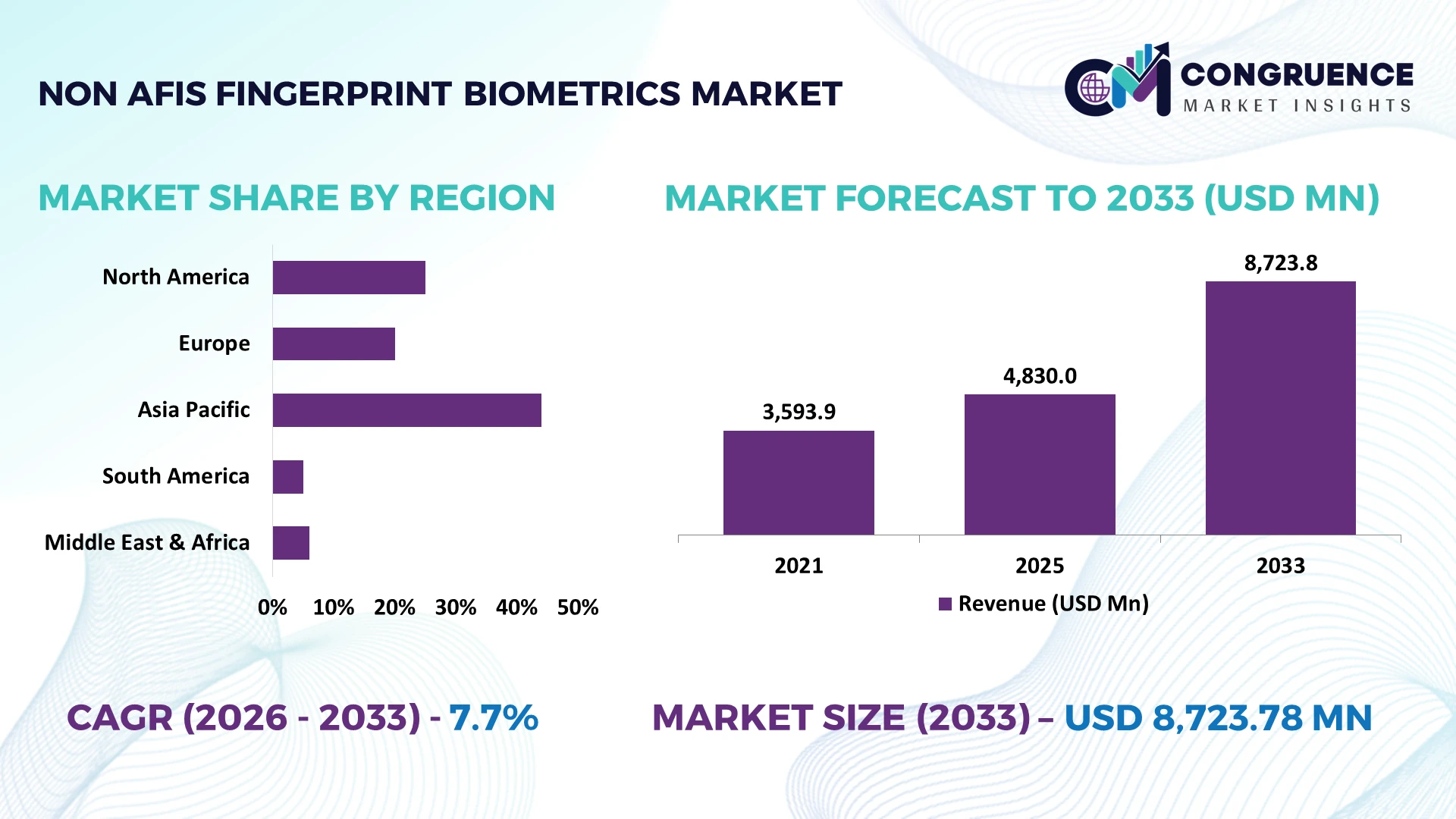
The Global Non-AFIS Fingerprint Biometrics Market was valued at USD 4830 Million in 2025 and is anticipated to reach a value of USD 8723.78 Million by 2033 expanding at a CAGR of 7.67% between 2026 and 2033. Growth is driven by fingerprint enabled smartphone authentication, biometric payment verification, enterprise access control modernization, and integration of fingerprint sensors into digital identity infrastructure.
India represents a major deployment ecosystem for fingerprint enabled authentication, supported by approximately 1.34 billion live Aadhaar holders and more than 170 billion cumulative authentication transactions reported in March 2026. Banking, telecommunications, public services, and digital identity verification underpin deployment. Compared with the United States, where enterprise authentication emphasizes decentralized credentials, India operates extensive centralized identity infrastructure. Globally, 68% of surveyed organizations reported deploying or introducing passkeys, strengthening the commercial opportunity for compatible fingerprint verification devices and secure authentication platforms.
Strategically, manufacturers should prioritize India's established biometric infrastructure and enterprise authentication integration, while distinguishing device authentication opportunities from centralized AFIS applications.
Market Size & Growth: USD 4,830 million in 2025, reaching USD 8,723.78 million by 2033 at 7.67% CAGR, driven by embedded fingerprint authentication.
Top Growth Drivers: 75% consumer passkey enablement, 68% organizational deployment activity, and 49% regular consumer usage support authentication ecosystem expansion.
Short Term Forecast: By 2028, fingerprint vendors face a measurable benchmark of 93% successful passkey sign ins, reported across participating services in 2026.
Emerging Technologies: Ultrasonic fingerprint sensing, AI assisted liveness detection, and secure enclave processing advance biometric authentication across 3 technology categories.
Regional Leaders: North America, Asia Pacific, and Europe lead deployment opportunities; separate regional USD forecasts remain unverified.
Consumer/End User Trends: 90% passkey awareness among surveyed consumers strengthens the addressable ecosystem for fingerprint enabled authentication.
Pilot/Case Example: The 2026 FIDO Passkey Index recorded 93% successful passkey sign ins versus 78% for traditional authentication methods.
Competitive Landscape: Fingerprint Cards, IDEMIA, Thales, Synaptics, and Goodix compete across sensing and identity solutions; individual market shares remain unverified.
Regulatory & ESG Impact: European Union rules distinguish biometric verification from remote identification, creating different compliance requirements for 2 authentication categories.
Investment & Funding: More than 240 organizations joined FIDO's Passkey Pledge, indicating expanding ecosystem commitments; dedicated fingerprint investment totals remain undisclosed.
Innovation & Future Outlook: An estimated 7 billion global passkeys in October 2026 reinforce opportunities for on device fingerprint verification and interoperable identity platforms.
The global Non-AFIS Fingerprint Biometrics Market is increasingly shaped by smartphone authentication, banking security, enterprise workforce verification, and embedded access control systems. Ultrasonic sensors, capacitive fingerprint modules, and AI assisted presentation attack detection are improving authentication reliability while enabling secure processing directly on connected devices. FIDO's 2026 findings show that 57% of surveyed organizations still primarily use authentication methods vulnerable to phishing, highlighting a substantial enterprise security modernization opportunity. European privacy requirements further favor carefully designed biometric verification architectures, making interoperability, template protection, and deployment economics central to strategic competitive positioning.
Non AFIS fingerprint biometrics is becoming strategically important as banks, smartphone manufacturers, healthcare providers, and enterprise security operators replace password dependent authentication with device based identity verification. The transition toward phishing resistant authentication, accelerated by FIDO standards and European digital identity regulations, is reshaping procurement priorities. India's Aadhaar infrastructure demonstrates the operational scale of biometric identity services, while private enterprises increasingly prioritize locally stored fingerprint templates to strengthen privacy and reduce centralized credential exposure.
Technology modernization is improving authentication performance. The 2026 FIDO Passkey Index reported 93% successful passkey sign ins compared with 78% for conventional authentication, representing a 15 percentage point improvement across the broader authentication ecosystem. China's smartphone supply chain emphasizes integrated fingerprint sensors, whereas American enterprises prioritize secure device authentication and workforce identity management. These differences influence sensor design, certification requirements, and distribution partnerships.
During 2026 to 2028, manufacturers are prioritizing ultrasonic sensing, presentation attack detection, and secure enclave integration. A practical deployment involves fingerprint enabled employee credentials replacing shared passwords across enterprise applications, reducing credential exposure and simplifying access administration. Suppliers are expanding partnerships with semiconductor manufacturers, authentication software developers, and device manufacturers. Competitive advantage increasingly depends on combining reliable sensing hardware with interoperable authentication platforms, measurable security performance, and efficient deployment across regulated industries.
Enterprise migration toward phishing resistant authentication is strengthening demand for embedded fingerprint sensors, secure authentication modules, and biometric access terminals. In 2026, 68% of surveyed organizations had deployed or were implementing passkeys, while 57% continued relying primarily on phishing vulnerable employee authentication. Additionally, 75% of surveyed consumers had enabled passkeys on at least one account, indicating wider acceptance of device based verification. The United States is accelerating workforce identity modernization through FIDO2 authentication and secure hardware integration. Fingerprint sensor manufacturers are responding through semiconductor partnerships, improved matching algorithms, and enterprise device certification. Suppliers integrating biometric hardware with existing identity management platforms gain stronger procurement positioning and lower deployment friction.
Legacy enterprise infrastructure creates immediate barriers to fingerprint authentication integration, particularly across shared workstations, industrial terminals, and older identity management systems. Among surveyed organizations facing passwordless deployment barriers, 38% identified legacy system compatibility, 35% reported budget approval constraints, and 33% highlighted device recovery concerns. Germany's industrial manufacturing environment illustrates the complexity of integrating biometric credentials with established operational technology and enterprise access systems. Additional requirements for fingerprint template encryption, reader compatibility, and identity lifecycle management increase implementation expenses. Vendors are addressing these constraints through modular biometric readers, software development kits, and compatibility partnerships. Supporting existing infrastructure without extensive replacement remains essential for protecting customer budgets and accelerating commercial deployment.
Ultrasonic fingerprint sensing, secure element integration, and decentralized identity verification are creating opportunities beyond conventional smartphone unlocking. In 2026, 90% of surveyed consumers recognized passkeys, while 49% used them regularly when available, revealing considerable scope for deeper authentication integration. Meanwhile, 47% of consumers surveyed in 2025 reported willingness to abandon purchases after forgetting passwords. India's digital payments ecosystem offers opportunities for fingerprint enabled merchant terminals, banking applications, and portable identity devices, subject to applicable authentication rules. Manufacturers are investing in compact sensors, biometric template protection, and interoperable authentication software. Combining fingerprint verification with secure payment credentials offers differentiation through transaction convenience, reduced authentication friction, and stronger customer retention.
Maintaining consistent fingerprint recognition performance across diverse devices, environmental conditions, and user populations remains a critical execution challenge. United States NIST guidance specifies a biometric false match rate no greater than 0.01% and recommends false nonmatch rates below 5%, establishing demanding performance benchmarks. Presentation attack detection introduces additional testing requirements for fingerprint authentication systems. Industrial deployments must also accommodate contaminated sensors, damaged fingerprints, and repeated authentication attempts without compromising security. Manufacturers are responding through enhanced image processing, liveness detection, multimodal fallback mechanisms, and independent performance certification. Long term competitiveness depends on maintaining recognition accuracy across large device fleets while ensuring secure firmware updates, reliable credential recovery, and consistent authentication performance.
Under Display Sensor Integration Accelerates: Smartphone manufacturers are shifting fingerprint modules beneath display panels to improve device design and authentication accessibility. Qualcomm's 3D Sonic Sensor Gen 2 offers a 77% larger sensing area and 50% faster processing than its predecessor. Chinese smartphone manufacturers are integrating ultrasonic modules into premium devices, while sensor suppliers strengthen partnerships with display manufacturers and semiconductor foundries. This transition increases component integration requirements while improving authentication responsiveness.
Contactless Fingerprint Capture Gains Traction: Contactless fingerprint acquisition is progressing across healthcare facilities and identity enrollment environments where physical contact introduces hygiene and maintenance concerns. NIST contactless fingerprint evaluations use 2D imaging and standardized matching procedures to assess interoperability with conventional fingerprint databases. Suppliers are refining optical capture, image normalization, and presentation attack detection. The operational advantage lies in reducing shared surface contact while preserving verification reliability across existing biometric workflows.
Fingerprint Authentication Enters Connected Devices: Industrial equipment manufacturers are embedding fingerprint authentication into connected terminals, smart cabinets, and specialized operational devices. Bluetooth 5.4 supports encrypted communication, while USB 3.2 enables data transfer rates reaching 20 Gbps for compatible peripheral interfaces. Equipment suppliers are integrating secure microcontrollers and encrypted fingerprint templates to support localized authentication. This architecture reduces dependence on continuous network connectivity and strengthens access management in distributed industrial facilities.
Biometric Template Protection Becomes Standardized: Fingerprint technology suppliers are strengthening template security as privacy requirements influence device procurement. ISO/IEC 24745 addresses biometric information protection, while ISO/IEC 30107 establishes presentation attack detection frameworks. The European Union's AI Act introduces phased regulatory obligations through 2026, increasing scrutiny of biometric applications. Manufacturers are prioritizing encrypted storage, cancellable templates, and independent testing, improving enterprise procurement readiness while reducing exposure associated with compromised biometric credentials.
Capacitive Fingerprint Scanners represent the leading type, with an indicative market share of approximately 40% to 45%, reflecting their established integration into smartphones, enterprise authentication devices, and compact biometric terminals. Their low power consumption, semiconductor compatibility, and compact architecture support large production volumes. Optical Fingerprint Scanners remain important for desktop authentication, attendance terminals, and institutional identity verification, where established manufacturing processes and affordable hardware support procurement. Capacitive technologies maintain competitive advantages through sensor miniaturization, consistent recognition performance, and integration with secure authentication processors.
Ultrasonic Fingerprint Scanners represent the fastest advancing technology category, benefiting from improved subsurface fingerprint imaging and premium device integration. Qualcomm's second generation ultrasonic technology demonstrated a 77% larger sensing area and 50% faster processing compared with its predecessor. Thermal Fingerprint Scanners serve specialized environments requiring temperature sensitive biometric capture, although integration complexity limits broader deployment. Manufacturers are directing product development toward ultrasonic sensing, while capacitive suppliers prioritize cost optimization, improved sensor coatings, and partnerships with electronics manufacturers to defend established applications.
Access Control represents the leading application, with an indicative market share of approximately 30% to 35%, supported by deployment across corporate offices, manufacturing facilities, commercial buildings, and institutional premises. Fingerprint enabled access terminals provide individual credential verification and centralized permission management, replacing shared access codes and conventional identification cards. Identity Verification remains important for customer onboarding and regulated authentication workflows, particularly where identity assurance and biometric matching are operational priorities. Workforce Management applications integrate fingerprint attendance recording with employee scheduling, payroll administration, and workplace access systems, strengthening operational accountability.
Financial Authentication represents the fastest advancing application as banks integrate device based fingerprint verification into mobile banking, payment authorization, and customer account protection. The 2026 FIDO Passkey Index recorded 93% successful passkey sign ins compared with 78% for conventional authentication, demonstrating the broader value of modern authentication workflows. Border Security remains a specialized application requiring high assurance identity checks and regulatory compliance. Technology providers are developing integrated authentication platforms, secure biometric readers, and application programming interfaces to address increasingly complex institutional requirements.
Government represents the leading end user category, with an indicative market share of approximately 30% to 35%, supported by public administration, institutional access control, citizen service verification, and identity infrastructure modernization. India's Aadhaar ecosystem demonstrates the scale of biometric enabled identity services, although centralized identification operations extend beyond the Non AFIS market scope. Government procurement emphasizes secure biometric terminals, standardized authentication protocols, and durable equipment. Banking and Finance represents the fastest advancing end user category as financial institutions integrate fingerprint authentication into digital banking applications, payment verification, and secure customer access.
Healthcare organizations deploy fingerprint readers for clinical workstation access, staff authentication, and restricted facility management, while IT and Telecommunications companies prioritize secure employee credentials and device authentication. Retail adoption centers on point of sale security, employee access, and transaction authorization. The FIDO Alliance reported 49% regular consumer passkey usage in 2026, indicating broader acceptance of modern authentication methods. Suppliers are strengthening financial technology partnerships, developing healthcare compatible devices, and offering modular authentication platforms to address sector specific deployment requirements.
Asia Pacific accounted for the largest estimated market share at 38% in 2025 however, Asia Pacific is expected to register the fastest growth, expanding at a CAGR of 9.2% between 2026 and 2033.
Enterprise Security Modernization and Advanced Authentication Integration
North America holds an estimated 27% share of the global Non AFIS fingerprint biometrics market, supported by enterprise cybersecurity modernization, advanced semiconductor development, and widespread deployment of fingerprint enabled consumer electronics. The United States dominates regional procurement through financial institutions, technology companies, healthcare networks, and corporate security operators. FIDO2 authentication standards are influencing hardware purchasing decisions, particularly for devices supporting secure local fingerprint verification. Canada's financial services and government institutions emphasize privacy compliant identity management and secure credential administration. The region benefits from established semiconductor design capabilities, authentication software ecosystems, and strong enterprise purchasing power. NIST biometric performance guidelines establish a false match rate benchmark of 0.01%, reinforcing demand for independently evaluated recognition technologies. Manufacturers are strengthening partnerships with cybersecurity platforms and enterprise hardware providers to improve authentication interoperability and reduce integration complexity.
United States Market Outlook: The United States maintains a strategic advantage through semiconductor innovation, cybersecurity research, and enterprise identity management infrastructure. NIST SP 800 63B provides technical guidance for biometric authentication, including requirements for secure authentication mechanisms. Technology companies are integrating fingerprint recognition into laptops, security keys, and workforce authentication systems. Federal zero trust initiatives further strengthen procurement opportunities for hardware backed identity verification.
Privacy Regulation Reshapes Biometric Technology Procurement
Europe accounts for an estimated 22% of global Non AFIS fingerprint biometrics demand, with Germany, France, and the United Kingdom supporting significant enterprise and institutional deployment. The General Data Protection Regulation establishes strict conditions for processing biometric information used to uniquely identify individuals, influencing product architecture and procurement procedures. European manufacturers emphasize encrypted fingerprint templates, secure local authentication, and privacy preserving credential management. Financial institutions are integrating biometric verification into customer authentication workflows, while industrial enterprises increasingly require reliable access control for restricted facilities. The European Digital Identity Framework introduces standardized digital identity capabilities, strengthening demand for compatible authentication technologies. Under the revised eIDAS framework, European Union member states are required to provide at least one European Digital Identity Wallet by the end of 2026. Suppliers are responding through certification investments, interoperability testing, and partnerships with identity infrastructure providers.
Germany Market Outlook: Germany represents a strategically important market because of its industrial manufacturing concentration, financial infrastructure, and established enterprise cybersecurity requirements. Manufacturing companies are integrating fingerprint authentication into workplace access systems and secure industrial terminals. The country's Industry 4.0 ecosystem encourages interoperability between physical security hardware and digital identity platforms, while GDPR compliance influences biometric template storage and workforce authentication policies.
Semiconductor Manufacturing Scale Strengthens Sensor Deployment
Asia Pacific leads the global Non AFIS fingerprint biometrics market with an estimated 38% share, supported by smartphone manufacturing, semiconductor packaging, electronics assembly, and digital authentication infrastructure. China maintains a strong position in fingerprint sensor integration through domestic smartphone manufacturers and component suppliers, including Goodix. South Korea contributes advanced display technologies and premium mobile device manufacturing, while Taiwan supports semiconductor fabrication and electronic component supply chains. India provides substantial authentication deployment opportunities across financial services, enterprise identity management, and digital public infrastructure. Qualcomm's second generation ultrasonic fingerprint sensor demonstrated a 77% larger sensing area and 50% faster processing than its predecessor, illustrating the technology improvements influencing regional device development. Manufacturers are expanding collaborations between sensor designers, semiconductor foundries, and electronics assemblers to improve production efficiency and shorten product development cycles.
China Market Outlook: China benefits from an extensive consumer electronics manufacturing ecosystem and domestic fingerprint sensor development capabilities. Goodix supplies fingerprint recognition technologies for smartphone manufacturers, supporting integration across multiple device categories. Chinese electronics manufacturers are expanding ultrasonic fingerprint integration into premium smartphones while maintaining capacitive solutions for cost sensitive devices. Semiconductor localization priorities strengthen domestic component development and encourage closer coordination between sensor suppliers and device manufacturers.
Financial Digitization Expands Biometric Authentication Applications
South America represents an estimated 7% of global Non AFIS fingerprint biometrics demand, with Brazil leading adoption across banking, enterprise security, retail, and institutional identity verification. Brazil's digital financial infrastructure creates opportunities for fingerprint enabled mobile authentication and secure customer access. The Central Bank of Brazil reported more than 170 million individual Pix users by 2025, demonstrating the scale of digital payment participation and associated authentication requirements. Argentina and Chile support additional deployment through financial services modernization and commercial access control. However, imported biometric components, uneven enterprise technology budgets, and integration expenses influence procurement decisions. Technology providers are responding through local distribution agreements, modular authentication products, and partnerships with financial software integrators. Suppliers offering affordable fingerprint terminals and compatibility with existing identity platforms maintain stronger positioning across price sensitive institutional deployments.
Brazil Market Outlook: Brazil leads regional opportunities through its banking infrastructure, digital payment adoption, and established financial technology ecosystem. The country's General Personal Data Protection Law regulates biometric information as sensitive personal data, influencing authentication system design. Banks and payment providers are incorporating device based verification into customer access workflows, while enterprise operators prioritize affordable fingerprint terminals, secure credential management, and reliable local technical support.
Digital Government Investment Accelerates Identity Infrastructure Modernization
The Middle East and Africa account for an estimated 6% of global Non AFIS fingerprint biometrics demand, supported by government digitization, banking modernization, and infrastructure security investments. Saudi Arabia and the United Arab Emirates prioritize digital identity infrastructure and integrated public service authentication, while South Africa supports enterprise and financial authentication deployment. Saudi Arabia's Vision 2030 program encourages digital government modernization and secure identity services. The United Arab Emirates has expanded UAE Pass as a national digital identity platform, with registered users exceeding 11 million in 2025. These developments create integration opportunities for fingerprint enabled authentication devices, although digital identity platforms also support alternative verification technologies. Manufacturers are developing partnerships with government technology contractors, financial institutions, and regional system integrators to address procurement requirements, infrastructure compatibility, and localized technical support.
United Arab Emirates Market Outlook: The United Arab Emirates benefits from advanced digital government infrastructure, financial technology investment, and extensive adoption of electronic public services. UAE Pass supports digital identity authentication across government and private sector applications. Fingerprint technology suppliers can target secure enterprise access, banking authentication, and specialized institutional terminals, emphasizing interoperability, encrypted biometric templates, and integration with established digital identity systems.
The global Non AFIS fingerprint biometrics market features competition between semiconductor specialists Goodix, Qualcomm, and Synaptics, authentication technology providers Fingerprint Cards and IDEX Biometrics, and enterprise security suppliers Suprema and IDEMIA. The five leading suppliers collectively represent an estimated 30% to 35% of the broader fingerprint sensor market, although Non AFIS concentration differs by application. Qualcomm's ultrasonic technology delivers 77% greater sensing area and 50% faster processing, intensifying performance competition against established capacitive solutions. Suppliers compete through sensor pricing, recognition accuracy, certification, and integration flexibility. Goodix emphasizes smartphone partnerships, while Suprema develops enterprise authentication terminals and IDEX targets biometric payment applications. Competition increasingly favors integrated hardware, encrypted credential management, and presentation attack detection rather than standalone fingerprint readers. Semiconductor manufacturing dependencies and certification expenses create substantial entry barriers. Winning requires differentiated sensing performance, reliable component sourcing, interoperable authentication software, and established relationships with enterprise equipment manufacturers and institutional buyers worldwide.
Fingerprint Cards AB
NEXT Biometrics Group ASA
IDEX Biometrics ASA
Egis Technology Inc.
Goodix Technology Co., Ltd.
Synaptics Incorporated
Qualcomm Technologies, Inc.
Suprema Inc.
IDEMIA Group
Thales Group
SecuGen Corporation
Integrated Biometrics LLC
ZKTeco Co., Ltd.
Precise Biometrics AB
Capacitive fingerprint sensors remain central to smartphone authentication, enterprise access terminals, and workforce identity verification because of compact integration and established semiconductor manufacturing. Optical scanners support institutional terminals requiring durable capture surfaces and standardized matching. Qualcomm's second generation ultrasonic sensing technology delivers a 77% larger scanning area and 50% faster processing than its predecessor, demonstrating measurable improvements over older ultrasonic designs. These advances strengthen device responsiveness and differentiate premium biometric hardware.
Emerging technologies combine ultrasonic imaging, artificial intelligence assisted fingerprint matching, and presentation attack detection with secure enclave processing. Contactless optical capture is gaining relevance in healthcare and shared authentication environments, while encrypted biometric templates reduce exposure associated with centralized credential storage. The FIDO Alliance reported 75% consumer passkey enablement in 2026, indicating substantial deployment readiness for compatible fingerprint authentication devices. Sensor manufacturers benefit from partnerships with smartphone producers, semiconductor suppliers, and identity software developers.
Between 2026 and 2028, disruptive development will emphasize secure local matching, interoperable credentials, and compact fingerprint modules for connected industrial equipment. Fingerprint Cards, Goodix, and Suprema compete through sensing accuracy, integration flexibility, and authentication reliability. Enterprises adopting integrated biometric hardware gain simplified credential administration and stronger device security. Suppliers combining certified sensing technologies with scalable authentication platforms strengthen long term positioning across regulated industries.
September 2026: Goodix Technology integrated ultrasonic and capacitive fingerprint sensors into nubia's NaviX Ultra AI smartphone, enabling 2 distinct authentication functions. The architecture separates AI authorization from device unlocking, strengthening secure interaction and expanding biometric applications. Source: goodix.com
October 2025: IDEMIA introduced MorphoWave XP2, a contactless biometric terminal capturing 4 fingerprints in less than one second. Integration with Apple Wallet credentials strengthens enterprise access control, enabling rapid identity verification and supporting more efficient authentication workflows. Source: idemia.com
May 2026: Suprema launched BioStation 3 Max, integrating fingerprint recognition, facial authentication, and mobile credentials into one terminal. Supporting 100,000 fingerprint users, the platform strengthens enterprise access control scalability and simplifies credential management across high security facilities. Source: supremainc.com
July 2026: IDEX Biometrics achieved FIDO2 Level 2 certification for its biometric access card technology, advancing independently validated authentication security. The certification strengthens enterprise procurement credentials and supports deployment of fingerprint enabled cards for secure physical and digital access. Source: idexbiometrics.com
The Non AFIS Fingerprint Biometrics Market Report evaluates industry developments between 2026 and 2033 across 4 technology types: optical, capacitive, ultrasonic, and thermal fingerprint scanners. Application coverage includes access control, identity verification, workforce management, financial authentication, and border security. End user analysis examines government, banking and finance, healthcare, IT and telecommunications, and retail. Geographic assessment covers North America, Europe, Asia Pacific, South America, and the Middle East and Africa, emphasizing manufacturing capabilities, deployment infrastructure, and regulatory requirements.
The report examines ultrasonic sensing, AI assisted recognition, secure biometric templates, and contactless authentication. Competitive analysis assesses Goodix, Suprema, Fingerprint Cards, IDEMIA, and emerging technology providers. Strategic coverage evaluates semiconductor sourcing, enterprise integration, certification requirements, and deployment economics, supporting investment prioritization, geographic expansion, technology selection, and competitive positioning.
| Report Attribute/Metric | Report Details |
|---|---|
Market Revenue in 2025 | USD 4830 Million |
Market Revenue in 2033 | USD 8723.78 Million |
CAGR (2026 - 2033) | 7.67% |
Base Year | 2025 |
Forecast Period | 2026 - 2033 |
Historic Period | 2021 - 2025 |
Segments Covered | By Type
By Application
By End-User
|
Key Report Deliverable | Revenue Forecast, Growth Trends, Market Dynamics, Segmental Overview, Regional and Country-wise Analysis, Competition Landscape |
Region Covered | North America, Europe, Asia-Pacific, South America, Middle East, Africa |
Key Players Analyzed | Fingerprint Cards AB, NEXT Biometrics Group ASA, IDEX Biometrics ASA, Egis Technology Inc., Goodix Technology Co., Ltd., Synaptics Incorporated, Qualcomm Technologies, Inc., Suprema Inc., IDEMIA Group, Thales Group, SecuGen Corporation, Integrated Biometrics LLC, ZKTeco Co., Ltd., Precise Biometrics AB |
Customization & Pricing | Available on Request (10% Customization is Free) |




