
Reports
The Global Noise Reducing Coatings Market was valued at USD 1,286.4 Million in 2025 and is anticipated to reach a value of USD 2,260.3 Million by 2033 expanding at a CAGR of 7.3% between 2026 and 2033. Expansion of electric vehicles, stricter industrial noise regulations, railway modernization, and lightweight acoustic material adoption is accelerating demand for advanced noise reducing coatings across transportation, construction, and industrial equipment.
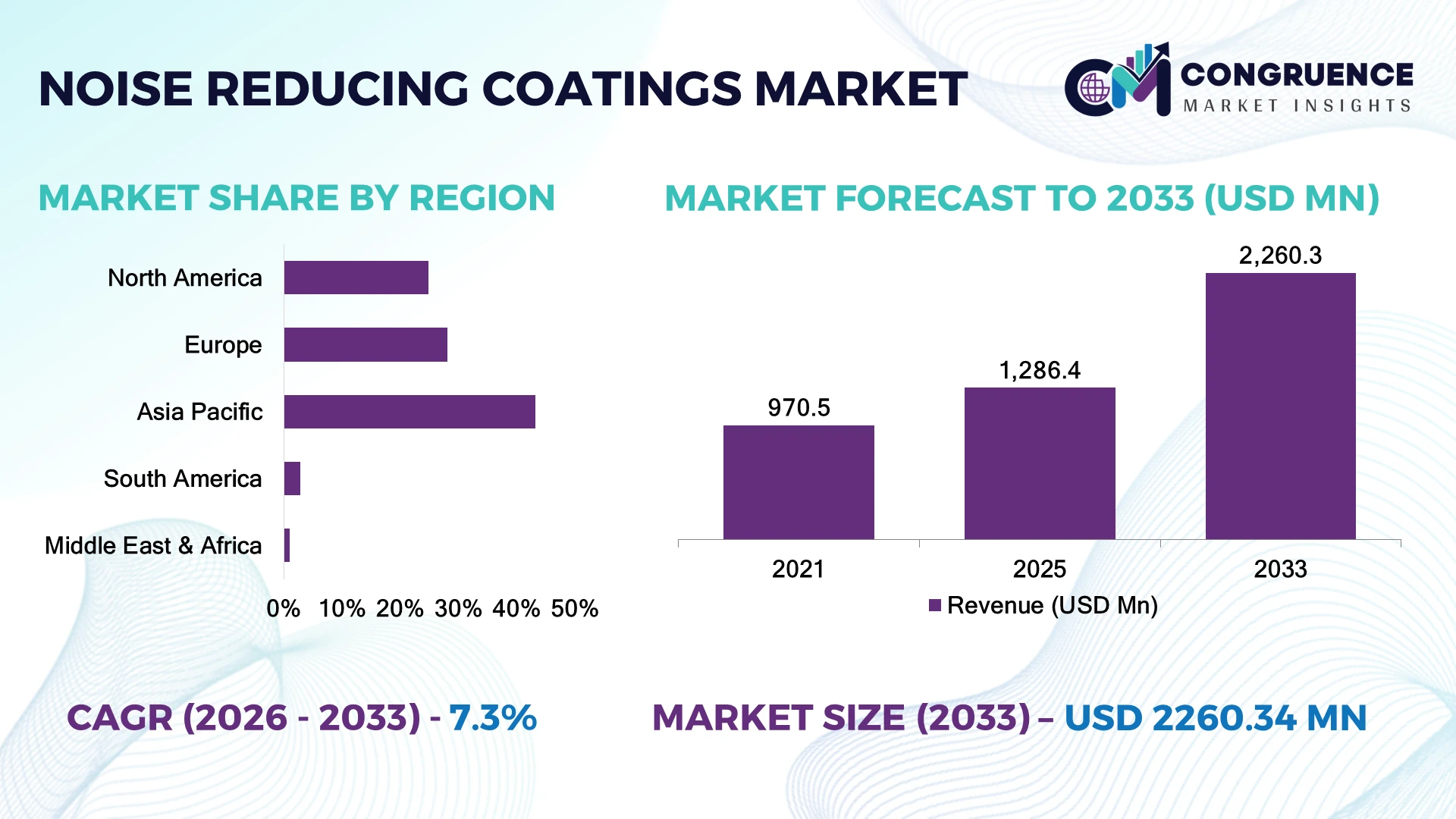
China remains the dominant country, accounting for approximately 34% of global manufacturing capacity, supported by its automotive, railway, shipbuilding, and industrial equipment sectors. More than 31 million vehicles were produced during 2025, creating significant demand for acoustic coatings, while Germany leads Europe in premium automotive applications and advanced coating technologies. Continued supply-chain diversification following geopolitical manufacturing realignments is encouraging regional production expansion and localized raw material sourcing.
Manufacturers investing in multifunctional acoustic coatings, automated production, and sustainable formulation technologies are strengthening long-term competitiveness across high-performance industrial applications.
Market Size & Growth: USD 1,286.4 Million in 2025, projected to reach USD 2,260.3 Million by 2033 at a CAGR of 7.3%, driven by electric mobility and industrial noise control.
Top Growth Drivers: Electric vehicles (+29%), railway modernization (+23%), and industrial automation (+19%).
Short-Term Forecast: By 2028, advanced acoustic coatings improve noise attenuation by approximately 18% while reducing coating weight by 12%.
Emerging Technologies: Nanomaterials, waterborne formulations, and AI-assisted coating development accelerate product innovation.
Regional Leaders: Asia-Pacific exceeds USD 980 Million, Europe approaches USD 590 Million, and North America surpasses USD 520 Million through transportation and industrial adoption.
Consumer/End-User Trends: Nearly 58% of OEMs prioritize lightweight acoustic coatings to improve vehicle efficiency and cabin comfort.
Pilot/Case Example: A 2026 rail modernization project reduced cabin noise by approximately 21% using multilayer acoustic coating systems.
Competitive Landscape: Leading suppliers control around 44% market share, including PPG Industries, AkzoNobel, BASF, Henkel, and Sika.
Regulatory & ESG Impact: Low-VOC coating technologies reduce solvent emissions by nearly 25% while supporting environmental compliance.
Investment & Funding: More than USD 1.2 Billion supports production expansion, sustainable coating technologies, and strategic manufacturing partnerships.
Innovation & Future Outlook: Smart acoustic coatings and multifunctional composite materials strengthen next-generation product differentiation.
Noise reducing coatings are increasingly deployed across electric vehicles, rail transport, heavy machinery, marine equipment, and commercial buildings where vibration damping and acoustic comfort directly improve operational performance. Waterborne formulations and nanostructured fillers now represent nearly 42% of advanced product development. Strengthening environmental regulations and regional manufacturing expansion continue accelerating innovation, establishing a solid foundation for the strategic market discussion.
The Noise Reducing Coatings Market is becoming strategically important as manufacturers balance lightweight engineering, acoustic performance, and environmental compliance across transportation and industrial sectors. Regulatory pressure on workplace noise, growing electric vehicle production, and infrastructure modernization are encouraging wider adoption of advanced damping technologies. Companies are restructuring supply chains and expanding regional manufacturing to improve delivery reliability while reducing dependence on imported specialty raw materials.
Modern polymer-based acoustic coatings incorporating nanofillers deliver approximately 20% greater vibration damping than conventional bitumen-based materials while reducing coating weight by nearly 15%. Asia-Pacific leads large-scale manufacturing and automotive deployment, whereas Europe focuses on premium mobility, sustainable formulations, and advanced industrial applications. During the next two to three years, wider adoption of low-VOC acoustic coatings and automated application technologies is expected to strengthen production efficiency and product consistency across multiple industries.
A practical example is the integration of lightweight acoustic coatings in electric vehicle battery enclosures and vehicle floor assemblies to improve passenger comfort without increasing structural mass. Manufacturers are investing in material science partnerships, expanding waterborne coating capacity, and developing multifunctional products combining corrosion protection with acoustic insulation. Organizations delivering superior acoustic performance, sustainable formulations, and scalable manufacturing capabilities will strengthen competitive positioning across the evolving global noise reducing coatings market.
The transition toward electric mobility is reshaping demand for advanced noise reducing coatings as quieter powertrains expose road, vibration, and structural noise previously masked by combustion engines. Nearly 64% of newly developed electric vehicle platforms now incorporate lightweight acoustic coating systems, while multilayer damping formulations improve vibration absorption by approximately 22%. China continues expanding electric vehicle manufacturing capacity, encouraging OEMs to integrate multifunctional coatings across battery enclosures and vehicle body structures. This structural shift improves passenger comfort without increasing vehicle weight. Manufacturers are investing in nanocomposite technologies, expanding waterborne coating production, and partnering with automotive OEMs to develop application-specific acoustic solutions that meet evolving mobility performance requirements.
Production of high-performance noise reducing coatings remains sensitive to fluctuations in specialty polymers, elastomers, and functional fillers. Advanced raw materials account for nearly 43% of total formulation costs, while prices for selected performance additives remain approximately 17% above historical averages following global supply-chain adjustments. Environmental regulations also require continuous reformulation toward lower-VOC chemistries, increasing development complexity and qualification expenses. These structural factors affect pricing flexibility, production planning, and manufacturing profitability. Companies are reducing operational exposure through localized raw material sourcing, long-term procurement contracts, reformulated binder technologies, and broader supplier diversification to improve cost stability while maintaining acoustic performance.
Demand is expanding for multifunctional coatings that combine acoustic insulation with corrosion resistance, thermal management, and lightweight protection in a single formulation. Approximately 36% of automotive material development programs now prioritize multifunctional surface technologies, while smart coating integration reduces assembly complexity by nearly 20%. Germany continues investing in advanced materials research supporting sustainable mobility and industrial manufacturing. Manufacturers are increasing R&D expenditure, collaborating with material science institutes, and developing nanostructured acoustic coatings compatible with automated production processes. A significant strategic opportunity lies in replacing multiple conventional protective layers with integrated coating systems that lower material consumption while improving operational efficiency.
Delivering uniform acoustic performance across diverse substrates and operating conditions remains a significant execution challenge. Approximately 31% of industrial coating qualification projects require repeated acoustic validation because substrate composition, coating thickness, and curing parameters directly influence damping efficiency. Increasing adoption of lightweight composites further complicates formulation optimization across automotive, rail, and industrial applications. These technical complexities affect product standardization, customer qualification timelines, and manufacturing scalability. Companies are investing in digital simulation tools, advanced acoustic testing laboratories, standardized application methods, and collaborative engineering programs to improve coating consistency while accelerating commercial deployment across multiple end-use industries.
Lightweight Acoustic Formulations Nearly 48% of newly developed automotive acoustic coatings utilize lightweight polymer technologies that reduce coating mass by approximately 15% while maintaining vibration damping performance. Electric vehicle production is accelerating this transition, prompting manufacturers to redesign formulations, automate application processes, and strengthen material partnerships that improve energy efficiency and production flexibility.
Waterborne Technology Adoption Low-VOC waterborne acoustic coatings now represent roughly 41% of premium product introductions, reducing solvent emissions by nearly 25% while improving workplace safety. Tightening environmental regulations are encouraging manufacturers to modernize production lines, optimize curing technologies, and expand sustainable coating portfolios without sacrificing acoustic effectiveness or durability.
Nanocomposite Material Integration Advanced nanofillers improve sound absorption efficiency by approximately 20% while enhancing coating durability by nearly 18%. Industrial equipment manufacturers increasingly specify nanocomposite acoustic coatings to reduce maintenance requirements and extend product life. Companies are scaling advanced material manufacturing and strengthening research collaborations to commercialize higher-performance formulations across transportation and heavy industry.
Automated Precision Application Automated coating systems improve application consistency by nearly 23% and reduce material waste by approximately 16% compared with conventional manual processes. Labor shortages and increasing quality requirements are accelerating robotic coating deployment across automotive manufacturing facilities. Companies are integrating digital process monitoring, inline inspection, and automated dispensing technologies to improve production efficiency while ensuring repeatable acoustic performance.
Water-based noise reducing coatings remain the dominant type, accounting for approximately 54% of global demand due to low-VOC compliance, ease of application, and compatibility with automotive, construction, and industrial manufacturing processes. Their ability to combine acoustic damping with environmental compliance makes them the preferred choice for large-scale OEM production. Nanocomposite-based coatings represent the fastest-growing segment as manufacturers seek higher sound attenuation without increasing coating thickness or component weight. Nearly 29% of newly developed premium acoustic coating systems now incorporate nano-engineered fillers to improve damping efficiency and mechanical durability. Companies are expanding water-based production capacity while increasing investment in advanced material research and multifunctional coating technologies.
Solvent-based coatings continue serving heavy industrial and marine environments where extreme durability remains critical, while powder-based acoustic coatings are gradually expanding into specialized industrial applications requiring higher material utilization and lower waste generation. Manufacturers are broadening product portfolios through customized formulations, automated application compatibility, and strategic partnerships with automotive and industrial OEMs. Investment priorities continue shifting toward lightweight, multifunctional coating technologies capable of delivering superior acoustic performance alongside corrosion and vibration protection.
Industry assessments published during 2025 indicate that water-based acoustic coatings continue gaining preference across transportation and industrial manufacturing because of tightening environmental standards and increasing demand for sustainable high-performance coating systems.
Automotive remains the largest application segment, representing approximately 48% of global noise reducing coatings consumption due to increasing requirements for cabin comfort, vibration damping, and lightweight vehicle engineering. Electric vehicle platforms are further strengthening demand as quieter drivetrains require enhanced structural noise control. Railway infrastructure is the fastest-growing application, supported by modernization of passenger fleets and urban transit systems where advanced acoustic coatings improve passenger comfort and reduce maintenance requirements. Nearly 26% of newly manufactured rail coaches now integrate multilayer acoustic coating technologies as part of broader lightweight design initiatives. Companies are expanding production capabilities and developing application-specific coating formulations tailored for transportation manufacturers.
Construction, marine, aerospace, and industrial machinery continue representing strategically important application areas where vibration reduction and operational noise control improve equipment reliability and workplace performance. Manufacturers are strengthening product differentiation through automated application systems, customized acoustic formulations, and integrated engineering support that improve deployment efficiency across multiple industrial environments.
Recent enterprise assessments during 2025 found that transportation manufacturers increasingly specify multifunctional acoustic coatings capable of combining noise reduction, corrosion resistance, and lightweight performance within a single protective layer.
Automotive OEMs remain the dominant end-user group, accounting for nearly 46% of purchasing activity as vehicle manufacturers continue integrating lightweight acoustic solutions across passenger cars, commercial vehicles, and electric mobility platforms. Railway operators and rolling stock manufacturers represent the fastest-growing end-user segment due to sustained investment in rail modernization and passenger comfort improvements. Approximately 32% of newly specified railway interior protection systems now include dedicated acoustic coating technologies supporting vibration damping and structural noise reduction. Coating suppliers are responding through customized product development, long-term OEM partnerships, and automated manufacturing support that aligns with high-volume production requirements.
Industrial manufacturers continue expanding adoption across compressors, generators, HVAC systems, and heavy machinery where acoustic control improves operational safety and equipment performance. Construction companies increasingly deploy acoustic coatings in commercial buildings and infrastructure projects requiring enhanced indoor environmental quality. Vendors are strengthening competitive positioning through application engineering, flexible product customization, regional technical support, and collaborative material development programs that address sector-specific performance requirements.
Industry findings released during 2025 indicate that automotive manufacturers remain the largest purchasers of noise reducing coatings, while railway infrastructure programs continue recording the strongest acceleration in advanced acoustic coating deployment as part of vehicle modernization and passenger comfort initiatives.
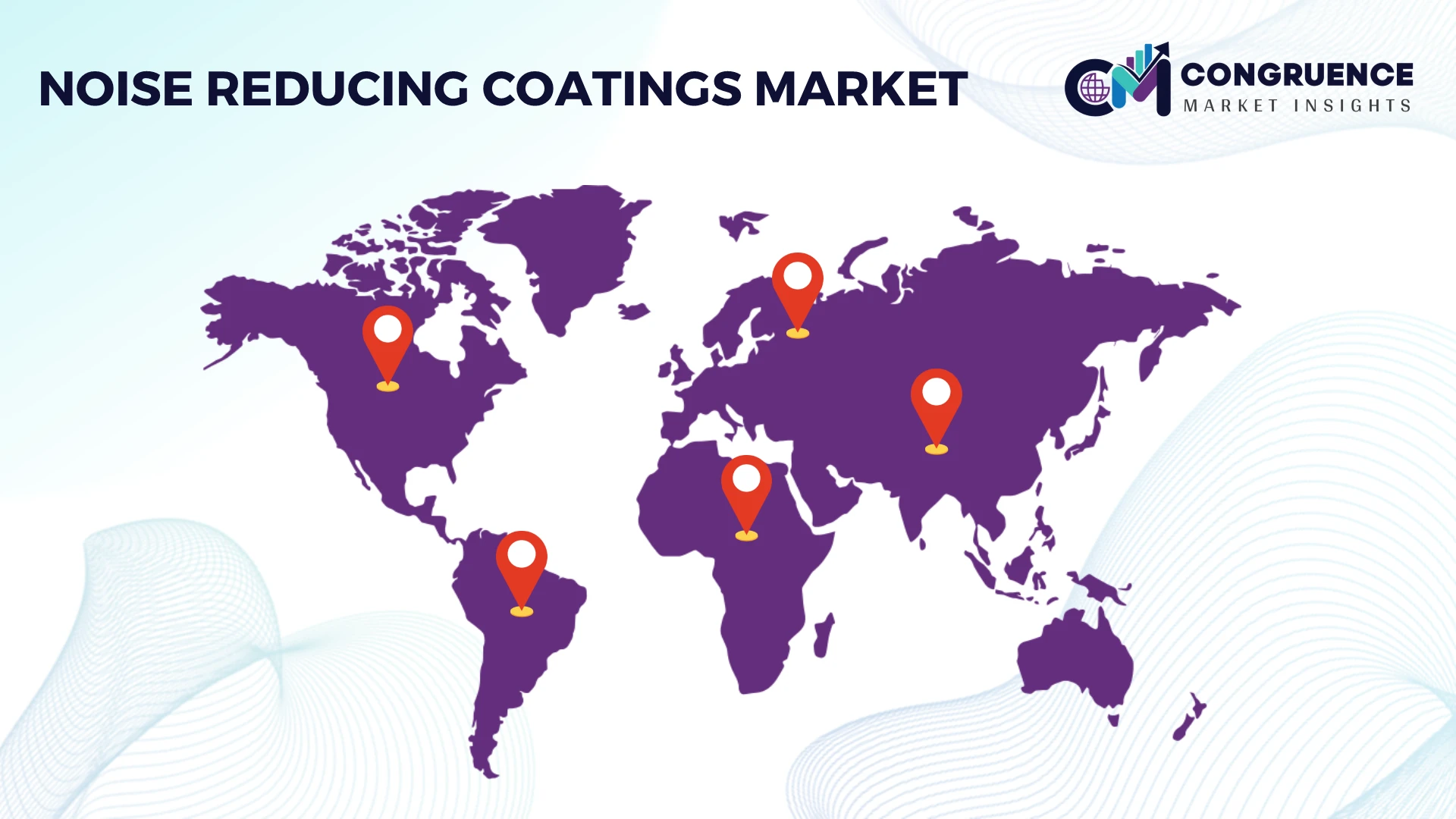
Asia-Pacific accounted for the largest market share at 43.2% in 2025 moreover, Asia-Pacific is also expected to register the fastest growth, expanding at a CAGR of 8.0% between 2026 and 2033.
Automotive Lightweighting Drives Advanced Acoustic Coating Adoption
North America represents approximately 24.8% of the global market, supported by advanced automotive manufacturing, aerospace production, industrial machinery, and commercial construction. Electric vehicle assembly and growing demand for lightweight noise mitigation solutions are encouraging wider adoption of multifunctional acoustic coatings across OEM production lines. Nearly 62% of premium vehicle manufacturers in the region have incorporated lightweight vibration-damping coating technologies into selected platforms. Industrial equipment manufacturers are also integrating acoustic coatings to improve workplace compliance and equipment performance. Companies continue investing in automated coating application technologies, expanding regional manufacturing capacity, and strengthening collaborations with automotive suppliers to improve production efficiency and product consistency.
United States Market Outlook: The United States leads regional demand through its large automotive manufacturing base, aerospace sector, and advanced industrial equipment production. Accelerating electric vehicle manufacturing and continuous investment in commercial transportation are increasing demand for lightweight acoustic coating technologies. Manufacturers are expanding nanocomposite coating development, automated production systems, and OEM partnerships to improve acoustic performance while supporting sustainability objectives across transportation and industrial applications.
Sustainable Mobility Accelerates Material Innovation
Europe accounts for approximately 28.1% of global demand, supported by premium automotive manufacturing, railway modernization, and stringent environmental regulations encouraging low-emission coating technologies. Vehicle manufacturers increasingly integrate multifunctional acoustic coatings that combine vibration damping with corrosion protection while reducing overall vehicle weight. Industrial modernization and sustainable building initiatives are further strengthening product adoption across multiple sectors. Manufacturers continue investing in waterborne technologies, advanced polymer research, and localized production capabilities to improve environmental compliance and product performance.
Germany Market Outlook: Germany remains the region's leading market through its globally competitive automotive industry, advanced coating technologies, and engineering expertise. Premium vehicle manufacturers increasingly specify lightweight acoustic coating systems to improve passenger comfort and energy efficiency. Domestic suppliers continue expanding research into nanostructured materials and automated coating processes while strengthening collaboration with automotive OEMs and industrial manufacturers.
Manufacturing Scale Strengthens Global Market Leadership
Asia-Pacific contributes approximately 43.2% of global market demand through its extensive automotive production, railway expansion, electronics manufacturing, and industrial infrastructure development. Large-scale manufacturing capacity enables rapid commercialization of advanced acoustic coating technologies while supporting competitive production costs. More than half of global electric vehicle production is concentrated within the region, creating sustained demand for lightweight vibration-damping materials. Manufacturers continue expanding coating production facilities, strengthening regional raw material sourcing, and increasing investment in advanced formulation technologies supporting transportation and industrial applications.
China Market Outlook: China dominates regional demand through its leadership in automotive manufacturing, electric mobility, rail infrastructure, and industrial equipment production. The country accounts for approximately 34% of global noise reducing coating manufacturing capacity and continues expanding domestic advanced materials production. Manufacturers are investing in automated coating facilities, multifunctional formulation technologies, and localized supply chains to strengthen export competitiveness and support high-volume industrial production.
Transportation Modernization Expands Industrial Demand
South America represents approximately 2.9% of global market demand, supported by automotive assembly, mining equipment manufacturing, and infrastructure development. Vehicle production recovery and railway modernization projects are increasing adoption of vibration-damping coatings across transportation applications despite ongoing logistics and raw material challenges. Industrial machinery manufacturers are increasingly adopting acoustic coatings to improve equipment performance and operator safety. Companies continue strengthening regional distribution, expanding technical support, and improving localized supply capabilities to enhance customer responsiveness while addressing infrastructure constraints.
Brazil Market Outlook: Brazil remains the largest market within South America because of its established automotive manufacturing industry and expanding industrial equipment sector. Commercial vehicle production, mining operations, and infrastructure investments continue supporting demand for advanced acoustic coatings. Suppliers are increasing local technical capabilities, strengthening OEM relationships, and introducing durable low-VOC coating systems designed for demanding tropical operating conditions.
Infrastructure Investment Supports Industrial Coating Demand
The Middle East & Africa market is expanding through large-scale infrastructure projects, commercial construction, transportation modernization, and industrial diversification initiatives. The region accounts for approximately 1.0% of global demand, with increasing adoption of acoustic coatings across rail systems, commercial buildings, and heavy industrial facilities. Investments in smart cities and logistics infrastructure are strengthening demand for multifunctional coating technologies combining sound insulation with environmental durability. Manufacturers continue expanding regional partnerships, technical service capabilities, and application-specific product offerings tailored to harsh operating environments.
Saudi Arabia Market Outlook: Saudi Arabia leads regional demand through ongoing industrial diversification, major transportation projects, and large-scale commercial infrastructure development. National investments in manufacturing, logistics, and urban expansion continue creating opportunities for advanced acoustic coating applications. Suppliers are strengthening local distribution networks, expanding engineering support services, and developing coating technologies optimized for high-temperature operating environments while supporting long-term infrastructure resilience.
Global coating leaders including PPG Industries, AkzoNobel, BASF, Sherwin-Williams, and Sika compete directly with regional specialty coating manufacturers focusing on automotive and industrial acoustic applications. The top five suppliers collectively account for approximately 44% of global market share. Competition is driven by acoustic damping efficiency, lightweight formulation, sustainability, and application productivity rather than price alone. Premium suppliers deliver coatings with 18–22% higher vibration attenuation, while regional producers generally compete with 12–16% lower production costs through localized manufacturing. Companies are expanding waterborne coating capacity, forming OEM development partnerships, investing in nanocomposite technologies, and strengthening raw material integration to improve supply resilience. Competitive momentum is shifting toward multifunctional coatings combining noise reduction, corrosion protection, and lightweight performance within a single formulation. Strict OEM qualification cycles, advanced formulation expertise, and specialty raw material availability remain key entry barriers. Success increasingly depends on differentiated material science, scalable manufacturing, strategic OEM collaboration, and consistent acoustic performance validation.
PPG Industries
AkzoNobel
BASF
Sherwin-Williams
Sika
Axalta Coating Systems
Hempel
Jotun
Nippon Paint Holdings
Kansai Paint
3M
Covestro
RPM International
Current technology development is centered on waterborne elastomeric coatings, viscoelastic polymer systems, and nanocomposite acoustic formulations capable of reducing vibration while maintaining lightweight structures. Nearly 58% of premium automotive acoustic coating programs now utilize low-VOC formulations, improving environmental compliance without compromising performance. Nanofiller integration enhances vibration damping by approximately 20% while increasing coating durability by nearly 18%. Automated spray systems further improve application consistency, reducing material waste and improving manufacturing efficiency across high-volume production facilities.
Emerging technologies include graphene-enhanced fillers, hollow ceramic microspheres, smart polymer matrices, and AI-assisted formulation optimization. Compared with conventional bitumen-based acoustic coatings, advanced nanocomposite coatings reduce system weight by approximately 15% while improving acoustic attenuation by nearly 22%. Automotive OEMs, railway manufacturers, and industrial equipment producers benefit most through improved energy efficiency, simplified assembly, and enhanced product durability. Digital process monitoring also improves coating quality consistency across automated manufacturing environments.
Between 2026 and 2028, multifunctional acoustic coatings integrating corrosion resistance, thermal insulation, and vibration damping will become increasingly common across transportation and industrial infrastructure. Intelligent formulation platforms and advanced material engineering are expected to reduce production waste by approximately 16% while improving manufacturing flexibility. Companies investing in sustainable raw materials, automated application technologies, and high-performance nanocomposite formulations will strengthen competitive positioning as OEMs prioritize lightweight engineering, operational efficiency, and environmentally compliant coating solutions.
March 2025 – BASF and Sika jointly launched the Baxxodur® EC 151 epoxy hardener technology for industrial flooring coatings, enabling up to 90% lower VOC emissions compared with conventional hardeners. The innovation strengthens sustainable high-performance coating applications across industrial facilities. Source: basf.com
March 2024 – PPG Industries introduced the PPG NEXEON™ 810 copper-free antifouling coating, delivering up to 15% lower friction than conventional premium antifouling technologies. The development improves vessel efficiency while supporting next-generation environmentally compliant marine coating solutions. Source: investor.ppg.com
September 2025 – AkzoNobel, BASF, and Arkema expanded their value-chain collaboration to develop architectural powder coatings with up to 40% lower product carbon footprint, accelerating sustainable coating innovation and strengthening low-carbon manufacturing capabilities. Source: akzonobel.com
April 2024 – BASF Coatings launched its next-generation biomass balance automotive refinish clearcoats and undercoats across the Asia-Pacific market, reducing product carbon footprint by up to 20% while improving sustainable automotive coating adoption. Source: basf.com
The report provides a comprehensive assessment of the Noise Reducing Coatings Market across major coating types, applications, end-user industries, and key geographical markets. It evaluates water-based, solvent-based, powder-based, and advanced nanocomposite acoustic coating technologies supporting automotive, railway, construction, marine, aerospace, and industrial applications. More than 55% of premium transportation programs now emphasize lightweight acoustic materials, reflecting the industry's transition toward multifunctional, environmentally compliant coating solutions.
The analysis covers North America, Europe, Asia-Pacific, South America, and the Middle East & Africa while examining technology adoption, manufacturing strategies, competitive positioning, and emerging acoustic material innovations between 2026 and 2033. It highlights deployment trends, product differentiation, enterprise purchasing behavior, and evolving OEM requirements across automotive manufacturers, industrial producers, construction companies, and transportation operators. The report supports investment planning, product portfolio expansion, competitive benchmarking, regional growth strategy, and long-term decision-making within the global noise reducing coatings industry.
| Report Attribute/Metric | Report Details |
|---|---|
|
Market Revenue in 2025 |
USD 1,286.4 Million |
|
Market Revenue in 2033 |
USD 2,260.3 Million |
|
CAGR (2026 - 2033) |
7.3% |
|
Base Year |
2025 |
|
Forecast Period |
2026 - 2033 |
|
Historic Period |
2021 - 2025 |
|
Segments Covered |
By Type
By Application
By End-User
|
|
Key Report Deliverable |
Revenue Forecast, Growth Trends, Market Dynamics, Segmental Overview, Regional and Country-wise Analysis, Competition Landscape |
|
Region Covered |
North America, Europe, Asia-Pacific, South America, Middle East, Africa |
|
Key Players Analyzed |
PPG Industries, AkzoNobel, BASF, Sherwin-Williams, Sika, Axalta Coating Systems, Hempel, Jotun, Nippon Paint Holdings, Kansai Paint, 3M, Covestro, RPM International |
|
Customization & Pricing |
Available on Request (10% Customization is Free) |




