
Reports
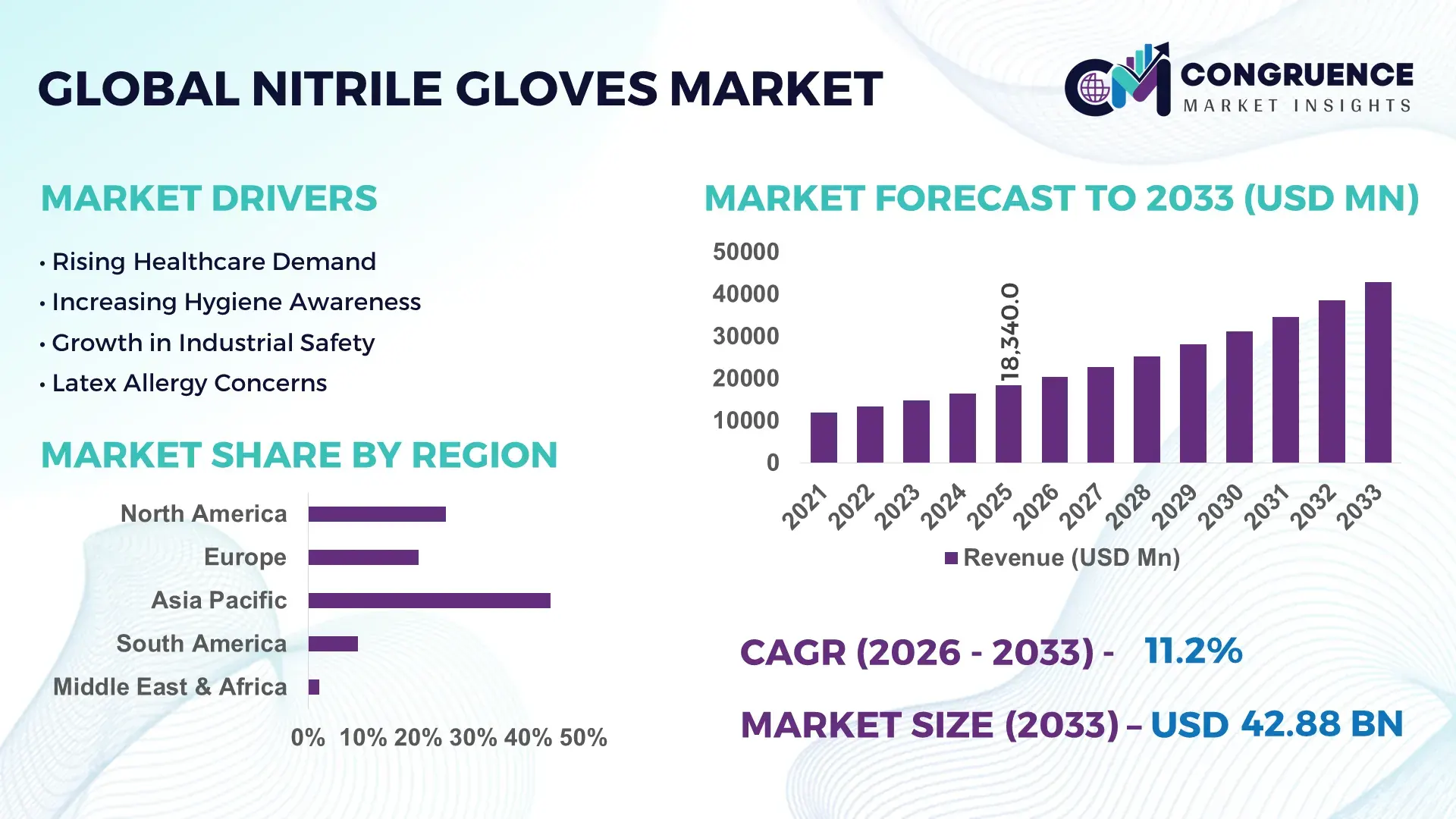
The Global Nitrile Gloves Market was valued at USD 18340 Million in 2025 and is anticipated to reach a value of USD 42878.3 Million by 2033 expanding at a CAGR of 11.2% between 2026 and 2033. Growth is accelerating through rising healthcare procurement, semiconductor cleanroom expansion, stricter industrial safety mandates, and the global shift from latex to powder-free nitrile variants with higher chemical resistance and automation compatibility.
Malaysia remains the dominant production hub, contributing nearly 62% of global nitrile glove manufacturing capacity in 2026, supported by large-scale automation investments and integrated nitrile butadiene supply chains serving healthcare and electronics sectors. Thailand accounts for approximately 18% capacity, while Vietnam is rapidly scaling export-oriented production with over 14% annual capacity additions linked to Western supply-chain diversification after Red Sea logistics disruptions. Advanced robotic dipping lines in Southeast Asia improved production efficiency by nearly 21% versus conventional systems, strengthening regional export competitiveness and reducing defect rates across medical-grade output.
Manufacturers prioritizing automated production, regional warehousing, and premium examination-grade portfolios are positioned to secure higher institutional contracts and long-term procurement resilience.
Market Size & Growth: USD 18340 Million in 2025 reaching USD 42878.3 Million by 2033, driven by automated glove manufacturing, hospital procurement expansion, and industrial safety compliance upgrades at 11.2% CAGR.
Top Growth Drivers: Healthcare demand contributes 38%, industrial safety applications 27%, and food processing adoption 16% of incremental global volume growth.
Short-Term Forecast: By 2027, AI-enabled inspection systems reduce glove defect rates by 24% while production downtime declines by 18%.
Emerging Technologies: Advanced dipping automation, antimicrobial coatings, and smart quality analytics improve output efficiency by over 20% across high-volume facilities.
Regional Leaders: Asia-Pacific exceeds USD 21 Billion with export-led automation, North America crosses USD 8 Billion through healthcare procurement, while Europe surpasses USD 6 Billion via ESG-compliant sourcing.
Consumer/End-User Trends: Nearly 71% of hospitals now prioritize powder-free nitrile gloves due to improved chemical resistance and lower allergy incidence.
Pilot/Case Example: In 2026, a Southeast Asian manufacturing expansion project increased production throughput by 26% using robotic dipping and predictive maintenance systems.
Competitive Landscape: Top manufacturers collectively control approximately 54% global share, led by integrated producers alongside Hartalega, Top Glove, Kossan, Supermax, and Ansell.
Regulatory & ESG Impact: Sustainable production initiatives reduced factory water consumption by 17% as global buyers tightened environmental procurement standards.
Investment & Funding: More than USD 3.4 Billion entered capacity expansion, regional warehousing, and automated cleanroom infrastructure amid post-pandemic supply-chain realignment.
Innovation & Future Outlook: Biodegradable nitrile formulations, ultra-thin examination gloves, and AI-based production analytics are reshaping premium high-growth product positioning.
Nitrile Gloves Market demand remains concentrated across healthcare, pharmaceuticals, semiconductor manufacturing, food processing, and chemical handling industries requiring advanced barrier protection and contamination control. Manufacturers are accelerating adoption of low-accelerator formulations and automated visual inspection technologies, improving production consistency by nearly 19% in 2026. Regional inventory localization and stricter occupational safety regulations are also reshaping procurement strategies, particularly across North America and Southeast Asia, creating a stronger foundation for long-term strategic expansion discussions.
The nitrile gloves market has evolved from a volume-driven healthcare supply segment into a strategically important industrial protection and manufacturing resilience category. Global procurement reforms after pandemic-era shortages accelerated long-term supplier diversification, while stricter occupational safety mandates in the U.S., Germany, and Japan expanded demand across pharmaceuticals, electronics, and chemical processing. Automated production infrastructure is also reshaping competitive positioning, with digitally monitored dipping systems reducing material wastage by nearly 18% compared to conventional semi-automated lines. This transition is strengthening margins while improving compliance consistency for medical-grade and cleanroom-certified gloves.
Malaysia continues to dominate high-volume exports through vertically integrated nitrile butadiene supply chains, whereas Vietnam and India are gaining traction through lower operating costs and rapid industrial expansion. In 2026, several manufacturers deployed AI-enabled optical inspection systems capable of identifying micro-defects 32% faster than manual quality control processes. North American buyers are simultaneously increasing localized inventory agreements, with hospital procurement groups maintaining nearly 20% higher buffer stock levels than pre-2023 benchmarks to reduce supply disruption risks.
Manufacturers are responding through strategic warehousing partnerships, automated plant expansion, and sustainable water-recycling investments that reduce processing consumption by approximately 15%. Over the next two to three years, competitive advantage will increasingly depend on production automation, regional fulfillment capability, and premium specialty glove innovation aligned with healthcare, semiconductor, and industrial safety standards.
Rising enforcement of workplace safety regulations and infection-control protocols is accelerating nitrile glove adoption across healthcare, electronics, food processing, and chemical manufacturing sectors. In 2026, powder-free nitrile gloves accounted for nearly 74% of hospital glove procurement due to lower allergen exposure and stronger puncture resistance than latex alternatives. Semiconductor cleanroom demand also increased by approximately 19% as chip fabrication investments expanded across Taiwan and South Korea. Stricter FDA and EU medical compliance requirements are pushing manufacturers toward automated quality inspection and traceability systems, reducing defect rates by nearly 22%. In response, producers in Malaysia and Thailand are investing in robotic dipping infrastructure and vertically integrated nitrile butadiene sourcing to secure long-term institutional contracts and reduce dependency on external raw material suppliers.
The market continues to face operational pressure from fluctuating nitrile butadiene rubber pricing, logistics disruptions, and concentrated manufacturing dependence. More than 60% of global production capacity remains concentrated in Malaysia, creating supply exposure during labor shortages, shipping bottlenecks, or geopolitical trade restrictions. In 2026, container freight costs across key Asia-Europe routes remained approximately 14% above pre-2022 averages, increasing procurement expenses for distributors and healthcare buyers. Energy-intensive glove manufacturing also raised production costs by nearly 11% in selected Southeast Asian industrial hubs following utility price revisions. To mitigate these risks, manufacturers are expanding localized warehousing, securing multi-year raw material agreements, and increasing regional production footprints in Vietnam and India to improve delivery stability and procurement flexibility.
Advanced automation and specialty glove development are creating high-value opportunities beyond conventional medical applications. Smart manufacturing systems integrating AI-driven inspection and predictive maintenance improved line efficiency by nearly 24% in newly commissioned facilities during 2026. Demand for accelerator-free, biodegradable, and cleanroom-certified nitrile gloves is also rising rapidly, particularly within Japan’s pharmaceutical manufacturing and U.S. semiconductor sectors. India expanded industrial safety compliance coverage across multiple export-oriented industries, increasing institutional glove procurement by approximately 17%. Manufacturers are leveraging this shift through R&D partnerships, sustainable material innovation, and high-margin specialty portfolios designed for chemical resistance and contamination-sensitive environments. A less visible opportunity lies in customized glove production for precision electronics assembly, where thinner formulations improve tactile sensitivity without compromising barrier protection.
Long-term market competitiveness depends on balancing rapid production scalability with increasingly complex environmental, labor, and quality compliance standards. Automated production lines require significant capital intensity, with next-generation robotic dipping installations costing nearly 28% more than traditional systems while demanding specialized engineering expertise. Water consumption and wastewater treatment obligations are also tightening across Malaysia and Thailand, where environmental audits increased by approximately 16% in 2026. Simultaneously, healthcare buyers are enforcing stricter traceability and contamination-control benchmarks, increasing operational pressure on mid-sized manufacturers lacking digital monitoring infrastructure. Companies must address workforce automation gaps, sustainability compliance, and supply-chain visibility through smart factory investments, industrial partnerships, and integrated ERP-based production control systems to maintain export competitiveness and long-term institutional credibility.
AI-Based Quality Inspection Expansion Automated optical inspection systems are rapidly replacing manual defect detection across Malaysia and Thailand, improving micro-tear identification accuracy by nearly 31% while reducing rejection-related downtime by 18%. Manufacturers are integrating AI-enabled cameras with robotic dipping lines to stabilize medical-grade compliance amid tighter U.S. and EU procurement standards. This transition is lowering operational waste and accelerating export certification cycles for high-volume producers.
Localized Inventory Network Restructuring Healthcare distributors in the U.S., Germany, and Japan increased regional glove stockpiling by approximately 22% following Red Sea shipping disruptions and extended freight lead times. Companies are shifting from centralized export dependency toward multi-country warehousing and shorter replenishment cycles. Several manufacturers expanded contract logistics partnerships in India and Vietnam to improve institutional delivery speed and reduce emergency procurement volatility during peak healthcare demand periods.
Shift Toward Sustainable Formulations Demand for accelerator-free and biodegradable nitrile gloves increased by nearly 17% in 2026 as pharmaceutical and food-processing buyers tightened sustainability procurement criteria. Water-recycling systems deployed across advanced production facilities reduced processing consumption by approximately 15%, helping manufacturers address stricter wastewater compliance policies in Southeast Asia. Producers are simultaneously marketing thinner high-durability gloves that reduce raw material consumption without compromising puncture resistance.
Industrial Cleanroom Demand Acceleration Semiconductor and precision electronics manufacturing expanded cleanroom glove procurement by over 19% due to contamination-control requirements in Taiwan, South Korea, and the U.S. Advanced nitrile formulations with low ionic residue and enhanced tactile sensitivity are replacing conventional industrial gloves in high-specification assembly environments. Manufacturers are responding through specialty product segmentation, automated cleanroom packaging investments, and collaborative development agreements with electronics component suppliers.
Powder-free nitrile gloves remain the dominant segment, accounting for nearly 68% of global institutional demand in 2026 due to stronger compliance alignment, lower contamination risk, and broader adoption across hospitals, laboratories, and pharmaceutical manufacturing. Healthcare procurement agencies in the U.S. and Germany increasingly favor powder-free variants because they reduce allergen exposure and improve compatibility with automated dispensing systems. Disposable gloves continue to hold a substantial share through high-volume usage in food handling and medical examination workflows, while sterile nitrile gloves maintain strategic importance in surgical and contamination-sensitive applications requiring validated microbial protection standards.
Reusable nitrile gloves are emerging steadily across chemical processing and industrial maintenance operations, where durability improvements extended product lifecycle performance by approximately 23% compared to earlier-generation industrial gloves. Sterile glove demand also increased by nearly 16% as advanced surgical centers expanded infection-control protocols. Manufacturers are prioritizing powder-free and specialty disposable portfolios through automated line expansion, antimicrobial coatings, and thinner high-strength formulations designed to reduce raw material consumption while preserving puncture resistance and tactile sensitivity.
Medical examination remains the leading application segment due to continuous consumption across hospitals, diagnostic centers, and outpatient care facilities requiring high-frequency glove replacement cycles. In 2026, examination-grade nitrile gloves represented approximately 61% of total healthcare glove utilization, supported by stricter infection-prevention protocols and expanded patient-handling standards. Surgical procedures continue to generate strong demand for sterile nitrile variants with enhanced puncture resistance and tactile precision, particularly across Japan and the U.S., where advanced operating environments prioritize contamination mitigation and regulatory compliance consistency.
Industrial safety is emerging as the fastest-growing application as electronics manufacturing, chemical processing, and automotive assembly operations strengthen worker protection standards. Industrial nitrile glove deployment increased by nearly 18% in 2026, driven by greater chemical resistance requirements and automated production workflows. Food handling applications are also expanding steadily as processors adopt powder-free disposable gloves to improve hygiene traceability, while laboratory use is benefiting from rising pharmaceutical R&D activity. Manufacturers are responding through industry-specific product customization, automated packaging integration, and strategic supply agreements targeting high-consumption institutional buyers.
Hospitals remain the dominant end-user group due to continuous procedural volume, emergency preparedness requirements, and centralized procurement systems supporting high-frequency glove utilization. In 2026, hospitals accounted for nearly 46% of global nitrile glove consumption, driven by stricter infection-control standards and expanded patient-care infrastructure in the U.S., China, and India. Clinics continue to generate stable demand through outpatient diagnostics and routine medical procedures, while laboratories and pharmaceutical companies increasingly require contamination-controlled nitrile gloves for precision testing and drug manufacturing environments.
The manufacturing industry is emerging as the fastest-growing end-user segment as electronics assembly, semiconductor fabrication, and chemical processing facilities strengthen occupational safety compliance. Industrial glove procurement across advanced manufacturing operations increased by approximately 21% in 2026, supported by automation-driven workplace standardization and cleanroom expansion. Food processing companies are also increasing disposable nitrile glove deployment to improve hygiene traceability and export compliance. Manufacturers are targeting these segments through customized thickness profiles, long-term supply contracts, and integrated distribution partnerships designed to improve delivery reliability and application-specific performance.
Asia-Pacific accounted for the largest market share at 61% in 2025 however, Middle East & Africa is expected to register the fastest growth, expanding at a CAGR of 12.8% between 2026 and 2033.

Institutional Procurement and Domestic Supply Reinforcement
North America maintains a strong demand position through healthcare procurement modernization, industrial safety enforcement, and strategic inventory localization. The region accounted for approximately 19% of global nitrile glove consumption in 2025, supported by high-volume hospital purchasing networks and expanding semiconductor manufacturing investments in the U.S. Automated warehousing and distributor-led replenishment systems reduced emergency procurement delays by nearly 21% during 2026. Pharmaceutical laboratories and food-processing facilities are also increasing premium powder-free glove adoption to strengthen contamination control and regulatory compliance. Manufacturers are responding through regional warehousing partnerships, long-term institutional supply agreements, and selective domestic assembly expansion to reduce import dependency and stabilize delivery cycles amid global logistics fluctuations.
United States Market Outlook: The United States remains the region’s operational center due to large-scale healthcare infrastructure, advanced pharmaceutical manufacturing, and rising cleanroom glove demand from semiconductor facilities. In 2026, nearly 73% of major hospital procurement groups maintained multi-quarter glove reserve contracts to improve supply continuity. Domestic distributors are also integrating AI-based inventory forecasting systems that reduced stockout frequency by approximately 18%, strengthening institutional purchasing efficiency and supporting localized supply-chain resilience.
Sustainability Compliance Reshaping Procurement Standards
Europe is strengthening its market position through sustainability-focused procurement, medical compliance modernization, and industrial hygiene regulation upgrades. The region represented nearly 14% of global nitrile glove demand in 2025, driven by healthcare systems, pharmaceutical manufacturing, and precision industrial operations. Germany, France, and the Netherlands accelerated adoption of recyclable packaging and low-chemical residue nitrile gloves during 2026 as environmental procurement standards tightened. Automated dispensing systems deployed across hospital networks improved glove utilization efficiency by approximately 16%, reducing unnecessary consumption and procurement waste. Manufacturers are prioritizing ESG-aligned production, localized distribution partnerships, and premium examination-grade portfolios to strengthen institutional relationships and meet stricter operational compliance benchmarks across healthcare and laboratory environments.
Germany Market Outlook: Germany leads the European market through advanced healthcare infrastructure, strong pharmaceutical production, and high regulatory enforcement standards. Industrial safety compliance across automotive and chemical manufacturing also supports significant nitrile glove deployment. In 2026, German medical procurement agencies increased purchases of powder-free nitrile gloves by nearly 19% to align with contamination-control protocols. Domestic distributors are expanding automated logistics centers and sustainability-certified sourcing partnerships to improve institutional delivery consistency and regulatory traceability.
Manufacturing Scale and Export Dominance Expansion
Asia-Pacific dominates the global nitrile gloves market through vertically integrated manufacturing infrastructure, large-scale export capacity, and cost-efficient production ecosystems. The region contributed more than 61% of global production output in 2025, led by Malaysia, Thailand, China, and Vietnam. Advanced robotic dipping lines installed across Southeast Asian facilities improved production efficiency by approximately 24% while reducing material wastage and defect rates. Export-oriented manufacturers are also increasing automated quality inspection deployment to comply with stricter U.S. and European healthcare procurement standards. Industrial expansion across electronics manufacturing and pharmaceutical processing further accelerated regional glove consumption, prompting companies to expand specialty cleanroom and accelerator-free glove portfolios for higher-value institutional applications.
Malaysia Market Outlook: Malaysia remains the most strategically significant production hub, accounting for nearly 62% of global nitrile glove manufacturing capacity in 2026. Integrated nitrile butadiene supply chains, advanced automation infrastructure, and strong export logistics continue to reinforce its leadership position. Leading manufacturers upgraded AI-enabled inspection systems capable of improving micro-defect detection speed by over 30%, helping producers strengthen compliance consistency for medical-grade and cleanroom-certified glove exports across high-volume institutional procurement channels.
Healthcare Expansion Supporting Industrial Demand
South America is experiencing steady nitrile glove demand expansion through healthcare modernization, food-processing growth, and industrial safety adoption. The region contributed approximately 4% of global consumption in 2025, with Brazil and Argentina accounting for the majority of institutional procurement activity. Public healthcare infrastructure upgrades and rising infection-control standards increased powder-free nitrile glove deployment by nearly 15% across urban hospital networks during 2026. However, dependence on imported glove supply continues to create pricing volatility and longer replenishment cycles for distributors. Companies are responding through regional warehousing investments, localized distribution agreements, and private-label manufacturing partnerships designed to improve procurement reliability and reduce exposure to freight-related supply disruptions.
Brazil Market Outlook: Brazil leads the regional market due to its extensive healthcare system, expanding food-processing industry, and rising occupational safety enforcement. Large hospital groups and industrial operators increased long-term glove procurement agreements by approximately 17% in 2026 to stabilize inventory availability amid import delays. Pharmaceutical laboratories and meat-processing facilities are also accelerating adoption of powder-free disposable nitrile gloves to improve export compliance and contamination-control efficiency across regulated production environments.
Healthcare Infrastructure Modernization Accelerates Adoption
Middle East & Africa is emerging as the fastest-transforming regional market due to healthcare infrastructure investment, industrial diversification, and modernization of medical procurement systems. The region represented nearly 2% of global nitrile glove consumption in 2025 but is rapidly strengthening its operational footprint through hospital expansion and pharmaceutical manufacturing initiatives. Gulf healthcare groups increased institutional nitrile glove procurement by approximately 20% in 2026 as infection-control standards tightened across newly commissioned medical facilities. Industrial safety adoption is also rising steadily within energy and chemical sectors. Manufacturers and distributors are expanding regional warehousing partnerships and localized supply agreements to reduce import lead times and improve procurement continuity across strategically important healthcare and industrial hubs.
Saudi Arabia Market Outlook: Saudi Arabia is becoming the region’s primary growth engine through large-scale healthcare modernization projects, pharmaceutical localization initiatives, and industrial workforce safety reforms. In 2026, newly developed healthcare infrastructure projects increased medical-grade glove procurement volumes by nearly 18% across public and private hospital systems. The country is also strengthening centralized procurement and cold-chain logistics capabilities, enabling faster institutional distribution and improving long-term operational stability for healthcare and laboratory supply networks.
The nitrile gloves market is dominated by global manufacturers including Top Glove, Hartalega, Kossan, Supermax, and Ansell competing against emerging regional producers in Vietnam, China, and India. The top five players collectively control nearly 54% of global supply capacity, with competition centered on production automation, export reliability, pricing efficiency, and medical-grade quality consistency. Malaysian leaders compete through vertically integrated nitrile butadiene sourcing and high-speed robotic dipping systems that improve output efficiency by over 20%, while regional challengers target lower operating costs and localized procurement contracts. Premium manufacturers are differentiating through accelerator-free formulations, AI-based defect inspection, and cleanroom-certified glove portfolios. Strategic partnerships with healthcare distributors and semiconductor manufacturers are increasing as supply-chain resilience becomes a procurement priority. Rising environmental compliance costs and capital-intensive automation infrastructure remain significant entry barriers. Winning requires scalable automated production, diversified logistics networks, premium specialty portfolios, and strong institutional procurement relationships.
Top Glove Corporation Bhd
Hartalega Holdings Berhad
Kossan Rubber Industries Bhd
Supermax Corporation Berhad
Ansell Limited
Semperit AG Holding
Riverstone Holdings Limited
Medline Industries
Unigloves (UK) Limited
Ammex Corporation
Dynarex Corporation
Kimberly-Clark Corporation
Sri Trang Gloves (Thailand) Public Company Limited
Shijiazhuang Hongray Group Co., Ltd.
Advanced robotic dipping systems and AI-enabled visual inspection technologies are transforming nitrile glove manufacturing efficiency across Malaysia, Thailand, and Vietnam. In 2026, automated production lines improved throughput efficiency by nearly 24% while reducing defect rates by approximately 21% compared to semi-automated legacy systems. More than 58% of large-scale glove facilities now integrate machine-vision inspection and predictive maintenance software to stabilize medical-grade compliance and reduce operational downtime. These technologies are strengthening export competitiveness through faster quality validation and lower material wastage.
Emerging technologies are centered on accelerator-free nitrile compounds, biodegradable formulations, and low-residue cleanroom gloves designed for semiconductor and pharmaceutical environments. Thin-wall nitrile technologies improved tactile sensitivity by nearly 18% while lowering raw material consumption by approximately 12% during 2026 deployments. Smart ERP-connected production systems are also enabling real-time batch traceability and automated inventory balancing, particularly across high-volume healthcare procurement networks in the U.S. and Germany. Premium manufacturers benefit most through stronger institutional contracts and faster regulatory qualification cycles.
Between 2026 and 2028, disruptive integration of AI analytics, digital twins, and closed-loop water recycling systems will reshape operational competitiveness. Companies adopting fully integrated smart-factory platforms are projected to reduce production interruption rates by nearly 20% versus conventional manufacturing environments. Early adopters with vertically integrated supply chains and specialty cleanroom portfolios will secure stronger positioning across healthcare, electronics, and pharmaceutical procurement ecosystems.
March 2026 – Top Glove Corporation reported quarterly sales volume growth of 23% with utilization rates improving to nearly 76% following stronger U.S. procurement activity and expanded European tenders. The operational rebound strengthened export throughput and improved production absorption across automated facilities. Source: SGinvestors.io
November 2025 – Hartalega Holdings announced commissioning plans for five additional production lines targeting total capacity of 26–27 billion gloves annually. The expansion supports automation-led efficiency optimization and improves scalability amid growing competition from Chinese manufacturers expanding into Southeast Asia. Source: BusinessToday Malaysia
May 2026 – OnPoint Solutions introduced “The Upper Hand Glove,” integrating built-in metal detection with puncture-resistant glove technology for high-volume security environments. The innovation streamlined screening workflows and improved operational inspection speed while reducing dependency on handheld scanning equipment.
April 2026 – Malaysian glove manufacturers including Top Glove and Hartalega implemented price adjustments after synthetic rubber input costs increased by nearly 50% during Middle East supply-chain disruptions. Hospitals strengthened inventory buffering strategies while producers accelerated procurement restructuring and supply stabilization initiatives. Source: Reuters
The report delivers comprehensive analysis of the nitrile gloves market across major product types including powdered, powder-free, disposable, reusable, and sterile gloves, alongside detailed evaluation of medical examination, surgical procedures, industrial safety, food handling, and laboratory applications. It further assesses procurement trends across hospitals, clinics, pharmaceutical companies, laboratories, manufacturing facilities, and food-processing industries. Asia-Pacific accounts for over 60% of global production activity, while North America and Europe remain strategically important for high-value medical and cleanroom glove deployment.
The study evaluates automation technologies, AI-based inspection systems, sustainable glove manufacturing, accelerator-free formulations, and cleanroom-certified product innovation shaping operational competitiveness between 2026 and 2033. More than 50% of leading manufacturers are prioritizing robotic production infrastructure and localized warehousing strategies to improve supply continuity and institutional responsiveness. The report supports expansion planning, sourcing optimization, competitive benchmarking, partnership evaluation, and long-term investment positioning across healthcare, industrial safety, semiconductor, and pharmaceutical procurement ecosystems.
| Report Attribute/Metric | Report Details |
|---|---|
|
Market Revenue in 2025 |
USD 18340 Million |
|
Market Revenue in 2033 |
USD 42878.3 Million |
|
CAGR (2026 - 2033) |
11.2% |
|
Base Year |
2025 |
|
Forecast Period |
2026 - 2033 |
|
Historic Period |
2021 - 2025 |
|
Segments Covered |
By Type
By Application
By End-User
|
|
Key Report Deliverable |
Revenue Forecast, Growth Trends, Market Dynamics, Segmental Overview, Regional and Country-wise Analysis, Competition Landscape |
|
Region Covered |
North America, Europe, Asia-Pacific, South America, Middle East, Africa |
|
Key Players Analyzed |
Top Glove Corporation Bhd, Hartalega Holdings Berhad, Kossan Rubber Industries Bhd, Supermax Corporation Berhad, Ansell Limited, Semperit AG Holding, Riverstone Holdings Limited, Medline Industries, Unigloves (UK) Limited, Ammex Corporation, Dynarex Corporation, Kimberly-Clark Corporation, Sri Trang Gloves (Thailand) Public Company Limited, Shijiazhuang Hongray Group Co., Ltd. |
|
Customization & Pricing |
Available on Request (10% Customization is Free) |




