
Reports
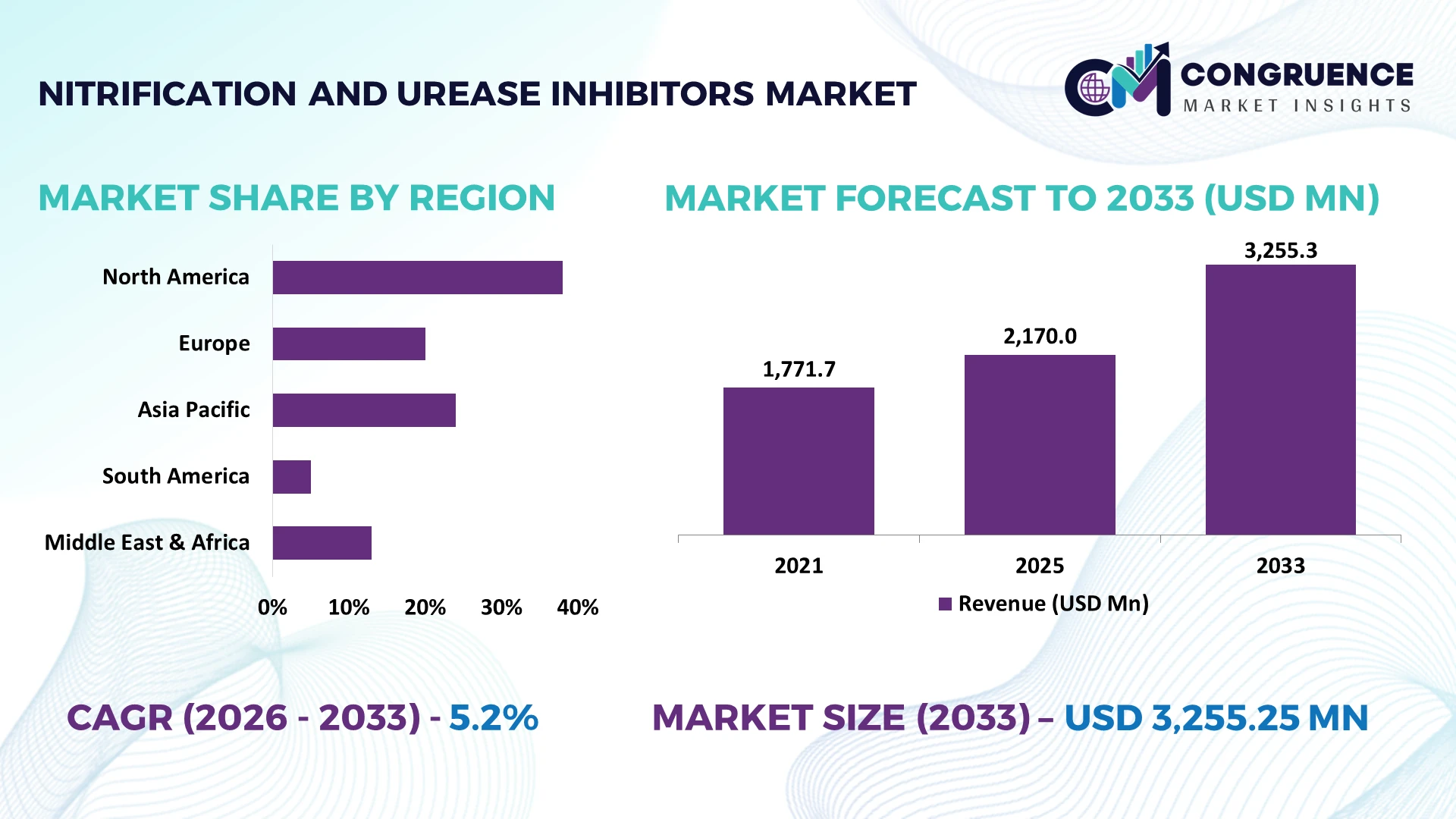
The Global Nitrification and Urease Inhibitors Market was valued at USD 2170 Million in 2025 and is anticipated to reach a value of USD 3255.25 Million by 2033 expanding at a CAGR of 5.2% between 2026 and 2033. Growth is driven by nitrogen fertilizer efficiency requirements, ammonia emission regulations, adoption of stabilized urea formulations, and increasing use of enhanced-efficiency fertilizers in intensive crop production.
China represents a major demand center for nitrification and urease inhibitors, supported by extensive nitrogen fertilizer consumption, domestic fertilizer manufacturing, and large-scale cereal cultivation. The country accounts for approximately 25% of global nitrogen fertilizer consumption, compared with India's share of roughly 17%. China's agricultural modernization policies emphasize improved nutrient-use efficiency, while its fertilizer industry supports production of stabilized nitrogen formulations. The European Union's Farm to Fork Strategy, targeting a 50% reduction in nutrient losses by 2030, reinforces international demand for nitrogen stabilization technologies.
Manufacturers should prioritize cost-efficient inhibitor formulations, compatibility with urea-based fertilizers, and partnerships with major fertilizer distributors to strengthen penetration in intensive agricultural markets.
Market Size & Growth: USD 2,170 million in 2025, reaching USD 3,255.25 million by 2033 at 5.2% CAGR, supported by stabilized fertilizer adoption and nitrogen efficiency requirements.
Top Growth Drivers: Urease inhibitors reduce ammonia volatilization by approximately 50%–70%; nitrification inhibitors can lower nitrous oxide emissions by 30%–50%, supporting improved fertilizer efficiency.
Short-Term Forecast: By 2028, stabilized nitrogen programs will increasingly target 10%–20% improvements in fertilizer-use efficiency through optimized inhibitor application and precision nutrient management.
Emerging Technologies: Three developments—NBPT-based urease inhibition, DMPP-based nitrification control, and polymer-assisted inhibitor delivery—are improving nitrogen stabilization and formulation compatibility.
Regional Leaders: Asia-Pacific concentrates approximately 40% of global fertilizer nutrient consumption, while Europe emphasizes regulated ammonia mitigation and North America advances stabilized fertilizer commercialization.
Consumer/End-User Trends: Agricultural trials demonstrate ammonia loss reductions exceeding 50% with effective urease inhibition, supporting adoption among commercial cereal and intensive crop producers.
Pilot/Case Example: A 2024 field research assessment of NBPT-treated urea reported ammonia volatilization reductions approaching 60% under suitable soil and weather conditions.
Competitive Landscape: BASF, Koch Agronomic Services, Corteva Agriscience, Yara International, and Nutrien compete through inhibitor chemistry, fertilizer integration, and agricultural distribution networks.
Regulatory & ESG Impact: The European Union targets a 50% reduction in nutrient losses and a 20% reduction in fertilizer use by 2030, strengthening interest in enhanced-efficiency fertilizers.
Investment & Funding: China's fertilizer modernization and India's agricultural nutrient-efficiency programs are directing industrial investment toward stabilized formulations, local blending, and improved fertilizer distribution.
Innovation & Future Outlook: Dual-inhibitor formulations combining urease and nitrification control target 2 nitrogen-loss pathways, supporting more comprehensive nutrient management across agricultural production systems.
The Nitrification and Urease Inhibitors Market is increasingly influenced by fertilizer application economics, agricultural emission reduction requirements, and improved nutrient management practices. NBPT-based urease inhibitors are gaining importance in surface-applied urea, while DMPP and DCD formulations address nitrogen transformation and nitrate leaching risks. Effective urease inhibition can reduce ammonia volatilization by 50%–70% under favorable field conditions, strengthening fertilizer value retention. European nutrient management policies and fertilizer supply-chain diversification are encouraging manufacturers to develop stabilized nitrogen products compatible with existing distribution infrastructure. These developments establish formulation efficiency, regulatory compliance, and agricultural economics as central strategic considerations.
Nitrification and urease inhibitors are becoming strategically important as fertilizer manufacturers transition from maximizing nitrogen application volumes toward improving nutrient retention and reducing agricultural emissions. Fertilizer supply disruptions, nitrogen price volatility, and tighter environmental requirements are accelerating investment in enhanced-efficiency fertilizers. The European Union's Farm to Fork Strategy targets a 50% reduction in nutrient losses by 2030, strengthening the commercial importance of stabilized nitrogen products. BASF, Koch Agronomic Services, and Corteva Agriscience are positioning inhibitor technologies within integrated crop nutrition portfolios.
Compared with untreated urea, NBPT-treated fertilizers can reduce ammonia volatilization by approximately 50%–70% under suitable field conditions, improving nitrogen availability and reducing application losses. China and India emphasize affordable nitrogen stabilization across intensive cereal cultivation, while Germany and France prioritize emission compliance and precision nutrient management. Nitrification inhibitors offer complementary benefits by slowing ammonium conversion and reducing nitrate leaching under susceptible soil conditions.
Between 2026 and 2028, manufacturers will prioritize dual-inhibitor formulations, improved coating stability, and compatibility with existing fertilizer blending infrastructure. Surface-applied urea in wheat and maize cultivation represents a practical deployment opportunity, particularly where immediate fertilizer incorporation is impractical. Suppliers are strengthening distributor partnerships and localized formulation capabilities. Long-term competitiveness will depend on proven field performance, application economics, and reliable nitrogen-loss mitigation.
Stricter nutrient management expectations are accelerating adoption of nitrification and urease inhibitors across intensive agricultural systems. The European Union targets a 50% reduction in nutrient losses and at least a 20% reduction in fertilizer use by 2030, encouraging improved nitrogen retention without compromising agricultural productivity. NBPT-based urease inhibitors can reduce ammonia volatilization by approximately 50%–70% under suitable field conditions. Germany's ammonia emission reduction commitments are strengthening interest in stabilized urea and precision fertilizer application. BASF, Yara, and Koch Agronomic Services are developing inhibitor-enhanced fertilizers and supporting agronomic distribution networks. The commercial advantage lies in reducing nitrogen losses while maintaining existing fertilizer application equipment, lowering adoption barriers for commercial farms.
Inhibitor adoption remains constrained by formulation premiums, variable field performance, and sensitivity to soil moisture, temperature, and application timing. Untreated surface-applied urea can lose substantial nitrogen through ammonia volatilization, but inhibitor effectiveness differs across climatic conditions and fertilizer management practices. Research frequently reports ammonia loss reductions of 50%–70% under favorable conditions, while nitrification inhibitor effectiveness varies with soil temperature and microbial activity. India's fertilizer subsidy framework creates additional pricing pressure because farmers prioritize affordable nutrient supply over premium formulations. Manufacturers must balance chemical stability, coating uniformity, and distribution costs against measurable fertilizer savings. BASF and Koch Agronomic Services are addressing these limitations through improved inhibitor formulations, distributor training, and crop-specific application recommendations that strengthen economic justification.
Combining urease and nitrification inhibitors creates opportunities to control nitrogen losses at different stages of fertilizer transformation. NBPT-based treatments can reduce ammonia volatilization by 50%–70%, while nitrification inhibitors have demonstrated nitrous oxide emission reductions of approximately 30%–50% under favorable agricultural conditions. Brazil's extensive maize cultivation and increasing adoption of precision agriculture create opportunities for stabilized nitrogen formulations tailored to tropical production systems. Between 2026 and 2028, manufacturers will increasingly integrate inhibitor coatings with variable-rate fertilizer application and digital nutrient management platforms. Companies including Yara and Koch Agronomic Services are positioned to strengthen fertilizer distribution partnerships and formulation development. Differentiation will depend on delivering consistent nitrogen retention across variable field conditions without requiring additional fertilizer application passes.
Maintaining consistent inhibitor effectiveness across diverse soil systems presents a significant long-term challenge for manufacturers and agricultural distributors. Nitrification rates depend on temperature, moisture, soil pH, and microbial activity, complicating standardized application recommendations. Field research demonstrates potential nitrous oxide reductions of 30%–50%, but performance varies substantially across cropping systems and environmental conditions. The European Union's 50% nutrient-loss reduction objective increases pressure for measurable agricultural outcomes, while its 20% fertilizer reduction target reinforces the need for efficient nitrogen utilization. Manufacturers must invest in multi-location field trials, validated emission measurements, and crop-specific formulation guidance. Partnerships with agronomic research institutions and fertilizer distributors will be essential for establishing reliable performance benchmarks and maintaining farmer confidence.
Stabilized Urea Gains Distribution Priority: Fertilizer distributors are increasingly incorporating NBPT-treated urea into standard product portfolios, particularly for surface-applied nitrogen programs. Field studies demonstrate ammonia volatilization reductions of approximately 50%–70% under favorable conditions. Koch Agronomic Services and Yara are strengthening enhanced-efficiency fertilizer offerings, enabling growers to improve nitrogen retention without changing conventional spreading equipment or application workflows.
Ammonia Regulations Reshape Fertilizer Formulations: Germany's fertilizer management requirements are encouraging greater use of inhibited urea where immediate soil incorporation is impractical. European policy targets include 50% lower nutrient losses and 20% reduced fertilizer use by 2030. BASF and fertilizer formulators are emphasizing compliant nitrogen stabilization technologies, improving market access while reducing ammonia emission exposure.
Microbial Activity Guides Inhibitor Selection: Agricultural research increasingly differentiates inhibitor performance by soil temperature, moisture, and microbial activity rather than applying uniform recommendations. Nitrification inhibitors have demonstrated nitrous oxide emission reductions of approximately 30%–50% under suitable conditions. Manufacturers are refining DMPP and DCD application guidance, helping distributors match stabilization chemistry with regional cropping systems and fertilizer timing.
Coating Technologies Improve Product Handling: Fertilizer producers are advancing liquid coating systems and stabilized granule formulations to improve inhibitor distribution across urea particles. NBPT formulations commonly operate at low application concentrations, while nitrogen fertilizers typically contain approximately 46% nitrogen in conventional urea. Suppliers are improving coating uniformity, storage compatibility, and blending processes, reducing handling complexity across established fertilizer manufacturing and distribution infrastructure.
Urease Inhibitors represent an established product category within the Nitrification and Urease Inhibitors Market, supported by widespread use with surface-applied urea fertilizers. NBPT-based formulations delay urea hydrolysis, reducing ammonia volatilization and improving nitrogen retention under susceptible soil conditions. Field research demonstrates ammonia loss reductions of approximately 50%–70% with effective urease inhibition. Their compatibility with conventional urea spreading equipment supports commercialization through existing fertilizer distribution networks. Koch Agronomic Services and Yara compete through stabilized nitrogen products, coating technologies, and agronomic support. Nitrification Inhibitors address different nitrogen-loss pathways by slowing ammonium oxidation and reducing nitrate formation.
Combined Inhibitors represent an emerging product category because they address ammonia volatilization and nitrification-related losses within integrated nitrogen management programs. Nitrification inhibitor studies have demonstrated nitrous oxide emission reductions of approximately 30%–50% under favorable conditions. BASF and other agricultural chemical manufacturers are developing differentiated stabilization technologies for intensive cropping systems. Investment priorities increasingly emphasize formulation stability, field validation, and compatibility with granular fertilizers, strengthening product differentiation beyond individual inhibitor performance.
Cereals and Grains represent the principal application category for nitrification and urease inhibitors, supported by extensive nitrogen fertilizer requirements in wheat, maize, and rice cultivation. China and India maintain substantial cereal production systems where urea-based fertilization remains central to crop nutrition. Conventional urea contains approximately 46% nitrogen, making effective stabilization economically important when fertilizer is surface-applied. Urease inhibitors can reduce ammonia volatilization by approximately 50%–70% under suitable conditions. Fertilizer manufacturers are strengthening stabilized urea distribution and crop-specific application recommendations to improve nitrogen retention in large-scale cereal production.
Fruits and Vegetables represent an attractive application for precision nitrogen management because intensive cultivation frequently involves repeated fertilizer applications and closely managed nutrient availability. Oilseeds and Pulses require differentiated nitrogen strategies according to crop physiology and soil fertility, while Turf and Ornamentals emphasize uniform growth, appearance, and controlled nutrient release. Nitrification inhibitors have demonstrated nitrous oxide reductions of approximately 30%–50% under favorable conditions. Suppliers are developing specialized formulations and advisory programs that support application efficiency across these production systems.
Fertilizer Manufacturers represent a major commercial end-user group for nitrification and urease inhibitors because they incorporate stabilization technologies into finished nitrogen fertilizer products. Their production infrastructure supports inhibitor coating, granular blending, formulation quality control, and distribution at industrial scale. Conventional urea contains approximately 46% nitrogen, making stabilization particularly relevant where surface application exposes fertilizer to volatilization losses. NBPT-based treatments can reduce ammonia emissions by approximately 50%–70% under suitable conditions. BASF, Koch Agronomic Services, and Yara compete through inhibitor chemistry, fertilizer integration, and technical distribution partnerships. Manufacturers increasingly prioritize coating uniformity and storage stability to support consistent product performance.
Commercial Farms represent an important direct adoption segment, particularly where intensive crop production requires predictable nitrogen availability and reduced application losses. Agricultural Cooperatives support wider market access through collective procurement, advisory services, and fertilizer distribution, while Plantation Operators require nutrient management solutions suited to perennial cropping systems. Nitrification inhibitors can reduce nitrous oxide emissions by approximately 30%–50% under favorable conditions. Suppliers are expanding agronomic support, localized product formulations, and distribution partnerships to strengthen adoption across differentiated agricultural operations.
Asia-Pacific accounted for the largest market share at an estimated 38% in 2025 however, South America is expected to register the fastest growth, expanding at a CAGR of approximately 6.5% between 2026 and 2033.

Precision Nitrogen Management and Stabilized Fertilizer Commercialization
North America represents an established market for nitrification and urease inhibitors, supported by intensive maize cultivation, advanced fertilizer distribution infrastructure, and widespread adoption of precision nutrient management practices. The United States leads regional commercialization through stabilized urea and urea ammonium nitrate formulations used in corn production. Koch Agronomic Services markets nitrogen stabilization technologies, while Corteva Agriscience supports nitrogen management through specialized agricultural products. Urease inhibitors have demonstrated ammonia volatilization reductions of approximately 50%–70% under suitable field conditions, strengthening the economic justification for enhanced-efficiency fertilizers. Canada's prairie agriculture supports nitrification inhibitor applications where soil moisture and temperature influence nitrogen transformation. Regional suppliers increasingly integrate inhibitor technologies with variable-rate fertilizer application and agronomic advisory services. The strategic advantage lies in leveraging established agricultural retail networks to distribute stabilized fertilizers without requiring major changes to existing application equipment.
United States Market Outlook: The United States benefits from extensive corn production, established nitrogen fertilizer manufacturing, and advanced agricultural distribution systems. American farmers planted approximately 95.2 million acres of corn in 2025, demonstrating the scale of nitrogen-intensive cultivation. Iowa, Illinois, and Nebraska represent important demand centers for stabilized nitrogen fertilizers. Koch Agronomic Services and agricultural retailers are emphasizing NBPT-based products, nitrogen retention technologies, and field-specific nutrient management recommendations to improve fertilizer efficiency and reduce application losses.
Nutrient Emission Regulations Accelerate Stabilized Fertilizer Adoption
Europe's nitrification and urease inhibitors market is shaped by agricultural emission regulations, established fertilizer manufacturing capabilities, and increasingly stringent nutrient management requirements. Germany, France, the Netherlands, and the United Kingdom represent important markets for stabilized nitrogen fertilizers. The European Union's Farm to Fork Strategy targets a 50% reduction in nutrient losses and at least a 20% reduction in fertilizer use by 2030, reinforcing demand for enhanced-efficiency fertilizer technologies. Germany's fertilizer regulations encourage urease inhibitor treatment where urea cannot be incorporated promptly into soil. BASF and European fertilizer manufacturers support DMPP-based nitrification control and specialized nitrogen formulations. The Netherlands emphasizes nitrogen emission management in intensive agricultural production, while France prioritizes nutrient efficiency across cereal cultivation. Regional suppliers are expanding agronomic advisory capabilities, product registration activities, and fertilizer blending partnerships to address evolving environmental requirements and improve nitrogen utilization.
Germany Market Outlook: Germany represents a strategically important market through established fertilizer distribution, agricultural research infrastructure, and strict ammonia emission management requirements. German fertilizer regulations require urea fertilizers to incorporate a urease inhibitor or be incorporated into soil within four hours, subject to applicable provisions. BASF's nitrification inhibitor technologies support stabilized nitrogen formulations for agricultural use. Manufacturers and distributors are emphasizing compliant fertilizer products, precision application guidance, and technical support for cereal and oilseed producers.
Large-Scale Nitrogen Consumption and Fertilizer Efficiency Modernization
Asia-Pacific represents a major demand center for nitrification and urease inhibitors, supported by intensive cereal cultivation, extensive nitrogen fertilizer consumption, and large domestic fertilizer manufacturing industries. China and India account for substantial shares of global nitrogen fertilizer demand, while Japan and Australia emphasize precision nutrient management and agricultural emission reduction. China contributes approximately one-quarter of global nitrogen fertilizer consumption, reflecting the scale of its agricultural production system. India's fertilizer subsidy structure supports widespread urea application, creating opportunities for cost-efficient nitrogen stabilization technologies. Regional manufacturers are developing NBPT-based formulations, nitrification inhibitors, and stabilized fertilizer blends compatible with conventional agricultural equipment. Government initiatives promoting balanced fertilization and improved nitrogen-use efficiency are influencing product development. Competitive positioning increasingly depends on affordable inhibitor chemistry, localized manufacturing, and distribution partnerships capable of serving large agricultural production networks.
China Market Outlook: China combines extensive nitrogen fertilizer manufacturing capacity with large-scale rice, wheat, and maize cultivation. The country produces more than 200 million tonnes of rice annually, creating substantial demand for efficient nitrogen management across irrigated agricultural systems. Government-supported fertilizer efficiency initiatives encourage improved application practices and reduced nutrient losses. Domestic fertilizer manufacturers are expanding stabilized nitrogen product capabilities, while agricultural research institutions evaluate inhibitor performance under different soil and climatic conditions. Local formulation development and established agricultural distribution networks strengthen China's commercial potential.
Commercial Crop Expansion and Nitrogen Efficiency Investment
South America's nitrification and urease inhibitors market is influenced by expanding commercial agriculture, intensive maize production, and increasing demand for efficient fertilizer utilization. Brazil represents the region's principal agricultural opportunity, supported by extensive soybean and maize cultivation and established fertilizer distribution networks. Argentina contributes commercial cereal production, while Paraguay and Uruguay support agricultural nutrient management across export-oriented farming systems. Brazil imports approximately 85% of its fertilizer requirements, creating exposure to international supply disruptions and pricing volatility. Stabilized nitrogen fertilizers provide an opportunity to improve nutrient retention during surface application, particularly where rainfall timing complicates fertilizer incorporation. Manufacturers are strengthening partnerships with agricultural cooperatives, fertilizer importers, and regional distributors. However, formulation premiums and variable tropical soil conditions require locally validated performance data to support commercial adoption and maintain grower confidence.
Brazil Market Outlook: Brazil benefits from extensive commercial farming operations, established agricultural cooperatives, and increasing investment in precision fertilizer application. The country's maize production exceeded 130 million tonnes in the 2024–2025 crop season, demonstrating substantial nitrogen management requirements. Mato Grosso, Paraná, and Goiás represent important agricultural demand centers. Fertilizer distributors are expanding access to stabilized urea products and agronomic advisory services. Domestic blending capabilities and partnerships with international inhibitor manufacturers support localized product availability and improved application economics.
Fertilizer Manufacturing Expansion and Climate-Specific Nutrient Management
The Middle East & Africa market is developing through fertilizer manufacturing investment, agricultural modernization, and growing interest in nutrient-efficient crop production. Saudi Arabia, Egypt, Morocco, and South Africa represent important markets with differing agricultural and industrial capabilities. Saudi Arabia and Qatar maintain substantial nitrogen fertilizer manufacturing infrastructure, while Morocco benefits from established fertilizer production and agricultural export networks. Egypt's irrigated agriculture creates demand for efficient nitrogen management under warm climatic conditions. High soil temperatures can accelerate urea hydrolysis and ammonia volatilization, increasing the relevance of urease inhibitor technologies. Morocco's OCP Group is implementing a major green investment program valued at approximately USD 13 billion for 2023–2027, supporting fertilizer industry modernization. Regional suppliers are emphasizing climate-adapted formulations, fertilizer distribution partnerships, and agronomic training to address nutrient losses and improve crop productivity.
Saudi Arabia Market Outlook: Saudi Arabia benefits from established petrochemical infrastructure, nitrogen fertilizer manufacturing capabilities, and agricultural technology investment. SABIC Agri-Nutrients maintains significant fertilizer production operations, supporting regional nitrogen fertilizer supply. The country's agricultural sector emphasizes efficient resource utilization under arid climatic conditions, where fertilizer application timing influences nitrogen retention. Agricultural producers increasingly require products compatible with irrigation-based nutrient management. Manufacturers are evaluating stabilized nitrogen formulations, localized distribution, and partnerships with agricultural technology providers to improve fertilizer performance in high-temperature production environments.
Competition in the Nitrification and Urease Inhibitors Market centers on proprietary chemistry, fertilizer integration, and agricultural distribution. Koch Agronomic Services and BASF compete through established inhibitor technologies, while Yara and Nutrien leverage fertilizer manufacturing and retail networks. Corteva Agriscience emphasizes agronomic solutions, challenging specialized chemical suppliers through customer relationships. Verified combined market share for the five largest participants remains undisclosed, limiting defensible concentration estimates. Product differentiation reflects measurable performance: effective urease inhibition reduces ammonia volatilization by approximately 50%–70%, while nitrification inhibitors achieve 30%–50% lower nitrous oxide emissions under favorable conditions. Suppliers compete through formulation stability, coating compatibility, localized field trials, and distributor partnerships. Integrated fertilizer producers gain advantages in product bundling and application support, whereas specialist innovators compete through chemistry licensing and technical performance. Registration requirements, variable soil responses, and manufacturing consistency constrain entry. Winning requires independently validated efficacy, competitive application economics, and dependable regional distribution across major agricultural markets.
BASF SE
Koch Agronomic Services
Yara International ASA
Nutrien Ltd.
Corteva Agriscience
Solvay SA
SKW Stickstoffwerke Piesteritz GmbH
EuroChem Group
ICL Group Ltd.
Kingenta Ecological Engineering Group Co., Ltd.
Compo Expert GmbH
Helena Agri-Enterprises LLC
Current nitrogen stabilization technologies center on NBPT urease inhibitors and DMPP or DCD nitrification inhibitors. NBPT delays urea hydrolysis, limiting ammonia volatilization after surface application; field studies commonly report 50%–70% lower losses under suitable conditions. DMPP slows microbial ammonium oxidation, helping retain plant available nitrogen and limiting nitrate formation. Compared with untreated urea, inhibited products improve nutrient retention without replacing conventional spreaders. Koch Agronomic Services and BASF differentiate through active ingredient performance, formulation stability, and compatibility with granular fertilizer manufacturing.
Emerging technologies combine both inhibitor functions with precision coating, controlled release carriers, and improved liquid impregnation systems. Dual treatment addresses two distinct nitrogen loss pathways, while uniform granule coverage reduces uneven inhibitor dosing during blending. Research reports nitrous oxide reductions of approximately 30%–50% in responsive soils, although results depend on temperature and moisture. Fertilizer manufacturers benefit from factory applied treatments that simplify farm operations, while agricultural distributors gain differentiated products supported by agronomic recommendations.
Between 2026 and 2028, digital nutrient mapping, field sensors, and variable rate application will increasingly guide inhibitor selection by soil conditions and crop requirements. Companies investing in regional trials and coating process controls will secure stronger commercial positioning than suppliers relying on undifferentiated additives.
April 2025: BASF launched Ampliqan, a DMPSA-K2 nitrification inhibitor, targeting fertilizer manufacturers. With approximately 50% of applied nitrogen typically absorbed by crops, the product addresses nitrogen losses while expanding stabilized fertilizer options. Source: basf.com
July 2025: Koch Agronomic Services introduced CENTURO A-PRO in Canada, featuring three times the active ingredient concentration of its existing formulation. The concentrated nitrification inhibitor lowers application volumes for anhydrous ammonia, improving handling efficiency for agricultural retailers. Source: kochagronomicservices.com
August 2025: University of Florida researchers published cotton field trials showing untreated urea produced 83%–87% higher ammonia emissions than dual-inhibitor and polymer-coated treatments in 2024. Findings establish measurable environmental benefits without demonstrated cotton yield improvements. Source: wiley.com
September 2026: Romanian university researchers published a two-year wheat trial evaluating six fertilizer formulations. A combined urease and nitrification inhibitor treatment achieved 70.3% nitrification inhibition, demonstrating sustained suppression and supporting further development of integrated nitrogen stabilization products. Source: mdpi.com
The Nitrification and Urease Inhibitors Market Report examines industry structure, product commercialization, agricultural adoption, and competitive dynamics between 2026 and 2033. Type segmentation covers Nitrification Inhibitors, Urease Inhibitors, and Combined Inhibitors. Application analysis evaluates Cereals and Grains, Oilseeds and Pulses, Fruits and Vegetables, and Turf and Ornamentals. End-user coverage includes Fertilizer Manufacturers, Commercial Farms, Agricultural Cooperatives, and Plantation Operators. Regional assessment spans North America, Europe, Asia-Pacific, South America, and the Middle East & Africa.
Technology coverage evaluates NBPT, DMPP, DCD, dual-inhibitor formulations, precision coatings, and digital nutrient management. Field performance benchmarks include ammonia volatilization reductions of 50%–70% under suitable conditions. Competitive analysis examines formulation capabilities, distribution partnerships, regulatory requirements, and localized agronomic validation. The report supports investment prioritization, product expansion, procurement decisions, and long-term positioning in enhanced-efficiency fertilizer markets.
| Report Attribute/Metric | Report Details |
|---|---|
Market Revenue in 2025 | USD 2170 Million |
Market Revenue in 2033 | USD 3255.25 Million |
CAGR (2026 - 2033) | 5.2% |
Base Year | 2025 |
Forecast Period | 2026 - 2033 |
Historic Period | 2021 - 2025 |
Segments Covered | By Type
By Application
By End-User
|
Key Report Deliverable | Revenue Forecast, Growth Trends, Market Dynamics, Segmental Overview, Regional and Country-wise Analysis, Competition Landscape |
Region Covered | North America, Europe, Asia-Pacific, South America, Middle East, Africa |
Key Players Analyzed | BASF SE, Koch Agronomic Services, Yara International ASA, Nutrien Ltd., Corteva Agriscience, Solvay SA, SKW Stickstoffwerke Piesteritz GmbH, EuroChem Group, ICL Group Ltd., Kingenta Ecological Engineering Group Co., Ltd., Compo Expert GmbH, Helena Agri-Enterprises LLC |
Customization & Pricing | Available on Request (10% Customization is Free) |




