
Reports
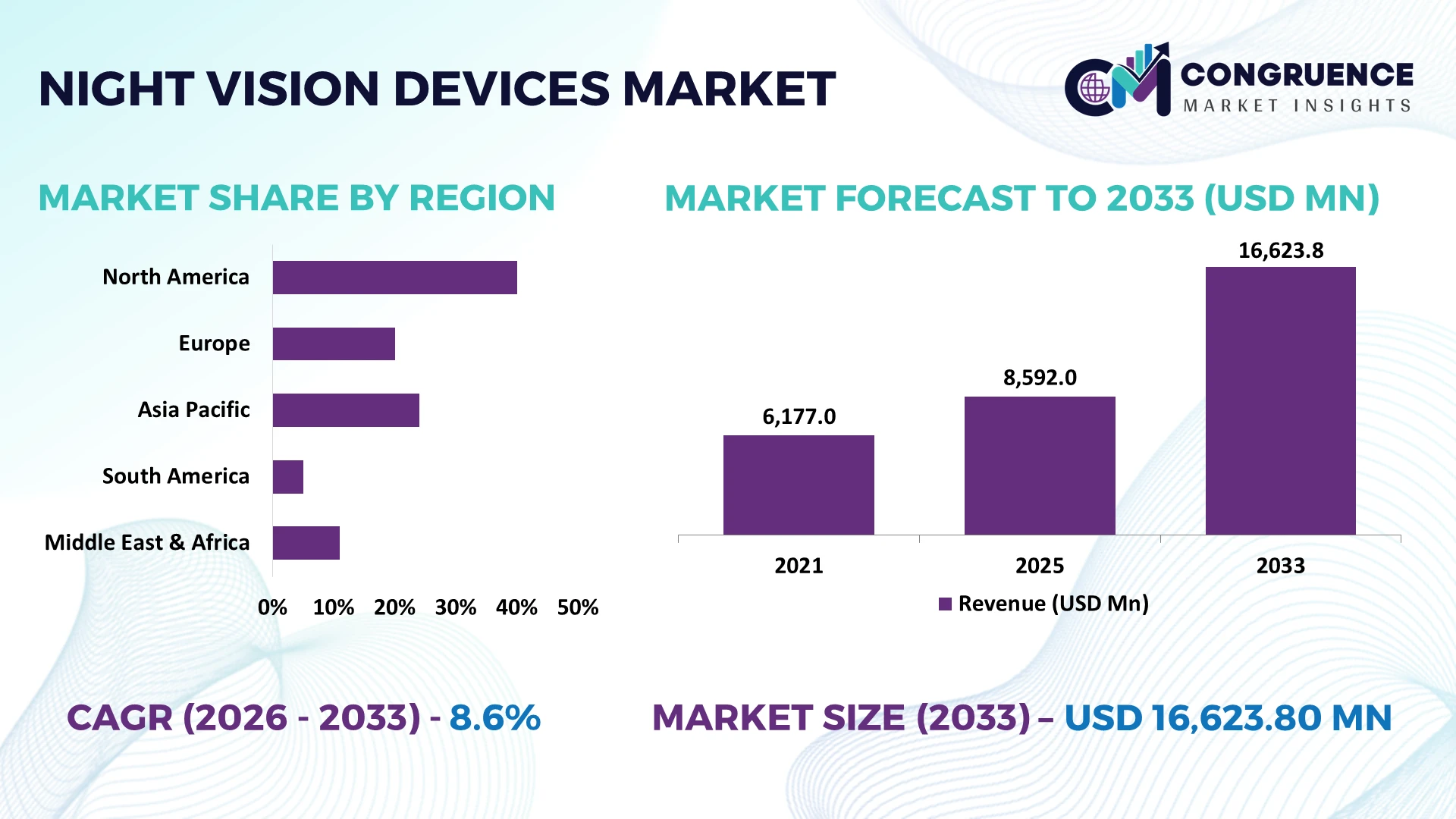
The Global Night Vision Devices Market was valued at USD 8592 Million in 2025 and is anticipated to reach a value of USD 16623.8 Million by 2033 expanding at a CAGR of 8.6% between 2026 and 2033. Growth is driven by military modernization, thermal-night fusion systems, digital image intensification, border surveillance upgrades, and rising deployment of vehicle-mounted and soldier-worn electro-optical equipment.
The United States dominates the global night vision devices market, supported by defense spending exceeding USD 900 billion annually and large-scale procurement across ground forces, aviation, special operations, and border security. Advanced fusion goggles increasingly combine image intensification with thermal sensing, while U.S. military modernization outpaces European procurement volumes. NATO readiness requirements and the Russia-Ukraine conflict continue accelerating night-operability investments across allied forces.
Manufacturers positioned around sensor fusion, lightweight optics, digital connectivity, and defense-qualified supply chains hold the strongest strategic advantage as procurement shifts toward networked, multi-spectral night-vision platforms.
Market Size & Growth: USD 8.592 billion in 2025 advances toward USD 16.624 billion by 2033 at 8.6%, supported by defense modernization and multi-spectral soldier systems.
Top Growth Drivers: Military modernization contributes roughly 45% of demand momentum, border surveillance 25%, and commercial/security applications approximately 15%.
Short-Term Forecast: By 2028, advanced digital processing and sensor fusion are positioned to improve target-recognition efficiency by more than 20%.
Emerging Technologies: AI-assisted object recognition, thermal-image fusion, augmented-reality overlays, and low-light CMOS sensors are reshaping next-generation night-vision architecture.
Regional Leaders: North America approaches USD 6 billion longer-term potential, Europe USD 4 billion, and Asia-Pacific USD 4.5 billion as defense adoption accelerates.
Consumer/End-User Trends: Defense and homeland-security users account for over 70% of advanced night-vision deployment, reinforcing ruggedized equipment demand.
Pilot/Case Example: In 2024, advanced fused-goggle deployments combined thermal and image-intensification channels, delivering substantially stronger detection performance than conventional single-channel systems.
Competitive Landscape: L3Harris holds an estimated 20%+ position in key military night-vision programs, alongside Elbit Systems, Teledyne FLIR, BAE Systems, and Thales.
Regulatory & ESG Impact: Export-controlled defense optics represent over 50% of high-performance procurement exposure, making ITAR-aligned production and secure component sourcing strategically critical.
Investment & Funding: Multi-billion-dollar global defense modernization programs are directing capital toward sensor production, semiconductor supply resilience, manufacturing expansion, and electro-optical partnerships.
Innovation & Future Outlook: Next-generation systems target 20–30% weight reductions while integrating thermal fusion, wireless connectivity, digital overlays, and AI-enabled battlefield awareness.
Night vision devices are moving beyond conventional image intensifiers toward fused thermal-optical platforms, digital low-light sensors, and connected soldier systems. Defense, border security, aviation, and critical-infrastructure surveillance remain core demand areas, while next-generation optics target 20–30% lower system weight. NATO operational-readiness priorities are reinforcing multi-spectral procurement, setting the foundation for increasingly software-defined, networked night-vision strategies.
Night vision devices are becoming strategic battlefield-computing assets rather than stand-alone optical equipment, shifting competition toward sensor fusion, software integration, secure connectivity, and domestic manufacturing capability. U.S. Army procurement has already moved fused binocular systems into full-scale production, while NATO modernization following the Russia-Ukraine conflict is reinforcing demand for interoperable low-light equipment. Supply chains are consequently restructuring around defense-qualified image intensifiers, thermal sensors, semiconductor components, and localized assembly.
Technology performance increasingly separates suppliers. Modern fused systems combine white-phosphor image intensification with thermal sensing, whereas legacy monocular devices depend primarily on ambient-light amplification. U.S. Army specifications target 80% man-sized target-recognition probability at 150 meters and continuous-fusion endurance progressing from a 7.5-hour threshold toward 15 hours—effectively doubling mission endurance. The United States leads deployment scale, while European forces emphasize NATO interoperability and domestic sourcing; India is expanding night-operability requirements across border, infantry, and armored applications.
Operationally, ENVG-B deployment connects helmet-mounted vision with weapon sights and tactical networks, allowing passive target engagement from protected positions. Suppliers are responding through production expansion, software partnerships, sensor R&D, and localized defense manufacturing. Through 2028, competitive advantage will increasingly depend on delivering lighter, network-ready, multi-spectral systems without sacrificing endurance, security, or optical performance.
Military modernization is the primary structural driver as armed forces replace single-channel night optics with fused image-intensification, thermal, and digital situational-awareness systems. U.S. Army specifications set an 80% target-recognition probability at 150 meters, while next-generation endurance targets represent a 100% improvement from 7.5 to 15 hours. Earlier system redesigns also reduced battery requirements by 25%, lowering field logistics. Lessons from Ukraine have increased emphasis on operating under darkness, smoke, camouflage, and electromagnetic exposure without active infrared signatures. This shifts procurement toward passive, dual-waveband systems connected to weapon sights and tactical networks. L3Harris, Elbit Systems, and specialist component suppliers are expanding production, improving tube performance, and integrating augmented-reality interfaces, creating an advantage for vendors capable of supplying complete soldier-vision ecosystems rather than isolated optics.
Advanced night vision remains constrained by demanding optical specifications, specialized semiconductor inputs, export controls, and the cost of producing defense-qualified image intensifier and thermal modules. U.S. Army requirements illustrate the engineering pressure: total system weight must move from a 2.5-pound threshold toward 1.5 pounds, a 40% reduction, while continuous-fusion endurance must improve 100% to reach the 15-hour objective. Recognition probability also declines from 80% at 150 meters to 50% at longer threshold distances, highlighting the performance trade-off between range, weight, power, and resolution. Military-grade tubes and infrared sensors remain tightly controlled in the United States, complicating international scaling. Manufacturers are reducing exposure through localized assembly, dual sourcing, long-term component agreements, and modular architectures that permit thermal, display, battery, and image-intensifier upgrades without redesigning complete platforms.
The strongest opportunity lies in converting night vision from an optical accessory into a networked soldier interface. Fused systems already target a 100% increase in continuous operating endurance, while design objectives seek approximately 40% lower system weight relative to threshold configurations and 80% target-recognition probability at tactical ranges. The next step is digital low-light imaging integrated with thermal overlays, augmented reality, navigation data, weapon-sight feeds, and AI-assisted object recognition. The United States is advancing Soldier Borne Mission Command architectures, while India offers an attractive pathway through indigenous defense-electronics manufacturing and large infantry modernization requirements. Suppliers are redirecting R&D toward low-power sensors, wireless interfaces, edge processing, and software-defined displays. A non-obvious advantage is lifecycle scalability: modular digital platforms allow capability upgrades through sensors and software rather than complete goggle replacement, improving fleet availability and lowering modernization disruption.
Long-term execution becomes harder as advanced goggles evolve into connected computing nodes carrying navigation, targeting, thermal imagery, and tactical data. Increasing functionality raises power, latency, cybersecurity, training, and human-factor requirements simultaneously. Army performance targets illustrate this balancing act: systems must sustain 80% recognition probability at 150 meters while pursuing a 40% weight reduction and 100% longer endurance between threshold and objective configurations. Adding wireless weapon-sight feeds and augmented-reality overlays increases software-validation requirements and creates additional electronic-signature and cyber-hardening concerns. U.S. forces have conducted repeated soldier test events before broader fielding, demonstrating that optical performance alone does not guarantee operational acceptance. Companies therefore need sustained investment in secure firmware, low-latency processors, power management, ergonomic testing, and open interfaces. Suppliers that cannot integrate optics, electronics, software, and soldier-network standards consistently will lose competitiveness despite strong standalone sensor performance.
Fusion Goggles Replace Single-Channel Optics: Image intensifiers still represent approximately 47.9% of technology demand, but dual-mode thermal fusion is gaining operational priority. Recent fused platforms have reduced target-recognition errors by roughly 40%, while the price premium over single-channel systems narrowed from about 80% to 60% between 2025 and 2026. Defense suppliers are scaling fused binocular production and consolidating sensor, display, and software integration.
Indigenous Procurement Reshapes Supply Chains: India is accelerating localization of military electro-optics as export controls and component-security requirements reshape sourcing. A 2025 Army program covered 29,762 indigenous night-vision weapon sights, while another order included 5,642 thermal weapon sights. More than 51% indigenous content is required under the associated IDDM procurement, pushing manufacturers toward domestic tubes, optics, electronics, and supplier partnerships.
Weight Reduction Becomes Procurement Metric: Lightweight engineering is moving from product differentiation to procurement necessity. Advanced housings using magnesium and composite materials are cutting device weight by around 15%, while military programs target reductions approaching 40% against earlier threshold configurations. Suppliers are redesigning battery packs, optics, mounts, and electronics simultaneously, lowering soldier fatigue while increasing usable mission duration.
Direct Contracts Concentrate Production Scale: Defense procurement is increasingly favoring suppliers capable of rapid high-volume production. Direct contracts represent roughly 53.7% of market distribution, while government buyers account for about 63.4% of demand. In May 2026, Elbit America became the sole producer under a major U.S. Army ENVG-B delivery order, highlighting how manufacturing readiness and qualification history increasingly determine contract concentration.
Image Intensifier systems lead the Night Vision Devices Market with approximately 47–48% share, reflecting extensive installed bases across infantry goggles, weapon sights, surveillance optics, and aviation equipment. Their high sensitivity under starlight, established military qualification, relatively low power consumption, and scalable tube manufacturing preserve procurement advantages. Thermal Imaging holds the next strategic position because heat-signature detection maintains visibility through smoke, darkness, and partial camouflage. Infrared Devices remain important for active illumination and specialized surveillance where covert emissions are less critical.
Fusion Systems are the fastest-advancing type as military users combine image intensification and thermal channels into a single field of view. Operational evaluations indicate fused imaging can reduce recognition errors by around 40% compared with conventional single-channel configurations. Digital Night Vision is simultaneously gaining relevance through CMOS sensors, recording, wireless connectivity, and software overlays. Manufacturers are consequently shifting R&D toward multi-spectral architectures, low-power electronics, lighter housings, and modular sensor packages, moving investment away from isolated optical performance toward integrated battlefield visualization.
Military Operations represent the leading application, accounting for approximately 55–58% of night-vision deployment as infantry, special operations, armored vehicles, aviation, and reconnaissance units require continuous low-light capability. Large fleet requirements and stringent performance standards concentrate spending on ruggedized goggles, weapon sights, thermal imagers, and fused systems. Surveillance & Security is the fastest-expanding application as border installations, airports, industrial facilities, and critical infrastructure integrate thermal cameras with automated perimeter monitoring and analytics.
Law Enforcement adoption is broadening around tactical response, search operations, and nighttime surveillance, supported by declining costs for uncooled thermal sensors. Hunting remains a specialized commercial application where digital night vision and thermal scopes provide long-range detection without military-grade intensifier costs. Navigation is strengthening across armored vehicles and other low-light mobility platforms, where thermal driver sights improve situational awareness without visible illumination. Suppliers are responding by separating product architectures: hardened multi-spectral systems target military programs, while compact digital and thermal devices address security, police, hunting, and navigation requirements.
Defense Forces dominate the Night Vision Devices Market with approximately 60–66% of end-user demand because equipment is deployed across infantry formations, special forces, armored crews, aviation personnel, and reconnaissance units. Procurement intensity remains substantially higher than civilian usage because military buyers require multiple device classes, qualification testing, secure electronics, and replacement inventories. Security Agencies form another established buyer base, particularly for border surveillance, counter-infiltration, and critical-infrastructure monitoring.
Law Enforcement is emerging as the fastest-expanding end-user as lighter thermal imagers and digital night-vision systems lower operational barriers for tactical teams and nighttime search missions. Wildlife Management increasingly adopts thermal devices for population monitoring, anti-poaching operations, and non-invasive nocturnal observation, while Outdoor Recreation supports demand for lower-cost digital monoculars, binoculars, and thermal viewers. Manufacturers are differentiating military-qualified systems from commercial platforms through sensor resolution, ruggedization, pricing, connectivity, and software features while building government partnerships and specialized distribution ecosystems.
North America accounted for the largest market share at 38.6% in 2025 however, Asia-Pacific is expected to register the fastest growth, expanding at a CAGR of 10.4% between 2026 and 2033.

Fused Soldier Systems Drive Procurement Leadership
North America accounts for approximately 38.6% of global Night Vision Devices Market demand, anchored by U.S. military procurement, electro-optical manufacturing depth, and large installed inventories across infantry, aviation, special operations, and border surveillance. Procurement is moving from conventional image-intensifier goggles toward binocular fusion platforms combining thermal channels, wireless weapon-sight connectivity, navigation, and augmented-reality information. U.S. Army ENVG-B programs demonstrate this transition, with performance requirements targeting 80% man-sized target recognition at 150 meters and substantial reductions in system weight. Domestic production capability across image intensifier tubes, infrared detectors, optics, and ruggedized electronics strengthens supply security. Canada contributes through defense modernization and surveillance applications, although deployment volumes remain below U.S. levels. Suppliers are prioritizing production capacity, power efficiency, sensor integration, and defense-qualified domestic component networks.
United States Market Outlook: The United States remains the decisive market because night-vision procurement extends across Army, Marine Corps, special operations, aviation, and federal security organizations. U.S. Army programs target continuous fused-operation endurance progressing from 7.5 hours toward 15 hours. L3Harris and Elbit America benefit from established production qualifications, while domestic semiconductor and electro-optical capabilities strengthen procurement resilience and shorten modernization cycles.
Defense Readiness Accelerates Optical Modernization
Europe represents approximately 25.4% of global demand, with Germany, France, the United Kingdom, Poland, and Nordic countries increasing investment in soldier systems, thermal surveillance, and armored-platform night capability. NATO readiness requirements and operational lessons from the Russia-Ukraine conflict have shifted procurement toward thermal fusion, passive detection, and interoperable electro-optical equipment. Germany’s defense modernization is particularly influential as procurement expands across infantry equipment, armored platforms, and surveillance infrastructure. European manufacturers hold established expertise in thermal detectors, optronics, targeting systems, and defense electronics, supporting localized supply chains. Poland and eastern NATO members are simultaneously accelerating equipment replacement as nighttime reconnaissance and counter-infiltration become operational priorities. Manufacturers are responding through cross-border partnerships, capacity expansion, common soldier-system architectures, and modular optics capable of integrating thermal, image-intensification, and digital information channels.
Germany Market Outlook: Germany provides one of Europe’s strongest procurement environments through Bundeswehr modernization and its EUR 100 billion special defense fund established after Russia’s invasion of Ukraine. Domestic industrial capabilities spanning optronics, sensors, armored systems, and defense electronics support localized integration. Demand increasingly favors network-compatible thermal and night-vision equipment capable of supporting infantry modernization and vehicle operations under NATO interoperability requirements.
Localization Meets Large-Scale Military Deployment
Asia-Pacific holds approximately 23.7% of global market demand and is becoming the most dynamic procurement environment as India, China, South Korea, Japan, and Australia modernize nighttime combat and surveillance capabilities. India provides a particularly visible localization signal: a 2025 procurement covered 29,762 advanced night-vision weapon sights with more than 51% indigenous content requirements. Another order covering 5,642 thermal weapon sights strengthens demand for locally integrated electro-optics. China maintains substantial domestic capability across infrared detectors, thermal cameras, digital optics, and military electronics, while South Korea and Japan emphasize advanced surveillance and networked defense platforms. Border tensions, maritime surveillance requirements, and defense-industrial localization are shifting sourcing toward domestic manufacturing. Suppliers are expanding sensor assembly, technology partnerships, indigenous component sourcing, and application-specific products spanning infantry, vehicles, perimeter surveillance, and weapon-mounted systems.
India Market Outlook: India combines large military deployment requirements with a policy-driven shift toward indigenous defense production. Procurement under Buy (Indian-IDDM) structures is increasing domestic value addition across optics, electronics, mounts, and integration. High-altitude operations along northern borders create sustained requirements for thermal and low-light equipment, giving local manufacturers and technology partners a scalable platform for military-grade production and subsequent export development.
Border Surveillance Shapes Selective Adoption
South America represents approximately 5.2% of global Night Vision Devices Market demand, led by Brazil, Colombia, Chile, and Argentina. Procurement is concentrated around border monitoring, counter-narcotics operations, special forces, policing, wildlife protection, and critical-infrastructure surveillance rather than broad infantry modernization. Brazil provides the largest operational base, supported by a land border exceeding 16,000 kilometers and extensive Amazon surveillance requirements. Thermal imagers and portable digital systems are gaining preference because they support detection across dense vegetation without requiring large fixed-lighting infrastructure. Budget constraints and dependence on imported high-performance sensors limit fleet-wide replacement, creating greater emphasis on selective deployments and lifecycle extension. Suppliers are responding through local distributors, maintenance partnerships, modular products, and commercially derived thermal platforms that lower acquisition and support costs while retaining operational capability.
Brazil Market Outlook: Brazil’s combination of extensive borders, Amazon monitoring requirements, defense forces, federal policing, and domestic aerospace-defense capability makes it South America’s central night-vision market. The country’s territory exceeds 8.5 million square kilometers, creating persistent surveillance complexity. Local integration and maintenance capacity provide suppliers with an advantage because government buyers increasingly value lifecycle support alongside sensor performance.
Security Modernization Prioritizes Thermal Surveillance
Middle East & Africa contributes approximately 7.1% of global demand, with Saudi Arabia, the United Arab Emirates, Israel, Türkiye, and South Africa forming important procurement and industrial nodes. Desert border surveillance, counter-drone operations, critical-infrastructure protection, and nighttime military mobility support demand for thermal imagers and fused observation systems. Saudi Arabia’s Vision 2030 defense localization objective targets more than 50% domestic military spending localization, encouraging international electro-optical suppliers to establish manufacturing, integration, and technology partnerships. Israel maintains advanced capabilities across thermal imaging, soldier systems, and electro-optical payloads, strengthening regional technology depth. African adoption remains more selective because procurement budgets and maintenance infrastructure vary substantially. Manufacturers are therefore combining premium military platforms with scalable surveillance systems, localized servicing, training, and modular architectures suited to different operating environments.
Saudi Arabia Market Outlook: Saudi Arabia is emerging as a strategically important procurement and localization center as defense programs move beyond imported finished systems toward domestic assembly, integration, and lifecycle support. The national 50% localization objective encourages partnerships involving sensor technologies, electronics, maintenance, and training. Border-security requirements and critical-energy infrastructure create additional demand for long-range thermal surveillance beyond conventional infantry applications.
The Night Vision Devices Market is led by L3Harris Technologies, Elbit Systems, Teledyne FLIR, Thales, and Leonardo, competing against specialized electro-optics manufacturers and cost-focused Asian suppliers. The top five players collectively control approximately 48% of global demand, supported by military qualifications, proprietary sensor technologies, and government relationships. Technology is the primary differentiator: fused thermal-image intensification can improve recognition effectiveness by roughly 40%, while next-generation platforms target system-weight reductions approaching 40%. Localized procurement increasingly influences competition, with Indian programs requiring more than 51% indigenous content. Leaders are expanding tube production, vertically integrating sensors and electronics, and partnering with defense ministries for soldier-system programs. Competition is shifting from standalone optics toward connected, multi-spectral platforms integrating thermal overlays, wireless weapon sights, and digital interfaces. Export controls, defense qualification cycles, and specialized detector manufacturing remain substantial entry barriers. Winning requires secure supply, field-proven performance, software integration, scalable production, and localized lifecycle support across priority procurement markets.
L3Harris Technologies
Elbit Systems
Teledyne FLIR
Thales
Leonardo
BAE Systems
Hensoldt
Safran
Rheinmetall
Photonis
Excelitas Technologies
ATN Corporation
Newcon Optik
ASELSAN
Current night vision technology centers on Gen III and image-intensifier tubes, white-phosphor displays, and uncooled thermal sensors. Modern binocular systems improve depth perception and target recognition by 20–30% versus legacy monocular configurations, while 16 mm tube architectures can reduce device weight by about 30%. Military adoption remains highest, with fused and binocular platforms deployed across infantry, aviation, and special operations, lowering fatigue and improving maneuver speed.
Emerging systems combine image intensification, thermal overlays, augmented reality, wireless weapon-sight feeds, and low-light CMOS imaging. Fusion platforms can improve detection performance by 35–40% over single-channel optics in obscured environments, while digital architectures enable recording, navigation overlays, and software upgrades. Adoption is expanding through U.S. Army and European modernization programs, benefiting suppliers integrating sensors, displays, power management, and secure battlefield connectivity within helmet-mounted platforms.
Disruptive development is shifting toward AI-assisted recognition, panoramic fields of view, digital low-light cameras, and software-defined imaging. Next-generation designs target 20–40% lower weight and longer battery endurance while retaining all-weather performance. Between 2026 and 2028, competition will favor vertically integrated manufacturers controlling image tubes, thermal cores, electronics, and software. Companies investing now gain faster qualification, scalable production, and positioning as procurement moves from standalone optics toward connected multi-spectral soldier systems.
April 2024 L3Harris Technologies received a U.S. Army order for continued ENVG-B production under full-scale Program of Record manufacturing, covering a $256 million award. The order expanded production continuity and strengthened L3Harris’ position in fused soldier night-vision systems. Source: L3Harris
April 2025 Thales unveiled its production Panoramic night-vision goggles at SOFINS, using four 18 mm image-intensifier tubes to deliver over 120° field of view versus roughly 42–50° for conventional binocular systems. Serial production strengthened Thales’ special-forces market positioning. Source: Janes
August 2025 U.S. Army C5ISR Center advanced the BNVD-F aviation prototype, integrating two image-intensifier channels with one thermal sensor for aircrews. Flight testing demonstrated a practical cross-platform fusion pathway, expanding night-vision technology from infantry deployment into aviation operations. Source: Army
May 2026 Elbit Systems of America secured a U.S. Army ENVG-B delivery order for production through 2028, becoming sole prime supplier for that award. The $212 million order consolidated responsibility and strengthened Elbit’s position in fused night-vision procurement. Source: Elbit
The Night Vision Devices Market Report covers Image Intensifier, Thermal Imaging, Digital Night Vision, Fusion Systems, and Infrared Devices across Surveillance & Security, Military Operations, Law Enforcement, Hunting, and Navigation applications. End-user analysis spans Defense Forces, Security Agencies, Law Enforcement, Wildlife Management, and Outdoor Recreation, with defense buyers accounting for the largest deployment concentration and fused systems gaining share in advanced programs.
Regional coverage includes North America, Europe, Asia-Pacific, South America, and Middle East & Africa, supported by country-level analysis of procurement, localization, manufacturing capability, and technology adoption. The report evaluates multi-spectral fusion, white-phosphor tubes, low-light CMOS sensors, thermal cores, augmented reality, and connected soldier systems. Competitive benchmarking, deployment patterns, supply-chain positioning, and emerging indigenous manufacturing opportunities support investment planning, market-entry decisions, partnership strategy, expansion priorities, and long-term positioning through 2033.
| Report Attribute/Metric | Report Details |
|---|---|
Market Revenue in 2025 | USD 8592 Million |
Market Revenue in 2033 | USD 16623.8 Million |
CAGR (2026 - 2033) | 8.6% |
Base Year | 2025 |
Forecast Period | 2026 - 2033 |
Historic Period | 2021 - 2025 |
Segments Covered | By Type
By Application
By End-User
|
Key Report Deliverable | Revenue Forecast, Growth Trends, Market Dynamics, Segmental Overview, Regional and Country-wise Analysis, Competition Landscape |
Region Covered | North America, Europe, Asia-Pacific, South America, Middle East, Africa |
Key Players Analyzed | L3Harris Technologies, Elbit Systems, Teledyne FLIR, Thales, Leonardo, BAE Systems, Hensoldt, Safran, Rheinmetall, Photonis, Excelitas Technologies, ATN Corporation, Newcon Optik, ASELSAN |
Customization & Pricing | Available on Request (10% Customization is Free) |




