
Reports
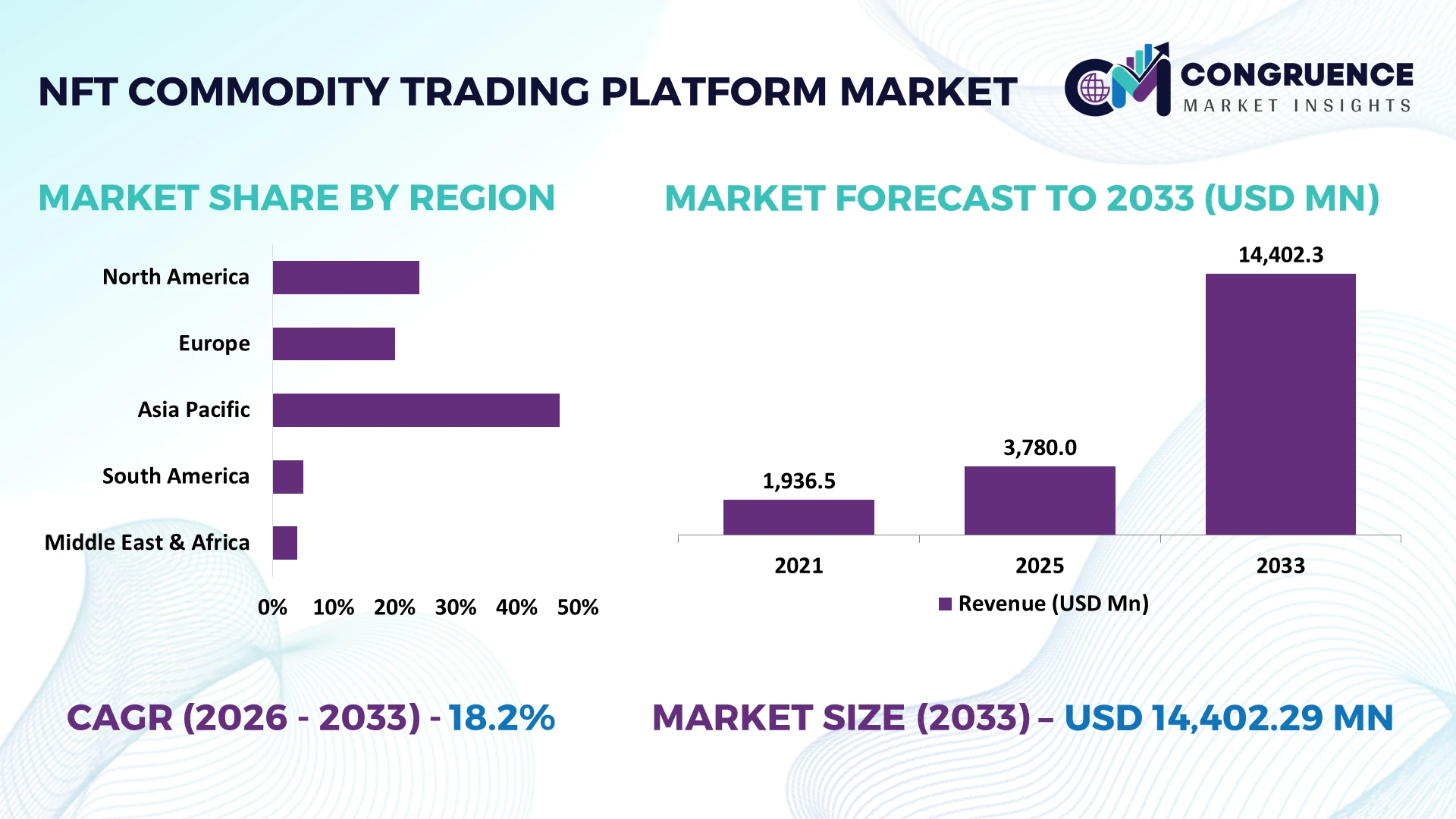
The Global NFT Commodity Trading Platform Market was valued at USD 3780 Million in 2025 and is anticipated to reach a value of USD 14402.29 Million by 2033 expanding at a CAGR of 18.2% between 2026 and 2033. Growth is being driven by tokenized commodity ownership, programmable settlement, blockchain-based provenance, and institutional integration of physical gold, metals, agricultural assets, and collateral into continuously tradable digital markets.
The United States remains the dominant operating hub for advanced NFT and tokenized-commodity infrastructure, supported by deep crypto liquidity, institutional custody capabilities, and increasingly explicit digital-asset rules. Tokenized commodities tripled in asset value during 2025, while PAX Gold and Tether Gold together approached USD 3 billion, demonstrating commercially significant adoption of blockchain-backed physical assets. By comparison, European platforms face tighter MiCA-aligned compliance requirements, strengthening regulated-custody competition.
Platform operators should prioritize regulated asset backing, multi-chain interoperability, institutional-grade custody, and transparent redemption infrastructure to capture the shift from collectible NFTs toward utility-based digital commodity ownership.
Market Size & Growth: USD 3,780 million in 2025 advances toward USD 14,402.29 million by 2033 at 18.2%, propelled by tokenized real-world commodities and programmable ownership infrastructure.
Top Growth Drivers: Tokenized commodity assets expanded roughly 200% during 2025, while multi-chain marketplace integration and institutional blockchain adoption are accelerating asset accessibility and liquidity.
Short-Term Forecast: By 2028, advanced smart-contract settlement is positioned to reduce reconciliation and intermediary-processing requirements by approximately 20–30% across digitally native commodity transactions.
Emerging Technologies: AI-assisted valuation, automated smart contracts, proof-of-reserve systems, and cross-chain interoperability are transforming NFT commodity exchanges from collectible-oriented marketplaces into advanced asset-trading infrastructure.
Regional Leaders: North America is positioned near USD 5.0 billion, Asia-Pacific around USD 4.1 billion, and Europe approximately USD 3.3 billion by 2033 as institutional tokenization, mobile crypto usage, and regulated custody expand.
Consumer/End-User Trends: The top three NFT marketplaces represented 82% of trading volume during 2024, showing that users increasingly concentrate activity on platforms offering liquidity, cross-chain access, and established infrastructure.
Pilot/Case Example: In 2025, tokenized commodities tripled in aggregate asset value, demonstrating roughly 200% expansion as blockchain rails brought gold, silver, base metals, and agricultural exposures on-chain.
Competitive Landscape: OpenSea currently captures approximately 73% of tracked NFT marketplace volume, followed by Blur at about 20%; Magic Eden, Rarible, SuperRare, and specialized RWA platforms broaden competitive positioning.
Regulatory & ESG Impact: U.S. SEC-CFTC coordination in 2025–2026 clarified treatment of several crypto-asset categories and spot commodity products, reducing regulatory ambiguity for compliant trading venues and institutional operators.
Investment & Funding: Approximately USD 3 billion combined value in PAX Gold and Tether Gold highlights capital concentration in physically backed digital commodities, reinforcing institutional interest in audited reserves and redeemable tokens.
Innovation & Future Outlook: Next-generation platforms are shifting toward 24/7 commodity tokenization, fractional ownership, automated compliance, and interoperable settlement, positioning regulated infrastructure providers ahead of collectible-only NFT marketplaces.
NFT Commodity Trading Platform Market demand is increasingly concentrated around tokenized precious metals, physical-asset provenance, fractional ownership, and institutional-grade settlement. Tokenized commodity value expanded roughly 200% during 2025, while proof-of-reserve technology and redeemable asset tokens strengthened confidence in physical backing. U.S. regulatory clarification is also reshaping platform architecture, setting up a decisive shift toward compliant, utility-driven digital commodity trading.
NFT commodity trading platforms are becoming strategically important as blockchain infrastructure shifts from speculative collectibles toward verifiable ownership, provenance, fractional access, and programmable settlement for physical and digital assets. The broader dapp ecosystem reached 24.6 million daily active wallets by year-end 2024, up 485%, while regulatory frameworks increasingly distinguish genuinely unique NFTs from fractionalized or fungible crypto-assets. This shift pushes operators toward compliance-led infrastructure, authenticated asset backing, and institutional-grade custody.
Smart-contract settlement provides a structural advantage over legacy commodity workflows that rely on brokers, registries, reconciliation, and restricted trading windows; automated execution can compress multi-stage settlement into near-real-time processing while materially reducing manual intervention. U.S. platforms benefit from deep blockchain liquidity and institutional infrastructure, while European operators face stricter asset-classification requirements under MiCA. NFT trading volume fell 19% in 2024 despite rapid growth in broader blockchain usage, reinforcing the pivot toward utility-backed assets.
A practical deployment model tokenizes warehouse-certified metals or agricultural inventory, linking ownership records with smart contracts and custody verification. Through 2026–2028, operators are prioritizing proof-of-reserve systems, interoperable chains, compliance automation, and custody partnerships. Competitive advantage will increasingly depend on trusted physical-digital settlement infrastructure rather than marketplace traffic alone.
The strongest structural driver is the migration from collectible NFTs toward tokens linked to verifiable commodities, ownership rights, and provenance records. The dapp ecosystem recorded a 485% increase in daily active wallets during 2024, reaching 24.6 million, while DeFi activity expanded 532%. NFT trading nevertheless declined 19%, highlighting a decisive shift from speculative turnover toward applications offering measurable utility. In the United States, institutional custody and tokenization infrastructure are supporting this transition, while commodity owners increasingly evaluate blockchain-based title and traceability systems. Platform companies are responding by integrating proof-of-reserve mechanisms, smart-contract settlement, fractional access, and multi-chain connectivity. The non-obvious advantage is data integrity: authenticated commodity NFTs can simultaneously function as ownership records, provenance tools, and transferable digital assets.
Market scalability remains constrained by unstable NFT liquidity, fragmented pricing, and uncertainty over whether commodity-linked tokens qualify as NFTs, crypto-assets, or regulated financial instruments. NFT trading volume declined 19% during 2024 and sales fell 18%; in August alone, volume dropped 16% month-on-month and stood 78% below its yearly peak. Such volatility weakens price discovery and raises inventory-management risks for platforms connecting tokens with physical commodities. Europe adds another structural constraint: MiCA excludes genuinely unique NFTs, but fractionalized NFTs are not automatically considered unique or non-fungible, creating additional classification requirements. Operators are reducing exposure through segregated custody, stronger KYC controls, diversified blockchain deployment, and asset-specific legal reviews. Platforms unable to establish enforceable links between tokens and underlying commodities face materially higher commercialization friction.
The strongest opportunity lies in converting authenticated physical assets into programmable digital ownership instruments rather than reproducing conventional NFT marketplaces. NFT activity approached 1 million daily active wallets during Q1 2024, while quarterly trading volume increased 50% and sales rose 13%, demonstrating that blockchain users respond rapidly when liquidity and market conditions improve. Commodity platforms can extend this infrastructure to precious metals, specialty agricultural inventory, collectibles, carbon-linked assets, and warehouse-certified materials. Singapore, the United States, and the UAE offer particularly relevant ecosystems for regulated tokenization and institutional digital-asset experimentation. Between 2026 and 2028, automated compliance, AI-assisted valuation, IoT-linked provenance, and interoperable custody will strengthen commercial deployment. Companies are building partnerships with custodians, inspection providers, exchanges, and blockchain networks to create vertically integrated tokenization ecosystems with continuous ownership verification.
Long-term competitiveness depends on solving execution risks that extend beyond token issuance. Hacks and exploits caused approximately USD 1.3 billion in dapp-industry losses during 2024 despite losses falling 31% year-on-year, demonstrating that smart-contract security remains a material infrastructure requirement. Blockchain fragmentation adds complexity: new networks gained substantial activity while Solana’s DeFi TVL increased roughly 2,000% during 2024, forcing marketplaces to support rapidly shifting liquidity pools and technical standards. Commodity NFTs introduce another difficulty because physical custody, inspection records, token ownership, and redemption must remain synchronized throughout the asset lifecycle. Operators therefore need audited smart contracts, cross-chain controls, oracle redundancy, custody integrations, and continuous reserve verification. The decisive challenge is maintaining one trustworthy record across blockchain and physical infrastructure; failure at that interface undermines settlement integrity regardless of transaction speed.
Tokenized Gold Liquidity Accelerates: Tokenized gold spot trading reached 90.7 billion in transaction volume during Q1 2026, already exceeding full-year 2025 activity, while PAXG represented 34.2%–82.5% of monthly volume. Centralized exchanges retain most execution activity, prompting platforms to deepen liquidity routing, market-making relationships, and institutional order-management capabilities.
Commodity Derivatives Move On-Chain: Real-world-asset perpetual trading reached 524.8 billion in Q1 2026 versus 313 billion throughout 2025, showing derivatives infrastructure scaling faster than basic token issuance. Operators are deploying automated margin engines, oracle-based pricing, and continuous risk controls, giving sophisticated trading firms faster hedging workflows and broader 24/7 exposure.
Custody Architecture Becomes Distributed: Institutional operating models are shifting away from single-provider dependence: 61% of surveyed investors now use multi-custodian structures versus 36% using one custodian. Meanwhile, 68% prefer partnerships with crypto-native firms and 53% favor traditional financial platforms with crypto capabilities, pushing marketplaces toward interoperable custody and compliance integrations.
Transfer Activity Outpaces Holdings: By August 2026, tokenized commodities recorded 6.8 billion in monthly transfers, up 118.13% in 30 days, while active addresses increased 58.95% and holders rose 24.91%. The divergence signals greater transactional intensity per participant, encouraging platforms to prioritize settlement throughput, wallet orchestration, and automated reconciliation instead of user-count expansion alone.
Exchange-Based Platforms hold an estimated 38% share of the NFT commodity trading platform market, reflecting their superior liquidity aggregation, standardized execution, API connectivity, custody integration, and ability to accommodate institutional order flow. Spot Trading Platforms account for approximately 27%, supported particularly by tokenized precious metals where transparent reference pricing and immediate settlement remain critical. Mature operators are strengthening market-making programs and integrating additional blockchain networks to reduce liquidity fragmentation.
Derivatives Platforms, representing roughly 19%, are the fastest-expanding type as professional traders increasingly seek leverage, short exposure, and continuous hedging against tokenized commodity positions. Auction-Based Platforms remain relevant for unique, illiquid, or provenance-sensitive commodities where price formation matters more than execution speed, while Peer-to-Peer Platforms serve bilateral and decentralized transactions but face weaker liquidity concentration. Investment priorities are consequently moving toward matching engines, collateral management, price oracles, and cross-margin infrastructure. Exchange operators able to combine spot liquidity with derivatives and compliant custody gain the strongest competitive position.
Commodity Trading represents the leading application with an estimated 34% market share as platforms increasingly provide continuous execution for digitally represented gold, silver, energy-linked instruments, and other physical assets. Price Discovery follows as an established application, benefiting from transparent blockchain transaction histories and global trading windows. Hedging remains strategically important for professional users requiring derivatives and collateralized positions against commodity-price volatility.
Asset Tokenization, at approximately 28% of activity, is the fastest-expanding application as issuance workflows move from experimental minting toward custody-linked, redeemable instruments. Tokenized commodities increased 289.1% between the beginning of 2025 and Q1 2026, while their share of tracked tokenized real-world assets reached 28.7%. Portfolio Management remains smaller but is strengthening as institutional dashboards combine digital commodities with conventional holdings. Platform companies are responding through automated issuance, reserve verification, oracle connectivity, compliance engines, and portfolio APIs. Operationally, asset tokenization is becoming the bridge between commodity ownership and secondary-market liquidity, making issuance infrastructure increasingly as important as transaction execution.
Trading Firms account for an estimated 32% share, reflecting their high transaction frequency, liquidity requirements, algorithmic execution capabilities, and dependence on real-time pricing infrastructure. Institutional Investors represent approximately 27% and are the fastest-expanding buyer group as regulated digital-asset access becomes embedded within conventional portfolio structures. Commodity Traders remain important users of spot execution and tactical hedging, particularly for tokenized precious metals and other liquid underlying assets.
Asset Managers are moving beyond passive exposure toward tokenization, portfolio integration, and custody-linked workflows, while Commodity Producers remain an emerging group using digital ownership infrastructure for inventory financing, traceability, and direct asset distribution. In 2026, 73% of surveyed institutions planned to increase digital-asset allocations, while 69% prioritized trading capabilities and 68% prioritized custody infrastructure. Platform providers are therefore targeting enterprises with institutional APIs, multi-custodian connectivity, configurable compliance, and portfolio reporting rather than retail-only interfaces. Competitive demand is shifting toward platforms that integrate execution, custody, risk controls, and tokenized-asset administration within one operating environment.
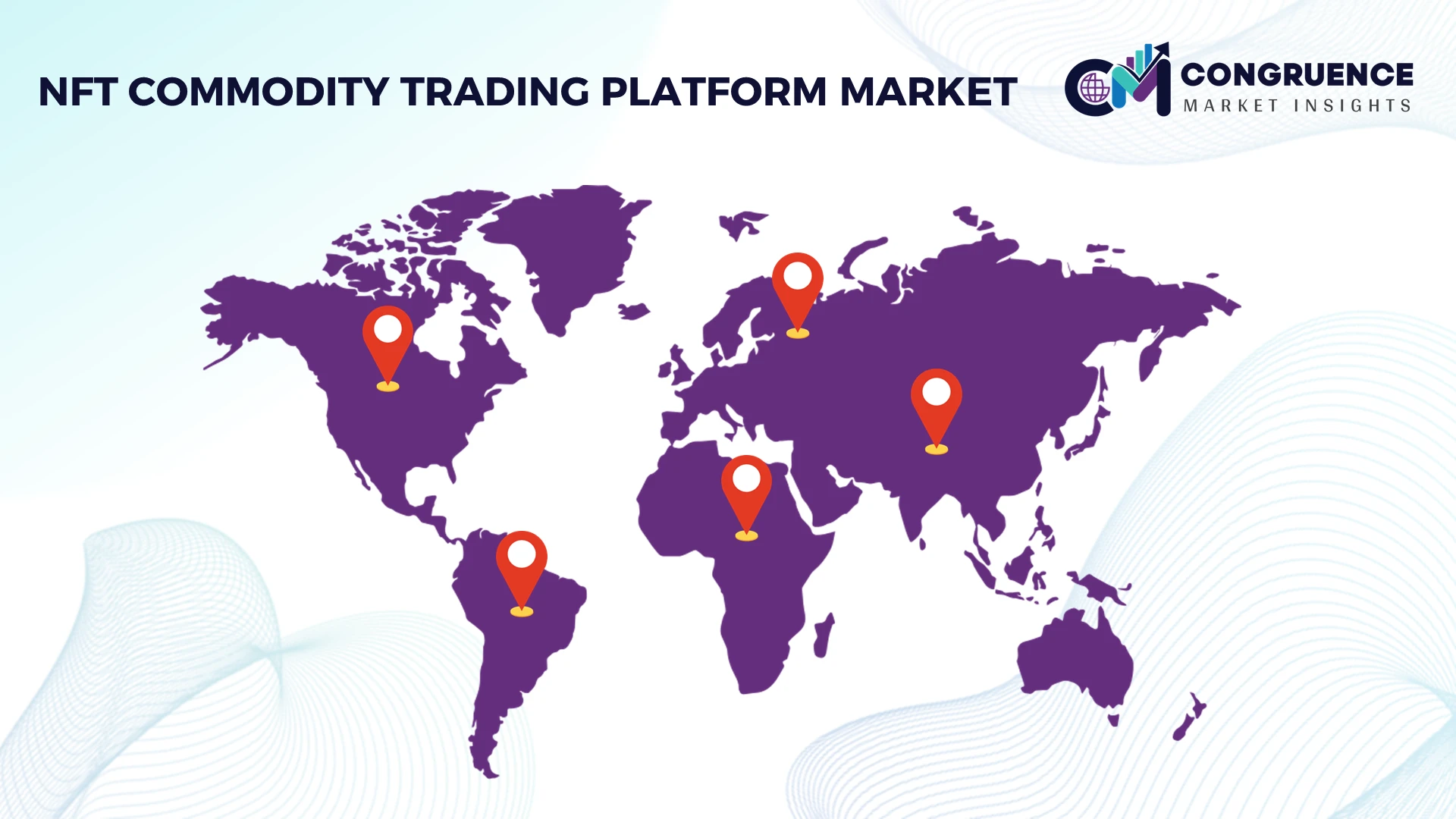
North America accounted for the largest market share at 36% in 2025 however, Asia-Pacific is expected to register the fastest growth, expanding at a CAGR of 20.4% between 2026 and 2033.
Institutional Tokenization Moves Into Regulated Infrastructure
North America commands approximately 36% of the global NFT commodity trading platform market, anchored by U.S. institutional liquidity, crypto-native exchanges, custody infrastructure, and real-world asset tokenization. Corporate blockchain adoption is moving beyond experimentation: 60% of Fortune 500 companies were working on blockchain initiatives in 2025, up 47% year over year, strengthening enterprise demand for programmable settlement and tokenized ownership. The CFTC’s 2025 digital-asset pilot introduced tokenized collateral into regulated derivatives infrastructure, while SEC-CFTC coordination opened pathways for certain spot crypto products on registered venues. Platform operators are consequently integrating institutional custody, reserve verification, collateral management, and compliance automation. The region’s strategic advantage lies less in collectible NFT activity and increasingly in connecting blockchain settlement with established capital-market infrastructure.
United States Market Outlook: The United States combines the region’s deepest institutional investor base with rapidly changing digital-asset policy. More than 75% of surveyed institutional investors planned to increase digital-asset allocations in 2025, while 59% intended allocations exceeding 5% of assets under management. Tokenization providers are therefore prioritizing regulated custody, commodity-linked collateral, exchange connectivity, and institutional APIs.
Regulated Tokenization Replaces Speculative Deployment
Europe represents an estimated 25% of global activity, with its competitive position shaped by regulatory standardization rather than unrestricted marketplace expansion. MiCA became fully applicable in December 2024, establishing common authorization, governance, disclosure, and reserve requirements for covered crypto-assets, while the EU DLT Pilot Regime enables controlled trading and settlement of tokenized financial instruments. This structure is pushing NFT commodity platforms toward compliance-by-design, segregated custody, auditable reserves, and institutional-grade post-trade systems. ESMA reported growing applicant interest in the DLT Pilot during 2025 despite initially limited uptake and proposed changes supporting broader participation. European operators are consequently investing in regulated trading architecture and cross-border interoperability. A non-obvious advantage is passportable regulatory infrastructure: compliant operators can design standardized services for multiple EU jurisdictions instead of maintaining fragmented national operating models.
Germany Market Outlook: Germany offers a strong combination of regulated financial institutions, industrial commodity users, and established crypto-asset supervision. MiCA implementation complements existing institutional custody expertise, creating favorable conditions for tokenized metals and other asset-backed instruments. German operators increasingly compete through secure custody, transaction transparency, and integration between blockchain rails and conventional financial-market infrastructure.
Institutional Pilots Accelerate Cross-Border Adoption
Asia-Pacific holds approximately 23% of the market but is advancing fastest through high blockchain participation, institutional tokenization pilots, and government-backed digital-finance infrastructure. Crypto value received across Asia-Pacific increased approximately 69% year over year in the period ending June 2025, ahead of every other major region. Singapore’s Project Guardian is establishing frameworks for interoperable tokenized assets, while Hong Kong is expanding tokenization into gold, non-ferrous metals, renewable-energy assets, and regulated investment products. Hong Kong had already authorized its first retail tokenized gold product, followed by three tokenized money-market funds in early 2025. Platform providers are responding with cross-chain settlement, institutional wallet connectivity, programmable compliance, and partnerships with banks and asset managers. The region’s critical advantage is policy-led experimentation that connects blockchain deployment directly with established financial institutions.
Hong Kong Market Outlook: Hong Kong is emerging as a strategic bridge between commodity infrastructure and regulated tokenization. Its government explicitly targeted precious metals and non-ferrous metals for broader tokenization, while the London Metal Exchange designated Hong Kong an approved delivery point in 2025. Combining physical warehousing with blockchain ownership creates a particularly strong operating model for digitally traded commodity claims.
Agricultural Assets Drive Practical Tokenization
South America accounts for approximately 9% of the global market, with adoption increasingly tied to agricultural production, export financing, and commodity-backed collateral rather than conventional NFT collecting. Latin American crypto activity expanded approximately 63% year over year through June 2025, demonstrating a rapidly deepening digital-asset user base. Brazil and Argentina provide particularly relevant environments because large agricultural supply chains generate warehouse receipts, inventories, and export flows suitable for blockchain representation. Agricultural tokenization platforms have already brought soybeans, soybean oil, cotton, and corn onto public blockchain infrastructure, demonstrating practical links between physical production and programmable financing. Operators are building integrations with custodians, warehouses, commodity verifiers, and payment providers. Infrastructure fragmentation and regulatory differences remain execution constraints, making local banking connectivity and enforceable asset claims essential for scalable deployment.
Brazil Market Outlook: Brazil ranked fifth globally for crypto adoption in 2025, improving from tenth in 2024. Its scale in soybeans, corn, coffee, and other export commodities creates a natural testing ground for inventory-backed tokens. Platforms linking verified agricultural assets with financing and settlement can address working-capital requirements that collectible-focused NFT marketplaces cannot serve.
Regulatory Hubs Attract Tokenization Infrastructure
Middle East & Africa represents approximately 7% of global market activity, with deployment concentrated around Gulf financial centers and digitally active African economies. Middle East and North African crypto activity increased approximately 33% year over year through June 2025, while Sub-Saharan Africa recorded about 52% growth. The UAE has developed a structured digital-asset environment through Dubai’s VARA framework and Abu Dhabi’s ADGM ecosystem, supporting institutional tokenization, custody, and blockchain settlement. Gold, property-linked assets, and other real-world instruments offer stronger commercial pathways than collectible NFTs because Gulf markets combine commodity trading expertise with international capital flows. Companies are establishing regulated entities, custody partnerships, and compliance infrastructure in Dubai and Abu Dhabi while using blockchain networks for cross-border distribution. African adoption remains more fragmented, with payment infrastructure and regulatory consistency limiting institutional deployment.
United Arab Emirates Market Outlook: The UAE is the region’s principal institutional tokenization hub, supported by VARA-regulated Dubai and ADGM’s financial-market infrastructure. Its established gold-trading ecosystem, global logistics connectivity, and crypto licensing architecture provide a strong foundation for commodity-backed digital assets. Operators increasingly use the country as a regulated base for serving international investors and cross-border asset flows.
OpenSea, Blur, Magic Eden, Coinbase, Paxos, and specialized tokenization providers compete across distinct layers of NFT commodity infrastructure, with marketplaces contesting liquidity while regulated platforms target custody and asset-backed issuance. The top five platforms capture an estimated 75% of relevant marketplace activity, creating strong concentration around established liquidity pools. Execution speed, fees, compliance, custody, and interoperability define competition; leading platforms target transaction-cost reductions of 10–20% through smart-contract automation while multi-chain deployment can expand accessible liquidity by over 25%. OpenSea and Blur emphasize marketplace technology, whereas Coinbase and Paxos leverage regulated infrastructure and institutional connectivity. Players are expanding through blockchain integrations, custody partnerships, tokenization services, and vertical links with physical-asset providers. Competition is shifting from NFT listing volume toward verifiable real-world ownership and programmable settlement. Regulatory authorization, liquidity depth, reliable price oracles, and enforceable commodity backing remain substantial entry barriers. Winning requires combining trusted custody, continuous liquidity, regulatory compliance, and seamless physical-to-digital settlement.
OpenSea
Blur
Magic Eden
Rarible
Coinbase
Kraken
Paxos
Tether
Securitize
Ondo Finance
Matrixport
JusToken
DigiFT
InvestaX
Smart contracts, asset-backed token standards, proof-of-reserve systems, and distributed ledgers form the current technology stack for NFT commodity trading platforms. Tokenized commodities expanded 289% from early 2025 through Q1 2026, signaling production-scale adoption. Automated delivery-versus-payment can cut reconciliation workloads by 20–30%, while on-chain reserve verification reduces manual audit dependency and strengthens collateral transparency for traders, custodians, and issuers across global commodity trading workflows today.
Emerging infrastructure centers on cross-chain interoperability, high-throughput networks, decentralized price oracles, and AI-assisted risk monitoring. Solana-based RWA value expanded more than tenfold within twelve months before mid-2026, while omnichain architectures increasingly connect Ethereum, BNB Chain, and Solana liquidity. Compared with legacy gold settlement requiring T+1 or T+2 processing, blockchain transfers settle within seconds, improving settlement speed by over 99% and enabling continuous collateral mobility. Regulated issuers and exchanges gain the strongest advantage.
Disruptive development through 2026–2028 will combine tokenized physical commodities with automated compliance, IoT provenance feeds, fractional NFTs, and programmable derivatives. Commodity perpetuals already represent 69.7–95.3% of monthly RWA perpetual volume, validating demand for always-on exposure. AI-driven surveillance can reduce manual exception handling by 15–25%, while interoperable custody lowers liquidity fragmentation. Platforms investing now secure faster product deployment, stronger institutional integration, and defensible operating scale.
September 2024 Matrixdock launched XAUm, a gold token backed by 99.99% pure LBMA-standard bullion, with each token representing one troy ounce. Ethereum and BNB deployment plus physical redemption in Singapore and Hong Kong expanded institutional-grade commodity tokenization access. Source: matrixdock.com
June 2025 Kraken launched 60 tokenized U.S. stocks and ETFs through xStocks for eligible non-U.S. clients, targeting rollout across 140+ countries. The deployment established 24/5 exchange trading and 24/7 on-chain transferability, strengthening Kraken’s real-world-asset infrastructure. Source: kraken.com
February 2026 Tether acquired a $150 million stake in Gold.com to expand tokenized-gold distribution and enable bullion purchases using Tether stablecoins. The investment connected XAU₮ infrastructure with physical-gold distribution, strengthening the bridge between blockchain liquidity and bullion markets. Source: coindesk.com
March 2026 Hyperliquid’s HIP-3 commodity perpetuals reached roughly 30% of platform open interest after launching in December 2025; open interest later peaked at $2.1 billion. The shift validated strong demand for continuous on-chain commodity derivatives and decentralized execution. Source: coingecko.com
The NFT Commodity Trading Platform Market Report evaluates Spot Trading Platforms, Derivatives Platforms, Auction-Based Platforms, Peer-to-Peer Platforms, and Exchange-Based Platforms across Commodity Trading, Price Discovery, Hedging, Asset Tokenization, and Portfolio Management. End-user coverage includes Commodity Traders, Institutional Investors, Asset Managers, Commodity Producers, and Trading Firms, with analysis spanning North America, Europe, Asia-Pacific, South America, and Middle East & Africa.
Technology coverage assesses smart contracts, proof-of-reserve architecture, cross-chain interoperability, decentralized oracles, AI-enabled surveillance, programmable settlement, and physical-asset verification. The scope also examines tokenized precious metals, agricultural commodities, fractional ownership, and commodity derivatives, where on-chain adoption is strengthening. Competitive assessment tracks approximately 10–14 influential operators alongside custody, liquidity, compliance, and ecosystem strategies. The 2026–2033 framework supports investment prioritization, geographic expansion, partnership selection, product positioning, infrastructure planning, and identification of emerging digital commodity trading models.
| Report Attribute/Metric | Report Details |
|---|---|
Market Revenue in 2025 | USD 3780 Million |
Market Revenue in 2033 | USD 14402.29 Million |
CAGR (2026 - 2033) | 18.2% |
Base Year | 2025 |
Forecast Period | 2026 - 2033 |
Historic Period | 2021 - 2025 |
Segments Covered | By Type
By Application
By End-User
|
Key Report Deliverable | Revenue Forecast, Growth Trends, Market Dynamics, Segmental Overview, Regional and Country-wise Analysis, Competition Landscape |
Region Covered | North America, Europe, Asia-Pacific, South America, Middle East, Africa |
Key Players Analyzed | OpenSea, Blur, Magic Eden, Rarible, Coinbase, Kraken, Paxos, Tether, Securitize, Ondo Finance, Matrixport, JusToken, DigiFT, InvestaX |
Customization & Pricing | Available on Request (10% Customization is Free) |




