
Reports
The Global Next Generation Customer Loyalty Market was valued at USD 12800 Million in 2025 and is anticipated to reach a value of USD 32147.9 Million by 2033 expanding at a CAGR of 12.2% between 2026 and 2033. AI-led personalization, real-time decisioning, mobile-wallet engagement, and coalition loyalty models are accelerating replacement of static points-based programs with continuously optimized customer experiences.
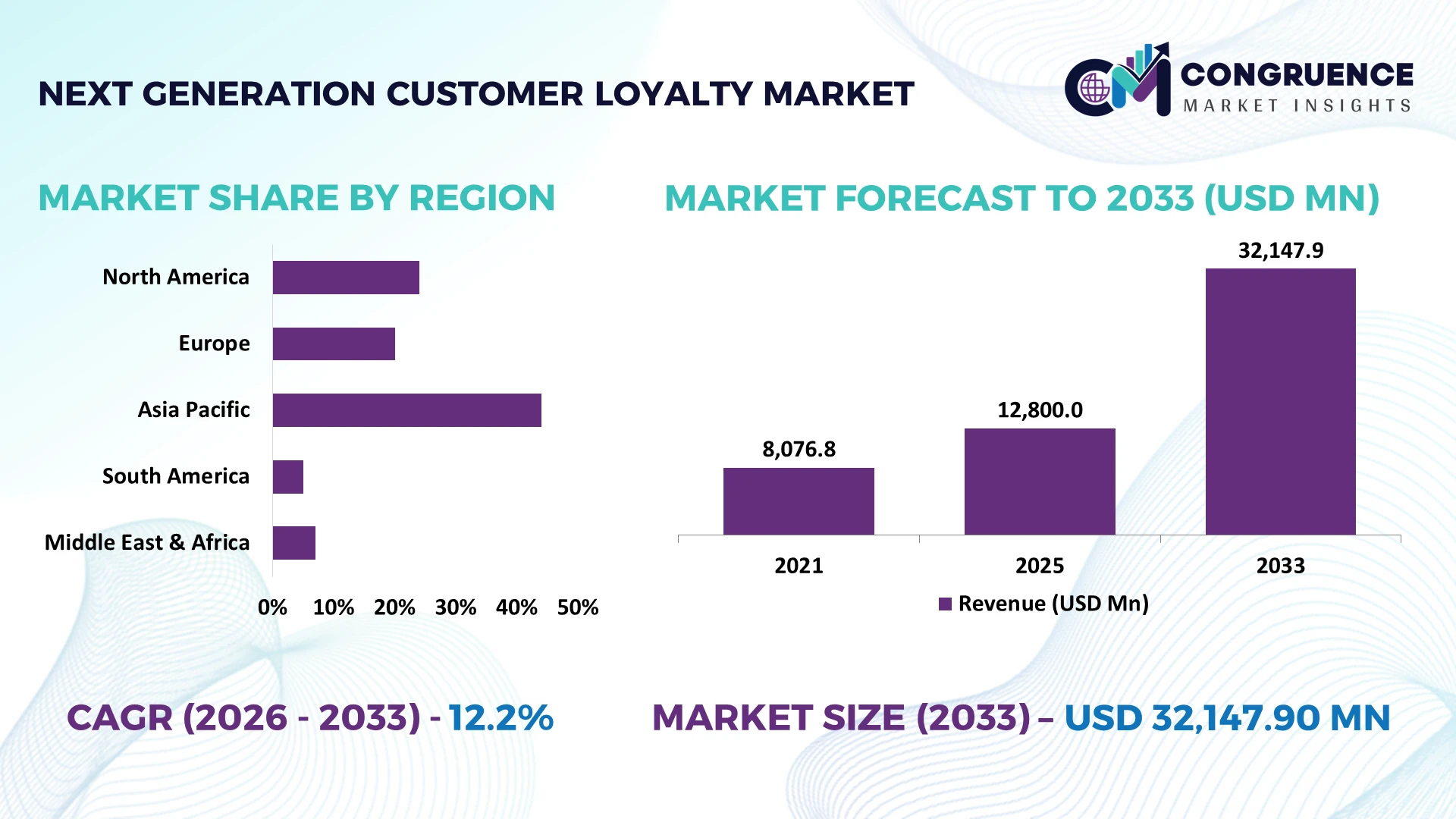
The United States is the dominant country market, supported by North America’s 37.35% share, 90% loyalty-program participation among online adults, and deep retail, BFSI, travel, and e-commerce adoption. US consumers average more than 15 loyalty memberships, versus about 9 in Europe, while 39.5% report increased spending after joining programs. The US therefore remains the primary benchmark for AI-enabled loyalty investment, while Asia-Pacific represents the strongest expansion opportunity.
Strategic implication: companies should prioritize AI personalization, first-party data infrastructure, mobile engagement, and cross-industry partnerships rather than expanding conventional points-based programs.
Market Size & Growth: USD 12.8 billion in 2025 is positioned to reach USD 32.15 billion by 2033 at 12.2% CAGR, driven by AI personalization and real-time loyalty orchestration.
Top Growth Drivers: AI personalization contributes a 15–20% potential satisfaction uplift, personalized engagement supports 5–8% revenue improvement, and AI-enabled service can reduce costs by up to 30%.
Short-Term Forecast: By 2030, AI-led decisioning is expected to push loyalty operations toward 20–30% faster offer optimization and materially lower manual campaign workloads.
Emerging Technologies: Generative AI, agentic AI, predictive analytics, mobile wallets, and composable loyalty APIs are replacing static reward engines with real-time engagement stacks.
Regional Leaders: North America leads at 37.35% share, while Asia-Pacific records the fastest projected growth at 11.64%; Europe remains a major privacy-led adoption center.
Consumer/End-User Trends: Mobile applications hold 43.44% of engagement share, while retail and e-commerce account for 31.38%, confirming mobile-first, transaction-rich loyalty as the core adoption model.
Pilot/Case Example: In 2025, an AI-powered airline personalization program delivered 210% better targeting of at-risk customers, an 800% customer-satisfaction improvement, and 59% lower churn intention.
Competitive Landscape: Oracle leads with approximately 3.8% share, while Microsoft, SAP, Adobe, and Salesforce form the core enterprise competitive group; the top five held 14.3% collectively in 2025.
Regulatory & ESG Impact: EU privacy enforcement is intensifying scrutiny of loyalty-data transfers, making consent, governed first-party data, and transparent AI essential to scalable personalization.
Investment & Funding: Talon.One secured approximately USD 135 million in July 2025, demonstrating continued funding for API-first loyalty and promotions infrastructure.
Innovation & Future Outlook: Next-generation loyalty is shifting from points accumulation toward AI agents, experiential rewards, payment-linked benefits, wallet-native engagement, and continuous next-best-action decisioning.
Next Generation Customer Loyalty is moving rapidly toward AI-native, omnichannel engagement as retailers, banks, travel operators, and e-commerce brands seek higher-value customer relationships. Mobile applications already represent 43.44% of engagement share, while personalized experiences can improve satisfaction by 15–20%. Regulatory scrutiny of customer-data usage, particularly across Europe, is simultaneously forcing loyalty providers to strengthen consent management, privacy controls, and first-party data strategies, shaping the next strategic phase.
Next Generation Customer Loyalty is becoming strategically important because customer retention is shifting from points accumulation toward real-time personalization, predictive engagement, and ecosystem-based rewards. Mobile applications already represent 43.44% of market engagement, while retail and e-commerce account for 31.38%, making loyalty infrastructure a direct competitive lever for customer lifetime value. Companies are therefore reallocating investment toward AI decision engines, unified customer data, and API-based loyalty platforms.
AI-driven loyalty systems can process behavioral signals and automate offer selection substantially faster than legacy batch-based platforms, reducing campaign decision cycles by 20–30% and lowering manual optimization workloads. The United States remains the most mature deployment market, while India is advancing through mobile-first commerce, digital payments, and rapidly expanding consumer platforms. Meanwhile, Europe's stricter privacy environment is accelerating investment in consent-based first-party data architectures rather than unrestricted third-party tracking.
Over the next 2–3 years, enterprises are expected to increase deployment of generative AI, predictive churn models, wallet-linked rewards, and partner ecosystems. Practical deployments increasingly connect purchase history, location, payment behavior, and service interactions to generate next-best offers automatically. Companies are responding through technology partnerships, platform modernization, and selective geographic expansion. Competitive advantage will increasingly depend on turning loyalty data into measurable, privacy-compliant customer intelligence.
AI-powered personalization is the strongest structural driver, with personalized experiences capable of improving customer satisfaction by 15–20%, while AI-enabled service models can reduce operating costs by up to 30%. Mobile applications already account for 43.44% of engagement, reinforcing demand for real-time offers and predictive rewards. The United States is leading enterprise deployment as retailers, airlines, banks, and digital platforms replace batch-based segmentation with continuous decisioning. Increasing privacy restrictions are simultaneously shifting companies toward first-party behavioral data. Leading providers are investing in machine-learning engines, customer-data platforms, and ecosystem partnerships. The non-obvious advantage is faster response to changing purchase intent, allowing brands to optimize incentives before competitors capture the same customer.
Data fragmentation remains a significant constraint because loyalty programs often operate across payment, CRM, e-commerce, mobile, and customer-service systems. Mobile applications represent 43.44% of engagement, yet disconnected identity layers can prevent consistent recognition across channels. Enterprise integration projects can consume 15–25% of technology implementation budgets when legacy APIs and proprietary databases require extensive customization. In Germany and other tightly regulated European markets, consent and data-governance requirements further increase architecture complexity. Supply-chain and software dependency on specialized cloud and customer-data infrastructure adds another cost layer. Companies are reducing exposure through API-first platforms, modular deployments, multi-vendor contracts, and centralized identity management. The key operational insight is that interoperability, rather than reward design, increasingly determines scalable deployment economics.
Wallet-linked rewards, embedded finance, and AI agents are opening high-value opportunities beyond traditional retail loyalty. Mobile applications already capture 43.44% of engagement, while retail and e-commerce represent 31.38%, creating a strong base for payment-connected incentives. Generative AI can improve personalization efficiency by 15–20% when customer signals are unified across transactions and interactions. India offers an especially attractive deployment environment because rapid digital-payment adoption enables loyalty mechanics to be integrated directly into everyday transactions. Companies are expanding through payment partnerships, retail alliances, travel ecosystems, and API-based reward marketplaces. A less obvious opportunity lies in coalition loyalty, where shared customer identities allow smaller merchants to compete for high-value consumers without funding an entire loyalty technology stack independently.
Scaling AI-driven loyalty introduces execution challenges around model governance, cybersecurity, identity resolution, and workforce capabilities. Loyalty platforms increasingly connect sensitive behavioral and transaction datasets, making security controls essential as digital engagement expands. Organizations can face 20–30% higher implementation workloads when AI models require additional governance, testing, monitoring, and integration layers. In the United Kingdom and European markets, evolving privacy requirements also demand explainable personalization and auditable consent workflows. Companies must therefore invest in zero-trust architectures, automated model monitoring, privacy-enhancing technologies, and specialist data engineering teams. The critical strategic challenge is maintaining personalization quality without creating excessive surveillance or compliance exposure; firms that standardize governance at the platform level will achieve more consistent deployment and stronger long-term customer trust.
AI-Driven Loyalty Orchestration: Enterprises are shifting from rule-based campaigns toward AI-assisted next-best-action workflows, improving offer-selection speed by 20–30% and reducing manual campaign effort by nearly 25%. US retailers and banks are integrating predictive models with customer-data platforms, while stricter European privacy controls are accelerating first-party data usage. Companies are scaling automated decision engines rather than expanding campaign teams.
Wallet-Linked Reward Expansion: Mobile loyalty engagement now represents approximately 43.44%, pushing brands toward wallet-linked coupons, payment-triggered rewards, and app-based redemption. Integration can shorten reward activation cycles by 15–20% and improve transaction-level visibility. Indian digital-commerce operators are connecting loyalty with payment ecosystems, while enterprises increasingly form fintech and platform partnerships to consolidate fragmented customer journeys.
Experiential Rewards Reshape Programs: Paid memberships, tier benefits, gamification, and personalized experiences are gaining traction as consumers seek immediate utility rather than delayed points accumulation. Personalized engagement can lift satisfaction by 15–20%, while gamified interactions can increase repeat participation by roughly 10–15%. Travel and hospitality companies are restructuring reward catalogs around upgrades, access, and experiences, creating higher-value engagement without proportionally increasing discounts.
Privacy-Led Data Restructuring: Consent requirements and tighter third-party tracking rules are changing loyalty-data workflows, particularly across European enterprises. Companies are reallocating approximately 15–20% more implementation effort toward identity resolution, consent management, and secure data integration. The non-obvious shift is that privacy modernization is becoming a competitive differentiator: firms with unified first-party profiles can personalize faster while reducing dependence on external audience-data supply chains.
Points-Based loyalty remains the leading type, accounting for approximately 34% of market adoption because it is scalable, familiar, and straightforward to integrate with retail transaction systems. Tiered programs follow at around 23%, using status progression to increase purchase frequency and customer lifetime value. Paid Membership is the fastest-growing type, expanding adoption as consumers increasingly accept subscription-style benefits, exclusive pricing, and premium access. Coalition programs hold roughly 15%, particularly where multiple merchants share reward ecosystems, while Gamified programs represent about 12% and are strengthening among mobile-first consumers.
The investment shift is clear: mature points systems are being upgraded with AI personalization, dynamic rewards, and real-time redemption rather than abandoned. Paid models are receiving stronger product attention because recurring membership economics can improve retention by approximately 10–15%. Companies are therefore prioritizing hybrid architectures combining points, tiers, paid benefits, and gamification instead of maintaining isolated reward structures.
Customer Retention leads application demand at approximately 29%, reflecting the direct financial value of reducing churn and increasing repeat purchases. Rewards & Incentives follow near 24%, while Personalized Offers represent roughly 21% and are the fastest-growing use case as AI enables real-time offer selection. Customer Engagement accounts for about 16%, supported by mobile interactions, gamification, and personalized communications, while Referral Programs remain smaller at approximately 10%.
The market is shifting from retrospective retention campaigns toward predictive intervention. Personalized Offers can improve conversion performance by roughly 10–20% when behavioral and transaction data are combined, encouraging enterprises to integrate loyalty engines with CRM and customer-data platforms. Referral Programs remain strategically useful for acquisition efficiency, while Engagement programs increasingly connect social, mobile, and transactional signals. Companies are expanding automation around churn scoring, individualized rewards, and triggered communications, making personalization an operational capability rather than a standalone marketing function.
Retail & E-Commerce is the dominant end-user group, representing approximately 32% of adoption because high transaction frequency, extensive customer datasets, and established mobile-commerce infrastructure support continuous loyalty engagement. Banking & Finance follows at roughly 23%, while Travel & Hospitality represents about 19%. Telecommunications contributes nearly 15%, and Consumer Goods accounts for around 11%. Travel & Hospitality is the fastest-growing buyer group as airlines and hotel operators increasingly connect loyalty with personalized offers, upgrades, and partner ecosystems.
Retail platforms are prioritizing real-time personalization and wallet integration, while financial institutions emphasize transaction-linked rewards and cross-product retention. Travel operators are investing more heavily in predictive customer segmentation, with personalized interventions capable of reducing churn intention by approximately 15–20% in advanced deployments. Telecommunications providers are strengthening loyalty through bundled services, and Consumer Goods companies increasingly use retailer partnerships to access purchase-level insights. Competitive positioning is therefore shifting toward ecosystem ownership and interoperable customer identities rather than standalone rewards catalogs.
North America accounted for the largest market share at 37.35% in 2025 however, Asia-Pacific is expected to register the fastest growth, expanding at a CAGR of 11.64% between 2026 and 2033.
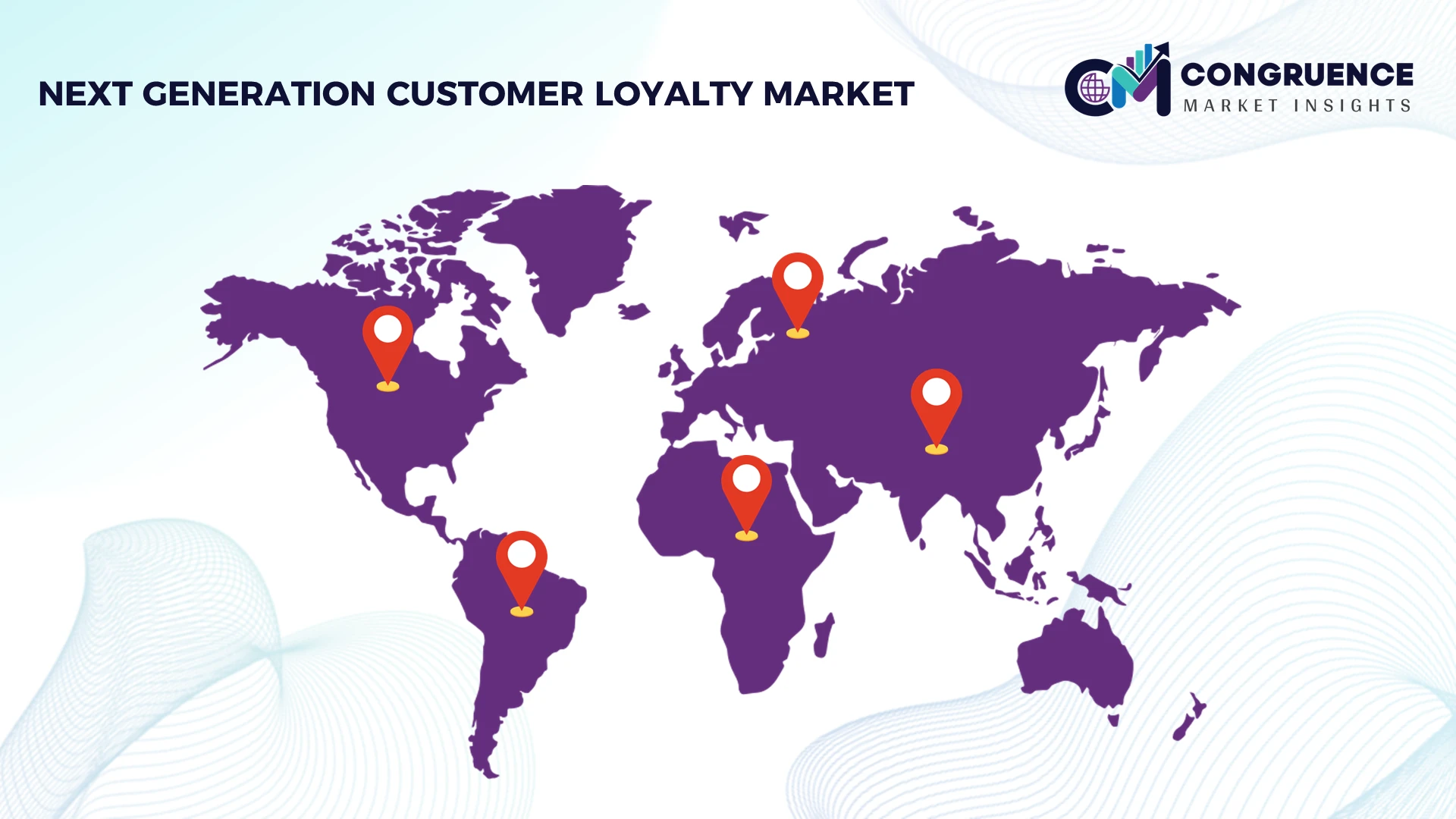
AI-led personalization and enterprise data integration are reshaping mature loyalty infrastructure
North America maintains the strongest position in the Next Generation Customer Loyalty Market because of its dense concentration of large retailers, e-commerce platforms, financial institutions, airlines, hospitality companies, and technology providers. The United States represents the primary deployment center, supported by advanced cloud infrastructure, widespread digital payments, sophisticated CRM platforms, and high consumer participation in loyalty programs. More than 90% of online adults participate in at least one loyalty program, creating a substantial base for personalized engagement. Enterprises are increasingly connecting loyalty engines with customer-data platforms, mobile applications, payment systems, and marketing automation tools. AI-based segmentation and next-best-action capabilities are reducing manual campaign workloads by approximately 20–30%, while real-time personalization improves the speed of promotional decisions. Companies are also prioritizing first-party data architectures as privacy requirements and restrictions on third-party tracking reshape customer-data strategies. Partnerships between retailers, payment providers, cloud companies, and loyalty technology specialists are becoming more important for scaling integrated ecosystems.
United States Market Outlook: The United States remains the dominant country-level market because of its extensive retail infrastructure, advanced digital-commerce ecosystem, and high enterprise technology spending. Consumers maintain more than 15 loyalty memberships on average, increasing competitive pressure for differentiated rewards, premium memberships, personalized offers, and experiential benefits. Major enterprises are moving beyond conventional points programs by integrating AI, predictive analytics, mobile wallets, and customer-data platforms. Strong cloud adoption also enables rapid deployment across multiple customer touchpoints, giving US companies a significant advantage in loyalty personalization and operational automation.
Privacy-led modernization is transforming customer-data and loyalty architecture
Europe is developing through a distinctive combination of digital loyalty modernization, strict data governance, omnichannel commerce, and increasing enterprise demand for privacy-compliant personalization. Germany, the United Kingdom, France, Italy, and Spain represent important deployment centers across retail, banking, telecommunications, travel, and consumer services. Unlike less regulated markets, European enterprises are placing greater emphasis on consent management, identity resolution, transparent AI decisioning, and secure first-party customer data. The regulatory environment is materially influencing technology architecture. GDPR requirements and evolving artificial-intelligence governance standards are encouraging companies to redesign loyalty platforms around controlled data access and auditable personalization. Complex modernization programs can allocate approximately 15–20% of implementation effort toward data governance, identity management, and compliance controls. Companies are therefore favoring modular cloud platforms, API-based integration, and privacy-enhancing technologies. European brands are also incorporating digital rewards and targeted promotions to reduce unnecessary physical marketing materials, creating an operational sustainability advantage while improving campaign precision.
Germany Market Outlook: Germany is strategically significant because of its large retail and financial-services base, sophisticated enterprise IT infrastructure, and stringent approach to customer-data governance. German companies are increasingly investing in consent-based customer-data platforms, secure API integration, and AI-supported personalization. Loyalty providers must demonstrate strong privacy controls alongside measurable operational performance. The combination of industrial technology capabilities and demanding regulatory expectations makes Germany an important testing ground for privacy-first loyalty architecture and enterprise-grade customer intelligence.
Mobile commerce and digital payments are creating high-frequency loyalty ecosystems
Asia-Pacific represents the most dynamic expansion environment for Next Generation Customer Loyalty as smartphone usage, digital payments, e-commerce, super-app ecosystems, and mobile-first consumer behavior continue transforming customer engagement. China, India, Japan, South Korea, Singapore, and Australia show different adoption patterns, but enterprises across these markets are increasingly embedding loyalty within digital commerce journeys. Mobile applications already account for approximately 43.44% of loyalty engagement, reinforcing the importance of app-based rewards, personalized notifications, wallet integration, and real-time incentives. India is particularly important because its digital-payment ecosystem creates frequent transaction touchpoints that can support personalized loyalty. China continues to demonstrate large-scale ecosystem integration through commerce, payments, social platforms, and mobile services. Companies are deploying AI recommendation engines, predictive churn models, digital wallets, coalition partnerships, and API-based reward platforms. Unlike mature Western markets that often modernize legacy programs, many Asian enterprises can build loyalty directly into newer digital ecosystems, reducing dependence on outdated infrastructure and enabling faster experimentation with gamified, subscription, and personalized models.
India Market Outlook: India is emerging as a strategically important country because of its combination of smartphone penetration, expanding e-commerce, digital payments, fintech innovation, and large consumer platforms. UPI processes billions of transactions each month, creating extensive opportunities for transaction-linked rewards and behavioral personalization. Retailers, banks, fintech companies, and digital platforms are increasingly integrating loyalty into payment and commerce journeys. Companies can use these high-frequency digital interactions to deliver personalized incentives without relying exclusively on traditional physical membership cards or standalone reward programs.
Digital payments and fintech integration are accelerating loyalty modernization
South America is experiencing increasing loyalty technology adoption through digital commerce, mobile payments, fintech expansion, and stronger integration between retail and financial services. Brazil represents the largest deployment center, followed by Argentina, Colombia, and Chile, where retailers, banks, telecommunications providers, and travel businesses are strengthening digital customer-engagement capabilities. The region remains more fragmented than North America, but increasing smartphone-based purchasing is creating new opportunities for app-centered loyalty models. Payment-linked loyalty is becoming particularly relevant because enterprises can connect purchase behavior with personalized rewards, targeted promotions, and retention campaigns. Digital workflows can reduce campaign execution time by approximately 15–20% compared with fragmented manual processes. Brazilian companies are expanding through fintech partnerships, mobile applications, coalition programs, and integrated customer-data platforms. Currency volatility and uneven digital infrastructure continue to influence reward economics, encouraging enterprises to adopt flexible pricing, localized incentives, and cloud-based technology. A significant strategic shift is occurring as loyalty moves closer to payment infrastructure, making transactional data a core competitive asset rather than simply a marketing input.
Brazil Market Outlook: Brazil is the leading country market because of its substantial retail sector, sophisticated banking ecosystem, expanding fintech landscape, and highly developed instant-payment infrastructure. PIX has created frequent digital transaction interactions between consumers and businesses, providing valuable opportunities for personalized rewards and behavioral segmentation. Major retailers and financial institutions are increasingly combining transaction information with mobile engagement, while fintech partnerships expand loyalty reach. Companies are prioritizing flexible reward structures that respond to local purchasing behavior and economic conditions, strengthening the role of real-time data in customer retention.
Digital transformation and premium customer ecosystems are driving investment
Middle East & Africa adoption is increasingly concentrated in digitally advanced economies such as the United Arab Emirates, Saudi Arabia, and South Africa. Retail, aviation, hospitality, banking, telecommunications, and luxury services represent the strongest deployment sectors because these industries have frequent customer interactions and substantial incentives to increase repeat spending. Gulf markets are particularly focused on premium loyalty models built around travel privileges, exclusive access, personalized services, lifestyle benefits, and cross-brand partnerships rather than conventional discount-based programs. Digital transformation initiatives and smart-city investments are encouraging enterprises to modernize CRM, payment, and customer-data infrastructure. Real-time customer engagement can improve campaign responsiveness by approximately 15–20% when loyalty platforms are connected with behavioral and transactional signals. Companies are investing in cloud infrastructure, AI personalization, mobile applications, and ecosystem partnerships. Airlines and hospitality groups are also extending loyalty benefits across broader partner networks, creating interconnected customer ecosystems. The region’s concentration of high-value consumers creates an important non-obvious opportunity: premium personalization can generate stronger loyalty economics without requiring mass-market reward discounts.
United Arab Emirates Market Outlook: The UAE is the most strategically advanced country market in the region because of its sophisticated digital infrastructure, smart-city programs, aviation industry, hospitality ecosystem, financial-services capabilities, and luxury retail concentration. High smartphone usage and advanced payment infrastructure allow enterprises to connect loyalty with travel, retail, banking, and lifestyle services. Companies are increasingly developing premium membership programs, AI-supported personalization, and cross-brand reward ecosystems. Dubai’s position as an international tourism and business hub further increases demand for loyalty platforms capable of handling multilingual, multicultural, and cross-border customer journeys.
Oracle, Salesforce, SAP, Adobe, Microsoft, and specialized loyalty technology providers compete across enterprise loyalty orchestration, customer-data integration, personalization, analytics, and reward management. Global technology leaders compete with specialized innovators through platform breadth, while regional providers differentiate through localization, customization, and industry-specific deployment. The top five players collectively command approximately 14.3% of the market, demonstrating a fragmented competitive structure with significant space for specialized providers.
Competition increasingly centers on AI capabilities, integration speed, customization, cybersecurity, and total operating cost. AI automation can reduce campaign workloads by approximately 20–30%, while API-first architectures can shorten deployment cycles by roughly 15–20%. Players are responding through cloud modernization, technology partnerships, acquisitions, embedded payment integrations, and ecosystem expansion. The competitive landscape is shifting from standalone points-management software toward integrated customer-intelligence platforms capable of orchestrating real-time interactions. High switching costs, enterprise integration complexity, cybersecurity requirements, and regulatory compliance remain important entry barriers. Winning companies will combine scalable AI, interoperability, privacy controls, rapid deployment, and flexible reward economics while delivering measurable improvements in retention and customer engagement.
Oracle Corporation
Salesforce, Inc.
SAP SE
Adobe Inc.
Microsoft Corporation
Talon.One
Comarch SA
Epsilon Data Management
Antavo
ICF Next
Capillary Technologies
Kobie Marketing
SessionM
Bond Brand Loyalty
Current loyalty infrastructure is moving from batch-based CRM rules to cloud-native customer-data platforms, decision engines, mobile wallets, and API orchestration. AI-driven segmentation can improve campaign efficiency by 20–30%, while automated next-best-action workflows cut manual optimization effort by roughly 20%. Mobile applications represent 43.44% of engagement, making omnichannel identity resolution important. Retailers, banks, airlines, and hospitality groups are integrating loyalty, commerce, payments, and service data into unified profiles.
Emerging technologies include generative AI, agentic AI, predictive churn models, and reward engines. Agentic workflows can accelerate offer configuration by 15–20%, while predictive analytics can improve targeting performance by 10–15% when transaction and signals are combined. Compared with legacy batch campaigns, orchestration can shorten decision cycles by around 25%, giving US and Asian enterprises an advantage. Privacy-enhancing technologies are gaining importance as European companies redesign first-party data architectures.
From 2026–2028, composable loyalty platforms, AI agents, wallet-native rewards, and event-driven APIs will become increasingly integrated across enterprise stacks. Adoption will favor companies connecting CRM, payment, ecommerce, and service signals without duplicating identities. Specialized innovators benefit through faster customization, while software vendors gain from platform consolidation. The strategic priority is immediate: modernize data infrastructure now to secure faster personalization, lower friction, and stronger competitive differentiation.
March 2025 Oracle enabled AEGEAN to unify customer data across 16.3 million annual passengers, using AI-powered personalization to improve loyalty and marketing decisions. The deployment strengthened cross-channel customer intelligence and supported more relevant travel offers at enterprise scale across destinations. Source: oracle.com
March 2025 Antavo reported 40% year-on-year growth, adding 13 enterprise customers within six months while Timi AI reached 80% adoption in its Loyalty Planner. The expansion strengthened Antavo’s enterprise footprint and accelerated agentic-AI adoption in loyalty management globally across sectors. Source: antavo.com
July 2025 Talon.One secured USD 135 million in growth funding from Silversmith Capital Partners and Meritech Capital, with CRV continuing participation. The financing supports enterprise loyalty and promotions infrastructure, expanding product development and market capabilities for over 270 global brands. Source: talon.one
October 2025 Comarch partnered with Saudi retailer Panda to develop and operate a new loyalty management platform for its large customer base. The agreement advances Panda’s digital transformation through hyper-personalized engagement and strengthens Comarch’s Middle East retail expansion strategy significantly. Source: comarch.com
The report covers the Next Generation Customer Loyalty Market across Points-Based, Tiered, Paid Membership, Coalition, and Gamified models, with application analysis spanning Customer Retention, Personalized Offers, Rewards & Incentives, Customer Engagement, and Referral Programs. End-user coverage includes Retail & E-Commerce, Banking & Finance, Travel & Hospitality, Telecommunications, and Consumer Goods. The assessment covers AI, predictive analytics, generative AI, mobile wallets, customer-data platforms, API orchestration, and privacy-enhancing technologies shaping deployment.
Regional analysis covers North America, Europe, Asia-Pacific, South America, and Middle East & Africa, with country assessment of adoption centers and digital markets. The study tracks indicators including mobile engagement at 43.44%, North American market share at 37.35%, and deployment shifts across industries. Coverage supports investment planning, modernization, expansion priorities, partnership selection, competitive positioning, and technology strategy through 2026–2033, highlighting programs, emerging loyalty models, ecosystem opportunities, and niche AI-enabled use cases.
| Report Attribute/Metric | Report Details |
|---|---|
Market Revenue in 2025 | USD 12800 Million |
Market Revenue in 2033 | USD 32147.9 Million |
CAGR (2026 - 2033) | 12.2% |
Base Year | 2025 |
Forecast Period | 2026 - 2033 |
Historic Period | 2021 - 2025 |
Segments Covered | By Type
By Application
By End-User
|
Key Report Deliverable | Revenue Forecast, Growth Trends, Market Dynamics, Segmental Overview, Regional and Country-wise Analysis, Competition Landscape |
Region Covered | North America, Europe, Asia-Pacific, South America, Middle East, Africa |
Key Players Analyzed | Oracle Corporation, Salesforce, Inc., SAP SE, Adobe Inc., Microsoft Corporation, Talon.One, Comarch SA, Epsilon Data Management, Antavo, ICF Next, Capillary Technologies, Kobie Marketing, SessionM, Bond Brand Loyalty |
Customization & Pricing | Available on Request (10% Customization is Free) |




