
Reports
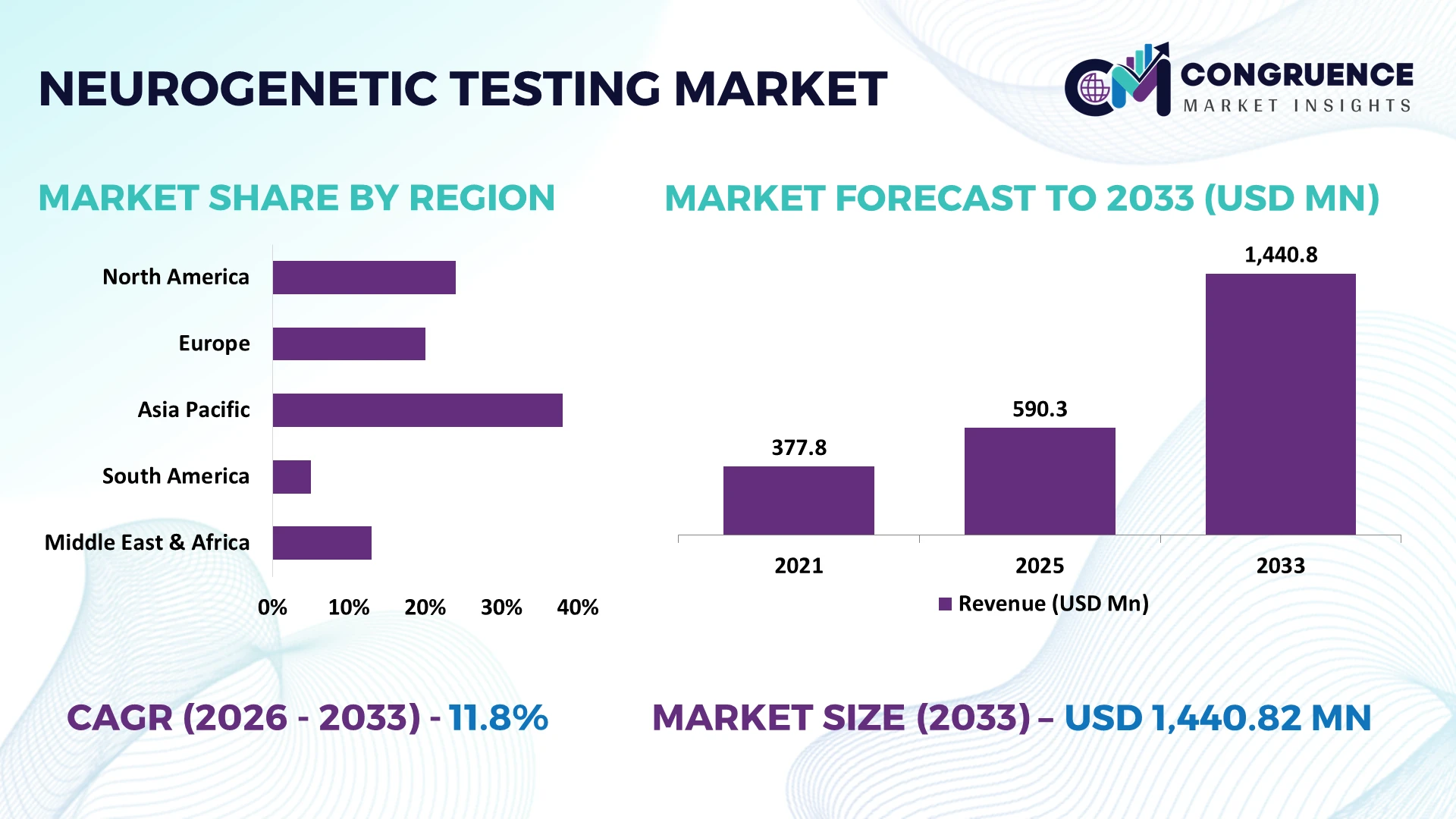
The Global Neurogenetic Testing Market was valued at USD 590.3 Million in 2025 and is anticipated to reach a value of USD 1440.82 Million by 2033 expanding at a CAGR of 11.8% between 2026 and 2033. Growth is driven by expanding whole-genome and exome sequencing, falling sequencing costs, rare neurological disease programs, and broader clinical use of molecular diagnosis for inherited neurodevelopmental disorders.
The United States accounts for approximately 40% of global neurogenetic testing activity, supported by more than 7,000 identified rare diseases, advanced clinical genomics laboratories, NIH-funded sequencing programs, and extensive neurology networks. Genome sequencing can deliver diagnostic yields approaching 40% in selected pediatric neurological cohorts, while U.S. clinical adoption remains ahead of India, where genomic testing capacity is expanding from a lower base. The U.S. NIH’s All of Us program, designed to build a cohort of at least 1 million participants, strengthens genomic infrastructure while international competition for sequencing capacity and genomic sovereignty increasingly influences national precision-medicine investment.
Strategically, laboratories combining broad sequencing, phenotype interpretation, rapid turnaround, and clinically actionable variant classification are best positioned to capture complex neurological testing workflows.
Market Size & Growth: USD 590.3 million in 2025 advances to USD 1,440.82 million by 2033 at 11.8% CAGR, driven by clinical exome and genome sequencing.
Top Growth Drivers: Rare-disease diagnosis contributes approximately 35% of momentum, sequencing accessibility 30%, and precision-neurology adoption 22%.
Short-Term Forecast: By 2028, automated variant interpretation can reduce genomic analysis workloads by approximately 30%, improving laboratory turnaround and specialist productivity.
Emerging Technologies: Whole-genome sequencing, long-read sequencing, and AI-assisted variant interpretation increasingly converge, enabling analysis across more than 20,000 protein-coding genes.
Regional Leaders: North America approaches USD 236 million, Europe USD 177 million, and Asia-Pacific USD 136 million in 2025, supported respectively by clinical genomics, rare-disease networks, and sequencing expansion.
Consumer/End-User Trends: Diagnostic yields of approximately 30–40% in selected neurological cohorts are strengthening physician preference for broad sequencing over sequential single-gene testing.
Pilot/Case Example: In 2025, population-scale genomic initiatives continued progressing toward cohorts exceeding 1 million participants, expanding reference datasets relevant to neurological variant interpretation.
Competitive Landscape: Illumina-linked sequencing ecosystems influence over 60% of global sequencing activity, alongside Labcorp, Quest Diagnostics, GeneDx, and Centogene in clinical testing workflows.
Regulatory & ESG Impact: U.S. FDA oversight of laboratory-developed tests entered a major transition after its 2024 rule, increasing compliance planning across thousands of diagnostic laboratories.
Investment & Funding: National genomics initiatives collectively represent multi-billion-dollar infrastructure commitments, increasingly targeting sequencing capacity, diverse reference populations, biobanks, and clinical translation.
Innovation & Future Outlook: Long-read platforms now produce reads above 10,000 bases, strengthening detection of repeat expansions and structural variants that conventional short-read workflows can miss.
Neurogenetic testing is shifting from targeted gene panels toward exome, genome, repeat-expansion, and increasingly long-read sequencing for epilepsy, neuromuscular disorders, neurodevelopmental conditions, and hereditary ataxias. Diagnostic yields can reach approximately 40% in selected complex neurological cohorts. AI-supported interpretation and richer population reference datasets are reducing analytical bottlenecks, while genomic sovereignty initiatives reshape laboratory infrastructure and sequencing strategy worldwide.
Neurogenetic testing is becoming strategically important as neurology shifts from symptom-based diagnosis toward molecularly defined disease pathways that influence treatment selection, genetic counseling, and clinical-trial eligibility. Whole-genome and exome sequencing are replacing sequential single-gene testing, while national genomics programs are modernizing diagnostic infrastructure. In a 1,000-patient clinical sequencing cohort, trio exome or genome analysis produced a 39% overall diagnostic yield, strengthening the business case for broader first-line testing.
Technology economics are also changing. First-line genome sequencing has produced mean diagnostic yields near 45%, versus about 33% in previously tested cohorts, reducing repeated testing and shortening diagnostic pathways. The United States benefits from deeper clinical sequencing capacity and reimbursement infrastructure, while South Korea and other Asian markets are scaling genome-led diagnostics; Korean data showed 49.2% diagnostic yield for neurological and neurodevelopmental disorders.
A practical deployment model combines phenotype capture, trio sequencing, automated variant prioritization, and multidisciplinary review within one workflow. Laboratories are investing in interpretation software, long-read platforms, specialist partnerships, and regional sequencing capacity. Through 2028, competitive advantage will increasingly depend on solving complex variants faster, reducing diagnostic dead ends, and integrating genomic results directly into neurological care pathways.
Clinical adoption is accelerating as exome and genome sequencing outperform fragmented gene-by-gene diagnostic pathways across heterogeneous neurological disorders. Trio analysis delivered a 39% overall diagnostic yield across 1,000 patients, increasing to 46% in syndromic neurodevelopmental disorders and 59% among patients with known consanguinity. This evidence is shifting testing earlier in the diagnostic pathway, reducing repeated molecular investigations and specialist referrals. U.S., Korean, and European laboratories are expanding comprehensive sequencing panels, trio workflows, and phenotype-driven interpretation. Companies are responding through broader assay menus, automated variant classification, hospital partnerships, and integrated counseling services. The strategic insight is that testing value increasingly depends on diagnostic resolution per patient, not simply sequencing throughput, favoring providers capable of combining genomic breadth with clinical interpretation.
A large proportion of sequenced patients still remain without a definitive molecular diagnosis, limiting the immediate clinical value of broad testing. More than half of rare-disease patients can remain undiagnosed after current genomic investigations, while first-line genome sequencing studies show diagnostic yields varying widely from 12% to 73%. Variant-of-uncertain-significance burdens, incomplete phenotype data, and ancestry gaps in reference databases further constrain interpretation. These limitations are particularly important in India, Africa, and other underrepresented populations where genomic reference diversity remains weaker. Laboratories are mitigating the problem through periodic reanalysis, family-based sequencing, phenotype standardization, and localized databases. The operational constraint is interpretive scalability: sequencing capacity can expand rapidly, but expert review and clinically validated annotation remain harder to industrialize.
Long-read sequencing opens a differentiated opportunity in repeat expansions, structural variants, methylation abnormalities, and difficult genomic regions that short-read workflows frequently resolve poorly. A 2025 rare-disease study detected additional diagnoses in 10% of patients previously negative on short-read testing, while a 2026 neurological comparison found long-read sequencing uniquely confirmed three repeat expansions and improved characterization of two complex structural variants. Per-sample costs were also nearly comparable in that study, at roughly USD 1,580 for long-read versus USD 1,546 for short-read sequencing. Companies are investing in long-read validation, bioinformatics pipelines, and specialist neurogenetic panels. The non-obvious opportunity is consolidation: one comprehensive assay can progressively replace several reflex tests, improving laboratory workflow economics.
The long-term challenge is converting increasingly complex genomic outputs into consistent clinical decisions across neurology departments, laboratories, counselors, and digital health systems. In a Korean genome-sequencing cohort, neurological and neurodevelopmental conditions represented 47.5% of families, yet diagnostic yield varied materially across disease categories, reaching 62.4% for neuromuscular disorders and 49.2% for neurological or neurodevelopmental conditions. Such variability complicates test selection, counseling, reimbursement, and outcome measurement. Cybersecurity and genomic-data governance add further pressure as laboratories retain highly sensitive, lifelong patient information. Providers must invest in interoperable reporting, secure cloud infrastructure, multidisciplinary interpretation teams, and neurologist education. Competitive sustainability will depend on integrating results into treatment pathways rather than simply returning sequence variants; laboratories that cannot operationalize clinical utility risk commoditization.
Trio Sequencing Enters Routine Workflows: Neurology laboratories increasingly sequence affected patients alongside both parents, improving variant interpretation and reducing uncertain findings. Trio-based workflows can deliver diagnostic yields near 39%, rising above 45% in selected neurodevelopmental presentations. Laboratories are expanding family-sample logistics, phenotype capture, and automated inheritance analysis to accelerate clinically actionable reporting.
Genomic Reanalysis Extends Test Value: Laboratories are increasingly reinterpreting previously negative sequencing data instead of immediately ordering another assay. Recent epilepsy programs achieved an additional 5.1% diagnostic yield through systematic reanalysis, lifting overall yield from 43.6% to 46.5%. Providers are building recurring reanalysis pipelines, creating longitudinal diagnostic value from existing sequence data without repeated sample collection.
Rapid Sequencing Moves Into Hospitals: Rapid whole-genome workflows are expanding beyond pediatric intensive care into adults hospitalized with unexplained neurological presentations. Results can now return within days rather than conventional multiweek testing cycles. Academic hospitals are integrating genomic consultations, expedited sequencing, and multidisciplinary review, reducing diagnostic delays and supporting earlier treatment decisions during complex inpatient episodes.
Variant Interpretation Becomes AI-Assisted: Automated phenotype matching and AI-based variant prioritization are changing laboratory workflows as expanding genomic datasets strain specialist capacity. Digital prioritization can reduce manual review requirements by roughly 30–50% in structured workflows. Laboratories are integrating Human Phenotype Ontology data, automated classification engines, and cloud interpretation platforms while retaining specialist validation for clinically consequential variants.
Whole-Exome Sequencing leads the type segment with an estimated 34% share, supported by broad coverage of protein-coding genes, established clinical validation, and lower analytical complexity than genome-wide testing. Diagnostic yields commonly reach approximately 30–40% across heterogeneous rare neurological cohorts, making exome sequencing economically attractive where targeted phenotypes are unclear. Targeted Gene Panels remain important for well-defined epilepsy, neuropathy, and movement-disorder presentations because focused analysis supports faster interpretation. Chromosomal Microarray retains relevance for copy-number abnormalities, particularly in developmental disorders, while Repeat Expansion Testing remains essential for conditions such as Huntington disease and selected hereditary ataxias.
Whole-Genome Sequencing is the fastest-growing type as laboratories pursue coding, noncoding, structural, and copy-number variants within one assay. Genome-first workflows can achieve diagnostic yields above 40% in selected neurological cohorts and progressively reduce sequential testing. Companies are investing in genome informatics, automated interpretation, structural-variant calling, and clinical partnerships, shifting capital from narrowly targeted assays toward comprehensive genomic platforms.
Developmental Disorders represent the leading application with an estimated 32% share because intellectual disability, developmental delay, autism-associated phenotypes, and congenital neurological abnormalities frequently lack a clear diagnosis from conventional assessment. Genomic testing can produce diagnostic yields exceeding 40% in highly selected neurodevelopmental cohorts, supporting earlier use of molecular diagnostics. Epilepsy represents another established application, particularly among early-onset, drug-resistant, and syndromic cases. Neuromuscular Disorders benefit from sequencing across genetically heterogeneous myopathies and neuropathies, while Movement Disorders increasingly incorporate genomic evaluation for hereditary ataxias, dystonia, and parkinsonian syndromes.
Epilepsy is the fastest-growing application as rapid sequencing, broad panels, and systematic reanalysis become integrated into specialist workflows. Recent infant epilepsy genome programs generated overall diagnostic yields above 45%, strengthening adoption beyond highly selected research cohorts. Neurodegenerative Disorders remain an emerging precision-diagnostics area as disease-modifying therapies increase the importance of molecular subclassification. Laboratories are expanding epilepsy-specific interpretation, neurology partnerships, and rapid testing pathways.
Hospitals lead the end-user segment with an estimated 38% share because neurological diagnosis increasingly requires coordination among neurologists, geneticists, laboratory specialists, counselors, and multidisciplinary care teams. Large hospitals concentrate complex pediatric and adult cases and can integrate sequencing results directly into treatment decisions. Diagnostic Laboratories remain major testing providers because centralized sequencing infrastructure improves batch efficiency, interpretation scale, and assay standardization. Academic Medical Centers combine clinical testing with translational research, while Research Institutes remain important for novel gene discovery and advanced sequencing validation.
Academic Medical Centers are the fastest-growing end-user segment as rapid genome sequencing enters acute neurology and precision-medicine programs. Diagnostic yields of approximately 20–50% across suspected monogenic neurological diseases reinforce institutional investment in specialist genomic services. Neurology Clinics increasingly outsource sequencing while retaining patient selection and counseling functions. Testing companies are therefore building hospital partnerships, institutional ordering portals, integrated reporting systems, and specialist support services rather than competing solely through laboratory throughput.
North America accounted for the largest market share at approximately 42% in 2025 however, Asia-Pacific is expected to register the fastest growth, expanding at a CAGR of approximately 13.5% between 2026 and 2033.
Clinical Genomics Moves Into Neurology Care
North America represents approximately 42% of global neurogenetic testing activity, supported by extensive sequencing infrastructure, specialized neurology centers, genetic counselors, established reimbursement pathways, and broad access to exome and genome testing. U.S. laboratories increasingly integrate phenotype-driven analysis, trio sequencing, copy-number detection, and repeat-expansion assessment into consolidated neurological workflows. Clinical sequencing studies demonstrate diagnostic yields around 30–40% across heterogeneous neurological cohorts, strengthening first-line genomic testing. Canada contributes through provincial genomics networks and rare-disease programs, although access varies between healthcare jurisdictions. Competition increasingly centers on interpretation quality and turnaround rather than sequencing alone. Laboratories are expanding automated variant prioritization, long-read capabilities, hospital partnerships, and reanalysis services, converting previously episodic testing into longitudinal genomic support for neurological patients.
United States Market Outlook: The United States combines high-throughput sequencing laboratories with NIH-supported genomic infrastructure and major academic neurological centers. The All of Us Research Program targets at least 1 million participants, strengthening population-scale genomic resources. Commercial laboratories increasingly pair sequencing with genetic counseling, digital ordering, phenotype capture, and clinical interpretation, giving U.S. providers substantial operational advantages in complex neurogenetic diagnosis.
National Genomics Programs Reshape Diagnostics
Europe accounts for approximately 27% of global neurogenetic testing activity, with the United Kingdom, Germany, France, Italy, and the Netherlands supporting mature clinical genetics networks. Public healthcare systems increasingly integrate genome sequencing into rare-disease pathways, while European genomic-data regulation reinforces secure processing, consent management, and cross-border governance. The UK’s 100,000 Genomes Project established population-scale infrastructure that now supports routine genomic medicine through the NHS Genomic Medicine Service. Neurological testing benefits particularly from centralized sequencing, multidisciplinary interpretation, and national referral pathways. Germany combines university hospitals with sophisticated molecular diagnostic laboratories, while France continues expanding genomic medicine infrastructure. Providers are adapting through accredited sequencing workflows, local data processing, hospital partnerships, and phenotype-integrated interpretation. Europe’s competitive advantage lies less in testing volume than in coordinated clinical implementation and standardized genomic pathways.
United Kingdom Market Outlook: The United Kingdom has embedded whole-genome sequencing within NHS genomic medicine, creating an unusually centralized route from clinical referral to molecular diagnosis. NHS England operates seven Genomic Laboratory Hubs serving national testing requirements. This infrastructure supports consistent access to rare-disease sequencing and provides neurogenetic testing companies with structured partnership opportunities across hospitals, laboratories, and specialist clinical services.
Sequencing Scale Meets Clinical Expansion
Asia-Pacific represents approximately 22% of global neurogenetic testing activity and combines expanding sequencing capacity with large genetically diverse populations. China, Japan, South Korea, India, and Australia are strengthening clinical genomics through hospital laboratories, national precision-medicine programs, and commercial sequencing providers. South Korean genome sequencing has produced diagnostic yields approaching 49% for neurological and neurodevelopmental disorders, demonstrating increasingly sophisticated clinical deployment. China benefits from substantial sequencing infrastructure and large patient cohorts, while Japan emphasizes specialist neurological diagnostics. India presents a different opportunity: growing private hospital networks and lower-cost sequencing are widening access, although genetic-counseling capacity remains constrained. Providers are building localized variant databases, clinical interpretation platforms, and hospital partnerships. Population diversity creates a strategic advantage because expanded Asian genomic datasets can improve classification of variants historically underrepresented in predominantly European reference resources.
China Market Outlook: China combines large patient volumes, domestic sequencing technology, expanding precision-medicine infrastructure, and strong academic genomics capacity. National population-genomics initiatives and major tertiary hospitals support increasingly complex rare-disease diagnostics. Domestic sequencing platforms also reduce reliance on imported instruments, allowing laboratories to localize workflows while building Chinese-specific variant databases that improve interpretation accuracy for neurological disorders.
Reference Networks Expand Genomic Access
South America represents approximately 4% of global neurogenetic testing activity, led by Brazil, Argentina, Chile, and Colombia. Demand concentrates in private diagnostic laboratories, university hospitals, pediatric neurology centers, and rare-disease referral networks. Brazil’s Unified Health System provides substantial clinical scale, although advanced sequencing access remains concentrated in major cities such as São Paulo and Rio de Janeiro. Regional laboratories increasingly replace overseas sample referral with domestic exome sequencing and targeted neurological panels, improving turnaround and reducing logistics complexity. Argentina and Chile maintain capable academic genetics centers, while smaller markets remain dependent on reference laboratories. Currency volatility, reimbursement limitations, and specialist shortages constrain uniform deployment. Providers are responding through centralized sequencing hubs, tele-genetics, hospital collaborations, and sample-logistics networks that extend advanced testing beyond metropolitan laboratories without duplicating expensive infrastructure.
Brazil Market Outlook: Brazil offers the region’s strongest combination of patient scale, biomedical research, specialist hospitals, and domestic diagnostic capacity. The country’s population exceeds 200 million, creating substantial genetic diversity relevant to variant interpretation. São Paulo’s academic and private laboratory ecosystem supports exome sequencing, neurological panels, and rare-disease research while increasingly generating locally representative genomic evidence.
Population Genomics Drives Diagnostic Infrastructure
Middle East & Africa accounts for approximately 5% of global neurogenetic testing activity, with Saudi Arabia, the UAE, Israel, South Africa, and Qatar providing the strongest genomic infrastructure. High consanguinity in parts of the Gulf increases clinical relevance for recessive neurological disorders, making family-based sequencing particularly valuable. Saudi Arabia and the UAE are investing in population genomics, biobanks, precision medicine, and domestic laboratory capacity rather than relying exclusively on overseas testing. African deployment remains concentrated in South Africa and selected academic centers because sequencing infrastructure, reimbursement, and genetic-counseling availability remain uneven. Providers are building local partnerships, sample referral networks, Arabic-focused interpretation resources, and genomic data infrastructure. The region’s non-obvious advantage is family structure: extended pedigrees can materially improve causal-variant identification in inherited neurological disease.
Saudi Arabia Market Outlook: Saudi Arabia combines substantial precision-medicine investment with unusually high clinical relevance for inherited disorders. The Saudi Human Genome Program targets sequencing of 100,000 human genomes, strengthening local variant databases and diagnostic infrastructure. Domestic genomic capacity supports faster interpretation of population-specific variants while creating opportunities for sequencing providers, bioinformatics companies, hospitals, and specialist neurogenetic services.
GeneDx, Labcorp, Quest Diagnostics, CENTOGENE, Illumina-linked laboratories, and Fulgent Genetics compete across comprehensive sequencing, targeted neurological panels, interpretation, and hospital testing relationships. The top five providers collectively represent an estimated 35–40% of commercial neurogenetic testing activity, leaving meaningful scope for specialized laboratories. GeneDx competes through rare-disease exome and genome expertise, while Labcorp and Quest leverage broad physician networks and logistics scale. Comprehensive sequencing can deliver 30–40% diagnostic yields, while systematic reanalysis adds roughly 5% incremental diagnoses and automation can reduce interpretation workloads by 30%. Players are expanding hospital partnerships, AI-supported variant classification, long-read workflows, and integrated genetic counseling. Competition is shifting from sequencing throughput toward diagnostic resolution, phenotype integration, and longitudinal reanalysis. Clinical validation, variant databases, reimbursement access, and specialist interpretation create substantial entry barriers. Winning requires differentiated diagnostic yield, rapid turnaround, population-relevant datasets, scalable interpretation, and direct integration into neurologists’ clinical decision workflows.
GeneDx Holdings Corp.
Laboratory Corporation of America Holdings
Quest Diagnostics Incorporated
CENTOGENE N.V.
Fulgent Genetics, Inc.
Ambry Genetics
Baylor Genetics
PreventionGenetics
Invitae
Blueprint Genetics
Dante Labs
Variantyx, Inc.
Greenwood Genetic Center
MapmyGenome
Current neurogenetic testing is centered on whole-exome sequencing, whole-genome sequencing, chromosomal microarray, and phenotype-linked variant interpretation. Exome-first workflows deliver roughly 30–40% diagnostic yields in heterogeneous neurological cohorts, while automated prioritization can reduce manual review by about 30%. Clinical adoption is strongest in pediatric neurodevelopmental disorders, epilepsy, neuromuscular disease, and hereditary movement disorders, improving diagnostic speed and reducing serial testing. Laboratories increasingly integrate sequencing with electronic phenotypes, family history, and structured clinical reporting to shorten interpretation cycles and improve consistency across complex neurological referrals.
Emerging technologies include long-read sequencing, optical genome mapping, transcriptomics, and AI-assisted classification. Long-read workflows can identify repeat expansions and structural variants missed by short reads, adding diagnoses in about 10% of previously unresolved rare-disease cases. Compared with sequential panels, comprehensive genome-first testing can improve diagnostic yield by roughly 20–30%, benefiting specialist laboratories and academic centers with strong bioinformatics infrastructure.
From 2026–2028, disruptive progress will come from integrated multi-omics, rapid inpatient sequencing, cloud interpretation, and automated reanalysis. Reanalysis can add approximately 5% new diagnoses without resequencing, creating recurring value from existing data. Laboratories combining genomic breadth, phenotype intelligence, and scalable interpretation will gain the strongest competitive advantage as neurologists increasingly expect actionable molecular answers within routine care pathways.
August 2026 GeneDx launched an online exome-testing pathway for children with developmental delay, intellectual disability, or epilepsy, using virtual clinicians to expand U.S. access. The scalable model targets specialty-care bottlenecks and supports earlier genomic diagnosis nationwide at scale. Source: genedx.com
July 2025 Quest Diagnostics’ Athena Diagnostics launched a long-read sequencing test for ataxia using PacBio PureTarget technology, targeting repeat expansions missed by conventional sequencing. The service broadens movement-disorder diagnostics and reduces dependence on multiple sequential genetic assays clinically. Source: questdiagnostics.com
September 2024 Variantyx launched Genomic Unity 2.0, combining short-read and Oxford Nanopore long-read whole-genome sequencing in one clinical test and covering more than 44 repeat expansions. The launch improves structural-variant detection and consolidates complex rare-disease testing workflows efficiently. Source: streetinsider.com
June 2024 CENTOGENE and Critical Path Institute signed an MOU to advance lysosomal-disease research using genetic and real-world data. CENTOGENE’s biodatabank included over 850,000 patients, strengthening biomarker discovery, trial design, and neurodegenerative drug-development partnerships across international programs globally. Source: c-path.org
The Neurogenetic Testing Market report covers Whole-Exome Sequencing, Whole-Genome Sequencing, Targeted Gene Panels, Chromosomal Microarray, and Repeat Expansion Testing across Neurodegenerative Disorders, Epilepsy, Neuromuscular Disorders, Developmental Disorders, and Movement Disorders. It evaluates Hospitals, Diagnostic Laboratories, Neurology Clinics, Research Institutes, and Academic Medical Centers, with hospitals representing roughly 38% of current end-user demand.
Regional analysis spans North America, Europe, Asia-Pacific, South America, and Middle East & Africa, alongside emerging areas such as rapid inpatient sequencing, long-read analysis, automated reanalysis, and AI-assisted interpretation. The report tracks diagnostic yields commonly reaching 30–40% in complex neurological cohorts and examines shifting adoption from sequential panels toward genome-first workflows. These insights support investment planning, laboratory expansion, partnership selection, competitive benchmarking, and technology prioritization between 2026 and 2033.
| Report Attribute/Metric | Report Details |
|---|---|
Market Revenue in 2025 | USD 590.3 Million |
Market Revenue in 2033 | USD 1440.82 Million |
CAGR (2026 - 2033) | 11.8% |
Base Year | 2025 |
Forecast Period | 2026 - 2033 |
Historic Period | 2021 - 2025 |
Segments Covered | By Type
By Application
By End-User
|
Key Report Deliverable | Revenue Forecast, Growth Trends, Market Dynamics, Segmental Overview, Regional and Country-wise Analysis, Competition Landscape |
Region Covered | North America, Europe, Asia-Pacific, South America, Middle East, Africa |
Key Players Analyzed | GeneDx Holdings Corp., Laboratory Corporation of America Holdings, Quest Diagnostics Incorporated, CENTOGENE N.V., Fulgent Genetics, Inc., Ambry Genetics, Baylor Genetics, PreventionGenetics, Invitae, Blueprint Genetics, Dante Labs, Variantyx, Inc., Greenwood Genetic Center, MapmyGenome |
Customization & Pricing | Available on Request (10% Customization is Free) |




