
Reports
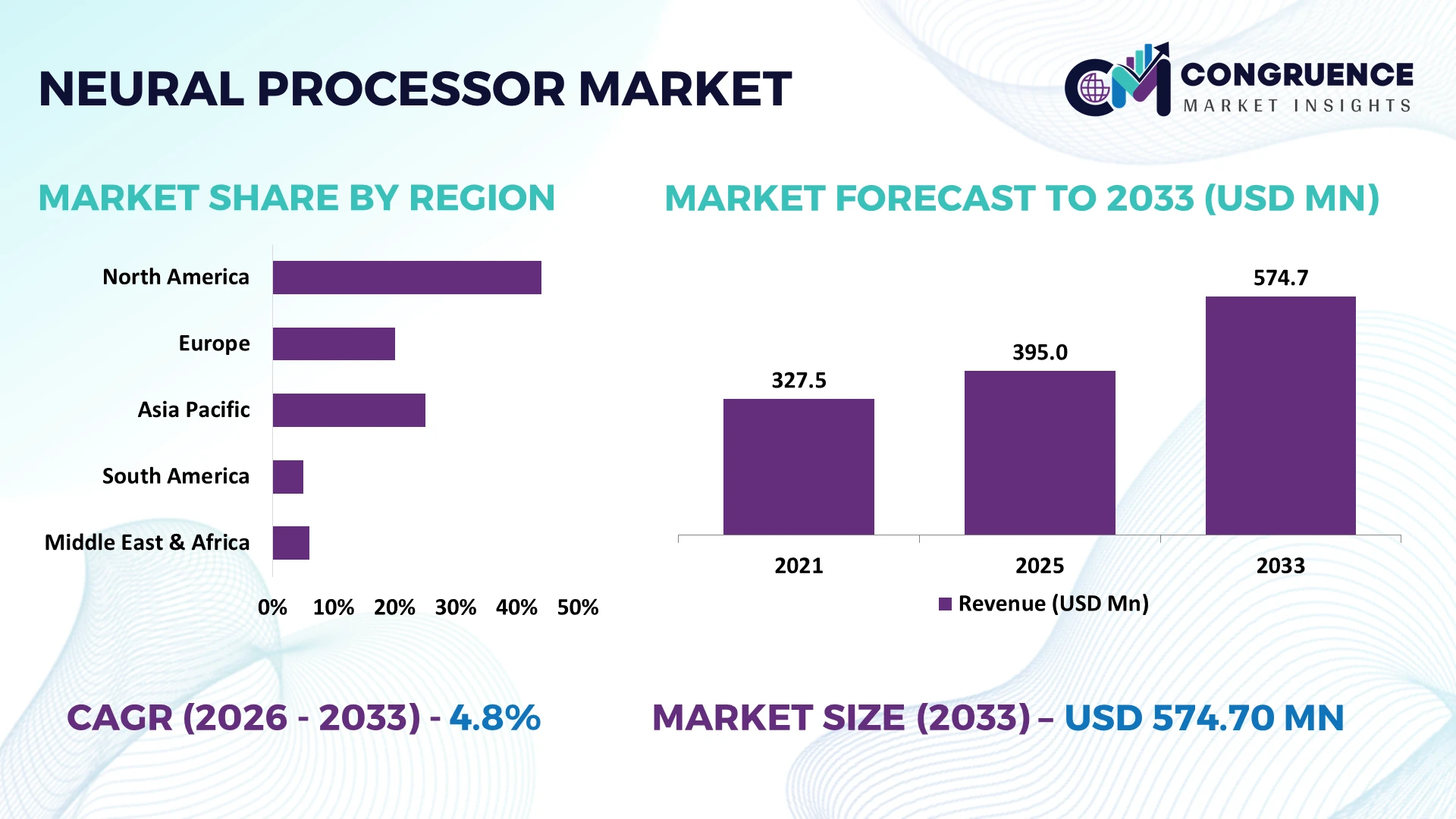
The Global Neural Processor Market was valued at USD 395 Million in 2025 and is anticipated to reach a value of USD 574.7 Million by 2033 expanding at a CAGR of 4.8% between 2026 and 2033. Growth is driven by on-device generative AI, dedicated neural processing units in AI PCs, automotive perception systems, and energy-efficient edge inference architectures.
Taiwan maintains a dominant position in advanced neural processor manufacturing through TSMC's semiconductor fabrication ecosystem. In 2025, advanced process technologies represented 74% of TSMC's wafer revenue, while 3-nanometer technology contributed 24%. The company initiated high-volume 2-nanometer manufacturing during the fourth quarter, strengthening its capabilities in AI accelerators, smartphones, and high-performance computing. Compared with Taiwan's established advanced-node production infrastructure, the United States is expanding domestic capabilities through TSMC's announced USD 165 billion Arizona investment, reflecting geopolitical efforts to diversify semiconductor manufacturing.
Strategically, neural processor suppliers must prioritize advanced-node access, hardware-software optimization, and geographically diversified manufacturing partnerships to strengthen competitive positioning.
Market Size & Growth: Valued at USD 395 Million in 2025, projected to USD 574.7 Million by 2033 at 4.8% CAGR, driven by on-device generative AI and edge inference requirements.
Top Growth Drivers: Smartphone NPU integration (24.4% application share), Copilot+ PC certification (40 TOPS threshold), and industrial embedded vision adoption.
Short-Term Forecast: By 2027, NPU-accelerated laptops and PCs expand deployment volume, driven by 40 TOPS Copilot+ baseline and Windows 10 end-of-support device refresh cycles.
Emerging Technologies: On-device large language model inference, neuromorphic event-based architectures, and runtime-reconfigurable NPU IP for heterogeneous edge environments.
Regional Leaders: North America at 38% share, Asia-Pacific expanding at 39.7% with South Korea and Japan leading neuromorphic R&D, and Europe at 27% through industrial automation.
Consumer/End-User Trends: Inference operations command 67% share; smartphones and tablets capture 24.4% application share as NPUs transition from premium feature to standard component.
Pilot/Case Example: Kneron KL1140 chip (November 2025) runs full Mamba networks on-device with 3X energy efficiency and 10X cost reduction versus cloud solutions.
Competitive Landscape: Qualcomm, Intel, AMD, Apple, MediaTek, Samsung, Google, and NVIDIA lead; specialized edge AI vendors include Hailo, Kneron, and SiMa.ai.
Regulatory & ESG Impact: US export controls on AI chips and China's rare earth restrictions reshape supply chains, with 2025 policy volatility driving regional self-reliance investments.
Investment & Funding: BrainChip secured USD 25 million for neuromorphic commercialization; EdgeCortix raised over USD 110 million cumulative including TDK Ventures Series B.
Innovation & Future Outlook: Above-80-TOPS tier and discrete NPU modules grow fastest; software utilization gap remains critical as hardware capacity outpaces application deployment.
The Neural Processor Market is experiencing increasing commercial integration across AI-enabled laptops, autonomous mobility, intelligent surveillance, and industrial automation. Dedicated neural processing architectures accelerate speech recognition, computer vision, and localized generative AI while limiting dependence on cloud infrastructure. AMD's Ryzen AI 300 processors deliver up to 50 trillion operations per second, providing 25% more peak NPU throughput than the 40 TOPS Copilot+ eligibility threshold. Developments in advanced packaging, low-precision inference, and semiconductor supply-chain localization are reshaping processor design priorities, establishing energy efficiency and software compatibility as strategic competitive differentiators.
Neural processors are becoming strategically important as semiconductor manufacturers shift artificial intelligence workloads from centralized computing infrastructure toward dedicated on-device acceleration. This transition changes competitive priorities from raw processing power to inference latency, power efficiency, and software compatibility. The introduction of AI-enabled personal computers, intelligent automotive electronics, and industrial edge systems is accelerating investment in heterogeneous computing architectures. Semiconductor companies are strengthening partnerships with operating system developers and equipment manufacturers to secure design wins and establish proprietary AI ecosystems.
Dedicated neural processing units offer measurable advantages over conventional CPU-based inference. Qualcomm's Snapdragon X Elite NPU delivers 45 trillion operations per second, while Intel's Lunar Lake platform provides up to 48 TOPS of dedicated neural acceleration. Apple's M4 Neural Engine processes AI workloads at up to 38 TOPS, exceeding the previous M3 generation by approximately 112%. Taiwan concentrates advanced chip fabrication, whereas the United States leads processor architecture development and China emphasizes domestic semiconductor substitution.
Between 2026 and 2028, deployment priorities will increasingly favor local multimodal inference, optimized memory bandwidth, and low-power AI execution. Enterprise laptop manufacturers are integrating neural acceleration into productivity, security, and collaboration applications. Companies investing in compiler optimization, developer tools, and application compatibility will secure stronger platform differentiation and recurring design opportunities.
The integration of dedicated neural processing units into personal computers and mobile devices is strengthening demand for specialized AI acceleration. Microsoft's Copilot+ ecosystem establishes a 40 TOPS minimum NPU performance requirement, encouraging manufacturers to redesign processor architectures. AMD's XDNA 2 technology delivers approximately 300% of the AI engine performance of its predecessor, while Apple's M4 Neural Engine provides roughly 112% higher throughput than the M3 generation. These improvements support local language processing, image enhancement, and enterprise AI applications without continuous cloud connectivity. Intel, AMD, and Qualcomm are expanding software development ecosystems and OEM partnerships to accelerate adoption. Hardware suppliers offering integrated AI processing and mature developer support gain stronger design-in opportunities.
Neural processor production faces structural constraints from advanced semiconductor fabrication expenses, limited foundry alternatives, and dependence on specialized manufacturing equipment. TSMC's 3-nanometer technology represented approximately 24% of wafer revenue in 2025, illustrating the commercial importance of leading-edge production. Advanced technologies accounted for approximately 74% of wafer revenue, concentrating sophisticated manufacturing capabilities within a limited supplier ecosystem. The United States' Section 301 semiconductor trade measures and export controls further complicate cross-border equipment sourcing. Smaller processor developers face higher wafer procurement commitments and reduced bargaining power when securing production capacity. Companies are addressing these constraints through multiyear foundry agreements, chiplet architectures, and mature-node peripheral integration. Separating neural compute dies from supporting circuitry improves manufacturing flexibility and capital allocation.
Next-generation neural processors present opportunities in industrial automation, medical imaging equipment, and embedded machine vision, where application-specific acceleration improves operational economics. Google's Edge TPU supports 8-bit integer inference with 4 TOPS processing capacity and approximately 2 TOPS per watt, demonstrating the efficiency potential of dedicated inference hardware. Quantization from 32-bit floating-point to 8-bit integer representation reduces model weight storage requirements by approximately 75%, enabling compact neural networks in resource-constrained devices. India's semiconductor development initiatives and expanding electronics manufacturing ecosystem create opportunities for localized accelerator integration. Processor companies are investing in lightweight compiler frameworks, model optimization, and application-specific silicon. Suppliers combining neural acceleration with industrial connectivity can capture specialized equipment contracts beyond conventional consumer electronics.
Maintaining consistent neural inference performance across hardware architectures remains a critical execution challenge as AI models evolve faster than embedded processor replacement cycles. Moving from 16-bit to 8-bit numerical precision reduces parameter storage requirements by 50%, but achieving equivalent application accuracy requires calibration and model-specific validation. Further conversion to 4-bit representations delivers another 50% storage reduction while increasing sensitivity to quantization errors. China's expanding domestic AI processor ecosystem and the United States' proprietary accelerator platforms create additional software portability requirements. Manufacturers must maintain compiler compatibility, security updates, and model execution reliability across heterogeneous devices. Investment in standardized intermediate representations, automated benchmarking, and developer partnerships is essential to prevent software fragmentation from undermining hardware efficiency advantages and long-term deployment consistency.
Software Stack Fragmentation Persists: Converting models to NPU-compatible ONNX format remains cumbersome, with developers reporting hardware detection failures even after installing vendor SDKs. Intel predicts 130 million of 260 million PCs shipped in 2026 will include NPUs, yet most buyers prioritize speed and battery life over AI functions, exposing a widening application utilization gap. Vendors are responding through unified runtimes like Ryzen AI Software, but the GGUF-to-ONNX migration friction continues to delay enterprise deployment.
Mixed-Signal Neuromorphic Silicon Gains Traction: Mixed-signal neuromorphic devices captured 52.19% growth trajectory, outperforming digital-only architectures at 51.57%. Innatera’s Spiking Neural Processor taped out on 40-nanometer CMOS delivers microwatt wake-word detection, demonstrating that capital-light fabrication paths enable startups to compete without leading-edge node dependency. This shifts procurement calculus toward firmware-flexible neurons for consumer and automotive design wins.
AI PC Shipment Volume Reaches Tipping Point: AMD’s Ryzen AI 400 series delivers 60 TOPS through XDNA 2 NPUs, with systems from Acer, ASUS, Dell, HP, and Lenovo already shipping. Lenovo reports AI models exceed 30% of its total PC shipments, validating enterprise refresh cycles. Vendors are positioning on-device inference as privacy-compliant infrastructure rather than premium feature, restructuring channel strategies toward Copilot+ certification requirements.
Regulatory Gap on Edge Inference Hardware Widens: Export controls restrict training accelerators like H100 but leave inference modules like Nvidia Jetson Orin NX uncovered, with 157 sparse INT8 TOPS commercially available through secondary markets at approximately €685 per unit. Maritime and industrial procurement teams face provenance uncertainty as dual-use policy reviews accelerate, forcing specification teams to establish primary-channel sourcing requirements before regulatory closure reshapes approved vendor lists.
AI GPUs represent the leading processor category by established deployment scale, supported by parallel computing capabilities, mature software ecosystems, and compatibility with computationally intensive neural networks. NVIDIA's CUDA platform and AMD's ROCm ecosystem support accelerated model training and inference across enterprise infrastructure. NVIDIA's first-half 2026 shipments in China declined 44% year over year, reflecting how export restrictions are reshaping accelerator procurement. Data Center AI Processors remain important for large-scale model execution, while AI ASICs offer workload-specific optimization and predictable performance for hyperscale operators.
Neural Processing Units (NPUs) are emerging as a particularly important growth category as device manufacturers integrate dedicated inference capabilities into laptops, smartphones, and embedded electronics. Edge AI Processors support low-latency execution in distributed equipment, whereas AI FPGAs serve reconfigurable applications requiring hardware flexibility. China's non-GPU AI accelerator shipments increased approximately 80% during the first half of 2026, demonstrating a shift toward specialized architectures. Manufacturers are prioritizing compiler development, heterogeneous processing integration, and application-specific accelerator designs to improve hardware utilization and differentiate their portfolios.
Natural Language Processing represents a leading application for neural processors, supported by enterprise search, document interpretation, conversational interfaces, and automated information extraction. Generative AI is emerging as the fastest-expanding application area as organizations incorporate multimodal content generation and intelligent assistants into operational workflows. McKinsey's 2025 enterprise survey found that 79% of respondents reported organizational generative AI usage, compared with 71% in the preceding survey. This adoption shift strengthens demand for transformer inference acceleration, memory-efficient processing, and scalable model execution. Processor developers are expanding software libraries and model compatibility to address enterprise deployment requirements.
Computer Vision maintains an established position in image classification, video analytics, and automated inspection, while Speech Recognition benefits from low-latency audio processing. Autonomous Driving requires deterministic perception and sensor-fusion capabilities, creating specialized automotive accelerator requirements. Predictive Analytics supports equipment monitoring and operational forecasting, whereas Robotics integrates neural inference with real-time control. Companies are tailoring processor architectures to workload characteristics, emphasizing inference throughput, memory utilization, and deployment reliability rather than peak computational performance alone.
Consumer Electronics represents a major end-user category through the widespread integration of neural acceleration into smartphones, personal computers, tablets, and connected devices. High-volume processor procurement, established device replacement cycles, and integrated system-on-chip architectures support this position. Apple's A-series processors, Qualcomm's Snapdragon platforms, and MediaTek's Dimensity portfolio illustrate how neural inference has become embedded within mainstream device functionality. The 40 TOPS Copilot+ performance requirement also creates a defined capability threshold for premium AI-enabled computers. Manufacturers are differentiating products through software integration, battery-efficient inference, and enhanced multimedia functionality.
Data Centers represent an important expansion area as enterprises scale model inference infrastructure and adopt specialized accelerators. Automotive manufacturers increasingly require neural computing for perception and intelligent cockpit systems, while Telecommunications operators deploy AI processing for network optimization. Healthcare applications emphasize diagnostic imaging and embedded monitoring, whereas Industrial Automation focuses on machine vision and equipment intelligence. Aerospace & Defense requires reliable inference in constrained operational environments. Suppliers are developing sector-specific processor configurations, long-term software support arrangements, and partnerships with equipment manufacturers to address distinct procurement requirements.
Asia-Pacific accounted for the largest market share at an estimated 42% in 2025 however, Middle East & Africa is expected to register the fastest growth, expanding at a CAGR of an estimated 6.2% between 2026 and 2033.

AI Semiconductor Design Leadership and Enterprise Infrastructure Modernization
North America maintains a strategically important position in the Neural Processor Market through advanced chip architecture development, enterprise AI infrastructure, and semiconductor intellectual property ownership. The United States hosts NVIDIA, AMD, Intel, Qualcomm, and major hyperscale operators developing custom neural acceleration platforms. Google's Tensor Processing Units and Amazon's Trainium processors demonstrate increasing specialization in large-scale machine learning infrastructure. Microsoft's integration of dedicated neural processing into Windows computing establishes additional demand for optimized hardware and software ecosystems. The United States CHIPS and Science Act provides approximately USD 52.7 billion for semiconductor manufacturing, research, and workforce development, supporting domestic production capabilities. Canadian AI research institutions and technology companies contribute expertise in neural network optimization and machine learning deployment. Regional competitive advantages increasingly depend on processor architecture innovation, advanced packaging, and commercial relationships between semiconductor designers, cloud providers, and enterprise technology suppliers.
United States Market Outlook: The United States benefits from concentrated semiconductor design expertise, hyperscale computing infrastructure, and established enterprise software ecosystems. Intel's advanced packaging investments and AMD's expanding AI accelerator portfolio strengthen domestic technology development. NVIDIA's Blackwell architecture supports high-performance neural computation, while major cloud providers are developing proprietary accelerators to optimize infrastructure economics. The country's semiconductor research network and federal manufacturing incentives reinforce long-term processor development capabilities.
Automotive Intelligence and Industrial Semiconductor Integration
Europe's neural processor ecosystem is shaped by automotive electronics, industrial automation, embedded intelligence, and semiconductor technology sovereignty. Germany's automotive manufacturing base supports demand for neural acceleration in driver assistance, vehicle perception, and intelligent cockpit applications. France contributes through semiconductor research and embedded AI development, while the Netherlands provides critical lithography equipment for advanced processor manufacturing. The European Chips Act establishes a framework intended to mobilize more than EUR 43 billion in public and private semiconductor investment, strengthening regional production resilience. STMicroelectronics, Infineon Technologies, and NXP Semiconductors are developing automotive and industrial processing platforms with integrated AI capabilities. European equipment manufacturers increasingly prioritize deterministic inference, functional safety, and extended product lifecycles over peak computational throughput. This specialization supports competitive differentiation in industrial applications where reliability, energy consumption, and regulatory compliance influence processor selection.
Germany Market Outlook: Germany represents a strategically significant neural processor market through its automotive engineering, industrial robotics, and semiconductor manufacturing capabilities. Infineon Technologies is expanding its Dresden semiconductor production infrastructure, supported by investments of approximately EUR 5 billion in a new fabrication facility. Bosch's automotive electronics expertise and established industrial automation networks create opportunities for embedded neural inference in manufacturing equipment, mobility systems, and intelligent sensors.
Advanced Semiconductor Manufacturing and Integrated Electronics Supply Chains
Asia-Pacific holds the strongest manufacturing position in the Neural Processor Market through Taiwan's advanced foundry capabilities, South Korea's memory technologies, and China's extensive electronics production ecosystem. Taiwan Semiconductor Manufacturing Company supplies advanced fabrication services supporting neural acceleration architectures developed by international chip designers. South Korea's Samsung Electronics and SK hynix contribute semiconductor manufacturing expertise and high-bandwidth memory technologies essential for sophisticated AI computing systems. China's domestic accelerator development initiatives are strengthening alternative processor architectures amid semiconductor export restrictions. Japan supports the ecosystem through semiconductor materials, precision equipment, and advanced packaging technologies. India's expanding electronics manufacturing base creates additional opportunities for neural processor integration into consumer and industrial devices. The region's competitive advantage lies in connecting wafer fabrication, packaging, component sourcing, and electronics assembly, enabling coordinated production scaling and shorter hardware integration cycles.
Taiwan Market Outlook: Taiwan occupies a central position in advanced neural processor manufacturing through TSMC's leading-edge semiconductor fabrication network. The company's 2-nanometer technology entered volume production in late 2025, advancing transistor density and power efficiency for sophisticated computing architectures. Taiwan's semiconductor ecosystem also includes MediaTek's processor design capabilities and ASE Technology's advanced packaging services. These complementary strengths support integrated manufacturing partnerships and reinforce the island's strategic importance in global AI hardware supply chains.
Enterprise AI Adoption and Local Computing Infrastructure Development
South America's neural processor market is shaped by enterprise digitalization, cloud infrastructure expansion, and increasing adoption of intelligent computing across financial services, agriculture, and industrial operations. Brazil represents the principal technology investment center, supported by established banking infrastructure, electronics manufacturing, and enterprise software development. The Brazilian Artificial Intelligence Plan for 2024–2028 provides for approximately BRL 23 billion in investment, including advanced computing infrastructure and business innovation initiatives. Chile contributes through data center development and renewable-energy-backed computing facilities, while Argentina maintains expertise in software engineering and AI applications. Limited domestic advanced semiconductor fabrication creates dependence on imported processors and international hardware suppliers. Regional technology providers are consequently emphasizing cloud-based acceleration, equipment integration, and partnerships with global semiconductor vendors. These arrangements improve access to neural computing capabilities while reducing the need for independent processor manufacturing infrastructure.
Brazil Market Outlook: Brazil benefits from its large enterprise technology ecosystem, financial services automation, and expanding industrial AI applications. The national AI investment plan allocates approximately BRL 5.79 billion toward infrastructure and AI development, supporting advanced computing capabilities. São Paulo's technology ecosystem provides a concentration of enterprise customers and system integrators, while domestic electronics manufacturers offer opportunities for neural processor integration into connected equipment and intelligent monitoring systems.
Sovereign AI Infrastructure and Accelerated Computing Investment
The Middle East & Africa neural processor market is undergoing infrastructure transformation as governments and technology companies establish sovereign AI computing capabilities. Saudi Arabia and the United Arab Emirates lead major accelerator procurement and hyperscale infrastructure development, while South Africa contributes enterprise computing demand from financial services, telecommunications, and industrial operations. Saudi Arabia's HUMAIN announced plans for AI factories with projected capacity reaching 500 megawatts, supported by NVIDIA accelerated computing platforms. The UAE's Stargate initiative establishes another major deployment pathway for advanced neural processing hardware. These investments strengthen demand for high-performance AI accelerators, networking equipment, and specialized inference infrastructure. Across African markets, limited advanced computing capacity and infrastructure financing remain operational constraints. Partnerships between cloud providers, national investment institutions, and semiconductor manufacturers are becoming central to procurement, deployment, and technical workforce development.
Saudi Arabia Market Outlook: Saudi Arabia is establishing a substantial neural computing ecosystem through government-backed infrastructure development and international technology partnerships. HUMAIN's initial NVIDIA deployment plan includes 18,000 GB300 Grace Blackwell GPUs, supporting sovereign AI model development and enterprise inference services. Collaboration with AWS and NVIDIA strengthens access to specialized processing architectures, while Vision 2030 initiatives create application opportunities across energy operations, logistics automation, industrial simulation, and public-sector digital services.
Qualcomm, Intel, AMD, Apple, and NVIDIA anchor the neural processor market, collectively commanding an estimated 55–60% of NPU-integrated silicon deployed across smartphones, PCs, and edge devices. They compete directly with mobile SoC rivals MediaTek and Samsung, while a specialized challenger cohort—Hailo, Kneron, BrainChip, and EdgeCortix—targets discrete NPU modules and neuromorphic architectures where incumbents lack optimized offerings. Basis of competition has shifted from raw TOPS throughput to software ecosystem maturity: hardware capacity now outpaces application deployment, making SDK quality and framework compatibility the decisive differentiators. AMD's XDNA 2 delivers 60 TOPS while Intel mandates 40 TOPS for Copilot+ certification, compressing differentiation on headline specifications alone. Competition in practice centers on ecosystem lock-in—Qualcomm's AI Engine, Intel's OpenVINO, and NVIDIA's CUDA create switching costs that favor integrated platform vendors.
Qualcomm
Intel
AMD
Apple
NVIDIA
MediaTek
Samsung Electronics
Hailo
Kneron
BrainChip
EdgeCortix
Arm
Current neural processor technology increasingly combines heterogeneous computing, dedicated inference engines, and hardware-level workload scheduling. Qualcomm's Hexagon NPU delivers 45 TOPS in Snapdragon X Elite platforms, while Intel's Lunar Lake architecture reaches 48 TOPS through dedicated neural acceleration. Apple's M4 Neural Engine provides approximately 112% higher computational throughput than its M3 predecessor, demonstrating measurable generational improvement. These architectures accelerate local image processing, language inference, and intelligent productivity applications. Enterprise adoption is strengthening as manufacturers integrate dedicated AI acceleration into commercial computing portfolios.
Emerging technologies emphasize low-precision arithmetic, memory-efficient transformer execution, and adaptive neural processing. INT8 quantization reduces model parameter storage by 75% compared with FP32 representation, improving deployment feasibility in memory-constrained systems. Structured sparsity, dynamic voltage scaling, and optimized tensor execution further improve computational resource utilization. Semiconductor developers are integrating compiler-level optimization with specialized processing architectures, enabling equipment manufacturers to balance inference accuracy, latency, and energy consumption.
Between 2026 and 2028, disruptive innovation will concentrate on chiplet-based accelerators, neuromorphic computing, and integrated neural memory architectures. Event-driven processing and specialized inference pipelines offer alternatives to conventional instruction-based execution. Automotive suppliers, industrial equipment manufacturers, and hyperscale operators benefit from workload-specific acceleration. Companies prioritizing software compatibility and packaging innovation will strengthen hardware differentiation, deployment flexibility, and long-term competitive positioning.
January 2025: Intel launched Core Ultra 200H series mobile processors with integrated NPUs delivering 13 TOPS, extending AI PC capability to mainstream laptops. This expands neural processing adoption beyond premium devices, with platform-level TOPS reaching 99 when combined with CPU and GPU. Source: intc.com
June 2025: EdgeCortix released its SAKURA-II M.2 AI accelerator for Raspberry Pi 5 and Arm-based platforms, enabling Vision Transformers and Small Language Models to run on-device. This democratizes generative AI at the edge, targeting drones, robotics, and smart agriculture where cloud dependency is impractical. Source: edgecortix.com
July 2025: BrainChip announced commercial availability of its AKD1500 M.2 form factor neuromorphic processor with sub-milliwatt power consumption, enabling fanless edge AI in industrial designs. The plug-and-play module upgrades legacy systems without power supply or thermal redesign. Source: brainchip.com
March 2026: Qualcomm powered Arduino's VENTUNO Q platform with Dragonwing IQ8 Series NPU delivering 40 dense TOPS, targeting generative AI and robotics prototyping. This positions neural processing as accessible infrastructure for the developer ecosystem, accelerating physical AI innovation. Source: qualcomm.com
The Neural Processor Market Report examines industry developments, technology adoption, competitive positioning, and investment opportunities between 2026 and 2033. Segmentation covers six processor types: Neural Processing Units, AI GPUs, AI ASICs, AI FPGAs, Edge AI Processors, and Data Center AI Processors. Application analysis includes Natural Language Processing, Computer Vision, Generative AI, Speech Recognition, Autonomous Driving, Predictive Analytics, and Robotics. End-user coverage spans Consumer Electronics, Data Centers, Automotive, Telecommunications, Healthcare, Industrial Automation, and Aerospace & Defense.
Regional assessment encompasses North America, Europe, Asia-Pacific, South America, and Middle East & Africa, evaluating semiconductor manufacturing, deployment infrastructure, and technology investment. The report examines advanced fabrication, neural inference optimization, heterogeneous computing, and emerging accelerator architectures. Competitive analysis supports supplier benchmarking, geographic expansion planning, product differentiation, and investment decisions across established and emerging neural processing ecosystems.
| Report Attribute/Metric | Report Details |
|---|---|
Market Revenue in 2025 | USD 395 Million |
Market Revenue in 2033 | USD 574.7 Million |
CAGR (2026 - 2033) | 4.8% |
Base Year | 2025 |
Forecast Period | 2026 - 2033 |
Historic Period | 2021 - 2025 |
Segments Covered | By Type
By Application
By End-User
|
Key Report Deliverable | Revenue Forecast, Growth Trends, Market Dynamics, Segmental Overview, Regional and Country-wise Analysis, Competition Landscape |
Region Covered | North America, Europe, Asia-Pacific, South America, Middle East, Africa |
Key Players Analyzed | Qualcomm, Intel, AMD, Apple, NVIDIA, MediaTek, Samsung Electronics, Google, Hailo, Kneron, BrainChip, EdgeCortix, SiMa.ai, Arm |
Customization & Pricing | Available on Request (10% Customization is Free) |




