
Reports
The Global Network Telemetry Market was valued at USD 434.86 Million in 2025 and is anticipated to reach a value of USD 1558.6 Million by 2033 expanding at a CAGR of 17.3% between 2026 and 2033. Growth is driven by streaming telemetry replacing polling, AI-cluster network complexity, cloud-native observability, programmable infrastructure, and demand for sub-second visibility across distributed applications.
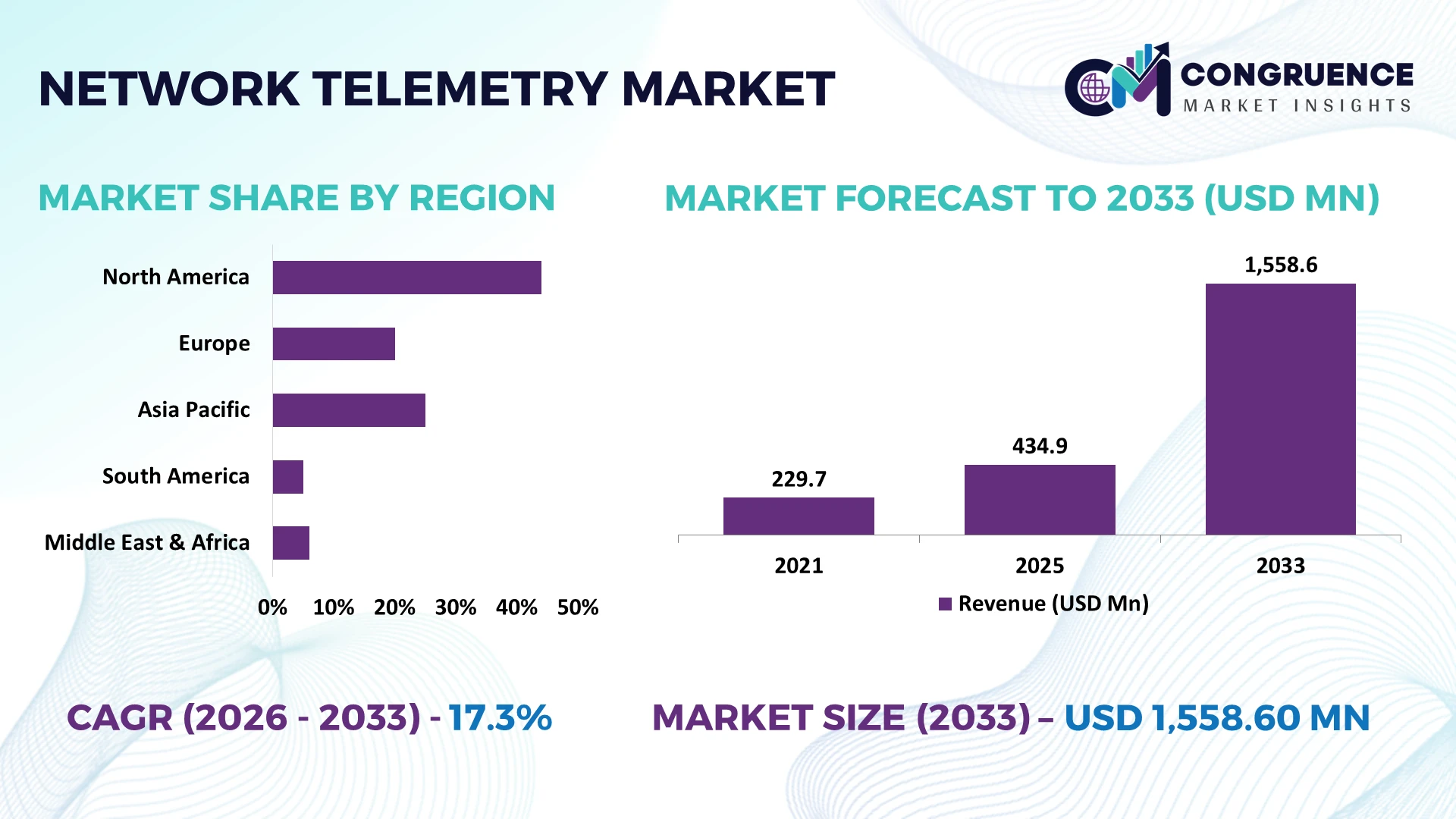
The United States commands an estimated 34% of global Network Telemetry demand, anchored by hyperscale cloud operators, telecom carriers, financial networks, and AI computing infrastructure. U.S. organizations operate within a data-center ecosystem exceeding 5,000 facilities, compared with fewer than 500 in Germany, creating substantially greater telemetry density. More than 80% of large enterprises use multiple clouds, increasing cross-domain monitoring requirements. U.S.-China semiconductor restrictions further reinforce domestic AI infrastructure investment and associated requirements for real-time network performance intelligence.
Strategically, investment should prioritize streaming, vendor-neutral telemetry architectures capable of correlating network behavior across cloud, data-center, and accelerated-computing environments.
Market Size & Growth: USD 434.86 million in 2025 reaches USD 1,558.6 million by 2033 at 17.3%, driven by streaming observability and AI infrastructure.
Top Growth Drivers: Multi-cloud adoption 80%, telemetry automation 65%, and AI infrastructure expansion 55% are reshaping enterprise monitoring requirements.
Short-Term Forecast: By 2028, automated telemetry correlation can reduce network troubleshooting time by approximately 35%, improving service restoration efficiency.
Emerging Technologies: gNMI streaming, eBPF observability, and AI-driven analytics support sub-second data collection versus traditional 5-minute polling intervals.
Regional Leaders: North America approaches USD 600 million, Europe USD 370 million, and Asia-Pacific USD 440 million as programmable networking adoption expands.
End-User Trends: More than 80% of large enterprises operate multi-cloud environments, increasing demand for unified network-state visibility across heterogeneous infrastructure.
Pilot/Case Example: 2025 streaming telemetry deployments reduced monitoring intervals from 300 seconds to below 10 seconds, improving anomaly detection responsiveness by over 95%.
Competitive Landscape: Cisco holds an estimated 18% position, competing with Arista Networks, Juniper Networks, Nokia, and Broadcom across programmable telemetry environments.
Regulatory & ESG Impact: NIS2 covers 18 critical sectors, strengthening continuous infrastructure-monitoring requirements across European digital and industrial networks.
Investment & Funding: More than USD 100 billion in announced U.S. AI infrastructure commitments expands the addressable telemetry layer around GPU-intensive computing facilities.
Innovation & Future Outlook: 800GbE provides 100% greater interface capacity than 400GbE, pushing telemetry toward real-time congestion intelligence and automated network remediation.
Network Telemetry Market demand is concentrating around hyperscale computing, telecommunications, financial services, cloud-native enterprises, and AI infrastructure where static monitoring cannot capture rapidly changing network states. Product innovation is shifting toward model-driven streaming, gNMI collectors, eBPF instrumentation, intent-based analytics, and machine-learning anomaly detection. Streaming architectures can shorten collection intervals by more than 95% compared with conventional five-minute polling, enabling faster congestion and fault identification. As NIS2 strengthens infrastructure oversight across 18 critical European sectors, continuous telemetry is becoming operationally important for resilience, creating a natural foundation for the market’s strategic priorities.
Network telemetry is becoming strategic infrastructure because AI workloads, distributed applications, and programmable networks require continuous state intelligence rather than periodic device checks. Infrastructure modernization is moving operators toward event-driven observability that captures interface utilization, queue depth, routing changes, and application behavior simultaneously. This transition gives network teams evidence for capacity decisions while enabling automated systems to detect service degradation before conventional alarms escalate.
Streaming telemetry can deliver measurements every 1–10 seconds versus legacy SNMP polling commonly configured around 300-second intervals, improving visibility frequency by more than 95%. U.S. hyperscalers emphasize telemetry at massive computing scale, while Japanese telecom operators prioritize deterministic service assurance across dense 5G infrastructure. A financial institution can continuously analyze latency and packet-loss indicators across trading links, automatically redirecting engineering attention when thresholds deteriorate rather than waiting for scheduled polling.
Through 2028, telemetry investment will increasingly target closed-loop automation, digital twins, predictive capacity management, and common data models. Network vendors are strengthening integrations with observability platforms and automation ecosystems while enterprises consolidate fragmented collectors. Competitive advantage will accrue to architectures that transform high-frequency network state into actionable decisions without overwhelming operations teams with raw measurements.
Accelerated computing is changing network monitoring economics because GPU clusters depend on synchronized communication where congestion directly reduces expensive compute utilization. Modern AI fabrics can connect thousands of accelerators, while Ethernet speeds have progressed from 100GbE to 800GbE, representing an eightfold interface-capacity increase. Training networks can also drive link utilization above 90% during collective operations, making queue and congestion visibility operationally critical. U.S. hyperscale operators are therefore replacing coarse health checks with high-frequency telemetry covering buffers, paths, interfaces, and accelerator connectivity. Network suppliers are responding with programmable telemetry agents, AI-fabric dashboards, congestion analytics, and automated remediation integrations. The strategic insight is utilization protection: telemetry investment increasingly safeguards costly compute capacity rather than merely supporting network administration, directly linking observability quality with AI infrastructure productivity.
Continuous instrumentation creates a structural cost problem because increasing collection frequency multiplies storage, transport, and analytics workloads. Moving from five-minute polling to five-second streaming generates roughly 60 times more observation intervals per metric, while large environments can expose millions of time-series measurements. Retaining high-cardinality telemetry for 30 days can therefore consume substantially more storage than traditional monitoring records. German enterprises face an additional constraint where privacy and operational-data governance influence how infrastructure information is transferred into external analytics platforms. Buyers consequently limit metric retention, sampling frequency, or monitored endpoints, reducing visibility depth. Suppliers are responding with edge aggregation, adaptive sampling, compression, tiered storage, and local processing. The commercial pressure point is increasingly telemetry economics per useful insight, not simply the number of devices a platform can monitor.
Network digital twins create a higher-value opportunity by converting live telemetry into continuously updated models for testing configuration, capacity, and failure scenarios before production changes occur. Telecom networks increasingly operate thousands of dynamic elements, while 5G standalone deployments can support network slicing and highly differentiated service policies. Singapore provides a strong deployment environment through nationwide digital infrastructure and enterprise experimentation with autonomous operations. Combining real-time state feeds with topology models can reduce manual pre-change validation effort by approximately 30%–40% in highly automated environments and expose hidden dependencies before maintenance begins. Vendors are investing in simulation engines, intent validation, topology intelligence, and API ecosystems connecting telemetry with orchestration systems. The strategic opportunity extends beyond monitoring: suppliers that enable pre-deployment decision testing can capture network-planning budgets traditionally separated from observability spending.
Closed-loop networking depends on trustworthy telemetry, yet heterogeneous devices frequently expose inconsistent schemas, timestamps, counters, and sampling behavior. Clock deviations measured in milliseconds can distort event sequencing across latency-sensitive systems, while packet loss of just 1% in telemetry transport can create gaps during critical incidents. Multi-vendor networks compound the problem because operators must normalize proprietary models alongside OpenConfig and other standardized structures. Indian telecom networks illustrate the scale challenge, serving more than one billion wireless subscriptions across diverse infrastructure generations and vendor estates. Providers must improve schema normalization, time synchronization, anomaly validation, and automated data-quality scoring while strengthening interoperability partnerships. The long-term risk is algorithmic misdiagnosis: autonomous remediation built on incomplete or poorly synchronized measurements can amplify outages rather than contain them, making telemetry integrity a decisive competitive requirement.
OpenConfig Standardization Gains Enterprise Ground Operators are replacing proprietary device schemas with vendor-neutral models as multi-vendor estates become harder to automate. OpenConfig covers more than 100 model areas, while gNMI supports continuous subscriptions rather than repeated polling requests. U.S. cloud and carrier networks are standardizing collection pipelines around common interfaces. Suppliers are expanding OpenConfig coverage and API interoperability, reducing custom integration work by an estimated 20%–30% and accelerating device onboarding.
eBPF Extends Kernel-Level Visibility Linux-based telemetry is moving deeper into application infrastructure through eBPF, which observes network behavior without modifying application code. Kubernetes can support clusters containing 5,000 nodes and 150,000 pods, creating visibility requirements beyond conventional device counters. Platform providers are embedding eBPF collectors into cloud observability stacks, enabling enterprises to correlate application and network events while reducing dependence on separate agents and shortening troubleshooting workflows by approximately 25%.
Edge Telemetry Reduces Backhaul Load Telecom and industrial operators are processing telemetry nearer network endpoints instead of transporting every raw measurement centrally. 5G specifications target latency as low as 1 millisecond for specialized scenarios, making centralized diagnostics insufficient for time-sensitive operations. Suppliers are deploying edge analytics, local collectors, and selective data forwarding. Processing anomalies locally can reduce telemetry backhaul volumes by 30%–50%, lowering bandwidth consumption while preserving rapid operational response across distributed facilities.
Telemetry Pipelines Become Observable Enterprises increasingly monitor the health of telemetry collection itself as dropped records, collector saturation, and schema failures undermine analytics accuracy. OpenTelemetry supports traces, metrics, and logs within one framework and has attracted contributions from more than 1,000 organizations. Vendors are adding pipeline-health dashboards, adaptive routing, and collector autoscaling. The non-obvious shift is operational: monitoring teams now treat telemetry pipelines as production infrastructure, improving data completeness while controlling observability overhead.
Streaming Telemetry leads with an estimated 36% share because continuous push-based collection delivers fresher network state while eliminating repeated polling requests. Large operators increasingly use subscription-driven interfaces to capture counters, routing conditions, queue behavior, and interface changes directly from infrastructure. Device Telemetry remains established for hardware health and configuration visibility, while Flow Telemetry provides scalable traffic-pattern intelligence without retaining complete packet payloads. Event Telemetry contributes targeted operational context by reporting state transitions rather than continuously transmitting every metric.
Network Analytics is the fastest-growing type as enterprises shift from collecting measurements toward interpreting relationships across topology, traffic, and service behavior. Analytics platforms can reduce manual incident investigation by approximately 25%–35% when automated correlation narrows probable causes before engineers intervene. Streaming feeds increasingly supply these engines with near-real-time inputs, creating complementary rather than competing architectures. Vendors are expanding machine-learning analytics, model-driven collectors, normalization engines, and cross-domain integrations, directing investment toward platforms that convert heterogeneous telemetry into prioritized operational decisions.
Network Monitoring represents the leading application with an estimated 31% share because infrastructure teams require continuous visibility into availability, interfaces, routing state, utilization, and service health. Performance Management builds on this foundation by correlating latency and throughput against service objectives, while Traffic Analysis identifies application behavior and communication patterns. Capacity Planning remains comparatively periodic, using historical telemetry to guide port, circuit, and infrastructure allocation. Automated collection can reduce routine manual monitoring effort by approximately 20%–30% in large device estates.
Fault Detection is the fastest-growing application as operations teams move from threshold alarms toward anomaly-based identification and automated correlation. High-frequency measurements allow platforms to recognize abnormal behavior before users experience complete service failure. Security Monitoring adds another analytical layer by identifying unexpected connections and infrastructure changes without duplicating dedicated security tooling. Vendors are responding with event correlation, baseline learning, topology-aware diagnostics, and integrated workflow automation. Investment is consequently moving toward monitoring platforms that prioritize probable causes rather than simply increasing alarm volumes.
Telecommunications leads with an estimated 30% share because mobile and fixed operators manage geographically distributed infrastructure where service quality depends on continuous visibility across access, transport, and core networks. Data Centers represent another mature buyer group, emphasizing interface utilization and fabric health, while Financial Services prioritize latency consistency across transaction infrastructure. Government and Healthcare deployments concentrate on resilient connectivity supporting critical applications. Enterprises increasingly consume telemetry through broader network-management platforms rather than operating dedicated collection systems.
Cloud Providers are the fastest-growing end-user segment as elastic infrastructure creates rapidly changing topology, workload placement, and network paths. Hyperscale environments can operate millions of infrastructure components, making manual monitoring structurally impractical. Cloud operators increasingly use automated collectors and analytics to reduce mean time to resolution by approximately 25%–40% for diagnosable network events. Vendors are targeting this demand through cloud-native licensing, scalable ingestion, open APIs, and integrations with orchestration ecosystems. Competitive positioning is therefore shifting toward software architectures capable of processing enormous telemetry volumes without proportional increases in operations staffing.
North America accounted for the largest market share at 38.7% in 2025 however, Asia-Pacific is expected to register the fastest growth, expanding at a CAGR of 19.6% between 2026 and 2033.
Programmable Infrastructure Deepens Operational Intelligence
North America accounts for approximately 38.7% of Network Telemetry Market activity, supported by software-defined enterprise networks, hyperscale computing campuses, carrier infrastructure, and mature observability operations. Deployment is increasingly concentrated around programmable switching environments where operators collect queue occupancy, routing changes, interface errors, and service-level indicators continuously. Large U.S. cloud platforms operate millions of infrastructure components, making machine-readable network state essential for automated operations. Canada adds demand through financial services, telecom modernization, and government cloud programs. The region’s distinguishing feature is telemetry integration with infrastructure-as-code: configuration changes and performance evidence increasingly enter the same operational pipeline. Suppliers are developing controller integrations, common schemas, high-cardinality databases, and automated baselining capabilities, allowing customers to connect network-state changes directly with application incidents and configuration events.
United States Market Outlook: U.S. enterprises lead adoption of programmable network operations because hyperscalers, financial exchanges, SaaS providers, and AI developers operate unusually complex digital estates. Public-cloud infrastructure spans more than 100 major availability zones across leading providers. This scale favors telemetry platforms that integrate with DevOps workflows, configuration repositories, and automated incident-response systems rather than functioning as isolated network-management consoles.
Resilience Regulation Elevates Evidence Quality
Europe represents approximately 25.8% of market activity, with operational resilience rules increasing the value of accurate infrastructure evidence across banking, utilities, transport, manufacturing, and digital-service providers. DORA has applied to EU financial entities since January 2025, requiring stronger ICT risk management and operational-resilience testing. Telemetry platforms therefore increasingly retain granular service-health histories that support post-incident analysis and control validation. European industrial networks add another dimension as IT and operational technology become more interconnected, requiring visibility without disrupting deterministic production environments. France, the Netherlands, Germany, and Nordic countries maintain advanced digital infrastructure, while data-governance requirements encourage controlled processing locations. Vendors are expanding role-based access, long-term analytical retention, audit integrations, and privacy-aware data handling, turning telemetry repositories into evidence systems supporting both engineering operations and governance functions.
United Kingdom Market Outlook: The UK combines a major financial-services cluster, extensive telecom infrastructure, cloud concentration, and regulated critical services. London’s financial ecosystem demands precise service-health evidence because milliseconds affect trading and transaction performance. UK operators increasingly link network measurements with service-level objectives and incident-management platforms, strengthening demand for analytics that distinguish infrastructure degradation from application-layer failures before escalation.
Telecom Scale Accelerates Automated Operations
Asia-Pacific holds approximately 24.1% of market activity, distinguished by enormous mobile subscriber bases, expanding fiber networks, dense metropolitan infrastructure, and rapid 5G standalone commercialization. China, India, Japan, South Korea, and Australia create markedly different deployment environments, ranging from nationwide carrier estates to highly automated enterprise networks. South Korea’s 5G penetration exceeds 50% of mobile subscriptions, increasing operational complexity across radio, transport, and core infrastructure. Japan contributes high-reliability requirements across telecom and industrial networks, while Australia’s distributed geography makes centralized network intelligence valuable for remote infrastructure management. Suppliers are building carrier-scale collectors, hierarchical analytics, multilingual operations interfaces, and automated service-assurance functions. Investment is increasingly directed toward platforms capable of translating billions of network measurements into prioritized service-impact signals rather than requiring engineers to inspect individual devices.
China Market Outlook: China operates more than 4 million 5G base stations, creating exceptional infrastructure-monitoring density across provincial and metropolitan networks. Domestic cloud platforms, industrial internet deployments, and large carrier estates reinforce requirements for scalable collection and automated service assurance. Local technology ecosystems favor platforms capable of integrating proprietary network environments with centralized operations systems while maintaining extremely high ingestion capacity.
Fiber Expansion Raises Service Assurance Requirements
South America accounts for approximately 5.2% of global activity, with telemetry adoption closely tied to fiber expansion, mobile-network modernization, digital banking, and increasingly cloud-dependent enterprises. Brazil dominates deployment concentration, while Chile and Colombia provide important secondary markets through data-center construction and connectivity investment. Fiber-to-the-home coverage has expanded substantially across major metropolitan areas, increasing the number of access-network elements operators must supervise. Unlike mature hyperscale environments, many operators prioritize practical service assurance, subscriber-impact identification, and remote fault localization over extremely high-frequency infrastructure instrumentation. This creates demand for scalable platforms that correlate access, transport, and customer-service conditions. Vendors are strengthening telecom partnerships, managed-service delivery, lightweight collectors, and centralized dashboards, allowing operators to improve fault isolation without proportionally expanding network-operations staffing.
Brazil Market Outlook: Brazil has more than 250 million mobile connections and an extensive competitive broadband ecosystem, producing significant service-management complexity across national territory. Telecom providers require telemetry capable of identifying localized degradation before customer complaints accumulate. Domestic system-integrator relationships, Portuguese-language operations, and compatibility with mixed-generation carrier equipment therefore materially influence supplier positioning and deployment success.
National Digital Programs Modernize Operations
Middle East & Africa represents approximately 6.2% of market activity, with adoption concentrated around Gulf telecom operators, government digital platforms, financial institutions, energy infrastructure, and African connectivity hubs. Saudi Arabia and the UAE increasingly operate cloud-connected public services and smart infrastructure requiring continuous performance intelligence across distributed digital assets. Saudi internet penetration exceeds 99%, creating demanding availability expectations for digital services, while African operators manage networks spanning large territories with uneven infrastructure density. Telemetry therefore serves different priorities: Gulf deployments emphasize automation and service optimization, whereas African implementations frequently prioritize remote fault localization and scarce engineering resources. Technology suppliers are expanding local engineering partnerships, managed analytics, Arabic interfaces, and cloud-hosted operations platforms. These approaches lower specialist requirements while supporting national infrastructure modernization without forcing uniform architectures across fundamentally different operating environments.
Saudi Arabia Market Outlook: Saudi Arabia combines nationwide 5G deployment, cloud-region investment, energy digitization, and government transformation under Vision 2030. Mobile internet usage is exceptionally high, increasing pressure on operators to maintain consistent service quality. Telecom and infrastructure operators are consequently prioritizing automated assurance, predictive maintenance, and centralized performance analytics capable of supporting geographically distributed assets with smaller intervention windows.
Cisco, Arista Networks, Juniper Networks, Nokia, and Broadcom compete across telemetry-enabled networking, analytics, and automation, collectively representing an estimated 57% of addressable deployments. Cisco challenges Juniper and Nokia through integrated routing, assurance, and controller ecosystems, while Arista targets cloud-scale operators with programmable switching and data-driven operations. Broadcom competes upstream through telemetry-capable merchant silicon embedded across networking platforms. Competition centers on collection scale, analytics accuracy, openness, and automation: model-driven streaming can improve measurement frequency by over 90%, while automated correlation can reduce diagnostic effort by 25%–35%. Vendors are expanding OpenConfig compatibility, AI-assisted operations, controller integration, and cloud partnerships while embedding telemetry deeper into switching silicon. The market is shifting from proprietary monitoring toward interoperable data pipelines and closed-loop operations. Protocol expertise, installed infrastructure, data-model consistency, and ecosystem integration create strong entry barriers. Winning requires scalable ingestion, vendor-neutral interoperability, precise analytics, and automation that converts telemetry into operational action without increasing engineering workload.
Cisco Systems
Arista Networks
Juniper Networks
Nokia
Broadcom
Huawei Technologies
HPE
IBM
SolarWinds
Kentik
LogicMonitor
Datadog
Splunk
Paessler
Current Network Telemetry architectures combine model-driven streaming, gNMI subscriptions, OpenConfig schemas, time-series databases, and programmable switching. State-streaming platforms continuously export interface, routing, queue, and device conditions instead of querying equipment. Moving from 300-second polling to 10-second subscriptions improves observation frequency by 96.7%, while selective subscriptions can cut unnecessary collection traffic by roughly 20%. Adoption is strongest across hyperscale, telecom, and software-defined networks where automated operations require infrastructure state.
Emerging technology centers on eBPF instrumentation, AI correlation, digital twins, and unified observability pipelines. eBPF captures kernel-level network behavior without application-code modification, helping operators reduce diagnostic workflows by approximately 25%. OpenTelemetry integration connects network measurements with application traces and metrics, allowing operations teams to isolate cross-domain faults. Compared with legacy SNMP polling, streaming architectures provide 30 times more measurement opportunities at ten-second intervals, benefiting vendors offering scalable ingestion, normalization, and analytics.
Through 2026–2028, disruptive development will concentrate on agentic operations and closed-loop remediation. AI models will interpret telemetry, validate intent, and trigger corrective actions, while digital twins test changes before deployment. Enterprises achieving 30% automated incident handling will reduce manual escalation pressure. Vendors combining open telemetry standards, data quality, and explainable automation will gain advantage as network complexity outpaces human monitoring capacity.
January 2024 Juniper Networks launched its AI-Native Networking Platform, trained on seven years of data science, adding Marvis digital twins and 800GbE infrastructure. The platform targets automated troubleshooting, with Juniper reporting up to 90% fewer network trouble tickets. Source: crn.com
March 2025 Arista Networks introduced EOS Smart AI Suite and CloudVision AI job-centric observability, combining cluster load balancing with real-time telemetry. The release targets Ethernet AI fabrics, improving troubleshooting and workload reliability across high-bandwidth accelerator clusters at scale. Source: sdxcentral.com
June 2025 Nokia launched Autonomous Network Fabric, combining telco-trained AI models, correlated data products, security, observability, and automation. Its expanded Google Cloud collaboration supports deployment across three environments: public cloud, on-premises, and hybrid infrastructure for greater operator flexibility. Source: lightreading.com
June 2025 Cisco introduced AgenticOps and expanded ThousandEyes assurance across mobile endpoints and industrial IoT, integrating telemetry with Splunk observability. Cisco positioned real-time network intelligence as the operating layer for machine-speed actions across enterprise and industrial network infrastructure. Source: cisco.com
The Network Telemetry Market report evaluates Streaming Telemetry, Event Telemetry, Flow Telemetry, Device Telemetry, and Network Analytics across Network Monitoring, Performance Management, Fault Detection, Capacity Planning, Security Monitoring, and Traffic Analysis. It assesses Telecommunications, Data Centers, Cloud Providers, Financial Services, Government, Healthcare, and Enterprises across North America, Europe, Asia-Pacific, South America, and Middle East & Africa. Streaming Telemetry represents approximately 36% of type demand, establishing a benchmark for continuous-state infrastructure visibility.
Technology coverage includes gNMI, OpenConfig, eBPF, AI-assisted correlation, digital twins, programmable switching, time-series analytics, and closed-loop automation. The analysis also examines cloud-native telemetry, multi-vendor normalization, high-cardinality data management, and autonomous-network architectures. Competitive profiling spans 14 influential participants, supporting investment prioritization, geographic expansion, partnership assessment, product positioning, and technology-roadmap decisions through 2033 as buyers shift spending from passive monitoring toward automated network intelligence.
| Report Attribute/Metric | Report Details |
|---|---|
Market Revenue in 2025 | USD 434.86 Million |
Market Revenue in 2033 | USD 1558.6 Million |
CAGR (2026 - 2033) | 17.3% |
Base Year | 2025 |
Forecast Period | 2026 - 2033 |
Historic Period | 2021 - 2025 |
Segments Covered | By Type
By Application
By End-User
|
Key Report Deliverable | Revenue Forecast, Growth Trends, Market Dynamics, Segmental Overview, Regional and Country-wise Analysis, Competition Landscape |
Region Covered | North America, Europe, Asia-Pacific, South America, Middle East, Africa |
Key Players Analyzed | Cisco Systems, Arista Networks, Juniper Networks, Nokia, Broadcom, Huawei Technologies, HPE, IBM, SolarWinds, Kentik, LogicMonitor, Datadog, Splunk, Paessler |
Customization & Pricing | Available on Request (10% Customization is Free) |




