
Reports
The Global Network Penetration Testing Service Market was valued at USD 515.0 Million in 2025 and is anticipated to reach a value of USD 738.0 Million by 2033 expanding at a CAGR of 4.6% between 2026 and 2033. Growth is driven by escalating ransomware campaigns, stricter cyber resilience mandates, and continuous security validation requirements across cloud, OT, and hybrid enterprise networks.
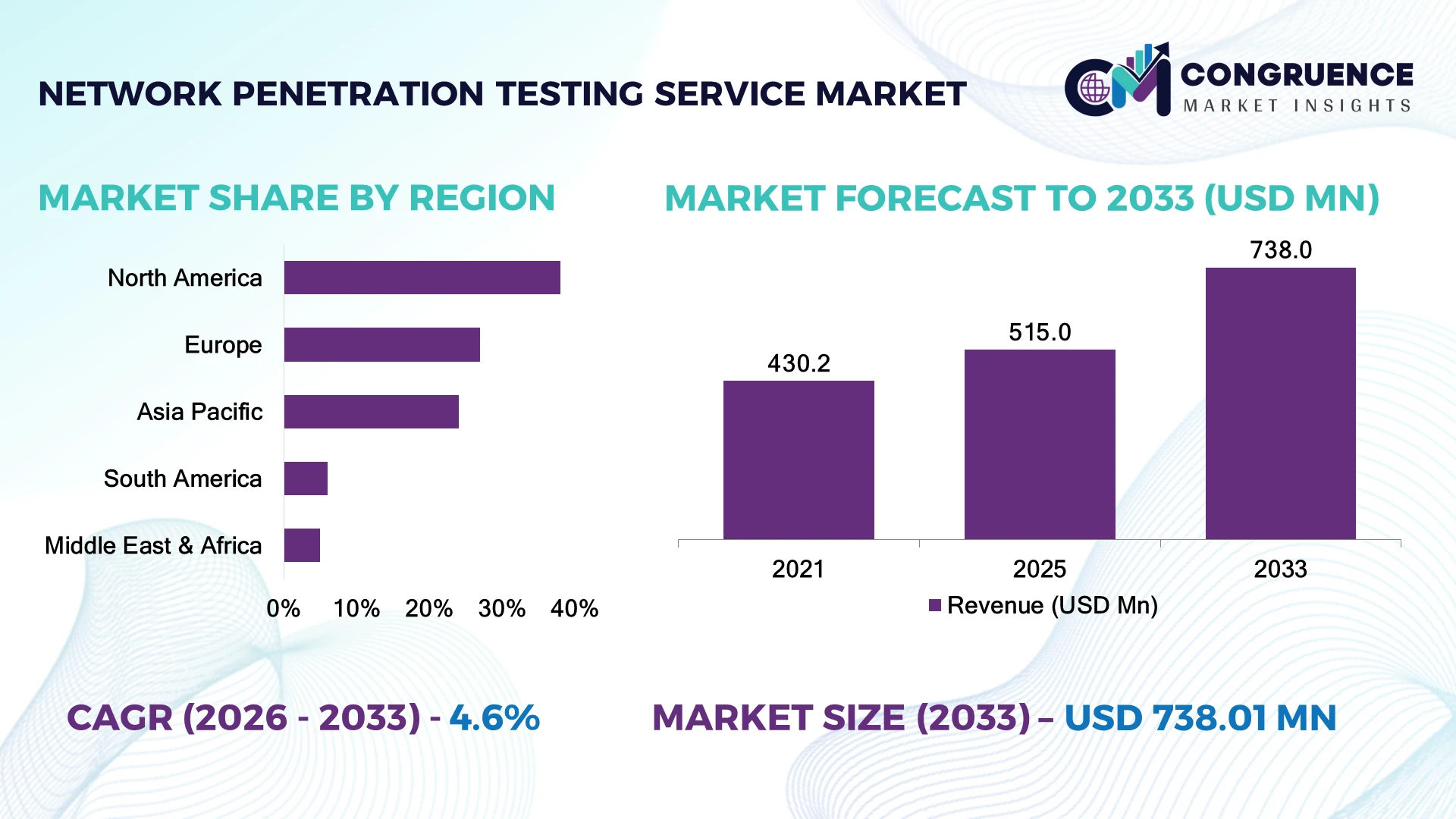
The United States dominates the market with an estimated 37% share, supported by cybersecurity spending exceeding USD 200 billion annually, extensive cloud adoption across over 90% of large enterprises, and strong penetration testing deployment in finance, defense, and healthcare sectors. Compared with Germany, where industrial cybersecurity testing is accelerating through Industry 4.0 initiatives, the U.S. maintains broader enterprise coverage and larger security operations ecosystems. Following heightened geopolitical cyber tensions and critical infrastructure protection efforts, organizations are increasing testing frequency by more than 25% to identify exploitable vulnerabilities before attackers do.
Strategic implication Service providers with advanced automated validation, cloud-native assessment capabilities, and sector-specific expertise are positioned to secure long-term enterprise contracts and premium engagements.
Market Size & Growth: USD 515.0 million in 2025 reaching USD 738.0 million by 2033, supported by rising ransomware activity and cloud security validation demand.
Top Growth Drivers: Cloud migration (+42%), regulatory compliance adoption (+35%), and critical infrastructure security spending (+31%).
Short-Term Forecast: By 2028, vulnerability remediation cycles are expected to improve by nearly 30% through continuous testing programs.
Emerging Technologies: AI-driven attack simulation, automated red teaming, and cloud-native security validation are transforming assessment efficiency.
Regional Leaders: North America (~USD 270 million), Europe (~USD 165 million), and Asia-Pacific (~USD 150 million) supported by enterprise digitization and cybersecurity modernization.
Consumer/End-User Trends: Over 68% of large enterprises now conduct recurring penetration testing at least twice annually.
Pilot/Case Example: In 2024, a financial-sector security program reduced critical vulnerability exposure by 40% after continuous testing deployment.
Competitive Landscape: Leading providers control approximately 28% market share; major players include IBM, Accenture, NCC Group, Coalfire, and Rapid7.
Regulatory & ESG Impact: Compliance-driven testing programs improved audit readiness by over 35% across regulated sectors.
Investment & Funding: More than USD 1.5 billion in cybersecurity investments supported testing automation, acquisitions, and service expansion initiatives.
Innovation & Future Outlook: AI-assisted offensive security and continuous validation platforms are becoming core enterprise cyber resilience strategies.
Network Penetration Testing Service solutions are increasingly deployed across banking, healthcare, government, telecommunications, and critical infrastructure environments where proactive threat detection is essential. AI-enabled attack simulation, automated vulnerability validation, and cloud-native assessment platforms are enhancing testing accuracy and reducing manual effort. More than 60% of large organizations now integrate testing into continuous security programs. Growing compliance obligations and operational resilience requirements are also accelerating adoption, creating a strong foundation for broader strategic cybersecurity investments.
Network penetration testing services have become strategically important as cyber risk increasingly influences investment decisions, operational continuity, and competitive positioning. Organizations are moving beyond periodic assessments toward continuous security validation as digital transformation expands attack surfaces across cloud, hybrid, and operational technology environments. New cybersecurity regulations, critical infrastructure protection programs, and supply-chain security requirements are reinforcing the role of independent security testing within enterprise risk management frameworks.
Modern AI-assisted penetration testing platforms can reduce assessment preparation time by nearly 35% compared with traditional manual methodologies while improving vulnerability identification rates. The United States leads in enterprise-scale deployment across finance and defense sectors, while Singapore and Germany are advancing specialized testing programs tied to smart infrastructure and industrial cybersecurity initiatives. This contrast highlights differences in deployment maturity and sector-specific innovation priorities.
Over the next two to three years, organizations are expected to increase testing frequency, continuous validation programs, and third-party security audits. A large healthcare provider deploying automated penetration testing across multi-cloud environments can identify critical exposures weeks earlier than legacy assessment schedules. In response, providers are expanding managed testing services, strategic partnerships, and AI-enabled platforms. Firms that deliver continuous visibility, faster remediation support, and sector-focused expertise will secure stronger competitive advantages and long-term relevance.
Escalating cyberattacks and stricter compliance requirements are accelerating demand for network penetration testing services. More than 70% of large enterprises now operate hybrid cloud environments, while ransomware incidents affecting critical infrastructure have increased by over 25% in recent years. Regulations such as NIS2 in Europe and expanding cybersecurity mandates across the United States require stronger security verification and vulnerability management practices. This shift creates a direct need for frequent offensive security assessments, reducing exposure windows and improving incident readiness. In response, leading providers are investing in AI-enabled testing platforms, cloud security expertise, and managed red-team services. A notable strategic insight is that organizations conducting quarterly testing often identify high-risk vulnerabilities significantly earlier than those relying on annual assessments, strengthening operational resilience and reducing remediation costs.
A persistent shortage of skilled penetration testers remains a major structural limitation. Global cybersecurity workforce gaps exceed 4 million professionals, while advanced offensive security specialists represent only a small fraction of the available talent pool. Service delivery costs have increased by approximately 15%, creating budget pressures for mid-sized enterprises. Organizations operating across complex multi-cloud environments also face challenges in securing specialized expertise capable of testing modern architectures. The constraint directly affects scalability, project timelines, and testing consistency. To mitigate risk, service providers are expanding offshore delivery centers, automating portions of vulnerability validation, and establishing long-term talent development programs. A critical operational insight is that firms with integrated automation capabilities can maintain testing capacity despite workforce shortages, preserving service quality and client retention.
The emergence of AI-powered security validation platforms is creating substantial opportunities across enterprise cybersecurity programs. Automated attack simulation can reduce manual assessment workloads by nearly 40%, while continuous validation frameworks improve threat visibility across dynamic cloud infrastructures. In Japan and the United Kingdom, digital transformation initiatives are accelerating demand for real-time security assessment services integrated into DevSecOps pipelines. Organizations increasingly seek ongoing validation rather than point-in-time testing, opening opportunities for subscription-based service models. Companies are responding through platform development, strategic acquisitions, and ecosystem partnerships with cloud providers. A less obvious opportunity lies in securing industrial control systems and connected operational technology networks, where security testing adoption remains below enterprise IT levels despite rising cyber exposure and increasing infrastructure modernization initiatives.
The growing complexity of enterprise technology ecosystems presents a significant execution challenge. More than 80% of large organizations operate multi-cloud infrastructures, while connected assets continue expanding through IoT, edge computing, and operational technology integration. Testing these environments consistently requires advanced tooling, specialized expertise, and coordinated stakeholder engagement. Misconfigured cloud assets account for a significant percentage of reported security exposures, increasing assessment complexity and remediation workloads. Organizations must also address evolving attack techniques targeting APIs, identity systems, and third-party integrations. To maintain competitiveness, providers are investing in automation, threat intelligence integration, and specialized cloud security practices. A key strategic insight is that scalable testing frameworks capable of delivering unified visibility across diverse environments will become essential for sustaining long-term cybersecurity effectiveness and enterprise trust.
AI-Driven Testing Automation Expansion Enterprise adoption of AI-assisted penetration testing has increased by nearly 38%, while automated vulnerability validation reduces assessment preparation time by approximately 30%. Organizations in the United States are integrating machine-learning-based attack simulation into continuous security workflows to address growing asset complexity. This transition improves testing speed and consistency while lowering manual workload. Service providers are expanding automated red-team capabilities and embedding AI into security validation platforms to support larger testing volumes without proportional workforce expansion.
Continuous Security Validation Adoption Continuous penetration testing programs have expanded by over 35% among large enterprises, with vulnerability verification cycles becoming 28% faster than traditional annual assessments. Regulatory oversight and cyber resilience requirements are pushing organizations toward ongoing validation models. Financial institutions and healthcare operators increasingly deploy integrated testing workflows across cloud and on-premise environments. Providers are restructuring service portfolios around subscription-based engagements, enabling recurring assessments and faster remediation support while improving operational visibility.
Cloud-Native Assessment Acceleration More than 72% of enterprise workloads now operate in cloud or hybrid environments, creating a sharp increase in demand for cloud-native penetration testing. Misconfiguration-related exposures account for over 25% of identified security weaknesses in multi-cloud deployments. Companies are expanding cloud security partnerships and investing in specialized assessment teams. This shift improves deployment security while enabling organizations to validate rapidly changing infrastructures without disrupting operational continuity.
Operational Technology Security Focus Penetration testing demand across industrial and operational technology environments has increased by approximately 32%, driven by infrastructure modernization and connected asset deployment. Manufacturing facilities now report over 40% more network-connected devices than five years ago. Organizations are integrating IT and OT security testing processes to identify cross-environment vulnerabilities. Service providers are developing specialized industrial testing frameworks, helping operators improve resilience while reducing the likelihood of production disruptions and operational downtime.
External Network Penetration Testing remains the leading segment, accounting for approximately 42% of market activity due to its critical role in identifying internet-facing vulnerabilities, exposed assets, and perimeter security weaknesses. Large enterprises prioritize external assessments because cloud adoption, remote access infrastructure, and third-party connectivity have expanded attack surfaces significantly. More than 65% of security incidents originate from externally accessible weaknesses, reinforcing the importance of regular perimeter testing. Companies continue investing in automated reconnaissance tools and attack-simulation platforms to improve assessment accuracy and coverage. Internal Network Penetration Testing represents the fastest-growing segment as organizations increasingly focus on lateral movement risks, privilege escalation pathways, and insider threat exposure. Adoption has increased by nearly 30% among enterprises implementing zero-trust architectures. Web Application Penetration Testing and Wireless Network Testing also remain strategically important as digital services and connected workplace environments expand. Service providers are broadening capabilities through specialized testing teams, automation investments, and integrated security validation programs. The shift toward internal security verification is influencing enterprise investment priorities, particularly among organizations seeking comprehensive cyber resilience rather than perimeter-focused protection alone.
The Banking, Financial Services, and Insurance (BFSI) segment accounts for approximately 31% of market demand and remains the leading application area. High-value digital transactions, stringent compliance obligations, and growing exposure to sophisticated cyber threats continue driving testing frequency. More than 70% of major financial institutions conduct multiple penetration assessments annually to validate security controls. Continuous testing frameworks have become increasingly common as organizations seek faster identification of exploitable weaknesses and improved audit readiness. Healthcare is emerging as the fastest-growing application segment due to the rapid expansion of connected medical systems, electronic health records, and telehealth infrastructure. Penetration testing adoption across healthcare environments has increased by roughly 34% as providers strengthen protection of sensitive patient data. Government, telecommunications, and retail sectors also maintain strong demand, driven by infrastructure modernization and expanding digital services. Service providers are responding through industry-specific methodologies, automated reporting capabilities, and integrated security validation services. Demand is increasingly shifting toward sectors where uninterrupted operations and data protection have become mission-critical business requirements.
Large Enterprises represent the dominant end-user segment with an estimated 63% share due to extensive digital infrastructure, complex network architectures, and elevated cyber risk exposure. These organizations manage large volumes of sensitive data and frequently operate across multiple cloud environments, creating sustained demand for advanced penetration testing services. Nearly 75% of large enterprises now integrate testing into broader cyber resilience programs. Service providers increasingly offer customized engagements, dedicated threat simulation teams, and continuous validation platforms tailored to large-scale operational requirements. Small and Medium-Sized Enterprises (SMEs) are the fastest-growing end-user category as cybersecurity incidents increasingly target resource-constrained organizations. Adoption among SMEs has risen by approximately 29%, supported by managed security services and more accessible testing solutions. Government agencies, critical infrastructure operators, and public-sector entities also continue expanding procurement activity due to heightened security mandates and infrastructure protection initiatives. Companies are addressing these segments through flexible pricing models, strategic partnerships, and scalable testing platforms. Competitive positioning is increasingly shaped by the ability to serve both enterprise-scale deployments and rapidly expanding mid-market cybersecurity requirements.
North America accounted for the largest market share at 38% in 2025 however, Asia-Pacific is expected to register the fastest growth, expanding at a CAGR of 6.8% between 2026 and 2033.
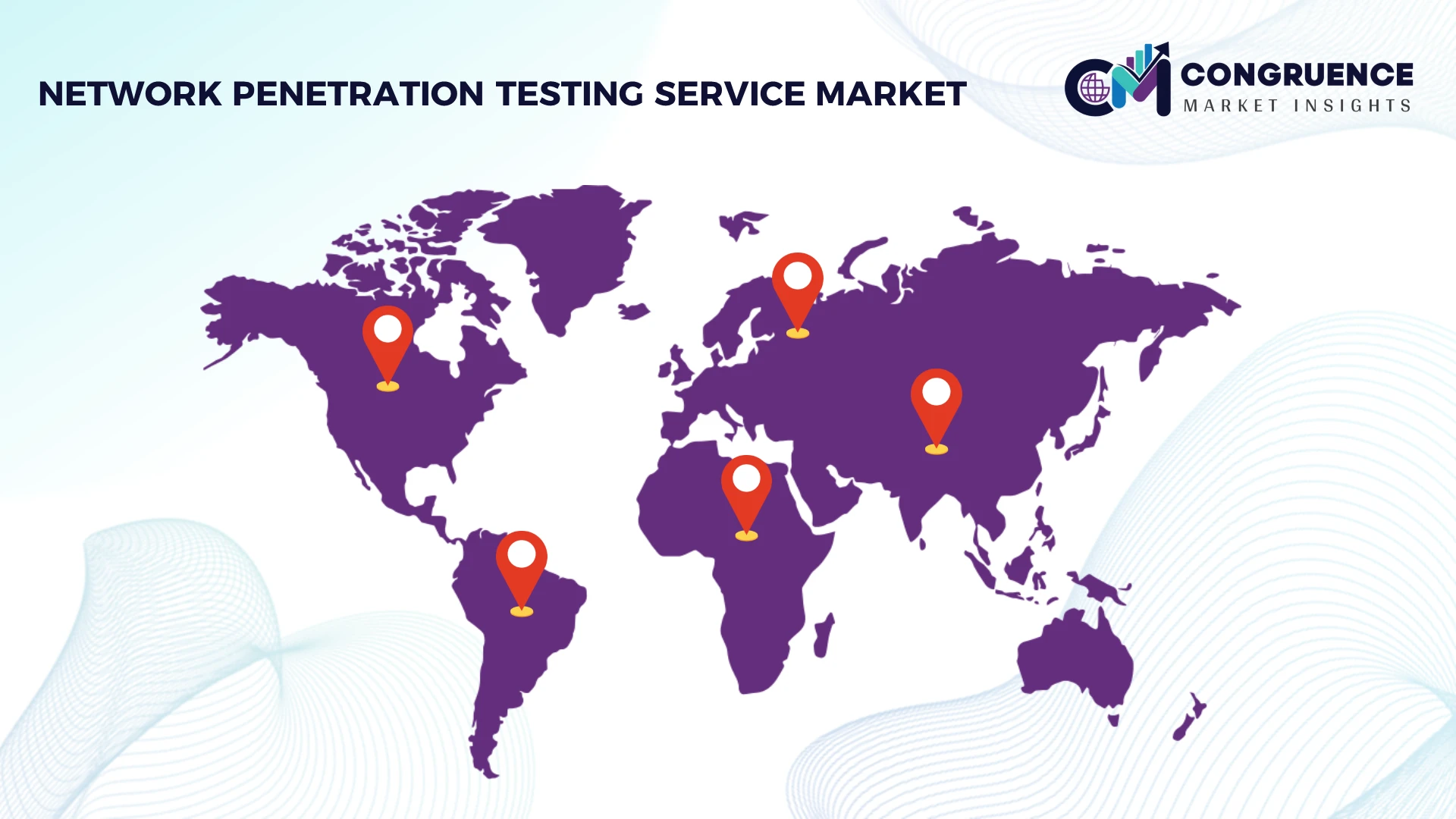
North America remains the largest market for network penetration testing services, supported by high cybersecurity spending, mature cloud infrastructure, and extensive deployment across financial services, healthcare, defense, and critical infrastructure sectors. The region contributes approximately 38% of global demand, with large enterprises increasingly adopting continuous security validation rather than periodic assessments. More than 70% of Fortune 500 organizations integrate penetration testing into broader cyber resilience frameworks. Regulatory scrutiny, ransomware preparedness programs, and third-party risk management initiatives continue to expand testing frequency. Organizations are also investing in automated red-team platforms and AI-assisted security validation tools to improve testing coverage across hybrid environments. Strategic partnerships between cybersecurity providers and cloud operators are accelerating service integration, reducing remediation timelines, and strengthening enterprise security governance.
United States Market Outlook: The United States represents the region’s dominant market due to its concentration of global technology firms, financial institutions, defense contractors, and cloud service providers. Over 90% of large enterprises maintain dedicated cybersecurity programs, creating consistent demand for advanced penetration testing services. Federal cybersecurity directives and critical infrastructure protection initiatives continue to increase security validation requirements. The country also leads adoption of AI-enabled testing platforms, with major enterprises expanding continuous assessment models across multi-cloud and operational technology environments to improve cyber resilience and regulatory readiness.
Europe accounts for approximately 27% of global market activity, supported by strong cybersecurity governance, digital infrastructure modernization, and growing enterprise security investments. Regulatory frameworks continue to influence testing deployment strategies, particularly among financial institutions, telecommunications providers, and industrial operators. Organizations increasingly prioritize penetration testing as part of broader cyber resilience and supply-chain security programs. More than 60% of large enterprises have expanded security validation activities following heightened compliance requirements. Industrial digitization and connected manufacturing environments are creating additional demand for specialized operational technology assessments. Security service providers are strengthening regional delivery capabilities and expanding managed testing offerings to address increasing enterprise requirements for continuous vulnerability validation.
Germany Market Outlook: Germany serves as the region’s most strategically important market due to its industrial scale, advanced manufacturing ecosystem, and extensive Industry 4.0 deployment. Industrial operators are increasingly conducting penetration testing across connected production networks and operational technology environments. More than half of large manufacturing enterprises now include cybersecurity validation within digital transformation initiatives. Strong engineering capabilities, enterprise modernization programs, and growing investments in industrial cybersecurity continue to reinforce Germany’s position as a leading adopter of advanced penetration testing services.
Asia-Pacific accounts for roughly 24% of global market demand and represents the fastest-evolving deployment landscape. Rapid cloud adoption, digital banking expansion, and growing cybersecurity awareness are driving penetration testing activity across enterprise and government environments. Organizations are increasingly validating security across large-scale digital infrastructure projects, telecommunications networks, and cloud-native applications. More than 65% of newly deployed enterprise workloads in major economies are now cloud-based, increasing the need for continuous security assessment. Investments in smart cities, digital public services, and advanced connectivity infrastructure continue to create new testing requirements. Service providers are expanding regional operations and developing localized delivery models to support growing enterprise demand.
China Market Outlook: China leads the regional market through its extensive digital economy, large enterprise base, and substantial technology infrastructure investments. Financial services, telecommunications, e-commerce, and cloud computing operators are increasing penetration testing activity as cyber risk management becomes a strategic priority. The country supports one of the world’s largest connected enterprise ecosystems, with cybersecurity validation becoming increasingly integrated into software deployment and infrastructure modernization programs. Strong investment in cloud services and digital transformation initiatives continues to strengthen demand for advanced security testing capabilities.
South America represents approximately 6% of global market activity, with adoption primarily driven by banking, telecommunications, government services, and expanding digital commerce platforms. Organizations are increasingly investing in cybersecurity validation to address growing cyber threats and support digital transformation objectives. Financial institutions remain among the most active users of penetration testing services due to the expansion of mobile banking and digital payment systems. Enterprise cybersecurity programs have expanded significantly as organizations seek improved visibility into network vulnerabilities. Despite infrastructure and talent limitations in certain markets, managed security services and regional partnerships are improving access to advanced testing capabilities. Operational demand continues to strengthen as businesses modernize technology environments and increase cloud deployment.
Brazil Market Outlook: Brazil remains the region’s leading market due to its large financial services sector, expanding digital economy, and growing cybersecurity investment activity. Banks, telecommunications providers, and public-sector organizations continue increasing security testing requirements as digital transactions and cloud adoption accelerate. Large enterprises are implementing more structured cyber resilience programs, with many organizations conducting recurring security assessments to strengthen operational continuity. Expanding cloud infrastructure and enterprise modernization initiatives continue to support sustained demand for penetration testing expertise across critical industries.
The Middle East & Africa region accounts for approximately 5% of global market demand, supported by infrastructure modernization, smart-city development, and national digital transformation initiatives. Governments and large enterprises are prioritizing cybersecurity resilience as digital service adoption accelerates across energy, finance, healthcare, and public-sector environments. Cloud migration and critical infrastructure modernization projects are creating new requirements for advanced security validation. Several large-scale digital programs now include mandatory security assessment phases before deployment. Service providers are expanding regional partnerships, cybersecurity operations capabilities, and specialized testing services to support increasingly complex digital ecosystems. Demand is particularly strong among organizations managing sensitive infrastructure and mission-critical networks.
Saudi Arabia Market Outlook: Saudi Arabia represents the most influential market within the region due to extensive digital transformation investments, critical infrastructure modernization, and strong government cybersecurity initiatives. Major projects linked to economic diversification programs are increasing demand for network security validation across public and private sectors. Financial institutions, energy operators, and smart-city developments are expanding penetration testing activity to strengthen cyber resilience. The country continues investing heavily in cybersecurity capabilities, creating favorable conditions for advanced testing services, specialized security expertise, and long-term enterprise security programs.
The Network Penetration Testing Service market is characterized by competition between global cybersecurity leaders such as IBM, Accenture, Rapid7, NCC Group, and Coalfire, and specialized regional security consultancies focused on compliance-driven assessments. The top five players collectively account for approximately 42% of market activity, creating a moderately consolidated structure. Competition is increasingly centered on automation, threat intelligence integration, continuous testing capabilities, and industry-specific expertise rather than price alone. AI-assisted testing platforms reduce assessment preparation time by nearly 30%, while continuous validation programs improve vulnerability identification rates by over 25%. Global providers compete through platform innovation, managed security integration, strategic acquisitions, and cloud ecosystem partnerships, while regional firms differentiate through localized compliance knowledge and faster service delivery. The competitive shift is moving from periodic testing engagements toward continuous exposure validation and automated red-teaming models. The primary entry barrier remains access to highly skilled offensive security talent and proprietary testing frameworks. Winning requires scalable automation, deep technical expertise, regulatory alignment, and continuous security validation capabilities.
Accenture
Rapid7
NCC Group
Coalfire
Trustwave
Synopsys
Secureworks
Checkmarx
Bishop Fox
NetSPI
BreachLock
Orange Cyberdefense
Kroll
Network penetration testing technologies are rapidly evolving from manual assessment methodologies toward AI-assisted validation platforms, automated attack simulation, and continuous exposure management systems. More than 60% of large enterprises now incorporate automated vulnerability validation into security operations, while AI-assisted reconnaissance can reduce testing preparation efforts by approximately 30%. Cloud-native testing frameworks are increasingly deployed to secure hybrid and multi-cloud environments, improving assessment coverage across dynamic infrastructures. Organizations benefit through faster identification of exploitable weaknesses and more consistent security validation processes.
Emerging technologies include continuous red teaming, attack path analysis, exposure validation platforms, and machine-learning-based threat simulation. Modern automated testing environments identify critical vulnerabilities up to 35% faster than traditional manual-only assessments. Nearly 55% of advanced cybersecurity programs now integrate penetration testing with threat intelligence and security operations workflows. Security providers with automated validation capabilities gain a competitive advantage by improving scalability and reducing operational bottlenecks. AI-enhanced testing also enables broader asset visibility across cloud, operational technology, and remote workforce environments.
Between 2026 and 2028, autonomous testing orchestration, agentic security validation, and real-time attack surface monitoring are expected to reshape deployment models. Organizations adopting continuous testing frameworks are projected to improve remediation efficiency by more than 25%. Companies investing early in automated validation, cloud security integration, and AI-driven offensive security capabilities will strengthen resilience, accelerate compliance readiness, and maintain stronger competitive positioning against increasingly sophisticated cyber threats.
March 2025 – Rapid7 announced a new Global Capability Center in Pune, India, expanding cybersecurity operations, engineering, and innovation capabilities with planned 24x7 global security coverage. The initiative strengthens service scalability and regional talent development for advanced penetration testing and exposure management operations. Source: www.rapid7.com
August 2025 – Rapid7 launched Vector Command Advanced, integrating continuous red teaming, internal penetration testing, and exposure validation into a unified platform. The solution enables organizations to validate internal controls and segmentation effectiveness, improving operational security assessment efficiency and compliance readiness. Source: www.investors.rapid7.com
October 2025 – Rapid7 established a local UAE entity and secured Dubai Electronic Security Center certification, strengthening regional cybersecurity delivery capabilities. The expansion enhances support for regulated industries and government digital transformation initiatives while improving localized security validation services. Source: www.rapid7.com
March 2026 – Rapid7 advanced its exposure management portfolio through new cloud security capabilities supporting runtime validation and data security posture management. The enhancement improves visibility across cloud environments and accelerates identification of exploitable exposures, strengthening enterprise cyber resilience programs.
This report provides comprehensive analysis of the Network Penetration Testing Service market across key service types, applications, end-user categories, and major geographic regions. Coverage includes external network testing, internal network testing, web application testing, and wireless security assessments across banking, healthcare, government, telecommunications, manufacturing, and enterprise environments. The study evaluates deployment trends, technology adoption patterns, and competitive positioning across North America, Europe, Asia-Pacific, South America, and the Middle East & Africa. More than 60% of enterprise demand is concentrated among organizations operating complex hybrid and cloud-based infrastructures.
The report also examines emerging technologies including AI-assisted testing, continuous validation platforms, automated red teaming, cloud-native security assessment, and exposure management solutions. Strategic insights cover enterprise adoption behavior, operational priorities, competitive dynamics, partnership activity, and evolving cybersecurity requirements. It supports investment evaluation, expansion planning, vendor benchmarking, risk assessment, and long-term market positioning decisions between 2026 and 2033 while identifying high-opportunity deployment segments and emerging areas of cybersecurity demand.
| Report Attribute / Metric | Details |
|---|---|
| Market Revenue (2025) | USD 515.0 Million |
| Market Revenue (2033) | USD 738.0 Million |
| CAGR (2026–2033) | 4.6% |
| Base Year | 2025 |
| Forecast Period | 2026–2033 |
| Historic Period | 2021–2025 |
| Segments Covered |
By Type
By Application
By End-User
|
| Key Deliverables | Revenue Forecast; Market Trends; Growth Drivers & Restraints; Technology Insights; Segmentation Analysis; Regional Insights; Competitive Landscape; Regulatory & ESG Overview; Recent Developments |
| Regions Covered | North America; Europe; Asia-Pacific; South America; Middle East & Africa |
| Companies Profiled | IBM; Accenture; Rapid7; NCC Group; Coalfire; Trustwave; Synopsys; Secureworks; Checkmarx; Bishop Fox; NetSPI; BreachLock; Orange Cyberdefense; Kroll |
| Customization & Pricing | Available on Request (10% Customization Free) |




