
Reports
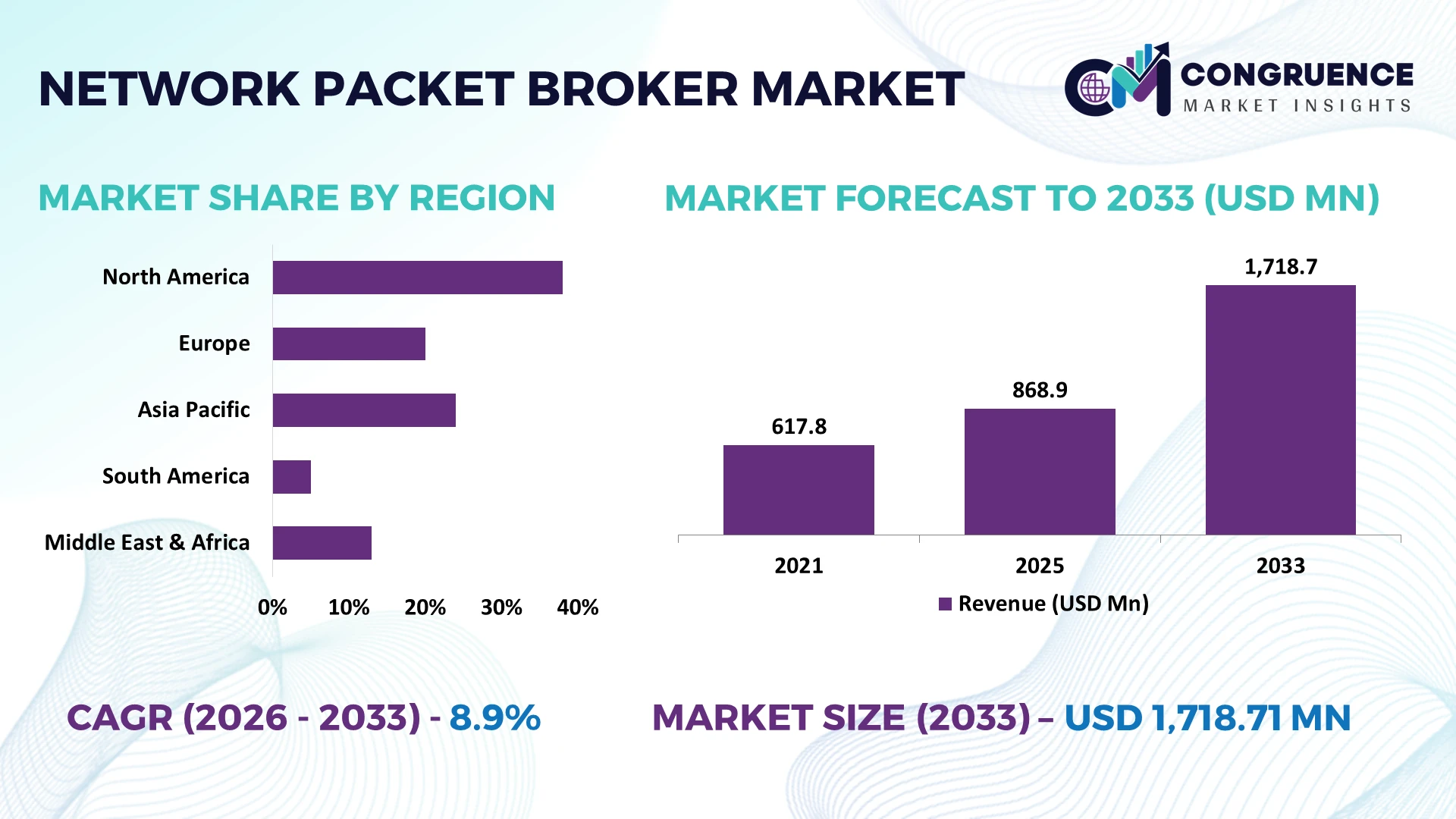
The Global Network Packet Broker Market was valued at USD 868.924 Million in 2025 and is anticipated to reach a value of USD 1718.71 Million by 2033 expanding at a CAGR of 8.9% between 2026 and 2033. Growth is driven by 100/400GbE network upgrades, east-west data-center traffic, encrypted-traffic visibility, zero-trust security architectures, and consolidation of monitoring feeds across hybrid cloud infrastructure.
The United States represents the dominant country market, supported by hyperscale data centers, telecom networks, financial institutions, defense infrastructure, and advanced cybersecurity operations, and accounts for an estimated 32% of global NPB demand. More than 50% of global hyperscale data-center capacity is concentrated in the U.S., versus roughly 16% in China. AI-cluster expansion and U.S.-China technology restrictions are accelerating domestic network modernization, while 400GbE deployments increase requirements for lossless packet aggregation, filtering, deduplication, and security-tool traffic optimization.
Strategically, buyers should prioritize scalable 400GbE-ready packet-broker architectures that reduce monitoring-tool overload while preserving visibility across increasingly distributed network environments.
Market Size & Growth: USD 868.924 million in 2025 reaches USD 1,718.71 million by 2033 at 8.9%, driven by 400GbE migration and security visibility.
Top Growth Drivers: 400GbE upgrades 35%, cybersecurity visibility 33%, and hybrid-cloud monitoring 32% collectively reshape packet-broker investment priorities.
Short-Term Forecast: By 2028, intelligent filtering and deduplication can reduce redundant monitoring traffic by 40%, improving security-tool utilization.
Emerging Technologies: 800GbE interfaces, AI-assisted traffic classification, and programmable packet processing target 2× higher interface capacity than 400GbE platforms.
Regional Leaders: North America approaches USD 700 million, Europe USD 430 million, and Asia-Pacific USD 420 million as high-speed visibility deployments expand.
End-User Trends: Data centers process more than 50% east-west traffic in many virtualized environments, increasing demand for lateral traffic visibility.
Pilot/Case Example: 2025 high-speed visibility architectures using packet deduplication demonstrated traffic-volume reductions exceeding 30%, protecting monitoring capacity.
Competitive Landscape: Keysight holds an estimated 20% share, challenged by Gigamon, Arista Networks, Garland Technology, and NetScout across advanced visibility deployments.
Regulatory & ESG Impact: NIS2 extends cybersecurity requirements across 18 critical sectors, increasing requirements for continuous network monitoring and incident evidence.
Investment & Funding: More than USD 100 billion in announced U.S. AI infrastructure commitments reinforces demand for high-throughput packet visibility around accelerated computing clusters.
Innovation & Future Outlook: 800GbE doubles 400GbE interface throughput, shifting NPB design toward programmable silicon, telemetry automation, and consolidated observability fabrics.
Network Packet Broker Market demand is increasingly concentrated in hyperscale data centers, telecom networks, financial services, government infrastructure, and security operations centers managing rapidly rising traffic volumes. Current innovation centers on 400GbE and emerging 800GbE interfaces, FPGA-based packet processing, intelligent filtering, deduplication, and integration with network detection platforms. With 800GbE providing 100% more interface capacity than 400GbE, visibility infrastructure is moving closer to high-speed AI and cloud fabrics. Cybersecurity regulation and geopolitical pressure on critical digital infrastructure are also elevating packet-level observability, creating a clear transition into strategic market priorities.
Network packet brokers are becoming strategic control points as enterprises redesign observability around distributed workloads, encrypted sessions, and multi-cloud operations. Infrastructure modernization is shifting visibility from appliance-by-appliance monitoring toward centralized traffic intelligence. With TLS encryption covering more than 95% of web traffic, security teams increasingly require selective decryption, metadata extraction, and policy-based forwarding that preserve monitoring effectiveness without multiplying inspection infrastructure.
Programmable packet processing delivers a material operational advantage over legacy TAP-to-tool architectures: filtering irrelevant packets before inspection can cut downstream security-tool traffic by 50% or more, extending existing appliance capacity. U.S. deployments emphasize large-scale cloud and security operations, whereas European investment increasingly reflects NIS2-driven incident visibility. A bank, for example, can route payment traffic to intrusion detection while sending application metadata separately to performance analytics, eliminating unnecessary duplicate processing.
Through 2028, deployment priorities will move toward software-defined visibility, container-aware telemetry, encrypted-traffic intelligence, and unified physical-virtual packet fabrics. Suppliers are investing in programmable silicon and integrations with SIEM, NDR, and cloud observability platforms. Competitive positioning will increasingly depend on converting raw packets into policy-controlled intelligence before monitoring costs escalate.
Cybersecurity tool proliferation is making traffic optimization an economic requirement rather than simply a monitoring function. IBM reported that organizations extensively using security AI and automation shortened breach identification and containment by 108 days, while encrypted web traffic exceeds 95% and zero-trust adoption continues across large enterprises. These conditions increase the value of packet brokers that classify, mask, slice, and distribute relevant traffic before it reaches expensive inspection appliances. U.S. financial institutions face heightened operational scrutiny following SEC cyber-disclosure changes, strengthening requirements for defensible network evidence. Suppliers are integrating packet intelligence with NDR, SIEM, and threat-detection ecosystems while expanding automated traffic policies. The strategic benefit is tool-life extension: filtering low-value packets allows enterprises to increase monitored coverage without proportionally expanding every downstream security appliance.
Specialized switching silicon, optical transceivers, and high-density interfaces create a substantial infrastructure burden when enterprises upgrade visibility fabrics. Moving from 100GbE to 400GbE quadruples port throughput, while 400G optical components remain materially more expensive than mature 100G equivalents; power requirements per high-capacity interface can also rise by more than 50% depending on optics and reach. U.S. restrictions affecting advanced semiconductor trade with China further complicate sourcing strategies for networking equipment manufacturers operating globally. This hardware intensity slows refresh decisions where existing monitoring tools cannot ingest equivalent speeds. Vendors are mitigating exposure through merchant-silicon diversification, modular chassis designs, backward-compatible ports, and longer-term component procurement. The operational constraint is synchronization: packet-broker upgrades deliver limited value when adjacent probes, analyzers, or optical infrastructure remain bandwidth-constrained.
Containerized infrastructure opens an underpenetrated visibility layer because traditional packet appliances were designed around persistent physical interfaces rather than ephemeral workloads. Kubernetes supports clusters of up to 5,000 nodes and 150,000 pods, while cloud-native environments can create and terminate application instances within seconds. This operational model favors software packet brokers, eBPF telemetry, service-aware filtering, and virtual traffic mirroring that follow workloads automatically. India’s expanding cloud-native developer ecosystem provides a strong deployment environment as banks, telecom operators, and digital-native businesses modernize application stacks. Suppliers are developing Kubernetes-native sensors, API-driven orchestration, and hybrid visibility fabrics linking data-center packets with cloud telemetry. The non-obvious opportunity is licensing portability: software-defined NPB capacity can follow workloads across clusters, creating recurring consumption models without requiring equivalent physical-appliance expansion.
Execution complexity intensifies as network speeds rise faster than inspection capacity and traffic becomes distributed across physical, virtual, and container environments. A single 800GbE link carries twice the throughput of 400GbE, while microburst conditions can temporarily approach 100% interface utilization and overwhelm undersized buffers or monitoring destinations. AI training fabrics add another pressure: thousands of accelerators exchange synchronized east-west flows where packet loss can distort troubleshooting evidence. Taiwan-centered advanced semiconductor manufacturing also concentrates dependency for high-performance networking silicon, exposing equipment roadmaps to geopolitical disruption. Vendors must therefore invest in terabit-scale switching, lossless buffering, load balancing, telemetry automation, and interoperable orchestration. Long-term competitiveness depends on maintaining packet fidelity at line rate; platforms that drop visibility precisely during congestion undermine the operational evidence security and network teams purchase them to preserve.
Optical Visibility Moves Upstream Enterprises are placing visibility closer to high-capacity network edges as 400G interfaces replace 100G connections, delivering 4× port throughput. Operators increasingly pair optical TAPs with packet brokers before traffic reaches monitoring stacks, improving capture consistency. Vendors are scaling high-density chassis and modular optics, helping customers consolidate physical interception points while reducing rack-space requirements by approximately 25% in dense environments.
Telemetry Convergence Changes Operations Network teams are combining packet data with flow records, metrics, and application telemetry rather than operating separate diagnostic pipelines. OpenTelemetry now has contributions from more than 1,000 organizations, while observability platforms increasingly correlate three or more telemetry classes. NPB suppliers are integrating metadata generation and analytics connectors, allowing enterprises to accelerate root-cause isolation and reduce duplicated collection infrastructure by approximately 20%–30%.
Data Sovereignty Alters Traffic Routing European enterprises are redesigning monitoring policies as NIS2 covers 18 critical sectors and DORA applies to financial entities from 2025. Instead of forwarding unrestricted packet copies across jurisdictions, operators increasingly perform masking, selective forwarding, and metadata extraction locally. Packet-broker vendors are adding programmable redaction and policy controls, enabling regulated customers to maintain operational visibility while reducing unnecessary exposure of payload information across monitoring domains.
Consumption Models Replace Fixed Capacity Enterprises are shifting visibility procurement toward flexible licenses as bandwidth requirements fluctuate across branches, colocation facilities, and cloud connections. Software-enabled capacity activation allows selected platforms to move from 100G toward 400G without equivalent appliance proliferation. Vendors are introducing subscription licensing and centralized fleet management, while operators consolidate previously isolated monitoring domains. The non-obvious benefit is capacity portability, which reduces stranded visibility resources when workloads migrate between facilities.
Physical network packet brokers lead with an estimated 46% share, reflecting their deterministic line-rate processing, high-density interfaces, deep buffering, and suitability for carrier, financial, and hyperscale environments. Dedicated hardware remains essential where packet loss is unacceptable and multiple 100G or 400G links must feed security and performance tools simultaneously. Standalone systems remain relevant for isolated monitoring zones, while Integrated platforms are gaining preference where enterprises want packet manipulation, bypass, and analytics functions within fewer appliances. Integrated configurations can reduce separate visibility components by approximately 20%–30%, improving rack utilization and operational control.
Cloud-Based is the fastest-growing type as workloads increasingly operate outside enterprise-owned switching infrastructure. Virtual brokers complement this transition by capturing traffic between virtual machines and distributed application environments without physical interception hardware. Cloud-Based deployments can shorten visibility provisioning from weeks to hours compared with hardware installation cycles. Suppliers are therefore expanding virtual sensors, cloud-native traffic mirroring integrations, centralized orchestration, and flexible licensing while preserving Physical platforms for bandwidth-intensive core networks.
Security Monitoring leads with an estimated 34% share because security operations require reliable delivery of relevant packets to intrusion detection, network detection, forensics, and threat-analysis platforms. Traffic Aggregation remains a mature application, consolidating multiple network links before inspection, while Traffic Filtering prevents unnecessary packets from consuming downstream tool capacity. Filtering policies can remove 30%–50% of irrelevant or duplicate traffic in heavily instrumented environments, materially extending security appliance utilization. Network Monitoring remains important for infrastructure troubleshooting and service assurance across complex enterprise estates.
Performance Management is the fastest-growing application as application availability becomes increasingly dependent on distributed infrastructure and digital-service latency. Load Balancing distributes selected flows across parallel tools, while automated packet steering prevents individual analyzers becoming bottlenecks during traffic spikes. Enterprises are integrating NPB telemetry with observability platforms and AIOps workflows, shifting troubleshooting from reactive packet capture toward continuous service intelligence. Vendors are responding with dynamic filtering, application recognition, timestamping, metadata generation, and API-driven traffic policies.
Data Centers represent the leading end-user group with an estimated 31% share because dense switching fabrics, multi-tenant workloads, and high interface utilization require continuous packet-level observability. Telecommunications remains a major buyer category for service assurance across core and access infrastructure, while Financial Services prioritizes low-latency transaction monitoring and forensic evidence. Enterprises increasingly deploy smaller visibility fabrics across distributed campuses. Government and Healthcare adoption emphasizes controlled monitoring around sensitive systems, where segmentation and selective packet delivery limit unnecessary exposure of protected information.
Cloud Providers are the fastest-growing end-user group as elastic computing, AI workloads, and geographically distributed services expand traffic visibility requirements beyond conventional facilities. Global data-center electricity consumption reached approximately 415 TWh in 2024, illustrating the infrastructure scale supporting this transition. Providers are adopting software-controlled traffic mirroring, virtual packet processing, and centralized policy orchestration rather than replicating hardware at every workload location. Suppliers are targeting these buyers through hyperscaler integrations, consumption licensing, programmable interfaces, and high-capacity platforms, making deployment flexibility increasingly decisive.
North America accounted for the largest market share at 39.6% in 2025 however, Asia-Pacific is expected to register the fastest growth, expanding at a CAGR of 10.8% between 2026 and 2033.
AI Infrastructure Raises Visibility Density
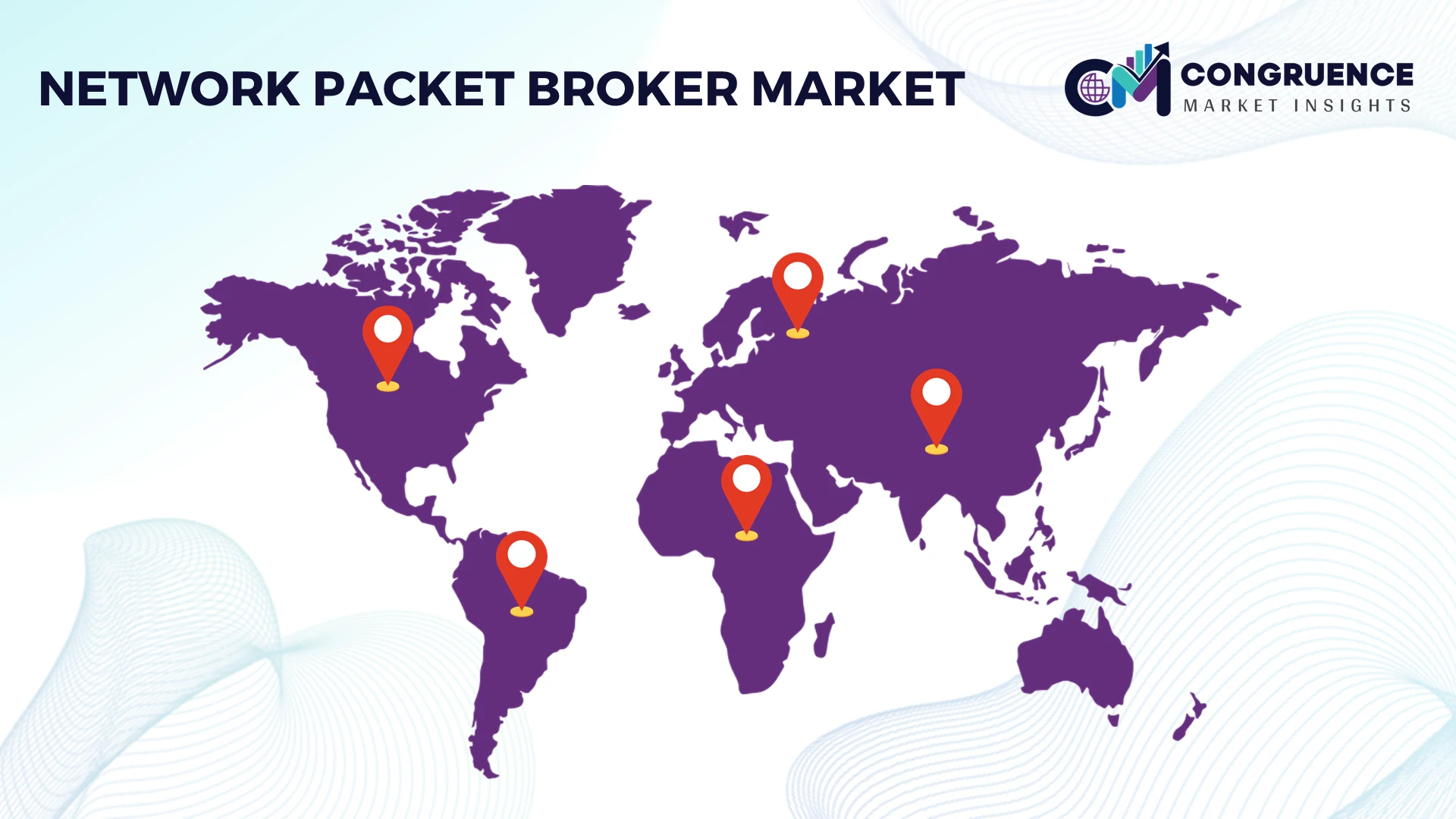
North America represents approximately 39.6% of Network Packet Broker demand, supported by dense hyperscale campuses, financial trading infrastructure, federal networks, and carrier interconnection facilities. The operational shift is toward higher-density visibility fabrics capable of supporting accelerated computing clusters without multiplying monitoring appliances. The United States hosts more than 5,000 data centers, giving packet-broker suppliers a concentrated deployment base around major digital hubs including Northern Virginia, Dallas, Phoenix, and Silicon Valley. Canadian operators contribute through expanding colocation capacity and regulated financial infrastructure. AI infrastructure investment is also changing traffic patterns: GPU clusters generate exceptionally intensive east-west communication, increasing the value of precise packet timestamping and congestion analysis. Suppliers are responding with high-density interfaces, nanosecond-level visibility, scalable aggregation, and architectures designed around increasingly accelerated data-center fabrics.
United States Market Outlook: U.S. infrastructure leadership is reinforced by Northern Virginia, the world’s largest concentrated data-center cluster, where individual campuses increasingly require hundreds of megawatts of power. Financial exchanges, defense networks, hyperscalers, and AI operators create differentiated requirements for deterministic packet capture. Suppliers therefore prioritize ultra-low-latency visibility, high port density, and resilient hardware availability for American deployments.
Digital Resilience Reframes Network Inspection
Europe holds an estimated 25.1% market share, with demand increasingly shaped by operational resilience rather than conventional capacity expansion. Financial services, telecommunications, industrial automation, government networks, and colocation operators require packet-level evidence that complements logs during incident reconstruction. DORA became applicable across EU financial entities in January 2025, strengthening technology-risk management and testing disciplines, while Germany’s industrial base creates additional requirements around operational technology connectivity. Frankfurt, London, Amsterdam, Paris, and Dublin remain important interconnection locations, but power constraints are influencing where new digital infrastructure is commissioned. This creates demand for visibility architectures that operate efficiently across distributed facilities instead of relying on one monitoring location. Suppliers are adapting with compact appliances, centralized management, data-masking functionality, and ecosystem integrations suited to regulated multi-site environments.
Germany Market Outlook: Germany combines DE-CIX Frankfurt, major banking infrastructure, automotive production networks, industrial automation, and sovereign-data requirements. DE-CIX Frankfurt has exceeded 18 Tbps of peak traffic, illustrating the packet-processing intensity surrounding major interconnection environments. German buyers prioritize deterministic performance, operational resilience, and precise traffic control, creating strong positioning for enterprise-grade visibility platforms integrated with security and industrial monitoring systems.
Digital Capacity Expands Across New Hubs
Asia-Pacific accounts for approximately 23.4% of global demand, with infrastructure expansion spreading beyond established Tokyo, Singapore, Hong Kong, and Sydney facilities into India, Indonesia, Malaysia, and other high-capacity digital hubs. The region combines semiconductor manufacturing, telecom modernization, cloud infrastructure, online services, and large subscriber populations, creating diverse packet-visibility requirements. Malaysia has emerged as an important data-center expansion location as operators seek capacity outside land-constrained Singapore, while India’s digital economy is generating additional enterprise and carrier traffic. Japan continues to emphasize high-reliability networking for financial, telecom, and industrial environments. Packet-broker suppliers are responding through channel expansion, localized technical support, flexible port configurations, and partnerships with cybersecurity integrators. Purchasing priorities increasingly reflect the ability to support heterogeneous network generations within rapidly expanding facilities.
India Market Outlook: India’s more than 900 million internet users create exceptional underlying traffic scale, while Mumbai, Chennai, Hyderabad, Bengaluru, and Delhi NCR are expanding as data-center nodes. Domestic data-localization requirements and rapid financial digitization strengthen requirements for in-country traffic inspection. Vendors gain leverage by pairing scalable visibility hardware with local system-integrator capabilities and support coverage across multiple metropolitan clusters.
Interconnection Expansion Concentrates Brazilian Demand
South America represents approximately 5.4% of global Network Packet Broker demand, led by Brazil’s concentration of data centers, internet exchanges, banking systems, telecom infrastructure, and large digital platforms. São Paulo functions as the region’s principal interconnection hub, creating high traffic density where packet aggregation and performance diagnostics have direct operational value. Brazil’s PIX ecosystem regularly processes traffic measured in tens of terabits per second, reinforcing requirements for scalable visibility around carrier and content networks. Chile contributes through data-center investment and international connectivity, while Colombia provides an emerging enterprise and telecom deployment base. Constraints remain around imported networking hardware, currency exposure, and uneven technical support outside major metros. Suppliers are countering these limitations through distributor inventories, local engineering partnerships, modular configurations, and centralized management that reduces specialist staffing requirements.
Brazil Market Outlook: Brazil combines more than 180 million internet users with one of the world’s largest internet-exchange ecosystems, creating sustained packet-processing intensity. São Paulo’s connectivity concentration makes it the priority deployment location for carriers, financial institutions, content providers, and colocation operators. Local stocking and Portuguese-language engineering support provide vendors with a practical advantage where replacement lead times directly affect network availability.
Digital Infrastructure Corridors Accelerate Modernization
Middle East & Africa accounts for approximately 6.5% of global demand, with investment concentrated in Gulf cloud infrastructure, telecom modernization, government digitization, financial services, and emerging AI computing campuses. Saudi Arabia and the UAE are building large digital ecosystems supported by national transformation programs, while submarine cable connectivity strengthens their role between Asian, European, and African networks. South Africa remains Africa’s principal enterprise and interconnection market, supported by Johannesburg and Cape Town data-center clusters. The operational requirement differs across these hubs: Gulf deployments emphasize new high-capacity infrastructure, whereas African operators frequently optimize constrained international and domestic connectivity. Suppliers are building distributor networks, training technical partners, and introducing scalable platforms that accommodate phased capacity expansion. This partner-led model reduces deployment friction where specialized packet-visibility expertise remains comparatively limited.
United Arab Emirates Market Outlook: The UAE combines hyperscaler availability, carrier-neutral facilities, financial free zones, government cloud programs, and international cable connectivity within a compact infrastructure footprint. Internet penetration exceeds 99%, supporting exceptionally digitalized enterprise activity. Dubai and Abu Dhabi therefore provide attractive deployment environments for packet brokers supporting cloud interconnection, financial cybersecurity, government networks, and high-availability digital services.
Keysight, Gigamon, Arista Networks, NETSCOUT, and Garland Technology compete across hardware visibility, software-defined monitoring, and security-oriented packet delivery, with the top five representing an estimated 58% of market activity. Keysight and Gigamon challenge each other in high-capacity enterprise and service-provider deployments, while Arista leverages switching integration and NETSCOUT emphasizes service assurance. Garland differentiates through modular connectivity and deployment simplicity. Competition increasingly centers on packet-processing density, automation, interoperability, and total monitoring economics: advanced filtering can remove 30%–50% of unnecessary traffic, while aggregation can reduce dedicated tool connections by more than 25%. Suppliers are integrating visibility with security analytics, expanding cloud capabilities, strengthening channel partnerships, and introducing programmable platforms. The competitive shift favors unified physical, virtual, and cloud visibility over isolated appliances. High-speed silicon expertise, protocol accuracy, ecosystem certification, and customer switching costs create substantial entry barriers. Winning requires line-rate performance, open integration, automation, and demonstrable monitoring efficiency at scale.
Keysight Technologies
Gigamon
Arista Networks
NETSCOUT Systems
Garland Technology
cPacket Networks
Cubro Network Visibility
Profitap
APCON
Niagara Networks
Network Critical
CGS Tower Networks
Datacom Systems
NetQuest Corporation
Current packet-broker architectures combine programmable ASICs, FPGA acceleration, traffic aggregation, deduplication, slicing, timestamping, and application-aware filtering. Modern platforms process 400Gbps links at line rate, while preprocessing can increase downstream security-tool capacity by about 30%. Centralized fabric controllers increasingly replace device-by-device configuration, giving NetOps teams policies across physical monitoring domains and reducing operational intervention without sacrificing packet fidelity.
Emerging systems add AI-assisted classification, metadata generation, encrypted-traffic intelligence, and hybrid-cloud orchestration. Keysight has moved AI processing directly onto visibility infrastructure, while Gigamon applies AI to identify GenAI traffic across 17 leading engines. Compared with legacy 100GbE brokers, 400GbE platforms deliver 300% more interface bandwidth, allowing fewer aggregation devices to support dense AI, financial, and telecom networks while improving rack efficiency and tool utilization.
Through 2026–2028, 800GbE processing, agentic operations, and software-defined packet pipelines will reshape competitive positioning. Gigamon already supports packet optimization reaching 800Gbps on specialized appliances, signaling the next performance tier. Integration with SIEM, XDR, observability data lakes, and automation APIs will make packet brokers active intelligence layers rather than passive traffic distributors. Vendors combining lossless hardware acceleration with AI-driven context will benefit most; buyers acting now can avoid visibility bottlenecks as accelerated computing pushes monitoring requirements beyond conventional appliance architectures.
February 2024 cPacket Networks completed a USD 67 million transaction involving Morgan Stanley Expansion Capital and Trinity Capital, funding 400Gbps observability development, cloud and hybrid expansion, and AI/ML capabilities, strengthening its ability to address demanding enterprise packet-data workloads.
February 2024 Garland Technology documented a customer migration from 10Gbps to 40Gbps, using its AF100G32DAC architecture to aggregate twelve 10Gbps and twenty-four 40Gbps monitor links within 3U, preserving existing packet-broker investment while avoiding wholesale monitoring infrastructure replacement.
March 2025 Keysight expanded Vision Network Packet Brokers with AI Insight Brokers, moving AI-driven security analysis toward the network edge. The initiative addresses cybersecurity operations where one in five organizations already uses AI, reducing downstream processing loads and accelerating threat analysis.
June 2025 Gigamon introduced AI Traffic Intelligence and GigaVUE-FM Copilot, enabling real-time visibility across 17 leading GenAI and LLM engines. The release targets shadow-AI governance as one-third of surveyed organizations reported network traffic more than doubling from AI workloads.
The Network Packet Broker Market report evaluates five technology types: Physical, Virtual, Cloud-Based, Standalone, and Integrated, alongside six applications spanning Network Monitoring, Traffic Filtering, Load Balancing, Security Monitoring, Traffic Aggregation, and Performance Management. Physical platforms account for approximately 46% of type demand, while Security Monitoring represents about 34% of application deployment, establishing clear benchmarks for infrastructure and product positioning.
Coverage extends across Data Centers, Telecommunications, Cloud Providers, Financial Services, Government, Healthcare, and Enterprises in North America, Europe, Asia-Pacific, South America, and Middle East & Africa. The 2026–2033 assessment examines 800GbE readiness, programmable processing, virtual visibility, AI-assisted traffic intelligence, observability integration, and specialized packet optimization. These dimensions support capacity investment, geographic expansion, product-roadmap prioritization, partnership selection, competitive benchmarking, and identification of deployment models positioned to capture changing network visibility requirements.
| Report Attribute/Metric | Report Details |
|---|---|
Market Revenue in 2025 | USD 868.924 Million |
Market Revenue in 2033 | USD 1718.71 Million |
CAGR (2026 - 2033) | 8.9% |
Base Year | 2025 |
Forecast Period | 2026 - 2033 |
Historic Period | 2021 - 2025 |
Segments Covered | By Type
By Application
By End-User
|
Key Report Deliverable | Revenue Forecast, Growth Trends, Market Dynamics, Segmental Overview, Regional and Country-wise Analysis, Competition Landscape |
Region Covered | North America, Europe, Asia-Pacific, South America, Middle East, Africa |
Key Players Analyzed | Keysight Technologies, Gigamon, Arista Networks, NETSCOUT Systems, Garland Technology, cPacket Networks, Cubro Network Visibility, Profitap, APCON, Niagara Networks, Network Critical, CGS Tower Networks, Datacom Systems, NetQuest Corporation |
Customization & Pricing | Available on Request (10% Customization is Free) |




