
Reports
The Global Network Detection and Response (NDR) Market was valued at USD 7643.79 Million in 2025 and is anticipated to reach a value of USD 16746.06 Million by 2033 expanding at a CAGR of 10.3% between 2026 and 2033. Growth is driven by AI-powered behavioral analytics, encrypted east-west traffic inspection, hybrid and multi-cloud expansion, zero-trust security architectures, and increasing integration of NDR with XDR, SIEM, and SOAR platforms to reduce threat-detection gaps and accelerate security operations.
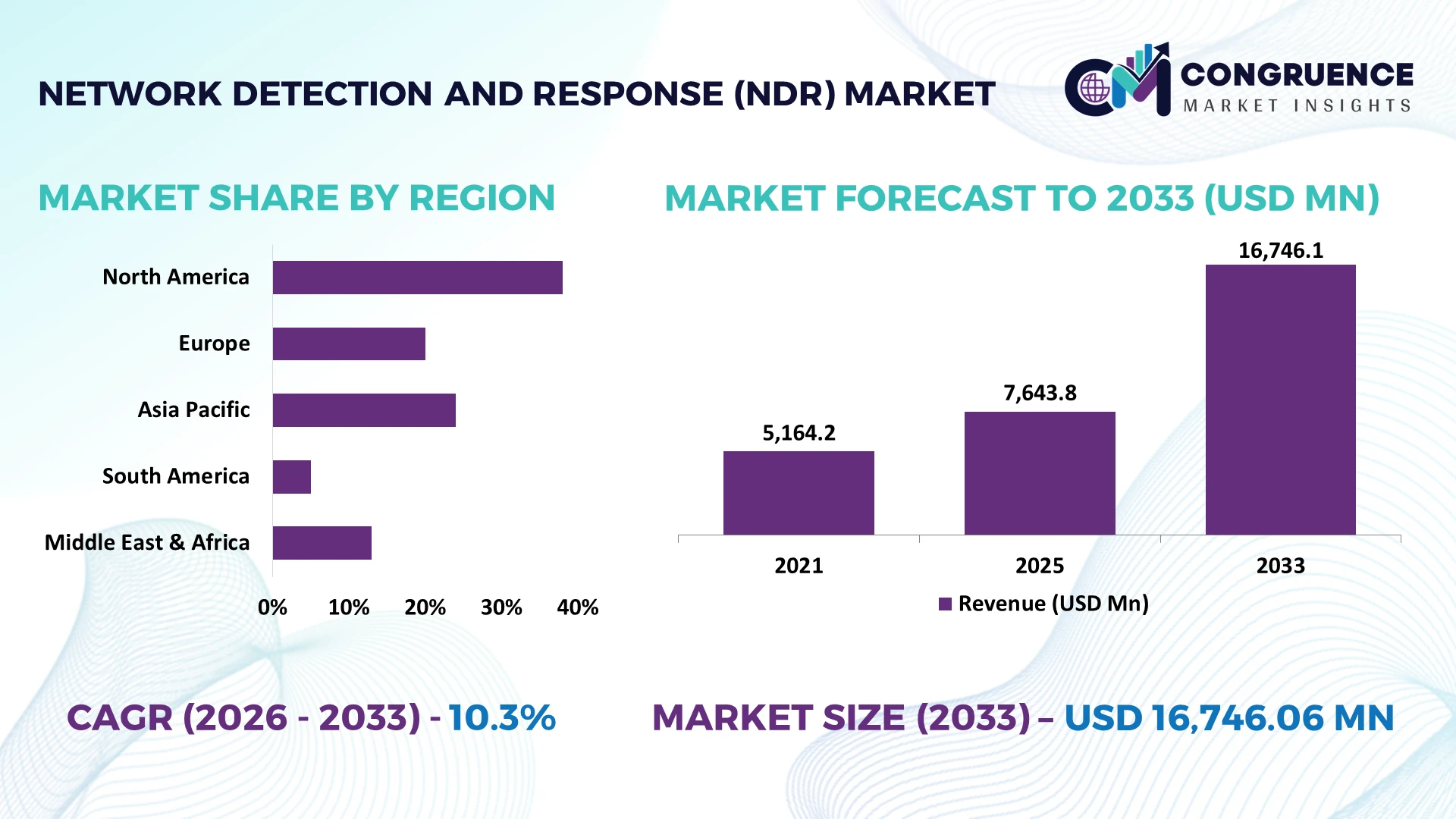
The United States remains the dominant country, accounting for an estimated 35% share of global NDR deployment, supported by heavy cybersecurity investment across financial services, healthcare, defense, technology, telecom, and critical infrastructure. North America commands approximately 41% regional share, while Asia-Pacific is expanding faster through cloud, 5G, and digital infrastructure investments. U.S. enterprises maintain substantially higher NDR maturity than emerging Asian markets, while India is rapidly increasing deployment across BFSI, IT, government, and telecom networks.
Strategic decisions should prioritize AI-native, cloud-integrated NDR platforms capable of encrypted-traffic analysis, automated investigation, and real-time response.
Market Size & Growth: USD 7.64 billion in 2025 is projected to reach USD 16.75 billion by 2033 at a 10.3% CAGR, supported by rising encrypted-traffic monitoring and AI-enabled threat detection.
Top Growth Drivers: AI-powered analytics contribute 36%, cloud security expansion 34%, and zero-trust adoption 29% to leading demand priorities across enterprise cybersecurity programs.
Short-Term Forecast: By 2028, automated NDR investigation is positioned to reduce security-analyst workload by 25% and improve incident-triage efficiency by 20%.
Emerging Technologies: AI anomaly detection, machine-learning encrypted-traffic inspection, autonomous response, and XDR integration are becoming core capabilities across advanced NDR platforms.
Regional Leaders: North America is projected near USD 6.87 billion, Europe around USD 4.69 billion, and Asia-Pacific approximately USD 3.68 billion by 2033, with cloud deployment accelerating fastest across Asia-Pacific.
Consumer/End-User Trends: BFSI represents approximately 25% of end-user demand, while large enterprises account for nearly 65%, reflecting heightened requirements for continuous network visibility and rapid containment.
Pilot/Case Example: 2025 NDR deployments integrating AI-based behavioral analytics demonstrated operational improvements of approximately 20% in investigation efficiency through automated threat prioritization and response workflows.
Competitive Landscape: Leading vendors collectively represent approximately 55–60% of the market, with Cisco, Palo Alto Networks, Darktrace, ExtraHop, and Vectra AI strengthening positions through AI-powered analytics and integrated security operations.
Regulatory & ESG Impact: NIS2 requirements covering 18 critical sectors are increasing continuous-monitoring and incident-reporting obligations, strengthening enterprise investment in measurable cyber resilience and third-party network visibility.
Investment & Funding: Global information-security spending exceeded USD 200 billion in 2025, directing substantial capital toward AI cybersecurity, cloud protection, SOC modernization, strategic partnerships, and NDR platform expansion.
Innovation & Future Outlook: Next-generation NDR is shifting toward autonomous containment, identity-aware analytics, AI-driven threat hunting, encrypted-traffic intelligence, and unified XDR architectures as enterprises consolidate security operations.
The Network Detection and Response (NDR) Market is becoming a critical cybersecurity layer as organizations replace perimeter-centric monitoring with continuous visibility across hybrid-cloud, remote, IoT, and operational networks. AI-driven anomaly detection, automated investigation, encrypted-traffic analytics, and behavioral modeling are expanding NDR capabilities, with AI-based detection adoption rising rapidly across enterprise security operations. Regulatory pressure, geopolitical cyber risks, and increasingly complex digital supply chains are further accelerating demand. These shifts position NDR as a strategic foundation for faster threat identification, lower analyst workload, and stronger enterprise cyber resilience.
Network Detection and Response is becoming strategically important because cyber resilience now directly influences enterprise continuity, customer trust, and competitive positioning. Organizations are shifting from perimeter-centric monitoring toward continuous behavioral analytics across cloud, remote, IoT, and operational networks. Regulatory changes such as Europe’s NIS2 framework are strengthening monitoring and incident-response requirements, while supply-chain digitization is expanding third-party network exposure.
AI-enabled NDR can reduce alert-investigation workloads by roughly 20–30% versus predominantly manual legacy monitoring while improving threat prioritization and response consistency. The United States remains the most mature deployment environment, whereas India is accelerating adoption through cloud migration, 5G infrastructure, BFSI modernization, and expanding digital enterprises. Over the next 2–3 years, enterprises are expected to increase automated detection and response coverage, particularly across hybrid-cloud workloads and encrypted traffic.
A practical deployment model combines NDR with SIEM, SOAR, XDR, and identity telemetry, allowing security teams to correlate network anomalies with endpoint and user behavior. Vendors are therefore increasing R&D, forming technology partnerships, and expanding managed-security offerings rather than selling standalone monitoring tools. Competitive advantage will increasingly favor providers delivering autonomous detection, rapid containment, and interoperable telemetry at enterprise scale.
AI-powered behavioral analytics is the strongest structural driver as enterprises face increasingly evasive attacks across encrypted and distributed networks. Approximately 35% of security teams prioritize AI-assisted detection, while nearly 30% are expanding automated response capabilities to reduce SOC workload. In the United States, financial institutions and technology companies are integrating NDR with XDR and SOAR platforms to improve cross-domain visibility. The operational shift from signature-based inspection to behavior-based analytics enables faster anomaly identification and reduces repetitive investigation activity. Vendors are responding with AI-native platforms, managed detection partnerships, and deeper cloud integrations. The non-obvious advantage is telemetry reuse: one NDR deployment can strengthen multiple security workflows without proportionally expanding monitoring infrastructure.
NDR scalability remains constrained by integration complexity, telemetry costs, and fragmented enterprise infrastructure. Around 40% of organizations operate mixed security stacks containing legacy appliances, cloud-native controls, and specialized monitoring tools, increasing interoperability requirements. High-volume network telemetry can also raise storage and processing expenses by 15–25% when organizations retain extensive packet and metadata histories. In India, smaller enterprises face additional constraints from limited SOC capacity and uneven cybersecurity infrastructure. These pressures directly affect deployment speed and total operating cost. Vendors are mitigating exposure through API-based integrations, modular architectures, managed services, and consumption-based contracts. The critical operational insight is that interoperability increasingly determines NDR deployment economics more than detection capability alone.
Autonomous NDR creates a high-value opportunity as enterprises seek measurable SOC efficiency rather than additional security dashboards. AI-based triage can reduce repetitive analyst workloads by approximately 25%, while automated containment workflows can shorten response activity by 20% or more in mature environments. India’s expanding digital infrastructure and large-scale cloud adoption provide an attractive deployment pathway across BFSI, telecom, technology, and government networks. Emerging encrypted-traffic analytics and identity-aware detection further expand addressable use cases without requiring payload inspection. Vendors are positioning through R&D, cloud partnerships, MSSP ecosystems, and XDR integrations. A less obvious opportunity lies in mid-sized enterprises: managed NDR can deliver advanced detection capabilities without requiring the internal staffing and infrastructure of a full-scale SOC.
Long-term NDR competitiveness depends on solving fragmented telemetry, encrypted traffic visibility, and skilled-workforce shortages. Nearly 45% of enterprises operate hybrid environments spanning multiple cloud providers and on-premise infrastructure, creating inconsistent data formats and response workflows. Encrypted traffic represents a growing share of enterprise network activity, increasing pressure for privacy-preserving behavioral inspection rather than conventional packet analysis. Security teams also face persistent shortages, with approximately 30% reporting difficulty filling advanced cybersecurity roles. These conditions can reduce deployment consistency and limit the value of sophisticated analytics. Companies are addressing the challenge through cloud-native sensors, unified data models, automation, and MSSP partnerships. The strategic priority is operational standardization: scalable NDR requires consistent telemetry and automated workflows across every network domain.
AI-Driven Detection Workflows: AI-assisted threat detection is moving into mainstream SOC operations, with 85% of organizations using AI for threat detection and 70% for response and recovery. Companies are automating alert prioritization and investigation to reduce analyst workload and accelerate containment.
Hybrid Visibility Becomes Standard: NDR platforms are expanding across cloud, on-premises, and IaaS environments as enterprises consolidate telemetry. Hybrid support and AI-driven SOC automation are pushing vendors toward unified sensors, APIs, and integrated security workflows.
AI Security Raises Network Demand: 86% of business leaders reported an AI-related security incident in the preceding year, increasing demand for network-level behavioral monitoring. Companies are extending NDR into AI workloads, shadow-AI discovery, and east-west traffic analysis rather than relying solely on endpoint controls.
Supply-Chain Monitoring Intensifies: India recorded third-party and supply-chain compromise as 17% of initial breach causes in 2025, strengthening demand for continuous network visibility. Enterprises are expanding vendor-network monitoring, segmentation, and automated detection to contain interconnected operational exposure.
Hybrid NDR represents the leading type, holding an estimated 45% market share as enterprises balance cloud scalability with established on-premises infrastructure. Its dominance reflects integration flexibility, centralized analytics, and lower migration disruption compared with fully replacing legacy security environments. Cloud-Based NDR follows at roughly 34%, supported by IaaS adoption, distributed workforces, and subscription-based security operations. On-Premises solutions retain approximately 21%, remaining strategically important for defense, financial institutions, and organizations requiring localized telemetry control.
Cloud-Based NDR is the fastest-growing type, with adoption expanding by an estimated 18% annually across digitally intensive enterprises. Companies are increasing cloud-native sensors, API integrations, and managed-security partnerships, while hybrid deployments increasingly serve as the transition architecture. This creates a two-speed investment pattern: mature enterprises modernize existing infrastructure through hybrid models, while cloud-first businesses prioritize SaaS-based NDR for rapid deployment and elastic monitoring.
Threat Detection leads the application segment with approximately 32% share because enterprises prioritize rapid identification of malicious behavior across north-south and east-west traffic. Network Monitoring follows at about 23%, providing continuous visibility into infrastructure performance and suspicious activity, while Incident Response accounts for nearly 19% as organizations connect NDR with SOAR and XDR workflows. Traffic Analysis and Anomaly Detection remain important supporting applications, particularly where encrypted or unfamiliar traffic patterns complicate signature-based controls.
Anomaly Detection is the fastest-growing application, expanding deployment by an estimated 20% as machine-learning models identify deviations without relying exclusively on known indicators. Companies are increasing automated baselining, behavioral analytics, and identity correlation, shifting NDR from passive visibility toward predictive investigation. This transition is particularly relevant for cloud environments, where changing workloads make static rules less effective and continuous behavioral context increasingly determines detection accuracy.
Banking & Finance leads NDR adoption with approximately 29% share, reflecting high transaction volumes, strict security controls, and continuous exposure to credential abuse and lateral movement. Telecommunications follows at nearly 24%, supported by large-scale network infrastructure and expanding 5G workloads. Healthcare represents about 18%, while Government and Retail & E-Commerce account for approximately 16% and 13%, respectively. Financial institutions increasingly integrate NDR with SIEM, SOAR, identity analytics, and fraud-monitoring systems.
Telecommunications is the fastest-growing end-user segment, with deployment expanding by an estimated 19% as operators modernize 5G infrastructure and secure increasingly distributed network estates. Healthcare is also strengthening investment because operational disruption and sensitive data exposure carry high financial consequences. Companies are responding with sector-specific detection models, managed-service partnerships, and customized deployment architectures. The competitive opportunity is shifting toward vendors capable of tailoring NDR to workload density, regulatory exposure, and network complexity rather than offering standardized monitoring alone.
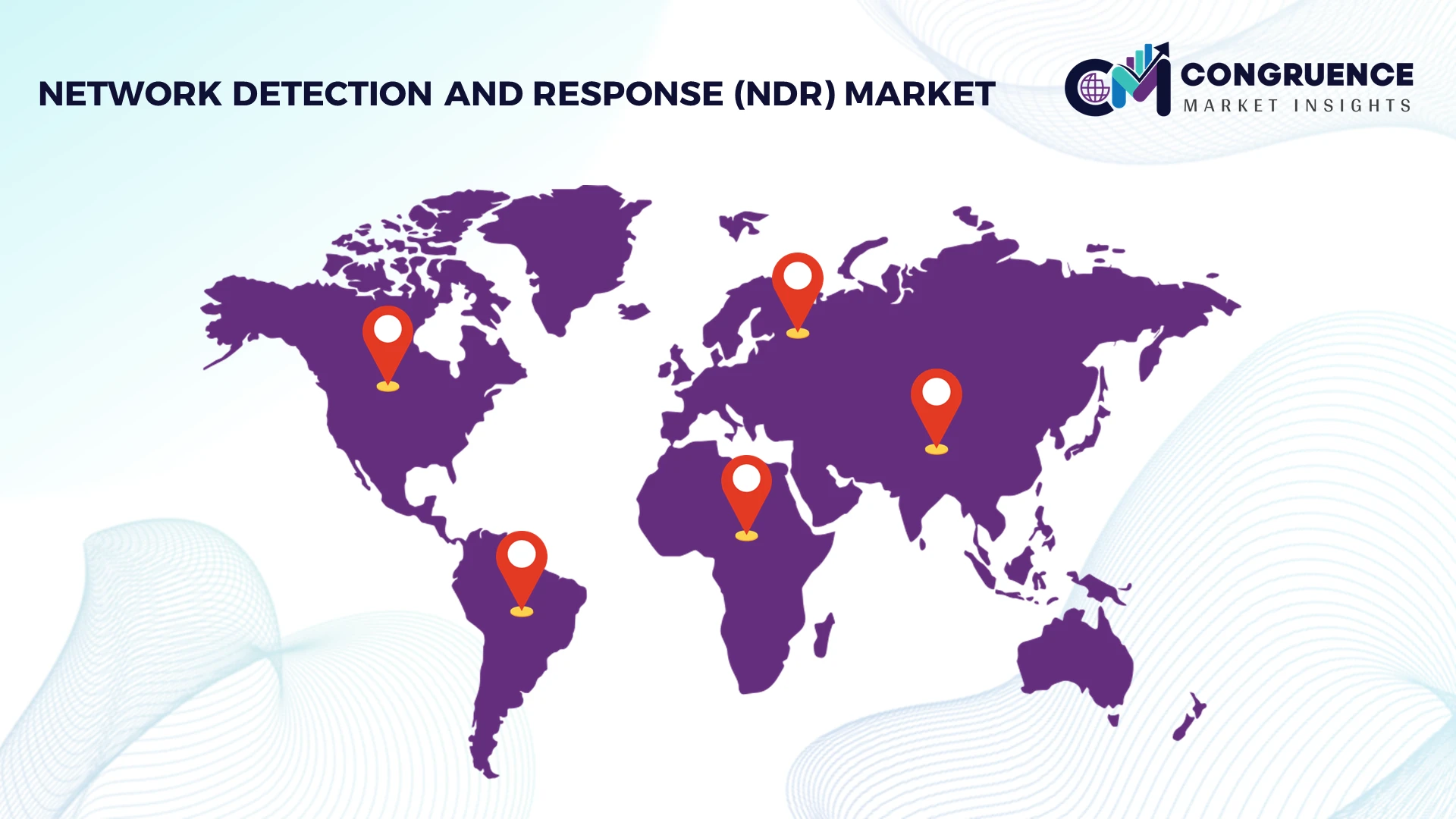
North America accounted for the largest market share at 41% in 2025 however, Asia-Pacific is expected to register the fastest growth, expanding at a CAGR of 13.8% between 2026 and 2033.
AI-led SOC modernization strengthens enterprise NDR deployment
North America remains the primary NDR deployment center, supported by high cybersecurity spending, mature cloud infrastructure, and concentrated demand from U.S. financial services, technology, healthcare, defense, and telecommunications companies. The region represents approximately 41% of global adoption, with the United States accounting for nearly 35% independently. Large enterprises increasingly integrate NDR with XDR, SIEM, SOAR, and identity analytics to consolidate security telemetry. U.S. organizations are also responding to SEC cyber-disclosure requirements and escalating nation-state activity by prioritizing continuous network visibility. Approximately 70% of large enterprises now operate automated security workflows, strengthening demand for NDR platforms capable of real-time investigation and containment. Vendors are expanding cloud-native capabilities and managed-security partnerships, making interoperability and automation the central competitive differentiators.
United States Market Outlook: The United States dominates regional NDR activity through its extensive hyperscale-cloud infrastructure, advanced SOC ecosystem, and high concentration of regulated industries. Federal agencies and critical infrastructure operators are increasing continuous-monitoring requirements, while enterprise security teams increasingly connect network telemetry with endpoint and identity controls. The country’s mature cybersecurity workforce and technology ecosystem support rapid deployment of AI-enabled NDR.
Regulatory modernization accelerates continuous network monitoring
Europe holds approximately 28% of global NDR adoption, with Germany, the United Kingdom, France, and the Netherlands representing major enterprise deployment centers. NIS2 is reshaping security architecture by strengthening incident reporting, risk management, and supply-chain oversight across 18 critical sectors. European enterprises are therefore moving beyond periodic network assessments toward continuous detection and behavioral monitoring. Approximately 60% of large organizations are increasing security automation to address staffing constraints and compliance workloads. Germany’s industrial base is particularly important as manufacturers connect operational technology with enterprise networks. Vendors are strengthening localized data controls, compliance-ready telemetry, and managed detection partnerships. The competitive emphasis is shifting from basic visibility toward explainable analytics, data sovereignty, and automated incident workflows.
Germany Market Outlook: Germany represents Europe’s strongest industrial NDR opportunity because automotive, chemicals, engineering, and manufacturing companies operate increasingly connected production environments. Industrial enterprises are prioritizing segmentation and behavioral monitoring as operational technology converges with IT infrastructure. More than 80% of German manufacturing organizations maintain substantial digitalization programs, creating demand for NDR architectures capable of monitoring complex factory and enterprise networks.
Cloud expansion and 5G scale reshape NDR deployment
Asia-Pacific represents approximately 22% of global NDR adoption and is experiencing the strongest deployment momentum as enterprises accelerate cloud migration, 5G rollout, digital payments, and connected infrastructure. China, Japan, South Korea, India, Singapore, and Australia form the principal demand centers, while India is rapidly expanding enterprise cybersecurity investment across BFSI, telecom, government, and IT services. Cloud-based NDR deployments are increasing by roughly 18% annually as organizations seek scalable monitoring without extensive appliance infrastructure. Telecom operators are also extending network analytics across increasingly distributed 5G environments. Vendors are responding through regional data centers, MSSP partnerships, localized threat intelligence, and consumption-based pricing. The region’s strategic advantage lies in its combination of digital scale and newer infrastructure, allowing cloud-native NDR architectures to bypass some legacy constraints.
China Market Outlook: China provides substantial NDR demand through hyperscale cloud infrastructure, telecommunications, manufacturing, and financial services. Large technology ecosystems support extensive network telemetry and AI development, while industrial digitalization increases the need for behavioral monitoring across connected facilities. Government cybersecurity requirements are encouraging organizations to strengthen localized security operations and network visibility, supporting domestic and international NDR technology deployment.
Digital banking expansion drives network-security modernization
South America contributes approximately 6% of global NDR adoption, with Brazil representing the principal deployment center through its large banking, telecommunications, retail, and government sectors. Financial institutions are accelerating behavioral monitoring as digital payments and online banking increase attack surfaces. Brazil accounts for nearly 55% of regional cybersecurity technology spending, creating a strong concentration of NDR demand. Cloud adoption is also restructuring enterprise security architectures, although infrastructure maturity varies considerably between major urban markets and smaller enterprises. Companies are increasingly selecting managed NDR services to compensate for limited internal SOC staffing and reduce deployment complexity. Partnerships between cybersecurity vendors, telecommunications operators, and managed-service providers are becoming particularly important. The key operational constraint is uneven infrastructure readiness, making flexible cloud-managed deployment more commercially viable than capital-intensive standalone appliances.
Brazil Market Outlook: Brazil leads South American NDR deployment because of its sophisticated banking ecosystem, large digital-commerce base, expanding cloud infrastructure, and stringent data-protection environment. Financial institutions represent a major buyer group, while telecom operators are expanding security monitoring alongside network modernization. Continued digital-payment adoption is increasing the requirement for continuous behavioral analytics and rapid incident containment.
Critical infrastructure investment accelerates cyber modernization
The Middle East & Africa accounts for approximately 5% of global NDR adoption, with demand concentrated in the United Arab Emirates, Saudi Arabia, Israel, and South Africa. Large-scale smart-city programs, cloud migration, financial digitization, energy infrastructure, and government modernization are increasing network complexity. Saudi Arabia and the UAE are directing substantial investment toward national digital infrastructure and cybersecurity capabilities, while critical-energy operators require continuous monitoring across IT and operational technology environments. Managed security services are gaining traction because they address specialist workforce constraints and accelerate deployment. Approximately 30% of enterprises in developing markets still face significant cybersecurity skills shortages, strengthening demand for automated detection. Vendors are responding with regional SOC partnerships, localized cloud infrastructure, and sector-specific solutions. The strongest opportunity is concentrated around critical infrastructure rather than broad-based enterprise adoption.
Saudi Arabia Market Outlook: Saudi Arabia is emerging as the region’s strongest NDR investment market through Vision 2030 digital transformation, smart infrastructure, financial modernization, and energy-sector cybersecurity requirements. Large government-linked enterprises are adopting centralized security operations and automated monitoring. The country’s expanding cloud ecosystem and national cybersecurity initiatives create favorable conditions for NDR platforms supporting both enterprise and operational technology environments.
Cisco, Palo Alto Networks, Darktrace, ExtraHop, and Vectra AI compete as technology-led global leaders, while regional MSSPs and specialized cybersecurity innovators challenge them through customization and managed services. The top five players collectively command an estimated 55–60% share, creating a concentrated but innovation-driven structure. Competition centers on AI detection accuracy, deployment speed, integration, and total operating cost. AI-enabled platforms can improve investigation efficiency by 20–30%, while automated response reduces analyst workload by roughly 25%. Leaders are expanding cloud-native portfolios, partnering with MSSPs, integrating XDR and SOAR, and strengthening regional data capabilities. Smaller specialists compete through behavioral analytics and faster implementation rather than scale. The competitive shift is moving from standalone network visibility toward autonomous, interoperable security operations. High integration requirements, threat-intelligence depth, and enterprise trust remain significant entry barriers. Winning requires superior automation, broad telemetry integration, rapid deployment, and measurable SOC efficiency.
Cisco Systems, Inc.
Palo Alto Networks, Inc.
Darktrace plc
Vectra AI, Inc.
ExtraHop Networks, Inc.
Fortinet, Inc.
CrowdStrike Holdings, Inc.
Trellix
Broadcom Inc.
IBM Corporation
Check Point Software Technologies Ltd.
Sophos Ltd.
Rapid7, Inc.
Arctic Wolf Networks, Inc.
AI-driven behavioral analytics is now the core NDR technology, with 85% of organizations using AI for threat detection and 70% for response. Compared with signature-led monitoring, behavioral models improve detection workflow efficiency by 20–30% through continuous anomaly analysis. NDR platforms increasingly integrate SIEM, SOAR, XDR, identity, and cloud telemetry, giving large enterprises faster investigation and stronger competitive resilience.
Cloud-native NDR is emerging rapidly as hybrid infrastructure expands. Darktrace’s Azure integration reduced deployment time by 95%, demonstrating a major advantage over appliance-heavy legacy architectures. Automated cloud sensors can lower infrastructure overhead by 10–15% while improving network visibility by approximately 2%. By 2026–2028, enterprises will increasingly prioritize agentless monitoring, encrypted-traffic analytics, and unified telemetry across cloud, IoT, OT, and remote environments.
Disruptive agentic AI is moving NDR toward autonomous investigation and response. IBM introduced agentic capabilities for automated triage, investigation, and remediation, while ExtraHop reported 63% faster security investigations in a 2026 study. Adoption will favor vendors combining AI precision, low-friction integration, and automated containment. Technology leaders such as Vectra AI, Darktrace, ExtraHop, and Palo Alto Networks benefit most as buyers consolidate fragmented security stacks and demand measurable SOC productivity.
April 2025 ExtraHop launched an all-in-one NDR sensor integrating NDR, NPM, IDS, and packet forensics; IDC cited 16% lower tool costs and nearly 20% less analyst time, strengthening platform consolidation. Source: extrahop.com
April 2025 Vectra AI expanded its CrowdStrike partnership with a joint NDR-endpoint offering for SMB and midmarket teams, introducing transparent pricing and rapid deployment to broaden automated detection access. Source: vectra.ai
February 2025 Palo Alto Networks introduced Cortex Cloud, combining cloud detection and response with CNAPP capabilities and AI-powered remediation, strengthening real-time cloud protection through unified security operations.
April 2026 ExtraHop reported 63% faster enterprise security investigations using RevealX, alongside 155% ROI and less-than-six-month payback, reinforcing measurable productivity as a core NDR buying criterion. Source: extrahop.com
The Network Detection and Response (NDR) Market Report covers Cloud-Based, On-Premises, and Hybrid deployment models across Threat Detection, Network Monitoring, Incident Response, Anomaly Detection, and Traffic Analysis applications. End-user coverage spans Banking & Finance, Healthcare, Government, Retail & E-Commerce, and Telecommunications, with detailed assessment of North America, Europe, Asia-Pacific, South America, and Middle East & Africa.
The analysis evaluates AI-driven behavioral analytics, machine learning, encrypted-traffic inspection, automated response, cloud-native sensors, XDR integration, and agentic security operations. Approximately 45% of deployments are concentrated in hybrid architectures, while cloud-based adoption is accelerating among digitally intensive enterprises. Competitive assessment covers major technology providers, partnerships, deployment strategies, and innovation positioning, supporting investment planning, geographic expansion, product prioritization, partnership decisions, and competitive positioning through 2026–2033.
| Report Attribute/Metric | Report Details |
|---|---|
Market Revenue in 2025 | USD 7643.79 Million |
Market Revenue in 2033 | USD 16746.06 Million |
CAGR (2026 - 2033) | 10.3% |
Base Year | 2025 |
Forecast Period | 2026 - 2033 |
Historic Period | 2021 - 2025 |
Segments Covered | By Type
By Application
By End-User
|
Key Report Deliverable | Revenue Forecast, Growth Trends, Market Dynamics, Segmental Overview, Regional and Country-wise Analysis, Competition Landscape |
Region Covered | North America, Europe, Asia-Pacific, South America, Middle East, Africa |
Key Players Analyzed | Cisco Systems, Inc., Palo Alto Networks, Inc., Darktrace plc, Vectra AI, Inc., ExtraHop Networks, Inc., Fortinet, Inc., CrowdStrike Holdings, Inc., Trellix, Broadcom Inc., IBM Corporation, Check Point Software Technologies Ltd., Sophos Ltd., Rapid7, Inc., Arctic Wolf Networks, Inc. |
Customization & Pricing | Available on Request (10% Customization is Free) |




