
Reports
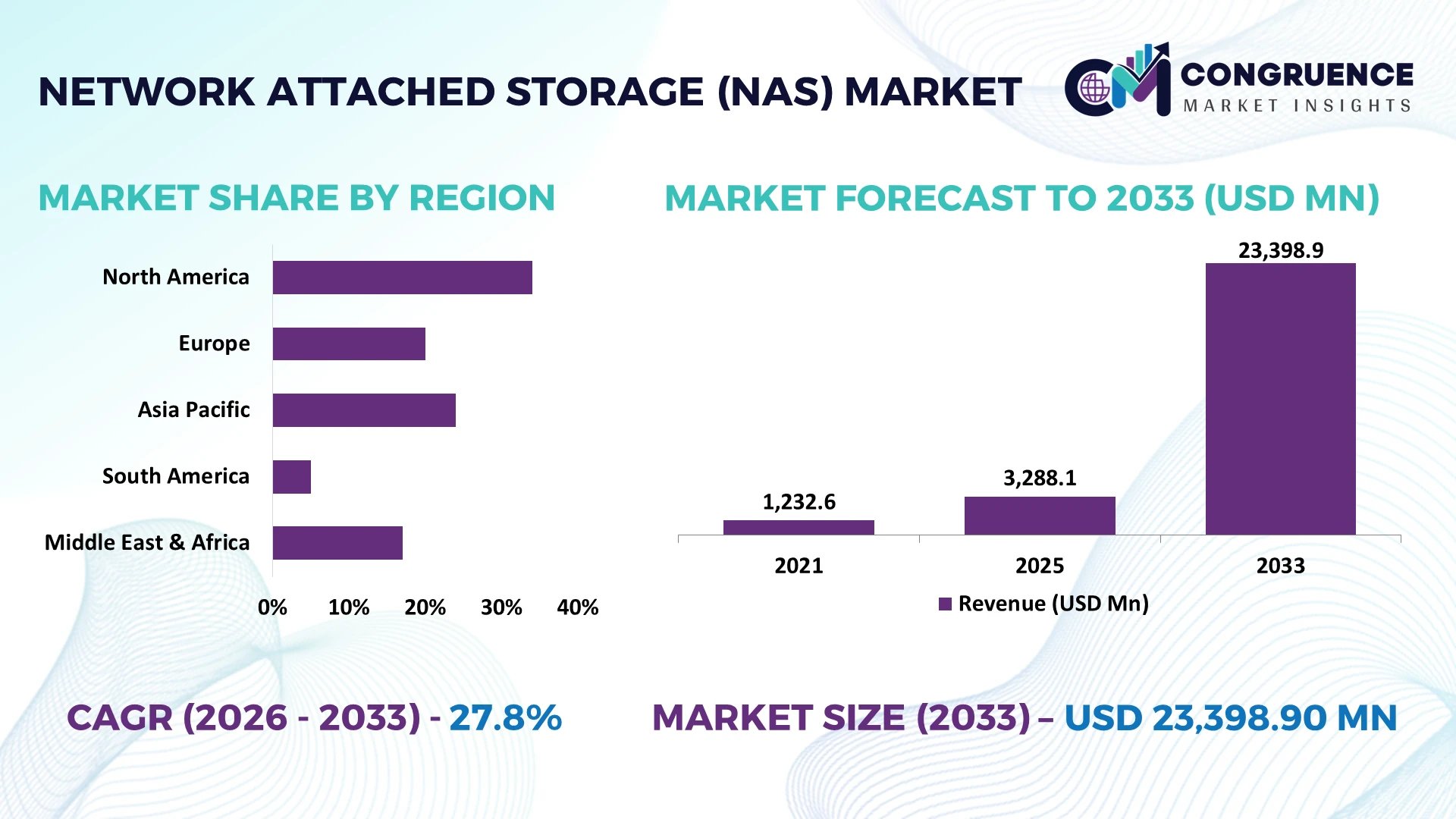
The Global Network-attached Storage (NAS) Market was valued at USD 3288.12 Million in 2025 and is anticipated to reach a value of USD 23398.9 Million by 2033 expanding at a CAGR of 27.8% between 2026 and 2033. Growth is driven by AI-generated data, edge computing, ransomware-resistant backup requirements, and rapid enterprise migration toward centralized high-capacity storage architectures.
The United States remains the dominant country, supported by 34% of global consumer NAS revenue and intensive hyperscale infrastructure expansion. U.S. data-center investment reached USD 63.35 billion in 2025, with private-equity participation representing 72%; AI infrastructure, media, healthcare, and surveillance are major NAS use cases. China is accelerating through national computing initiatives, creating a stronger Asia-Pacific counterweight.
Strategically, vendors should prioritize AI-ready NAS, 10GbE/25GbE connectivity, cybersecurity, and energy-efficient storage to capture enterprise workloads shifting toward distributed infrastructure.
Market Size & Growth: USD 3.29 billion in 2025 is projected to reach USD 23.40 billion by 2033 at 27.8% CAGR, propelled by AI data growth and centralized backup requirements.
Top Growth Drivers: AI workloads contribute 34% of incremental infrastructure pressure, ransomware protection 28%, and edge-data generation 22%.
Short-Term Forecast: By 2028, automated storage management is positioned to reduce administration costs by 18% and improve utilization efficiency by 15%.
Emerging Technologies: AI-assisted NAS, NVMe caching, and automated tiering are advancing, with intelligent storage deployments approaching 30% of new enterprise installations.
Regional Leaders: North America is projected near USD 7.8 billion, Asia-Pacific near USD 6.9 billion, and Europe near USD 4.7 billion, with Asia-Pacific showing the fastest cloud-edge integration.
Consumer/End-User Trends: Approximately 34% of consumer NAS revenue is concentrated in North America, reflecting strong adoption for media libraries, private-cloud backup, and connected-device storage.
Pilot/Case Example: In 2025, AI-focused data-center expansion accelerated storage modernization, while U.S. infrastructure investment reached USD 63.35 billion, reinforcing demand for scalable data-management systems.
Competitive Landscape: Synology leads premium NAS visibility, while QNAP, Western Digital, Seagate, Netgear, and Asustor strengthen competition across enterprise and prosumer segments.
Regulatory & ESG Impact: Data sovereignty and energy-efficiency requirements are increasing storage-localization priorities, while AI data-center regulation in the U.S. is adding environmental and transparency requirements.
Investment & Funding: U.S. data-center investment reached USD 63.35 billion in 2025, with private equity accounting for 72%, accelerating storage, networking, and infrastructure procurement.
Innovation & Future Outlook: Next-generation NAS is shifting toward AI inference storage, NVMe architectures, zero-trust backup, automated cybersecurity, and hybrid edge-cloud orchestration.
Network-attached Storage demand is increasingly concentrated in AI-ready enterprises, video surveillance, healthcare imaging, media production, and distributed-office environments. NVMe caching, 10GbE connectivity, AI-assisted file management, and ransomware recovery are reshaping product design, while roughly 30% of new enterprise installations are moving toward intelligent storage capabilities. Geopolitical supply-chain shifts and tighter data-sovereignty requirements are also strengthening localized storage architectures, creating a strategic opening for vendors combining cybersecurity, performance, and flexible deployment models.
Network-attached Storage (NAS) is becoming strategically important as enterprises shift from centralized data centers toward distributed, AI-enabled, and edge-intensive architectures. The expansion of video surveillance, healthcare imaging, industrial IoT, and generative AI is increasing requirements for low-latency, locally controlled storage. Over the next 2–3 years, enterprise NAS deployments are expected to increasingly incorporate 10GbE connectivity, NVMe caching, automated tiering, and immutable backup, improving storage utilization by roughly 10–15%.
Technology modernization is also changing the cost equation. NVMe-based NAS with automated data placement can deliver approximately 20–30% higher storage-access efficiency than legacy HDD-only configurations while reducing administrative intervention by around 15%. The United States remains the largest innovation hub, supported by AI infrastructure investment, while China emphasizes localized computing capacity and domestic storage ecosystems. Europe places greater emphasis on data sovereignty, energy efficiency, and regulatory compliance.
Operationally, enterprises are deploying NAS clusters alongside cloud platforms rather than replacing cloud storage entirely. This hybrid architecture allows frequently accessed workloads to remain local while archival data moves to lower-cost tiers. Vendors are responding through partnerships covering networking, cybersecurity, virtualization, and cloud integration. Competitive advantage increasingly depends on combining performance, cyber resilience, energy efficiency, and flexible deployment rather than raw capacity alone.
AI workloads, surveillance systems, and edge applications are accelerating localized storage requirements, with enterprise deployments increasingly prioritizing 10GbE connectivity and NVMe acceleration. AI-generated datasets can increase storage traffic by 20–30%, while automated tiering improves utilization by roughly 15%. U.S. enterprises are therefore expanding NAS clusters closer to compute environments to reduce latency and cloud-egress exposure. Vendors are responding with GPU-aware storage, immutable snapshots, and integrated cybersecurity. The non-obvious advantage is workload control: keeping active datasets locally reduces dependency on external cloud capacity while improving governance. Companies combining NAS with edge computing and private-cloud architectures are gaining stronger operational flexibility and faster data-access cycles.
Hardware costs remain sensitive to NAND, DRAM, controller, and high-capacity HDD supply conditions, while mixed-vendor environments create interoperability friction. Enterprise deployments can experience 10–15% higher integration workloads when NAS platforms require separate virtualization, backup, and cybersecurity layers. In China and the United States, technology-trade restrictions also encourage localized sourcing and alternative component strategies. Companies are mitigating exposure through multi-supplier contracts, standardized protocols, longer procurement agreements, and broader compatibility testing. A key operational constraint is not storage capacity itself but integration overhead: platforms that cannot interoperate cleanly with existing cloud, virtualization, and security stacks face slower deployment and higher lifecycle costs.
AI-assisted storage management, computational storage, and automated lifecycle orchestration are creating differentiated opportunities beyond conventional file serving. Intelligent tiering can raise usable capacity efficiency by approximately 15%, while predictive analytics can reduce manual storage administration by 20%. India is emerging as an attractive deployment market as data-center expansion, digital services, surveillance, and enterprise modernization increase requirements for localized storage. Vendors are investing in R&D partnerships that combine NAS, cybersecurity, observability, and cloud platforms. The strongest opportunity lies in policy-sensitive workloads where organizations require local control but still need cloud scalability. NAS providers offering automated hybrid-cloud orchestration can capture higher-value enterprise workloads without competing solely on hardware pricing.
Ransomware, fragmented infrastructure, and escalating data volumes are making NAS security a core execution challenge. Immutable backup adoption is increasing, yet approximately 20–25% of enterprise storage environments still require modernization of recovery workflows and access controls. Larger deployments also introduce namespace, replication, networking, and firmware-management complexity that can undermine operational consistency. U.S. healthcare, financial-services, and government workloads face particularly stringent data-protection requirements, forcing vendors to strengthen encryption, zero-trust access, and recovery testing. Companies must invest in automated monitoring, security partnerships, workforce training, and multi-site replication. The strategic challenge is achieving scale without creating an equally large management burden; automation and integrated security will increasingly determine deployment sustainability.
AI-Ready Storage Architectures: Enterprises are moving toward NVMe caching, GPU-aware storage, and automated tiering, with intelligent capabilities reaching nearly 30% of new enterprise NAS deployments. These systems improve data-access efficiency by 15–20% and reduce manual administration by about 15%. U.S. vendors are integrating NAS directly with AI infrastructure, shifting procurement toward performance and workload orchestration.
Cyber-Resilient Backup Operations: Ransomware protection is reshaping NAS workflows, with immutable snapshots, air-gapped copies, and automated recovery testing becoming standard requirements. Around 70% of enterprises are strengthening backup resilience, while automated verification can reduce recovery-related operational effort by 20%. Companies are increasingly evaluating recoverability alongside capacity, creating stronger demand for cybersecurity-integrated NAS platforms.
Edge Video Storage Expansion: High-resolution surveillance is pushing storage closer to cameras, reducing centralized data movement by approximately 20–30% and improving response speed by nearly 15%. Indian retailers, logistics operators, and manufacturers are combining NAS with AI video analytics and local retention. Vendors are expanding edge-ready systems with higher drive density, faster networking, and automated lifecycle management.
Energy-Efficient Infrastructure Design: Data-center power constraints are encouraging workload-aware scheduling, SSD caching, and higher-density NAS architectures. Automated workload placement can improve storage utilization by 10–15% while reducing unnecessary disk activity by approximately 12%. U.S. and European enterprises are increasingly including power efficiency in infrastructure procurement, prompting manufacturers to optimize cooling, firmware, component density, and system-level energy consumption.
2-Bay NAS systems represent the leading type, accounting for approximately 32% of demand, supported by affordable redundancy, compact deployment, and easy scalability across small businesses and advanced home environments. 4-Bay systems follow with nearly 27% share, offering stronger capacity, RAID flexibility, and multi-user performance for professional workloads. 1-Bay systems remain relevant for entry-level backup but face increasing pressure from multi-drive architectures. Companies are strengthening 2-Bay and 4-Bay portfolios with 10GbE connectivity, NVMe caching, automated backup, and improved virtualization support.
Rackmount NAS is the fastest-growing type, with deployment growth approaching 16% as enterprises consolidate storage into standardized data-center environments. 8-Bay systems retain strategic importance for media production, surveillance, and departmental workloads, while rackmount platforms provide greater density and centralized administration. Vendors are shifting investment toward rack-optimized chassis, expansion shelves, and enterprise software integration. This transition improves infrastructure utilization by approximately 15% and enables companies to reduce floor-space requirements while supporting larger workloads.
File Storage remains the leading application, representing approximately 35% of NAS demand, because enterprises depend on centralized repositories for documents, engineering files, collaboration content, and departmental information. Data Backup accounts for nearly 27%, supported by ransomware recovery and disaster-resilience requirements. Media Streaming contributes around 15%, while Virtualization represents approximately 13%. Companies are integrating deduplication, snapshots, replication, and access controls to support multiple workloads through unified NAS infrastructure.
Video Surveillance is the fastest-growing application, with adoption momentum approaching 17% as AI-enabled cameras, higher resolutions, and longer retention periods increase storage intensity. Modern surveillance deployments can generate 20–30% more storage traffic than conventional video systems, accelerating demand for high-capacity NAS. Companies are integrating NAS with AI analytics, virtualization, and cybersecurity platforms to automate retention and recovery. The strategic shift is positioning NAS as continuous operational infrastructure rather than a basic file repository.
Enterprises represent the dominant end-user group at approximately 38% share, driven by larger data volumes, multi-site operations, compliance requirements, and dependence on centralized backup infrastructure. IT Service Providers account for nearly 22%, supported by managed backup, private-cloud, and disaster-recovery services. Small Businesses contribute around 19%, while Media Companies and Home Users maintain specialized demand. Vendors are responding with enterprise-grade security, centralized management, subscription services, and flexible capacity expansion.
IT Service Providers are the fastest-growing end-user segment, with adoption momentum approaching 17% as organizations increasingly outsource storage administration, cybersecurity, and recovery operations. Small Businesses are prioritizing preconfigured NAS systems with automated backup, while Media Companies favor high-throughput networking and large sequential workloads. Home Users increasingly demand private-cloud synchronization and media management. Companies are strengthening partnerships between NAS vendors, managed-service providers, cybersecurity firms, and cloud platforms to create integrated storage ecosystems. The strongest competitive advantage is shifting toward managed functionality rather than hardware capacity alone.
North America accounted for the largest market share at 41.4% in 2025 however, Asia-Pacific is expected to register the fastest growth, expanding at a CAGR of 17.9% between 2026 and 2033.
Enterprise AI workloads are reshaping storage deployment
North America remains the largest NAS market, supported by mature enterprise IT infrastructure, high cloud penetration, cybersecurity spending, and extensive data-center capacity. The region represented approximately 41.4% of global NAS demand in 2025, with the United States accounting for the majority of regional deployments. AI infrastructure, healthcare data, financial services, media production, and surveillance are strengthening demand for high-performance NAS. Enterprise buyers increasingly combine NAS with NVMe caching, 10GbE networking, immutable backup, and hybrid-cloud orchestration. The operational shift toward localized AI data processing is also increasing demand for low-latency storage near compute clusters. Vendors are expanding channel partnerships and enterprise support capabilities, while U.S. buyers increasingly prioritize cyber resilience and workload-specific performance over basic capacity.
United States Market Outlook: The United States remains the region's technology and deployment center, supported by hyperscale data centers, AI infrastructure, healthcare digitization, and financial-services modernization. Enterprise storage buyers increasingly integrate NAS with private-cloud, virtualization, and cybersecurity platforms, creating demand for higher-density rackmount systems and automated data-management capabilities.
Data sovereignty is redefining enterprise storage architecture
Europe is increasingly shaped by data governance, energy efficiency, cybersecurity, and infrastructure modernization. GDPR requirements encourage organizations to maintain stronger control over personal-data storage and processing, supporting localized and hybrid NAS architectures. Germany, the United Kingdom, France, and the Netherlands remain important enterprise deployment centers, while Nordic countries are gaining relevance for energy-efficient data infrastructure. European enterprises increasingly favor encrypted storage, immutable backup, and automated lifecycle management. Power availability is also becoming a procurement factor as AI workloads increase storage intensity. Vendors are responding through energy-efficient chassis, localized support, compliance-oriented software, and partnerships with cloud and cybersecurity providers. The region's distinctive opportunity is the combination of regulatory pressure and sustainability priorities, which favors vendors able to demonstrate secure data control without excessive infrastructure overhead.
Germany Market Outlook: Germany benefits from a large manufacturing base, industrial automation, engineering workloads, and stringent enterprise data-management requirements. Industrial firms increasingly use NAS for design files, production data, backup, and distributed collaboration. Strong demand for secure, locally controlled infrastructure supports adoption of rackmount and high-capacity systems across manufacturing and enterprise IT environments.
Manufacturing scale meets rapid digital infrastructure expansion
Asia-Pacific is the fastest-expanding NAS market, supported by industrial digitization, data-center construction, cloud adoption, and large-scale electronics manufacturing. The region represented approximately 32.6% of global NAS demand in 2025, while India, China, Japan, South Korea, Singapore, and Malaysia are strengthening deployment capacity. China combines extensive electronics production with large enterprise and consumer storage demand, while India is accelerating through data-center expansion and digital-service infrastructure. Vendors benefit from proximity to component ecosystems and established networking supply chains. AI workloads and edge computing are increasing demand for higher-performance storage, particularly in manufacturing, telecommunications, surveillance, and media. Companies are expanding local distribution, strengthening OEM relationships, and developing products optimized for higher-density deployment. The key advantage is the region's ability to combine manufacturing scale with rapidly expanding digital infrastructure.
China Market Outlook: China remains the principal Asia-Pacific NAS manufacturing and deployment center, supported by electronics production, cloud infrastructure, industrial automation, and domestic technology ecosystems. Consumer NAS demand is substantial, while enterprise users increasingly require localized storage for AI, surveillance, manufacturing, and data-management workloads, reinforcing domestic supply-chain participation.
Cloud modernization is accelerating localized storage adoption
South America remains an emerging NAS deployment market, with Brazil representing the primary demand center because of its large enterprise base, financial-services industry, telecommunications infrastructure, and expanding data-center ecosystem. Organizations are increasingly using NAS for centralized file storage, backup, surveillance, and branch-office data management. Brazil's large geographic footprint makes localized storage valuable where connectivity limitations can increase dependence on centralized cloud infrastructure. Argentina, Chile, and Colombia are developing additional demand through digital transformation and enterprise modernization. Vendors are emphasizing affordable multi-bay systems, remote management, and hybrid-cloud compatibility to address budget sensitivity and infrastructure variability. The strongest operational opportunity lies in distributed enterprises that need dependable local storage while maintaining cloud connectivity. Companies are responding through regional distributors, managed-service partnerships, and modular products that reduce deployment complexity.
Brazil Market Outlook: Brazil offers the strongest commercial base in South America because of its financial institutions, industrial enterprises, retail networks, telecommunications operators, and expanding digital infrastructure. NAS adoption is strengthening for backup, surveillance, branch-office synchronization, and centralized file management, with multi-bay systems providing an effective balance between redundancy and cost.
Sovereign digital infrastructure is creating new storage demand
The Middle East & Africa market is increasingly influenced by sovereign-cloud programs, smart-city development, telecommunications modernization, and new data-center capacity. The UAE and Saudi Arabia are leading regional infrastructure deployment, with approximately 56 and 43 data centers respectively, creating stronger requirements for localized storage and backup infrastructure. AI initiatives are increasing demand for high-throughput NAS, while government, healthcare, banking, and surveillance applications require controlled data environments. African markets remain more infrastructure-sensitive, making modular systems and managed services particularly important. Vendors are responding through local channel partnerships, data-center alliances, and ruggedized or energy-conscious systems. The strategic opportunity is strongest where national digital-transformation programs require data sovereignty and resilient infrastructure without the complexity of hyperscale storage platforms.
United Arab Emirates Market Outlook: The UAE is emerging as a regional technology and data-center hub, supported by sovereign-cloud initiatives, AI infrastructure, smart-city programs, and enterprise digitization. Its dense concentration of data-center projects supports demand for rackmount NAS, high-speed networking, backup automation, and cybersecurity-integrated storage across government and commercial workloads.
The Network-attached Storage market pits established hardware leaders such as Synology, QNAP, Western Digital, Seagate, and NetApp against enterprise infrastructure vendors including Dell Technologies and Hewlett Packard Enterprise. The top five players collectively command an estimated 35–40% share, leaving substantial room for specialized and regional suppliers. Competition centers on technology, price, ecosystem integration, supply availability, and customization. Premium platforms can command 15–25% higher pricing when advanced security, virtualization, NVMe acceleration, and enterprise support are bundled. Synology emphasizes software integration and usability, while QNAP competes through hardware flexibility and expandability. Enterprise vendors differentiate through broader infrastructure portfolios and partnerships. Supply-chain localization and component availability are increasingly influencing product roadmaps as manufacturers diversify sourcing and strengthen regional distribution. Entry barriers remain high around firmware development, cybersecurity, channel networks, and enterprise support. Winning requires reliable hardware, differentiated software, rapid ecosystem integration, and strong lifecycle support rather than capacity alone.
Synology Inc.
QNAP Systems, Inc.
Western Digital Corporation
Seagate Technology Holdings plc
NetApp, Inc.
Dell Technologies Inc.
Hewlett Packard Enterprise Company
IBM Corporation
Hitachi Vantara LLC
NETGEAR, Inc.
Buffalo Inc.
ASUSTOR Inc.
TerraMaster
Huawei Technologies Co., Ltd.
Current NAS architectures are shifting from conventional HDD-only systems toward NVMe caching, 10/25GbE networking, automated tiering, and AI-assisted management. NVMe caching can improve access performance by 15–20%, while automated tiering raises storage utilization by 10–15%. Adoption is strongest in enterprise, surveillance, media, and virtualization deployments where faster data access directly improves workflow responsiveness and reduces manual administration.
Emerging technologies include AI-powered search, edge inference, computational storage, immutable backup, and software-defined orchestration. AI-enabled NAS deployments are approaching 30% of new enterprise installations, while integrated ransomware protection can reduce recovery administration by approximately 20%. Compared with legacy HDD-only NAS, hybrid HDD-NVMe architectures deliver roughly 20–30% higher performance for latency-sensitive workloads. Synology and QNAP benefit strongly by combining hardware, networking, backup, and intelligent software into integrated platforms.
From 2026–2028, disruptive storage architectures will increasingly combine AI acceleration, high-density HAMR drives, NVMe pools, and hybrid-cloud orchestration. HAMR-based drives can provide up to 300% greater capacity density than conventional architectures, strengthening space efficiency for large deployments. Companies acting now can reduce infrastructure complexity, improve data locality, and strengthen cyber resilience. Competitive advantage will favor vendors that integrate compute, storage, networking, and security rather than competing on capacity alone.
January 2025 Seagate introduced Exos M samples up to 36TB, with HAMR delivering 300% more capacity in the same footprint and 25% lower cost per terabyte. The move strengthens high-density NAS infrastructure for AI-scale workloads and data-center consolidation. Source: seagate.com
June 2025 Synology launched DS1825+ and DS1525+, adding 10/25GbE options and up to 360TB expandable capacity. SSD testing reached 2,239MB/s reads, strengthening performance for SMB, surveillance, and creative workloads while expanding partner-led deployments across international channels globally. Source: synology.com
October 2025 QNAP launched TVS-AIh1688ATX with 36 TOPS AI performance, 12 SATA bays, and four U.2 slots. The architecture brings inference closer to stored data, reducing infrastructure separation and improving AI deployment flexibility for enterprises across distributed environments. Source: qnap.com
July 2026 IDC reported external OEM enterprise-storage spending rose 22.9% year over year in Q1, reaching $9.9 billion. AI-driven storage demand and deferred refreshes accelerated infrastructure investment, increasing pressure on NAS vendors to prioritize capacity, performance, supply resilience. Source: idc.com
The Network-attached Storage (NAS) Market Report evaluates 1-Bay, 2-Bay, 4-Bay, 8-Bay, and Rackmount systems across File Storage, Data Backup, Media Streaming, Virtualization, and Video Surveillance applications. Coverage extends across Small Businesses, Enterprises, Media Companies, IT Service Providers, and Home Users, enabling assessment of demand concentration, deployment intensity, and evolving purchasing priorities.
Regional analysis covers North America, Europe, Asia-Pacific, South America, and Middle East & Africa, with country-level evaluation of infrastructure maturity, enterprise adoption, manufacturing influence, and data-center expansion. The report assesses NVMe caching, AI-enabled storage, 10/25GbE connectivity, HAMR-based capacity expansion, immutable backup, edge computing, and hybrid-cloud integration. Approximately 30% of new enterprise deployments are incorporating intelligent storage capabilities, highlighting technology-driven market restructuring. The analysis supports investment planning, geographic expansion, product positioning, partnership strategy, and competitive decisions through 2026–2033.
| Report Attribute/Metric | Report Details |
|---|---|
Market Revenue in 2025 | USD 3288.12 Million |
Market Revenue in 2033 | USD 23398.9 Million |
CAGR (2026 - 2033) | 27.8% |
Base Year | 2025 |
Forecast Period | 2026 - 2033 |
Historic Period | 2021 - 2025 |
Segments Covered | By Type
By Application
By End-User
|
Key Report Deliverable | Revenue Forecast, Growth Trends, Market Dynamics, Segmental Overview, Regional and Country-wise Analysis, Competition Landscape |
Region Covered | North America, Europe, Asia-Pacific, South America, Middle East, Africa |
Key Players Analyzed | Synology Inc., QNAP Systems, Inc., Western Digital Corporation, Seagate Technology Holdings plc, NetApp, Inc., Dell Technologies Inc., Hewlett Packard Enterprise Company, IBM Corporation, Hitachi Vantara LLC, NETGEAR, Inc., Buffalo Inc., ASUSTOR Inc., TerraMaster, Huawei Technologies Co., Ltd. |
Customization & Pricing | Available on Request (10% Customization is Free) |




