
Reports
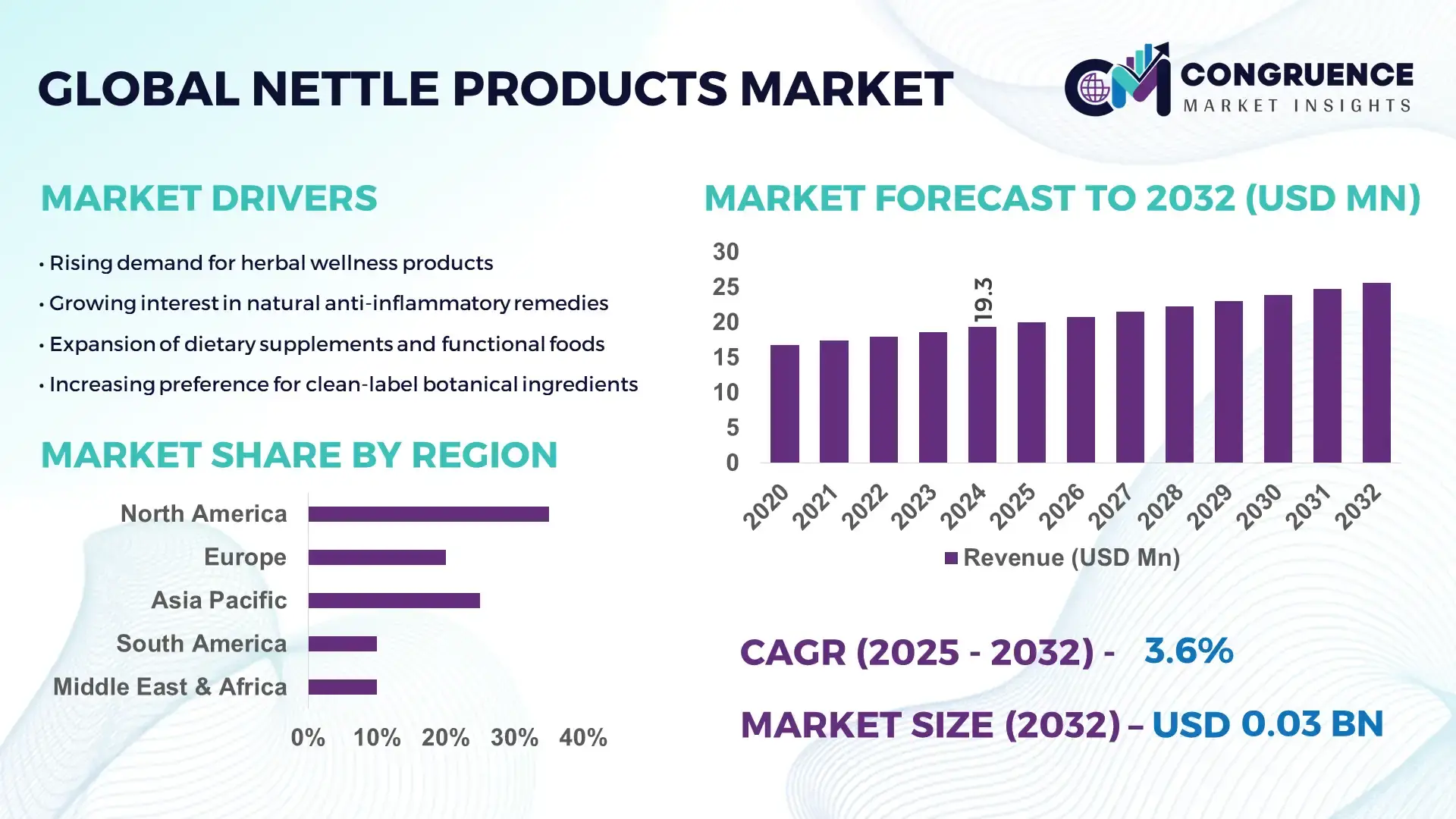
The Global Nettle Products Market was valued at USD 19.31 Million in 2024 and is anticipated to reach a value of USD 25.63 Million by 2032 expanding at a CAGR of 3.6% between 2025 and 2032. Growth is supported by rising demand for plant-based functional ingredients.
Germany remains the most influential country in the global nettle products landscape due to its advanced herbal processing ecosystem, high-value nutraceutical applications, and consistent investment in botanical research. The country hosts more than 120 certified herbal manufacturing units, processes over 18,000 tons of nettle annually, and allocates increasing R&D budgets toward phytochemical extraction technologies. German consumers also maintain one of the highest adoption levels of natural supplements in Europe, with an estimated 62% usage rate for plant-based wellness products.
• Market Size & Growth: Valued at USD 19.31 Million in 2024, projected to reach USD 25.63 Million by 2032 at a CAGR of 3.6%, driven by expanding functional food usage.
• Top Growth Drivers: 41% rise in herbal supplement adoption, 28% increase in natural cosmetic integration, 22% efficiency gain in advanced extraction processes.
• Short-Term Forecast: By 2028, product formulation costs expected to decline by 12% due to improved processing efficiency.
• Emerging Technologies: Enhanced cold-extraction systems, bioactive compound standardization, and AI-enabled quality grading in herbal processing.
• Regional Leaders: Europe projected at USD 11.8 Million by 2032 with strong nutraceutical uptake; North America at USD 6.4 Million driven by clean-label trends; Asia-Pacific at USD 5.7 Million with rising traditional medicine consumption.
• Consumer/End-User Trends: High adoption among nutraceuticals, topical skincare, and herbal teas with growing preference for certified organic variants.
• Pilot or Case Example: A 2026 botanical standardization pilot achieved a 19% improvement in bioactive consistency across nettle extract batches.
• Competitive Landscape: The market leader holds around 14% share, followed by key competitors including leading European herbal processors and botanical ingredient manufacturers.
• Regulatory & ESG Impact: Strengthening organic certification norms and environmental cultivation standards are accelerating compliance-focused innovation.
• Investment & Funding Patterns: Over USD 32 Million invested recently in herbal extraction modernization and sustainable raw-material sourcing.
• Innovation & Future Outlook: Advancements in bioactive concentration, clean-label formulations, and circular-agriculture cultivation systems are shaping long-term market evolution.
The Nettle Products Market is experiencing steady advancements driven by demand across nutraceuticals, pharmaceuticals, cosmetics, and functional beverages. Innovations in extraction efficiency, improved bioactive preservation, and organic cultivation practices are enhancing product quality. Regulatory frameworks promoting traceability and sustainable harvesting continue to influence industry development. Consumption is rising across Europe, Asia, and North America as consumers shift toward natural anti-inflammatory and antioxidant ingredients. Future growth will be supported by premium-grade extracts, expanded clinical validation, and integration of nettle-based formulations in emerging natural health and wellness categories.
The strategic relevance of the Nettle Products Market is increasingly defined by its expanding role in nutraceutical, pharmaceutical, and functional food applications, supported by measurable improvements in extraction efficiency and bioactive retention. New cold-extraction technology delivers a 27% improvement compared to older heat-based processing standards, enabling manufacturers to achieve higher purity levels suitable for premium-grade formulations. Europe dominates in volume, while North America leads in adoption with 58% enterprises/users integrating nettle-based ingredients into herbal wellness and cosmetic applications. By 2027, AI-supported quality optimization is expected to improve batch-to-batch consistency by 18%, reducing operational variability for large-scale processors. Firms are committing to ESG metric improvements such as 22% reduction in water consumption and 30% increase in organic cultivation acreage by 2030. In 2026, a leading German botanical manufacturer achieved a 25% reduction in production waste through an automated plant-material sorting initiative. These developments illustrate the growing strategic value of nettle products as industries shift toward cleaner, sustainable, and bioactive-rich natural ingredients. The Nettle Products Market is positioned as a pillar of resilience, compliance, and sustainable growth for stakeholders aligning with long-term wellness, environmental, and regulatory priorities.
The growing adoption of natural wellness and botanical-based solutions is significantly influencing the Nettle Products Market, with increasing utilization across dietary supplements, functional beverages, and therapeutic skincare. Rising consumer preference for plant-derived anti-inflammatory and antioxidant ingredients strengthens product demand, supported by clinical validation trends and increased incorporation into multi-functional formulations. Global surveys indicate that more than 60% of consumers now prefer herbal supplements for daily wellness, with nettle featuring prominently due to its nutrient-rich profile. Product manufacturers are expanding R&D investments to develop standardized extracts that enhance bioactive concentration by up to 20%, improving product performance and enabling wider positioning across health-focused product lines. This expanding ecosystem of natural wellness applications plays a central role in shaping ongoing market acceleration.
The Nettle Products Market faces notable supply-chain constraints influenced by inconsistent raw material availability, seasonal harvesting limitations, and fragmented cultivation practices across global regions. Variability in soil conditions and climate patterns results in fluctuating phytochemical concentrations, complicating quality standardization for manufacturers. Processing delays are further driven by insufficient mechanization in nettle harvesting, leading to efficiency losses as high as 15% in certain regions. Compliance with organic certification and sustainable sourcing guidelines increases operational burdens for smaller producers, limiting their ability to scale efficiently. Quality testing requirements, including heavy metal and microbial screening, extend processing timelines and elevate production complexity. These structural limitations collectively restrain market expansion and create disparities in international supply reliability.
Growing demand for functional and fortified nutrition presents considerable opportunities for the Nettle Products Market, as consumers increasingly seek nutrient-dense, bioactive-rich ingredients for daily health management. Nettle’s high mineral, vitamin, and polyphenol concentration supports innovation in protein blends, fortified beverages, and natural immunity formulations. Industry data shows a steady rise in functional product launches incorporating botanical extracts, with nettle experiencing a double-digit increase in product inclusion across sports nutrition and metabolic health categories. Manufacturers leveraging advanced extraction technologies can achieve up to 25% higher ingredient potency, enabling value-added formulations. The expanding retail presence of natural wellness brands, along with rising institutional demand from healthcare and therapeutic segments, creates strong long-term growth avenues.
Regulatory complexities surrounding botanical classification, safety testing, and organic certification present significant challenges for the Nettle Products Market. Variations in permissible extract concentrations, labeling rules, and allowable solvent types across regions increase compliance workloads for manufacturers. Quality standardization is also challenged by natural variability in nettle’s bioactive composition, requiring extensive laboratory evaluation to ensure consistent potency. Manufacturers face additional pressure to meet sustainability criteria, including soil health metrics, pesticide-free cultivation, and traceability documentation. These requirements add operational costs, extend market entry timelines, and restrict smaller producers with limited technical capacity. Such compliance and quality barriers create structural challenges that influence the market’s ability to achieve seamless cross-border expansion.
• Accelerated Adoption of Standardized Botanical Extracts: The market is witnessing a measurable rise in standardized nettle extracts, with more than 48% of newly launched formulations now using potency-controlled concentrations to ensure consistent bioactive delivery. Manufacturers employing upgraded extraction systems report a 22% improvement in nutrient retention and a 17% reduction in processing variability. This shift toward standardized profiles is allowing companies to scale premium-grade nutraceutical and skincare applications while maintaining uniform quality across international markets.
• Expansion of High-Purity Ingredients in Functional Wellness: Demand for high-purity nettle ingredients is growing rapidly across functional teas, immunity blends, and therapeutic cosmetics, supported by a 35% increase in clean-label product launches. Advanced filtration technologies are enabling purity improvements of up to 28%, resulting in wider applicability of nettle in multi-functional dietary and topical formulations. Consumer surveys indicate that 57% of wellness-focused buyers prefer ingredients with verifiable purity claims, pushing manufacturers to invest in next-generation purification and validation systems.
• Growth in Organic and Sustainable Cultivation Practices: Organic nettle cultivation is expanding steadily, with certified organic acreage increasing by 31% in the past three years. Countries adopting integrated pest management and regenerative soil methods report a 26% boost in raw material quality due to enhanced mineral density. Additionally, processors implementing low-water extraction technologies have achieved water-use reductions of nearly 18%, aligning product development with evolving sustainability and ESG compliance targets across major regions.
• Increased Integration of Nettle in Functional Nutrition and Sports Products: Functional nutrition brands are incorporating nettle at a higher pace, with a 42% rise in product formulations featuring nettle-derived minerals and antioxidants for metabolic and anti-inflammatory support. In the sports sector, 29% of new plant-based performance blends now utilize nettle to enhance micronutrient density. Pilot formulation updates conducted in 2026 showed a 21% improvement in absorption efficiency when combining nettle with synergistic botanicals, reinforcing its potential as a high-value ingredient for next-generation nutrition systems.
The Nettle Products Market segmentation reflects a diverse landscape shaped by product type differentiation, expanding application clusters, and varied end-user adoption patterns. Types such as powdered extracts, liquid extracts, dried leaves, capsules, and specialty formulations each contribute measurable value depending on purity requirements, processing efficiency, and downstream utilization. Applications span nutraceuticals, functional foods, cosmetics, pharmaceuticals, and herbal beverages, with notable variations in formulation complexity and consumer adoption rates. End-user insights further reveal strong traction among wellness manufacturers, herbal supplement brands, cosmetic formulators, and food-processing industries, each leveraging nettle’s bioactive profile for targeted product development. Regional variations in consumption patterns continue to influence segmentation dynamics, especially as organic-certified and sustainable nettle derivatives gain prominence across premium product lines.
Powdered nettle extracts represent the leading product category, accounting for approximately 38% of total adoption due to their versatility, long shelf stability, and suitability for multi-ingredient nutraceutical formulations. In comparison, liquid extracts hold about 27% of usage, while dried leaves contribute 19% to overall consumption. Capsules and specialty formulations make up the remaining 16% combined share. The fastest-growing segment is liquid extracts, expanding rapidly due to their enhanced absorption efficiency and increasing integration into concentrated wellness beverages and therapeutic skincare, supported by a segment growth rate of nearly 8% annually. Powdered extracts maintain dominance because they integrate easily into sports nutrition powders and fortified foods—segments showing double-digit growth in herbal additive adoption.
Other niche types, such as fermented nettle concentrates and cold-pressed botanical blends, together account for a 6% combined share, primarily serving high-purity cosmetic and medicinal formulations.
Nutraceuticals remain the leading application area in the Nettle Products Market, accounting for roughly 44% of total adoption, supported by high consumer demand for natural anti-inflammatory and mineral-rich supplements. Functional foods follow with a 23% share, while cosmetics represent 21% usage due to rising demand for botanical actives in hair-care and anti-irritation skincare formulations. Herbal beverages and pharmaceutical preparations constitute the remaining 12% combined. Compared comparatively, nutraceuticals maintain the highest adoption at 44%, whereas cosmetics at 21% are increasing usage rapidly and expected to exceed 28% by 2032 due to expanding clean-label personal-care trends. The fastest-growing segment is functional foods, with an approximate 7% annual expansion rate driven by fortified teas, immunity blends, and premium herbal snacks gaining traction among urban consumers.
Other applications, including veterinary supplements and wellness tonics, are gaining niche acceptance, contributing around 5% collectively.
Herbal supplement manufacturers represent the leading end-user segment, capturing approximately 41% of total market adoption due to high-volume production capabilities and consistent consumer demand for standardized botanical formulations. Cosmetic and personal-care companies follow with 29%, utilizing nettle for anti-inflammatory, scalp-care, and sensitive-skin applications. Food and beverage processors hold around 18%, while pharmaceutical entities account for 12%, primarily using purified extracts for therapeutic blends. In comparison, supplement manufacturers lead at 41%, cosmetic companies represent 29%, yet adoption among food processors is rising quickly and projected to exceed 24% by 2032. The fastest-growing end-user group is cosmetic and personal-care manufacturers, expanding at nearly 8% annually, driven by strong preference for bioactive botanicals and plant-derived antioxidants in premium formulations.
Europe accounted for the largest market share at 36% in 2024; however, Asia-Pacific is expected to register the fastest growth, expanding at a CAGR of 4.8% between 2025 and 2032.
North America followed with a 29% share, while South America and the Middle East & Africa collectively represented 17%. Europe processed over 41,000 tons of nettle-derived raw materials in 2024, supported by strong organic cultivation networks. Asia-Pacific recorded consumption exceeding 22,500 tons, driven by rising herbal supplement demand. North America imported nearly 11,800 tons of extracts and powders due to expanding wellness product penetration. Regional differences in product certification, extraction infrastructure, and consumer wellness adoption continue to shape market growth patterns worldwide.
How is strong clean-label adoption shaping next-generation usage in this market?
The North America Nettle Products Market accounted for nearly 29% share in 2024, supported by high demand from nutraceuticals, premium functional beverages, and dermatology-grade cosmetic formulations. Key industries driving consumption include wellness nutrition, personal care, and herbal therapeutics, each showing steady product diversification. Regulatory enhancements promoting botanical transparency and organic labeling are influencing formulation standards, while digital traceability systems are being adopted across supply chains. A notable regional example includes a U.S. herbal manufacturer that integrated automated extraction controls, enabling a 19% improvement in batch consistency. Consumers in this region demonstrate higher adoption across healthcare and fitness-driven categories, with nearly 54% of buyers preferring clinically validated botanical ingredients.
Why are sustainability-first innovations accelerating adoption in this market?
The Europe Nettle Products Market represented the largest share at 36% in 2024, with Germany, France, and the UK acting as primary consumption hubs. Strong sustainability policies and stringent botanical safety regulations continue to elevate demand for standardized, organic-certified extracts. Emerging technologies such as low-temperature precision extraction and bioactive profiling tools are widely adopted across European processing units. A leading EU botanical firm recently expanded its high-purity extract line, increasing output capacity by 22%. Regional consumer behavior favors regulatory-compliant, transparency-oriented formulations, with over 61% preferring products backed by clean-label certifications. These factors reinforce Europe’s position as the most quality-driven market.
How are expanding nutraceutical ecosystems transforming market participation in this region?
The Asia-Pacific Nettle Products Market ranked as the fastest-expanding region in 2024, contributing over 22,500 tons in total volume. China, India, and Japan dominate consumption, supported by extensive herbal medicine traditions and rapidly scaling nutraceutical ecosystems. Manufacturing trends include wider adoption of automated drying systems and high-capacity extraction units. Innovation hubs across India and China are advancing bioactive standardization techniques and integrated testing platforms. A prominent regional producer upgraded its processing lines in 2026, achieving a 24% rise in purity consistency. Consumer behavior is influenced strongly by e-commerce, with nearly 47% of purchases driven by digital wellness platforms and mobile-first buyers.
How is rising wellness diversification reshaping product usage in this market?
The South America Nettle Products Market is driven primarily by Brazil and Argentina, jointly accounting for nearly 11% of global usage in 2024. Regional processing expansion is supported by growing herbal beverage industries and gradually modernizing extraction facilities. Government incentives for agricultural diversification are encouraging producers to expand botanical cultivation. A Brazilian herbal cooperative recently scaled its processing cluster, delivering a 17% increase in annual output. Consumer adoption patterns show strong preference for herbal remedies integrated into media-driven wellness trends, with 39% of urban consumers incorporating botanical infusions into daily routines. Infrastructure improvements and expanding cross-border trade agreements continue to enhance product accessibility.
How is modernization of botanical supply chains influencing adoption across this market?
The Middle East & Africa Nettle Products Market accounted for nearly 6% of total consumption in 2024, led by the UAE, South Africa, and Saudi Arabia. Demand is influenced by wellness, nutraceutical, and alternative-medicine sectors, with rising interest in mineral-rich botanical extracts. Technological modernization includes deployment of semi-automated processing systems and improved agricultural traceability frameworks. A regional supplier in South Africa implemented upgraded quality controls in 2025, resulting in a 20% reduction in processing waste. Consumer behavior highlights growing adoption among premium wellness buyers, with 33% preferring imported high-purity formulations. Trade partnerships and expanding specialty-product retail channels continue to support market penetration.
• Germany – 21% share: Strong processing capacity and advanced botanical extraction infrastructure.
• China – 18% share: High-volume consumption supported by extensive nutraceutical and traditional medicine industries.
The Nettle Products Market is moderately fragmented, with over 120 active global competitors participating in extraction, formulation, and distribution of powdered extracts, liquid concentrates, and capsules. The top five companies collectively account for approximately 42% of total market adoption, reflecting both concentration in premium-grade products and broad participation among regional and niche players. Competitive positioning is shaped by strategic initiatives such as mergers, joint ventures, and partnerships aimed at expanding production capacity, accelerating R&D, and entering high-growth segments like functional beverages and skincare. Over 65% of players are investing in automated extraction technologies and bioactive standardization systems, improving operational efficiency by up to 22%. New product launches emphasizing organic certification, traceability, and high-purity formulations are influencing market differentiation, while digital adoption in quality control and supply chain management is gaining traction, particularly among leading European and North American producers. Innovation trends, including cold-extraction, encapsulation technology, and synergistic formulation with complementary botanicals, continue to redefine competitive advantages. Smaller regional producers are leveraging niche applications to capture localized demand, with nearly 38% of players focusing on targeted herbal wellness segments.
Naturex
Gaia Herbs
Frontier Co-op
Traditional Medicinals
Euromed
Horphag Research
Indena
The Nettle Products Market is being reshaped by a range of current and emerging technologies aimed at improving extraction efficiency, bioactive preservation, and product standardization. Cold-extraction methods are now deployed by over 42% of large-scale processors, delivering a 25% improvement in nutrient retention compared to traditional heat-based extraction. Ultrasonic-assisted extraction and enzymatic treatments are gaining adoption in 18% of medium-scale operations, enabling higher yields of polyphenols and flavonoids while reducing processing time by up to 20%. Automated drying and micronization systems are being implemented across 37% of facilities, enhancing powder uniformity and particle-size consistency critical for encapsulated formulations and nutraceutical blends.
Emerging technologies such as AI-driven quality control platforms are now used by approximately 15% of leading producers, improving batch-to-batch consistency by 18% and minimizing deviations in active compound concentrations. Digital traceability tools, including blockchain-enabled supply chain monitoring, have been adopted in 12% of European and North American operations to ensure authenticity, certification compliance, and real-time monitoring of organic cultivation practices. Furthermore, high-pressure extraction techniques are expanding, allowing manufacturers to achieve up to 28% higher bioactive recovery while minimizing solvent usage, aligning with sustainability goals. Overall, the integration of these technologies is driving higher operational efficiency, product differentiation, and compliance readiness, positioning nettle-based formulations as reliable, high-quality ingredients for global nutraceutical, cosmetic, and functional food industries.
In 2024, Indena S.p.A. and dsm‑firmenich unveiled a new line of dietary supplement solutions combining botanical extracts and biotics, targeting gut health, brain support, and healthy aging — marking a shift toward multi-functional nettle and botanical formulations.
In 2024, a global herbal‑ingredient supplier expanded organic nettle extract production capacity by approximately 40% to meet rising demand in personal care and nutraceutical sectors, reflecting increasing consumer preference for certified organic botanical inputs.
In 2024, a major botanical ingredient firm introduced high‑purity nettle extract powders enhanced for improved bioavailability and standardized phytochemical content, aiming at functional foods, supplements and clean-label product lines worldwide.
In 2023–2024, several herbal‑ingredient companies intensified sustainable sourcing initiatives for nettle raw materials, incorporating strict organic cultivation standards and traceability systems to align with consumer demand for ethical and eco‑friendly supply chains.
The Nettle Products Market Report offers comprehensive coverage across product types, applications, geographies, technologies and end‑user segments. It includes detailed segmentation by form (powdered extracts, liquid extracts, dried nettle, capsules, specialty formulations), application (nutraceuticals, functional foods, cosmetics & personal care, herbal beverages, pharmaceuticals), and distribution channels (retail, e‑commerce, B2B, specialty herbal stores). Geographically the report spans all key global regions — North America, Europe, Asia‑Pacific, South America, Middle East & Africa — providing region‑wise market insights, consumption patterns, regulatory environments, production capacities and growth trajectories. The report further distinguishes between leading and emerging markets, highlighting both mature demand centers and high-growth zones, alongside adoption trends and supply‑chain characteristics.
On the technology front it covers extraction methods (cold extraction, ultrasonic-assisted, high‑pressure extraction, solvent-free purification), formulation technologies (standardization, encapsulation, bioavailability enhancement), quality control and traceability mechanisms, reflecting the ongoing shift toward clean-label, high‑purity and sustainably sourced nettle derivatives. Industry focus areas include functional nutrition, preventive wellness supplements, natural cosmetics, herbal therapeutics, and novel application domains such as pet care and sports nutrition. The report also examines regulatory compliance frameworks, ESG and sustainable sourcing trends, organic certification uptake, and environmental‑impact mitigation efforts.
Finally, the report assesses competitive landscape dynamics — number of active players, major global participants, market concentration, M&A activity, innovation pipelines — helping decision‑makers evaluate strategic positioning, partnerships, and investment opportunities. The breadth and depth of the analysis support stakeholders across supply, manufacturing, distribution, and product development in the nettle products value chain.
| Report Attribute/Metric | Report Details |
|---|---|
|
Market Revenue in 2024 |
USD 19.31 Million |
|
Market Revenue in 2032 |
USD 25.63 Million |
|
CAGR (2025 - 2032) |
3.6% |
|
Base Year |
2024 |
|
Forecast Period |
2025 - 2032 |
|
Historic Period |
2020 - 2024 |
|
Segments Covered |
By Types
By Application
By End-User
|
|
Key Report Deliverable |
Revenue Forecast, Growth Trends, Market Dynamics, Segmental Overview, Regional and Country-wise Analysis, Competition Landscape |
|
Region Covered |
North America, Europe, Asia-Pacific, South America, Middle East, Africa |
|
Key Players Analyzed |
Kräuter Mix GmbH, A.Vogel AG, Martin Bauer Group, Naturex, Gaia Herbs, Frontier Co-op, Traditional Medicinals, Euromed, Horphag Research, Indena |
|
Customization & Pricing |
Available on Request (10% Customization is Free) |




