
Reports
The Global Neodymium Iron Boron Magnet Market was valued at USD 2,037.0 Million in 2025 and is anticipated to reach a value of USD 4,058.9 Million by 2033 expanding at a CAGR of 9.0% between 2026 and 2033. Growth is driven by increasing permanent magnet requirements in electric vehicle traction motors, direct-drive wind turbines, industrial robotics, and energy-efficient automation systems, alongside advances in grain-boundary diffusion and heavy rare-earth reduction technologies.
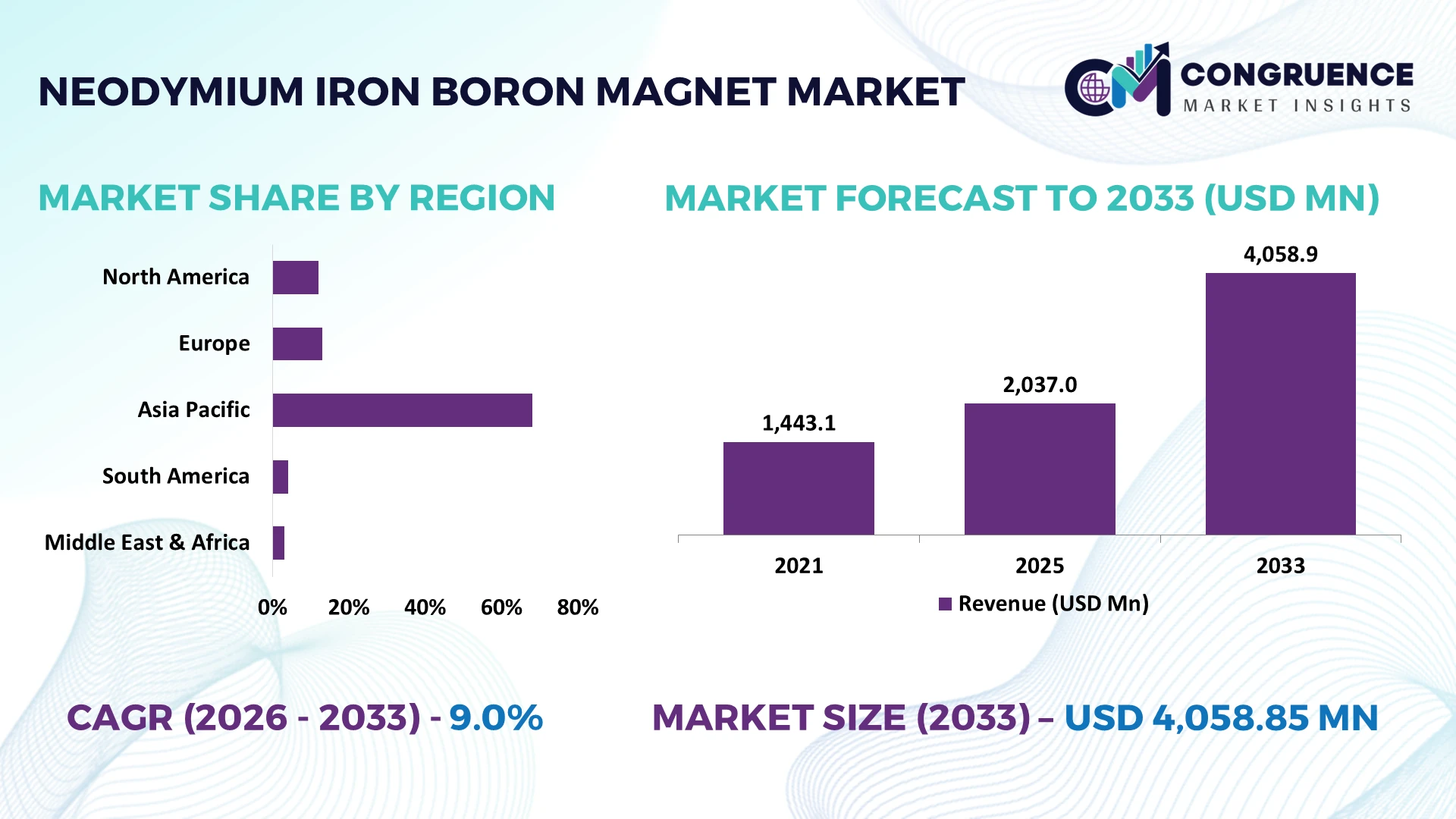
China dominates the global neodymium iron boron magnet industry, accounting for approximately 90% of rare-earth permanent magnet manufacturing and over 90% of rare-earth processing capacity. Its integrated production ecosystem supports electric vehicles, industrial motors, and renewable energy equipment. China's manufacturing advantage contrasts with Japan's specialization in high-coercivity magnet technologies and the United States' expanding domestic supply-chain investments under critical minerals policies.
Strategically, manufacturers must prioritize diversified rare-earth sourcing, high-performance magnet engineering, and localized production partnerships to reduce geopolitical exposure and secure long-term industrial competitiveness.
Market Size & Growth: USD 2,037.0 million in 2025, reaching USD 4,058.9 million by 2033 at 9.0% CAGR, driven by electric vehicle traction motor electrification.
Top Growth Drivers: Electric mobility, renewable energy deployment, and industrial automation strengthen demand, with rare-earth permanent magnets delivering over 90% of global production concentration in China.
Short-Term Forecast: By 2028, advanced grain-boundary diffusion technologies target 20–30% reductions in heavy rare-earth consumption while maintaining thermal stability.
Emerging Technologies: AI-assisted magnet design, automated powder metallurgy, and grain-boundary diffusion improve material utilization, coercivity, and manufacturing precision.
Regional Leaders: Indicative 2033 allocations place Asia Pacific near USD 2.76 billion, Europe at USD 0.69 billion, and North America at USD 0.45 billion, supported by EV production, wind electrification, and supply-chain localization.
Consumer/End-User Trends: Automotive traction systems increasingly adopt permanent magnet motors, with leading designs achieving peak efficiencies above 95%.
Pilot/Case Example: In 2025, heavy rare-earth reduction initiatives targeting grain-boundary diffusion demonstrated pathways toward 20% lower dysprosium utilization in selected magnet designs.
Competitive Landscape: China-based manufacturers dominate production; JL MAG, Zhong Ke San Huan, Ningbo Yunsheng, Proterial, and Shin-Etsu compete through performance and capacity expansion.
Regulatory & ESG Impact: EU Critical Raw Materials Act benchmarks target 10% domestic extraction, 40% processing, and 25% recycling by 2030.
Investment & Funding: The U.S. Department of Defense's USD 400 million equity investment in MP Materials in 2025 strengthens domestic rare-earth magnet integration.
Innovation & Future Outlook: Next-generation recycled NdFeB magnets, low-dysprosium formulations, and high-temperature grades accelerate localized manufacturing and circular material recovery.
The neodymium iron boron magnet industry supports high-efficiency traction motors, wind turbine generators, precision robotics, and compact consumer electronics. Advanced sintered magnet grades provide maximum energy products exceeding 50 MGOe, enabling smaller and lighter electromechanical assemblies. Heavy rare-earth reduction, recycled magnet feedstocks, and automated manufacturing are reshaping production economics as export controls and critical mineral localization policies increase supply-chain scrutiny.
Neodymium iron boron magnets have become strategically important components of electrification, industrial automation, and energy security. Their superior magnetic energy density allows manufacturers to develop compact, high-torque motors while reducing equipment weight and material intensity. China's dominance in rare-earth processing has accelerated supply-chain restructuring across the United States, Japan, and Europe, where manufacturers are investing in domestic separation, alloy production, and permanent magnet manufacturing capabilities.
Compared with conventional ferrite magnets, sintered NdFeB magnets deliver substantially higher magnetic energy density, with premium grades exceeding 50 MGOe against approximately 4–5 MGOe for typical ferrites. This performance difference enables compact traction motors and precision actuators, although thermal stability and material costs require careful engineering. Japan emphasizes advanced high-coercivity formulations, while the United States prioritizes integrated domestic production and strategic sourcing.
During 2026–2028, manufacturers will increasingly deploy automated powder processing, grain-boundary diffusion, and recycled rare-earth feedstocks. Automotive suppliers are qualifying lower-dysprosium magnets for electric drive units to reduce exposure to critical material constraints. Companies securing qualified upstream materials, scalable processing capacity, and long-term OEM partnerships will achieve stronger operational resilience and competitive differentiation.
Electric vehicle electrification is accelerating demand for high-performance sintered NdFeB magnets used in permanent magnet synchronous motors. Global electric car sales exceeded 17 million units in 2024, representing more than 20% of new car sales, creating sustained requirements for compact, high-torque propulsion systems. Premium NdFeB magnet grades achieve magnetic energy products above 50 MGOe, enabling smaller motor architectures and improved power density. China's integrated automotive and rare-earth manufacturing ecosystem reinforces procurement advantages, while European manufacturers accelerate localized magnet qualification. Companies are expanding sintering capacity, optimizing grain-boundary diffusion, and securing long-term automotive supply agreements. The strategic advantage increasingly lies in delivering thermally stable magnets with reduced dysprosium intensity rather than simply increasing production volumes.
Concentrated rare-earth processing capacity creates significant procurement constraints for global NdFeB magnet manufacturers. China controls approximately 90% of rare-earth processing and dominates permanent magnet production, exposing overseas manufacturers to export licensing requirements and supply interruptions. Dysprosium and terbium remain particularly sensitive inputs because high-temperature magnet applications require enhanced coercivity. China's 2025 export controls on selected medium and heavy rare-earth materials intensified qualification and sourcing pressures across automotive and industrial supply chains. European policymakers consequently established 2030 benchmarks of 40% domestic processing and 25% recycling capacity for strategic raw materials. Manufacturers are responding through multiyear supply contracts, alternative sourcing, recycled feedstock qualification, and reduced heavy rare-earth formulations. Material traceability and procurement flexibility now directly influence manufacturing continuity and customer contract competitiveness.
Recycled NdFeB magnet production creates opportunities to recover valuable neodymium, praseodymium, dysprosium, and terbium from industrial scrap and end-of-life equipment. The European Union's Critical Raw Materials Act establishes a 25% recycling benchmark for strategic raw materials by 2030, encouraging investment in magnet-to-magnet recovery systems. Advanced hydrogen processing and selective separation technologies enable recovery of magnet materials while reducing dependence on newly mined inputs. Grain-boundary diffusion offers another opportunity, with application-specific development programs targeting heavy rare-earth reductions of 20–30%. Companies are developing recycling partnerships with automotive dismantlers, electronics manufacturers, and industrial equipment suppliers. The strongest opportunity lies in integrating recycled feedstock directly into qualified automotive magnet production, where traceability and consistent magnetic properties command greater strategic value.
Scaling advanced NdFeB magnet manufacturing requires precise control of powder composition, grain structure, oxygen exposure, and sintering conditions. High-performance automotive magnets must maintain coercivity under operating temperatures that can approach 150–200°C, depending on motor architecture and cooling design. Premium grades exceeding 50 MGOe require tightly controlled microstructures, while grain-boundary diffusion introduces additional process uniformity and qualification requirements. Automotive customers also demand consistent magnetic performance across large production batches, increasing inspection complexity and manufacturing validation costs. Japanese and European suppliers are investing in automated powder handling, advanced metrology, and digital process monitoring to improve repeatability. Manufacturers must integrate material science expertise with scalable quality systems, because inconsistent coercivity or dimensional tolerances can undermine motor reliability and delay OEM production approvals.
Automated Magnet Manufacturing Gains Industrial Momentum: Chinese magnet producers are expanding automated strip casting, hydrogen decrepitation, and precision sintering operations to improve production consistency. Advanced NdFeB grades exceed 50 MGOe, while selected manufacturing programs target 10–15% improvements in material utilization and 15–20% reductions in manual handling. Automated inspection and closed-loop powder processing reduce batch variability, supporting automotive qualification requirements. Manufacturers are prioritizing integrated production lines and digital quality monitoring.
Export Controls Reshape Magnet Procurement Strategies: China's 2025 rare-earth export restrictions accelerated procurement restructuring among Japanese, American, and European manufacturers. China accounts for approximately 90% of global rare-earth processing and dominates permanent magnet manufacturing. The European Union's 2030 benchmarks include 40% domestic processing and 25% recycling. Automotive suppliers are increasing inventory visibility, qualifying alternative material sources, and negotiating longer procurement contracts to protect production continuity.
High-Precision Magnet Grades Gain Preference: Industrial robotics and compact servo systems increasingly require tightly controlled magnetic tolerances and elevated thermal performance. Premium sintered NdFeB magnets deliver energy products above 50 MGOe, while specialized grades support operating temperatures approaching 180–200°C. Manufacturers are expanding precision machining, protective coating, and magnetic characterization capabilities. The operational shift favors suppliers offering application-specific magnetic consistency rather than standardized bulk magnet output.
Integrated Magnet Assemblies Replace Component Procurement: Electric motor manufacturers increasingly purchase preassembled magnet rotors and customized magnetic modules instead of individual magnets. Permanent magnet traction motors achieve peak efficiencies exceeding 95%, while high-performance assemblies require tightly controlled positioning and bonding tolerances. Suppliers are expanding rotor assembly, automated magnetization, and coating services. This integration strengthens customer retention and shifts competitive differentiation toward engineering support, assembly reliability, and production traceability.
Sintered NdFeB magnets represent the leading product type, accounting for an estimated 82.5% of global market demand in 2025, supported by superior magnetic energy density, high coercivity, and established integration into electric vehicle traction motors, wind turbine generators, and industrial automation equipment. Premium sintered grades deliver magnetic energy products exceeding 50 MGOe, enabling compact motor architectures and high torque density. Their manufacturing scalability and performance advantages sustain demand among automotive OEMs and industrial equipment manufacturers. Chinese suppliers are expanding automated sintering capacity, while Japanese manufacturers concentrate on high-temperature stability and precision magnetic performance.
Bonded NdFeB magnets represent the fastest-growing type, benefiting from increasing adoption in compact electric motors, sensors, consumer electronics, and precision electromechanical assemblies. Their ability to support complex geometries, tight dimensional tolerances, and near-net-shape manufacturing reduces secondary machining requirements. Although bonded magnets generally offer lower magnetic strength than sintered alternatives, injection molding and compression bonding enable greater design flexibility. Manufacturers are investing in improved magnetic powders, polymer binders, and automated molding systems to strengthen application-specific competitiveness.
Automotive applications account for an estimated 38.5% of global neodymium iron boron magnet demand in 2025, supported by electric vehicle traction motors, electric power steering, braking systems, and auxiliary automotive actuators. Permanent magnet synchronous motors provide high torque density and peak efficiencies frequently exceeding 95%, supporting their integration into advanced electric drivetrains. China's automotive manufacturing ecosystem maintains substantial demand concentration, while Japanese and European suppliers emphasize high-coercivity grades and thermally stable magnet assemblies. Manufacturers are expanding automotive-qualified production, rotor integration capabilities, and long-term supply agreements to secure recurring OEM demand.
Wind energy represents a rapidly expanding application, particularly in direct-drive and offshore wind turbine generators requiring high-performance permanent magnets. Compared with conventional geared generator configurations, direct-drive systems reduce mechanical complexity and eliminate gearbox-related maintenance requirements. Consumer electronics, industrial motors, medical devices, and aerospace applications retain strategic importance through miniaturization, precision control, and specialized magnetic performance requirements. Magnet producers are developing application-specific coatings, improved corrosion resistance, and optimized magnetic geometries to address increasingly differentiated equipment specifications.
Automotive manufacturers represent the dominant end-user segment, accounting for an estimated 37.0% of global neodymium iron boron magnet consumption in 2025. Demand is concentrated among electric vehicle OEMs, traction motor suppliers, and automotive component manufacturers requiring consistent magnetic performance, thermal stability, and large-volume production capability. Permanent magnet motors commonly achieve peak efficiencies above 95%, making magnetic material quality critical to drivetrain performance. Chinese automotive manufacturers benefit from proximity to rare-earth processing and magnet production facilities, while European and American OEMs increasingly emphasize supply traceability, supplier qualification, and localized sourcing agreements.
Renewable energy equipment manufacturers represent a fast-expanding end-user group, driven by direct-drive wind generator deployment and the development of larger offshore turbine platforms. Industrial machinery manufacturers, electronics producers, aerospace contractors, and medical equipment companies maintain differentiated requirements for magnetic strength, dimensional precision, and environmental durability. Suppliers are responding through customized magnet grades, integrated assemblies, technical partnerships, and specialized coating technologies. Competitive positioning increasingly depends on meeting end-user qualification standards while balancing magnetic performance, production consistency, and procurement security.
Asia-Pacific accounted for the largest market share at 68.0% in 2025 however, North America is expected to register the fastest growth, expanding at a CAGR of 12.5% between 2026 and 2033.
North America accounted for approximately 12.0% of the global neodymium iron boron magnet market in 2025, supported by electric vehicle manufacturing, aerospace applications, industrial automation, and strategic investments in domestic rare-earth processing. The United States is restructuring permanent magnet supply chains to reduce dependence on Chinese processing and manufacturing capacity. MP Materials is expanding downstream magnet production capabilities in Texas, strengthening integration between rare-earth extraction, separation, and finished magnet manufacturing. The U.S. Department of Defense's USD 400 million investment in MP Materials during 2025 reinforced domestic critical mineral security objectives. Canadian rare-earth development projects provide additional opportunities for upstream diversification. Automotive OEMs and defense contractors are prioritizing traceable materials, high-coercivity magnet grades, and qualified domestic suppliers. Regional competitiveness increasingly depends on converting upstream mineral resources into commercially scalable magnet manufacturing capacity.
United States Market Outlook: The United States leads North American magnet supply-chain localization through industrial investment, defense procurement, and advanced manufacturing development. MP Materials' Fort Worth magnet manufacturing facility represents a significant step toward domestic production of automotive-grade permanent magnets. Federal critical mineral initiatives and procurement commitments are supporting downstream processing infrastructure. The country's aerospace, defense, and electric mobility industries provide a concentrated customer base for high-performance sintered NdFeB magnets, encouraging long-term supplier qualification and technology partnerships.
Europe represented approximately 13.0% of the global neodymium iron boron magnet market in 2025, supported by automotive electrification, offshore wind generation, industrial robotics, and precision engineering. Germany, France, and the United Kingdom maintain substantial demand for high-performance permanent magnets used in electric motors and industrial equipment. The European Critical Raw Materials Act establishes 2030 benchmarks of 10% domestic extraction, 40% processing, and 25% recycling for strategic raw materials, strengthening investment incentives for localized supply chains. Neo Performance Materials has developed rare-earth magnet manufacturing operations in Estonia, supporting European industrial supply diversification. Automotive manufacturers are also increasing procurement scrutiny around material traceability, environmental compliance, and supply continuity. The region's competitive advantage lies in advanced motor engineering, specialized magnet applications, and integrated industrial qualification rather than low-cost bulk production.
Germany Market Outlook: Germany remains Europe's strategically important NdFeB magnet demand center, supported by Volkswagen, BMW, Mercedes-Benz, and established industrial automation manufacturers. Its automotive and machinery sectors require high-performance magnetic components for electric drivetrains, precision actuators, and energy-efficient equipment. Germany's automotive industry produced approximately 4.1 million passenger cars in 2024, demonstrating the scale of its manufacturing ecosystem. Suppliers are strengthening magnet qualification procedures, engineering partnerships, and procurement diversification to support advanced electric motor production.
Asia-Pacific dominated the global neodymium iron boron magnet market with approximately 68.0% share in 2025, reflecting China's extensive rare-earth processing infrastructure, established magnet manufacturing clusters, and strong downstream industrial integration. China accounts for approximately 90% of global rare-earth processing and dominates sintered NdFeB magnet production. Manufacturing centers in Zhejiang, Jiangxi, and Inner Mongolia support integrated operations spanning rare-earth separation, alloy preparation, powder metallurgy, and finished magnet production. Japan maintains technological leadership in high-coercivity magnet formulations, while South Korea contributes advanced automotive and electronics manufacturing capabilities. China's 2025 export licensing restrictions on selected rare-earth materials increased international procurement scrutiny. Regional manufacturers are responding through production automation, specialized magnetic grades, and closer coordination with electric vehicle and industrial motor OEMs. Manufacturing concentration provides significant scale advantages but increases geopolitical sensitivity across international supply chains.
China Market Outlook: China remains the central manufacturing and supply-chain hub for NdFeB permanent magnets, supported by vertically integrated rare-earth processing and extensive downstream industrial capacity. Companies including JL MAG, Zhong Ke San Huan, and Ningbo Yunsheng maintain established capabilities in high-performance magnet manufacturing. China's electric car sales exceeded 11 million units in 2024, reinforcing domestic requirements for traction motor components. Advanced powder processing, grain-boundary diffusion, and automated magnet production strengthen the country's competitive position in high-volume industrial applications.
South America accounted for approximately 4.0% of the global neodymium iron boron magnet market in 2025, supported by renewable energy infrastructure, industrial machinery, automotive manufacturing, and mining equipment modernization. Brazil represents the principal regional demand center, benefiting from its automotive production ecosystem and expanding wind energy installations. Argentina and Chile contribute demand through industrial electrification, mining automation, and energy infrastructure development. Brazil's installed wind power capacity exceeded 30 GW in 2024, strengthening the broader market for advanced electrical equipment, including permanent magnet generator configurations. However, limited domestic rare-earth separation and finished magnet manufacturing capacity sustain reliance on imported components. Regional equipment manufacturers are prioritizing supplier partnerships, localized assembly, and more efficient electric motor technologies. Future competitiveness depends on developing processing capabilities and integrating domestic mineral resources into industrial supply chains.
Brazil Market Outlook: Brazil leads South American NdFeB magnet demand through automotive manufacturing, renewable energy deployment, and industrial machinery production. The country possesses significant rare-earth mineral resources, creating opportunities to develop downstream processing and permanent magnet manufacturing capabilities. Brazilian automotive production exceeded 2.5 million vehicles in 2024, supporting an established industrial supplier ecosystem. Investment in mineral processing, electric motor engineering, and industrial partnerships is strengthening opportunities for domestic magnetic material applications while reducing long-term import dependence.
The Middle East & Africa represented approximately 3.0% of the global neodymium iron boron magnet market in 2025, supported by industrial diversification, renewable energy development, transportation electrification, and infrastructure modernization. Saudi Arabia and the United Arab Emirates are expanding advanced manufacturing ecosystems, creating opportunities for high-efficiency electric motors, automation equipment, and precision industrial components. South Africa contributes through automotive manufacturing, mining machinery, and industrial equipment applications. Saudi Arabia's Vision 2030 industrial transformation initiatives are encouraging localization of advanced manufacturing technologies and strategic mineral processing capabilities. Regional magnet demand remains dependent on imported finished products because downstream rare-earth processing and specialized magnet manufacturing infrastructure are limited. Companies are developing industrial partnerships, expanding component distribution networks, and evaluating localized assembly opportunities. Competitive positioning depends on aligning magnetic component supply with infrastructure deployment and industrial equipment procurement requirements.
Saudi Arabia Market Outlook: Saudi Arabia represents a strategically important emerging market for NdFeB magnets, supported by industrial diversification, renewable energy investments, and electric vehicle manufacturing initiatives. The Kingdom's National Industrial Strategy targets approximately 36,000 factories by 2035, strengthening the broader manufacturing ecosystem. Investments associated with Ceer and electric vehicle production facilities are creating opportunities for advanced motor components and precision magnetic assemblies. Industrial localization policies encourage international suppliers to establish partnerships, develop technical capabilities, and integrate into emerging automotive and automation supply chains.
China's JL MAG, Zhong Ke San Huan, and Ningbo Yunsheng compete through manufacturing scale, while Japan's Shin-Etsu Chemical and Proterial emphasize advanced magnetic performance. The leading five manufacturers collectively command an estimated 35–40% market share, reflecting fragmented downstream production despite concentrated rare-earth processing. Chinese suppliers leverage integrated procurement and competitive manufacturing costs, while Japanese producers prioritize high-coercivity grades and precision engineering. Grain-boundary diffusion technologies target 20–30% reductions in heavy rare-earth consumption, while automated manufacturing programs pursue 10–15% improvements in material utilization. MP Materials challenges established supply chains through American vertical integration and domestic magnet manufacturing expansion. Competition increasingly centers on qualified raw material access, thermal stability, customized rotor assemblies, and reliable delivery schedules. Export licensing restrictions intensify procurement diversification, while automotive qualification requirements create substantial entry barriers. Winning requires secure rare-earth inputs, scalable processing technology, consistent magnetic performance, and long-term OEM partnerships across strategically important industrial markets worldwide.
JL MAG Rare-Earth Co., Ltd.
Beijing Zhong Ke San Huan High-Tech Co., Ltd.
Ningbo Yunsheng Co., Ltd.
Shin-Etsu Chemical Co., Ltd.
Proterial, Ltd.
VACUUMSCHMELZE GmbH & Co. KG
MP Materials Corp.
Neo Performance Materials Inc.
Yantai Zhenghai Magnetic Material Co., Ltd.
Anhui Earth-Panda Advance Magnetic Material Co., Ltd.
Daido Steel Co., Ltd.
Arnold Magnetic Technologies
Bunting Magnetics Co.
Sintered NdFeB technology dominates high-performance applications because advanced grades deliver magnetic energy products exceeding 50 MGOe, compared with approximately 4–5 MGOe for conventional ferrite magnets. This substantial performance advantage enables compact traction motors, precision actuators, and lightweight industrial assemblies. Automated strip casting, hydrogen decrepitation, and controlled sintering improve production consistency, while digital inspection systems target 10–15% reductions in material waste. Chinese manufacturers benefit from integrated processing infrastructure, whereas Japanese suppliers differentiate through specialized magnetic formulations and thermal stability.
Emerging grain-boundary diffusion technologies reduce dependence on dysprosium and terbium while maintaining coercivity under elevated operating temperatures. Application-specific development programs target 20–30% reductions in heavy rare-earth consumption. Advanced protective coatings, precision machining, and automated magnetization improve component reliability and integration efficiency. Automotive OEMs increasingly require customized magnetic assemblies, encouraging manufacturers to combine materials engineering with rotor production and digital quality assurance.
During 2026–2028, hydrogen-based recycling, AI-assisted microstructure optimization, and advanced powder metallurgy will reshape manufacturing priorities. Recycled magnet feedstocks support localized supply strategies, while automated process control strengthens qualification consistency. Companies integrating magnetic material innovation, traceable procurement, and scalable assembly capabilities will secure stronger competitive positions across electrified transportation and industrial automation markets.
July 2025: Proterial developed heavy-rare-earth-free NdFeB sintered magnets for electric vehicle traction motors. Its NMX-G1NH-HF material achieved 1.42 T residual flux density and coercivity of at least 1,830 kA/m, strengthening high-temperature motor performance without dysprosium or terbium additions. Source: proterial.com.
September 2025: Neo Performance Materials inaugurated its Narva, Estonia, permanent magnet manufacturing facility, establishing an initial annual capacity of approximately 2,000 tonnes. The investment strengthens European automotive magnet localization and reduces dependence on imported finished magnetic components for industrial electrification. Source: neomaterials.com.
February 2026: MP Materials selected Northlake, Texas, for its 10X magnet manufacturing campus, committing more than USD 1.25 billion and targeting over 1,500 jobs. The expansion strengthens American rare-earth vertical integration and supports domestic automotive and defense procurement. Source: investors.mpmaterials.com.
April 2026: Arnold Magnetic Technologies announced expansion of its Thailand manufacturing operations, targeting a doubling of overall magnet production capacity. Although focused on samarium-cobalt magnets, the investment strengthens its broader permanent magnet manufacturing footprint and supply-chain resilience. Source: arnoldmagnetics.com.
The Neodymium Iron Boron Magnet Market Report provides comprehensive analysis of industry performance, competitive positioning, technological developments, and investment opportunities between 2026 and 2033. Segmentation covers sintered and bonded NdFeB magnets, alongside automotive, wind energy, industrial motors, consumer electronics, aerospace, and medical applications. End-user analysis evaluates automotive manufacturers, renewable energy equipment producers, industrial machinery companies, electronics manufacturers, and specialized engineering industries. The study examines North America, Europe, Asia-Pacific, South America, and Middle East & Africa, highlighting Asia-Pacific's estimated 68.0% market contribution in 2025.
The report evaluates advanced powder metallurgy, grain-boundary diffusion, heavy-rare-earth-free formulations, magnet recycling, and automated manufacturing technologies. Competitive benchmarking examines production integration, material sourcing, supplier qualification, and localized manufacturing investments. Strategic insights support capacity planning, market entry decisions, technology partnerships, procurement diversification, and long-term competitive positioning across emerging industrial applications.
| Report Attribute / Metric | Details |
|---|---|
| Market Revenue (2025) | USD 2,037.0 Million |
| Market Revenue (2033) | USD 4,058.9 Million |
| CAGR (2026–2033) | 9.0% |
| Base Year | 2025 |
| Forecast Period | 2026–2033 |
| Historic Period | 2021–2025 |
| Segments Covered |
By Type
By Application
By End-User
|
| Key Report Deliverables | Revenue Forecast; Market Trends; Growth Drivers & Restraints; Technology Insights; Segmentation Analysis; Regional Insights; Competitive Landscape; Regulatory & ESG Overview; Recent Developments |
| Regions Covered | North America; Europe; Asia-Pacific; South America; Middle East & Africa |
| Key Players Analyzed | JL MAG Rare-Earth Co., Ltd.; Beijing Zhong Ke San Huan High-Tech Co., Ltd.; Ningbo Yunsheng Co., Ltd.; Shin-Etsu Chemical Co., Ltd.; Proterial, Ltd.; VACUUMSCHMELZE GmbH & Co. KG; MP Materials Corp.; Neo Performance Materials Inc.; Yantai Zhenghai Magnetic Material Co., Ltd.; Anhui Earth-Panda Advance Magnetic Material Co., Ltd.; Daido Steel Co., Ltd.; Arnold Magnetic Technologies; Bunting Magnetics Co. |
| Customization & Pricing | Available on Request (10% Customization Free) |




